




No CrossRef data available.
Interaction of lexical and sublexical information in spelling: Evidence from nonword priming
Published online by Cambridge University Press: 01 October 2004
Abstract
In a series of lexical priming experiments we examined the interaction between spelling processes dedicated to spelling familiar words (lexical processes) and those dedicated to spelling unfamiliar words or nonwords (sublexical processes). Participants listened to lists of intermixed monosyllabic words and nonwords and were required to spell only the nonwords. In the priming condition, nonwords were preceded by real word primes that were phonologically related to the nonwords. In two experiments, we found that the spellings of nonwords could be influenced by previously heard rhyming words, replicating previous work. Furthermore, we examined the mechanism of this lexical/sublexical interaction and found that it is both phonologically and orthographically based and that word primes are most effective when they overlap in word body (vowel+coda) with the nonword. We conclude that lexical and sublexical processes interact in a manner that involves a dynamic updating of sound–spelling correspondences, which, at a minimum, are specified in terms of the word body.
Information
- Type
- Articles
- Information
- Copyright
- © 2004 Cambridge University Press
In most theories of spelling it is typically assumed that there are both lexical and sublexical processes for translating between phonology and orthography. The lexical process involves retrieving the spellings of familiar words from long-term memory (e.g., Barry, 1994; Ellis, 1982; Patterson, 1988; see Figure 1) and may be semantically mediated (Hillis & Caramazza, 1991) or may involve direct connections between phonology and orthography (Patterson, 1986; Roeltgen, Rothi, & Heilman, 1986). The sublexical process, in contrast, uses knowledge of the systematic mappings between phonology and orthography to assemble a plausible spelling from a segmented phonological input (e.g., Goodman & Caramazza, 1986; see Figure 1). This dual process organization is similar to certain proposals regarding the organization of the reading system (e.g., Coltheart, Rastle, Perry, Langdon, & Ziegler, 2001) that posit both lexical and sublexical processes for translating between orthography and phonology to generate pronunciations for written stimuli.

The cognitive architecture of the spelling system, illustrating how theword myth activates its graphemes via the lexical and sublexicalsystems. Only the semantically mediated lexical route is shown.
Parallel distributed processing (PDP) theories of reading and spelling could also be considered to fall under the general rubric of dual process accounts. However, they assume distributed representations rather than localist phonological and orthographic lexemes, and they distinguish the two processing streams as semantically and phonologically mediated processes (rather than lexical and nonlexical). Although we assume a dual-process framework in our presentation of the current study, a discussion of connectionist accounts of spelling is included in the general discussion.
Dual process theories have been proposed to account for our ability to spell both familiar words and unfamiliar, novel words. The lexical process, although able to retrieve the spellings of familiar words from memory, cannot produce spellings for novel or unfamiliar words and nonwords. The sublexical process, on the other hand, assembles a spelling based on the application of knowledge of how sounds are typically spelled. This process is able to correctly assemble spellings for words that have “regular” or high-frequency phonology–orthography mappings and generates plausible spellings for novel words or pseudowords. However, it will typically (or often) generate phonologically plausible misspellings for (irregular) words with low frequency sound–spelling mappings (e.g., spelling yacht as YOT).
The lexical and sublexical processes are hypothesized to be independent of one another in that neither requires the other and each can be selectively lesioned (Beauvois & Dérousné, 1981; Shallice, 1981). However, there is also evidence that the two processes interact in spelling (Barry & de Bastiani, 1997; Barry & Seymour, 1988; Burden, 1989; Campbell, 1983; Folk, Rapp, & Goldrick, 2002; Hillis & Caramazza, 1991; Hillis, Rapp, & Caramazza, 1999; Rapp, Epstein, Tainturier, 2002; Seymour & Dargie, 1990). The current study investigates the nature of this lexical/sublexical interaction by examining lexical influences on the sublexical process. Specifically, we examined the effect of word primes on the spelling of nonwords to investigate the influence of the lexical process on the operation of the sublexical system and to examine the functioning of the sublexical system itself.
Much of the evidence suggesting that lexical and sublexical processes interact in spelling has examined lexical influences on the spelling of nonwords. In one such study conducted in French, Tainturier, Bosse, Valdois, and Rapp (2000) had subjects spell nonwords that ended in a phoneme that could be spelled with a low-probability spelling (e.g., /i/ spelled as IT, as in petit). They varied whether or not the nonword had a close phonological word neighbor. A close phonological neighbor was defined as a word that differed from the nonword by only one phoneme, shared the same final phoneme, and had a very low frequency spelling of the final phoneme. Tainturier and colleagues found that nonwords with close phonological neighbors (e.g., nonword /b′ti/ with the close phonological neighbor /p′ti/ spelled as PETIT) were more often spelled using the same final low probability grapheme (e.g., /b′ti/ spelled as BETIT) than were nonwords with the same final phoneme but lacking a close phonological neighbor (e.g., /taJi/). They argued that this provided evidence that the spellings of word neighbors can influence the spellings of nonwords. Specifically, they suggested that the auditory presentation of a nonword activates its word neighbors and their spellings. Those activated word spellings influence how the nonwords are spelled.
Other studies have examined the influence of previously heard rhyming words on the spelling of nonwords (“lexical priming”; Barry & Seymour, 1988; Campbell, 1983; Cuetos, 1993; Perry, 2003). Barry and Seymour (1988) compared the spellings that subjects produced for nonwords on lexical priming trials (where a nonword was preceded by a rhyming word) with the spellings produced for the same nonwords when they were not preceded by words. These investigators found lexical priming effects such that nonword spellings were influenced by the spellings of previously heard rhyming words. For example, based on phoneme–grapheme (P–G) probabilities the most likely spelling of the nonword /n∧t∫/ is NUTCH. However, it was more likely to be spelled NOUCH when preceded by the oral presentation of the rhyming word “touch” than when there was no word prime. Barry and Seymour (1988) interpreted this as evidence that the sublexical process is open to lexical influence, in other words, as evidence of lexical–sublexical interaction.
In a secondary analysis, Barry and Seymour (1988) found significant effects of P–G probability in nonword spelling. That is, subjects produced more high-probability spelling patterns (e.g., spelling the vowel /i/ as EE) than low (e.g., spelling the vowel /i/ as IE). Based on these findings and the fact that the priming effect was additive with the P–G probability effect, Barry and Seymour proposed that the sublexical process consists of a set of probabilistic P–G mappings. These mappings are weighted according to their frequency, and the selection of a particular P–G mapping from the weighted lists is open to lexical influence. In addition, they reported that there was no evidence in their data that higher order units such as word bodies (vowel+coda, also referred to as orthographic rimes) affect processing.
Several issues remain unresolved from the lexical priming studies. First, little has been said regarding the specific mechanism/s of lexical–sublexical interaction and, as a result, it is not clear at what point in the spelling process lexical and sublexical information interact. A second issue concerns the nature of the representational units involved in the priming effects. Several researchers have reported evidence that graphemes within a written word are organized into units larger than an individual grapheme and smaller than a syllable. These subsyllabic units may include the onset (syllable initial consonant/s), vowel, word body or rime (vowel+coda), and possibly the head (onset+vowel). While the majority of work has examined the representation of these units in reading (Bowey, 1993; Forster & Taft, 1994; Kay & Bishop, 1987; Patterson & Morton, 1985; Treiman, 1994; Treiman & Chafetz, 1987; Treiman & Danis, 1988; Warrington & Shallice, 1980), recent evidence suggest that these subsyllabic units are also involved in spelling. For example, in a large-scale lexical corpus study Kessler and Treiman (2001) reported evidence that the spelling of a phoneme in one syllable position (e.g., onset, vowel, and coda) may be conditioned by the spelling of phonemes in other positions (called contextual conditioning effects). Specifically, they compared the consistency with which a particular vowel sound is spelled when the vowel is considered alone versus its spelling consistency in bodies and heads. They found that although the vowel is the most inconsistently spelled syllable position, the inclusion of the coda reduced this inconsistency. The same was true, although to a lesser extent, for the consistency of vowel spellings when vowel+onset was considered. These contextual conditioning findings provide information about the structure of written language. Data are just beginning to emerge that suggest that these effects also have implications for how the processing system actually works. For example, Treiman, Kessler, and Bick (2002) found that adult spellers were sensitive to contextual conditioning associations during nonword spelling. These findings raise the possibility that the sublexical process makes use of body (and head) representations and that the word–nonword priming effects may involve representations larger than those of individual P–G mappings.
CURRENT STUDY
We investigate the nature of the sublexical process in spelling and its relationship with the lexical process by expanding upon the findings of Barry and Seymour (1988). We assume that the priming paradigm can be used to reveal the mechanisms and representations that underlie lexical/sublexical interaction in spelling. In Experiment 1, we investigate the origin of the lexical priming effects. Specifically, we explore whether lexical priming has a phonological source (e.g., the priming of specific P–G mappings within the sublexical system) or whether the priming is orthographic in nature (e.g., resulting from the priming of specific graphemes). In Experiment 2, we investigate the nature of the representations that participate in lexical priming; specifically, we evaluate whether lexical priming results from the priming of individual P–G mappings, word bodies, and/or heads.
EXPERIMENT 1
In Experiment 1 we investigated whether the lexical priming results found previously in the literature (e.g., Barry & Seymour, 1988; Campbell, 1983) had a phonological or an orthographic basis. Because the prime words and nonwords rhymed in the previous studies, the target spelling of a nonword overlapped in both orthography and phonology with the spelling of the prime word. We use the terms target spelling of a nonword to refer to the particular spelling of the nonword's vowel that corresponds to the spelling of the same vowel in the prime word. For example, we examined the probability that the vowel of the nonword /n∧t∫/ was spelled OU (the target spelling) when it was preceded by the word prime touch.
We examined two possible bases for the priming effect in order to gain insight into the mechanisms of lexical–sublexical interaction. One possibility is that the priming arises from lexical preactivation of the target graphemes1
We use the term grapheme/s and letter/s interchangeably to refer to abstract, amodal representations of letters or letter groups. However, the term grapheme is used by some authors exclusively to refer to the letters or letters that correspond to a single phoneme, such that the digraphs (SH, EA) are represented as single graphemes.
We investigated these two possibilities by manipulating the orthographic and phonological overlap between prime words and target nonwords in the related prime condition. In the orthographic overlap condition, the prime word's vowel shared only orthography with the target spelling of the nonword's vowel (e.g., prime couch paired with /n∧t∫/→target spelling NOUCH). If priming occurs under these conditions it can be understood as resulting from the preactivation of the target graphemes. In the phonological overlap condition, the prime word's vowel shared both orthography and phonology with the spelling of the target nonword's vowel (e.g., touch–/n∧t∫/→target spelling NOUCH), allowing us to evaluate the possibility that P–G mappings might be lexically primed. Priming was assessed by comparing levels of responding with a target spelling in the related prime condition to the unrelated prime condition in which the prime words were replaced with unrelated, neutral words that did not overlap with the target nonwords in phonology or orthography.
If the lexical priming effects that have been observed result only from the priming of P–G mappings in the sublexical system, then one would expect to find significant lexical priming for the target spellings in the phonological overlap condition but none in the orthographic overlap condition. If, instead, the priming effects resulted only from the preactivation of the prime word's graphemes, then one would expect to find significant and comparable priming in both the orthographic and phonological overlap conditions. A third possibility is that both orthographic and phonological factors contribute to the priming. In that case, one would expect to see significant priming in both conditions, with greater priming in the phonological condition than in the orthographic condition given that in the phonological overlap condition the prime word could preactivate both the target P–G mapping and the target letters used to spell it.
Method
Participants
Eighty undergraduate students from the Johns Hopkins University participated in this experiment. Forty of the participants were in the related prime condition (10 per list) and 40 in the unrelated prime condition (20 per list). Participants received either course credit or a candy bar and a chance to receive $20 in a raffle for their participation. All participants were native speakers of English.
Materials
Two prime types were used. Phonological overlap primes were used to generate prime word/nonword pairs that rhymed and overlapped in both the phonology and orthography of the target segment/s (e.g., touch–/n∧t∫/ with target spelling NOUCH). Orthographic overlap primes were used to generate word/nonword pairs that did not rhyme and though the two vowels were phonologically different, the spelling of the prime word's vowel corresponded to the target spelling of the nonword's vowel (e.g., couch–/n∧t∫/ with target spelling NOUCH). Fifteen pairs of each type were created (see Appendix A for a list of materials).
For the “related prime” condition four lists were created. In List 1, eight of the nonwords were preceded by phonological overlap primes, and seven were preceded by orthographic overlap primes. In List 2, eight nonwords were preceded by orthographic overlap primes and seven were preceded by phonological overlap primes. An additional two lists were created by presenting the critical word–nonword pairs in Lists 1 and 2 in different pseudorandomized orders.
For the “unrelated prime” condition two lists were created. In the first list, the prime words were replaced with words that did not overlap in phonology or orthography with the target spelling of the nonword (e.g., lot–/p∈d/). The second list included the same critical nonwords and their control primes but presented in a different pseudorandomized order. In both the related and unrelated prime conditions, each subject heard the critical nonwords only once.
Each list contained 138 items. Of the 138 items, 15 were critical nonwords (preceded by 15 related word primes or unrelated word primes depending on prime condition). Thus, 108 items were filler items (67 word fillers, 41 nonword fillers). The vowels used in the filler items were different than the 10 vowels used in the critical prime word–nonword pairs. Because 15 nonwords were created from 10 vowels, some vowel sounds and target spellings were repeated. Previously, Perry (2003) reported that priming persisted across two intervening filler items. Thus, we pseudorandomized the presentation of the target materials with the constraint that the repeated vowel sounds or spellings never occurred within 10 trials of one another.
Procedure
The experimenter read aloud a list of 138 words and nonwords at a rate of approximately one word every 4 s. The participants were instructed to write a spelling for the nonwords and to put a check if they heard a real word. Participants were tested in groups or individually. A testing session lasted approximately 20 min.
Results
Only the spellings of the vowels in the critical nonwords were analyzed. We calculated the proportion of trials on which the target spelling was produced for the critical nonwords. In the related prime condition we excluded any responses where the corresponding prime word was written. In addition, some responses were not included because the critical nonword was not written either because the subject misheard it or thought that it was a real word. Overall, 4.3% of responses were excluded. The data were analyzed considering both subject (F1) and item (F2) variability.
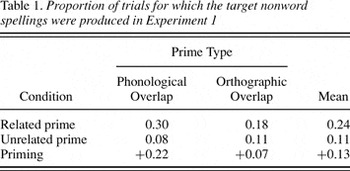
A 2 (Condition: related or unrelated prime)×2(Prime Type: phonological overlap or orthographic overlap) analysis of variance (ANOVA) was run. In the analysis by subjects, prime type was treated as a within-subjects variable and condition was treated as a between-subjects variable. In the analysis by items, condition and prime type were treated as within-items variables (see Appendix B for item means). This analysis yielded a main effect of condition, F1 (1, 78)=29.25, mean square error (MSE)=.03, p<.001; F2 (1, 14)=49.05, MSE=.01, p<.001, indicating that significantly more target spellings were produced in the related primed condition (24%) than the unrelated prime control condition (11%), replicating the lexical priming effect from Barry and Seymour (1988).2
We replicated the findings of Barry and Seymour (1988) even with vastly more filler items (108) than they used (32), making it unlikely that lexical priming arises because participants notice the rhyming relationships in the materials.

To test the details of the interaction, simple effects analyses were performed comparing the phonological and orthographic overlap conditions in the unrelated prime and prime conditions separately. These analyses revealed that the two overlap conditions did not differ in the unrelated prime condition, F1 (1, 78)=1.33, MSE=.01, p>.25; F2<1. However, in the related prime condition, the number of target spellings produced in the phonological overlap condition was significantly greater than the orthographic overlap condition (30 vs. 18% respectively) in the analysis by subjects, F1 (1, 78)=8.98, MSE=.03, p<.01; F2 (1, 30)=2.30, MSE=.10, p=.14. Thus, the significant interaction reflects the fact that subjects produced significantly more target spellings of the nonwords' vowels when the prime words and target nonwords overlapped in phonology and orthography (e.g., touch–/n∧t∫/, with target spelling NOUCH) as opposed to only orthography (e.g., couch–/n∧t∫/, with target spelling NOUCH), but only in the related prime condition.
Two planned comparisons were performed to examine the significance of the lexical priming effects for each of the prime types. The first revealed that subjects were significantly more likely to produce the target spellings for nonwords in the phonological overlap condition when they were preceded by word primes that rhymed than when preceded by unrelated primes, F1 (1, 78)=35.44, MSE=.03, p<.001; F2 (1, 14)=37.25, MSE=.01, p<.001. The second comparison revealed a significant effect of priming in the orthographic overlap condition, F1 (1, 78)=5.55, MSE=.02, p<.05; F2 (1, 14)=9.62, MSE=.004, p<.01.
Discussion
The results of Experiment 1 provide evidence that the lexical priming effects may have resulted both from lexical preactivation of target graphemes and from preactivation of specific P–G mappings. The interaction effect, however, indicates that the 22% priming effect for the phonological overlap condition was significantly larger than the 7% orthographic priming effect; this suggests that the lexical priming primarily affects the activation of P–G mappings with a lesser effect on the preactivation of the target graphemes.
To ensure that the greater priming that we found in the phonological condition was the result of the activation of P–G mappings and not just an effect of lexical preactivation of graphemes, we examined the number of “friends” each prime word has. Friends were defined as words that differed from the prime word by one phoneme but with the same spelling of the critical vowel (e.g., tough is a friend of touch). It is possible that the auditory presentation of a prime word may activate the phonological lexemes of all words that are phonologically similar to it, resulting in the activation of their constituent graphemes. If the prime words in the phonological overlap condition have more friends than the primes in the orthographic overlap condition, then there is the possibility that the graphemes that spell the vowel for a phonological prime will be more highly activated than for the orthographic prime. To examine this, we calculated the number of friends of each prime word. The mean number of friends for the orthographic prime condition was 5.1 whereas for the phonological prime condition the mean number of friends was 1.3. This indicates that the greater priming in the phonological condition was unlikely to be simply the result of greater lexical preactivation of graphemes.
We also examined the possibility that the greater priming in the phonological overlap condition resulted from the prime words having fewer “enemies” than in the orthographic overlap condition. An enemy was defined as a word that differed from the prime by a single phoneme, shared the same phonological vowel with the prime, but had a spelling for its vowel that was different than that of the prime (e.g., BED is an enemy of the prime word SAID). If the auditory presentation of a prime word activates the phonological lexemes of phonologically similar words that in turn activate their constituent graphemes, then having a greater number of enemies might reduce priming; enemies will activate graphemes that are different than the target graphemes. However, the prime words in the phonological overlap condition had a greater number of enemies on average (6.8) than the orthographic overlap condition (5.1), making it unlikely that the greater priming in the phonological overlap condition was a result of enemies reducing the priming in the orthographic overlap condition. Instead, the data provide support for the notion of both lexical priming of P–G mappings and preactivation of graphemes.
EXPERIMENT 2
In Experiment 1 we found that a significant portion of the lexical priming effect could be attributed to phonologically based priming, presumably the priming of the P–G mappings themselves. In Experiment 2 we explore the “size” of these representations. Specifically we examine whether phonological priming originates in the priming of representations of mappings between individual phonemes and their corresponding graphemes or if, instead, larger units such as the body and/or the head are involved.
To investigate this issue we varied the type of phonological overlap between the prime word and critical nonword. In the body condition, the prime word and nonword rhymed, overlapping phonologically in vowel and coda (e.g., touch–/n∧t∫/; as in Experiment 1). In the head condition, the prime word and nonword shared onset and vowel (e.g., touch–/t∧p/), and in the vowel condition, the prime word and nonword shared only the vowel (e.g., touch–/l∧f/). If the observed lexical priming is the result of the priming of individual P–G mapping representations, then we should find significant lexical priming of the target vowel spelling in all three conditions, given that in all three the prime word and critical nonword share the same vowel. However, we noted previously that Kessler and Treiman (2001) found that the spellings of vowels considered in the context of the syllabic body are more consistent than the spellings of vowels alone, and that they also found a similar, although smaller, benefit for vowels considered within head units. If these findings reflect the nature of the representations involved in sublexical processing, we might find priming to be greater in the body or head conditions (or both) than in the vowel condition.
Method
Participants
One hundred eighty undergraduate students from Kent State University participated in this experiment. Ninety of the participants were in the related prime condition (15 per list), and 90 were in the unrelated prime condition (15 per list). Participants received course credit for their participation. None of the participants had participated in the previous experiments, and all were native speakers of English.
Procedure
The procedure was the same as in Experiment 1.
Materials
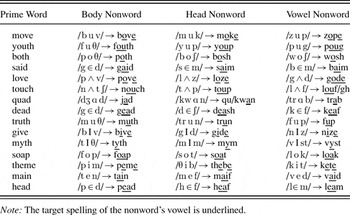
Fifteen prime words were selected. Eight vowels were represented among the fifteen prime words (/u/, /o/, /∈/, /∧/, /I/, /i/, /e/, and /a/). For each prime word, three nonwords were created, each corresponding to one of three prime types, for a total of 45 nonwords. For the body primes, the nonwords rhymed with the word primes, overlapping in vowel and coda (e.g., myth–/t I θ/→TYTH). For the head primes, the nonword shared the head (onset+vowel) of the prime words (e.g., myth–/m I m/→MYM); for the vowel primes, the nonwords shared only their vowels with the word primes (e.g., myth–/v I st→VYST; see Appendix C for a complete list of materials). An additional variable was controlled for: the number of word “enemies” of each nonword. An enemy was defined as any word that differed from the nonword by only one phoneme, shared the same phonological vowel with the nonword, but had a spelling for its vowel that was different than the target spelling. For example, much is an enemy of the nonword /n∧t∫/ with respect to the target spelling NOUCH. Much differs from the nonword by only one phoneme, but its vowel is spelled differently than the target spelling of the vowel in /n∧t∫/. A reason to control for the number of enemies is the possibility that the auditory presentation of a nonword may activate the phonological lexemes of all words that are phonologically similar to the nonword; this may, in turn, result in the activation of their constituent graphemes. Enemies will activate graphemes that differ from the target graphemes and thus may reduce priming effects. In this experiment, nonwords in the head and vowel conditions had as many or fewer enemies than the nonwords in the body condition. This ensured that if greater priming was found in the body condition, it could not be attributed to the presence of fewer enemies.3
It was impossible to match the nonwords across conditions with regard to the number of friends, a word that is different from the nonword in only one phoneme and that shares the same vowel and target vowel spelling with the nonword (e.g., said is a friend of the nonword/g Ed/ with target spelling GAID). However, every nonword in the body and head conditions had at least one word friend and the average number of friends was equivalent across the body (mean=2.1) and head (mean=2.3) conditions. Five nonwords in the vowel condition had no friends, but the mean number of friends for the remaining 10 items was 1.8, not different from the other two conditions. To make sure that the items with friends and without in the vowel condition did not produce different data patterns, we compared the items with friends to the items without and found no significant difference (F<1) in the number of target vowel spellings produced between the two conditions (mean with friends=.05, mean without=.08).
Six related prime lists were created. Each list contained all 15 prime words and one of the three corresponding critical nonwords. In addition, there were 108 filler items that consisted of 67 words and 41 nonwords. The filler items did not contain any of the target vowel sounds. Lists 1–3 contained five prime-nonword pairs in the body condition, five in the head condition, and five in the vowel condition. For example, List 1 contained the body pair myth–/t I θ/, List 2 contained the head pair myth–/m I m/, and List 3 contained the vowel pair myth–/v I st/. Lists 4–6 were identical to Lists 1–3 except that the target word–nonword pairs were presented in a different pseudorandomized order. Six unrelated prime lists were also created by replacing the prime words with control words that did not overlap with nonwords in phonology or in the orthography of the nonword's target spelling (e.g., foil–/v I st/ with target spelling of VYST). Once again, we pseudorandomized the presentation of the target materials to ensure that repeated vowel sounds or spellings never occurred within 10 trials of one another (see Appendix C for a list of the materials).
Results
As in Experiment 1, only the vowel spellings of the critical nonwords were analyzed. We analyzed the proportion of trials for which the target spelling was produced. In the related prime conditions, we excluded any response for which the prime word was written, and some responses were not included because the critical nonword was not spelled either because the subject misheard it or thought it was a real word. Overall, 4.9% of the trials were excluded. The data were analyzed considering both subject (F1) and item (F2) variability.
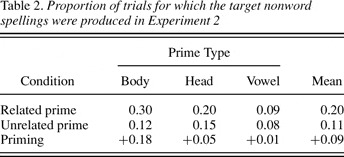
A 2 (Condition: related or unrelated prime word)×3(Prime Type: body overlap, head overlap, or vowel overlap) ANOVA was performed. This analysis revealed a significant main effect of condition, F1 (1, 178)=23.82, MSE=.04, p<.001; F2 (1, 14)=17.84, MSE=.02, p<.001, indicating that subjects produced significantly more target nonword spellings in the related prime condition (20%) than the unrelated prime condition (11%). The main effect of prime type was also significant, F1 (2, 356)=25.72, MSE=.03, p<.001; F2 (2, 28)=2.76, MSE=.097, p=.08, as was the interaction, F1 (2, 356)=12.72, MSE=.03, p<.001; F2 (2, 28)=15.94, MSE=.008, p<.001, suggesting that there were different levels of priming in the three prime conditions (see Table 2 for subject means and Appendix B for individual item means).

An analysis of simple effects indicated that rates of responding with the target vowel spellings in the related prime condition for the body, head, and vowel conditions differed significantly, F1 (2, 267)=25.70, MSE=.04, p<.001; F2 (2, 42)=3.78, MSE=.09, p<.05. The proportions of target vowel spellings across the different stimulus types were also significantly different in the unrelated prime condition, but by subjects only, F1 (2, 267)=5.00, MSE=.03, p<.01; F2<1. These analyses indicate that the significant interaction reflected the fact that the proportion of target spellings in the related condition differs for the three prime types, but these differences are less robust in the unrelated condition.
A planned comparison of the primed versus unprimed conditions for the body primes was significant, F1 (1, 178)=27.97, MSE=.06, p<.001; F2 (1, 28)=8.03, MSE=.07, p<.01 (see Table 2). There was no evidence of significant priming for the vowel primes (Fs<1). Finally, the priming effect in the head condition approached significance in the subjects analysis, F1 (1, 178)=3.58, MSE=.03, p=.06; F2<1.
Discussion
We found robust lexical priming of the spelling of a nonword's vowel when a prime word and the nonword shared vowel+coda (i.e., when the prime word and target nonword rhymed). We also found some evidence of priming when a prime word and a nonword shared onset and vowel. We found very little evidence of priming when a prime word and nonword shared the vowel only. These data provide clear evidence for the representation of word bodies and possibly of heads at some point in the spelling process.
GENERAL DISCUSSION
We used a lexical priming task in order to investigate the nature of the relationship between lexical and sublexical processing in spelling. First, we replicated previous findings (Barry & Seymour, 1988; Campbell, 1983) that the processing of lexical items influences the subsequent spelling of nonwords. This evidence that the sublexical process is open to influence from the lexical process in spelling adds to the growing evidence that lexical and sublexical processes interact in spelling (e.g., Barry & Seymour, 1988; Folk et al., 2002; Hillis & Caramazza, 1991; Hillis et al., 1999; Rapp et al., 2002). Second, we found evidence that sheds some light on the mechanisms of lexical–sublexical interaction. Specifically, we found that lexical and sublexical processes interact at the grapheme level and also that lexical processing may influence the weightings of P–G mappings in the sublexical system. Third, we found that the interaction between these processes clearly involves representations of units such as the syllabic body (vowel+coda) and, possibly, the head (onset+vowel) and only weak evidence was found for the involvement of the isolated vowel.
Mechanisms of interaction
Barry and Seymour (1988) assumed a dual-route model of spelling in which the sublexical system contains a set of weighted sound–spelling mappings. The weightings reflect the frequencies with which each phoneme is expressed in the spelling patterns of the words of the language. They explained lexical priming effects by proposing that when a critical nonword is presented, the prime word's spelling is reactivated. This reactivation increases the weighting of its spelling pattern temporarily, increasing the likelihood that the spelling pattern will be selected on subsequent presentations of the same phonemes.
We found evidence for two mechanisms by which the lexical system may exert an influence on sublexical processing. The first involves the lexical activation of graphemes. In the orthographic overlap condition of Experiment 1, we found that when presented with a spoken prime word such as couch, participants were more likely to spell the vowel of a subsequent nonword such as /n∧t∫/ with an OU than when the prime word was unrelated to the nonword. This priming occurred even though the phonological vowel in couch (/au/) is different than the vowel in /n∧t∫/. This suggests that the graphemes O and U were “primed” or preactivated by the presentation of the word prime, increasing the likelihood that they would be selected in the spelling of a subsequent nonword. Note that this explanation for how the selection of the graphemes to be used in nonword spelling is open to lexical influence requires that we assume that lexical and sublexical processes share a level of graphemic representation (see Figure 1). These findings, therefore, are consistent with a spelling architecture in which lexical and sublexical processes activate a common pool of letter or grapheme representations.
We also found evidence for a second mechanism of interaction that is consistent with Barry and Seymour's proposal. Specifically, the results of Experiment 1 showed that the priming effects were three times larger when the prime word's vowel overlapped in both phonology and orthography with the target spelling of the nonword (e.g., touch–/n∧t∫/→NOUCH) than when it overlapped only in orthography (e.g., couch–/n∧t∫/→NOUCH). If the only mechanism for lexical–sublexical interaction were the lexical preactivation of graphemes, then we would have expected priming effects to be comparable in these two conditions (given that, in both cases, the primes contained the target spelling of the nonwords' vowels). The additional effect of phonological overlap is consistent with lexical priming of the word primes' component P–G mappings. These mappings, after being activated by a word prime, are more likely to be selected upon presentation of a subsequent nonword that shares the prime word's phonemes.
What is unclear is the means by which the processing of a word increases the availability of its constituent P–G mappings. One possibility is that this “reweighting” of the P–G mappings results from the same mechanisms that support the learning of P–G mappings. Presumably weighted P–G mappings are acquired on the basis of experience with written language through a learning process that involves a constant updating of information regarding the relationships between sounds and letters. Trial-by-trial changes in the weightings of P–G mappings might well be expected in the course of this learning. If so, the learning mechanism may form the basis of the phonologically based priming effects that we have observed. This proposal assumes that the learning of P–G mappings and weightings continues even in the mature spelling system and suggests that the adult system maintains some of the dynamic properties of the developing system.
This proposal of dynamic reweighting is consistent with the recent proposal of Perry (2003). He found that lexical priming effects, although attenuated, still persisted when there were two intervening items and argued that this makes it unlikely that the priming resulted from residual activation left in the spelling system from exposure to the prime word. Rather, Perry interpreted this finding as supporting a model in which both orthographic entries in the lexical system and P–G correspondences in the sublexical system have changeable resting activation levels. He claimed that if a prime word changes the resting activation level of a lexical entry or P–G correspondence, intervening items should have little effect because changes in resting activation levels would affect the speed with which a node is activated and the likelihood that it becomes active.
We have framed our discussion of lexical priming effects in terms of a dual-process model of spelling (see Figure 1), with separate lexical and sublexical spelling processes. In contrast, Graham, Patterson, and Hodges (1997, 2000) proposed a PDP model in which knowledge of word spellings is represented in a network of interconnected phonological, orthographic, and semantic units in which there is no distinction between lexical and sublexical processes. Within this framework spelling involves the mapping of distributed phonological representations to distributed orthographic representations. The process does not involve lexical look-up and, depending on the properties of the words to be processed, may rely to a greater or lesser extent on semantically based activation. Our findings of differential priming effects for head (onset+vowel) and body (vowel+coda) conditions may pose a challenge to the PDP architecture given the distributed nature of the representations encoded within the network. However, without further testing and analysis of such networks it is impossible to know if orthographic groupings of these types might not emerge from the constraints on learning phonology–orthography relations.
Subsyllabic units
Although a number of researchers have investigated the size of the representational units involved in spelling (Barry & Seymour, 1988; Kessler & Treiman, 2001; Nation & Hulme, 1996; Perry, Ziegler, & Coltheart, 2002; Treiman et al., 2002; Treiman & Zukowski, 1988), this remains a highly controversial topic. As indicated earlier, some have reported evidence that subsyllabic units larger then a single phoneme are represented in spelling, finding that the spelling of a nonword's vowel is influenced by coda information (Treiman et al., 2002; Treiman & Zukowski, 1988). However, the default assumption for models of spelling has been that P–G knowledge is represented in terms of single P–G sized mappings. This assumption is based on notions of parsimony and may also have been derived by analogy to reading models such as that of Coltheart et al. (2002), which explicitly assume single grapheme–phoneme (G–P) mappings. Furthermore, various studies have found little evidence of representations larger than single P–G mappings. For example, although it was not central to their claims regarding lexical–sublexical interaction, Barry and Seymour (1988) hypothesized that if word bodies are represented, then in the unprimed free-spelling task nonword spellings should be produced according to the frequency of the word body spelling (e.g., how frequently the vowel /au/ in the nonword /v au n/ occurs in the word body-OUN) versus the frequency of the single vowel's P–G spelling. To examine this possibility, Barry and Seymour considered whether nonword spellings were more likely produced according to what they referred to as local versus global frequency. They found little evidence of the influence of body level representations.
Perry, Ziegler, and Coltheart (2002) also reported data that is largely consistent with the claim that simple P–G mappings play an important role in spelling. In a series of four experiments these researchers had subjects either spell nonwords, select among alternative spellings for the preferred spelling for auditorily presented nonwords, or make decisions between two spellings as to the most wordlike. They found only weak evidence that representations larger than single P–G mappings were used in the free spelling tasks. An effect of body frequency on nonword spelling was only significant across items when the body frequency of the nonword was low. Evidence of larger units was found for the other more “metalinguistic” tasks such as an auditory–orthographic choice task in which a nonword was presented auditorily and two alternative spellings were presented visually. The Perry et al. (2002) results suggest that in spelling nonwords, spellers rely most heavily on simple P–G correspondences, although, consistent with our findings, there may be some role for larger units.
Interestingly, Nation and Hulme (1996) found equivalent priming in children when the prime–target pairs shared a vowel, head, or body, using a similar task to ours. One difference between our studies, however, was that Nation and Hulme used a within subjects design in which the children first spelled the nonwords in the absence of prime words, and at a later testing session, spelled the same nonwords preceded by prime words. Their within-subjects design increased the power of their study, possibly making it more likely to detect vowel and head priming. A second difference is in the subject population. It is theoretically possible that the size of priming effects changes with increasing expertise in written language processing. Finally, a third difference between the studies was that, unlike the Nation and Hulme study (1996), most of the target spellings used in our study were not only irregular in terms of the frequency of the P–G mappings, they were also irregular for reading. That is, they were irregular in both P–G and G–P directions. It is not clear, however, how this difference would affect a lexical priming paradigm in spelling. Previous research using a lexical priming paradigm in spelling has produced equivalent levels of priming for nonwords regardless of the regularity of their G–P mappings (e.g., Barry & Seymour, 1988; a result also replicated in a pilot study we conducted). Furthermore, the vast majority of previous studies that have examined the effect of irregularity in the “feedback” direction (P–G for reading, G–P for spelling) have been carried out in reading using either naming or lexical decision tasks (e.g., Lacruz & Folk, in press; Stone, Vanhoy, & Van Orden, 1997; Ziegler, Montant, & Jacobs, 1997). Thus, given the current empirical evidence, it is not obvious that G–P irregularity plays a role in the type of priming paradigm we have used to investigate the spelling process.
Our data are in agreement with the proposals that subsyllabic representations of the body and possibly the head are involved in the priming and, therefore, that representations of this sort play a role in sublexical processing more generally. Specifically, in Experiment 2 we found robust priming of a nonword's vowel when the prime word and critical nonword shared both vowel and coda, weaker priming when the two shared onset and vowel, and very little evidence of priming when the prime word and critical nonword shared only the vowel. These findings indicate that the process of mapping phonemes to graphemes is at least in part context sensitive and is consistent with similar conclusions that have been drawn from studies that did not involve priming (Treiman et al., 2002; Treiman & Zukowski, 1988). However, we would like to be clear in stating that on the basis of our findings we cannot rule out that the sublexical process does not also represent P–G mappings in terms of individual phonemes and their corresponding graphemes. One interesting possibility is that different experimental paradigms tap into the spelling processes at different time points in the course of spelling or at different levels of representation. Additional work is needed to explore these processes in more detail.
CONCLUSIONS
Using the technique of lexical priming of nonword spelling we investigated the mechanisms and representations that are involved in the interaction between lexical and sublexical processes in spelling. We found evidence that both orthographically and phonologically based mechanisms contribute to this interaction. These findings suggest that lexical and sublexical processes activate a shared set of graphemic representations and that the spelling process involves a dynamic updating of the sublexical mappings between phonology and orthography even in the expert, adult system.
APPENDIX A
Materials from Experiment 1

APPENDIX B
Item means for Experiments 1 and 2: Proportion of trials for which the target nonword spelling was produced for each item

APPENDIX C
Materials from Experiment 2
ACKNOWLEDGMENTS
This work was supported by a grant from the NIMH to B. Rapp (#R29MH55758). Portions of these data were presented at the 40th Annual Meeting of the Psychonomic Society, Los Angeles. We thank Ruth Danglemaier for her help with data collection and scoring.
References
Barry C.
1994.
Spelling routes (or roots or rutes).
In G. D. A. Brown &
N. C. Ellis (Eds.),
Handbook of spelling: Theory, process and intervention
(pp. 27–49).
Chichester, UK:
Wiley.
Barry C., &
de Bastiani P.
1997.
Lexical priming of nonword spelling in the regular orthography of Italian.
Reading and Writing,
9,
499–
517.Google Scholar
Barry C., &
Seymour P. H. K.
1988.
Lexical priming and sound-to-spelling contingency effects in nonword spelling.
The Quarterly Journal of Experimental Psychology,
40,
5–
40.Google Scholar
Beauvois M. F., &
Dérousné
1981.
Lexical or orthographic agraphia.
Brain,
104,
21–
49.Google Scholar
Bolla–Wilson K.,
Speedie L. J., &
Robinson R. G.
1985.
Phonologic agraphia in a left-handed patient after a right-hemisphere lesion.
Neurology,
35,
1778–
1781.Google Scholar
Bowey J. A.
1993.
Orthographic rime priming.
Quarterly Journal of Experimental Psychology,
46A,
247–
271.Google Scholar
Burden V.
1989.
A comparison of priming effects on the nonword spelling performance of good and poor spellers.
Cognitive Neuropsychology,
6,
43–
65.Google Scholar
Coltheart M.,
Rastle K.,
Perry C.,
Langdon R., &
Ziegler J.
2001.
DRC: A dual route cascaded model of visual word recognition and reading aloud.
Psychological Review,
108,
204–
256.Google Scholar
Cuetos F.
1993.
Writing processes in shallow orthography,
Reading and Writing,
5,
17–
28.Google Scholar
Ellis A. W.
1982.
Spelling and writing (and reading and speaking).
In A. W. Ellis (Ed.),
Normality and pathology in cognitive functions.
New York:
Academic Press.
Folk J. R.,
Rapp B., &
Goldrick M.
2002.
Lexical/sublexical interaction in spelling: What's the point?
Cognitive Neuropsychology,
19,
653–
671.Google Scholar
Forster K., &
Taft M.
1994.
Bodies, antibodies, and neighborhood-density effects in masked form priming.
Journal of Experimental Psychology: Learning, Memory and Cognition,
20,
844–
863.Google Scholar
Goodman R. A., &
Caramazza A.
1986.
Aspects of the spelling process: Evidence from a case of acquired dysgraphia.
Language and Cognitive Processes,
1,
263–
296.Google Scholar
Graham N. L.,
Patterson K., &
Hodges J. R.
1997.
Progressive dysgraphia: Co-occurrence of central and peripheral impairments.
Cognitive Neuropsychology,
14,
975–
1005.Google Scholar
Graham N. L.,
Patterson K., &
Hodges J. R.
2000.
The impact of semantic memory impairment on spelling: Evidence from semantic dementia.
Neuropsychologia,
38,
143–
163.Google Scholar
Hillis A. E., &
Caramazza A.
1991.
Mechanisms for accessing lexical representations for output: Evidence from a category-specific semantic deficit.
Brain and Language,
40,
106–
144.Google Scholar
Hillis A.,
Rapp B., &
Caramazza A.
1999.
When a rose is a rose in speech but a tulip in writing.
Cortex,
35,
337–
356.Google Scholar
Kay J., &
Bishop D.
1987.
Anatomical differences between nose, palm and foot, or the body in question: Further dissection of the processes of sub-lexical spelling-sound translation.
In M. Coltheart (Ed.),
Attention and performance: Vol. 12, The psychology of reading.
Hillsdale, NJ:
Erlbaum.
Kessler B., &
Treiman R.
2001.
Relationship between sounds and letters in English monosyllables.
Journal of Memory and Language,
44,
592–
617.Google Scholar
Lacruz I., &
Folk J. R. (in press).
Feedforward and feedback consistency effects for high and low frequency words in lexical decision and naming.
Quarterly Journal of Experimental Psychology (A).
Nation K., &
Hulme C.
1996.
The automatic activation of sound–letter knowledge: An alternative interpretation of analogy and priming effects in early spelling development.
Journal of Experimental Child Psychology,
63,
416–
435.Google Scholar
Patterson K. E.
1986.
Lexical but nonsemantic spelling?
Cognitive Neuropsychology,
3,
341–
367.Google Scholar
Patterson K. E.
1988.
Acquired disorders of spelling.
In G. Denes,
C. Semenza, &
P. Bisiacchi (Eds.),
Perspectives on cognitive neuropsychology
(pp. 213–
229).
Hove, UK:
Erlbaum.
Patterson K., &
Morton J.
1985.
From orthography to phonology: An attempt at an old interpretation.
In K. E. Patterson,
M. Coltheart, &
J. C. Marshall (Eds.),
Surface dyslexia.
London:
Erlbaum.
Perry C.
2003.
Priming the rules of spelling.
The Quarterly Journal of Experimental Psychology,
56A,
515–
530.Google Scholar
Perry C.,
Ziegler J. C., &
Coltheart M.
2002.
A dissociation between orthographic awareness and spelling production.
Applied Psycholinguistics,
23,
43–
73.Google Scholar
Rapp B.,
Epstein C., &
Tainturier M. J.
2002.
The integration of information across lexical and sublexical processes in spelling.
Cognitive Neuropsychology,
19,
1–
29.Google Scholar
Roeltgen D. P.,
Rothi L. G., &
Heilman K. M.
1986.
Linguistic semantic agraphia: A dissociation of the lexical spelling system from semantics.
Brain & Language,
27,
257–
280.Google Scholar
Seymour P. H., &
Dargie A.
1990.
Associative priming and orthographic choice in nonword spelling.
European Journal of Cognitive Psychology,
2,
395–
410.Google Scholar
Shallice T.
1981.
Phonological agraphia and the lexical route in writing.
Brain,
104,
413–
429.Google Scholar
Stone G. O.,
Vanhoy M., &
Van Orden G. C.
1997.
Perception is a two-way street: feedforward and feedback phonology in visual word recognition.
Journal of Memory and Language,
36,
337–
359.Google Scholar
Tainturier M. J.,
Bosse Valdois, &
Rapp B.
2000.
Lexical neighborhood effects in pseudoword spelling.
Paper presented at the 41st Annual Meeting of the Psychonomic Society,
New Orleans.
Treiman R.
1994.
To what extent do orthographic units in print mirror phonological units in speech?
Journal of Psycholinguistic Research,
23,
91–
110.Google Scholar
Treiman R., &
Chafetz J.
1987.
Are there onset- and rime-like units in written words?
In M. Coltheart (Ed.),
Attention and performance: Vol 12. The psychology of reading
(pp. 281–
298).
Hillsdale, NJ:
Erlbaum.
Treiman R., &
Danis C.
1988.
Syllabification of intervocalic consonants.
Journal of Memory and Language,
27,
87–
104.Google Scholar
Treiman R.,
Kessler B., &
Bick S.
2002.
Context sensitivity in the spelling of English vowels.
Journal of Memory and Language,
47,
448–
468.Google Scholar
Treiman R., &
Zukowski A.
1988.
Units in reading and spelling.
Journal of Memory and Language,
27,
466–
477.Google Scholar
Ziegler J. C.,
Montant M., &
Jacobs A. M.
1997.
The feedback consistency effect in lexical decision and naming.
Journal of Memory and Language,
37,
533–
554.Google Scholar
Proportion of trials for which the target nonword spellings were produced in Experiment 1
Proportion of trials for which the target nonword spellings were produced in Experiment 2
 You have
Access
- 26
- Cited by