Introduction
Although not commonly observed in specific sites in the South-western Atlantic, rough-toothed dolphins (Steno bredanensis) (Lesson, 1828) are widely distributed over the continental shelf (Lodi & Hetzel, Reference Lodi and Hetzel1998b; Rossi-Santos et al., Reference Rossi-Santos, Wedekin and Sousa-Lima2006) but little information is available on their occurrence outside coastal areas. Few records of the species in deep oceanic waters (1500 and 4123 m) are available (Ramos et al., Reference Ramos, Poletto, Moreira, Erber, Dafferner, Freitas, Figna, Miranda, Alencastro, Carneiro, Fortes, Rinaldi, Demari e Silva, Barbosa, Ramos, Siciliano and Ribeiro2010; Wedekin et al., Reference Wedekin, Rossi-Santos, Baracho, Cypriano-Souza and Simões-Lopes2014).
Distribution results report pelagic habitat usage of this species, for most part of its range, between 1000 to 2000 m depths off French Polynesia (Gannier & West, Reference Gannier and West2005) and greater than 1500 m depths off Hawaii (Baird et al., Reference Baird, Webster, Mahaffy, MCSweeney, Schorr and Ligon2008). In Rio de Janeiro, south-eastern Brazil, the rough-toothed dolphin occurs closer to the coast. They are most commonly found at depths of 5–20 m (Lodi & Tardin, Reference Lodi and Tardin2018).
Their offshore distribution in most tropical and subtropical areas of all three major oceans should minimize potential threats arising from habitat loss and/or habitat alteration, whereas such threats are reported for coastal areas, where potential impacts from human activities would be higher. Rough-toothed dolphin in Brazilian waters may be affected negatively by interactions with fisheries (Lodi & Capistrano, Reference Lodi and Capistrano1990; Di Beneditto et al., Reference Di Beneditto, Ramos and Lima1998; Lodi & Hetzel, Reference Lodi and Hetzel1998b; Monteiro-Neto et al., Reference Monteiro-Neto, Alves-Júnior, Ávila, Campos, Costa, Silva and Furtado-Neto2000; Netto & Barbosa, Reference Netto and Barbosa2003), habitat degradation and chemical pollution (Dorneles et al., Reference Dorneles, Lailson-Brito, Santos, Costa, Malm, Azevedo and Torres2007; Yogui et al., Reference Yogui, Santos, Bertozzi and Montone2010; Lailson-Brito et al., Reference Lailson-Brito, Dorneles, Azevedo-Silva, Bisi, Vidal, Legat, Azevedo, Torres and Malm2012) and marine debris ingestion (Meirelles & Barros, Reference Meirelles and Barros2007), but the magnitude of such effects remains unknown.
Studies based on individual identification of rough-toothed dolphins have been conducted around Atlantic and Pacific oceanic islands and have shown some degree of site fidelity with individuals being seen exclusively around one island in multiple years (Mayr & Ritter, Reference Mayr and Ritter2005; Kuczaj & Yeater, Reference Kuczaj and Yeater2007; Baird et al., Reference Baird, Webster, Mahaffy, MCSweeney, Schorr and Ligon2008; Oremus et al., Reference Oremus, Poole, Albertson and Baker2012).
Information on the individual and spatial behaviour of S. bredanensis in the South-western Atlantic are scarce. Individual movements between areas of south-eastern Brazil suggest that the species can possibly display site fidelity also in coastal environments (Lodi et al., Reference Lodi, Oliveira, Figueiredo and Simão2012; Wedekin et al., Reference Wedekin, Paro, Cypriano, Daura-Jorge, Silveira, Olimpio, Dalpaz, Rossi-Santos and Cremer2017; Santos et al., Reference Santos, Laílson-Brito, Flach, Oshima, Figueiredo, Carvalho, Ventura, Molina and Azevedo2019).
While they are widely distributed throughout tropical and warm-temperate waters worldwide, little is known about rough-toothed dolphins anywhere in their range. Detailed, long-term behavioural ecology studies on rough-toothed dolphins have only been conducted in recent years and in deep waters around oceanic islands, hence our knowledge is limited to specific areas. The objective of this study was to evaluate the occurrence, habitat use and individual movements of the species in coastal waters off Rio de Janeiro, which are subject to intense human use, to understand their behavioural ecology and provide baseline information vital to support conservation measures.
Guanabara Bay, a eutrophic coastal bay in south-eastern Brazil, is part of a large ecosystem that forms the Guanabara Bay drainage basin, impacted by the polluted discharge from the Rio de Janeiro metropolitan area. After decades of continuous anthropogenic impact and degradation, and intense eutrophication, Guanabara Bay faces a complex of environmental, social and economic challenges (see Fistarol et al., Reference Fistarol, Coutinho, Moreira, Venas, Cánovas, de Paula, Coutinho, Mora, Valentin, Tenenbaum, Paranhos, Valle, Vicente, Amado Filho, Pereira, Kruger, Rezende, Thompson, Salomon and Thompson2015 for a review). The coast of Rio de Janeiro is vulnerable to pollution from sources such as the Ipanema submarine sewer outfall, and various waste discharges in the waters of Guanabara Bay (van Weerelt et al., Reference van Weerelt, Cunha, Dorneles, Padilha, Ormond, Torres, Torres, Batista, Nudi, Wagener, Cabral, Pinto and Paranhos2013).
Materials and methods
Study area
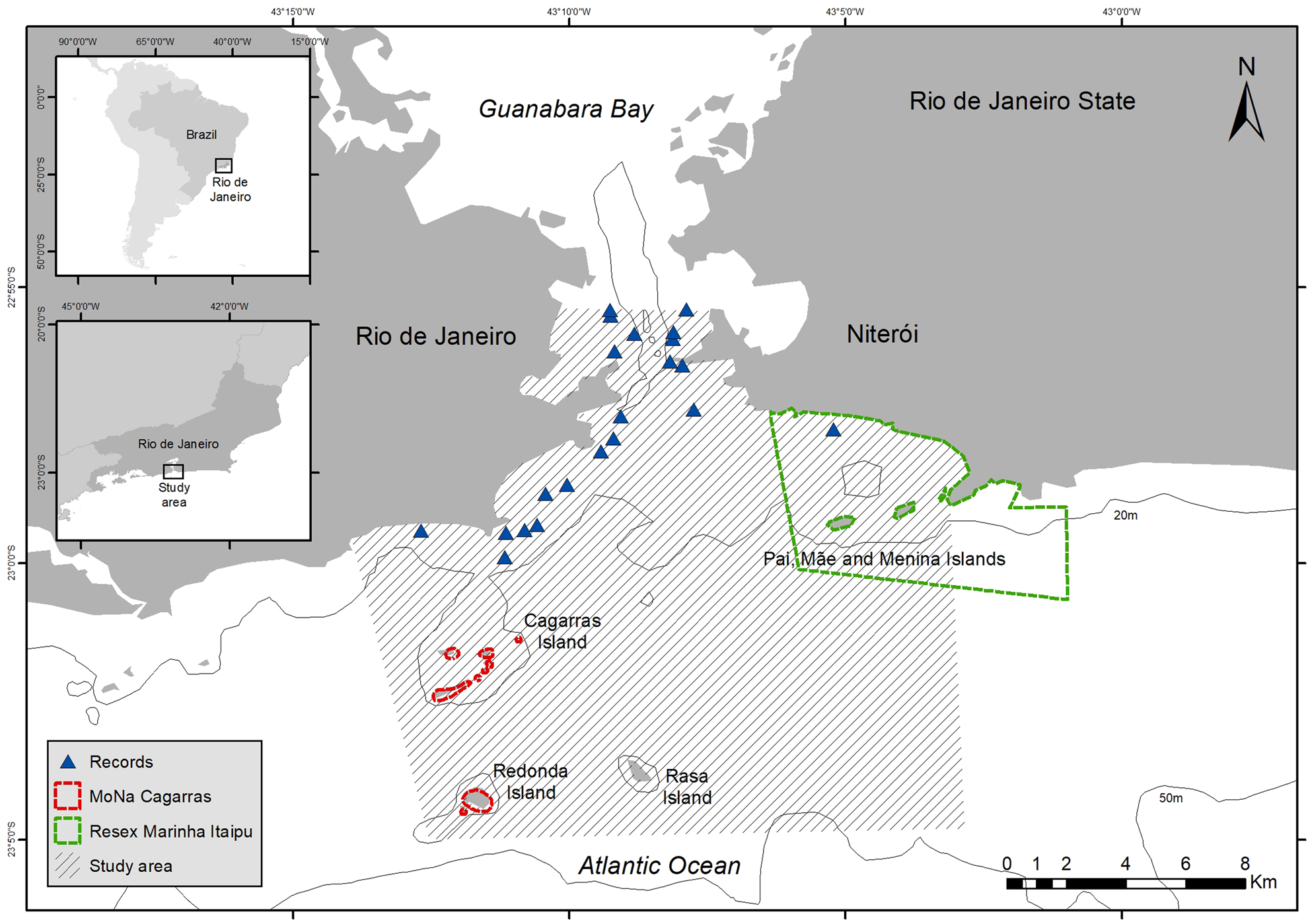
Our study comprised coastal waters off the city of Rio de Janeiro, located on the eastern coast of Brazil (Figure 1) and one of the most densely populated cities in Latin America with ~6,600,000 inhabitants (IBGE, 2018).
Study area along the coast of Rio de Janeiro state, south-eastern Brazil. Isobaths are shown in continuous light grey lines. Study area (dashed line) was delimited as the polygon around survey routes, which also corresponds to the area surveyed by boat. The dashed outlines represent the MPAs (MoNa Cagarras and Resex Marinha Itaipu). Records of rough-toothed dolphin (Steno bredanensis) recorded during surveys along the coastal waters off Rio de Janeiro from August 2011 to April 2018.

Located to the north-east coast of the city, Guanabara Bay, historically known as a highly contaminated area (Fistarol et al., Reference Fistarol, Coutinho, Moreira, Venas, Cánovas, de Paula, Coutinho, Mora, Valentin, Tenenbaum, Paranhos, Valle, Vicente, Amado Filho, Pereira, Kruger, Rezende, Thompson, Salomon and Thompson2015), is the second largest coastal bay in Brazil with an area of 384 km2 (Kjerfve et al., Reference Kjerfve, Ribeiro, Dias, Filippo and Quaresma1997). Most of the bay (84%) is <10 m depth, with a maximum depth of 58 m on its central channel (Ruellan, Reference Ruellan1944). Tides in the Guanabara Bay are mainly semidiurnal, with a mean tidal range of ~0.7 m (spring tidal range: 1.1 m, neap tidal range: 0.3 m), without significant spatial variance (Fistarol et al., Reference Fistarol, Coutinho, Moreira, Venas, Cánovas, de Paula, Coutinho, Mora, Valentin, Tenenbaum, Paranhos, Valle, Vicente, Amado Filho, Pereira, Kruger, Rezende, Thompson, Salomon and Thompson2015).
Two Marine Protected Areas (MPA) are included in the study area (Figure 1). On 13 April 2010, the Cagarras Archipelago Natural Monument (MoNaCa), a category III (Day et al., Reference Day, Dudley, Hockings, Holmes, Laffoley, Stolton and Wells2012) was created by Brazilian Federal Law number 12,229. This category was established to protect natural features and their associated biodiversity and habitats that are highly valuable for visitors and where recreational activities are encouraged. Extractive use (of living or dead material) is not deemed consistent with the objectives of this category. The Itaipu Marine Extractive Reserve (Resex Itaipu) is a category V (Day et al., Reference Day, Dudley, Hockings, Holmes, Laffoley, Stolton and Wells2012), and it was established on 30 September 2013 by Rio de Janeiro state law number 44,417. This category applies to areas where local communities, interacting with nature over time, have produced areas of distinct character with traditional management practices such as fisheries and sustainably use the sea. Nevertheless, the primary objectives of these areas remain nature conservation.
Survey effort
Data on rough-toothed dolphins reported here were collected between 2011 and 2018. Survey effort was non-systematic and track lines generally intended to maximize the likelihood of finding cetaceans.
Group size and composition
Immature individuals were considered to be up to two-thirds the length of adults, classified as such through visual estimation. For the purpose of this study, immatures included neonates, calves and juveniles, and group refers to all dolphins sampled in a single encounter, thus defined as a spatial aggregation that appears to be involved in a similar activity (e.g. foraging, socializing, resting or travelling, Shane et al., Reference Shane, Wells and Würsig1986). Group locations were determined using a Garmin Etrex 30x Global Positioning System (GPS).
Habitat use
Occurrence, distance from coast, depth and slope were mapped using ArcGIS Desktop 10.6. Distance from coast was considered as the smallest possible distance between each sighting and the coast. The study area was divided into a 1 × 1 km grid with 226 cells. Depths were obtained with a bathymetric raster surface (Nautical Chart no. 1506, Directorate of Hydrography and Navigation of the Brazilian Navy) using the depth closest to the dolphins' recorded location. Whenever more than one value was available, these were averaged to assign the depth of the sighting. The slope was calculated as the difference between maximum and minimum depth values in each grid divided by the distance in metres between both depth values. Then the values were converted to degrees.
First, a Multiple correspondence analysis (MCA) (Greenacre, Reference Greenacre1988) was performed to visually represent the relations among similar variables. Moreover, quantitative variables (group size, depth, slope and distance from coast) were divided into three categories by the natural breaks using the conversion of values to factors (Supplementary Figure S1). Univariate tests were later performed to test the relation between these variables.
Seasons were defined as summer (December to February), autumn (March to May), winter (June to August) and spring (September to November). The ANOVA one-way test (DeGroot & Schervish, Reference DeGroot and Schervish2012) was used to verify significant differences in group size in different months, seasons and years sampled as well.
Analysis of group size variation in the presence of immatures was carried out with the Shapiro–Wilk normality test (Mason et al., Reference Mason, Gunst and Hess2003). The Bartlett's test (Mason et al., Reference Mason, Gunst and Hess2003) was then performed to determine if parameters varied independently and, finally, significance was tested with the Student's t-test for independent samples (DeGroot & Schervish, Reference DeGroot and Schervish2012). The same analyses were run to investigate possible temporal-spatial relations using the closing season for the fisheries of Lebranche mullet, Mugil liza (when mullets approach the coast to spawn in shallower waters) and the depth associated with dolphin sightings. The Lebranche mullet closing season runs from 15 March to 15 September (Ordinance No. 04, of 14 May 2015, Ministry of Fisheries and Aquaculture and the Environment), in order to ensure that the reproductive cycle of the species and their stocks are maintained.
The Fisher's exact test (Choi et al., Reference Choi, Blume and Dupont2015) was applied for further analysis of the presence of immatures in groups sighted in relation to the type of coast (visually determined as rocky or sandy) and the closing season for Lebranche mullet fisheries. This same test was also carried out to investigate if the type of coast preferentially used by rough-toothed dolphins showed any relation to the closing season for Lebranche mullet fisheries. The choice in the use of the Fisher's s test was due to the existence of frequencies smaller than 5.
Tidal state data (ebb tide and flood tide) were obtained from the Centre of Hydrography of the Brazilian Navy at the nearest port of the study area (Ilha Fiscal: 22°53′8″S 43°10′0″W). The terms used to describe direction of dolphins' movements were ‘up’ for inwards movements towards Guanabara Bay and ‘down’ for outwards movements towards the sea. Thus, the Wilcoxon signed-rank test (DeGroot & Schervish, Reference DeGroot and Schervish2012) was used to analyse the movement of ‘up’ and ‘down’ of dolphins' groups in Guanabara Bay. This test investigated whether the proportion of ‘up’ and ‘down’ movements varied at different depths and slopes for the recorded sightings. To test whether movement and tide recorded for sightings were dependent, the χ2 test (DeGroot & Schervish, Reference DeGroot and Schervish2012) was carried out. All tests were performed using a 0.05 significance level.
Photo-identification
Photo-identification has been established as a powerful tool in cetacean research (Whitehead et al., Reference Whitehead, Christal, Tyack, Mann, Connor, Tyack and Whitehead2000). The nicks and notches along the trailing edge of the dorsal fin define an individual's unique signature (Würsig & Jefferson, Reference Würsig, Jefferson, Hammond, Mizroch and Donovan1990). Rough-toothed dolphins exhibit distinct features suitable for individual identification, such as notch patterns on the dorsal fin and distinct scratches (Mayr & Ritter, Reference Mayr and Ritter2005). During each encounter, an attempt was made to photograph as many individuals as possible, regardless of distinctive marks or vicinity to the vessel. Only well-focused images were considered for the analysis and creation of a photo-identification catalogue; these were unobscured, with dorsal fin perpendicular to the plane of the photographer, with the dorsal fin large enough to identify notches, and which showed the entire anterior and trailing edge of the dorsal fin from the tip to anterior and posterior insertion. The protocol for photo-identification in Espécie et al. (Reference Espécie, Tardin and Simão2010) were followed. One researcher was designated to focus on obtaining suitable photographs of individuals during sightings, using a digital SLR camera with 100–300 mm zoom lenses for photo-identification purposes.
All dolphin sightings and resightings from photographs were confirmed by two independent researchers before being entered into our database. Photographed individuals were classified according to their quality ratings on a scale of 1 to 5 (poor to excellent) (Oremus et al., Reference Oremus, Poole, Steel and Baker2007) and sighting histories. Only photographs classified in scales 4 and 5 were used. To avoid misidentification, immatures and individuals without distinctive markings were not included in the analysis. The photographs of distinct dorsal fins were compared among individuals using Darwin software 2.22 (Digital Analysis and Recognition of Whale Images on a Network: darwin.eckerd.edu).
In addition, reference catalogues were constructed with photographic records to explore individual movements and site fidelity to the area: the latter was defined as the tendency of an individual to return to an area previously occupied or remain in an area over an extended period (White & Garrot, Reference White and Garrot1990).
Site fidelity was classified in three degrees (low, medium and high) based on analysis of three parameters: (1) the ratio between the number of sightings and the number of survey dates from its first sighting to its last; (2) the ratio between the number of survey dates a dolphin was sighted and the total of survey dates; and (3) the ratio between the number of seasons a dolphin was sighted and the total of seasons (adapted from Passadore et al., Reference Passadore, Möller, Diaz-Aguirre and Parra2018 using only individual recaptures). We used Agglomerative hierarchical clustering (AHC) analysis to separate individuals into three categories based on the dissimilarity of these three standardized parameters (Legendre & Legendre, Reference Legendre and Legendre2012), by means of the average distance method and the Euclidean distance. Finally, the Correlation Cophenetic Coefficient (CCC) value was calculated (Sokal & Rohlf, Reference Sokal and Rohlf1962) to ascertain if the clustering was efficient, when the result was above 0.7 (Rohlf, Reference Rohlf1970).
All computational procedures were performed using the RStudio software 1.1.456 (https://www.rstudio.com) through the R 3.5.1 (https://www.r-project.org).
Results
Survey effort
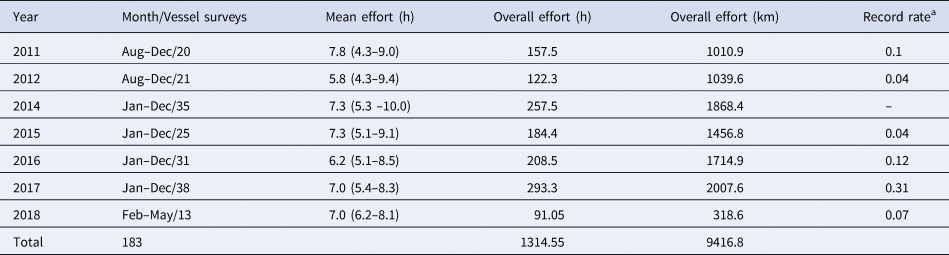
Surveys were undertaken on 183 vessel days, covering 9416.8 km of trackline in 1314.55 h of effort between August 2011 and May 2018 (Table 1), during which rough-toothed dolphins were sighted in 21 distinct events (see Figure 1).
Survey effort and record rate of rough-toothed dolphins in coastal waters off Rio de Janeiro per year

Values in parentheses represent the minimum and maximum effort/year.
a Calculated as number of total groups sighted that year/number of survey effort days that year.
The group size ranged from a minimum of four to a maximum of 60 individuals (mean = 29, SD = 14). There were no significant differences in group size by month (one-way ANOVA, P = 0.36), season (one-way ANOVA, P = 0.29) or year (one-way ANOVA, P = 0.41).
Group size and composition
The presence of immature individuals in 76.2% of the sighted groups resulted in higher numbers of dolphins per group (Student's t-test, P = 0.03).
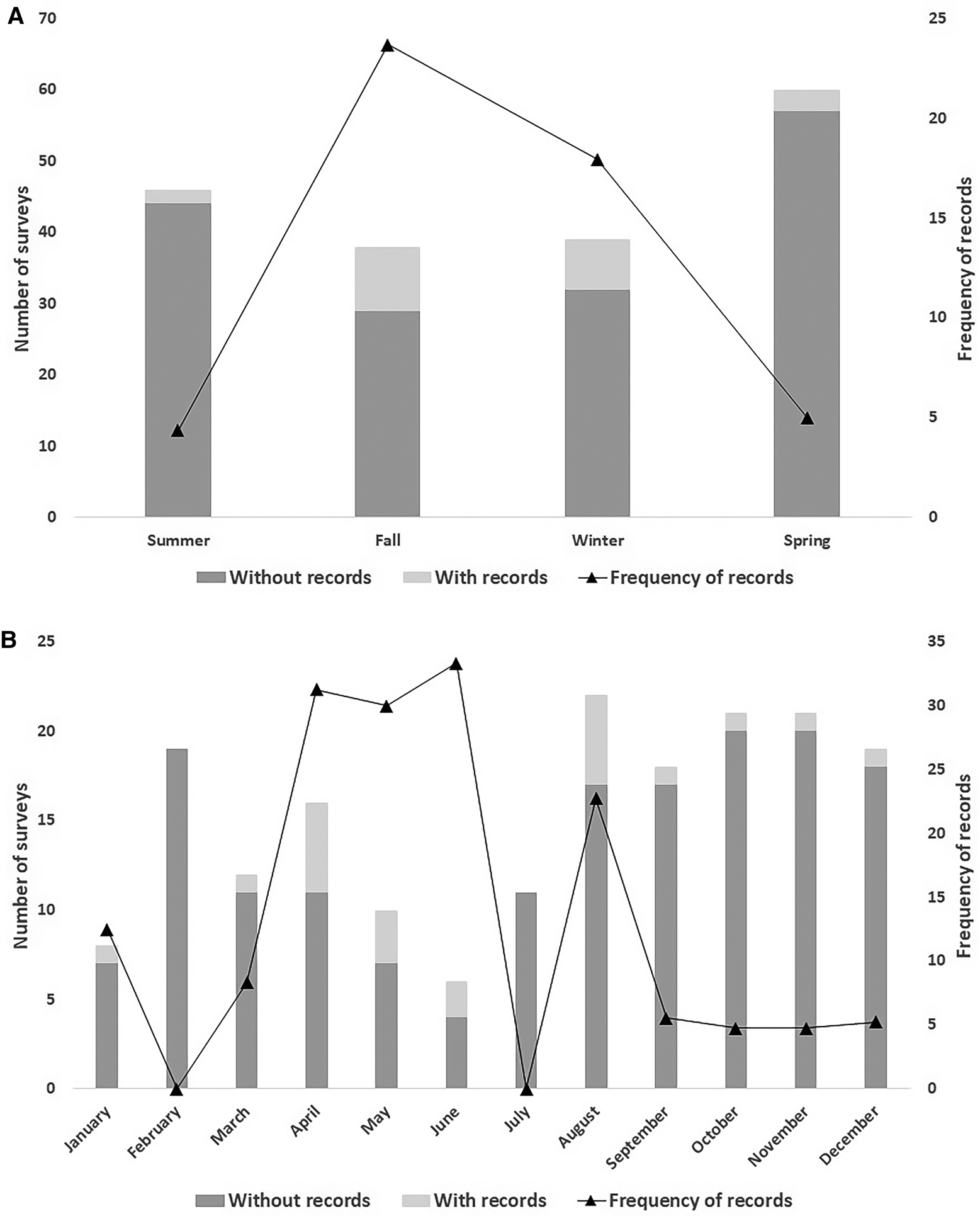
Group records were made throughout the year with two peaks, in autumn (23.7%) and winter (17.9%) (Figure 2A). The frequency of group records per month (Figure 2B) varied from 0 to 33.3 (mean = 13.2, SD = 12.6, N = 12).
Seasonal (A) and monthly (B) distribution of rough-toothed dolphins (Steno bredanensis) groups along coastal waters off Rio de Janeiro (N = 21) between August 2011 and April 2018. With records (light grey) and without records (dark grey).

Habitat use
Steno bredanensis groups were usually recorded between 130 and 2300 m from the coast (mean = 760, SD = 545) and depths between 7.6 and 28 m (mean = 14.9, SD = 5.4). The occurrence grids showed slopes between 0 and 4.2° (mean = 0.7°, SD = 1.1°).
Groups with immatures did not show dependence on the type of coast or the closing season for Lebranche mullet fisheries (Fisher's exact test and P = 0.22 and 0.55, respectively). However, the type of coast where groups were sighted has shown to be related to the closing season for Lebranche mullet fisheries (Fisher's exact test, P = 0.02). Groups were sighted with higher frequency near rocky shores during the closing season for Lebranche mullet fisheries.
Depth and slope recorded at dolphin sighting locations were not significantly different during the closing season for Lebranche mullet fisheries (Student's t-test, P = 0.1761 and Wilcoxon test, P = 0.0904, respectively).
The movement of rough-toothed dolphin groups in Guanabara Bay was related to depth, with more sightings ‘up’ the bay at greater depths (Wilcoxon test, P < 0.01). Their movements were also related to the tide, since any sighted groups were ‘down’ the bay during flood tides (χ2 test, P < 0.01).
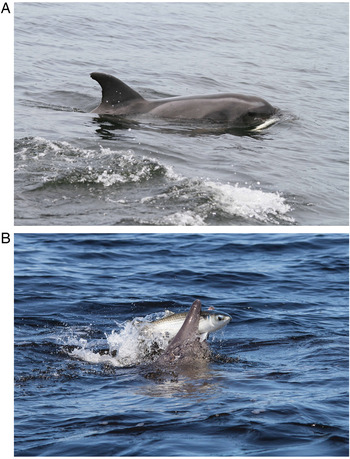
Surface feeding behaviours (actively chasing or circling fish, tossing a fish in the air and then retrieving it or holding prey in the mouth and aerial behaviours around the schools (sensu Lodi & Hetzel, Reference Lodi and Hetzel1999)) were documented in 15 encounters, including individual dolphins chasing and/or preying identified species by direct observation or photographs such as Lebranche mullet (Mugil liza) (Figure 3A), white mullet (Mugil curema) (Figure 3B), largehead hairtail (Trichiurus lepturus) and Brazilian menhaden (Brevoortia aurea). Interactions with other species included surface feeding of rough-toothed dolphins together with Brown boobies (Sula leucogaster) (in nine encounters), and the Magnificent frigatebird (Fregata magnificens) (in five encounters).
Rough-toothed dolphins (Steno bredanensis) capturing Lebranche mullet (Mugil liza) (A) (photo: Liliane Lodi) and white mullet (Mugil curema) (B) (photo: Bia Hetzel) in Guanabara Bay.

Photo-identification
A total of 9402 photographs were taken, of which 3200 pictures (34%) were characterized as being of good or excellent quality (≥3). In total 115 rough-toothed dolphins were individualized using photo-identification techniques, 61 (53%) of which were resighted on between one (47.5%) and four (9.8%) occasions, indicating some site fidelity (Supplementary Table S1). The interval between resightings ranged from 7 to 2087 days (mean = 268). Photo-identification resightings over one to six years indicated long-term site fidelity in coastal waters off Rio de Janeiro for at least some individuals.
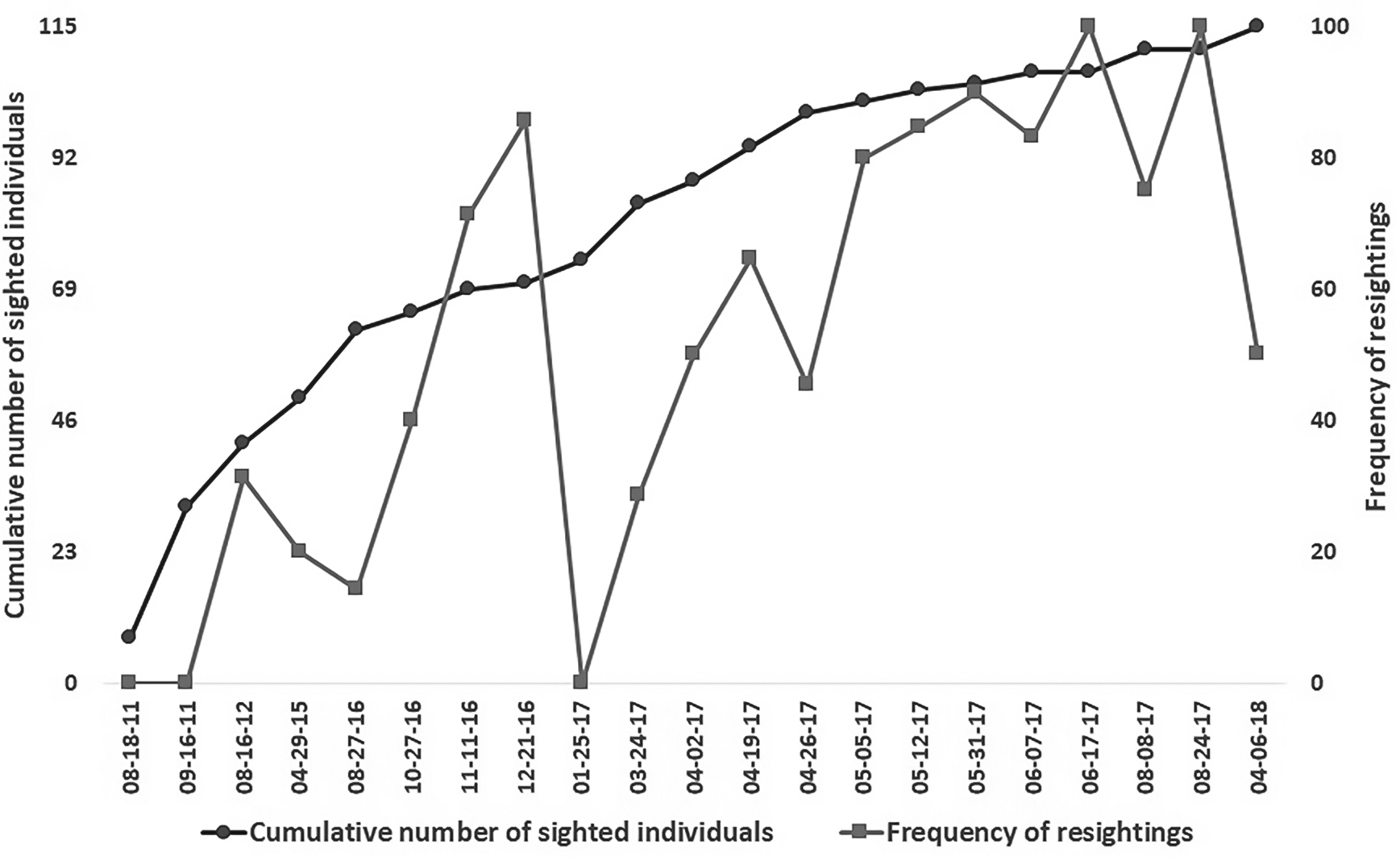
The discovery curve continued to rise throughout the study period, with newly sighted individuals being identified (Figure 4).
Cumulative sighting and resighting frequency of rough-toothed dolphins (Steno bredanensis) along coastal waters off Rio de Janeiro from August 2011 to April 2018.

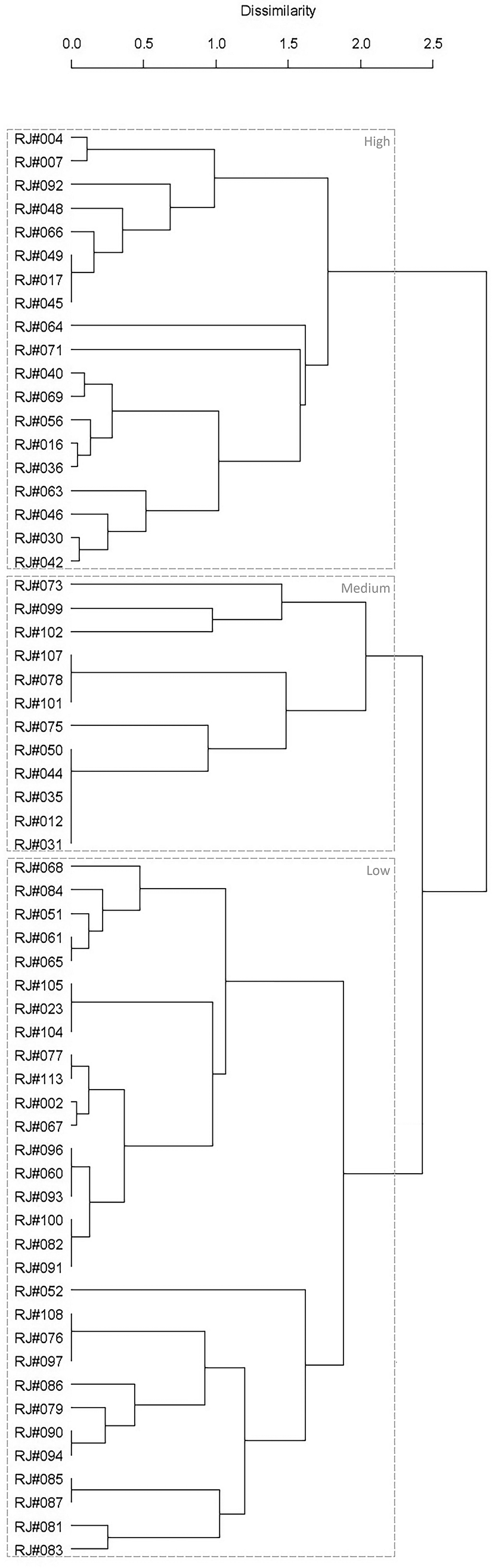
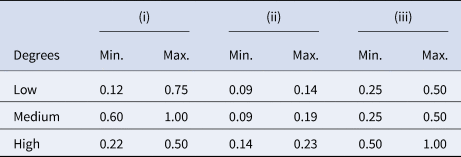
Through the AHC analysis, 30 individuals (49.2%) were grouped in the low degree of fidelity, 12 (19.7%) in the medium degree and 19 (31.1%) in the high degree (Figure 5). The reference values found in each parameter and degree of fidelity are shown in Table 2. The resulting CCC was 0.76, indicating an adequate clustering of the data.
Agglomerative hierarchical clustering (AHC) dendrogram of rough-toothed dolphins (Steno bredanensis) in coastal waters off Rio de Janeiro. The dashed lines represent clusters.

Reference values found in each parameter (i, ii and iii) according to each degree of site fidelity of rough-toothed dolphins in coastal waters off Rio de Janeiro

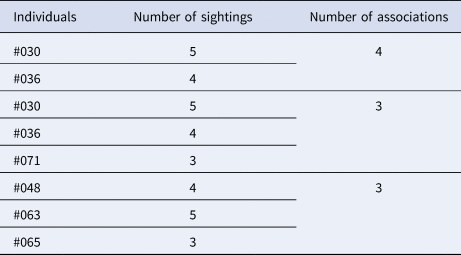
Some identified rough-toothed dolphins were sighted on the same dates and groups. Trios and pairs were sighted together three and four times respectively (Table 3).
Individuals observed together in coastal waters off Rio de Janeiro. Number of sightings = times individuals were sighted. Number of associations = times individuals were sighted together

Discussion
The rough-toothed dolphin has been described as a primarily pelagic cetacean species that is found in tropical and subtropical oceans throughout the world; however, information on its distribution patterns or habitat use in most coastal regions remains limited. We present the first uninterrupted investigation of rough-toothed dolphins in south-eastern Brazil, indicating that in coastal environments this species may show peaks of occurrence in autumn and winter, and low site fidelity, despite inter-annual resightings. There is also indication of a relationship between the presence of groups near rocky shores during the closing season of mullet fisheries.
The peak occurrence of rough-toothed dolphins in this study corresponds to the reproductive or recruitment season of Lebranche mullet, an important item of their diet (Lodi & Hetzel, Reference Lodi and Hetzel1999). Mugil sp., M. curema and T. lepturus have also been previously described in the diet of S. bredanensis (Lodi & Hetzel, Reference Lodi and Hetzel1999; Di Beneditto et al., Reference Di Beneditto, Ramos, Siciliano, Santos, Bastos and Fagundes-Neto2001; Lodi et al., Reference Lodi, Oliveira, Figueiredo and Simão2012). Our study shows that preferred areas for rough-toothed dolphins consist of rocky coastlines, which may be found in the interior of Guanabara Bay, this may help them in pushing fish schools against the shoreline (Lodi & Hetzel, Reference Lodi and Hetzel1999) and coral reefs (Rossi-Santos et al., Reference Rossi-Santos, Wedekin and Sousa-Lima2006).
Within the Delphinidae family several species are known or suspected to make use of tidal features presumably because of enhanced foraging opportunities (Benjamins et al., Reference Benjamins, Dale, Hastie, Waggitt, Lea, Scott and Wilson2015). Our results also show that groups usually moving ‘up’ Guanabara Bay would do so through areas of greater depths and moving ‘down’ through lower depths, closer to coastal areas. Groups were also mostly sighted ‘down’ the bay during flood tides. The counter-current movement (‘down’ movements during flood tide) may represent a foraging method. Dolphins may catch fish more easily when fish are swimming with or being carried by the current (Shane, Reference Shane S1980).
Group sizes were consistent with those previously reported for Brazil (1–50: Lodi & Hetzel, Reference Lodi and Hetzel1998b; Ramos et al., Reference Ramos, Poletto, Moreira, Erber, Dafferner, Freitas, Figna, Miranda, Alencastro, Carneiro, Fortes, Rinaldi, Demari e Silva, Barbosa, Ramos, Siciliano and Ribeiro2010) and known patterns of social groupings for S. bredanensis in other regions, e.g. Mauritania (10–12: Addink & Smeenk, Reference Addink and Smeenk2001), the Canary Islands (10–50: Ritter, Reference Ritter2002), French Polynesia (1–35: Gannier & West, Reference Gannier and West2005; 1–23: Oremus et al., Reference Oremus, Poole, Albertson and Baker2012), Honduras (5–30: Kuczaj & Yeater, Reference Kuczaj and Yeater2007) and Hawaiian Archipelago (2–90: Baird et al., Reference Baird, Webster, Mahaffy, MCSweeney, Schorr and Ligon2008).
Groups with immature individuals were usually larger, offering more protection and possibly allowing better cognitive development (e.g. Hill et al., Reference Hill, Greer, Solangi and Kuczaj2007; Bender et al., Reference Bender, Herzing and Bjorklund2009; Kuczaj & Eskelinen, Reference Kuczaj and Eskelinen2014; Mackey et al., Reference Mackey, Makecha and Kuczaj2014). Rough-toothed dolphins appear to cooperate in a variety of ways to increase foraging success and may even actively teach immatures to forage (Steiner, Reference Steiner1995; Lodi & Hetzel, Reference Lodi and Hetzel1999; Addink & Smeenk, Reference Addink and Smeenk2001; Pitman & Stinchcomb, Reference Pitman and Stinchcomb2002; Ritter, Reference Ritter2002).
Migratory movements of the species was first reported in Brazil by Lodi et al. (Reference Lodi, Oliveira, Figueiredo and Simão2012). Four photo-identified rough-toothed dolphins from Rio de Janeiro were resighted in the Cabo Frio region, ~117 and 119.7 km from the original sighting. Three individuals catalogued in this study were resighted in five different opportunities in the coastal waters between south and north of Rio de Janeiro, at intervals of one to five years, with a maximum linear distance of about 297 km (Wedekin et al., Reference Wedekin, Paro, Cypriano, Daura-Jorge, Silveira, Olimpio, Dalpaz, Rossi-Santos and Cremer2017). Such resightings reinforce the hypothesis of degree of site fidelity. Moreover, three catalogued rough-toothed dolphins seen in Rio de Janeiro state were resighted 240 km southwards of São Paulo state (Santos et al., Reference Santos, Laílson-Brito, Flach, Oshima, Figueiredo, Carvalho, Ventura, Molina and Azevedo2019). The straight-line distance of 480 km between resighting locations in the main Hawaiian waters is the greatest travel distance reported for the species (Baird et al., Reference Baird, Webster, Mahaffy, MCSweeney, Schorr and Ligon2008), showing that S. bredanensis are likely to have large home ranges. The shape of the discovery curve and the predominance of low site fidelity found for rough-toothed dolphins around inshore waters off Rio de Janeiro suggests a large home range and possibly a nomadic way of life.
Photo-identification studies of rough-toothed dolphins conducted in the Atlantic and Pacific archipelagos report long-term site fidelity in the species (i.e. individuals sighted over multiple years), suggesting the presence of resident populations near oceanic islands (Gannier & West, Reference Gannier and West2005; Mayr & Ritter, Reference Mayr and Ritter2005; Kuczaj & Yeater, Reference Kuczaj and Yeater2007; Baird et al., Reference Baird, Webster, Mahaffy, MCSweeney, Schorr and Ligon2008; Johnston et al., Reference Johnston, Robbins, Chapla, Matthila and Andrews2008; Oremus et al., Reference Oremus, Poole, Albertson and Baker2012). Additionally, strong genetic differentiation among islands as well as among archipelagos of insular communities of rough-toothed dolphins was reported in the central Pacific Ocean from the Hawaiian, French Polynesian and Samoan archipelagos, where separate management units were identified (Albertson et al., Reference Albertson, Baird, Oremus, Poole, Matien and Baker2017). Site fidelity with little dispersal between populations has been shown, and rough-toothed dolphins can form highly localized, and apparently isolated, island communities, which is relevant for their conservation (Oremus et al., Reference Oremus, Poole, Albertson and Baker2012). Increased productivity near the Canary Islands, Hawaii and French Polynesia due to a variety of oceanographic processes, potentially results in better predictability of food resources in these ecosystems. Conversely, the discontinuity of food within the surrounding oligotrophic areas, might encourage high site fidelity and increased prey availability (Ritter, Reference Ritter2002; Gannier & West, Reference Gannier and West2005; Baird et al., Reference Baird, Webster, Mahaffy, MCSweeney, Schorr and Ligon2008; Oremus et al., Reference Oremus, Poole, Albertson and Baker2012; Albertson et al., Reference Albertson, Baird, Oremus, Poole, Matien and Baker2017).
Long-term and large-scale studies are needed to determine the range of home areas for groups of rough-toothed dolphins in south-eastern Brazil, as well as the ecological characteristics of their habitats. The social organization of rough-toothed dolphin groups is poorly understood; this species not only has strong social bonds between mother and calf/juvenile but, based on dolphin resightings, at least some animals in stable social groups for several years (Mayr & Ritter, Reference Mayr and Ritter2005; Kuczaj & Yeater, Reference Kuczaj and Yeater2007; Santos et al., Reference Santos, Laílson-Brito, Flach, Oshima, Figueiredo, Carvalho, Ventura, Molina and Azevedo2019). Data reported in this study on the associations between identified individuals support this hypothesis; thus, S. bredanensis exhibits behaviours associated with a complex social system such as formation of tight and synchronous swimming, high tactile contact, cooperative foraging, and mass stranding events, provisioning of large prey to calves and care giving behaviours (Lodi & Hetzel, Reference Lodi and Hetzel1998a, Reference Lodi and Hetzel1999; Addink & Smeenk, Reference Addink and Smeenk2001; Pitman & Stinchcomb, Reference Pitman and Stinchcomb2002; Gotz et al., Reference Gotz, Verfuss and Schnitzler2006; Kuczaj & Yeater, Reference Kuczaj and Yeater2007). These findings suggest social organization may play a role in rough-toothed dolphin population structure (Oremus et al., Reference Oremus, Poole, Albertson and Baker2012).
Guanabara Bay, an area used by rough-toothed dolphins, is one of the most industrialized coastal areas of Brazil (Fistarol et al., Reference Fistarol, Coutinho, Moreira, Venas, Cánovas, de Paula, Coutinho, Mora, Valentin, Tenenbaum, Paranhos, Valle, Vicente, Amado Filho, Pereira, Kruger, Rezende, Thompson, Salomon and Thompson2015) harbouring industries, refineries, ports, shipyards and terminals of the oil and gas industries that contribute to water and noise pollution. Anthropogenic interference in Guanabara Bay area is high, with heavy eutrophication and hypoxia (Aguiar et al., Reference Aguiar, Neto and Rangel2011), emergence of pathogenic microorganisms (Fistarol et al., Reference Fistarol, Coutinho, Moreira, Venas, Cánovas, de Paula, Coutinho, Mora, Valentin, Tenenbaum, Paranhos, Valle, Vicente, Amado Filho, Pereira, Kruger, Rezende, Thompson, Salomon and Thompson2015), metal bioaccumulation in prey such has M. liza (Hauser-Davis et al., Reference Hauser-Davis, Isabella, Bordon CA, Oliveira and Ziolli2016) and heavy shipping and vessel traffic (Bittencourt et al., Reference Bittencourt, Carvalho, Lailson-Brito and Azevedo2014).
In this study some records of rough-toothed dolphins were made in five gillnet fishing spots (or ‘pesqueiros’) of the artisanal fishing community of Copacabana, Colônia de Pesca de Copacabana, Z-13 (Amorim & Monteiro-Neto, Reference Amorim and Monteiro-Neto2016). Known prey of rough-toothed dolphins such as white mullet, largehead hairtail and Brazilian menhaden are fished in gillnets at these fishing spots (Amorim & Monteiro-Neto, Reference Amorim and Monteiro-Neto2016), although the potential threats of by-catch and associated dolphin mortality have yet to be reported. No sightings of S. bredanensis occurred in the MoNaCa Cagarras and adjacent areas but rather in Resex Itaipu where fishing activity occurs which again points to the need for further monitoring potential interactions with fisheries.
This study shows that at least some individuals of rough-toothed dolphins use coastal habitats off Rio de Janeiro, making them more exposed than their pelagic conspecifics to a variety of anthropogenic disturbances such as harassment from boats, risk of incidental capture, over-fishing, organic and persistent pollution and marine traffic. The long-term effects of anthropogenic activities on the survival of this species are still unknown. Nevertheless, sound management and continued monitoring efforts are essential to ensure the conservation of S. bredanensis along the coast of Rio de Janeiro. Our results may contribute towards forming a benchmark for further studies in this region, which are fundamental to fill gaps in our understanding of this species throughout its distribution. Within the Atlantic Ocean basin three populations were detected (southern, south-eastern Brazil and Caribbean), and are considered as population management units for conservation purposes (Da Silva et al., Reference Da Silva, Azevedo, Secchi, Barbosa, Flores, Carvalho, Bisi, Laílson-Brito and Cunha2015).
Further data collection of environmental and anthropic variables is equally important for a better understanding of the factors driving rough-toothed dolphin habitat use and to allow future habitat modelling. Continuous photo-identification surveys, through enhanced research collaboration, are also of great importance to improve our understanding of the home range and population status of rough-toothed dolphins.
Supplementary material
The supplementary material for this article can be found at https://doi.org/10.1017/S0025315420000132.
Acknowledgements
We would like to thank Bruno F.T. Simões and Erick Monteiro for the support regarding the statistical tests used in this study and Monica Borobia, Eduardo Morteo and an anonymous reviewer for improving our manuscript immensely with their comments.
Financial support
The results of this study are part of the Ilhas do Rio I, II and III Project, of the Mar Adentro Institute, which is sponsored by Petrobras (grant numbers 6000.0064815.11.2, 6000.0086840.13.2 and 5850.0106133.17.2, respectively). Baleias e Golfinhos do Rio de Janeiro Project was supported by Marine Program of WWF-Brazil (grant number CPT 00776-2016) and the SOS Mata Atlântica Foundation (unnumbered donation).