Introduction
Deer farming related to the game and tourism industry has been of increasing interest in Lithuania and the rest of the Baltic region over past decade and new deer farms were established where parasite-associated production losses were experienced. Experiences from intensive cattle farming suggests that intensification is likely to lead to parasite-associated problems, one of which may be the increased incidence of nematode infections (Nansen et al., Reference Nansen, Foldager, Hansen, Henriksen and Jorgensen1988). Gastrointestinal nematodes are not recognized as having much significance for red deer (Blaxter et al., Reference Blaxter, Kay, Sharma, Cunningham, Eadie and Hamilton1988), although the level of significance may be underestimated due to difficulties in diagnosis. Even in mild or moderate infections Ostertagia spp. may be responsible for the reduced growth and impaired development of deer, especially as they graze on pastures throughout the autumn thereby being largely exposed to nematode infections (Conan, Reference Conan1991).
In the East Baltic region, the prevalence of helminths in wild artiodactyls (Marma, Reference Marma1969; Järvis, Reference Järvis1993; Shimalov & Shimalov, Reference Shimalov and Shimalov2003) and the impact of ecological factors on nematode infections in wild roe deer (Järvis, Reference Järvis1983a, Reference Järvis1983b) have received some attention. However, no published information is available on the epidemiology of nematodes that could be used for the control of nematode infections in farmed deer. In the UK studies, the epidemiology and treatment of nematode infections in red deer have been investigated by Lancaster & Andrews (Reference Lancaster and Andrews1991) and Conan (Reference Conan1991, Reference Conan1997). However due to the different management practices in deer farms and more severe climatic conditions during the winter, the epidemiology and impact of nematode infections in deer is likely to be different in the East Baltic region.
The aim of the present study is therefore to examine the faecal egg output and subsequent herbage larval contamination with infective third stage larvae (L3) of species of Ostertagia and Oesophagostomum by a herd of naturally infected sika deer, set-stocked on the same pasture for a full year in Lithuania.
Materials and methods
Experimental design
The study was performed in the central part of Lithuania, 20 km north-east of Kaunas during a 12-month period in 2001–2002. Grass contamination with infective L3 was monitored in two enclosures (A and B). Enclosure A (100 ha) was grazed by a herd of 290 sika deer Cervus nippon with 20% of this area being occupied by woodland, especially young conifer trees. Enclosure B (150 ha) was grazed by the same herd up to October 2000 and was free of deer during the entire study. No fertilizer was applied to both pastures during the past 5 years. Animals in the herd were of various ages with 30%, 50% and 20% comprising stags, hinds and yearlings/calves respectively. Up to 5% of stags were harvested annually while hinds were essentially unharvested. Calves were unweaned and grazed with adult deer throughout the study. All animals were raised under semi-native conditions, with no human contact or housing. No anthelmintics were used for the past two years.
All animals were fed on grass but to compensate for the gradually declining growth of grass towards the end of the grazing season, supplementary feeding with straw and hay was introduced in early September and continued until the spring.
Parasitological procedures and analyses
Enclosures A and B were visited every two weeks and on each occasion herbage and fresh faecal samples were randomly collected. Each of five samples of the mid-sized elongate (approximately 8 × 15 mm) and small (approximately 6 × 11 mm) fresh pellets were collected separately and represented hind and calf faeces, respectively. Large rounded (approximately 12 × 15 mm) pellets, representing stag faeces were avoided (Herczeg, Reference Herczeg1983).
Three replicate approximately 150 g samples of herbage were collected from each of enclosures A and B for the determination of numbers of nematode larvae. Each herbage sample was collected while walking across the pasture in a W-shaped pattern and retrieving a sub-sample at every 20 steps. Grass within 20 cm of faecal pellets was avoided. Using a technique described by Fernandez et al. (Reference Fernandez, Šarkūnas and Roepstorff2001) L3 were isolated, differentiated, counted and the results expressed as the number of larvae per kg of dried grass. The number of nematode eggs per gram of faeces (EPG) was determined using a modified McMaster technique (Henriksen & Aagaard, Reference Henriksen and Aagaard1976) with a sensitivity of 20 eggs per gram of faeces. Third stage larvae were obtained on each occasion for the identification of nematodes to the genus level. Faecal cultures were established using procedures described by Henriksen & Korsholm (Reference Henriksen and Korsholm1983).
Eleven deer were necropsied and examined for the presence of gastrointestinal nematodes during November 2000 to February 2001. Four were calves up to 1 year of age and the remainder were adults. All animals were harvested except for calves. One of the calves was found dead and three were killed by stray dogs. Following post-mortem, the abomasum and the small and large intestine were eviscerated and examined according to procedures described by Gronvold et al. (Reference Gronvold, Henriksen, Nansen, Wolstrup and Thylin1989) and Satrija & Nansen (Reference Satrija and Nansen1993). Nematode larvae and adult worms were identified to genus and species level and counted.
On each sampling day, the herbage height was estimated visually and the distribution and behaviour of deer recorded. Data on daily precipitation and average temperature were obtained from a meteorological station situated 25 km from the experimental enclosures. For comparison, data on precipitation and average temperatures during a 25-year period (1975–1990) were obtained from the Kaunas Meteorological Laboratory. Faecal egg and larval counts (log(x+1) transformed) were analysed by a non-parametric Mann-Whitney or Wilcoxon test procedure using GraphPad Prism 3.02. A value of P < 0.05 was considered statistically significant.
Results
Faecal egg counts and larval recovery from herbage
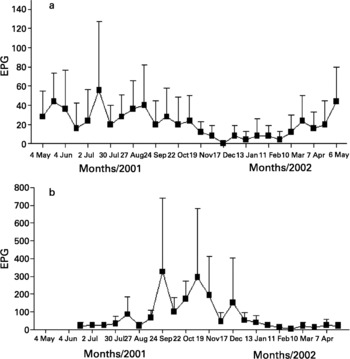
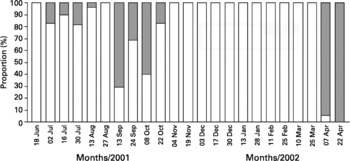
The spring rise in nematode egg counts in hind faeces was observed at the beginning of May (fig. 1a), followed by further rise in July and August. The mean numbers of eggs per gram of faeces (EPG) were low and never exceeded 60 EPG. By the second half of September the mean number of eggs in calf faeces showed a step rise reaching a peak of 300 EPG (fig. 1b), followed by a second peak in early November. However, faecal egg counts were decreasing gradually to around 30 EPG towards the end of September, remaining at this level until the spring. Analyses of nematode larvae in faecal cultures (fig. 2) showed an increase in the numbers of Oesophagostomum spp. in September and October. The highest number of Ostertagia spp. larvae occurred during September to November with the highest value of around 250 larvae per 10 g of faeces in early November.
The mean number of nematode eggs per gram (EPG) of (a) hind faeces (mean ± standard deviation) during May 2001 to May 2002, and (b) calf faeces (mean ± standard deviation) during the period June 2001 to April 2002.

The proportion (%) of Ostertagia spp. (□) and Oesophagostomum spp. (░) third stage larvae from calf faecal cultures during June 2001 to April 2002.

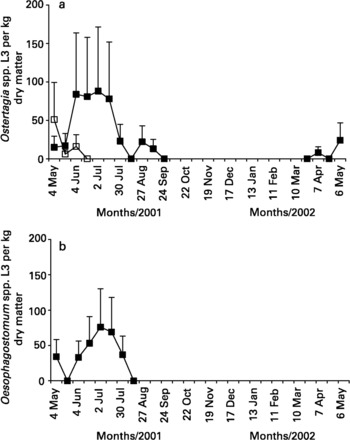
Herbage larval counts of Ostertagia spp. (fig. 3a) and Oesophagostomum spp. (fig. 3b) were low on the pasture of enclosure A and variable. The number of larvae increased slightly in early June (P < 0.05) reaching a peak of around 80 per kg of dried grass in early July. Subsequently the number of Oesophagostomum spp. larvae decreased during July and August (P>0.05). Low numbers of Ostertagia spp. larvae were still present in herbage in September. At the beginning of May the number of Ostertagia spp. larvae in enclosure B was around 50 per kg of dried grass, but by mid June and thereafter no larvae were recovered. Oesophagostomum spp. were not recovered from herbage samples in enclosure B throughout the study period.
The mean number of (a) Ostertagia spp. and (b) Oesophagostomum spp. third stage larvae per kg dry matter during May 2001 to May 2002. ■, Pasture in enclosure A (grazed by herd of sika deer); □, pasture in enclosure B (grazed by the same herd of sika deer until October 2000).

Worm counts
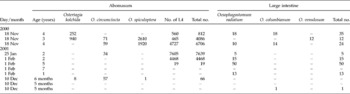
The post-mortem examination of deer (table 1) revealed the following nematode species: Ostertagia kolchida, O. circumcincta, O. spiculoptera, Oesophagostomum radiatum, O. columbianum and O. venulosum. The average number of Ostertagia in 2–4-year-old deer (n = 5) was 4742 ± 2655, whereas in deer over 4 years old and up to one year old showed very low nematode burdens. Calves born in July (n = 2) were not infected with gastrointestinal nematodes. In November 50% of the total Ostertagia spp. population comprised hypobiotic early fourth stage larvae (EL4). Oesophagostomum radiatum was the most prevalent nematode in the large intestine, but the burden was low and did not exceeded 50 worms per deer.
The number of adult worms and fourth stage larvae (L4) of species of Ostertagia and Oesophagostomum in sika deer necropsied during November 2000 to December 2001.

Condition of herbage
The grass height had increased to 15 cm in June and in July the rainfall was high with precipitation around 143 mm, compared with an average value of 80 mm. This, however, did not prevent the grass from drying out on the hilltops. In August the grass was dry with the height reduced to 4–5 cm with a scarcity of grass, coinciding with a reduced precipitation in August of 55 mm compared an average value of 78 mm. During the summer, deer usually grazed on the pasture in the morning, but retreated to the woodland areas during the day, as they did during the winter.
Discussion
Species of Ostertagia were the dominant gastrointestinal nematode in all deer examined, with O. spiculoptera being the most prevalent. Fifty per cent of the total Ostertagia spp. population in November comprised hypobiotic EL4, which tended to rise to 99% in January and 100% in February.
Nematode egg counts in hind faeces were elevated from the beginning of May and thus could be regarded as the spring/periparturient rise. Although egg output was low compared with that in cattle, it was sufficient to produce a new generation of larvae as a source of infection for calves in early summer. It was anticipated that the highest levels of infection would be manifested in first year calves at the end of the summer. However, the average number of faecal egg counts in calf faeces was low until September, gradually increasing by the end of September and reaching a peak in early November. Results from faecal cultures showed that larvae of Ostertagia spp. were dominant during this period.
On the east coast of the Baltic Sea, conditions are largely influenced by the continental climate. Cold winters characterized by low temperatures and a constant snow coverage may prevail in some years. Such conditions may have an impact on the survival of infective larvae in the faeces and subsequently may alter contamination of herbage by larvae during the following spring. Prior to the study it was anticipated that unfavourable weather conditions in spring would delay larval availability in herbage thus resembling the general pattern of cattle gastrointestinal nematodes in Lithuania (Šarkūnas et al., Reference Šarkūnas, Malakauskas, Paulikas, Nansen and Hansen1998, Reference Šarkūnas, Nansen, Hansen and Paulikas2000). However, herbage larval counts indicated an early increase in infective Ostertagia spp. and Oesophagostomum spp. larvae in June, although overall numbers of larvae on herbage did not rise to appreciable levels. This presumably was partly influenced by wet weather during and before sampling days in late June/early July, which may have washed away a large amount of larvae from the herbage. By late July/early August, herbage larval counts started to decrease on the pasture, coinciding with the reduction in precipitation.
Baliešis et al. (Reference Baliešis, Bluzma and Balčiauskas1987) reported that one month after birth sika deer calves started to graze and, although herbage forms a small part of the feed, the calves are at risk of acquiring early nematode infections. The present results show that the risk of Ostertagia spp. infection may be increased in calves born early and starting to graze on pasture in June and July with the highest risk of Oesophagostomum spp. infection being in July. By late August, the availability of infective larvae on pasture was reduced and the risk of infection in calves significantly lowered in Lithuania. This situation differs from that in Britain (Lancaster & Andrews, Reference Lancaster and Andrews1991) where red deer calves are exposed to the highest levels of infection in the autumn.
Results from the herbage larval counts in enclosure B showed that larvae of Ostertagia spp. were able to survive during the winter and persisted on pasture until early June. Despite a constant snow cover, the number of overwintered larvae of Ostertagia spp. was relatively small compared with that in cattle (Šarkūnas et al., Reference Šarkūnas, Malakauskas, Nansen, Hansen and Paulikas1999, Reference Šarkūnas, Nansen, Hansen and Paulikas2000) in Lithuanian conditions. This might be explained by the lower pasture contamination with L3, when compared with cattle and low reservoir effects in pelleted faeces. Larvae of Oesophagostomum spp. on the other hand, did not survive during the winter and were not prevalent on the pasture in early May in 2001 or 2002. This supports the fact that Oesophagostomum spp. larvae are not able to survive winter conditions in temperate climates (Shumakovich, Reference Shumakovich1968) and suggests that adult animals were responsible for contaminating the pasture and served as a source for this nematode to susceptible calves during the following spring.
Species of Ostertagia are the most widespread and numerous gastrointestinal nematodes found in farmed red deer. Large numbers of hypobiotic EL4 may be prevalent in stags and hinds in winter causing type II ostertagiosis in spring (Connan, Reference Conan1991). In Lithuania, sika deer calves are usually grazed with adult stock and are not housed during the winter. Anthelmintics are rarely used in most of the farms and no extra pastures are available for moving animals between the seasons. Under such conditions, sika deer are likely to be exposed to high nematode burdens and, if combined with malnutrition during the winter, this may lead to morbidity and mortality. To prevent the acquisition of large burdens of inhibited larvae, calves should be treated with anthelmintic in September. During this time the risk of reinfection with Ostertagia spp. and Oesophagostomum spp. is reduced and the number of hypobiotic EL4 are expected to be low in Lithuanian conditions. Even if the hinds do not appear to suffer seriously from the effects of gastrointestinal parasites (Lancaster & Andrews, Reference Lancaster and Andrews1991), a single treatment of adult deer is also recommended. If treated in September, deer will be prevented from accumulating high burdens of hypobiotic EL4 during the winter. This subsequently may reduce contamination of herbage with infective L3 in spring.
Acknowledgements
It is a pleasure to acknowledge the owners of the herd without which this study would not be possible. It is also a pleasure to thank the staff at the Meteorological Laboratory in Kaunas, Lithuania, for providing climate data.