Metropolitan does not want Third Avenue, has not been trying to get it and is not trying to get it.… The possibilities of Third Avenue have been thoroughly canvassed by the Metropolitan management and the conclusion not to touch the road at any price has been reached after mature deliberation.Footnote 1
The Metropolitan Street Railway interests were in fact engaged in buying control of the wronged and maligned Third Avenue road. A fortnight before, for reasons unprofitable to seek, their mouthpiece had been induced to explain publicly that the Metropolitan had positively no intention of buying the Third Avenue, and it may be imagined that this pronouncement had quickened the tendency of the price to decline.… It is difficult to resist the conviction that the entire movement of the stock was the product of superior design.Footnote 2
Technological progress is like an axe in the hands of a pathological criminal.—Albert Einstein
Introduction
Imagine your daily commute to work from Midtown Manhattan to Wall Street in the year 1890. You leave your home at 6:00 a.m. and walk south to catch the top-heavy and hard to brake horse-drawn streetcar operated by the Third Avenue Railroad Company. After dodging ill-treated and skittish horses, pedestrians, wagons, and mounds of manure and urine infested with disease-ridden insects, you board the car, breathe a sigh of relief, and take a seat, all while fruitlessly hoping for a smooth ride. Over the next ninety minutes, you change cars three times and finally arrive at work at 7:30 a.m. Your morning commute has left you exhausted and you start your workday feeling as if you need a bath.
Over the next two decades, your daily commute would have changed dramatically. Horses are replaced by electric motors drawing on a rail placed in a conduit just below street level. Routes are consolidated and extended. An underground subway is built, dramatically reducing your commute time. Manhattan’s bustling avenues are cleaned and the air quality improves markedly. Technological innovation is a wondrous thing, but it advances in a herky-jerky manner that often leaves a trail of destruction in its wake.
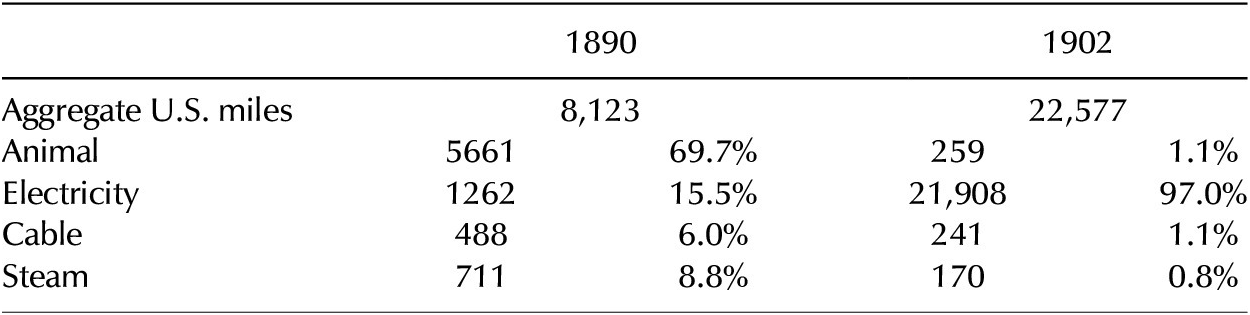
Our study focuses on a transformative episode in 1900, during a period when a new technology, street railways driven by electric power, emerged to revolutionize the transport systems of large, urban centers like New York City. Between 1890 and 1902, commuter rail mileage in the United States nearly tripled, with electricity’s modal share growing from 15 percent to 97 percent, and the proportion traversed by animals (mostly horses) declining from 70 percent to 1 percent. Compared with horse-drawn streetcars, electric railcars had lower marginal operating costs. Transit companies could achieve significant economies of scale by constructing larger, strategically placed power stations. Electric rail transformed the urban landscape, allowing workers to live farther from their places of work. Thereupon suburban land values increased substantially.
We focus on the Metropolitan Street Railway Company (henceforth, Metropolitan), the largest player in Manhattan’s transportation industry and a fascinating antagonist to illustrate how capital markets can finance, facilitate, promote, and stifle innovation during a lightly regulated period when U.S. capital markets had limited depth and breadth. Metropolitan owned or controlled 219 miles of track in 1899. Its primary competitor was the Third Avenue Railroad Company (Third Avenue), which controlled or operated 143 miles of track. Third Avenue had begun a switch to electricity as its primary means of propulsion in 1899, financing the investment with a mix of new equity and unsecured debt. The increased debt burden damaged the company’s financial health and market capitalization and made Third Avenue an attractive takeover target.
Our story involves colorful characters. Henry Hart, the octogenarian vice president of Third Avenue is the consummate company man; he has dedicated more than forty years to the firm and has amassed a dominant ownership position in the firm’s shares. Hart increased his ownership stake in Third Avenue throughout the bull market of 1899 to nearly one-third of the shares outstanding by borrowing against these shares and using the proceeds to purchase additional shares (thus creating a chain of hypothecation). However, the loans carried punitive interest rates of up to 36 percent per year. Opposing Hart are Thomas Fortune Ryan and William Collins Whitney, the driving forces of a syndicate that had assembled Metropolitan as Third Avenue’s primary competitor through the consolidation of many independent firms with street railway operations in Manhattan. Attempting to rescue Hart is James R. Keene, a well-known stock operator and sworn enemy of Whitney and Ryan, who had attempted bear raids on Metropolitan and other Whitney/Ryan interests in 1898 and 1899.
Some of these characters enjoy insider status and engage in unsavory but not illegal schemes such as stock price manipulation and tunneling. Operators, very likely including Keene and Ryan, routinely planted rumors and negative stories in the press to temporarily inflate or depress the share prices of Third Avenue, Metropolitan, and other companies. With no restrictions on short selling, and active call loan and securities lending markets where funds and securities could be borrowed, operators were able to take highly levered long and short positions in stocks.Footnote 3 They could camouflage their trading activities by using multiple brokers and submitting matched (simultaneous) buy and sell orders. The Whitney/Ryan syndicate created shell companies to purchase rail lines that they would eventually sell or lease to Metropolitan at higher prices, thereby enriching themselves at the expense of Metropolitan’s minority shareholders.
Metropolitan’s stealth, hostile takeover of Third Avenue was so expertly done that almost nobody knew it happened until it was announced after the close of trading on March 20, 1900. In fact, it cornered the market in Third Avenue shares, sparking a short squeeze and panicked trading the next day. Whitney and Ryan were able to gain control of Third Avenue without paying an acquisition premium. We estimate the Whitney and Ryan syndicate earned returns in excess of 60 percent. These gains came mostly at the expense of Third Avenue shareholders who were manipulated and chose to sell their shares while prices fell over the prior seven-week period. It was during this previous period that the rumor mill was running in full force and short sellers were levering their positions.
Consolidation in the street railway industry initially produced significant benefits for commuters. They now could transfer from one line to another and travel anywhere in Manhattan for five cents, although full integration of the Third Avenue and Metropolitan systems progressed slowly. The gains in transport efficiency likely had broad, positive spillover effects for economic growth in New York City. Manhattan’s high population density engendered squalor and fears of epidemic diseases. Urban reformers advocated for improvements in transportation infrastructure to alleviate these health concerns.Footnote 4 Without question, pedestrians and conservationists celebrated the shift from horses to electricity and the consequent reduction in horse manure, urine, and carcasses polluting the streets.Footnote 5
Ultimately, Metropolitan shareholders would lose their capital (though not Whitney, who had unloaded his shares before his death in 1904) as Metropolitan’s efforts to maintain its monopoly power in the market for street railway transport utterly failed. Under the terms of the acquisition, Third Avenue maintained its existence as a separate company and leased its lines to Metropolitan at unsustainable rates for 999 years. Furthermore, the first line of the New York subway opened on October 27, 1904. It was a hit with the public and immediately began stealing market share and profits from Metropolitan. By 1907, Metropolitan was unable to make its lease payments to Third Avenue and other subsidiaries, forcing the companies into receivership.
The 1900 hostile takeover of Third Avenue was anomalous. Most of the mergers during the 1897–1903 merger wave were friendly and involved interstate consolidations.Footnote 6 Still, our case study illustrates broad features of early twentieth-century U.S. financial markets: a lax regulatory environment, a massive call loan market, and a narrow, concentrated stock market enabled speculators to take highly levered long and short positions, operators to manipulate market prices, and insiders to extract excess profits. More generally, the Third Avenue takeover shows us the capabilities of capital markets and reveals how they can enable or impede disruptive technologies. We describe how investing syndicates could use an information advantage and complex and overcapitalized financial structures to extract excess profits. Ideally, the regulatory framework would provide incentives for socially valuable consolidations while discouraging those transactions motivated by insiders’ efforts to extract private benefits.Footnote 7 Our analysis of the Third Avenue takeover suggests that the ability to do a stealth acquisition—unavailable today due to disclosure requirements—provided significant incentives for financiers to initiate a potentially valuable consolidation, but at a substantial cost to uninformed market participants.
Evolution of the Two Primary Street Railways Serving Manhattan at the End of 1899
Metropolitan Street Railway Company
The origins of the Metropolitan Street Railway Company can be traced to 1884, when a syndicate of investors led by Whitney and Ryan (henceforth, the Whitney/Ryan syndicate) began their consolidation of control of the street railways of Manhattan.Footnote 8 At the time, the street railways were poorly run, fragmented, and characterized by corruption: “Backwardness, stupidity, deterioration were apparent on every hand.”Footnote 9
Whitney and Ryan came from different backgrounds. Whitney was born in comfortable surroundings, went to Yale, and married the daughter of a wealthy U.S. senator and brother of a partner of John D. Rockefeller. He was instrumental in the fight against Boss Tweed and Tammany Hall in the early 1870s, earning him a reputation as a political reformer. He also was the secretary of the Navy from 1885 to 1889 and played a significant role in the nomination of Grover Cleveland as the Democratic presidential candidate in 1892.Footnote 10
In contrast to Whitney, Ryan was born in much more humble surroundings near Charlottesville, Virginia. He came to New York and bought a seat on the New York Stock Exchange (NYSE) in 1874. He worked for Jay Gould and other stock operators, earning a brilliant reputation of his own. While heavily involved with street railways throughout his career, he also had interests in intercity rail, banking, tobacco (as one of the organizers of the American Tobacco Company, which at one point controlled 80 percent of the U.S. tobacco market), insurance, and the Congo.Footnote 11 The last investment was at the invitation of King Leopold II of Belgium, who wanted to work with the “ablest Catholic capitalist in the United States.”Footnote 12 Ryan attended a daily Mass officiated by his family’s personal priest and generously contributed toward the construction of several churches, including the Cathedral of the Sacred Heart in Richmond, Virginia. According to a diocesan official, it was the only cathedral in the world “ever constructed by the sole munificence of one family.”Footnote 13 He died in 1928 at age 77, leaving a fortune exceeding $100 million.Footnote 14
In 1884, Whitney and Ryan were members of separate groups fighting for a lucrative new franchise to provide railway service on lower Broadway. The third competitor for the franchise was Jacob Sharp, who wanted to incorporate the new franchise into his existing Broadway and Seventh Avenue Railroad. Sharp won the franchise rights because his bribe of $500,000 to the board of alderman was all cash. The Ryan group’s bribe, while larger, was half cash and half bonds.Footnote 15 The episode highlights city government corruption in the awarding of street franchises in New York and many other cities.Footnote 16 Whitney, Ryan, and the Philadelphia trio joined forces after the franchise initially was awarded to Sharp. In 1886, they succeeded in wresting control of it and the Broadway and Seventh Avenue lines away from Sharp.Footnote 17
Whitney undertook his portion of the work while simultaneously serving as secretary of the Navy from 1885 to 1889. The unsavory nature of the Broadway and Seventh Avenue transaction, and his many discreet trips to New York, resulted in unwelcome attention and questioning of his motives.Footnote 18 For example, the New York Tribune reported:
Mr. Whitney was in town a week ago yesterday, although few New Yorkers discovered it. He did not proclaim his presence on the house-tops. But the Philadelphia men who were in the city were informed of it and they spent hours in consultation with the Secretary of the Navy in his house at Fifty-seventh St and Fifth Ave. Mr. Whitney returned to Washington, but was soon back here again and quiet conferences at which few were present, but in which those few were deeply absorbed, have been going on day after day in the Whitney mansion.Footnote 19
The syndicate created the Metropolitan Traction Company, which eventually went public in 1892, to acquire control of four smaller street railways in Manhattan. The syndicate then created the first of three iterations of the Metropolitan Street Railway in 1893 as a wholly owned operating subsidiary of Metropolitan Traction and went on to acquire control of additional lines. Metropolitan Street Railway itself went public in October 1897 with a market capitalization of $30 million, using the proceeds to absorb its former parent, Metropolitan Traction, from within. One fierce critic of the structure claims it afforded the syndicate the opportunity to skim millions of dollars from Metropolitan’s minority shareholders.Footnote 20 Amory claimed a typical transaction would begin with the syndicate independently buying control of a new railway, which would then be sold at an inflated price to Metropolitan Traction, thereby creating “water” (i.e., overcapitalized assets bought by excess liquidity) in the stock. Metropolitan Traction would in turn, sell control to Metropolitan Street Railway, the wholly owned subsidiary. One 1896 transaction supposedly netted a $4 million profit to the syndicate. In 1897, Whitney was able to get elected as a director for the Second Avenue Railroad Company, another line that ran the length of Manhattan. In January 1898, Metropolitan negotiated a lease for the line with the interest-conflicted Whitney on both boards.Footnote 21 Ryan frankly admitted in 1908 that “there was considerable stock-jobbing and stock watering” involved in the formation of the second and third iterations of the Metropolitan Street Railway.Footnote 22
The Metropolitan Street Railway continued to acquire independent companies throughout the 1890s. By 1899, it controlled fifteen operating companies through the ownership of large blocks of stock or lease. The leases typically spanned 999 years, provided total control to Metropolitan, and guaranteed a fixed dividend to the shareholders of the leased companies. These dividends typically exceeded the earnings capacity of the lines.Footnote 23 In some cases the control was indirect, with one of the subsidiaries making the purchase or acquiring the lease. In essence, Metropolitan was a holding company.Footnote 24 As of 1899, it owned and leased 50.41 and 168.90 miles of track, respectively, controlling an aggregate of 219.31 miles.
Third Avenue Railroad Company
As of the end of 1899, the Third Avenue Railroad Company was the only significant street-level system in Manhattan not controlled by Metropolitan. It was incorporated on October 8, 1853. Vice President Henry Hart had been with the company at least forty years and was the largest shareholder.Footnote 25 As of 1899, it owned 29.38 miles of track and controlled four companies operating an additional 112.71 miles.Footnote 26
Hart owned a pawn shop near the southern extent of the Third Avenue system and became interested in the rail line’s operations in the late 1850s. Though illiterate, he did a fine job of operating Third Avenue.Footnote 27 In fact, he dedicated his life to the company. According to Edward Lauterbach, Third Avenue’s counsel, “Henry Hart had one idol, the Third Avenue Railroad. He went to the office on Sunday as he did on the other six days in the week. It was his only worship.”Footnote 28
Hart became alarmed by Metropolitan’s growing reach. In defense, Third Avenue began its own series of acquisitions beginning with the Forty-Second Street, Manhattanville and St. Nicholas Avenue Railway in 1895. While Metropolitan and Third Avenue did not operate on the same streets, they operated many parallel lines along the primary north–south avenues in Manhattan. A strong network of cross-island lines was necessary to feed these main lines. The surface routes also faced competition from the Manhattan Railway Company, which operated four elevated north–south routes. However, the elevated routes typically catered to riders who were commuting longer distances, as their steam engines limited their use for short-distance, stop-and-start routes.Footnote 29
Third Avenue began the process of electrification in 1899, funded by an increase in equity capital of $4 million and the issuance of $5,860,360 in additional unfunded (unsecured) debt. However, the Republican Hart’s initial reluctance to use contractors allied with the Democratic Tammany Hall political machine led to delays in obtaining the necessary permits. Construction began once the Tammany contractor was hired; however, little meaningful construction actually occurred despite the expenditure of millions.Footnote 30 Furthermore, the upgrade required the construction of a not yet completed powerhouse estimated to cost $5 million.Footnote 31 The increase in unfunded debt to pay for the acquisitions and for the switch to electric power was a primary cause of Third Avenue’s financial distress in early 1900.Footnote 32
By 1899, Hart’s concern that the Whitney/Ryan syndicate would secretly purchase a controlling stake in Third Avenue became acute. He began a risky strategy of borrowing against his shares to purchase additional shares. He then created a chain of hypothecation, whereby the newly purchased shares would be put up as collateral for even more purchases. Fear of losing his dominant ownership position and his overextended personal debt obligations led Hart to vote against the issuance of additional shares in the fall of 1899 and in favor of more corporate debt. This decision, which was opposed by several members of Third Avenue’s board, sowed the seeds for Third Avenue's eventual receivership.Footnote 33
Hart had increased his ownership to at least 50,000 of the 160,000 outstanding shares by the end of 1899. However, some of his loans carried crippling interest rates of up to 36 percent.Footnote 34 A brief market panic in December 1899 and the ongoing fall in Third Avenue shares beginning in January 1900 impacted the value of his collateral and left him dangerously exposed to financial distress.
James R. Keene
Contemporaries of James R. Keene frequently cited him as the best stock operator in U.S. market history.Footnote 35 Keene was known for his manipulative pools and for his ability to create markets for new, typically waterlogged, stock issues. In fact, J. P. Morgan hired Keene to handle the sale of shares of United States Steel, the first $1 billion corporation created in the United States.Footnote 36 Keene was known for his ability to find inside information in support of his campaigns and for his secrecy in turn.Footnote 37 He had been involved in several pools with Whitney and Ryan in the early 1890s, some of which involved betrayal and resulted in their becoming bitter enemies.Footnote 38 Keene executed attacks on several Whitney/Ryan stocks in late 1899, including Electric Vehicle, Electric Storage Battery, and even Metropolitan itself. Whitney supposedly suffered a loss of $9 million in the Metropolitan attack.Footnote 39
The Transformation of an Industry
While rudimentary battery-powered street railways date to 1835, commercially viable electric systems did not exist until the 1880s.Footnote 40 Frank Sprague initiated the transformation of the street railway industry with a successful demonstration using electricity as the “motive power” in Richmond, Virginia, in 1888.Footnote 41 This proof of concept and subsequent improvements in the technology induced street and elevated commuter railway systems throughout the United States to switch from horse and cable power. Durand and Martin prepared a comprehensive study of the state of the industry in 1902 for the newly created U.S. Department of Commerce and Labor. Table 1 summarizes their comparative data for 1890 and 1902 on the aggregate number of U.S. commuter rail miles subdivided by the four methods for moving cars.Footnote 42 A large increase in ridership accompanied the transformation of the industry. The total number of passengers carried were 2,023,010,202 and 4,774,211,904 in 1890 and 1902, respectively. The U.S. population increased by 20.7 percent to 75,994,575 over the same period.
Commuter rail mileage in the United States, by motive power source

Note: Animal power is mostly horse, and steam power is primarily on the limited number of elevated lines in the largest cities. Elevated lines in New York were operated by the Manhattan Railway and portions of the operations of the Brooklyn Rapid Transit Company. Cable power was introduced in 1873, but rapidly became obsolete. Our source is Durand and Martin, Street and Electric Railways, table 4.
Durand and Martin report as of 1890 that 557 of the 691 street railway companies in the United States (81 percent) operated less than ten miles of track. These smaller companies typically operated on one major street with a few feeder routes on side streets.Footnote 43 The largest company operated somewhere between 90 and 100 miles of track. By 1902, 394 of 817 (48 percent) companies operated on less than ten miles of track. Moreover twenty-five companies nationally operated more than 100 miles of track. As for Manhattan, there were fifteen independent operating companies with a total of 210 miles of track in 1890, none of which controlled more than 30 miles. Only Third Avenue and the elevated Manhattan Railway Company traded on the NYSE at that time. A few other lines traded on the informal “curb” market.
Durand and Martin discuss the benefits of the move toward electric power and consolidation. Companies could offer longer routes at faster average speeds.Footnote 44 The longer routes attracted more riders, allowing companies to minimize the number of transfer passengers, who often paid reduced rates. Commuters could live in more desirable neighborhoods farther from their places of work (the most common destination). In fact, residential development followed the expansion of the street railways, with newly developed areas consisting of “long fingers or tentacles.” Land values substantially increased with the arrival of a new route. Another significant benefit came from cost savings. Electric cars were less expensive to operate than those drawn by animals. Larger companies could achieve significant economies of scale by constructing larger, more strategically placed powerhouses.Footnote 45
The State of the Stock Market and the Merger Wave of 1897–1903
The street railways’ transformation, like that of many other industries, coincided with remarkable increases in NYSE trading volume and the first merger movement in U.S. history. The movement was part of a broader trend that Hansen characterizes as a period in which economic laissez-faire facilitated financial innovation and rent-seeking.Footnote 46 The events we describe do share characteristics with laissez-faire policies, especially the lax regulatory environment of the stock market. However, government played an important, corruption-inducing role, as the street railways were the product of lucrative government franchises and were subject to the political winds of the day, notably those blowing from Tammany Hall.Footnote 47
The Panic of 1893 had sparked a crippling depression and suppressed stock market activity. NYSE trading revived in 1897 following the post-panic low of 49,275,736 shares traded in 1894. By early 1899, Wall Street was enjoying a strong bull market with annual trading volume totaling 175,073,855 shares. Trading reached its apex in 1901 with record volumes of 265,277,354 shares, or 319 percent of the shares outstanding. These years marked the most active period in NYSE history in terms of shares traded to total shares outstanding.Footnote 48
In 1900, U.S. securities markets lacked breadth and depth. Railroad companies were the dominant issuers of corporate securities, and financial institutions (mostly banks, life insurance companies, and trust companies) were the dominant investors in stocks and bonds. Compared with the markets in London, the U.S. financial system was much less diversified. At the same time, New York’s massive call loan market was a critical supplier of credit and securities for speculators. Call loans constituted between 30 percent and 40 percent of the total loans held by New York’s national banks during the period 1898 to 1912. New York’s trust companies were also active participants in this market, which largely sustained the speculative demand for railroad stocks. Footnote 49
O’Sullivan argues that U.S. securities markets evolved in an erratic and protracted fashion that mirrored the country’s idiosyncratic economic and industrial developments. At first, securities were created to finance the development of the nation’s railroad network. The industrial sector developed slowly and suffered from instability and low profits. It only overtook the railroad sector as a supplier of corporate securities after World War I.
Nelson dates the first U.S. merger wave to the period 1897 to 1903, a period marked by strong stock returns and a growing economy.Footnote 50 Rapid expansion in the number of securities traded on the NYSE was associated with lower interest rates, increased corporate production and profits, overconfidence in the new trusts, and increased institutional investments.Footnote 51 Speculative fever precipitated the remarkable trading volumes, which in turn allowed the promoters of the great consolidations (e.g., U.S. Steel) to easily sell new debt and equity securities.Footnote 52 The cash raised made it easy for parent companies to acquire constituent companies. Most mergers were friendly and often involved legal insider purchases of the target firms’ stock before any public announcement. Furthermore, financing syndicates typically injected water into the parents’ capital before selling to the public.Footnote 53
In one sense, the hostile acquisition of Third Avenue was inconsistent with the typical trust formation, as an intransigent Hart was dead set against selling the company. Even so, trading up through an acquisition was emblematic of that time. The press carried frequent breathless accounts of the operations of Keene and others, which were made possible, and also furthered, by the remarkable trading volumes. The Third Avenue acquisition was a foretaste of the battle for control and corner of Northern Pacific a little more than one year later.Footnote 54
Durand and Martin discuss three methods used in the consolidation of the street railways: (1) a regular merger with either cash or shares as the means of payment; (2) a lease in which “the controlling company takes over the entire operation of the system of the lessor, often for nine hundred and ninety-nine years,” and agrees to pay a definite rental to the lessor company, the latter continuing at least nominally in existence; and (3) purchase of a controlling stake on the open market.Footnote 55 The Whitney/Ryan syndicate and Metropolitan acquired control of Third Avenue using a combination of the second and third methods.
The local street railways were similar to the interstate freight and passenger railways, which were particularly attractive for consolidation due to their fragmentation, high fixed costs, and heavy capital needs at the end of the nineteenth century.Footnote 56 They had the added feature of having greater disclosure, reducing information asymmetries. Railroads fell under the purview of the Interstate Commerce Act of 1887 that established the Interstate Commerce Commission, which in turn required annual statistical reports from railroads.Footnote 57 These reports typically were submitted to state boards of railroad commissioners. In contrast, disclosure for industrials was sparse before the regulatory requirements associated with the Security Exchange Act in the 1930s.Footnote 58 The merger movement fostered the creation of many large companies, and growing sophistication among investors sparked calls for better disclosure from the NYSE and the Investment Bankers Association. Even so, many industrial companies continued to provide only the most basic information.Footnote 59
Main Events
Third Avenue in Financial Distress
News concerning the extent of Third Avenue’s difficulties broke on January 14, 1900. In particular, there were serious rumors concerning the excessive debt associated with the transition to electric power.Footnote 60 Two days later, the company released its quarterly report showing floating (i.e., unsecured) debt of approximately $16 million. Moreover, revenues were down from the previous year, because the upgrade to electric power temporarily interrupted services. To lead the effort to refund (refinance) its debt, Third Avenue engaged the banking firm of Kuhn, Loeb & Co., which anticipated no difficulties.Footnote 61
A lack of reliable information regarding Third Avenue’s financial health meant the real and rumored difficulties in the refunding effort could be used by bear operators over the next month.Footnote 62 There also were repeated denials of trouble: “There is no hitch (in the financing) as reported, and the rumors of the hitch are looked upon by the officials of the company as intended simply for stock jobbing purposes.”Footnote 63
At the same time, Third Avenue insiders were concerned Henry Hart would be forced to sell some of his shares. Hart was nearly ninety years old and had suffered significant losses throughout late 1899, which were exacerbated by a brief market panic in December 1899. Therefore, Edward Lauterbach, Third Avenue’s counsel, led efforts to form a syndicate composed of “some very strong interests” to protect Hart’s holdings: “Mr. Hart’s holdings have been fully protected by a syndicate, the arrangements contemplating a partial sale of his stock.”Footnote 64 It later came out that Keene was the central figure in the syndicate. News of the syndicate’s existence coincided with the election of William Curtiss as Third Avenue’s new treasurer. Curtiss had been the confidential secretary of William Rockefeller, and his appointment was “generally considered an indication that Standard Oil interests are taking action on the bull side.”Footnote 65 Third Avenue increased four points on a volume of almost eighteen thousand shares, ten thousand of which were said to have been purchased by those Standard Oil interests.Footnote 66
Two other significant rumors regularly began to circulate. One involved the extent of the short interest in Third Avenue. The New York Times and the Wall Street Journal both made several mentions of a large short interest immediately following the news of Third Avenue’s debt trouble. The other rumor involved oft-repeated suggestions of alliances among the various New York commuter railways, now with heavy attention on Third Avenue. In fact, there were a minimum of seven reports of interest on the part of the Metropolitan and/or the elevated Manhattan Railway by the end of January. The rumors involving Metropolitan were given special credence, as acquiring Third Avenue would give Metropolitan a near monopoly of the surface lines in Manhattan and the Bronx. Even so, most of these rumors were met with denials from corporate executives.
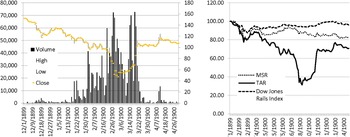
Uneasy investors began selling small amounts of Third Avenue shares.Footnote 67 Prices fell to 107⅞ dollars by the end of January from the 1899 close of 132, representing a loss of 18.3 percent. We report in Figure 1 price and trading volume data for Third Avenue (Figure 1A) and relative performance data for Third Avenue, Metropolitan, and the Dow Jones Rails Index (Figure 1B). Both Third Avenue and Metropolitan suffered during the short panic of December 1899, though prices started to recover by the end of the month. The price pressure coincided with growing concerns about Third Avenue’s debt burden.
Performance of Third Avenue Railroad and Metropolitan Street railway shares.
(A) Daily high, low, and closing prices (right scale) and trading volume (left scale) for Third Avenue Railroad. (B) An index of closing prices, scaled to 100, for Third Avenue Railroad, Metropolitan Street Railway, and the Dow Jones Rails Index.

Failed Refunding Effort
Third Avenue’s troubles came to a climax in February. It opened the month losing 8¼ to close at 99⅝ on rumors of a dividend cut, more negative speculation regarding the debt, and manipulative attempts to force tired holders to sell: “There is admitted to be a good sized short interest and a rather general bearish feeling on the stock which might suit the purposes very well of a strong set of syndicate of buyers.”Footnote 68 The Wall Street Journal went on to report (officially denied) rumors that Metropolitan interests “were back of the effort to secure lower prices for Third Avenue stock in order to get control of it.”Footnote 69
Refunding negotiations with Kuhn, Loeb dominated the news during the first week of February. At various times, rumors swirled regarding the type of new debt to be used to pay off the floating debt (e.g., would the new debt be convertible with the associated possibility of a change in control?), the magnitude of the company’s indebtedness, the status of the auditor’s reports, and, most importantly, whether the dividend would be cut. In the end, the quarterly dividend was cut from 1.25 percent to 1 percent of par on February 14 (it was 1.75 percent the previous August).Footnote 70 The cut added to the selling pressure, especially by long-term shareholders previously attracted to Third Avenue’s steady dividends.
On February 6, Third Avenue directors approved a general proposition from Kuhn, Loeb contemplating the issuance of new mortgage notes, which would be convertible to new stock at the end of three years.Footnote 71 However, following several days of rumors of a hitch in the proceedings, Kuhn, Loeb pulled out of the negotiations on February 15. As a result, Third Avenue experienced another fall in price and a remarkable spike in daily trading volumes to around 40 percent of the shares outstanding. Kuhn, Loeb officially stated there were disagreements over commissions. However, other rumors suggested they disapproved of the recently announced, but reduced, dividend and clashed with Hart’s rescue syndicate regarding the new composition of Third Avenue’s board.Footnote 72
Kuhn, Loeb’s departure elicited much commentary. In his weekly market commentary, the Tribune’s Cuthbert Mills likened Third Avenue’s shareholders to “a mendicant ordering a dinner at Delmonico’s, while he holds out his hand for alms.”Footnote 73 The New York Times did not blame Kuhn, Loeb, but was critical of Third Avenue’s situation: “Not all of the Third Avenue story is yet told: extraordinary chapters in that story may not so far have been even hinted at. What certainly the management of the corporation stands clearly indictable for is the making of false pretense – in the declaration of dividends which earnings do not warrant, do not provide, do not even approach.”Footnote 74
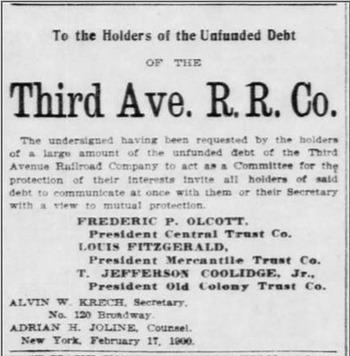
Following Kuhn, Loeb’s departure, a group of unsecured creditors formed a protective committee to defend their interests (see Figure 2 for an ad that regularly ran in several New York newspapers).Footnote 75 Third Avenue hired another bank, Vermilye & Co., to continue with the refunding effort, which took on some urgency, as a portion of the debt was coming due on March 1.
Creditor committee advertisement.
This ad alerting creditors of a new committee formed to protect their interests appeared regularly beginning February 18, 1900, in several newspapers including the New York Times, the New York Tribune, and the Wall Street Journal.

Third Avenue as a “Football of Speculation”
The existence of the rescue syndicate and Keene’s involvement became public knowledge immediately following the termination of Kuhn, Loeb’s refunding efforts. Both the New York Times and Tribune reported Keene was the preeminent member of a syndicate that bought thirty thousand of Hart’s shares at par for $3 million, even though the stock was selling at 120 at the time.Footnote 76 The agreement stipulated Hart could repurchase the shares at par within the year. Moreover, the syndicate lent Hart $2 million at 6 percent. In return the syndicate received a call on the stock for 125, which was good for one year. Keene himself was a bit more cryptic, “I have loaned some money on Third Avenue stock at par, but I never bought or sold 100 shares of it in my life. The stock at par is different from what it was at 240. The company’s indebtedness, I admit, is somewhat greater than I believed at the time I advanced the money.”Footnote 77 However, three days later Keene released a published statement claiming he was “now the holder of a large amount of the stock”Footnote 78
Conflicting reports in leading newspapers contributed to uncertainty over whether outsiders were attempting to gain control of Third Avenue. In the days surrounding Kuhn, Loeb’s withdrawal, both the Tribune and the Wall Street Journal pointed to the presence of Curtiss and another Standard Oil representative as evidence that the Standard interests were supporting Third Avenue.Footnote 79 However, on the same day that Keene’s involvement was disclosed, the New York Times claimed that Standard was not involved and that Curtiss did not represent them. Plus, there were more denials of interest from the Metropolitan people, this time from Ryan: “The intimation that the Metropolitan Street Railway Company, or any one [sic] connected with its management or control, proposes to take any part in the affairs of the Third Avenue Railway Company is absolutely false, and those who helped spread the story know it to be so.”Footnote 80 However, the very next day, Third Avenue’s new treasurer, Curtiss, disagreed, claiming no less than J. P. Morgan agreed to lease Third Avenue on behalf of Metropolitan (which, in turn, met with official denial).Footnote 81 The rumors and counter-rumors branded Third Avenue even more as “one of the footballs of speculation, the quotations of price being controlled by Wall Street manipulation and therefore conservative investors are quitting it.”Footnote 82
Turmoil in Third Avenue affairs had a broader impact on market sentiment throughout late February. Additionally, rumors spread that Keene (with or without the aid of Standard Oil interests) was attacking Metropolitan and other syndicate interests such as People’s Gas and Brooklyn Rapid Transit in retaliation.Footnote 83 Asked to comment on the widespread perception Keene was a loser in Third Avenue, a Metropolitan insider said, “We have given him a dose of the medicine he gave us last December.”Footnote 84 Regardless of which party had the upper hand, the general belief was that the public and small “fry” had abandoned Third Avenue by this point and that “the big cannibals were eating each other.”Footnote 85
At this time, the rumors that Metropolitan was buying shares of Third Avenue were likely true. In testimony before a 1907 New York Public Service Commission investigation of Metropolitan affairs (discussed later), Grant Schley of the brokerage firm Moore & Schley produced trading schedules suggesting the Whitney/Ryan syndicate held a large, probably controlling, block of Third Avenue shares by the end of February.Footnote 86 Hendrick, without documentation, asserts Ryan’s campaign began on February 19 and that the stock was cornered three weeks later.Footnote 87 There were emphatic denials of Metropolitan interest from both Ryan and Metropolitan president Herbert Vreeland. His denial was particularly telling: “We do not purchase roads the net earnings of which are not sufficient to pay the interest on their debt, nor have we ever bought a property that gave no prospect of future development.”Footnote 88 On February 22, Vreeland went further: “I have been persistently denying for the past five years statements that we had bought or would ultimately buy the control of the Third Avenue Railroad. Notwithstanding these repeated denials the story is again revived and the persistence of it seems to have convinced a number of people that there is some truth in it.” Following these denials, Third Avenue share prices began a final descent from 98¼ to an intraday low of 45¼ on March 2.
The bear campaigners scored a major victory on February 27 when Third Avenue shares fell by 17 points, or 27.6 percent, to 51¾, on yet another spike in trading volume. Rumors were rife that Third Avenue was about to be thrown into receivership and even liquidated. Moreover, the Wall Street Journal released a report suggesting the shares were worth about 50 inside or outside of receivership.Footnote 89 At least some of the rumors came true the very next day when the company was placed in receivership. A former mayor of New York (and a Tammany manFootnote 90), Hugh J. Grant, was appointed receiver, and the most recent dividend was placed in abeyance. The stock bounced to 58¼, with many traders believing the worst of the news was now known.
In early March, traders were focused on the receiver’s report, especially the magnitude of Third Avenue’s debt. Grant’s first announcement that the accounts were “such a tangle and chaos” provided additional evidence of Third Avenue’s poor management.Footnote 91 Moreover, President Albert Elias resigned, a grand jury was convened to look into Third Avenue affairs, and Henry Hart vacated his office in a “pathetic scene.”Footnote 92 The preliminary receiver’s report was released on March 14. It detailed the steps necessary to fully convert to electric power and tried to get a handle on the company’s indebtedness, which seemed to be less than expected.Footnote 93 However, “Receiver Grant, of Third Avenue, has nothing to say regarding his report, which is not regarded as pre-eminently satisfactory nor altogether intelligible.”Footnote 94
The release of the receiver’s report immediately precipitated a minor short squeeze, with Third Avenue shares jumping 10 points as many speculators had incorrectly surmised the report would contain new explosive negative details.Footnote 95 One broker, Provost Brothers, was said to have purchased more than fifty thousand shares, with more speculation as to which party or parties stood behind the purchases.Footnote 96 Naturally many of the rumors (and strong denials) centered on the Metropolitan interests. In fact, some traders began selling Metropolitan on the belief it would be expensive to buy Third Avenue and assume its debt, necessitating a new issue of Metropolitan shares.Footnote 97 Other purported buyers included Keene, Standard Oil interests, and Chicago street railway magnate Charles Yerkes.Footnote 98
Trading in Third Avenue entered a new phase following the release of the receiver’s report. In particular, conditions were ripe for a short squeeze: “But what counts on the Stock Exchange much more than the company’s actual condition is that almost every little speculator has gone short of the stock on what has been considered the certainty of further severe declines: and this has provided a short interest so extensive that it has become unwieldy and can be scared into nervousness by very little manipulative effort upon the part of interests disposed to give the crowding bears a squeeze.”Footnote 99 Given the large short interest and the shares held by Henry Hart, the amount of stock freely available for trading was limited. In fact, the Wall Street Journal reported a strong bull clique managed to trigger several large stop orders placed by shorts, precipitating a rapid advance at the close “giving the impression that the movements were apart from the merits of the concern in light of the receiver’s report.”Footnote 100
Third Avenue shares continued their erratic ascent over the next few days. Provost Brothers continued to be a heavy buyer, but the party behind it was a mystery. Was the unknown party buying for control, simply buying to boost prices of a heavily demoralized stock to earn a quick profit, or was it a short looking to cover his position?
Third Avenue’s weekly return of 21.2 percent prompted the New York Times to run some critical commentary on Sunday, March 18:
We have had during the week much ado over the local traction [street railway] stocks, largely because of the extraordinary conditions that have developed in the Third Avenue Street Railway’s affairs. … Official statements are issued which to some extent disclose…a phenomenal case of mismanagement, or worse. Professional speculators have, however, been so much overselling the stock of this unfortunate corporation that is has finally been found easy by manipulators to squeeze the quotation upward sharply. … No such change to higher figures denotes, however, anything that is good discoverable in the property’s condition. The company is bankrupt. It has been bankrupted by its managers. … Third Avenue happens to be but more than generally sensational in its illustration of the abiding fact that blind-poolism is destructive.Footnote 101
However, everything was about to change.
A Stealth Hostile Takeover on the Open Market
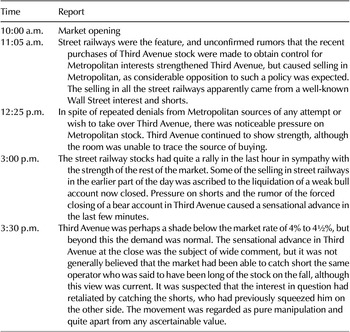
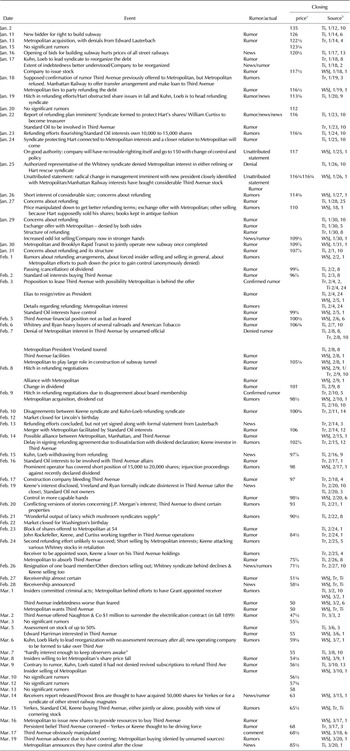
The acquisition of control of Third Avenue was so expertly done that almost nobody knew it happened until it was announced. A regular feature in the Wall Street Journal provided updates on trading activity at various times during the day. Table 2 reports the March 19 commentary pertaining to Third Avenue, providing a real-time view of this activity.
Wall Street Journal reports of trading activity in Third Avenue and the other street railway stocks for March 19, 1900

As indicated in the table, there were rumors of Metropolitan interest, but nothing certain is reported. In the rather colorful words of the New York Times, “All of Wall Street was overcome by mystery; a hundred theories had circulation.… The names of conspicuous operators were bandied freely. Some representations had it that Mr. Keene had hurt Mr. William C. Whitney; some others were to the effect that Mr. Whitney had overwhelmed Mr. James R. Keene.”Footnote 102 While it was Whitney (more accurately Ryan) who prevailed, Whitney’s representative continued to deny his or Metropolitan’s interest after the market closed at 3 p.m.Footnote 103 The Eagle also reported Metropolitan president Vreeland (the mouthpiece mentioned in the second quote at the start of this paper) told a friend Metropolitan was not interested in Third Avenue as late as 10:30 that morning. Lauterbach and Grant similarly were in the dark as late as 4:30 and 5 p.m., respectively.Footnote 104 Ultimately, Metropolitan president Vreeland announced the syndicate had control of Third Avenue at 6 p.m.Footnote 105
The post-close 3:30 report pertained to the final “loan crowd” activity when margin loans were settled and short sellers found lenders for the shares needed for delivery. The fact the loan rate for Third Avenue “was perhaps a shade below the market rate” indicated short sellers had minimal difficulty finding shares for delivery.Footnote 106 In fact, as discussed in the next section, the short sellers were about to have considerable difficulty covering their positions. After a small fall at the open to 66½ from the previous day’s close of 68½, Third Avenue finished the day at 85½, an increase of 24.8 percent.
The typical news story suggested Metropolitan had purchased control of Third Avenue. However, the facts were a bit more complicated. Metropolitan was controlled by the Whitney/Ryan syndicate. This same syndicate bought control of Third Avenue with the intention that Metropolitan would take over Third Avenue’s day-to-day operations. In fact, the New York Tribune reported that it was Ryan who did the masterful job of acquiring control without most people being aware of it.Footnote 107
After the excitement immediately following the takeover announcement (discussed in the next section), trading volumes returned to historically low levels. The only two days of note were April 10 and 11, when Metropolitan issued $50 million in debt for the purposes of taking on Third Avenue’s debt and leased the Third Avenue railway lines for 999 years while promising to gradually increase the dividend to 7 percent.Footnote 108
One outcome of the acquisition was the remaining holders of Third Avenue securities were compensated for enduring the gyrations of their assets over the previous months. The promised dividend of 7 percent was in line with the historical dividends paid by Third Avenue. Moreover, Metropolitan successfully placed Third Avenue’s debt on a much sounder footing. However, it was arguable that Metropolitan and/or the syndicate were behind much of the trouble in the first place.
The acquisition also added to an already complex ownership structure for Metropolitan. As noted, Metropolitan generally did not fully purchase its operating subsidiaries, preferring to use leases or the purchase of controlling stakes. Following the Third Avenue deal, Metropolitan had a total of 23 subsidiaries, of which ten were leased and consolidated into Metropolitan’s primary financial statements and five with controlling stakes were not consolidated. One of the five was a subsidiary of a subsidiary controlled via a pyramid of ownership stakes. The remaining eight subsidiaries comprised Third Avenue and its three direct (which all reported separately) and four indirect subsidiaries.Footnote 109 This complex structure of controlling stakes and leases afforded the syndicate the opportunity to control a vast network of lines with minimal capital outlay. As discussed later, it also created many opportunities for expropriation.
Trading Issues and Manipulation
Shorting and the Loan Market
A short sale involves borrowing shares of a company and then selling them for cash with the hope of purchasing the shares later at a lower price.Footnote 110 The cash would remain at the lending broker as collateral against the borrowed shares, and the short seller would be required to add to the account if the market value of the shares increased. The loans were said to be callable. That is, the lender could require a return of the shares at his discretion. Because the lender had free use of the cash, he typically would agree to pay interest to the borrower of the shares, at an interest rate known as the loan rate. If a stock was easy to borrow, the loan rate matched the call money rate paid by individuals borrowing to buy shares on margin. However, if there was a considerable short interest and shares for loaning were scarce, the loan rate would be less than the call rate, “loan flat,” or at a premium. If flat, no interest was paid or received. If the loan rate was at a premium, the lender would be able to charge the short seller for the use of the shares while holding onto the short seller’s cash. The premium loan rate prevailing on Third Avenue throughout much of March and April was indicative of a very large short interest outstanding.
The loan crowd met most days at 3:30, just after the market closed, to allow shorts to find lenders for the shares they had sold that day. As with share prices, operators occasionally tried to manipulate loan rates. For example, bull operators would purposely lend freely, making the shares appear more plentiful than they truly were in an effort to encourage additional shorting (the loaned shares later would be suddenly withdrawn to precipitate covering purchases). In contrast, there was “artificial scarcity” designed to deter short selling of Third Avenue on Saturday, February 17, a day that experienced the second lowest trading volume from the beginning of February through the acquisition of control.Footnote 111
One danger of shorting on a large scale is that another operator can come along and buy most of the available shares (i.e., corner the stock). In this event, the short seller would not be able to purchase sufficient shares to cover his position. In such a short squeeze, the short is at the mercy of the trader accomplishing the corner, and special terms must be reached for the fulfillment of the short’s obligations. In the case of Third Avenue, once Ryan and Whitney were known to have acquired control, speculation naturally turned to the questions of what would happen to short sellers in general and Keene in particular. Was he about to be squeezed?
It was widely known that considerable animosity existed between Keene and Whitney/Ryan—the “reverse of amicable.”Footnote 112 Keene’s bear raids on Metropolitan in 1898 and 1899 were among the many grievances.Footnote 113 Whitney and Ryan later “tried to put James R. Keene in prison behind bars” due to Keene’s attack on a bank.Footnote 114 The bank in question was likely the State Trust Company, which was controlled by Whitney and whose president accused Keene of being in a conspiracy to depress State Trust’s prices around the same time as the Third Avenue events.Footnote 115 The rivalry even extended to the track, as they were both avid horsemen.Footnote 116
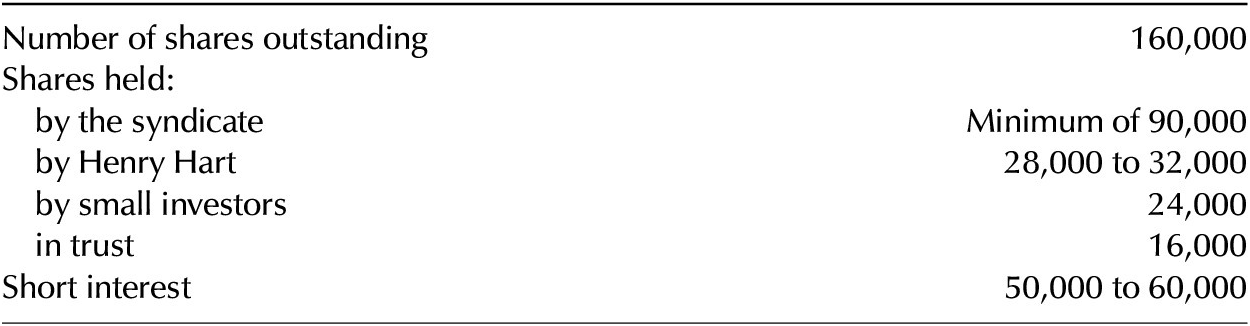
While there were conflicting reports concerning the number of shares Ryan had acquired, the holdings of individuals unlikely to sell and the extent of the short interest suggest the number of shares held short vastly exceeded the number of shares available for purchase. We provide a summary of the situation in Table 3.
Estimates of the ownership and short interest in Third Avenue as of the market opening on March 20, 1900

Note: The data come from “M.S.R. Gets Third Ave,” New York Tribune, March 20, 1900, 1–2; “Sharp Stick for Keene,” New York Tribune, March 21, 1900, 1–2; “News and Views about Stocks,” Wall Street Journal, March 20, 1900, 1; and “Metropolitan in Official Control,” New York Times, March 22, 1900, 1–2. The shares held by the small investors and in trust were reported by the Tribune on March 22 (“Now in Full Control,” p. 1) and were obtained through an analysis of Third Avenue’s ownership books. The March 21 Tribune article cited one Metropolitan representative who estimated the syndicate had control of as many as 104,000 shares.
An inspection of Third Avenue’s trading books indicated there were a total of 1350 shareholders. Of these, 800 were small investors holding an average of thirty shares each. Another 50 lots totaling 16,000 shares were in the hands of trustees or guardians. General opinion had it that neither the scattered small investors nor the trustees/guardians were likely or able to sell. Keene’s involvement as part of the rescue syndicate that had purchased shares from Henry Hart the previous December was common knowledge. The syndicate acquired a minimum of 90,000 shares and perhaps as many as 104,000 as one Metropolitan officer stated that the syndicate held 65 percent of the shares.Footnote 117 Widespread speculation existed that Keene had sold the 30,000 shares he had bought from Hart. It is unlikely Ryan would have been about to purchase 90,000 to 104,000 shares aside from Hart’s out of the 160,000 shares outstanding, especially given the 40,000 shares from small investors and trusts (though some of the 16,000 trust shares might have been lent in the shorting market).
In fact, it generally was believed that Keene had unsuccessfully attempted to persuade Hart to vacate their agreement giving Hart a call on the thirty thousand shares at par (a price Third Avenue hit on March 20). When asked about the source of the shares held by Metropolitan interest, President Vreeland would only note they had bought their shares on the open market, refusing to speculate where they came from.Footnote 118 Even if denials “by those in a position to know” that Keene had sold the shares held in trust were true, it was certain the stock was thoroughly cornered.Footnote 119 Other than one statement “Dictated Exclusively” to The World, Keene refused all questions asked of him that week. In this statement, Keene claimed that the reports he had sold Hart’s shares were false and that “every share of stock belonging to Mr. Hart is here in my office safe and always ready for delivery on demand.” He added: “You can also tell my friends not to worry about me. I am all right.”Footnote 120
Had Keene shorted stock extending his losses beyond his call obligation to Hart? There were no short sales directly registered to Keene, but the New York Times reported gossip that “Keene broker” Arthur M. Hunter was caught short five thousand shares. While Whitney was cagey regarding the matter, it was clear that he hoped they had caught Keene short. Hendrick suggests Ryan masterfully manipulated Keene, whereby Ryan lent Keene shares to short via brokers and then repurchased them on the open market. Thus Keene was thoroughly cornered and at Ryan’s mercy once control of Third Avenue was announced.Footnote 121 If so, Keene was not alone; as attention turned to the extent of the short interest and the fate of short sellers, it quickly became clear that the stock was cornered. The market opening of March 20 was expected to be dramatic and it did not disappoint:
Third Avenue met all expectations, going up by leaps and bounds; and all the other traction stocks also advanced sharply in sympathy with it. At the opening of business on the Stock Exchange the galleries were filled with spectators, and around the Third Avenue trading point was the largest crowd of brokers which had gathered to trade in any single stock in years. At 10 o’clock the whole crowd began yelling and gesticulating at once, the brokers for the hapless shorts bidding wildly and desperately in the effort to effect purchases which would enable their customers to close out their contracts and escape threatened further loss. Third Avenue closed on Monday at 85, but yesterday morning opened “wide” at a minimum advance of five points, sales being effected simultaneously in different parts of the crowd at prices ranging all the way from 90 to 100. These transactions represented the transfer of nearly six thousand shares.Footnote 122
That was the first five minutes. Overall, the trading volume was 61,285 shares. One speculator admitted to losses of $250,000, with ten or more losing between $10,000 and $100,000.Footnote 123
The loan rate on Third Avenue was punitive, at one point reaching 4 percent per day premium, meaning traders had to pay $400 per day to borrow 100 shares for delivery. The new controlling shareholders helped keep panic under control by freely lending their newly acquired shares for the first couple of days.Footnote 124 Even so, the short interest was still extensive the next day with shorts paying a ⅛ to ¼ percent premium in the morning and ½ percent in the afternoon.Footnote 125 The Wall Street Journal reported that manipulators tried to bid up the premium, attempting to force shorts to cover, thereby increasing prices. It further reported the short interest remained at ten thousand shares on March 26, and “the already small account was much reduced” by April 9. While price volatility settled down on reduced volumes, the stock continued to loan flat or at a small premium for more than a month.
As for Keene, the press coverage at the time and Hendrick’s detailed examination of traction affairs indicate Keene suffered large losses.Footnote 126 For example, one contemporaneous rumor “quoted his losses as being far beyond $1,000,000.”Footnote 127 Keene’s precise losses likely will never be known, with estimates ranging from $1 million to as high as $5 million. To start, Keene was on the wrong side of the call with Hart, but it is unknown when the call was settled. The average closing price of Third Avenue from March 21 to the end of April was 107⅝ providing an estimated loss on the call of $227,750. More likely, given the amount of shares needed, Keene’s delivery was later in the year, greatly increasing Keene’s loss, as Third Avenue’s stock generally traded in the 110 to 120 range for the rest of 1900.Footnote 128
The estimates of Keene’s losses of $1 million and beyond imply that he shorted stock at unfavorable prices (Third Avenue’s stock went as low as 45¼ on March 2 in intra-day trading) and suffered from the high premium loan rates in the days following the acquisition. That Keene was squeezed by Ryan comports with established views that operations such as Ryan’s were common. Hendrick suggests Ryan wanted to leave Keene with nothing, while Whitney counseled a degree of charity.Footnote 129 On April 30, the New York Times began its markets coverage with this note: “Speculators upon the bear side are heavy losers in the departure of Mr. James R. Keene for an extended European vacation. They will miss him especially in their campaigns against the local traction stocks and a number of industrials, notably the tobacco and iron and steel shares.”Footnote 130
Manipulative Trading
If the Metropolitan officers had frankly proclaimed their desire to buy a majority of the Third Avenue stock they could have done it if at all only by paying an enormous price for it, and the next best thing to not desiring to do it was to make the holders of the stock and competing purchasers believe that they did not desire it. The mischief they were doing to their reputation for veracity, they do not seem to have considered, and, thus their present indignant denials that they contemplate a fresh issue of Metropolitan stock is received with the incredulity it deserves.Footnote 131
Three broad strategies exist for manipulators when they attempt to move stocks away from fundamental valuations and earn abnormal trading profits. First, manipulators might inflate the price of a stock beyond its fundamental value and then sell before the broader market is aware of the mis-valuation. This method was referred to as a “bull raid” during the time of our story. A modern term for this strategy is “pump and dump.” Second, investors can take short positions and engage in a “bear raid.” Finally, as just discussed, if an extended short interest exists, manipulators can acquire sufficient shares in an attempt to corner the market and squeeze those with short positions.
Allen, Litov, and Mei dissect market corners, examine the risks involved for the manipulator, and provide a history of successful and failed corner attempts.Footnote 132 As with the Third Avenue case (which is not in their sample), a successful corner forces short sellers to buy stock from the manipulator at a high price to cover their short positions. Corners are more likely to be successful when short interest is especially high and where there is sufficient liquidity to allow the manipulator to acquire a substantive long position. Allen, Litov, and Mei also provide evidence that large investors and insiders had market power allowing them to manipulate prices.
Outside of market corners, there are only a few studies of manipulative trading in the early part of the twentieth century. These studies find little evidence of price manipulation, and instead document that unusual pool activity was driven by informed trading.Footnote 133
Armour and Cheffins argue the likelihood of success of a typical open market bid (OMB) of the era was influenced by the willingness of existing shareholders to sell at prevailing prices.Footnote 134 Their discussion hinges on the elasticity of supply and whether it is possible for shareholders to determine whether a bid is underway. If they can make the determination, they will demand higher prices. Consistent with the quote at the start of this section, most OMB acquirers would engage in significant manipulation to camouflage the acquisition effort, thereby reducing the potential cost of obtaining control.
Ryan was able to use the press and incomplete information surrounding Third Avenue’s financial difficulties to camouflage his trading activity. Indeed, he and other Metropolitan insiders helped keep the tone of coverage negative with their regular public statements indicating a disinterest in acquiring control. Keene inadvertently helped draw attention away from Ryan through his participation in the syndicate to bail out Hart and his revealed disgust with the state of Third Avenue’s finances. Ultimately, Keene’s (atypical) recklessness afforded Ryan the opportunity to do a short squeeze.
Allen and colleagues investigate a modern market corner in which Porsche briefly squeezed the shares of Volkswagen in 2008, causing the price to spike from €210 to €1005 over the course of two trading days, an event that had many parallels to the corner and short squeeze in Third Avenue.Footnote 135 In particular, they show the comparative lack of investor protections in German financial markets reduced market quality and increased information risk. Porsche and Metropolitan officials both engaged in information campaigns to camouflage their activity and dupe analysts or journalists. Moreover, Porsche is controlled via a complex pyramidal ownership structure similar to that employed by Metropolitan. The controlling shareholders in both cases also found it necessary to provide liquidity to limit the effects of their respective short squeezes. In the end, both cases show that manipulative activity hampered efficient price discovery.
Various twentieth-century market reforms have had the effect of making Ryan’s Third Avenue operations illegal. First, the NYSE modified its rules in 1910 to limit market manipulation, especially fictitious trading practices such as matched orders. These rules were put in place in response to a 1908 investigation instigated by New York’s governor Hughes into Wall Street’s speculative practices.Footnote 136 Second, the Securities and Exchange Act (1934) empowered the board of the Federal Reserve to set more stringent margin requirements and made providing false information or spreading false rumors with the intent to manipulate stock prices illegal. Finally, the Williams Act (1968) requires a 13D filing within ten days of hitting the 5 percent ownership threshold. Had either of these last two regulations been in effect in 1900, Ryan’s ability to accumulate stock at favorable prices would have been severely compromised.
Winners and Losers
We explore several themes that emerge from the acquisition of Third Avenue. We begin with a discussion of the capital market environment that provided incentives for consolidation. Next, we discuss how Whitney and Ryan systematically tunneled wealth from Metropolitan’s minority shareholders. Finally, we discuss the syndicate’s ongoing efforts to keep Metropolitan afloat concluding with its collapse in 1907.
Industry Consolidation and Acquisitions in 1900
Mitchell and Mulherin and Andrade, Mitchell, and Stafford document that merger waves tend to be clustered in industries where exogenous shocks such as technological advances, financing innovations, changes in input costs including increases in foreign competition, sudden changes in the price of oil, and deregulation disrupt the business environment.Footnote 137 White cites innovations such as barbed wire, bicycles, the Bessemer process in refining steel, and the Bonsack machine in making cigarettes as innovations that sparked the creation of large companies in the late nineteenth century.Footnote 138 These shocks precipitate waves of mergers and other restructurings as the optimal firm size or scope for firms might change, offering constituent companies the opportunity to create more effective operating structures and earn economic rents (or survive a more adverse environment).
Vreeland referred to the benefits of consolidation in his official statement upon the announcement of the change of control. He cited the “good many millions” in savings arising from the use of Metropolitan’s power plant to run Third Avenue’s electrified routes. He also noted Third Avenue was worth more when operated in cooperation with Metropolitan, and that the consolidation was urged upon him by his “own people” and Third Avenue’s creditors.Footnote 139
One regularity in the empirical data in the M&A literature examining more recent merger waves (beginning with the 1960s) is that the acquiring firms tend to average a very modest return.Footnote 140 On average, the returns appear to be captured by the target firms’ shareholders, and quite possibly the target firms’ managers through golden parachutes. Several explanations have been proffered to clarify why a firm, or other entity, would choose to initiate consolidations, given the relatively poor average returns for acquirers. For example, agency considerations such as empire building might explain some acquisitions.Footnote 141 Alternatively, rent-seeking managers might be responding to a shock where consolidation is viewed as inevitable, thus taking an “eat or be eaten” view with a willingness to overpay in an effort to survive.Footnote 142 The economic incentives for the consolidators were more straightforward during the merger wave of 1897–1903. These incentives included strong potential returns available to those able to successfully pursue OMBs. As such, the motivations for making an acquisition do not require agency-based explanations.
The returns earned by the syndicate and/or Metropolitan likely were spectacular. Hendrick dates the start of the campaign to the day of the dual Metropolitan denials (February 19) and claims it lasted three weeks.Footnote 143 In turn, Grant Schley of the brokerage Schley & Moore handled Metropolitan’s purchases of Ryan’s Third Avenue shares at the orders of Whitney and Vreeland. The purchases totaled $6,585,070.36 and occurred between March 19 and June 27, 1900. The Times also reported Ryan had obtained control before the beginning of March.Footnote 144
We cannot know Ryan’s exact purchase prices, the number of shares he purchased, or whether he later sold the shares to Metropolitan at cost or at prevailing prices. Regarding the last point, it was understood the Public Service Commission intended to investigate. However, we can find no further information.
At the very least, we can estimate the returns per share earned by the syndicate or Metropolitan, whichever it was. Assuming Ryan distributed his trades in line with overall Third Avenue trading, his volume-weighted acquisition price over Hendrick’s three weeks beginning February 19 was $64.35. If we assume the shares were acquired from February 19 to February 28, the volume-weighted price was $72.73.Footnote 145 Third Avenue’s closing price on March 20, the day after the control announcement, was $101.25. Altogether, these prices imply the returns to the syndicate and/or Metropolitan were between 39.2 percent and 64.4 percent. Furthermore, Metropolitan officially signed the lease on April 11 when Third Avenue was at 117, suggesting overall returns of 60.9 percent to 81.8 percent. The syndicate likely earned further returns via lending stock and earning premium loan rates in the weeks following the acquisition.
Given the changes in acquisition methods and disclosure rules, we cannot make an apples-to-apples comparison of returns in the merger wave of 1897–1903 relative to those of the more recent merger waves. Even so, the contrast is striking. Andrade, Mitchell, and Stafford report an average 1.8 percent announcement period return for acquiring firms and a 16.0 percent average announcement return for target firms over the period 1973–1998.Footnote 146 This stylized finding that target firms capture the lion’s share of synergistic gains has been confirmed in a variety of studies and stands in stark contrast to the gains earned by the Whitney/Ryan syndicate in the Third Avenue takeover.
The wealth gains for the Whitney/Ryan syndicate as well as those earned by existing Third Avenue shareholders who held their shares during the period in question came at the expense of Third Avenue shareholders who sold their shares in February and early March in the wake of the misinformation campaign. For Metropolitan shareholders, the results were mixed. They appear to have garnered control of Third Avenue’s assets through a lease. However, Metropolitan took on $50 million in new debt on April 10, and the lease terms were generous and ultimately unsustainable. In contrast, Third Avenue bondholders were paid in full as the new debt issue was used to eliminate Third Avenue’s floating debt.
Tunneling and Corporate Governance
In response to the corporate governance failures associated with the Asian financial crisis in 1997, financial economists have discussed how insiders can take advantage of ownership pyramids to control large companies with minimal capital investments while “tunneling” out wealth from inside the pyramids for private benefit.Footnote 147 Notably, Johnson and colleagues argue different legal regimes can assist or hinder tunneling attempts.Footnote 148 Atanasov, Black, and Ciccotello provide a detailed discussion of how to extract wealth through tunneling, such as by cash flow tunneling, asset tunneling, or equity tunneling.Footnote 149
The Whitney/Ryan syndicate created a similar pyramid structure at Metropolitan and successfully used all three methods to amass a fortune, but most particularly via asset tunneling. Whitney was estimated to be worth $40 million at the time of his death in 1904, and Ryan was estimated to be worth $50 million as of 1905.Footnote 150 These fortunes would both exceed $1 billion in current value. Much of this wealth was generated by growing valuable businesses, investing in new technologies, and engaging in valuable consolidations. However, both Whitney and Ryan were dogged by accusations that some of their wealth was earned by tunneling.
The treatment of Metropolitan’s minority shareholders comports with that of the modern era in many countries. A voluminous literature examines the agency conflicts between large controlling shareholders and minority shareholders.Footnote 151 A typical problem in this context is the expropriation of minority shareholders via asset tunneling, which can involve either selling assets cheaply to related parties (tunneling out) or, as with the accusations levied against the Whitney/Ryan syndicate, having the firm overpay for assets from a related party (tunneling in). The syndicate had effective control over Metropolitan, even though the firm had a substantial shareholder base. Metropolitan was able to raise capital to fund its expansion through new stock and bond offerings on an ongoing basis.
As Metropolitan fell under the purview of the Interstate Commerce Act of 1887 requiring railways to submit annual reports to the Interstate Commerce Commission, it is possible to gain a reasonably clear picture of its financing activities. The Third Avenue acquisition was the culminating transaction in the ongoing effort to achieve control of street transport in Manhattan. To facilitate its activities, the syndicate created two shell companies, first the Metropolitan Traction Company and then Metropolitan Street Railway. The syndicate bought lines for itself and would in turn sell them at a profit to Metropolitan Traction and then Metropolitan Street Railway. As such, the syndicate was on both sides of each transaction, shifting capital from Metropolitan Street Railway toward Metropolitan Traction. As mentioned earlier, the cash to purchase or lease assets frequently came from newly issued securities (creating water in the stock as described next). In one notable example, in 1894, Metropolitan issued $16 million (par value) in securities, comprising $8,300,000 in equity and the rest in bonds, to raise capital to pay the Whitney/Ryan syndicate for sixteen miles of cable railway lines. Hendrick estimated that these lines could not have a capitalized cost greater than $3 million.Footnote 152 The syndicate liquidated Metropolitan Traction in 1897 after having shifted capital raised from a series of securities issued by Metropolitan Street Railway Company.Footnote 153
Financial economists debate the trade-offs of holding excess capital (financial slack), with information asymmetries increasing value and agency problems decreasing value.Footnote 154 At the time of our story, the agency problems associated with raising excess capital to purchase overvalued assets were considered severe, far overwhelming any possible benefits of retaining financial slack. Given the very real concerns over insider tunneling, companies would provide precise estimates of capital needs and uses as part of the book-building process for equity issues.Footnote 155 Nonetheless, investors routinely accused firms of issuing watered stock. Even so, market participants were willing to overlook the water, because they hoped to get rich via their own speculations, as is common in speculative manias.
It is not clear exactly when Whitney and Ryan set their sights on Third Avenue. The December 1899 issue of the Street Railway Journal suggests it had been a long-standing goal, as Third Avenue was the only entity preventing Metropolitan from gaining monopoly control of the street railways in Manhattan. Events from fall 1899 suggest that interests aligned with Whitney and Ryan hindered Third Avenue’s survival as a stand-alone firm. That summer, Third Avenue authorized a capital increase of $24 million to continue the changeover from horse-drawn lines to electric power. Hart attempted to expand electrification without Tammany Hall support, but he was stymied by a lack of regulatory approvals. Third Avenue ultimately was forced to use a notorious Tammany-connected contractor, costing the company $10 million but yielding little progress. In contrast to Hart, Ryan was well aligned with Tammany Hall.Footnote 156 As noted earlier, Whitney had an adversarial relationship with Tammany interests earlier in his career. Moreover, he had fought against Tammany’s preferred candidate and on behalf of Cleveland for the Democratic nomination in 1892. However, in the intervening years, Whitney included some Tammany figures in the syndicate’s street railway investments.
Muckraker journalists made repeated accusations that the syndicate overloaded Metropolitan with water, including the money they raised to pay for the Third Avenue acquisition. Metropolitan bought the shares Ryan had purchased on behalf of the syndicate during the March operations using this newly raised money.
Third Avenue maintained its existence as a separate company and leased the streetcar lines to Metropolitan for 999 years. The lease rate at 7 percent of par value was in line with expectations but was phased in. Third Avenue’s shares had traded as low as 45¼ intraday on March 2, and on the day the lease was announced (April 11), closed at 117. Ultimately, as the next section details, Metropolitan’s inability to make these lease payments was the critical factor in forcing Metropolitan and Third Avenue into receivership in 1907.
Subsequent Events: The Creation of Metropolitan Securities
The Third Avenue acquisition was the culminating event of Metropolitan’s quest to gain control of street railway transportation in Manhattan. However, it “was nevertheless financially embarrassed; greatly overcapitalized and water-logged.”Footnote 157 Looking to restructure the debt taken on through their many acquisitions and raise funds necessary for additional electrical upgrades, the Whitney/Ryan syndicate, on February 14, 1902, proposed the creation of a new superstructure to assume control of Metropolitan. Coincidentally, it afforded the syndicate the opportunity to exit from its position.Footnote 158
The syndicate brought in a new group of investors to form new parent and operating companies above Metropolitan in the ownership pyramid. The new holding company, capitalized at $30 million, the Metropolitan Securities Company, would be the 100 percent owner of the Interurban Street Railway Company, which in turn would lease the Metropolitan and its subsidiary lines for 999 years. The three entangled railways—the newly created Interurban, Metropolitan, and Third Avenue—had almost identical sets of directors creating conflicts of interests.Footnote 159 Interurban, with newly raised capital, agreed to pay Metropolitan shareholders a guaranteed 7 percent dividend as well as paying all rentals due to Metropolitan subsidiaries. Moreover, it committed $23.4 million dollars to pay for the electrification of various crosstown lines and provide reserve capital. In return, Metropolitan assigned its holdings in various smaller lines it had acquired over the years to Interurban. Existing Metropolitan shareholders had the opportunity to buy 45 percent of Metropolitan Securities, with new investors providing the remainder. Moreover, $65 million in new 100-year 4 percent mortgage bonds would be issued for the purpose of retiring existing Metropolitan debt carrying higher rates, including the unsecured bonds issued following the Third Avenue acquisition.Footnote 160
The Merger with Interborough Rapid Transfer
Attempts to build a subway in Manhattan began with an 1849 article by Alfred Beach in Scientific American proposing the construction of a Pneumatic Tube subway and the secret construction twenty years later of a one-block model.Footnote 161 After decades of delay due to competing political claims and, by the 1890s, the syndicate’s obstructive strategies, including their own early 1899 proposal to privately build the subway, the New York Rapid Transit Commission finally approved the subway in December 1899.Footnote 162 The city would pay for the construction of the subway and call for bids for its actual construction and operation.Footnote 163 The commission awarded the rights to build it to John McDonald on January 16, 1900.
The only other bidder was secretly supported by the syndicate, which continued its efforts to delay construction by convincing most of the banks in New York to not fund McDonald until he found a kindred spirit in the financier Augustus Belmont. The syndicate next blocked his efforts to obtain the necessary permits from the state legislature in Albany. However, Whitney came through, secretly paving the way (a fact that Belmont reluctantly revealed on the witness stand in a trial on a different matter in 1913).Footnote 164
The subway opened on October 27, 1904. It was a hit with the public and immediately began stealing market share and profits from Metropolitan. Direct comparisons are impossible due to the creation of Metropolitan Securities, but Metropolitan had an average surplus margin (profit margin) of 22.7 percent over the period 1900 to 1903. In contrast, Interurban (by now renamed the New York City Railway) had a margin of −16 percent in 1905. When McDonald proposed extensions to the subway, the syndicate co-opted him by hiring him away from Belmont and paying him $500,000 essentially to do nothing.Footnote 165 They also hinted they were ready to build the extensions and garnered public support for their proposals through the promise of free transfers to the surface lines.Footnote 166 Ryan, firmly in control of the syndicate following Whitney’s death, was able to effect a tie-up with Belmont in January 1906. They created yet another holding company, the Interborough-Metropolitan, which now had monopoly control over all public transportation (elevated, street level, and the subway) in Manhattan.
The Collapse of the System
By 1907, the system of rental payments emanating from the New York City Railway at the top of the operating pyramid was unsustainable. It was showing a deficit of $2,286,315 on gross revenue of $17,425,660 (a margin of −13.1 percent) for the 1906 fiscal year, the last year with independent data. While the rentals allowed Metropolitan to pay its own dividends each year, it in turn was finding it difficult to maintain the promised dividends payable to Third Avenue shareholders.
The New York Public Service Commission held a series of explosive public hearings examining congestion, the lack of progress toward completing electrification, and the generally poor condition of the rolling stock. The controlling syndicate had just made a final effort to prop up the system’s poor finances in May. Metropolitan Securities would provide $15 million to Metropolitan, through the New York City Railway, for the purposes of paying its dividends. Metropolitan would issue new debt to Metropolitan Securities in return.Footnote 167 However, the cash flow problems were insurmountable, and the New York City Railway went into receivership on September 24, 1907. Metropolitan, Third Avenue, and three other subsidiaries went into separate receivers’ hands in the succeeding months, and Metropolitan’s Third Avenue’s lease was dissolved in 1908, ending the practice of free transfers between the systems.Footnote 168
In the end, Third Avenue did not emerge from receivership until 1912. Metropolitan and New York City Railway took until March 1916, with New York City Railway returning to receivers’ hands in 1919.Footnote 169
The Final Word
The Public Service Commission hearings sparked public outrage over Metropolitan’s affairs. This outrage prompted New York district attorney William Travers Jerome to institute grand jury investigations into Metropolitan, Thomas Ryan, and other surviving syndicate members in November 1907 and then again in January 1908.Footnote 170 These investigations found no evidence of wrongdoing. Outraged investors, in turn, demanded an investigation of Jerome on corruption grounds. The New York Times gave Jerome the opportunity to explain his decisions. Finding no evidence of a crime, Jerome also said, “I believe the attitude of the ‘Traction Trust,’ so-called, was that expressed by the late Commodore Vanderbilt, when he said, ‘The people be damned.’ I do not think that these persons are actuated by an unselfish desire to help the people but seek to make out of the people every dollar they can, too often by means most unscrupulous.”Footnote 171
Summary
For at least another hundred years we must pretend to ourselves and to every one that fair is foul and foul is fair; for foul is useful and fair is not. Avarice and usury and precaution must be our gods for a little longer still.—John Maynard Keynes
Trading volumes (relative to shares outstanding) peaked on the NYSE during the years 1899 – 1901. This period overlaps with the first U.S. merger wave, an era marked by incredible capital market development, strong stock returns, and a growing economy. The most actively traded shares included the street railway companies located in New York City. During this period, rail electrification began in earnest. This disruptive technology created challenges and opportunities for companies servicing urban commuters.
The Third Avenue Railway began the process of electrification in 1899, financing the investment with a mix of new equity and unsecured debt. The debt burden damaged the company’s financial health and made Third Avenue an attractive target for manipulation and then acquisition. We research the period surrounding the stealth hostile takeover of Third Avenue by a syndicate in control of the Metropolitan Street Railway Company and document the activities of insiders who tried to prosper from the uncertainty surrounding the industry’s future. We compile a historical record of the information and misinformation that insiders planted in the press. This extensive misinformation campaign included rumors about excessive debt, refinancing activities, short interest, dividend cuts, a forced liquidation, an impending receivership, forced stock sales by Henry Hart, the formation of a trading syndicate led by James Keene, attempts by Metropolitan to take control of the company, and the elements of the auditor’s report.
We provide evidence that a trading syndicate led by William Whitney and Thomas Ryan was able to gain control of Third Avenue and earn significant returns in March 1900 at the expense of certain Third Avenue shareholders. We also show how Whitney and Ryan used their interconnected rail investments as a means to transfer wealth from Metropolitan’s minority shareholders to themselves.
Finally, we argue that the lax regulatory environment of the period, which afforded speculators greater opportunities to profit, facilitated the stealth hostile takeover. Ultimately, Metropolitan, the industry behemoth, could not make a profit and a newer, cleaner, more efficient technology, namely underground rail, reduced the viability of street railway operations.
The birth of the subway, its history, and its place in New York City history have been extensively studied.Footnote 172 While profitable from the start, the subway was burdened with a public/private ownership structure that made it financially unwieldy. There were further battles over the rights to build additional lines.Footnote 173 These difficulties were exacerbated by the creation of the Interborough-Metropolitan in 1905 and the collapse of the system in 1907. Ultimately, the sensational disclosures of a transit monopoly run amok in the 1907 Public Service Commission hearings fed Progressive outrage and paved the way for a new era of public ownership.
Appendix 1
Summary of rumors and significant news events pertaining to the Third Avenue Railroad and its interactions with the Metropolitan Street Railway