Introduction
Since the early 1980s epidemiological research has found evidence of an ‘immigrant paradox’ with respect to mental health: immigrants to the USA have lower risk for mood and anxiety disorders compared with the US-born population of the same national origin (Burnam et al. Reference Burnam, Hough, Karno, Escobar and Telles1987; Vega et al. Reference Vega, Kolody, Aguilar-Gaxiola, Alderete, Catalano and Caraveo-Anduaga1998; Grant et al. Reference Grant, Stinson, Hasin, Dawson, Chou and Anderson2004; Alegría et al. Reference Alegría, Canino, Shrout, Woo, Duan, Vila, Torres, Chen and Meng2008). This apparent intergenerational change within migrating populations suggests that environmental factors are responsible for the elevated risk for these disorders among the US-born (Haenszel, Reference Haenszel1970; Rutter, Reference Rutter, Rutter and Tienda2005). Particular attention has been given to adversities specific to the process of adaptation to the USA among immigrant groups, such as discrimination, family stressors and detachment from familiar cultural patterns (Rogler et al. Reference Rogler, Cortes and Malgady1991; Alegria et al. Reference Alegria, Shrout, Woo, Guarnaccia, Sribney, Vila, Polo, Cao, Mulvaney-Day, Torres and Canino2007b). However, recent research suggests that the increase in risk for mood and anxiety disorders associated with US-nativity may be more limited than suggested by previous research. Understanding the pattern of change in risk for mood and anxiety disorders that occurs among immigrant groups as they settle in the USA is important both for identifying etiological factors and for improving services for underserved ethnic minority groups (Rogler, Reference Rogler1994; Escobar & Vega, Reference Escobar and Vega2000; Bhugra, Reference Bhugra2004).
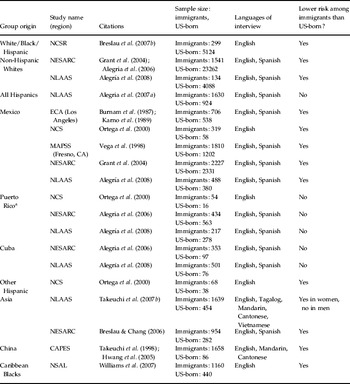
Evidence suggesting a higher risk of mood and anxiety disorders among US-born individuals than among foreign-born individuals who have immigrated to the USA is limited in two important ways. First, this association is not universal across immigrant groups. Table 1 summarizes results of population-based epidemiological studies that have compared lifetime risk for mood and anxiety disorders between immigrants and the US-born and the specific groups in which these comparisons have been made, as defined by ethnicity within the USA and country or region of ancestral origin. In studies that examined all immigrants as a single group (Breslau et al. Reference Breslau, Aguilar-Gaxiola, Borges, Kendler, Su and Kessler2007b) and studies that examined immigrants grouped by ethnicity in the USA [i.e. Hispanics (Alegria et al. Reference Alegria, Mulvaney-Day, Torres, Polo, Cao and Canino2007a), non-Hispanic Black (Williams et al. Reference Williams, Haile, Gonzalez, Neighbors, Baser and Jackson2007), non-Hispanic White (Grant et al. Reference Grant, Stinson, Hasin, Dawson, Chou and Anderson2004), Asian-Americans (Breslau & Chang, Reference Breslau and Chang2006; Takeuchi et al. Reference Takeuchi, Zane, Hong, Chae, Gong, Gee, Walton, Sue and Alegria2007b)] the finding of lower risk among immigrants relative to the US-born is universal. However, studies that have examined groups by country or region of origin have found some important exceptions to this rule: among people of Puerto Rican and Cuban origin, studies have found no difference in risk of mood and anxiety disorders between US-born and foreign-born individuals (Ortega et al. Reference Ortega, Rosenheck, Alegria and Desai2000; Alegria et al. Reference Alegria, Canino, Stinson and Grant2006; Alegría et al. Reference Alegría, Canino, Shrout, Woo, Duan, Vila, Torres, Chen and Meng2008).
Epidemiological comparisons of risk for mood and anxiety disorders between immigrants and the US-born

NCSR, National Comorbidity Survey Replication; NESARC, National Epidemiological Survey of Alcohol and Related Conditions; NLAAS, National Latino and Asian American Survey; ECA, Epidemiological Catchment Area Survey; NCS, National Comorbidity Survey; MAPSS, Mexican-American Prevalence and Services Study; CAPES, Chinese-American Psychiatric Epidemiology Survey; NSAL, National Survey of American Life.
a In the case of Puerto Rico, a commonwealth of the USA, ‘immigrant’ refers to those born on the island of Puerto Rico and ‘US-born’ refers to those born in the continental USA.
Second, recent evidence suggests that the low risk among immigrants relative to the US-born is limited to immigrants who arrived in the USA as adolescents or adults. For example, Breslau et al. reported no differences in risk for psychopathology between all immigrants who arrived in the USA prior to the age of 13 years and the US-born (Breslau et al. Reference Breslau, Aguilar-Gaxiola, Borges, Kendler, Su and Kessler2007b). Similar findings have been reported among Hispanics (Alegria et al. Reference Alegria, Sribney, Woo, Torres and Guarnaccia2007c) and Asians (Breslau & Chang, Reference Breslau and Chang2006; Takeuchi et al. Reference Takeuchi, Hong, Gile and Alegria2007a). The implication of these studies is that nativity differences in the risk of psychiatric disorders are driven by factors surrounding the experiences of immigration during early stages of development. However, this hypothesis has not been investigated within particular immigrant groups.
The goal of this paper is to advance our understanding of the etiological factors that might explain the consistent finding of low risk among immigrants to the USA relative to the US-born by examining variation in this pattern across groups with origins in different countries or world regions. Data on 33 601 Hispanics, non-Hispanic Whites and non-Hispanic Blacks from a large national survey of psychiatric disorders in the USA are used to examine these associations in seven groups of different national or regional origin. The seven groups include: four Hispanic groups, those from Mexico, Cuba, Puerto Rico, and Central or South America; two non-Hispanic White groups, those from Western and Eastern Europe; and one non-Hispanic Black group, those from Africa or the Caribbean.
Method
Sample
Data come from the National Epidemiological Survey of Alcohol and Related Conditions (NESARC), a survey (n=43 093) of the adult (age 18+ years) US household population conducted by the US Bureau of the Census for the National Institute of Alcohol Abuse and Alcoholism (Grant et al. Reference Grant, Kaplan, Shepard and Moore2003b). The survey was conducted under the auspices of the US Bureau of the Census. The response rate was 81%. Informed consent procedures were approved by the US Census Bureau and the US Office of Management and Budget. The design and weighting methodology are described in detail elsewhere (Grant et al. Reference Grant, Kaplan, Shepard and Moore2003b).
Survey instrument
Diagnoses were based on fully structured face-to-face computer-assisted interviews administered by trained non-clinician interviewers using either the English or Spanish versions of the Alcohol Use Disorder and Associated Disabilities Interview Schedule – DSM-IV version (AUDADIS; Grant et al. Reference Grant, Dawson, Stinson, Chou, Kay and Pickering2003a). In this report, we examine any anxiety disorder (social phobia, specific phobia, agoraphobia/panic disorder or generalized anxiety disorder) and any mood disorders [major depression, dysthymia or bipolar disorder (1 or 2)]. Age of onset was defined as the age at which the first disorder in the category began.
A test–retest reliability study conducted in a subsample of NESARC respondents found fair reliability for lifetime diagnoses of anxiety disorders (κ=0.42–0.48) and slightly better reliability for dysthymia (κ=0.58) and major depression (κ=0.65). Due to low prevalence, reliability for bipolar disorder could not be examined (Grant et al. Reference Grant, Dawson, Stinson, Chou, Kay and Pickering2003a).
Immigrant groups
Information on race/ethnicity and country of origin was used to identify seven groups within which differences by nativity (foreign versus US-birth) and age at immigration were compared.
Race/ethnicity
Respondents were asked to self-identify their race/ethnicity in two questions. The first asked whether the respondent was Hispanic. The second asked respondents to identify the racial category or categories to which they belong from the following list, which was presented in a respondent booklet: American Indian or Alaska Native, Asian, Black or African American, Native Hawaiian or Other Pacific Islander, White, Other. Only Hispanics, non-Hispanic Blacks and non-Hispanic Whites were included in this analysis. Respondents who indicated membership in more than one of the above race/ethnic groups were classified into the first of the above groups they indicated.
Origin/descent
Respondents were asked ‘What is your origin or descent?’ and asked to choose one category from a list of 59 countries and regions presented in a respondent booklet.
Definition of origin groups
Combining information on ethnicity and origin/descent we defined seven groups that share a region or country of origin and US ethnicity: (1) Western European, White or Hispanic; (2) Eastern European, White; (3) Mexican, Hispanic; (4) Cuban, Hispanic; (5) Puerto Rican, Hispanic; (6) Central or South American, Hispanic; (7) African or Caribbean, Black. Note that the Asian-American sample from this survey was examined in a previous paper (Breslau & Chang, Reference Breslau and Chang2006) and is not included here. The sample comprised of these seven groups included 33 601 respondents; 28 006 US-born and 5595 immigrants.
Foreign versus US birth
Respondents were asked whether they were born in the USA, and, if not, the length of time they have lived in the USA.
Age at immigration
Respondents were asked the age at which they arrived in the USA. We divided immigrants into two groups: immigrants who arrived as children (age ⩽13 years) and immigrants who arrived as adolescents or adults (age >13 years).
Statistical analysis
Lifetime prevalence of mood and anxiety disorders was estimated as the proportion of respondents in the sample who met criteria for a disorder at any time in their life. Study hypotheses concerning the association of US-nativity and age at immigration with risk for mood and anxiety disorders were assessed using partial logistic regression (Efron, Reference Efron1988), a discrete time survival analysis model (Allison, Reference Allison1982). In these models, biographical information collected from respondents is segmented into person-years, beginning at age 5 years and extending to either the year of disorder onset or the year in which the respondent was interviewed. Associations between study covariates and the odds of having a disorder onset are estimated in a logistic regression model controlling for age in each person-year of risk, sex, birth cohort and region of origin. To account for the complex survey design, standard errors were calculated using Taylor series linearization as implemented in the sudaan software package (Software for Data Analysis, version 8.1; Research Triangle Institute, Research Triangle, NC, USA). A small number of observations (n=55) with missing values on key predictors were excluded from analysis.
Differences between those born outside of the USA (or Puerto Rico) and those born in the USA were assessed using a binary indicator for US-nativity. Heterogeneity of the US-nativity effect across origin groups was then assessed through a test of the statistical interaction between the indicator of US-nativity and the indicators for region of origin. Heterogeneity of risk by age at immigration was assessed separately within each origin group.
Results
Samples for each origin group
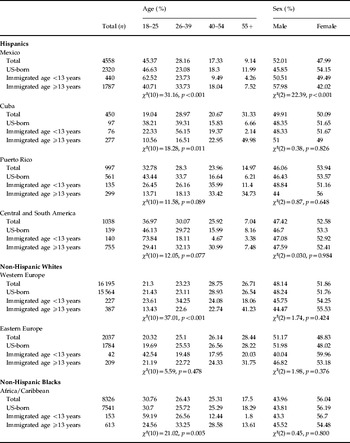
The sample sizes for the seven groups range from 450 for Cubans to 16 195 for Western Europeans (Table 2). There are large differences across groups in the proportion of US-born and the proportion of early versus late immigrants among the foreign-born. The smallest subgroups are those who arrived in the USA before age 13 years from Eastern Europe (n=42) and Cuba (n=76). Within origin groups, US-nativity and age at immigration are significantly associated with age at interview in four of the seven groups and with sex in one of the seven groups. Note that the sample sizes within groups defined by US-nativity and age at immigration do not sum to the total for each group because of observations that were dropped due to missing information on age at immigration.
Sample characteristicsFootnote a

a Total sample size (all groups)=33 601. Fifty-five respondents missing data on nativity were excluded.
Association between US-nativity and lifetime risk
In the entire sample, the immigrants as a group are less likely to have had a mood [odds ratio (OR) 0.64, 95% confidence interval (CI) 0.58–0.70] or anxiety (OR 0.59, 95% CI 0.52–0.68) disorder compared with the US-born, when age, sex and origin are statistically controlled. The interaction between US-nativity and origin was statistically significant for both mood [χ2(6)=5.70, p<0.001] and anxiety [χ2(6)=6.67, p<0.001] disorders. Subsequent analyses were stratified by origin.
Group-specific associations between generation and risk
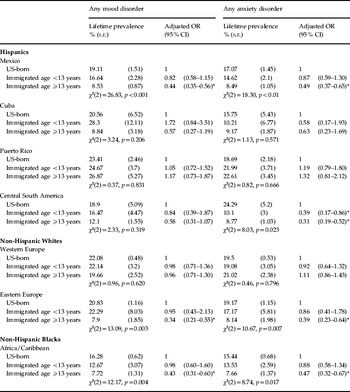
Table 3 presents comparisons of lifetime prevalence (%, unadjusted) and lifetime risk (OR, adjusted for age and sex) by US-nativity and age at immigration within each of the seven origin groups.
Lifetime prevalence and risk for mood and anxiety disorders by US-nativity and age at immigration across seven immigrant groups in the USAFootnote a

s.e., Standard error; OR, odds ratio; CI, confidence interval.
a Association of lifetime prevalence with US-nativity and age at immigration tested with design-adjusted χ2 tests. OR estimated in discrete time survival models controlling for age and sex.
* OR significantly different from 1 at p=0.05.
Among the four Hispanic groups, statistically significant lower risk among immigrants relative to the US-born is found only among immigrants of Mexican origin who arrived in the USA at the age of 13 years or older [for both mood (OR 0.44) and anxiety disorders (OR 0.49)] and among both groups of immigrants of South or Central American origin [for anxiety disorders only (OR 0.31–0.39)].
Among the two non-Hispanic White groups, risk among immigrants is significantly lower than among the US-born only for immigrants from Eastern Europe who arrived in the USA at the age of 13 years or older. This group has significantly lower risk for both mood (OR 0.34) and anxiety disorders (OR 0.39) compared with those born in the USA.
Among people of African or Caribbean origin, those who arrived in the USA at the age of 13 years or older have lower risk than the US-born for mood (OR=0.43) and anxiety disorders (OR=0.47).
Discussion
In this study we used a large national survey to examine patterns of lifetime risk for mood and anxiety disorders associated with US-nativity and age at immigration across a more diverse set of immigrant groups than has been examined in any previous study. While previous studies have suggested that an immigrant paradox exists for mental health in the USA, i.e. that immigrants have lower risk than would be predicted by their socio-economic position, our findings suggest that the immigrant advantage in risk for mood and anxiety disorders is limited in several respects. First, among some groups immigrants are not at lower risk for these disorders than the US-born. Second, among groups in which immigrants have an advantage with respect to the US-born in lifetime risk for mood and anxiety disorders, this advantage is generally limited to those immigrants who arrived in the USA as adolescents or adults, i.e. older than the age of 12 years. Two exceptions to this second pattern are noted below.
Comparison of our results with previous studies summarized in Table 1 shows that our results are consistent with prior studies that have compared immigrants with US-born when those prior studies defined groups as we have done here. Specifically, previous studies of Mexican-Americans (Grant et al. Reference Grant, Stinson, Hasin, Dawson, Chou and Anderson2004) and African-Americans (Williams et al. Reference Williams, Haile, Gonzalez, Neighbors, Baser and Jackson2007) have found lower risk among immigrants relative to the US-born and studies of Puerto Ricans and Cubans (Alegría et al. Reference Alegría, Canino, Shrout, Woo, Duan, Vila, Torres, Chen and Meng2008) have found no differences between the Island-born and mainland born. These consistencies across studies strengthen our confidence in these results. This is the first study to distinguish people of Western European and Eastern European origin, to examine people of Central or South American origin, and to examine age at immigration across this broad range of immigrant groups.
Groups without nativity differences in risk for disorders
We found no evidence of an association of lifetime risk for mood and anxiety disorders with US-nativity and age at immigration among Hispanics from Puerto Rico or non-Hispanic Whites from Western Europe. In both cases, immigrants have equally high levels of risk as the US-born, regardless of the age at which they arrived in the USA. Previous studies of people of Puerto Rican origin in the USA have also found no association between US-nativity and risk for psychiatric disorder (Ortega et al. Reference Ortega, Rosenheck, Alegria and Desai2000; Alegría et al. Reference Alegría, Canino, Shrout, Woo, Duan, Vila, Torres, Chen and Meng2008), and epidemiological evidence from Puerto Rico also suggests that risk for disorder is equally high there as among the US general population (Canino et al. Reference Canino, Bird, Shrout, Rubio-Stipec, Bravo, Martinez, Sesman and Guevara1987).
Previous studies have included people of Western European origin in the broader category of non-Hispanic White (Grant et al. Reference Grant, Stinson, Hasin, Dawson, Chou and Anderson2004; Alegria et al. Reference Alegria, Canino, Stinson and Grant2006; Breslau et al. Reference Breslau, Aguilar-Gaxiola, Borges, Kendler, Su and Kessler2007b), which in the USA includes people from Eastern Europe and the Middle East as well as people of European ancestry from other areas of the world. Our results suggest that people of Western European origin are an important exception to the pattern of lower risk among immigrants relative to the US-born that has been reported in those studies. There are no studies of mood and anxiety disorders in samples representative of the sending population of Western Europe. Published data from the European Study of the Epidemiology of Mental Disorders (ESEMeD) study, which included six Western European countries (France, Spain, The Netherlands, Italy, Germany and Belgium) found lower lifetime prevalence of mood (14.0%) and anxiety (13.6%) disorders compared with our findings (Alonso et al. Reference Alonso, Angermeyer, Bernert, Bruffaerts, Brugha, Bryson, de Girolamo, Graaf, Demyttenaere, Gasquet, Haro, Katz, Kessler, Kovess, Lépine, Ormel, Polidori, Russo, Vilagut, Almansa, Arbabzadeh-Bouchez, Autonell, Bernal, Buist-Bouwman, Codony, Domingo-Salvany, Ferrer, Joo, Martínez-Alonso, Matschinger, Mazzi, Morgan, Morosini, Palacín, Romera, Taub and Vollebergh2004). However that study did not include England or Ireland, the two largest sources of immigrants to the USA in Western Europe.
It is important to note that these two groups, Puerto Ricans and Western Europeans, though similar in having high levels of risk regardless of place of birth or age at immigration, are very different with respect to cultural backgrounds, levels of development in country of origin and motivation for immigration.
Groups with lower risks of disorders among immigrants
In three groups from three different world regions – Hispanics from Mexico, non-Hispanic Whites from Eastern Europe, and non-Hispanic Blacks from Africa or the Caribbean – we found a very similar pattern of differences in the risk for mood and anxiety disorders. In each of these groups, there was no difference in lifetime risk between immigrants who arrived in the USA at the age of 13 years or younger and the US-born, but lower risk among immigrants who arrived after the age of 13 years compared with the US-born. This pattern is identical to that found in a previous study of people of Asian origin from this survey (Breslau & Chang, Reference Breslau and Chang2006). In all four of these groups, the association between risk for mood and anxiety disorders is due to differences between people who spent their early childhood in the USA and those who spent their early childhood outside of the USA. This pattern strongly suggests that factors present in early development account for this association (Breslau et al. Reference Breslau, Aguilar-Gaxiola, Borges, Kendler, Su and Kessler2007b; Takeuchi et al. Reference Takeuchi, Hong, Gile and Alegria2007a). Of these three groups, comparable studies are available only for Mexico, where studies have found lower lifetime prevalence for mood (9.1%) and anxiety (14.3%) disorders than in the USA (Medina-Mora et al. Reference Medina-Mora, Borges, Lara, Benjet, Blanco, Fleiz, Villatoro, Rojas, Zambrano, Casanova and Aguilar-Gaxiola2003).
Hispanics of Cuban or South or Central American origin follow neither of the above patterns. Among the group of Cuban origin, there were no significant associations between lifetime risk and US-nativity. However, Cubans differed from the Western European and Puerto Rican groups discussed above because there is some evidence that immigrants who arrived in the USA at the age of 13 years or older were at lower risk for mood disorders than immigrants who arrived at the age of 12 years or younger. These differences do not reach statistical significance. Among those from South or Central America, there was no association between US-nativity and risk for mood disorders, but immigrants had lower risk for anxiety disorders than the US-born regardless of the age at which they arrived in the USA.
Potential explanations
Differences between immigrants and the US-born in mental health and general health status might be explained by a number of processes. Immigrants and their US-born descendants also differ on a wide range of behavioral risk factors for adult health problems (Abraido-Lanza et al. Reference Abraido-Lanza, Chao and Florez2005). Among these behavioral risk factors associated with US-nativity, use of alcohol (Johnson et al. Reference Johnson, VanGeest and Cho2002), nicotine (Acevedo-Garcia et al. Reference Acevedo-Garcia, Pan, Jun, Osypuk and Emmons2005) and other drugs (Blake et al. Reference Blake, Ledsky, Goodenow and O'Donnell2001) may be factors in subsequent mood and anxiety disorders (Swendsen & Merikangas, Reference Swendsen and Merikangas2000). However, the results of this and other studies (Breslau et al. Reference Breslau, Aguilar-Gaxiola, Borges, Kendler, Su and Kessler2007b) suggest that changes in risk for mood and anxiety disorders occur more rapidly than changes in these behavioral risk factors. There is evidence that immigrants who arrived in the USA as children, who our results suggest have an equally high risk for mood and anxiety disorders as the US-born, are less likely to use substances than the US-born. A recent report by Alegria and colleagues suggests that among Puerto Ricans, those born in Puerto Rico are not at lower risk for mood and anxiety disorders despite lower risk for substance-use disorders compared with those born in mainland USA (Alegría et al. Reference Alegría, Canino, Shrout, Woo, Duan, Vila, Torres, Chen and Meng2008).
Another potential explanation that is also inconsistent with our findings is that stressors that are specific to the immigration process, i.e. acculturative stress, account for increasing risk for disorder (Alegria et al. Reference Alegria, Shrout, Woo, Guarnaccia, Sribney, Vila, Polo, Cao, Mulvaney-Day, Torres and Canino2007b). Acculturative stresses, resulting from the disconnection from one's culture of origin and struggle to accommodate a strange and potentially hostile environment in the host country (Rogler et al. Reference Rogler, Cortes and Malgady1991), are more extreme among immigrants who arrived in the USA as adults. Immigrants who are older at arrival have already developed social networks and cultural orientations in their country of origin while immigrants who arrived as children experience their primary socialization in the USA. However, the pattern of risk for mood and anxiety disorders does not follow the pattern that one would predict if acculturative stress were the primary cause of increasing risk; it is the younger immigrants and not the older immigrants who experience higher risk for disorder.
Similarly, our results are not consistent with a protective effect of immigrant cultural practices on risk for mood and anxiety disorders. Cultural practices that change across generations as immigrant groups assimilate to the USA, such as strong extended kinship networks, have been suggested as explanations for relatively good physical health status and low mortality among some immigrant and minority groups (Singh & Miller, Reference Singh and Miller2004; Markides & Eschbach, Reference Markides and Eschbach2005). If these factors were also protective with respect to mood and anxiety disorders we would predict lower risk among immigrants who arrived as children, who are more likely to live in immigrant communities, compared with the US-born. Our findings do not confirm this prediction.
An alternative hypothesis is that differences associated with US-nativity arise from cross-national differences in disposition to mood and anxiety disorder acquired in childhood. Our results are consistent with this model in two important respects. First, low risk is generally restricted to immigrants who spent their early life outside of the USA. People who spent their early life in the USA appear to have similar levels of risk, regardless of place of birth. Second, the same pattern of risk associated with US-nativity occurs among groups from vastly different ancestral origins (Eastern Europe, Mexico, Africa/Caribbean) and from different ethnic groups in the USA (Hispanic, non-Hispanic Black and non-Hispanic White). The fact that the same pattern was observed in an earlier study of Asian-Americans (Breslau & Chang, Reference Breslau and Chang2006) further strengthens this evidence. The fact that immigrants who arrived as children in the USA from these vastly different backgrounds acquire the same high level of risk for mood and anxiety disorder as the US-born population suggests developmental pathways that are common to enculturation of both immigrants and natives rather than a distinct set of pathways characteristic of immigrants (Sam, Reference Sam, Bornstein and Cote2006).
It is important to note the difference between this explanation for differences in risk associated with US-nativity and the ‘healthy migrant hypothesis’, which has also been suggested (Grant et al. Reference Grant, Stinson, Hasin, Dawson, Chou and Anderson2004; Alegria et al. Reference Alegria, Canino, Stinson and Grant2006). Differences between immigrants and the US-born may be due to cross-national differences whether or not immigrants differ in risk from the general populations in their countries of origin. Studies with comparable data collected in both sending and receiving countries are needed to assess the healthy migrant hypothesis.
Methodological limitations
The pattern of variation in risk we found could be due in part to the exclusion from the sample of individuals who could speak neither English nor Spanish. These individuals are most likely to be immigrants who arrived in the USA as adults. If there were higher prevalence of disorder among individuals who spoke neither English nor Spanish, we would underestimate the prevalence of disorder in that group. However, evidence from studies that interviewed respondents in a wider variety of languages, particularly Asian languages, suggests that individuals who are not proficient speakers of English or Spanish have equal lifetime risk for psychiatric disorders as those who are proficient speakers of English or Spanish (Takeuchi et al. Reference Takeuchi, Zane, Hong, Chae, Gong, Gee, Walton, Sue and Alegria2007b). These patterns have not been investigated among speakers of European languages (other than Spanish).
The sample sizes are smallest for immigrants who arrived prior to the age of 13 years. It is possible that the finding of no difference in risk between the immigrants who arrived prior to the age of 13 years and the US-born is due to the limited power we have to detect differences between these two groups. We cannot rule out the possibility that a larger study would find significant differences. However, among the groups where differences between the US-born and immigrants were limited to those who arrived at the age of 13 years or older, we found that the two ORs comparing the age at immigration subgroups with the US-born were statistically different from each other (results not shown).
Data in this study were collected at a single point in time and are affected by problems in recall of psychiatric symptoms across the lifespan. Evidence from methodological studies suggests that problems in recall are likely to result in underestimates of lifetime prevalence of disorder because more people fail to recall symptoms than mis-remember symptoms that did not occur. Problems in recall would lead to bias in the current study if they were systematically related to US-nativity, but this possibility has not been examined in methodological studies. In the one longitudinal study that compared retrospective reports of depression with prior assessments, respondents were likely to under-report past symptoms, but associations between depression and risk factors did not differ meaningfully across the two ascertainment methods (Wells & Horwood, Reference Wells and Horwood2004).
Psychiatric diagnoses were made by lay interviewers and the chance corrected agreement (κ coefficient) with clinician interviews for some disorders was in the fair to moderate range, as reported above. To examine whether our results may have been affected by low κ we repeated the analysis reported above for major depression, the disorder with the highest κ. We found the same pattern of results for major depression as for the mood disorders as a group (results available on request).
We have offered some comparisons of our results with epidemiological studies of psychiatric disorders conducted in immigrant-sending populations. While suggestive, these comparisons do not adjust for the many factors that might lead to differences between immigrants in the USA and the general population in their country of origin. None of these studies used the same survey instrument, and none of the comparisons adjusted for factors that might predict both immigration and lifetime risk for psychiatric disorder such as age, sex and socio-economic status. Future studies based on samples interviewed with consistent methods in both sending and receiving countries are needed to evaluate the impact of immigration on risk for psychiatric disorders.
The finding in this study regarding differences in risk associated with US-nativity and age at immigration do not imply that migration to the USA is not associated with increases in risk among those who arrived in the USA as adults. There is evidence that longer duration of residence in the USA is associated with higher risk of disorder among immigrants relative to the US-born (Vega et al. Reference Vega, Kolody, Aguilar-Gaxiola, Alderete, Catalano and Caraveo-Anduaga1998; Alderete et al. Reference Alderete, Vega, Kolody and Aguilar-Gaxiola2000; Breslau & Chang, Reference Breslau and Chang2006; Alegria et al. Reference Alegria, Sribney, Woo, Torres and Guarnaccia2007c; Breslau et al. Reference Breslau, Aguilar-Gaxiola, Borges, Kendler, Su and Kessler2007b; Takeuchi et al. Reference Takeuchi, Hong, Gile and Alegria2007a). However, variations in the pattern of risk associated with duration of residence across these seven immigrant groups have not been investigated. Studies of the impact of immigration to the USA should focus on those who arrived in the USA as adults. The most valuable studies will be those that can compare immigrants with the populations from which they emigrated, controlling for other predictors of migration and mental health (Breslau et al. Reference Breslau, Aguilar-Gaxiola, Borges, Castilla-Puentes, Kendler, Medina-Mora, Su and Kessler2007a).
Conclusions
The findings of this study add support to the suggestion that the finding of lower risk for psychiatric disorders among immigrants relative to the US-born of the same national origin is more circumscribed than previously suggested. Lower risk appears to be largely limited to immigrants who spent their pre-adolescent years outside of the USA and only applies to groups with low risk for mood and anxiety disorder. The groups in which lower risk occur are not homogeneous with respect to region of origin or ethnicity in the USA. This pattern is consistent with a disposition towards mood and anxiety disorders that is acquired early in life by immigrants who spent their childhoods in the USA and the US-born.
Acknowledgements
This research was supported by grants from the National Institute of Mental Health (J.B.: K01 MH66057) and National Institute on Drug Abuse/National Institute on Alcohol Abuse and Alcoholism (NIDA/NIAAA) (S.G. and J.B.: RO3DA20887.).
Declaration of Interest
None.