“...If you don't measure it, it didn't happen.”
Anonymous
Introduction
The scope of the global burden of surgical disease arising from lack of access to surgical expertise and services in low- and middle-income countries remains unknown. This burden is neglected as a public health and humanitarian issue, and further complicated by a diminishing health care workforce,Reference Farmer and Kim1-Reference Ozgediz, Riviello and Rogers3 but is estimated by the World Health Organization (WHO) to rise dramatically by 2020. Both the public health community and the growing numbers of surgeons, anesthesiologists, surgical nurses, nurse anesthetists, and many surgical sub-specialties interested in humanitarian assistance have come to accept that essential surgical services are a vital component of basic public health infrastructure and protections.Reference Ivers, Garfein and Augustin4 Catalyzed primarily by awareness of the catastrophic outcomes brought on by war and natural disasters, the relief community in recent years has begun to mobilize foreign medical teams (FMTs), particularly those specialized in surgical and trauma care, to respond to major crises. The 2010 Haitian earthquake response revealed “serious concerns about the clinical competence and practices of some FMTs,” prompting the United Nations’ Inter-Agency Standing Committee, the primary mechanism for inter-agency coordination of humanitarian assistance, to call for “greater accountability, coordination, and more stringent oversight and documentation of their work.”5
Systematic documentation and dissemination of such data plays a pivotal role in the management of health information during crises.Reference Mills6 Within the surgical environment, this entails an assessment of previous patterns of burdens of surgical disease, the types of surgical interventions that have been employed to address surgical pathologies, the resources required to do so, and the outcomes of these interventions.
Evidence-based decisions require reliable and accurate data from which conclusions can be drawn. Despite the growing emphasis on the need for data to examine the population-level effects of crises, the conduct of field surveys estimating commonly measured indicators such as mortality and malnutrition have been the subject of considerable debate among epidemiologists.Reference Spiegel7-Reference Grais, Luquero, Grellety, Pham, Coghlan and Salignon9 Furthermore, assessing the availability and accessibility of health services during crises presents a challenge for coordination and gap analysis.Reference Pavignani and Colombo10
Anticipating the potential surgical needs of a crisis-affected population requires an understanding of previous patterns of morbidity and mortality during similar events, and of the types of interventions effective in mitigating further harm and treating illness. As has been previously reported, the collective understanding of the patterns of surgical care utilization during such situations is notably poor, and perceptions of need may not reflect accurately the true burden of surgical disease.Reference Chu, Trelles and Ford11
The peer-reviewed literature was examined both for patterns of surgical resource utilization during crises and for the ways in which these interventions were reported. The intention was to review systematically the current literature to examine patterns or trends in surgical pathology and interventions that might be useful for future planning in the organization of FMTs providing surgical care in crisis settings. Specifically, the objective was to describe the most common surgical pathologies encountered by FMTs, and the types of interventions effective in treating them. A second objective was to explore the quality of descriptive demographic information concerning surgical caseloads, surgical personnel, and patient outcomes following surgical intervention by FMTs.
Methods
A literature search was conducted using MEDLINE, PubMed, and EMBASE databases to locate papers containing surgical, epidemiological data useful in understanding the burden of surgical disease during major disasters and crises. The search strategy was broad, and articles containing epidemiologic data were selected from a large group of surgical care articles. Searches of MEDLINE frequently failed to capture one or more of the known manuscripts of interest, whereas a PubMed search using the same keywords was successful in capturing all of the articles the authors already were aware of. The search strategy was developed using the Peer Review of Electronic Search Strategies (PRESS) checklist for electronic literature searches,Reference McGowan, Sampson and Lefebvre12 and is detailed in the Appendix.
Abstracts obtained through the literature search were screened for inclusion in the review using the following criteria:
• Studies where surgical care was provided during a major crisis as a component of a humanitarian intervention by a FMT
• Studies where the total surgical caseload was reported
• Studies published in the English or French languages from 1990 through 2011. Exclusion criteria included the following:
• Studies where surgical care was provided by military medical services during combat
• Studies where the focus was a single type of surgical pathology (e.g., soft tissue injuries or blast injuries) or a single type of surgical service (e.g., orthopedics, neurosurgery, or plastic surgery).
Articles meeting these criteria were obtained in full-text copies and further screened for inclusion. Relevant data were extracted separately by two reviewers (authors JN and SC), and the results were compared for accuracy. Studies were assessed for their inclusion of the presenting pathology, and grouped with reported procedural data into the most appropriate surgical service (general surgery, orthopedics, obstetrics/gynecology, soft tissue, and other), allowing for a comparison among studies.
Results
The initial literature search located 2,171 publications, the abstracts of which were reviewed by one of the authors (JN). At this stage, 185 articles of interest were identified, and full text copies of these articles were obtained and reviewed. The reference lists of full-text articles reviewed were also examined, yielding a further 49 articles of interest that were obtained and reviewed. In total, 99 articles were of relevance to surgical care in crisis settings, of which 18 articles contained surgical caseload data. Of these, 12 articles contained data meeting the inclusion criteria and detailing the surgical workload of FMTs during crises. One article was excluded from final analysis because the nature of reporting did not allow for meaningful data extraction concerning specific surgical activities.Reference Bar-Dayan, Beard and Mankuta13 An additional six articlesReference Korver14-Reference Wolf, Bar-Dayan and Mankuta19 contained epidemiologic data, but focused either on one type of surgical service or one type of surgical pathology (generally trauma) and were excluded as their scope was too limited to be of value in the assessment of the overall burden of surgical disease encountered by FMTs.
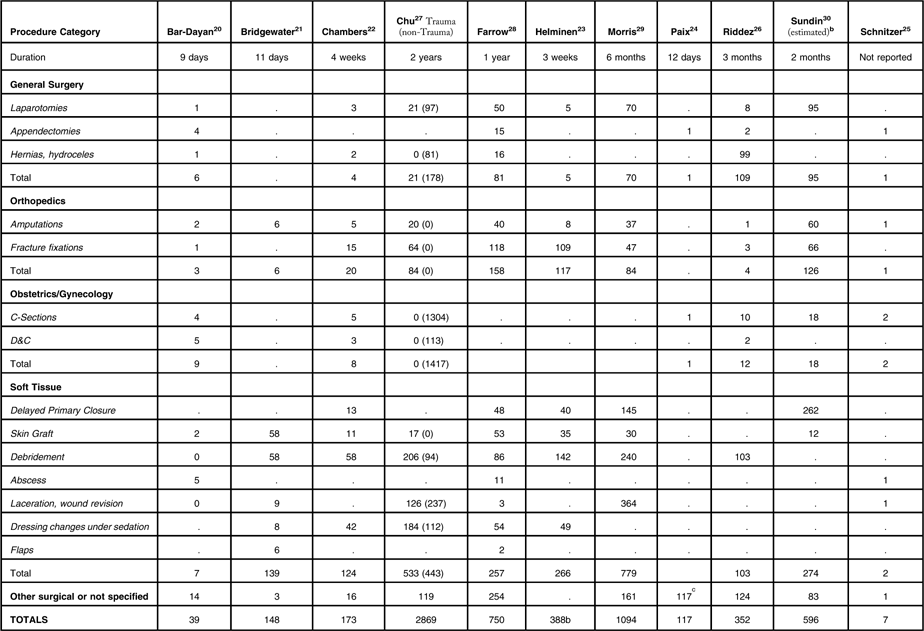
The 11 articles retrieved for final analysis (Table 1) consisted of seven articles that described surgical services during a natural disasterReference Bar-Dayan, Leiba and Beard20-Reference Riddez, Kruck, Gardarsdottir and Redwood-Campbell26 and four describing surgical care either during or following a complex emergency.Reference Chu, Havet, Ford and Trelles27-Reference Sundin30
Summary of extracted epidemiological data

aCaseload data does not add up to number of cases reported in text of article
bEstimated from percentages given in article
c98 unspecified lower limb surgeries; 17 unspecified upper limb surgeries; 1 caesarean section; 1 appendectomy. Reports 130 “procedures” but describes only 117
Characteristics of the Studies
Data reported varied significantly among the 11 included studies. Ten studies (91%) provided sufficient data to determine the length of deployment or data collection. Nine studies (82%) reported medical-surgical team composition. Only five studies (45%) reported the total number of patients (both surgical and non-surgical) seen by their team throughout the period of interest. All 11 studies reported the total number of procedures performed while only seven studies (64%) reported the total number of patients who underwent surgical procedures. Perioperative mortality was reported in only three studies (27%), one of which reported only deaths following laparotomy but not from other procedures. None reported long-term surgical outcomes of patients treated.
Surgical interventions were described in all of the included studies, although surgical pathology was only described in seven (64%). In describing the surgical pathology, only four studies (36%) reported a cause of injury or illness that was secondary or otherwise unrelated to the primary event (i.e., natural disaster, conflict).
Quantitative Assessment
Quantitative assessment of the burden of surgical disease among FMT inpatients is difficult given the heterogeneity of reporting and timelines of each of the studies included in this review. Furthermore, the resulting small sample size from widely differing FMT experiences, along with contexts provided by different crises, countries, societies, and populations, creates a challenge when comparing absolute numbers of patients or procedures. As such, quantitative assessment of the burden of surgical disease was not possible using statistical methods or meta-analysis. This was primarily due to the descriptive or anecdotal nature of the reports, lack of congruence among the types of data reported, lack of standardized indicators to report on surgical caseload or infrastructure, significant time variability in data reporting, and inconsistencies in the classification of surgical pathology and procedures.
Of the 11 included studies, few provided sufficient data to determine the burden of surgical disease among the overall patient population or a reliable classification of surgical pathology, perioperative mortality, or length of deployment. None reported long-term surgical outcomes. Additionally, there was significant time variability in data reporting, from nine daysReference Bar-Dayan, Leiba and Beard20 to three weeksReference Chambers, Campion, Courtenay, Crozier and New22 following natural disasters, and extending to over two years in one complex emergency.Reference Chu, Havet, Ford and Trelles27 Contextual factors such as the geographic and physical locations (field hospital, existing facilities, etc.) that provide pertinent spatial information for understanding differing patterns of care among populations both within and outside of crisesReference Noor, Alegana, Gething and Snow31 was seldom available and it was often unclear if those reporting were the sole providers of care for the region or if they were operating in tandem with other FMTs or hospitals.
Qualitative Assessment
Natural Disasters—Seven articles included in this review describe surgical care provided following natural disasters with four following the 2004 Indian Ocean earthquake and tsunami, and three following earthquakes in Turkey, Pakistan, and Iran. Upon review, it was determined that two articles reporting on the surgical activities of the Australian Defence Force in Banda Aceh, Indonesia, were reporting on some of the same patients, although based on slightly different accounts and activities from the perspective of the team's surgeonReference Bridgewater, Aspinall and Booth21 and anesthesiologist,Reference Paix, Capps, Neumeister and Semple24 making a reliable assessment impossible.
Qualitative analysis of the studies reporting surgical activities following natural disasters reveals similarities among the reports. Surgical management of soft tissue injuries, including delayed primary closure, skin grafting, debridement, and other procedures comprised the largest proportion of emergency surgical interventions in the studies analyzed. This was followed by orthopedic surgical procedures, general surgery, miscellaneous procedures, and obstetrics and gynecology. All but two of the studies reported performing caesarean sections as a component of the surgical care provided. As the duration of the deployment lengthened, the procedures performed by FMTs became more reflective of what may be the local burden of surgical disease, potentially unrelated to the crisis. Riddez et alReference Riddez, Kruck, Gardarsdottir and Redwood-Campbell26 report on a three-month period of activity during which 99 hernia repairs, ten caesarean sections, and eight appendectomies were performed. Similarly, Chambers et alReference Chambers, Campion, Courtenay, Crozier and New22 report performing two hernia repairs and five caesarean sections out of a total caseload of 173 procedures over a period of four weeks.
Estimates of the true proportion of procedures that were directly related to the natural disaster, secondary to it, and otherwise unrelated were not possible with these studies. Chambers et alReference Chambers, Campion, Courtenay, Crozier and New22 report that 30 patients underwent 119 procedures related to the tsunami (69%) and Helminen et alReference Helminen, Saarela and Salmela23 report that “most” procedures they performed were due to earthquake-related trauma. Schnitzer et alReference Schnitzer and Briggs25 report an increase in the occurrence of traumas secondary to the crisis, such as motor vehicle collisions, a point emphasized by the fact that one of the seven surgical procedures performed by this team was due to a gunshot wound.
Complex Emergencies/Conflict—Four studies included in this review examined humanitarian surgical care provided during or following complex emergencies including two in Rwanda, one in the Democratic Republic of Congo, and one in Afghanistan. The period of reporting for these studies was longer than in the natural disasters group, and ranged from two monthsReference Sundin30 to two years.Reference Chu, Havet, Ford and Trelles27
The data show a trend more indicative of FMTs providing surgical care for conditions that are representative of the existing and unmet burden of surgical disease among the population. Orthopedic and soft tissue repair still accounted for a significant number of surgical procedures, although this number was not evenly distributed across all studies. Chu et alReference Chu, Havet, Ford and Trelles27 report on the surgical care provided in the Democratic Republic of Congo during periods of conflict in which violent injuries accounted for only 13% of the overall surgical caseload, while obstetric emergencies accounted for 51% of the caseload. This was not consistently demonstrated across all studies, as SundinReference Sundin30 reports that only five percent of the surgical cases encountered in Rwanda following the genocide were unrelated to the war, and caesarean sections/gynecology accounted for only three percent of the surgical caseload.
Discussion
In general, the length of deployment is likely to influence the nature of surgical pathology encountered such that over time, the burden of surgical diseases shifts from a proximal association with an acute event, be it war or natural disaster, to more distal influences suggestive of broader health system disruption. This results in a surgical caseload that is more reflective of the existing and unmet burden of surgical disease in the population. Subsequently, the role of FMTs in providing surgical care should encompass a broad array of capabilities rather than single-service teams capable of providing treatment limited to one area of specialization, unless these services are specifically requested by reliable sources (ministries of health, NGOs) already operating in the area.
Many challenges face FMTs in adapting surgical techniques, procedures, resources, and equipment that are routine in developed countries for use in crisis settings in austere environments. For example, patients may present with untreated tropical diseases, requiring surgical care for which teams are poorly equipped.Reference Holian and Keith32 In short, services and supplies cannot always simply be “transplanted” into the local context.
Qualitative analysis further suggests the need to envision the provision of surgical care within the context of a disrupted health system, and not as a vertical intervention directed solely toward the treatment of injuries from one source. This is particularly evident in the two year review of surgeries performed by Médecins Sans Frontières (MSF)Reference Chu, Havet, Ford and Trelles27 that showed obstetric emergencies constituted over half of all surgical consultations in a crisis-affected population in the Democratic Republic of Congo. While injuries are prevalent immediately following crises, so too are referrals for clinical services not related to the initial event.Reference Sjoberg and Yearwood33-Reference Krieg and Gardemann35
A lack of an understanding of the geographic location and medical services available within close proximity significantly hinders the ability to understand the spectrum of events presented in different field reports. This leads to a less comprehensive understanding of the patterns of surgical care provided, and does not allow for providing an indication of incentives for seeking care in one health facility over another.
The availability of a surgical team capable of comprehensive emergency obstetric care (basic emergency obstetric care, caesarean section, and blood transfusion) has been identified as criticalReference Bar-Dayan, Leiba and Beard20, Reference Riddez, Kruck, Gardarsdottir and Redwood-Campbell26, Reference Abolghasemi, Radfar, Khatami, Nia, Amid and Briggs36 as has the availability of multidisciplinary medical teams capable of managing a broad array of medical and surgical conditions beyond orthopedics and soft tissue injuries.Reference Rosenfeld15 In available peer-reviewed studies, considerable variation exists in reports of surgical care provided among FMTs operating within the same disaster. Future studies must examine the population-level burden of surgical disease. This is a crucial requirement for FMTs to become a reliable and responsible force in mitigating surgically induced mortality and morbidity, and to comprehensively understand the true unmet surgical burden needs. Case reports provide an indication of services provided, but do not report reliably on unmet need.
Clearly, standardization of data collection and reporting tools for surgical care is in order to improve the reporting of surgical interventions in the field and to provide a standard framework for reporting of surgical interventions in crises. Current guidelines for the publication of medical interventions in crisis settings are known as the Consensus Guidelines on Reports of Field Interventions in Disasters and Emergencies (CONFIDE).Reference Bradt and Aitken37 Unfortunately, the CONFIDE statement lacks the specificity necessary for the reporting of surgical interventions, which should include standardization of pathology and intervention, as well as basic patient demographics. The development of an expanded statement to standardize the reporting of surgical interventions in disasters and emergencies, while allowing for a more comprehensive understanding of the burden of surgical disease and its public health impact in these settings, is crucial to the sustained development, accountability, coordination, and epidemiological integrity of FMTs.
Conclusions
Surgical interventions and safe anesthesia practices are essential components of the health sector response to humanitarian crises, conflicts, and disasters. While countless numbers of surgical reports are available in the international literature, the lack of robust analysis hinders the ability to provide surgical care and interventions in an evidenced-based manner. The largest organizations providing surgical care, the International Committee of the Red Cross and Médecins Sans Frontières, have noted the importance of outcome measures and epidemiology in crises, but also admit that resources for follow-up, measurement and publication are sparse. This study confirms the adage “... if you don't measure it, it didn't happen,” and underscores the critical importance that data on internal quality, performance of services, and standards of performance of FMTs must be properly collected, measured and reported in a manner expected of scientific inquiry.
The international humanitarian community must acknowledge and commit to a standard of care that includes surgical and anesthesia practices in non-emergent humanitarian settings as well as during crises. Outcome measures and patient follow-up are critical for the establishment of evidence-based surgical and anesthesia practices, and for ensuring that the public health essential surgical service needs of all populations are addressed through timely, competent and comprehensive care.
Abbreviations
- FMT:
foreign medical team
- NGO:
non-governmental organization
- WHO:
World Health Organization
Appendix: Search Strategies
EMBASE Search Strategy
1. “complex emergenc*”.ti,ab.
2. war?.ti,ab.
3. conflict?.ti,ab.
4. disaster?.ti,ab.
5. exp disaster/
6. exp war/
7. “emergenc*”.ti,ab.
8. exp surgery/
9. exp obstetric operation/
10. exp anesthesia/
11. exp “surgical and obstetric care”/
12. “surger*”.ti,ab.
13. “surgical*”.ti,ab.
14. an?esthesia.ti,ab.
15. anesthesia.ti,ab.
16. an?esthetic?.ti,ab.
17. war.ti,ab.
18. disaster.ti,ab.
19. surgical.ti,ab.
20. complex emergency.ti,ab.
21. “obstetric*”.ti,ab.
22. obstetric.ti,ab.
23. exp relief work/
24. exp international cooperation/
25. exp REFUGEE/
26. conflict.ti,ab.
27. “anesthesi*”.ti,ab.
28. “an?esthesi*”.ti,ab.
29. refugee?.ti,ab.
30. refugee.ti,ab.
31. humanitarian.ti,ab.
32. 23 or 24 or 31
33. 1 or 2 or 3 or 4 or 5 or 6 or 7 or 17 or 18 or 20 or 25 or 26 or 29 or 30
34. 8 or 9 or 10 or 11 or 12 or 13 or 14 or 15 or 16 or 19 or 21 or 22 or 27 or 28
35. 32 and 33 and 34
PubMed Search Strategy
1. Geological Processes [Majr]
2. Emergencies [Majr]
3. Refugees [Majr]
4. Disasters [Majr]
5. War [Majr]
6. disaster*
7. conflict*
8. refugee*
9. war*
10. complex emergenc*
11. crisis-affected population* OR crisis affected population*
12. 1 or 2 or 3 or 4 or 5 or 6 or 7 or 8 or 9 or 10 or 11
13. Surgical Procedures, Operative [Majr]
14. Specialties, Surgical [Majr]
15. Anesthesia and Analgesia [Majr]
16. obstetric*
17. surger*
18. surgical*
19. anesthesia OR anaesthesia
20. anesthesiolog* OR anaesthesiolog*
21. anestheti* OR anaestheti*
22. analgesi*
23. 13 or 14 or 15 or 16 or 17 or 18 or 19 or 20 or 21 or 22
24. Humanitarian
25. Relief Work [Majr]
26. International Agencies [Majr]
27. 24 or 25 or 26
28. 12 and 23 and 27