What is ‘governance’ and how should it be measured using cross-national surveys? How concerned are citizens in East Asia about the performance of their government? Which governments are the best and worst performers? At the individual level, what specific life experiences and circumstances explain divergent views about governance within the same country? Finally, to what extent are citizens’ perceptions of governance consistent with expert ratings?
These are some of the most significant questions in cross-national survey research and among the most challenging to answer definitively. One of the immediate issues is how the concept of governance should be measured and quantified. In recent years, institutional financial organizations such as the World Bank and International Monetary Fund define governance as the power between citizens and government to implement economic and social programs (Gonzalez III and Bhatta, Reference Gonzalez III, Bhatta, Gonzalez III and Bhatta1998: 3). According to their view, ‘good’ governance refers to the institutionalizing processes necessary to achieve effective, efficient, transparent, and accountable government (Howell, Reference Howell and Howell2004: 1). Policymakers and administration experts argue that good governance is a necessary, if not critical, condition for economic development (Turner and Hulme, Reference Turner and Hulme1997: 229).
To measure the multifaceted nature of governance has not been easy, particularly in developing countries where appropriate empirical indicators are lacking. The occurrence of political corruption, for example, has proved challenging for scholars and policymakers to quantify because of its clandestine nature. As one means to gauge its pervasiveness, scholars frequently utilize perceptions data to capture the extent to which individuals or organizations believe corruption transpires in their country (Anderson and Tverdova, 2003; Chang with Chu, 2006). Not surprisingly, most cross-national studies of corruption make use of Transparency International's Corruption Perceptions Index or other perceptions indicators from a variety of sources, including business firms, nongovernmental organizations, and polling agencies.Footnote 1
In a series of recent studies, Daniel Kaufmann and his associates at the World Bank have aggregated an extensive amount of the available perceptions data to generate country-level scores that measure various components of governance (Kaufmann, Kraay, and Zoido-Lobatón, 1999, 2002; Kaufmann, Kraay, and Mastruzzi, 2004, 2005, 2006). The latest version of their public data set, the Worldwide Governance Indicators (henceforth, WGI), draws from 31 separate data sources, created by 25 organizations that cover 213 countries and territories (Kaufmann, Kraay, and Mastruzzi, 2006).Footnote 2 Their measures offer broad coverage of the Asian region that includes all of the countries polled in the 2006 wave of the AsiaBarometer Survey.Footnote 3 A major purpose of this article is to compare for the first time the indicators and governance categories developed by Kaufmann and his associates against the public opinion data derived from the AsiaBarometer Survey.
Since its inception several years ago, one of the principal aims of the AsiaBarometer has been to capture what citizens in Asia think about their government (Inoguchi, Reference Inoguchi, Inoguchi, Basáñez, Tanaka and Dadabaev2005). For example, to what extent do South Koreans trust the parliament, media, police, or public education system? Are Japanese satisfied with their right to vote or right to freedom of speech? How do Chinese rate their government's handling of corruption or crime? The current wave of the AsiaBarometer Survey has generated a variety of perceptions data for seven societies that many scholars, including Samuel Huntington, place in the ‘Confucian’ zone of world politics: China, Hong Kong, Japan, South Korea, Singapore, Taiwan, and Vietnam (Huntington, Reference Huntington1991: 300–301).Footnote 4 The combined use of the AsiaBarometer and WGI data allows us to make some tentative comparisons of governance perceptions between Confucian Asia and the rest of the world, as well as within the Confucian zone itself.
In this article, I focus on the study of governance perceptions at several levels. First, it is necessary to determine the extent of commonalities and differences within the countries represented in the AsiaBarometer. Northeast Asia, along with Singapore, is often described as a Confucian region that is influenced by social and political thoughts associated with the Chinese scholar Confucius (Zhang, Reference Zhang2003; Jones, Reference Jones1997). In contrast to Western traditions that emphasize the rule of law, Confucius focused on the virtues of good rulers: ‘Be lenient and you shall win the multitude; be truthful and the people shall trust you; be industrious and you shall score successes; be impartial and the people shall be pleased’ (Huang, Reference Huang1997: 185).
The extent to which Confucian countries share a similar view of the virtues of good leaders or governance is not clear for the countries represented in the AsiaBarometer, particularly because many differ in terms of history, economy, and politics. Moreover, it is likely that any Confucian influences experienced in these countries vary considerably from one individual to another. Indeed, attempts to group the seven countries under the Confucian label probably overstate the commonalities and cultural traditions of the region at the expense of its divergence and dynamism. As such, in this article, I strive to compare the surveyed countries against each other and to examine the individual-level determinants that shape governance perceptions. The models used in this article consequently include measures that tap respondents’ level of education, their gender, age, and satisfaction with their economic circumstances.
In this article, my second goal is to compare the AsiaBarometer Survey against the perceptions data created by Kaufmann and his associates. How different or similar are the two sources of data in evaluating the quality of governance in the selected countries? Are citizens’ understandings of governance in line with elite perceptions? Or are parts of Asia somehow an exception compared to other regions such as Europe and Latin America (Carlson and Listhaug, 2007)? These questions are important to address because recent studies have questioned the extent to which perceptions diverge or converge from political ‘realities’ in different regions of the world (Anderson et al., Reference Anderson, Paskeviciute, Sandovici and Tverdova2005; Carlson, Reference Carlson, Tanaka, Sonoda and Dadabaev2006). An analysis of mass and elite perceptions and their degree of divergence or convergence is thus necessary and in order.
I structured this article as follows. In the next section, I discuss some of previous literature and attempts to measure and quantify governance. Using the WGI and the AsiaBarometer, I then examine the various subcomponents of governance for East Asia and for each of the seven surveyed countries, which allows tentative comparisons to be made at the country level. Following this, I use multivariate models to examine the individual-level sources that shape perceptions of governance. Moreover, I test the extent that divergence or convergence occurs between the various measures of governance. Lastly, I conclude by noting several possible areas for future research on governance and the relevance this line of academic inquiry holds for policymakers and scholars.
Perceptions and governance
For at least two reasons, it is important to understand perceptions of governance. First, perceptions are important in the creation of motivations for political action. The failure of government to provide public services, the lack of rule of law, or the exposure of political corruption can increase feelings of discontentment among the populace and may encourage citizens to protest or speak against the existing regime. These perceptions are formed through multiple avenues, which include country-specific contexts such as government policies or the formal and informal norms in society (Dittmer, Fukui, and Lee, 2000). At the same time, citizens within the same country are likely to have different views of governance issues due to their specific circumstances, opportunities, and amount of information available to them.
Second, perceptions are useful, if not essential, to gauge political realities that are otherwise difficult to quantify such as political corruption or the level of democracy. The Freedom House's popular measure of democracy in a country, for example, is devised from the answers given by country experts to a checklist of questions about political rights and civil liberties. Through the use of experts’ opinions, scholars are able to derive measurements that have proven useful in comparing countries across space and time. At the World Bank and International Monetary Fund, it is perhaps not surprising that many researchers utilize perceptions data to better understand the relationship between governance and economic development.
Despite the utility and widespread use of perceptions data in cross-national research, political leaders in Asia and other regions of the world have complained that the use of perceptions data to evaluate their country on the basis of a single score is not bias-free. In addition, scholars have criticized the efforts of the Freedom House organization by suggesting that concepts such as political rights may be a Western specialty with little relevance to other parts of the world (Onuma, Reference Onuma, Bauer and Bell1999). As these criticisms question the very use of perceptions data, it seems imperative for additional research to compare within and across different indicators and also to probe the nature of mass opinion by examining individual-level variation within countries.
In a recent study, Matthew Carlson and Ola Listhaug (2007) examine the linkages between citizen- and expert-based perceptions for the specific issue of human rights. Using multivariate models to incorporate both macro- and micro-level factors for a total of 55 countries, the results confirm a positive relationship between expert and mass opinion for all the regions represented in the survey with the exception of the surveyed countries in Asia. The models also demonstrate the important determinants of individual-level variables such as the respondents’ level of education. The authors of the study note that the lack of conclusive results might be attributed to the relatively small sample of countries or to the particular selection of countries. Alternatively, the possibility remains that citizens and elites may hold considerably different perceptions about human rights issues.
To reconcile and build on previous research, the current study examines governance perceptions using a different set of countries and indicators. The distinction between experts and citizens is important, although the measures employed have some overlap between these two groups. The AsiaBarometer Survey reflects citizens’ opinions as compiled by polling agencies that take a random sampling of the population. The WGI is largely an aggregated score based on expert opinions derived from business firms and nongovernmental organizations. However, it also includes survey data from polling agencies for some, but not all, of its governance scores. Nonetheless, comparisons of both sources are valuable to evaluate whether the seven countries in East Asia have similar or shared perceptions of governance.
Measuring perceptions of governance
Kaufmann and his associates conceptualize and measure perceptions of governance around the world in terms of six broad categories. The first category, Voice and Accountability (henceforth, Voice), reflects the ability of citizens to participate in selecting their government and reflects freedom of expression and freedom of association. The second category, Political Stability and Absence of Violence (Stability), refers to perceptions of the likelihood that the government will become unstable or be overthrown by such acts as political violence and terrorism.
Third, Government Effectiveness (Effectiveness) taps aspects such as the quality of public services and the quality of policy formulation and implementation. Fourth, Regulatory Quality indicates the ability of government to create and implement policies that promote private sector development. The fifth category, Rule of Law, measures the quality of contract enforcement, the police, as well as the probability of violence and crime. Finally, Control of Corruption captures the extent that public power is utilized for private gain.
The basic methodology of their approach is to locate as many individual sources of perceptions data that can be assigned to these six categories. The sources include surveys of individuals or domestic firms such as the World Economic Forum's Global Competitiveness Report, the Freedom House organization, the Institute for Management Development's World Competitiveness Yearbook, and an assortment of global public opinion polls administered by Gallup, Afrobarometer, and Latinobarometer. The individual measures from these surveys are converted into aggregate measures using a statistical technique known as an unobserved components model. Countries are then assigned point estimate scores on a scale from –2.5 to 2.5, where higher values indicate more positive evaluations of governance.Footnote 5
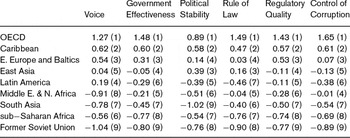
To show how the various regions of the world fare across the six governance indicators, I have presented the point estimates of the WGI according to the regions designated by the World Bank in Table 1. The highest rated regions across the six categories belong to the Organization for Economic Cooperation and Development (OECD), followed by the Caribbean and Eastern Europe and the Baltics. East Asia falls somewhere in the upper middle range of the world's regions. At the bottom are sub-Saharan Africa and the former Soviet Union.
Governance indicators across regions

Notes: The indicators are based on a −2.5 to 2.5 scale, with higher values indicating more positive perceptions. The number in parenthesis is the ranking of the region for the particular governance indicator. The regional classification is from the World Bank. Source: World Governance Indicators.
Table 1 also captures the positive and negative values for each of the regions. Here, the top four regions have positive values across all categories. In the case of East Asia, three of the six categories are positive; in Latin America only Voice is positive. For all of the remaining regions, every category of governance falls on the negative side of the scale.
By using the conceptual framework developed by Kaufmann and his associates, I am able to examine four of the six governance categories using the AsiaBarometer questionnaire. The categories I exclude because of lack of relevant data are Stability and Regulatory Quality. The first dependent variable, Voice, is an aggregated measure based on three relevant questions taken from the AsiaBarometer. It focuses on the extent that respondents are satisfied with the following rights in their country: (1) the right to vote; (2) the right to participate in any kind of organization; and (3) the right to gather and demonstrate.Footnote 6 To facilitate comparison, I have rescaled the AsiaBarometer responses for all four dependent variables using the same –2.5 to 2.5 scales employed for the WGI.Footnote 7 The negative and positive scores indicate, respectively, the positive and negative qualities of governance.
The second dependent variable, Effectiveness, is an aggregated measure based on three questions from the AsiaBarometer. It taps the extent that citizens trust the public education system and the public health system, and also how well they believe the government is dealing with the quality of public services. The contents of these questions are conceptually close to the WGI. Higher values on the scale indicate more positive evaluations.
The third dependent variable is a measure for Rule of Law. It is also an average taken from three AsiaBarometer questions. Specifically, it is based on the extent that respondents trust the legal system and the police, and how well they believe the government is dealing with the issue of crime. Finally, the fourth dependent variable, Control of Corruption, is a single-item question taken from the AsiaBarometer that asks respondents how well they think the government is dealing with the issue of political corruption. In the next section, I detail the independent variables used in the multivariate models.
Independent variables
Education
There are different theoretical expectations for the effect of education on perceptions. One plausible argument is that more highly educated citizens have better access to information from media sources and presumably possess more ‘accurate’ information concerning the multifaceted concept of governance in their country. Thus, we might argue that the highly educated will be more critical of their government than less educated citizens, particularly in countries where the government does not respect the basic political and civil rights of citizens (Anderson et al., Reference Anderson, Paskeviciute, Sandovici and Tverdova2005). However, there are obviously limits to the extent that governments will tolerate critical opinions. In some countries, for example, citizens may not be comfortable expressing negative opinions lest they attract the attention of security agents.
The notion and possibility of a ‘critical citizenry’ may also be a hallmark of democratic Asian countries such as Japan, South Korea, and Taiwan (Pharr and Putnam, 2000; Norris, 1999; Rose, Shin, and Munro, 1999: 154).Footnote 8 In these cases, highly educated citizens may be more inclined to criticize their government, despite the latter's ability to tout its accomplishments in improving the general welfare of the people. Some of this criticalness likely stems from the amount and nature of the available information about actual political conditions within the country reported by the media. It may also stem from the high expectations of citizens who feel disappointed with the government, despite the high standards they may enjoy. Lastly, the seemingly endless cycle of political corruption issues in many East Asian countries, for example, may generate some of the potential discontent (Pharr, Reference Pharr, Pharr and Putnam2000).
An alternative hypothesis views the effect of education on governance perceptions as positive. Indeed, higher levels of education may help cultivate civic values, trust, and satisfaction with democracy (Fuchs, Guidorossi, and Svensson, 1995: 336–337). Moreover, high levels of education are likely to be positively associated with high social and economic standing (Inglehart and Welzel, Reference Inglehart and Welzel2005: 37). This privileged portion of society might be expected to hold positive views of governance issues. The hypothesis tested here is simply whether education has a statistically significant effect in each of the seven countries. To the extent that the ‘critical citizens’ hypothesis may be correct, I might anticipate a negative relationship in many of the countries.
To capture the effect of education, the AsiaBarometer asks respondents about the highest level of education they have completed on a 1–6 scale, where a ‘1’ indicates primary school or below and a ‘6’ refers to graduate school or above. Because education systems differ widely from country to country, I opted to recode the education level on a 1–3 scale, where ‘1’ indicates low education and ‘3’ equals high.
Satisfaction with income
The next control measures respondents’ sense of economic well-being. The expectation is that respondents who express satisfaction with their current economic status will register more positive evaluations toward governance issues (Chang with Chu, 2006; Carlson, Reference Carlson, Tanaka, Sonoda and Dadabaev2006; Dalton, Reference Dalton2004). Specifically, I use an AsiaBarometer question that asks respondents to specify how satisfied or dissatisfied they are with their household income on a scale of 1–5. The values have been recoded so that higher values reflect greater satisfaction. To the extent that it matters that respondents’ reported satisfaction about their household income, I anticipate a positive effect for this measure.
Gender and age
Another important control variable is gender. The AsiaBarometer requests respondents to indicate their gender: all female respondents are coded with the value of ‘1’ and all males with ‘0’. There are different expectations for the effect of this measure. One claim is that women are more critical than men because they are more likely to face discrimination in areas such as the job market or health care (Peters and Wolper, Reference Peters, Wolper, Peters and Wolper1995; Anderson, 2005). However, the effect of gender also depends on broader socioeconomic factors in society, which are country specific and are not always easily captured in statistical analysis. Because gender differences may be manifested differently across the surveyed countries, the effect of gender can be expected to be either positive or negative.
We also include a control for the age group of respondents. This is a recoded variable on a scale of 1–5, where the youngest group (20–29 years old) is labeled ‘1’ and the oldest group (60–69 years old) is ‘5’. One hypothesis is that older respondents are more likely to have experienced a repressive government than younger respondents and consequently will be more critical of the government. However, much like the effect of gender, the effect of age may not be uniformly negative because of the diversity of history and of experiences with democracy and dictatorship among the seven surveyed countries.
Results of comparison of mean scores
A comparison of the AsiaBarometer and WGI is necessary to consider how experts and East Asian publics view the many facets of governance. This section uses a scale that runs from –2.5 to 2.5 to compare the average values for both data sets for each of the East Asian countries. The negative and positive values indicate, respectively, the positive and negative qualities of governance. Both sets of scores are available for all four categories of governance with the exception of Vietnam, where the questions were deemed too sensitive to ask in three of the four categories based in the AsiaBarometer.
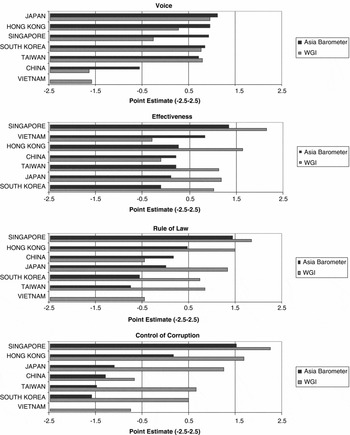
Figure 1 shows the mean values for the four perception measures by country with the WGI captured in black and AsiaBarometer in grey. By comparing the relative position of countries using the AsiaBarometer and WGI, it is possible to discern some trends about the various perceptions of governance.
Comparisons of AsiaBarometer and World Governance Indicators
Notes: No survey data for Vietnam in three of the four governance categories in the AsiaBarometer. Sources: AsiaBarometer and World Governance Indicators.

At the top of Figure 1 are the ratings for the Voice category. According to the AsiaBarometer, Japanese respondents show the most positive perceptions out of the surveyed countries. Hong Kong, Singapore, and South Korea follow Japan, with Taiwan and China in the last positions. As previously mentioned, AsiaBarometer does not have a score on this aspect for Vietnam, thus a direct comparison cannot be made for this dimension.
In a comparison between the AsiaBarometer values with those of the WGI, Japan also appears at the top in the Voice category. However, there are several major differences in the specific rankings of the countries. First, Taiwan replaced Hong Kong for the second most positive score, and Singapore dropped two places to just above Vietnam and China, the last placed countries. Second, the WGI point estimates capture a wider range of variation across the Asian countries. In the AsiaBarometer, for example, there does not appear to be significant differences across the point averages for the top five countries; in the WGI, the differences are more pronounced, particularly after the top scoring three countries of Japan, Taiwan, and South Korea.
We can also specify the countries with the most negative and positive scores to offer some general observations regarding the Voice category. The least favorable scores belong to China, suggesting that both experts and citizens are not satisfied completely with this element of governance. Although the AsiaBarometer lacks scores for Vietnam, the WGI scores reveal a similar level of dissatisfaction in Vietnam. With these exceptions and Singapore's negative WGI rating, the rest of the surveyed countries reflect positive evaluations for Voice. In sum, with the exceptions of China, Vietnam, and Singapore for WGI, the scores for Voice fall into the positive spectrum on the scales.
Below Voice are the scores for perceptions about Government Effectiveness. Of the four categories, this is the only one with both scores for Vietnam. The AsiaBarometer shows that Singapore, Vietnam, and Hong Kong hold the most favorable perceptions; the least favorable perceptions belong to South Korea, Japan, and Taiwan. Moreover, the most favorable scores fall into the positive range of the scale; among the countries with the least favorable perceptions, South Korea is the only case that registers a negative value.
The WGI data confirm the high and positive score for Singapore. In terms of how the remaining countries compare against each other, there are a few salient differences. In particular, Vietnam, which placed second highest in the AsiaBarometer data has the lowest WGI score, which is also the only score besides China's to fall on the negative side of the scale. Finally, Hong Kong places second instead of third, and Japan improves from sixth to third place.
When perceptions of Government Effectiveness with Voice are compared, two of the three countries with negative scores in both surveys belong to China and Vietnam. Singapore's negative WGI score is now in the positive range, whereas South Korea's positive WGI score falls just short of the positive range. Overall, WGI scores for Effectiveness are higher than Voice, and AsiaBarometer scores are generally lower on the Effectiveness scale. The gap between the public and the expert assessments appears to be wider for this aspect of governance, suggesting that the public may offer more critical assessments on the quality of public services and the quality of policy formulation and implementation in comparison to the variety of sources captured in the WGI scores.
For Rule of Law, Singapore and Hong Kong place at the top of the surveyed countries for both sets of scores, with Singapore capturing nearly a full point more for the AsiaBarometer score. China comes in third on the AsiaBarometer, but in last place for the WGI. The countries that fare the lowest for this category are Taiwan and South Korea, which have relatively similar scores for both surveys, with AsiaBarometer scores considerably lower than that of WGI.
Finally, the mean scores for the Control of Corruption category are listed at the very bottom of Figure 1. Once again, Singapore and Hong Kong lead the surveyed countries with the highest scores. In the case of Hong Kong's AsiaBarometer score, however, it should be noted that it is barely positive and registers as its lowest score for any of the four categories of governance. On the other hand, Singapore has its highest score here across all of the governance categories, which seems to attest to the efforts of its anti-corruption commission (Heilbrunn, Reference Heilbrunn2004: 5–7).
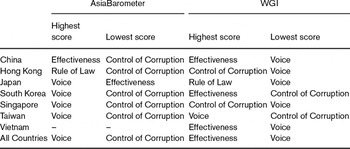
Another avenue for comparing and summarizing these data is to present the highest and lowest governance scores for each country and for the set of surveyed countries as a whole. This is done in Table 2 where it is easier to see similarities and differences for both the AsiaBarometer and WGI scores. In terms of commonalities, three of six countries with complete scores have at least one matching category. Both the AsiaBarometer and WGI place Effectiveness as China's highest scoring category. There is also convergence on Control of Corruption as the lowest scores for both South Korea and Taiwan. Interestingly, Taiwan is the only case where both the AsiaBarometer and WGI converge for the highest and lowest categories.
Highest and lowest scores for governance categories

Notes: The categories with the highest and lowest scores, respectively, are reported for each country for the AsiaBarometer and WGI.
In terms of differences, Hong Kong, Japan, and Singapore do not have any matches among the highest and lowest scoring categories. In the AsiaBarometer, Hong Kong citizens expressed the most positive responses for Rule of Law and the least positive for Control of Corruption. Yet for the WGI scores, Hong Kong's highest score was for Control of Corruption. In Japan, Voice has the highest score for the AsiaBarometer, but was the lowest for the WGI. Finally, Control of Corruption fared the lowest for Singapore in the AsiaBarometer, but received the highest WGI score. In a summary of the mean scores for all of the surveyed countries, it becomes clearer that the highest scoring category is Voice in the AsiaBarometer and Effectiveness in the WGI. For the lowest scores, the corresponding categories are Control of Corruption and Voice.
The comparisons between the AsiaBarometer and WGI suggest that the perceptions of governance by the general publics and experts sometimes, but not always, converge. This may reflect a genuine difference in perspectives and biases. Or the most divergent areas might suggest that governance perceptions rest in the eyes of the beholder. Measurement issues are another possible explanation, as the AsiaBarometer scores may not fully capture the content of the WGI. In the next section, it is essential to move beyond the country averages and use multivariate models that include variables measured at the individual level.
Multivariate analysis of governance perceptions by country
Citizens within the same country do not all have the same perceptions toward governance issues because of differences in circumstances and life experiences. Due to dissimilar political and economic systems and differences in history, what citizens think about governance issues in China, for example, is likely to differ from citizens in Japan, Hong Kong, or Taiwan. Moreover, it might be suggested that such basic differences between the countries are likely to complicate efforts to discern a clear common Confucian heritage across these countries, especially when analysis is at the level of individual respondents.
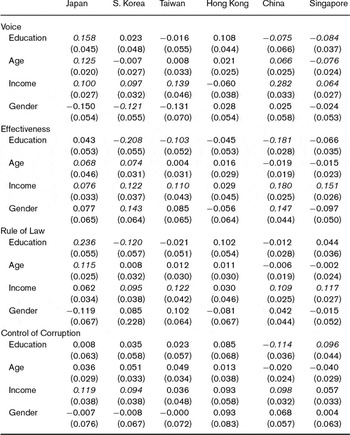
To examine how perceptions of governance differ within and across this set of Asian countries, it is essential to incorporate the independent variables detailed earlier in this article – education, age, gender, and satisfaction with household income. The dependent variables for this section are the four governance categories created using the AsiaBarometer Survey. Table 3 shows the results of these models. The effects of the independent variables are listed in the left column for each of the four governance categories, beginning with Voice.
Regression analysis of governance perceptions by country

Notes: Table entries are ordinary least squares coefficients with standard errors in parentheses. Statistical software used is Stata 9.0. Italicized values indicate p < 0.05. Source: AsiaBarometer.
The results for Japan are listed first. In examining the effects of the independent variables across each of the four governance categories, there is a positive and statistically significant effect for education in two of the four models, that is, Voice and Rule of Law.Footnote 9 This suggests that higher education translates into more positive evaluations for these two aspects of governance. Interestingly, this result conflicts with the ‘critical citizens’ hypothesis. In the case of age and income, there is also a positive and significant effect in three of the four models. For the former variable, this also conflicts with the interpretation that older respondents are more critical than younger respondents because they are more likely to have experienced a more repressive government.
When these effects for Japan are compared with other countries, the positive effects for education make it somewhat of an exceptional case. The only other two countries where education proved to be positive are Hong Kong and Singapore, but even here the effect is only statistically significant in one model. Japan also appears to have the most consistent effects for age; for most of the models age proved to be significant in only a handful of the models.
In contrast to Japan, the effects of education for South Korea are negatively correlated for two of the four governance items: Effectiveness and Rule of Law. This lends some support to the ‘critical citizens’ hypothesis. The only consistent effect across the models is that for income. Greater income satisfaction is positively associated with better governance perceptions. This is consistent with the effects of income in Japan, Taiwan, China, and Singapore. In a comparison of the effects for education between South Korea and the other countries, China is the only country where the effect of education is negative in more than one model.
In contrast to Japan and South Korea, the models for Taiwan and Hong Kong confirm a lack of significant results for education and age with the exception of education in the Voice model for Hong Kong. A positive effect for income is registered for respondents in Taiwan, but there is no effect in Hong Kong. In fact, Hong Kong is the only country where the income variable has no bearing on governance perceptions. One possible explanation is the relatively high per capita income that citizens in Hong Kong already enjoy. However, this explanation does not easily explain why the income satisfaction is significant in Singapore and Japan, which also have high per capita income levels.
Finally, the results for China and Singapore are reported in the last two columns. Although the effect for education is negative in three of the four models for China, the effects are inconsistent in Singapore. Education has a negative effect in the model for Effectiveness but a positive effect for Corruption, with no registered effects for the other two governance concepts. The only consistent effect across the models for Singapore is a positive effect for income.
The results of the multivariate models show that the most consistent effect that helps explain governance perceptions is respondents’ satisfaction with household income. In nearly all of the surveyed countries, the effect of this measure proved to be positive. The effects of education, age, and gender, however, captured either mixed or inconclusive results. In sum, this suggests that individual-level determinants of governance perceptions are considerably heterogeneous across this particular group of East Asian countries, which likely underscores significant country-level differences as well as the different circumstances and experiences faced by citizens in these countries.
In the final section of analysis, I have aggregated all of the individual-level variables for the set of surveyed countries into one model. I also include the country-level WGI as one of the independent variables. This analysis allows us to consider the effects of the individual-level measures of education, age, income and gender on ‘Confucian’ Asia as a whole. Moreover, the inclusion of WGI as an independent variable allows us to consider to what extent there is convergence or divergence between the perceptions of different governance perceptions.
Results of multivariate analysis for all countries
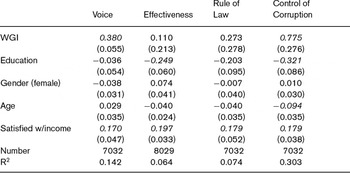
Following the previous models, the governance categories created from the AsiaBarometer are used as the dependent variables; the WGI along with the individual-level measures detailed earlier are the independent variables. The WGI point value for Voice, for example, is included in the model for Voice based on the AsiaBarometer. To the extent the concepts measured in the AsiaBarometer match the content of the WGI, it is hypothesized that there will be a statistically significant relationship. Table 4 shows the results of these models.
Regression of governance perceptions

Notes: Table entries are ordinary least squares coefficients with robust standard errors in parentheses. Statistical software is Stata 9.0 using the clustering option for the WGI. WGI is the point estimate from the corresponding category of each model. Italicized values indicate p < 0.05. Source: AsiaBarometer and World Governance Indicators.
Overall, the results confirm a positive association between the WGI and two of the governance categories: Control of Corruption and Voice.Footnote 10 In these two models, the strongest predictor is the WGI. The evidence partially suggests that the perceptions of governance from the AsiaBarometer are positively related to the WGI for at least some aspects of governance.Footnote 11 The results of Table 4 are consistent with the results of the country-by-country comparisons of average values based on Figure 1.
Beyond the effects for the WGI, the results of the individual-level control variables warrant discussion. In only two of the four models, the effect of education proved to be statistically significant and negatively correlated, suggesting that higher education levels contribute to more critical evaluations. A negative and statistically significant effect was also uncovered for the age variable in the model for Control of Corruption, which suggests that older respondents are more critical of governance issues than younger respondents for this specific dimension of governance.
The models also confirm a consistently strong and positive effect for the measure of respondents’ level of satisfaction with their household income. Greater satisfaction appears to be positively correlated with governance perceptions. It is likely that the causal direction between these variables travels both ways. Better governance perceptions may indicate better infrastructure or economic opportunities and hence greater satisfaction with household income. Finally, the models largely fail to confirm an effect for gender. This is largely consistent with the previous analyses conducted separately for each country.
Conclusion
Perceptions are important for two reasons. First, perceptions may lead to the creation of motivations for political action. In countries with repressive governments, feelings of discontentment among citizens may encourage actions that contribute to greater liberalization of the political and economic process. For this reason, it is extremely important to analyze the very perceptions held by experts and citizens across a variety of governance concerns such as the rule of law and the control of corruption. The hope is that future research on this topic might better link the perceptions held by citizens with specific political actions.
Second, perceptions are essential to study political phenomena that are otherwise difficult to quantify. The clandestine nature of political corruption, for example, is a case in point. The interest of institutional financial organizations such as the World Bank in perceptions data comes as no surprise given its utility in helping to establish a link between good governance and economic development. However, as I argue in this article, it is critical that scholars analyze and further disaggregate what governance means to elites and to citizens. The particular use of the AsiaBarometer, for example, provides a useful contrast with the WGI scores and allows us to consider the meaning of governance held by average citizens. It is not always clear, for example, that the Washington-based consensus of what constitutes good governance is in the same direction as that held by the many citizens and subgroups that live in East Asia and other regions of the world.
The analysis of the AsiaBarometer and WGI scores revealed several interesting results for the region of the world sometimes called Confucian Asia. The comparisons of mean scores at the country level were useful in discussing which governments are the best and worst performers for the various components of governance. One country could have high ratings in one category, but much lower rankings in another category. Moreover, the country-level comparisons captured some of the extent that citizens’ perceptions and the more expert-based ratings of the WGI are congruent with each other. Here, the basic comparisons were mixed as many examples of convergence and divergence were noted. Indeed, in the final multivariate analysis section, the results rather weakly suggested some degree of convergence in two of the four models. Future research will hopefully subject this hypothesis to a more rigorous test with a greater number of countries.
Beyond the country-level comparisons, the individual-level analyses suggested that citizen-based understandings of governance issues partly hinge on the particular life experiences and specific circumstances faced by individual respondents. Moreover, the effects for variables such as education and age often diverged considerably across the surveyed countries in East Asia, suggesting that the impact of the broader social, economic, and political processes on citizens in these countries are far from uniform. If there is a general impact of Confucian values on the seven surveyed countries examined above, it seems difficult to discern given the many sources of variation that exist at the country and individual levels.
With the continuing interest in evaluating the quality of governance in East Asia and other parts of the world, it is desirable that scholars and policymakers can better refine and measure the concept of governance and its various components. To offer a few tentative assessments, it is hoped that additional polling questions that can more fully examine the various components of governance might be incorporated into public opinion surveys. Second, if the goal is to better assess why evaluations of citizens and experts converge or diverge, it might be useful to include an elite panel into the survey itself. Likewise, organizations that collect elite-based data might be encouraged to better reveal more precisely how and why countries are assigned specific scores. Finally, as broad processes such as modernization and globalization proceed in East Asia and in other parts of the world, there is a need to measure the quality of governance by moving beyond the focus on the traditional borders of nation-states to regional subunits, where variation in terms of citizen and expert evaluations remains largely unexplored.