

Resilience: the concept
Commenting on the recent avalanche of both popular and academic writing on the topic, Ganong and Coleman (Reference Ganong and Coleman2002: 346) argue that we have recently entered the ‘age of resilience’. In this paper, we explore some key ideas about individual and social resilience from varied fields, and propose new ways to conceptualise these in relation to resilience in later life. We see these as important contributions to the field of critical gerontology, that broad area of scholarship that is ‘concerned with identifying possibilities for emancipatory social change, including positive ideals for the last stage of life’ (Moody Reference Moody, Cole, Achenbaum, Jakobi and Kastenbaum1993: xv).
Within the social sciences, resilience research is most strongly associated with the field of developmental psychology. Founded in the 1970s, resilience research had a focus on ‘survival’ and ‘adaptation’ and sought to challenge the grim determinism of much developmental psychology, with its (over) emphasis on the pathology that awaits those who experience hardship in their early lives. As Cicchetti and Garmezy relate:
Studies ranging from genetic and biological predispositions to pathology, to assaults on development associated with inadequate caregiving, graphically convey the multiplicity of risks that eventuate in psychopathology. Thus it is especially refreshing to explore the more optimistic component of the psychopathology–risk equation, namely resilience. (1993: 497)
These resilience researchers use a common vocabulary centred on the identification of ‘risks’ to human development, and the ‘protective factors’ (or ‘assets’) and ‘vulnerabilities’ in the lives of children (and more recently adults) that influence their ability to positively negotiate these adversities (Luthar and Cicchetti Reference Luthar and Cicchetti2000; Luthar, Cicchetti and Becker Reference Luthar, Cicchetti and Becker2000a; Masten Reference Masten2001; Rutter Reference Rutter1993).
There is much debate within this field about exactly what constitutes adversity or ‘risk’. The concept of risk is recognised to a certain extent to be a subjective or at least a relative phenomenon. What is considered to be a risk for some people in certain situations is harmless for others, and could even be an asset to particular individuals or groups (Luthar,Cicchetti and Becker Reference Luthar, Cicchetti and Becker2000a; Masten Reference Masten2001; Rutter Reference Rutter1993). Most resilience researchers interpret risk as an event or process that poses a serious threat to normal development (Masten Reference Masten2001; Masten et al. Reference Masten, Hubbard, Gest, Tellegen, Garmezy and Ramirez1999). Luthar and Cicchetti (Reference Luthar and Cicchetti2000: 858) define risks as ‘negative life circumstances’ that are ‘known to be statistically associated with adjustment difficulties’. Examples of childhood ‘risks’ commonly cited by resilience researchers include socio-economic disadvantage, exposure to violence, low birth weight, and chronic illness (Luthar and Cicchetti Reference Luthar and Cicchetti2000; Luthar, Cicchetti and Becker Reference Luthar, Cicchetti and Becker2000a; Masten Reference Masten2001; Rutter Reference Rutter1993). In older age, ‘risks’ or adversity might also include socio-economic disadvantage and elder abuse (Lowenstein Reference Lowenstein2009; Wilson Reference Wilson1997), along with bereavement (Bennett Reference Bennett2010; Bonanno, Wortman and Nesse Reference Bonanno, Wortman and Nesse2004), health challenges including dementia, depression and physical frailty (Braudy Harris Reference Braudy Harris2008; Grenier Reference Grenier2005) and changing social roles (Minkler and Holstein Reference Minkler and Holstein2008). Despite this emphasis on adversity, however, an increasing number of researchers are also using the concept of resilience to explore how people cope with ‘negative life events’ (Hildon et al. Reference Hildon, Montgomery, Blane, Wiggins and Netuveli2010), and even how individuals negotiate the more ordinary upheavals associated with normal ‘life transitions’ (Bauman, Adams and Waldo Reference Bauman, Adams and Waldo2001).
Similar debates proliferate about the definition and operationalisation of the concepts of protective factors, assets and vulnerabilities. Assets or protective factors are generally defined as factors that can assist an individual to avoid or mitigate the negative effects of a risk (e.g. a strong internal locus of control, or supportive social networks), while vulnerabilities are conceptualised as factors that increase an individual's susceptibility to the negative impacts associated with a risk (e.g. low intelligence, or social isolation) (Luthar and Cicchetti Reference Luthar and Cicchetti2000; Luthar, Cicchetti and Becker Reference Luthar, Cicchetti and Becker2000a; Masten Reference Masten2001; Rutter Reference Rutter1993).
The first ‘wave’ of this psychology-based resilience research tended to focus primarily on the personality characteristics or ‘traits’ of individuals that enable them to survive hardship. More recently, however, this work has expanded to explore the processes through which people attain these characteristics (Bennett Reference Bennett2010; Richardson Reference Richardson2002; Wiles et al. Reference Wiles, Wild, Kerse and Allenin press). This move from traits to processes of adaptation has also been accompanied by greater consideration of the role of environmental factors in the development of coping resources, with resilience characterised as a process of ‘person–environment’ interaction (Sapountzaki Reference Sapountzaki2007) that enables individuals to adapt to hardship.
In general, resilience researchers within the developmental psychology tradition are interested in positive adaptation to adversity, in ‘maximising potential and well-being among at risk individuals’ (Luthar, Cicchetti and Becker Reference Luthar, Cicchetti and Becker2000b: 574). This focus is in contrast to earlier psychology research that tended to have an emphasis on avoidance of disease and ill-health (Fries Reference Fries, Baltes and Baltes1990), and the ‘evasion of serious psychiatric disorder’ (Luthar, Cicchetti and Becker Reference Luthar, Cicchetti and Becker2000b: 574). Resilience research is credited with reinvigorating the positive psychology movement (Masten Reference Masten2001), with its emphasis on ‘thriving versus merely surviving’ (Bauman, Adams and Waldo Reference Bauman, Adams and Waldo2001: 5). Resilience researchers have also argued for further expansion of the concept to incorporate the potential for ‘growth’ as a result of, not just in spite of, the experience of adversity – i.e. the idea that new skills are learnt and insights gained through coping with difficult circumstances (Richardson Reference Richardson2002).
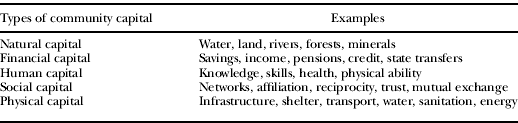
In addition to this body of research on resilience at an individual level, there is also some interest in economic resilience (Rose Reference Rose2004), and an emerging and relevant body of work on social or community resilience. (The terms ‘social’ or ‘community’ resilience are often used interchangeably.) This literature is in part indebted to the ecological sciences, based as it is on the idea of communities as organic, balanced ‘ecosystems’ vulnerable to the destabilising influence of external risks. Ideas about social or community resilience have risen to prominence within both academic and popular writing, against a backdrop of increasing anxiety about ‘risk’ in Western societies (Beck Reference Beck1992; Ganong and Coleman Reference Ganong and Coleman2002; Giddens Reference Giddens1999). Concerns about the ability of ‘vulnerable’ societies to adapt to large-scale environmental risks like climate change have been a major focus of this literature (see e.g. Folke Reference Folke2006; Folke and Rockström Reference Folke and Rockström2009; Marshall Reference Marshall2010; Pelling and Uitto Reference Pelling and Uitto2001; Sapountzaki Reference Sapountzaki2007). While this body of writing is often concerned with the more extreme ends of the risk and adversity spectrum, the researchers within this field provide useful discussion about the types of ‘assets’ that enable communities as well as individuals to ‘thrive’ and adapt well to change. Sapountzaki (Reference Sapountzaki2007: 280), for instance, lists the major types of community ‘capital’ that form the foundation of social resilience, outlined in Table 1.
Types of community capital that underpin social resilience
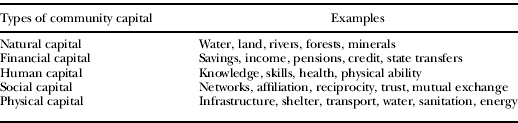
Source:Sapountzaki (Reference Sapountzaki2007: 280).
The notion of types of community capital usefully draws attention to the need to focus on broader resources and structures that may contribute to an individual's resilience. For example, one's ability to ‘bounce back’ from personal adversity may be hampered by inadequate transport to reach social networks or support, or alternatively enhanced by being able to access a tranquil natural setting or a comfortable home. A recent review of resilience scales (Windle, Bennett and Noyes Reference Windle, Bennett and Noyes2011) identifies the lack of attention paid to family and community resources as a major weakness of existing attempts to create a valid measure of the concept.
Amongst researchers and policymakers concerned with wellbeing and sustainability, resilience is increasingly being positioned as a new concept that complements or even provides an alternative to these traditional concepts (Bacon et al. Reference Bacon, Brophy, Mguni, Mulgan and Shandro2010). The notion of social or community resilience is also becoming more popular in public health research. A number of researchers within the health field (e.g. Ahmed et al. Reference Ahmed, Seedat, van Niekerk and Bulbulia2004; Davis, Cook and Cohen Reference Davis, Cook and Cohen2005; Zautra et al. Reference Zautra, Hall and Murray2008) have pointed to existing work on ‘social capital’, in particular, as a central candidate for assisting us to develop indicators of community resilience:
The last two decades have given way to an outcropping of research on community resources that foster resilience. At the forefront of this research, extensive examinations of social capital have underscored the importance of social trust, reciprocity, neighbourhood efficacy, and civic engagement in many aspects of community life. … Not surprisingly given the importance of social support and personal mastery as resources that promote adaptation to the most stressful situations, social connectedness and cohesion have been shown to be linked to greater vitality and stability in communities. (Zautra et al. Reference Zautra, Hall and Murray2008: 48)
Population health researchers Davis, Cook and Cohen (Reference Davis, Cook and Cohen2005) argue that, in addition to high levels of social capital, the other key components of community resilience that foster positive health outcomes include high-quality built environments, good access to culturally relevant social services, and low levels of socio-economic stratification.
Despite the burgeoning of literature devoted to the topic of resilience, there is still, however, a lack of consistency in how the concept is used and defined, and how common vocabulary such as ‘risk’, ‘assets’, ‘vulnerabilities’ and ‘protective factors’ are employed. Researchers in the fields of individual or community resilience remain largely separate, reducing opportunities for conceptual consistency or further theoretical innovation. Luthar, Cicchetti and Becker (Reference Luthar, Cicchetti and Becker2000a) argue that this problem is not new, that resilience research in general has long suffered from a lack of internal theoretical consistency which, they believe, reduces opportunities for the use and development of the concept. They contend that as a concept aligned with efforts to ‘redress … human suffering or social inequities’, resilience, like ‘empowerment’, is at risk of becoming the latest poorly conceptualised emancipatory buzz-word, with a ‘ring of virtue and unquestioned morality [that] outpace[s] [its] scientific bases in rigorous empirical and theoretical efforts’ (Luthar, Cicchetti and Becker Reference Luthar, Cicchetti and Becker2000a: 556).
Despite these concerns, however, it is clear that many gerontologists consider the concept of resilience useful for exploring how older people negotiate the adversities associated with later life. While early resilience research focused primarily on the experiences of children, later life has been identified as a key area for future research in the field (Bauman, Adams and Waldo Reference Bauman, Adams and Waldo2001; Luthar, Cicchetti and Becker Reference Luthar, Cicchetti and Becker2000a). However, while resilience is increasingly conceptualised as a resource available to people at all stages of life (Cichetti and Garmezy Reference Cicchetti and Garmezy1993; Luthar, Cicchetti and Becker Reference Luthar, Cicchetti and Becker2000a; Seccombe Reference Seccombe2002), there is as yet no common understanding of what might be distinctive or unique about the experience of resilience in later life. With a small but growing body of research on resilience and ageing emerging, it seems opportune to reflect on the possibilities and challenges associated with using the concept within critical gerontology. Given the ongoing complaints about the lack of theoretical rigour within gerontology in general (Daatland Reference Daatland and Anderson2002; Sahoo, Andrews and Rajan Reference Sahoo, Andrews and Rajan2009), and critical ageing research in particular (Katz Reference Katz, Biggs, Hendricks and Lowenstein2003), it is useful to consider the potential for future theoretical development within this emerging area of research interest.
Resilience: gerontologists engage with the concept
The emphasis on the ‘strengths’ of individuals, families, and communities has been one of the major drawcards of the concept of resilience to critical social scientists (Brodsky Reference Brodsky1999; Canvin et al. Reference Canvin, Marttila, Burstrom and Whitehead2009). This focus has also been attractive to gerontologists, many of whom seek to explore how older people deal with the ‘multiple losses’ (Bauman, Adams and Waldo Reference Bauman, Adams and Waldo2001: 2) of older age, and how these experiences help to constitute them as the ‘strongest of the strong’ (Hamarat et al. Reference Hamarat, Thompson, Steele, Matheney and Simons2002: 365). As Browne, Mokuau and Braun argue:
In contrast to the focus on adversities, deficits and pathologies, so common in gerontology scholarship, resiliency theory draws from the strengths perspective, a philosophical standpoint that recognizes the inherent power and resilience of individuals and communities. (2009: 255)
While much of the work on successful ageing (Rowe and Kahn Reference Rowe and Kahn1998) is seen as an important move away from pathology-orientated models focused on the treatment of problems, it can be argued that most of this work is still concerned with overcoming or avoiding problems (Scheidt, Humphreys and Yorgason Reference Scheidt, Humphreys and Yorgason1999). In contrast, the resilience literature is more explicitly focused on exploring the experience of rather than the avoidance of vulnerability (Felton and Hall Reference Felton and Hall2001). The concept of resilience is positioned as providing greater opportunity to acknowledge the ways that older people thrive in spite of and even at times because of their experience of these difficulties.
Beyond general agreement that resilience provides a useful corrective to the tendency to focus on the negative aspects of ageing, there is limited convergence about what additional theoretical resources the concept offers to gerontology. In addition to a welcome focus on assets and strengths, the concept of resilience has also been attractive to at least some critical ageing researchers because it foregrounds universal, everyday processes, the ‘ordinary magic’ (Masten Reference Masten2001) of human adaptation, rather than what some consider to be more exclusionary aspirational goals associated with successful ageing. Gattuso (Reference Gattuso2003), in particular, argues that unlike successful ageing, which is not achievable by all and therefore effectively creates an elderly elite, resilience is open to everyone; it is an integral part of human experience. Braudy Harris agrees, arguing that with resilience as our aim:
[A]ll older adults have the possibility of achieving it. We can be inclusive, not exclusive. Developing resilience is possible for many older adults regardless of social and cultural backgrounds or physical and cognitive impairments, unlike successful aging. (2008: 59)
Gerontologists interested in the concept of resilience have engaged primarily with the developmental psychology tradition of resilience research, placing primary, although not exclusive, emphasis on individual personality traits that promote inner strength. Tools for measuring resilience have been developed, although a recent review found no ‘gold standard’ out of 15 resilience scales (Windle, Bennett and Noyes Reference Windle, Bennett and Noyes2011: 17). Wagnild and Young's (Reference Wagnild and Young1993) Resiliency Scale has been popular. This 25-item questionnaire (short form 11 items), originating from a study of older women, measures individual resilience as five components of inner strength including equanimity, perseverance, self-reliance, meaningfulness, and existential loneliness. Each item is rated on a type of Likert scale, with higher scores reflecting high resiliency. Wagnild (Reference Wagnild2003) defines resilience as a personality characteristic that moderates the effects of stress and promotes adaptation, which is associated with better health and successful ageing.
Fitzpatrick and Vacha-Haase (Reference Fitzpatrick and Vacha-Haase2010), drawing upon Wagnild and Young's research, equate resilience with ‘internal hardiness’, emphasising the importance of personality characteristics such as the flexibility to adapt to change or a realistic outlook. Bonanno (Reference Bonanno2004) has also explored the role that ‘hardiness’ plays in enabling people to remain resilient in the face of bereavement, a common source of trauma in later life. His definition of hardiness contains three components: a sense of meaningful purpose, a belief that you can influence your surroundings, and the ability to learn from both positive and negative experiences. Bonanno (Reference Bonanno2004) also points to repressive coping strategies, positive emotions, and laughter as other important contributors to psychological resilience.
Beutel et al. (Reference Beutel, Glaesmer, Wiltink, Marian and Brähler2010), who also use Wagnild and Young's short-form Resiliency Scale, define resilience as the achievement of positive psychological outcomes despite suffering from life events expected to cause ongoing suffering and distress. They define resilience ‘operationally’ as the ability to use internal and external resources successfully to adapt to developmental tasks (Beutel et al. Reference Beutel, Glaesmer, Wiltink, Marian and Brähler2010: 32).
Despite its wide application, there is concern that the psychometric properties and component definitions of Wagnild and Young's scale could be improved (Windle, Bennett and Noyes Reference Windle, Bennett and Noyes2011). A scale deemed slightly more robust psychometrically is the Connor-Davidson Resilience Scale (Campbell-Sills and Stein Reference Campbell-Sills and Stein2007), an intervention-oriented measure that has not yet been widely used with older adults and focuses on individual-level resilience. The Psychological Resilience Scale (Windle, Markland and Woods Reference Windle, Markland and Woods2008) was based on secondary data from 50–90-year-olds in Britain. The data showed that individual resilience, measured using the constructs of self-esteem, personal competence, and interpersonal control, may moderate the negative effects of illness on feelings of wellbeing (Windle, Woods and Markland Reference Windle, Woods and Markland2010). The authors acknowledge that they could have potentially used other measures had the data been available, and that the construct of psychological resilience per se ‘has not been fully validated’ (Windle, Markland and Woods Reference Windle, Markland and Woods2008: 291). They wonder about the potential role of factors such as spirituality/religion and self-acceptance, which were not covered in the original data collection. A more intrapersonal scale is the Norwegian Resilience Scale for Adults (Friborg et al. Reference Friborg, Hjerndal, Rosenvinge and Martinussen2003) in which social support systems are measured as well as personal behaviours and attitudes in adults (although not specifically older adults).
Other ageing researchers, however, conceptualise resilience as influenced by a combination of both environmental and individual factors and resources. Rather than using measurement tools and questionnaires, resilience is positioned as a negotiated ‘process’ (for example of achieving balance between negative and positive factors), rather than a trait that is either in existence or not. Nakashima and Canda (Reference Nakashima and Canda2005), for example,conducted in-depth work on resilience with 16 older palliative care patients. They develop a multidimensional view of what characterises resilience in later life, arguing that this includes not just an individual's ability to cope with adverse circumstances in ways that enable them to maintain normal functioning, but also in ways that facilitate continuing growth. Their model emphasises the importance of balance between adequate care-giving resources and personal strengths carried over from previous life experience, as well as the importance of internal processes (such as life narratives and dialetical tensions) that drive the development of resilience in later life. In particular, they highlight the ways that storytelling amongst older people is used to recall how they overcame difficulties in the past and mobilise themselves to confront current adversities. They also highlight the emotional work older people do to balance the tension between resistance and surrender within the dying process. Whilst their participants were determined to fight against the negative impacts of their illness, each one also strove to accept their mortality and ‘go with the flow’ in their daily lives. Many also reported experiencing growth through the dying process, including the development of new valued personal qualities, improvements in relationships with loved ones, and new spiritual beliefs (Nakashima and Canda Reference Nakashima and Canda2005).
Gattuso's (Reference Gattuso2003) work is similarly concerned with how older people use storytelling or ‘life review’ and, in particular, narratives about loss and coping in the ‘construction or reconfirmation’ of a sense of self as resilient (Gattuso Reference Gattuso2003: 176). In line with Temperley (Reference Temperley and Bronstein2001), she argues that ‘repeated reconciling with loss’ experienced over a lifetime confers a degree of ‘emotional maturity’ that enables older people to cope better with adversity (Gattuso Reference Gattuso2003: 172). Thus resilience is positioned as cumulative, as a process honed by a lifetime of adaptation to hardship. Gattuso argues that ageing itself ‘can confer a sense of wellness growing from a kind of wisdom that prizes endurance and acceptance, rather than being founded in indicators of health’ (Gattuso Reference Gattuso2003: 173).
Braudy Harris's (Reference Braudy Harris2008) work on the ability of individual older people to negotiate risk also balances recognition of the impact of both individual and environmental resources. She utilises a conceptual framework familiar to resilience researchers within developmental psychology, providing two case studies of older people with dementia in which she seeks to catalogue the risks, assets, vulnerabilities and protective factors that influence the ability of these individuals to live well with Alzheimer's disease. Assets are defined as resources within the person (human capital), such as effective coping strategies or a positive attitude; a person's social networks (social capital), such as family; and resources within the community, such as specialist Alzheimer support services. Protective factors and vulnerabilities are conceptualised as positive or negative factors affecting the ability of at-risk individuals in particular (as opposed to any individual, whether at risk or not) to overcome adversity. For her participants, protective factors included close relationships with daughters or the adoption of a ‘person-centred’ approach to dealing with the diagnosis within the family (Braudy Harris Reference Braudy Harris2008).
While the above authors have looked to resilience research for fresh ideas and resources to extend gerontological scholarship, other ageing researchers have sought to make the case for the contribution that existing research and debates within gerontology can make to the field of resilience research. For example, Staudinger, Marsiske and Baltes (Reference Staudinger, Marsiske and Baltes1993) seek to situate the notion of resilience within wider debates in lifespan theory about ‘reserve capacity’ (internal and external resources such as cognitive abilities, health, social networks and finances) and ‘plasticity’. They position resilience specifically as a type of ‘plasticity’ or flexibility, in particular the ability to utilise internal and external reserve capacity to avoid risk-related pathology. They contrast this emphasis on avoiding negative developmental outcomes (or maintenance) with what they consider to be lifespan theory's rather more ambitious goal of reaching ‘optimal’ development and achieving growth. They argue that the concept of resilience is particularly important to the study of old age because, due to the frequency of loss in later life, more reserve capacity is used up on the task of ‘resilience’, leaving less available to pursue ‘optimal’ development.
Staudinger, Marsiske and Baltes (Reference Staudinger, Marsiske and Baltes1993) characterise lifespan development as both multi-dimensional and multi-directional, in that an individual may experience both gains and losses, and may develop resilience in one domain or time period but not others. They argue that their definition of resilience emphasises the person-in-context, and thus those using the construct should be specific about the domain of functioning in which they are examining resilience and the markers for assessing resilience. Their work is useful because they highlight the contribution that existing gerontological research has already made to highlighting the resilience ‘advantage’ experienced by older people. They contend that existing gerontological research shows that while older people may experience greater adversity than younger people, they also have more developed resilience resources in the form of more advanced coping strategies. They also highlight the importance of age-friendly environments to supporting resilience in later life.
Also situating their research within debates in lifespan theory, Bauman, Adams and Waldo's (Reference Bauman, Adams and Waldo2001) qualitative research uses ‘life review’ to identify major ‘transitions’ in the lives of older people, and to ask them to provide their own definitions of the meaning and characteristics of resilience in relation to managing these upheavals. Bauman, Adams and Waldo (Reference Bauman, Adams and Waldo2001) conclude from their participants’ comments that resilience should be characterised as a ‘behavioural repertoire’ that includes ‘cognitive strategies’, ‘social support’, ‘spiritual practice’, and ‘involvement’ in community life.
Both Bauman, Adams and Waldo (Reference Bauman, Adams and Waldo2001) and Gattuso (Reference Gattuso2003) argue that providing older people with at least some opportunity to have input into the definition of resilience is necessary. This is consistent with the call from many critical ageing researchers for greater involvement of older people in the development of research concepts and projects (Bowling and Dieppe Reference Bowling and Dieppe2005; Phelan et al. Reference Phelan, Anderson, Lacroix and Larson2004; Reichstadt et al. Reference Reichstadt, Sengupta, Depp, Palinkas and Jeste2010; Wiles et al. Reference Wiles, Leibing, Guberman, Reeve and Allen2011). In contrast, however, Baltes and Baltes (Reference Baltes and Baltes1993: 6) argue that subjective measures are ‘necessary but not sufficient’ definitions, pointing out that while indeed the perceiving self ‘ought to be the litmus test’ for quality of life, the usefulness of subjective criteria is somewhat undermined by the extraordinary plasticity and adaptive capacities of the human self to adapt subjective assessments to objectively quite diverse conditions.
Finally, Browne, Mokuau and Braun's (Reference Browne, Mokuau and Braun2009) research on adversity and resilience in the lives of native Hawaiian elders takes a different approach to much of the resilience literature. They conceptualise resilience as a collective, rather than individual, process or resource that is grounded in cultural values and traditions:
Rather than viewing resiliency as a quality found only in an individual or a group of people, Native Hawaiian scholarship has consistently indentified their cultural values and traditions as resiliency factors to their people. (Browne, Mokuau and Braun Reference Browne, Mokuau and Braun2009: 255)
Browne, Mokuau and Braun (Reference Browne, Mokuau and Braun2009) employ a lifecourse approach to identify the key adversities faced by four cohorts of Native Hawaiian elders. Here the focus is on macro-level adversities such as those associated with colonisation (loss of land, infectious diseases, outlawing of native religion, destruction of local governance systems); wars (the bombing of Hawaii in World War II); declining land affordability; changes to family structures; and new health problems like obesity, hypertension, cancer and heart disease. These adversities are counterposed with examples of collective resilience such as the establishment of health, education and housing services by and for Native Hawaiians; the revival of Hawaiian culture and language; and moves towards the return of federal lands and partial self-determination for Hawaiian people (Browne, Mokuau and Braun Reference Browne, Mokuau and Braun2009).
Windle, Bennett and Noyes's (Reference Windle, Bennett and Noyes2011) review of resilience scales identifies the general lack of attention paid to cultural variability in experiences and measures of resilience as an ongoing weakness in this field of research. Browne, Mokuau and Braun's (Reference Browne, Mokuau and Braun2009) work is thus valuable, and unusual, in giving serious consideration to the impact that wider social-structural factors have on individual resilience. Despite the fact that most resilience researchers position the concept as a theory of ‘person–environment’ interaction, the ongoing under-theorisation of the role that wider contextual and ‘structural’ factors play in resilience continues to limit its potential usefulness to critical gerontology.
Personal factors rather than social resources dominate the list of resilience resources. The following section explores the limitations associated with this (over)emphasis on personal qualities and experience within debates on resilience and ageing.
Resilience: the challenges
Cognitive resources and (to a lesser extent) social connections still remain the primary focus of most resilience research. A number of authors are critical of the individualism and conservatism of much resilience research, arguing that there is the need for greater exploration of the role that social difference and social inequality play in limiting or enabling access to resilience resources (Canvin et al. Reference Canvin, Marttila, Burstrom and Whitehead2009; Massey et al. Reference Massey, Cameron, Ouellette and Fine1998; Seccombe Reference Seccombe2002).
Seccombe (Reference Seccombe2002), in particular, argues that the decisions made by states about things like provision of public services, housing, income support, and employment law all influence the amount of risk that individuals (and low-income people in particular) are exposed to, as well as the degree of access people have to resilience resources to deal with this risk. She argues that resilience is a ‘social good’, and that the most successful societies ‘have changed their social structure so that all people can have relatively equal access to that good’ (Seccombe Reference Seccombe2002: 392). Seccombe concludes that in order to be useful to critical social scientists, resilience research must become less concerned with assisting people to ‘beat the odds’ and more concerned with ‘changing the odds’ that put people at risk in the first place:
[R]esiliency will be enhanced more by keen attention to national economic policies than by focusing upon individual personality characteristics, family attributes, or even unique community features. (Seccombe Reference Seccombe2002: 384)
Sapountzaki is also critical of the individualism of much resilience research, arguing that the popularity of the term is consistent with the neoliberal emphasis on divesting the state of responsibility for risk:
[T]his transfer of responsibility for risk assessment and management decisions to the individual keeps pace with wider processes of individualization and … state power shrinkage. (2007: 284–5)
In addition, Sapountzaki (Reference Sapountzaki2007) asserts that as well as considering the impact that the community has on the resilience of the individual, it is equally important to examine the impact that individual efforts to remain resilient have on the vulnerability and resilience of the community. She contends that individual efforts to reduce vulnerability inevitably impact on the resilience and resources available to others, as well as to the collective; and, as such, resilience needs to be acknowledged as a form of ‘vulnerability redistribution’:
Resilience practices of individual social actors have been widely acknowledged as means of reducing their vulnerability. It comes as a surprise though, that there has not been any reflection on the probable impacts of these practices on collective vulnerability or that of other individuals. … Social actors are interdependent, therefore fluctuations in anyone's vulnerability is expected to involve changes in the vulnerability of others and of the whole community system. (Sapountzaki Reference Sapountzaki2007: 285)
Thus the resilience of individuals should not be viewed in isolation. As well as concerns about the individualism within much resilience research, a number of writers have also questioned its conservative focus on ‘adaptation’ and maintaining ‘normal’ trajectories of development. This emphasis, it is argued, privileges adaptation that results in people fitting into pre-existing structures, rather than challenging these structures. As Massey et al. contend:
Valuing social competence and compliance over expressions of personal agency would bias who gets the label resilient towards those most likely to conform, overlooking those most likely to critique. (1998: 339)
Massey et al. (Reference Massey, Cameron, Ouellette and Fine1998) maintain that if the concept of resilience is to be useful to critical theorists, then notions like the development of ‘critical consciousness’, or ‘becoming aware of one's position in an oppressive hierarchy’ (Massey et al. Reference Massey, Cameron, Ouellette and Fine1998: 339), need to be recognised as equally important ways to respond to risk and adversity. Staudinger, Marsiske and Baltes (Reference Staudinger, Marsiske and Baltes1993) also raise concerns about the normative nature of many assessments about risks and resilience in old age. They assert, for example, that while ‘dependency’ is still consistently seen as a negative outcome for older people, it actually often provides a number of new assets, including freeing up resources for other activities, new social connections, and a decline in risks or adversities such as the stress associated with everyday life management (Staudinger, Marsiske and Baltes Reference Staudinger, Marsiske and Baltes1993: 561).
Some of these concerns about resilience research could at least partly be addressed by forging closer links with the research on social resilience produced by sustainability, public health, and community development writers. This would provide scope for greater recognition of the structural constraints that set the parameters of individual resilience. In addition, a convergence of these bodies of thought would also provide greater possibilities for recognition of indigenous conceptualisations of resilience, which tend to situate resilience more firmly within the collective than the individual, as outlined by Browne, Mokuau and Braun (Reference Browne, Mokuau and Braun2009) above, and others (Clauss-Ehlers Reference Clauss-Ehlers2003; Fraser, Richman and Galinsky Reference Fraser, Richman and Galinsky1999; Miller and MacIntosh Reference Miller and MacIntosh1999; Sonn and Fisher Reference Sonn and Fisher1998; Tse and Liew Reference Tse and Liew2004).
Resilience: the way forward for critical gerontology
Responding to critiques of traditional conceptualisations of resilience, the following five principles point to ways forward for the use of the concept within critical ageing research and to enhance the potential of resilience as a useful conceptual resource for critical gerontology.
1. Recognise the interdependence of individual and social resilience
Research on resilience and ageing needs to treat both individual resilience as well as social or community resilience as equally important, and interdependent, units of analysis. Most studies on resilience, even where they do consider the role of community, analyse it only in terms of the impact that it has on individual resilience. However, the health of communities or population groups is an important object of analysis not just because of the impact that community resilience has on the resilience of individual older people, but because older people as a group make a significant contribution to building up and maintaining community resilience.
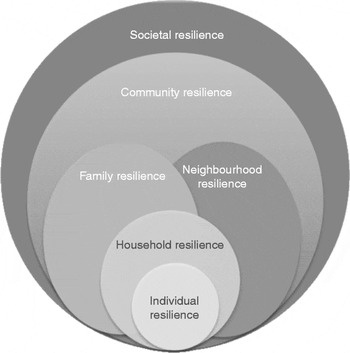
Resilience within a critical ageing perspective needs to go beyond the individual to explore how different scales (or levels) of resilience make sense to the exploration of the lives of older people. Most traditional resilience research in psychology is concerned with the micro-level of resilience of individual children and families: i.e. dealing with the risks and adversities associated with childhood and early to middle adulthood. In contrast, most of the current resilience research within the sustainability, public health, and community development fields is concerned with macro-levels of socio-economic and environmental resilience. Neither body of writing currently provides the conceptual resources to think about resilience ‘in place’ for older people. Given the importance of community, households and neighbourhoods in discussions of the experience of older people, perhaps a useful way to conceptualise resilience and old age within a critical ageing framework might look something like Figure 1.
Resilience as contextual and collective: scales of resilience in later life.

Figure 1 situates individual resilience within overlapping and inter-related scales of household, family, neighbourhood and community resilience, recognising that each of these contributes to (and potentially detracts from) any of the other scales of resilience.
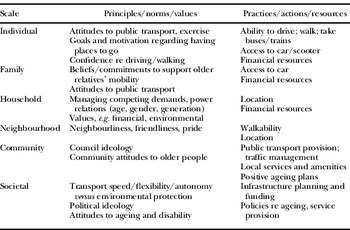
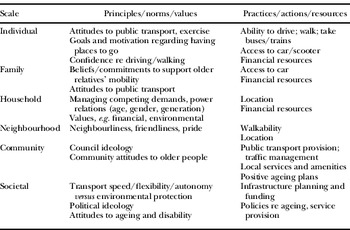
For example, ‘mobility resilience’ might refer to an individual's personal mobility in terms of whether they are able to walk, whether they have a car, or whether they are physically fit, but also to broader environmental elements of mobility, such as whether there is an accessible high-quality public transport system or other forms of collective transport, whether a neighbourhood has high ‘walkability’, or what road conditions are like and the degree to which a person feels safe to use them (many older people for example may technically ‘drive’, but choose to do so at quite specific times of day along carefully planned routes where they will not encounter high-density traffic).
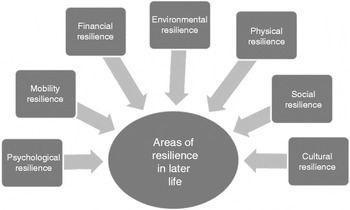
As well as recognising the different scales of resilience, we argue that models of resilience in later life also need to recognise the different ‘areas’ where resilience may be occurring or being undermined (see Figure 2), in line with Staudinger, Marsiske and Baltes (Reference Staudinger, Marsiske and Baltes1993) and others (Sanders, Lim and Sohn Reference Sanders, Lim and Sohn2008; Tusaie and Dyer Reference Tusaie and Dyer2004).
Some important areas of resilience in later life.
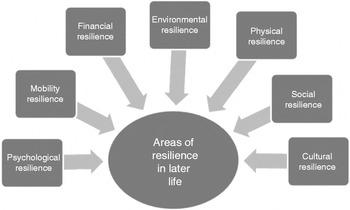
We could think of resilience as operating across a number of different areas of life, which may or may not overlap or interact. Therefore we may think of a person or group as being socially or environmentally resilient, but they may not necessarily be financially resilient or emotionally resilient, as in Figure 2.
In addition, the scales and areas operate interactively, as outlined in Table 2, which elaborates on the example of mobility resilience discussed above. That is, at each scale, there is also reciprocal interaction between principles and practices (e.g. personal or societal positive attitudes towards exercise which are mitigated/promoted by opportunities for exercise such as physical ability or accessibility of good pavements for walking). Moreover, the different scales interact (e.g. a person may be committed to public transport on principle, but a government may not share the principle so public transport may be limited).
Influences on mobility resilience
2. Recognise that resilience is not a ‘zero-sum’ equation
As Sapountzaki (Reference Sapountzaki2007) argues, resilience often involves a degree of vulnerability ‘redistribution’. An increase or decrease in the resilience of one individual can strengthen or weaken the resilience of others, or even the resilience of the same individual at a later point in their life. Thus, for instance, the use of private transport may increase the resilience of older people with minor health problems or disabilities, but may undermine the development of public transport services that are crucial to the resilience of older people who can no longer drive or afford to maintain a car.
At the same time, increased resilience for one individual or group does not always detract from that of others, and indeed may enhance it. For example, environmental design that is good for older people, such as traffic calming, careful attention to roadside kerbs and the quality of paths, or well-designed park spaces, is also good for young children and people using prams or wheelchairs. Policies which support older people could potentially go one way or the other, depending on how much thought is put into the flow-on effects. For example, policies for providing care-giver allowances or patient-centred allowances, retirement age policies and pension rates may allow increased spending, but also shrink the available pension pool; housing policies may encourage home ownership and savings, but reverse mortgages may create greater opportunities for spending and affect intergenerational transfers of wealth. All of these have the potential to change, for better or worse, the social structures and systems of inequity which lead to greater or lesser normalisation of what it means to grow older and to be resilient.Critical gerontologists need to provide adequate recognition of the power differentials involved in access to resilience resources; and, as Seccombe (Reference Seccombe2002) argues, play our part in ‘changing’ these unequal odds.
3. Ask older people to define what resilience means to them
Critiques of the power of theories of resilience and ‘adaptation’ to normalise particular trajectories of development for older people can at least partly be addressed by asking older people to contribute to the debate over how resilience should be defined and fostered. A number of useful qualitative studies on resilience (Bauman, Adams and Waldo Reference Bauman, Adams and Waldo2001; Canvin et al. Reference Canvin, Marttila, Burstrom and Whitehead2009; Gattuso Reference Gattuso2003; Massey et al. Reference Massey, Cameron, Ouellette and Fine1998; Wiles et al. Reference Wiles, Wild, Kerse and Allenin press) provide good examples of this principle in action. Older people's definitions tend to be more multi-dimensional, nuanced, contextualised, and attentive to balance and tension than the rather more narrowly focused normative definitions often used by researchers.
4. Look for expressions of resilience that are currently ignored or undervalued within traditional accounts of the phenomenon
Canvin et al.'s (Reference Canvin, Marttila, Burstrom and Whitehead2009) research on resilience and urban poverty, in particular, provides an excellent, and relevant, discussion on the importance of documenting the ‘hidden resilience resources’ of low-income and marginalised populations. For instance, they discuss the wide range of skills and competencies that poorer people, in particular, demonstrate and develop through negotiating with service providers to get their needs met:
Public services could be sources of adversity for many of our participants yet dealing with services is rarely acknowledged as a skilled activity undertaken by poor households. In our study it emerged as a commonplace, time-consuming and often strategic activity. …[D]ealing with services encapsulated … strengths such as tenacity, negotiation skills, advocacy skills, expert knowledge, preparing information to support an argument, presentation skills, organisational skills and the confidence to challenge a range of professionals (doctors, psychologists, teachers etc.) (Canvin et al. Reference Canvin, Marttila, Burstrom and Whitehead2009: 242)
Given the greater contact many older people have with state services such as income support services (superannuation), and health and disability services, the ‘hidden resilience’ of negotiating with such services warrants further exploration, in line with the work of Canvin et al. (Reference Canvin, Marttila, Burstrom and Whitehead2009).
5. Be wary of the potential for resilience to be used as a euphemistic buzz-word for transferring responsibility or blaming victims
Paying more attention to the political consequences of notions of ‘normal’ or ‘average’ trajectories of development in relation to resilience should be addressed by ensuring greater reflexivity in the use of the term. This reflexivity must also extend to the tendency of some resilience researchers to romanticise the ‘assets’ and capabilities of the individual as ‘survivor’, while underplaying the very real struggle and disadvantage associated with living with chronic adversity. Mitchell (Reference Mitchell, Smith, Pain, Marston and Jones2010: 345), in particular, cautions that resilience, with its focus on ‘positive deviancy’ (Spreitzer and Sonenshein Reference Spreitzer and Sonenshein2004) can be attractive to policymakers keen to cut social services, since ‘if they can demonstrate that “some people” cope with adversity and risk successfully, they may be able to imply that everyone “should be able to cope” ’. Massey et al. (Reference Massey, Cameron, Ouellette and Fine1998) assert that the challenge for critical resilience researchers is to find ways of acknowledging the power of people to take control of their lives, without ‘blaming the victim’ by undermining critiques of structural disadvantage:
How can we celebrate an individual's accomplishments and well-being in adverse situations without either blaming those whose lives show less cause for celebration, or dropping the critique of the contextual structures that promote the adversity? (Massey et al. Reference Massey, Cameron, Ouellette and Fine1998: 338)
Conclusion
While interest in the concept of resilience is growing within gerontology, there is as yet little agreement about how the concept should be used or defined. This article provides an overview of some of the current possibilities and limitations associated with using the concept of resilience to elucidate aspects of the experience of old age. In particular, it provides some pointers for those who are impressed with the critical and emancipatory potential of the concept, and who now seek new ways to establish or enhance its relevance to critical gerontology. Finally, we have made some suggestions for thinking about resilience in a contextualised framework that might be used as a helpful way to understand ‘ageing well’.
Acknowledgements
This work was supported by the Health Research Council of New Zealand and The University of Auckland.