Health care organizations are constantly evolving to meet patient needs within cost-effective care models. Budget constraints and increasing demands for care have resulted in significant restructuring of services within Canadian health care organizations. Organizational change may be defined as the introduction of new processes, structures, or technology (Kim, Reference Kim2011). Change can be pro-active, as part of continuous quality improvement initiatives, or reactive, as a response to problems. In the current study, organizational change was implemented in response to an increase in wait times for geriatric rehabilitation services in one Canadian hospital. To decrease wait times, health care administrators introduced new policies to increase patient flow-through (i.e., the number of patients admitted and discharged within a specific time period). This organizational change provided an opportunity for researchers to study the effects of restructuring on patients and staff within that setting.
A conceptual model of organizational change developed by Barnett and Carroll (Reference Barnett and Carroll1995) and expanded upon by Armenakis and Bedeian (Reference Armenakis and Bedeian1999) is useful for understanding organizational change and its impact. Barnett and Carroll stated that much could be learned about a work setting undergoing restructuring by examining the content and process of the organizational change. The content of change refers to what actually differs in the organization after the transformational change, whereas the process of change is how the change occurs, including speed of change, sequence of activities, decision making, communication systems, and so on. Armenakis and Bedeian added context and outcomes of change to this framework. Context refers to the existing forces or conditions that influence change, and outcomes are the criteria used to measure the success of the change. Two relevant outcomes are patient well-being and staff experiences (McCloskey & Diers, Reference McCloskey and Diers2005; Wanberg & Banas, Reference Wanberg and Banas2000).
Restructuring has been reported to have a direct impact on the well-being of patients participating in rehabilitation programs. Gillen, Tennen, and Eberhardt-McKee (Reference Gillen, Tennen and Eberhardt-McKee2007) examined the impact of implementation of a prospective payment system (PPS) on functional outcomes of 945 patients within a stroke rehabilitation program over a period of 8.5 years (pre- and post-PPS implementation). The PPS provides financial incentives for hospitals that minimize patient length of stay (LOS). However, decreasing LOS may result in patients’ being discharged before essential rehabilitation goals can be met, or at lower functional levels, thus increasing safety risk and caregiver burden (Gillen et al., Reference Gillen, Tennen and Eberhardt-McKee2007). In fact, Gillen et al. found that patients admitted after PPS implementation had a shorter LOS but made less progress towards goals, had lower levels of functional ability at discharge, and had higher rates of institutional admissions compared to patients admitted prior to PPS. Similar findings were reported by Dobrez, Heinemann, Deutsch, Manheim, and Mallinson (Reference Dobrez, Heinemann, Deutsch, Manheim and Mallinson2010) among 132 patients participating in in-patient stroke rehabilitation. The research evidence to date suggests that patient outcomes are adversely affected when LOS is decreased. However, studies on this topic are lacking, making it difficult to draw firm conclusions about the relationship between LOS, rehabilitation, and health-related outcomes in older adults.
Staff experiences have also been identified as important measures of the success of organizational change (Wanberg & Banas, Reference Wanberg and Banas2000). The majority of research on this topic includes reports of the negative effects of organizational change from staff perspectives. For example, Woodward et al. (Reference Woodward, Shannon, Cunningham, McIntosh, Lendrum and Rosenbloom1999) found that staff nurses (n = 900) going through restructuring reported significant increases in job demands, decreases in social support from both colleagues and supervisors, and deterioration of teamwork. Furthermore, reduced control and growing work demands were shown to be related to health problems among staff (e.g., anxiety, depression, and emotional exhaustion). Similarly, Way et al. (Reference Way, Gregory, Baker, Lefort, Barrett and Parfrey2005) studied 223 acute care registered nurses’ perceptions of restructuring’s impact on their workplace conditions and health care quality in one Canadian hospital, and reported that attitudes of staff members were generally negative after the restructuring. Yet negative perceptions became more positive over time, suggesting that staff interviews should be conducted more than once during the change process.
The exclusion of staff in decision making about reforms may further contribute to problems. Wynne (Reference Wynne2003) found that staff members did not feel that they had sufficient input into proposed changes, and they reported workplace dissatisfaction, anxiety, low morale, and concerns about the quality of care being provided. Researchers have noted that implementing change without attending to staff input and perspectives can result in employees’ experiencing stress and cynicism, each of which has the potential to reduce organizational commitment, job satisfaction, and motivation (Reichers, Wanous, & Austin, Reference Reichers, Wanous and Austin1997; Rush, Schoel, & Barnard, Reference Rush, Schoel and Barnard1995). Barry-Walker (Reference Barry-Walker2000) studied the effects of restructuring on three in-patient hospital units. A total of 125 nursing staff (i.e., registered nurses, licensed practical nurses, nursing assistants, and nursing unit clerks) shared written responses about their perspectives on the restructuring process. Staff reported feelings of frustration, bitterness, and anger related to perceived lack of support by management, as well as a lack of voice in decision making regarding changes. As in the work by Way et al. (Reference Way, Gregory, Baker, Lefort, Barrett and Parfrey2005), staff perceptions became more positive as time passed.
Although much is known about the impact of organizational change on nurses’ work experiences and attitudes, little is known about how such change influences other health care professionals in different settings. Context differences and professional roles within a health care setting may influence responses to change, and therefore should be studied directly.
Purpose of the Study
The purpose of this study was to examine the impact of organizational change of one rehabilitation program for older adults, focusing particularly on patient outcomes and staff experiences related to the change. This study addresses gaps in the literature: specifically, a focus on older adults, a rapidly growing demographic with a high need for health care services, and a focus on the perspectives of interdisciplinary health care professionals in a rehabilitation setting.
Methods
Setting
This Western Canadian rehabilitation program for older adults consists of two units, one with 35 beds and one with 36 beds. Generally, patients are admitted to these units from acute care hospitals where a geriatrician or geriatric assessment team determines patient eligibility for the program. They have medically complex problems and significant recent changes in function as a result of injury, surgery, debilitating illness, or exacerbation of a chronic health condition. The interdisciplinary team on the two units consists of physicians, nurses, physiotherapists, occupational therapists, recreation therapists, speech-language pathologists, social workers, dietitians, pharmacists, and therapy aides, as well as consultants from psychology, geriatric psychiatry, and geriatric medicine. Patients participate in rehabilitation approximately five times a week.
Context, Content, and Outcomes of Interest
Program restructuring was initiated because older adults who required rehabilitation were waiting for increasingly longer periods of time in acute care hospitals. Therefore, as part of a larger-scale restructuring in the rehabilitation hospital, the focus was on reducing patient LOS and increasing admissions to the rehabilitation program. To ultimately increase flow-through on the two units in the geriatric rehabilitation program, changes were made as follows.
1. Fine-Tuning Admission Criteria
Prior to program restructuring, patients with minimal rehabilitation potential were occasionally admitted to the program because of bed shortages in acute care. Although the hospital did not implement major changes, some modifications were made. Specifically, patients had to be able to (a) register, retain, and follow instructions; (b) be able to manage their behaviours on an open in-patient unit; and (c) have recently completed a Mini-Mental State Examination (MMSE; Folstein, Folstein, & McHugh, Reference Folstein, Folstein and McHugh1975). Administrators from the rehabilitation program communicated these changes to referring sites and emphasized the need to ensure that any patients referred to the units were appropriate candidates for rehabilitation.
2. Increasing Rehabilitation Efficiency
Prior to changes, staff members sometimes continued to provide individual treatment to patients who had completed their rehabilitation program, but who remained on the unit awaiting discharge to an alternate level of care (ALC) such as a long-term care facility. After restructuring, patients who were waiting for an ALC participated in group treatment (as opposed to individual treatment) to help maintain optimal functioning until discharge. In addition, more attention was paid to timely discharge of patients by regularly reviewing targeted discharge dates and attempting earlier discharge when appropriate. No changes were made to the number of staff working on the units.
3. Review of Rehabilitation Goals
Prior to the rehabilitation program’s redesign, goals were focused on optimal functioning. For example, a rehabilitation goal for a client with impaired ambulation may have been to “walk independently”. After restructuring, goal setting was focused on safe discharge home, rather than on achieving ultimate goals during the in-patient stay. Staff worked with patients to identify specific, measureable, functional goals that could support their independence upon discharge (e.g., “Patient will walk 30 metres with a cane for safe discharge home”), whereupon patients could continue work towards optimal functioning through outpatient therapy and/or home health care (e.g., “Patient may continue in outpatient rehabilitation to progress to independent ambulation”).
4. Creation of a Short-Stay Unit
The short-stay unit was developed for patients whose rehabilitation goals could be achieved in shorter periods of time (i.e., 2–3 weeks). Patients admitted to this new program had physical problems that temporarily reduced independence but had the potential to return to pre-admission levels of function and community living. Patients were required to be independent with activities of daily living and be ambulatory prior to admission to acute care. They also had to meet the criteria of being cognitively healthy (i.e., able to register, retain, and follow instructions) and having stable medical conditions.
Process of Change
Discussions and preparations for the organizational change took place over a period of four months. A specific date was chosen (February 1, 2010), and changes were phased in over 2 months. Communication and consultation with staff were deemed important by administration. Prior to changes, a Redesign Steering Committee and working groups were established to guide the implementation. Several staff forums were held to discuss the changes and gather feedback. A newsletter and an email address were set up for the purpose of staff sharing information and to allow staff members to provide ongoing input during the change process.
Study Design
To examine the impact of the restructuring on patient outcomes and staff experiences, a convergent mixed-methods design was used (Creswell & Plano Clark, Reference Creswell and Plano Clark2011). In this design, quantitative and qualitative data collection are conducted concurrently, results are analyzed separately, and then considered together in an overall interpretation of the issues of interest.
Quantitative Methods
To examine patient outcomes, a retrospective cohort design was used to analyze quantitative data related to patient characteristics and outcomes pre- and post-restructuring. Two groups of patients were compared (n = 255): those consecutively discharged for a 3-month period prior to restructuring (April 1 to June 30, 2009) and those consecutively discharged for a 3-month period 2 months after restructuring (April 1 to June 30, 2010). Analysis of data over a 3-month period before and after restructuring allowed adequate time for all patients who were admitted to be discharged (accounting for outliers), and ensured an adequate number of cases for analysis. All patient data were obtained from the administrative databases at the hospital and included patient characteristics (i.e., age, sex, and cognitive functioning) as well as LOS, rehabilitation outcomes, rehabilitation efficiency, and discharge destination.
Cognitive functioning was estimated based on scores on the MMSE (Folstein et al., Reference Folstein, Folstein and McHugh1975), which was administered to patients upon admission to the program. The MMSE is a well-known screening tool for cognitive impairment, with 11 items related to orientation to time and place, registration and recall of words, attention and calculation, language comprehension, and visual construction. Scores may range from 0 to 30 (Cockrell & Folstein, Reference Cockrell and Folstein1988), with a score of 23 or less indicative of the presence of cognitive impairment and the need for further evaluation (Folstein et al.).
LOS was calculated as the number of days between admission to and discharge from the rehabilitation program. Data on rehabilitation outcomes were based on total score as well as motor score from the Functional Independence Measure (FIM; Uniform Data Systems, 1999). The FIM is a widely used 18-item ordinal scale that allows rating of functional status of patients participating in rehabilitation (Chumney et al., Reference Chumney, Nollinger, Shesko, Skop, Spencer and Newton2010). Each item is scored on a scale of 1 (complete dependence) to 7 (independence); the scores are then summed and range from 18 (totally dependent) to 126 (totally independent). The FIM motor score is used to further quantify physical abilities and level of assistance that a patient needs to perform basic life activities, including self-care, transfer, and locomotion (Qu, Shewchuk, Chen, & Deutsch, Reference Qu, Shewchuk, Chen and Deutsch2011). The FIM motor score may provide a more accurate indication of physical abilities and level of assistance that the patient requires during activities, as compared to the FIM total score. The motor score is derived by summing scores from the following components: self-care (eating, grooming, bathing, upper-body dressing, lower-body dressing, and toileting), sphincter control (bladder management and bowel management), and mobility (transfers to bed, chair, wheelchair, toilet, and tub or shower; and locomotion by walking, wheelchair, and climbing stairs). FIM motor scores range from 13 (total dependence) to 91 (total independence). The FIM was administered to patients at admission and discharge.
Rehabilitation efficiency refers to gains in functional independence in relation to LOS. Efficiency was calculated as a ratio of change in FIM score (i.e., discharge FIM score minus admission FIM score) divided by LOS. Discharge destination was used as an indicator of the level of care needed by patients at discharge. Discharge locations were categorized as home, facility, acute care, or unknown. These categories provide general information on patients’ level of function upon completion of their rehabilitation program.
The quantitative data on patient characteristics and outcomes were extracted from administrative databases and analyzed using IBM SPSS Statistics 17.0 software. Descriptive statistics were calculated to characterize the sample and describe the outcome measures. Independent samples t tests were used to test for differences in patient outcomes between pre- and post-restructuring. To control for type 1 error after performing repeated analyses on the data set, a Bonferroni correction was used, with p values of less than or equal to .006 considered statistically significant. Chi-square analysis was used to compare the categorical variables of discharge setting.
Qualitative Methods
Focus groups and one-to-one interviews were conducted 2 months after restructuring and 1 year later to solicit staff perspectives on the changes. At the first time point, 2 months after program redesign, 18 individuals (15 females, 3 males) participated in four focus groups, each consisting of 3–6 participants. In addition, one participant was interviewed by telephone due to a scheduling conflict that did not allow participation in the focus group. Participants represented the disciplines of nursing, medicine, occupational therapy, physiotherapy, social work, dietetics, recreation therapy, and pharmacy.Footnote 1 One year later, staff members who participated in the first interview were invited to participate in follow-up focus groups. Seven individuals (4 females, 3 males) participated in the second set of focus groups, and one individual participated in a face-to-face interview. This study was approved by both the university and hospital Health Research Ethics Boards.
Open-ended questions were used to explore participant perspectives on the restructuring. Examples include the following: “Can you tell me about your experiences with respect to the change in service delivery on your unit? Have you changed the way you deliver care to your patients? If so, can you give me some examples?” The focus groups and face-to-face interview ranged in length from 45 minutes to 60 minutes and took place at the hospital; the telephone interview lasted 30 minutes.
All interviews were digitally recorded, transcribed, and organized using NVIVO software (Qualitative Solutions and Research, 1997), a textual database computer software program. NVIVO was used to manage the data by storing codes and graphically representing relationships among these codes. Interpretive description was used to analyze the data. Interpretive description has been described by Thorne, Reimer Kirkham, and MacDonald-Emes (Reference Thorne, Reimer Kirkham and MacDonald-Emes1997) as a non-categorical or generic approach to qualitative data analysis that goes beyond description of a phenomenon to a meaningful interpretation. In the current study, interpretive description facilitated the abstraction of common themes across focus groups and participants, such that a comprehensive understanding of staff experiences could be gained.
The focus group and individual interview data were analyzed by the first author, in consultation with the second author. After data were collected and organized, the analysis involved coding ideas and refining themes as patterns emerged (Silverman, Reference Silverman2000).
Member checking occurred. Shortly after the first interviews, the findings were anonymized and shared with participants and administrators. At the interviews 1 year later, the themes from the first interviews were again shared with the participants and administrators. The opportunity to conduct repeated interviews contributed to a rich interpretation of the data, and helped to establish rigor in the analyses.
Results
Patient Characteristics and Outcomes
Patient Characteristics
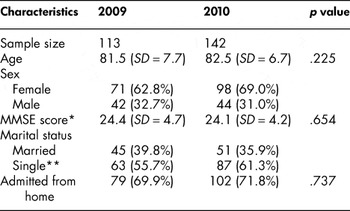
Table 1 includes demographic characteristics of the two patient cohorts discharged from the rehabilitation program in April–May–June of 2009 and 2010. The cohorts comprised primarily older-old adults, with a mean age across both samples (n = 255) of 82 years (SD = 7.13); 60 per cent of the combined sample was 80 years and older, and 30 per cent was aged 85 and older. Most of the patients were single females, who had been living at home prior to admission to hospital. Demographic characteristics were not significantly different between 2009 and 2010. Average admission FIM and MMSE scores were also not significantly different between time points.
Characteristics of rehabilitation patients discharged before and after rehabilitation program restructuring

* (n = 111 for 2009; n = 132 for 2010)
** “Single” category includes individuals who were divorced and widowed
Patient Outcomes
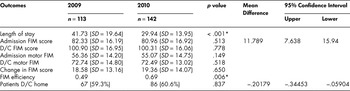
The primary outcome measure related to the organizational change was LOS. Average LOS was significantly shorter after the program restructuring (M = 29.94 days; SD = 13.9) as compared to before restructuring (M = 41.73 days; SD = 19.6) (t (253) = 5.594; p = < .001; see Table 2). A larger percentage of patients had shorter stays (defined as less than or equal to 21 days) in 2010 (28.9%) compared to 2009 (6.2%). There was no significant difference between total FIM scores at discharge before and after restructuring. The FIM motor score at admission and discharge also was not significantly different across time points. Rehabilitation efficiency (FIM change score divided by LOS) was significantly higher after restructuring (M = .69) than the average efficiency achieved for patients prior to restructuring (M = .49; t (253) = –2.78; p = .006). There was no significant difference between the number of patients who were discharged home before and after the program redesign (59.3% vs. 60.6% respectively).
Outcomes for patients before and after rehabilitation program restructuring

* indicates statistically significant difference
D/C = discharge
FIM = Functional Independence Measure
SD = standard deviation
To determine if patients with cognitive impairment were particularly affected by the restructuring, we examined outcomes for patients with MMSE scores of 23 or less. As Table 3 shows, there were no significant differences in rehabilitation outcomes, efficiency, or proportion of patients discharged to home as a function of the restructuring.
Outcomes for patients with cognitive impairment before and after rehabilitation program restructuring

D/C = discharge
FIM = Functional Independence Measure
SD = standard deviation
Health Professionals’ Experiences Regarding Restructuring
The findings regarding the participants’ experiences are organized around four themes that emerged from the data: (1) changes in work environment, (2) changes in rehabilitation philosophy and goals, (3) the role of administration during restructuring, and (4) the benefits of change.
Changes in Work Environment
At the first interview, staff reported significant changes in the work environment as a result of restructuring, specifically related to increased workload due to more daily admissions and discharges. “We have not been given the tools to do our job, and we’re scrambling on the floors” remarked one participant. In response to increased workload, participants reported feelings of frustration. For example:
Everyone’s so busy, things are falling through the cracks a bit. I think you can improve efficiencies a little bit without having issues, but you can’t improve it 100%. There is not much slack in the system. We’ve almost doubled our admissions … and our flow-through. And with the same resources, you are going to have stresses, so we have to work to increase our resources.
The unit clerk was particularly affected by the changes, as the person in that position has increased workload due to increased admissions and discharges (e.g., photocopying, inputting information into charts, and delivering documents to other team members). “If that desk doesn’t run properly, everything falls apart” stated one participant. In response, other team members reported helping out when the clerk was unable to attend to all required work created by increased admissions and discharges.
The increased workload was also perceived to affect patient care. Participants reported that patients’ families were no longer receiving the same level of support, assistance, or involvement with patients during rehabilitation, as compared to assistance offered to them prior to restructuring. The implications of such time constraints were uncertain; however, staff members expressed concern about the increased burden on caregivers upon patient discharge.
At the 1-year follow-up, the majority of staff reported acceptance of the new program and improved morale as compared to the first interview. “We have weathered the storm,” remarked one participant. Participants discussed how their professional relationships with colleagues had improved in several cases, as they had worked through the changes as a team. However, two participants reported that even 1 year later they were still adapting to the outcomes of the program redesign.
Changes in Rehabilitation Philosophy and Goals
During the initial interviews, participants spoke of a change in the program’s vision. The primary focus shifted from optimizing patients’ functional abilities to focusing on identifying and overcoming barriers to a safe discharge home. Participants spoke of this new approach as having a “more time-oriented” focus which required “a bigger reliance on community care because they [the patients] are not necessarily going to be ‘optimized’ at discharge from the rehab setting.” This change in rehabilitation philosophy appeared to be difficult for staff. Participants reported feeling that patients were being discharged with lower levels of functional abilities, and some voiced concerns for patient well-being. There was a feeling of ethical conflict between what staff members thought was necessary for patient care and what was possible to provide under the new program. One participant observed: “It’s very frustrating. You have a patient and you feel that pressure to have him ready to go in four weeks. Some of them just aren’t there. So you’re having this pressure to discharge them.” Another commented on the stress of this conflict:
I went to this ethics talk about moral distress – and it feels like moral distress, in some ways, because we have expectations for the care we want to be able to provide to really make a difference in patients’ lives, and to really see them being healthy and being as independent as they can in the community. But … constraints limit us.
At the 1-year follow-up interview, participants appeared to have adjusted to the program redesign. They reported being more effective and focused on setting “better, more manageable, and achievable goals.” They remarked that recent improvements in outpatient rehabilitation services meant that patients who had not reached their maximum rehabilitation potential upon discharge from in-patient services had more options for continuing treatment in the community. Participants also reported that there was increased flexibility in determining when a patient should be discharged, and that LOS could be extended if concerns about patient safety arose. In fact, concerns surrounding patient safety under the new program appeared to have diminished.
Role of Administration during Restructuring
In the first set of interviews, participants stated that communication with administration was limited, and staff lacked important information about proposed changes. Some staff members noted that administrators should have spent more time or been more “present” on the units during the restructuring. Participants reported a lack of control related to their work environments and expressed the view that they were excluded from the decision-making process (e.g., how and when programs and tasks should be carried out, and about changes in restructuring). “If there is poor communication, it builds distrust and people get anxious.” This perceived lack of communication and staff input into the change process created a sense of conflict (“us” versus “them”). Participants used phrases such as “we’re told that this had to happen”, “they decided, whoever they are”, and “I just keep getting told by upper management”.
Further, participants felt that the changes were implemented too quickly. Several staff noted that they “need that vision to buy into the program, and that wasn’t done because there was basically no time.”
Findings from the first set of focus groups were shared with staff participants and then with administrators. After reviewing staff feedback, administrators focused on improving communication with staff on the units. At the 1-year follow-up, staff reported an increase in effective communication, particularly with regard to proposed changes to the hospital’s outpatient rehabilitation program. One participant said, “It really helps with morale, when staff feel that their voice is being heard and they’re involved.” Staff members also noted increased engagement within the decision-making process. For example, there was increased opportunity to provide input into the redesign of the outpatient program (e.g., a newsletter, or working groups). Other forms of interaction included large forums, encounters on the units and in the cafeteria, as well as updates by email. As one participant remarked:
I have appreciated coming to the forums … it’s pretty personal when you see upper management just down in the cafeteria just talking to people about it, and asking their opinion and putting themselves out there, and being vulnerable to potential constructive and unconstructive feedback. I’ve appreciated that transparency.
Benefits of Change
There was little evidence during the first interview that participants saw any benefit to the changes. However, at the 1-year interview, participants spoke of some positive outcomes. “In the end, we’ll have lots of positive changes even though there’s a lot of stress at the time of it happening.” Staff reported seeing the benefits of fine-tuning admission criteria to ensure appropriateness of referrals from acute care centers. Patients were more likely to “fit the criteria”, were “more medically stable”, “more ‘rehab-able’”, and “more teachable”. As well, patients were being discharged from the rehabilitation units within a shorter time frame, thus “relieving pressure on the acute care sites” and providing greater access for more patients to the rehabilitation program from acute care. However, several did note that there appeared to be a small group of patients still being admitted from acute care that was medically unstable, and being sent back to acute care, creating a “revolving door” syndrome. Generally, though, the perception of an increase in the appropriateness of referrals, efficiencies in services, and implementation of the short-stay unit were viewed as successful.
Although participants spoke of a “fractured team” during the first interview, a year later service delivery changes appeared to have brought team members on both units closer together. “I think it was kind of a negative atmosphere for a while … I think, if anything, it [the change] sort of brings people a little bit close … there’s a closer bond there.” In addition, although participants felt time pressures to implement the new service delivery model, one participant had a positive spin on it, stating that typically any changes on the unit take a significant length of time. However, with the current restructuring, “It’s exciting to be part of this change … within three or four months we’ve got to really radically change the whole organization … it’s nice to see some change, get some input and see that go through.” There was also discussion that newer staff on the unit helped make the transition easier as they “don’t have old expectations and old roles ingrained in them, and so they’re more flexible in terms of taking on a new program or any changes that might come about.”
One participant remarked that due to the new shorter LOS, patients were less likely to become accustomed to institutionalization (e.g., getting in the habit of having meals made for them, or getting routine physiotherapy), thus facilitating reintegration into the community and return to their everyday routines back home. Prior to restructuring, when patients were told they were going home, some would develop “anxiety and start to get their symptoms back again because they were afraid to leave the comfort of the hospital.”
Participants’ Suggestions for Future Organizational Change
Immediately after restructuring and 1 year later, participants made several suggestions to facilitate more-positive transitions during organizational change. Supporting, communicating, and consulting with rehabilitation professionals who work with the patients were viewed as crucial components: “You have to take care of your staff” as one individual noted. Participants offered a number of specific suggestions, as follows:
• Include two or three frontline staff from each unit who are key leaders in their discipline, and ask their perspectives.
• Have small discussion groups early on during the planning phases.
• Run focus groups during restructuring, monitoring staff experiences and incorporating feedback.
• Increase the presence of upper management on units.
• Ensure that all staff members receive similar information.
• Communicate a clear vision. If there is a change in vision, inform staff.
• Minimize uncertainty (e.g., change in roles, risk of job loss, or sense of decreased control).
• Slow the speed of implementation of changes.
• Identify issues ahead of time that may be problematic and work to address them.
• Have community programs in place prior to changes within the hospital to handle the increased need for outpatient rehabilitation services.
Discussion
Restructuring of an in-patient rehabilitation program for older adults did not appear to have a negative effect on patient-related outcomes. Patient characteristics (e.g., age, sex, and cognitive functioning) were not significantly different after restructuring. Patient outcomes also were not significantly affected: FIM admission and discharge scores were not significantly different, and patients were discharged home in the same proportions after program changes. The primary difference between patients admitted before and after restructuring was that LOS was significantly shorter after restructuring and rehabilitation efficiency was higher. That is, based on FIM scores, similar gains were made in a shorter period of time. Decreased LOS facilitated patient flow-through and enabled an increased number of older adults to participate in necessary rehabilitation programs, all without negative effects on patients’ rehabilitation outcomes.
This finding does not seem consistent with previous literature in which shorter LOS was shown to lead to decreased functional improvement, lower discharge FIM scores, and fewer patients discharged home after hospital stays (Dobrez et al., Reference Dobrez, Heinemann, Deutsch, Manheim and Mallinson2010; Gillen et al., Reference Gillen, Tennen and Eberhardt-McKee2007; Qu et al., Reference Qu, Shewchuk, Chen and Deutsch2011). However, methodological differences across studies do not permit direct comparisons between data sets. For example, Dobrez et al. (Reference Dobrez, Heinemann, Deutsch, Manheim and Mallinson2010) examined thousands of patient records across several facilities over 9 years, and limited their sample to individuals over the age of 16 who had suffered a stroke. The current study included small samples of individuals, all of whom were elderly, with multiple diagnoses, and the data were from the same facility. It is reasonable to assume that LOS interacts with other factors that affect rehabilitation outcomes, such as family support, therapy type and intensity, and so on. Appropriate measurement of these factors, along with their individual and combined contributions to older adults’ rehabilitation outcomes, should be the focus of future studies in this area.
When quantitative data on patient outcomes were compared to qualitative data from staff participants’ interviews, there was a discrepancy in the findings. Specifically, staff participants reported that the decrease in LOS led to a concomitant decrease in quality of patient care as well as diminished rehabilitation outcomes for patients. These negative perceptions may have been a result of staff members’ initial lack of acceptance of change. Decreased workplace morale and lack of acceptance of change have been reported early in the reform process (Way et al., Reference Way, Gregory, Baker, Lefort, Barrett and Parfrey2005; Woodward et al., Reference Woodward, Shannon, Cunningham, McIntosh, Lendrum and Rosenbloom1999). These feelings were expressed by staff in the current study, primarily in the first interview. It is also possible that the outcome measures used in this study (i.e., FIM total score and motor score, discharge setting, LOS, and rehabilitation efficiency) were not sufficiently sensitive enough to capture changes in patient outcomes that staff members were able to see in their everyday practice. The FIM is primarily based on task-related outcomes, whereas health care professionals often gauge their patients’ improvements in terms of the patients’ ability to participate in meaningful social roles and to reintegrate into their communities. Further investigation is required into the relationship between health care professionals’ views on patient outcomes and quantitative measures of the same. How health care professionals define success or “optimal” rehabilitation outcomes is an important part of future research.
In terms of the process of change, staff perceptions were predominantly negative, and administrators appeared surprised at this response. Organizational change and its impact can be perceived differently at various levels of an organization (Walston & Chou, Reference Walston and Chou2006). Sharp et al. (Reference Sharp, Greiner, Li, Mitchell, Sochalski, Cournoyer and Sales2006), for instance, reported that staff nurses had a different perception from nurse executives regarding the effect and impact of organizational change on staff nurses’ job satisfaction and quality of patient care. Sharp et al. found that administrators often described effects of reorganization at the facility level, focusing on nursing standards and consistency of practice, whereas nursing staff focused specifically on the work environment of their unit. In the current study, facility goals were achieved but staff thought that the quality of the work environment was diminished as a result. Communication breakdown was cited as a key contributor to workplace stress. Understanding differences and fostering collaborative relations between health professionals and administration are important for increasing the likelihood of positive staff experiences during restructuring. It may also be helpful for administrators to acknowledge challenges in the process of restructuring, to create trust and a sense of unity. There is a lack of consensus about what actions facilitate staff acceptance and adjustment to organizational change (Way et al., Reference Way, Gregory, Baker, Lefort, Barrett and Parfrey2005); however, the participants in this study provided specific recommendations that could be applied to help with such a transition. These recommendations are grounded in the interview data and, although they are representative of this particular group of participants, may be generalizable across similar settings.
The positive aspects of organizational change are often overlooked in studies of this type. Yet at 1 year post-restructuring, participants reported improved job satisfaction working with patients who were considered to have greater rehabilitation potential as compared to before restructuring. Although staff morale decreased immediately after the changes, it also improved over time, as staff recalibrated expectations and adjusted to changes in the workplace. In the final focus groups, participants expressed a continued love of their work, with much agreement among group members. One stated, “I love coming to work. It’s not every day you say you love the staff that you work with and you want to go to work.” Another expressed:
I love my job. I love what I do, and I really appreciate all the people I work with … I really truly think this hospital is a great place to work. I know it’s a time of change, but I think we can be positive about it.
This change in perspectives over time underscores the importance of interviewing staff at different time points, in order to ensure a comprehensive and representative portrait of their views, after organizational change has occurred.
Conclusions
Restructuring of one hospital’s older adult rehabilitation program resulted in decreased LOS and increased rehabilitation efficiency. These changes did not appear to impact patient outcomes, as measured by quantitative data analyses. However, staff reported that in the immediate time frame following changes, patients were not achieving optimal levels of functioning during their shorter rehabilitation stays. In addition, the process and impact of the restructuring were viewed negatively by staff. Participants’ opinions of the changes became more positive over time. Staff members recommended several actions that could facilitate the change process and lead to improved workplace morale. These recommendations may be useful to health care administrators who are contemplating restructuring, and similarly could be useful for the staff who will be affected by these initiatives.