Introduction
The Indigenous community of Australia, known collectively as the Aboriginal and Torres Strait Islander people, are one of the most socially disadvantaged groups of people in Australia. They make up 2.5% (approximately half a million people) of the Australian population and have a life expectancy that is 17 years lower than the rest of the population.Reference Pink and Allbon 1 The perinatal mortality rate for Indigenous neonates is ~1.5 times higher than that of non-Indigenous neonates.Reference Pink and Allbon 1 The proportion of Indigenous low birth weight (LBW; birth weight <2500 g) neonates is 12.3%, which is double that of LBW neonates found amongst non-Indigenous neonates (6.3%). 2 Hoy et al. Reference Hoy, Rees, Kile, Mathews and Wang 3 observed that up to 35% of adults in Indigenous populations were born with LBW. In addition, the percentage of preterm neonates born to Indigenous women in 2009 is 13.1%, which is almost 1.5 times higher than that of non-Indigenous mothers (8.0%). 2
Chronic kidney disease (CKD) is a major contributor to the disparity in life expectancy between Indigenous and non-Indigenous Australians. A study by McDonald et al. Reference McDonald and Russ 4 showed that CKD rate among Indigenous people exceeded non-Indigenous rate by eight-fold and the mean age at the start of renal replacement therapy was 10 years earlier. The reason for these disparities remains unclear, but researchers have shown a strong association between LBW and renal disease in this population.Reference Hoy, Rees and Kile 5 A study by Hoy et al. Reference Hoy, Rees, Kile, Mathews and Wang 3 , Reference Hoy, Hughson, Singh, Douglas-Denton and Bertram 6 in various Australian Indigenous populations established an association between LBW and an increased risk of CKD in these communities. In addition, histopathological studies have demonstrated that Australian Indigenous adults have lower number of nephrons, which could also be attributed to suboptimal intrauterine conditions.Reference Hoy, Hughson, Singh, Douglas-Denton and Bertram 6 According to Brenner’sReference Brenner, Garcia and Anderson 7 hypothesis, low nephron number triggers a vicious cycle that is associated with glomerular hyperfiltration, glomerular damage, proteinuria, hypertension, and long-term progression to CKD.
All studies to date showing an association between LBW and CKD in Indigenous peopleReference Hoy, Rees, Kile, Mathews and Wang 3 , Reference Hoy, Rees and Kile 5 , Reference Hoy, Hughson, Singh, Douglas-Denton and Bertram 6 , Reference White, Perkovic and Cass 8 were conducted in adult populations. Information regarding birth weight was retrospectively obtained from medical records and LBW was considered as one homogenous group by these investigators. The investigators did not make any distinction between the causes of LBW. In recent years, evidence from animal study,Reference Sutherland, Gubhaju and Black 9 autopsy findings,Reference Rodriguez, Gomez and Abitbol 10 and epidemiological dataReference Hodgin, Rasoulpour, Markowitz and D’Agati 11 has indicated that prematurity, independent of birth weight, results in abnormal renal development including further reductions in nephron number, which predisposes to development of CKD. Since nephrogenesis is completed between 34 and 36 weeks of gestation, individuals are born with their full complement of nephrons;Reference Schreuder 12 i.e. their nephron number is fixed for life at that time. Therefore, if extrauterine kidney development is impaired as has been shown in animal and human studies then preterm neonates are also at risk of oligonephronia. Furthermore, if they are of LBW, the oligonephronia is likely to be more severe.
There have been numerous studies conducted in Indigenous children and adults describing the natural history of CKD, but there are no published studies that estimate nephron numbers of Australian Indigenous newborn neonates. The only accurate method for determining nephron number is to count them at autopsy.Reference Rodriguez, Gomez and Abitbol 10 As this is not possible in the clinical setting, kidney volume is often used as a surrogate marker for nephron number.Reference Nyengaard and Bendtsen 13 – Reference Zhang, Quinlan and Hoy 15
We postulated that an Indigenous neonate is more likely to have a smaller kidney volume (and therefore a reduced nephron number) from birth. To test this hypothesis, we compared the kidney volumes of a cohort of LBW and preterm Indigenous neonates with the kidney volumes of a similar cohort of non-Indigenous neonates.
Methods
This prospective observational study was performed at the Department of Neonatology, Townsville Hospital, Northern Queensland, Australia, a tertiary perinatal centre for a region two-and-a-half times the size of France and with more than 10,000 births annually with ~17% to Indigenous mothers. 16 The study period lasted for 12 months. The Townsville Health District Human Research Ethics Committee approved this study, which was conducted in accordance with the tenets of the Declaration of Helsinki. Written consent was obtained from parents of all neonates who participated in this study. The hospital adheres to the national guideline on determining the Indigenous status of a patient and that is through self report. 17 The health professional or hospital administrative officer asks for the Indigenous status of a patient. The parents determine a neonate’s Indigenous status and that information is then recorded in the medical records. An Indigenous reference group guided the investigators during every phase of this study. The patients recruited into this study were part of a larger study that also investigated the relationship between retinal microvasculature and birth weight; the findings of that study are discussed elsewhere.
Preterm neonates at <32 weeks of gestation admitted to the department during the study period were eligible to participate in this study. Patients with congenital abnormalities or syndromes were excluded. Preterm neonates were recruited and followed until discharge. Once recruited, the preterm patients underwent a first assessment (weight, length, renal sonography and renal function measurement) at 32 weeks corrected age (CA) and a second assessment at 38 weeks CA (weight, length, renal sonography, renal function, and blood pressure measurements). CA for the preterm neonates was defined as follows: CA=gestational age at birth (weeks)+postnatal age in weeks.
Term neonates (gestation more than 37 weeks) were also recruited into this study. Once recruited, all term neonates underwent blood pressure measurement, kidney ultrasounds and renal function measurements within the first week of life. Birth weight and length were also recorded and these neonates were classified according to their birth weight: those with birth weights <2500 g were classified as LBW neonates, while those weighing 2500–4499 g were classified as normal birth weight (NBW) neonates. Neonates who needed respiratory support or surgery, neonates of diabetic mothers, macrosomic neonates (those with a birth weight >90th percentile), and those with congenital syndromes, renal or chromosomal abnormalities were excluded from the study.
All kidney ultrasounds were obtained using the Philips IU22 Ultrasound System (Philips Healthcare, Andover, MA, USA) with a compact curvilinear 5–8 MHz frequency transducer. Renal length (L), anteroposterior diameter (AP), and transverse diameter (W) were measured for both kidneys. Kidney volume was calculated according to the following formula: (π/6×L×W×AP).Reference Hricak and Lieto 18 The total kidney volume (TKV) (right kidney volume+left kidney volume) was then calculated. All ultrasound scans of the kidneys were performed by a single sonographer who was blinded to the clinical information. The intra-class coefficient for intra-observer variability was 0.85 (95% confidence interval: 0.73–0.91). Weight measurements were performed with an electronic infant weighing scale (Seca 727 Electronic neonate scale, Seca Deutschland, Hamburg, Germany). The length measurement (measured from head to toe) was carried out with the infant lying supine and with the body, hips, and knees straightened; measurements were taken twice and then averaged. The blood pressure was obtained using a non-invasive blood pressure recording system (Dash 4000 Monitor; GE HealthCare, Waukesha, WI, USA). An infant cuff was applied to the right upper arm with the infant calm and lying supine. Three successive BP recordings were taken at 2 min intervals and the average was then calculated.
Venous blood was collected through a peripheral venepuncture for serum creatinine (SCr) (μmol/l) and Cystatin C (Cys C) (mg/l) measurements from each patient on the same day that the renal sonogram was obtained. Serum Cys C was measured using a commercially available kit according to the manufacturer’s instructions (Beckman Coulter, Gentian AS, Moss, Norway). The coefficient of variation (CV) for this measurement was 6%. A Creatinine/Cys C-based prediction equation was then used to calculate the estimated glomerular filtration rate (eGFR) as follows: eGFR (ml/min/1.73 m2)=(507.76×e0.003×height)/(Cys C0.635×SCr0.547).Reference Zappitelli, Parvex and Joseph 19 None of the neonates in this study received a prolonged course of nephrotoxic medications and none developed acute kidney injury.
Variables with normal distribution were presented as mean (standard deviation), whereas those without normal distribution were presented as medians (inter-quartile range). A Student’s t-test and χ 2 test were performed where appropriate. A P value<0.05 was considered statistically significant. Statistical analyses were performed using Stata Version 11.0 statistical software (StataCorp, College Station, TX, USA).
Results
Preterm neonates
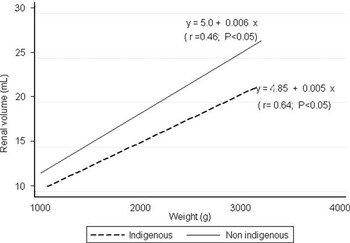
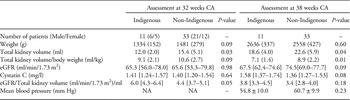
A total of 288 preterm neonates were admitted to the department during the study period. Forty-nine preterm neonates out of 112 who fulfilled the recruitment criteria were recruited; two died and three were transferred back to regional hospitals, which made them unavailable for assessment. The deceased preterm neonates were small for their gestational age (SGA, birth weight<10th percentile). Therefore, data from 44 preterm neonates (all appropriate for gestational age) were available for analysis (18 female, 26 male; 11 Indigenous, 33 non-Indigenous). The Indigenous neonates recruited in our study were more preterm [26.4 (2.1) v. 28.6 (2.2) weeks; P=0.003] and smaller [965 (298) v. 1193 (336) g; P=0.036] than the non-Indigenous neonates, respectively. The patients’ clinical data and kidney volume measurements at 32 and 38 weeks CA are summarized in Table 1. At 38 weeks CA, there was no difference in body weight and blood pressure. The kidney volumes of Indigenous neonates were significantly lower at 32 weeks [12.0 (2.0) v. 15.4 (5.1) ml; P=0.03] and 38 weeks CA [18.6 (4.0) v. 22.6 (5.9) ml; P=0.04], respectively. Table 1 shows the comparison between Indigenous and non-Indigenous preterm neonates at 32 and 38 weeks CA. Using pooled TKV measurements taken at 32 and 38 weeks CA, Fig. 1 shows the comparison of the extra uterine renal growth trajectories for Indigenous and non-Indigenous preterm neonates from 32 to 38 weeks of gestation. Analysis of covariance shows a significant difference between the slopes (P=0.004).
The difference in extra uterine renal growth trajectories between preterm Indigenous and non-Indigenous neonates from 32 to 38 weeks of gestation [using pooled total kidney volume (TKV) measurements taken at 32 and 38 weeks CA] (P=0.004).

Comparison between Indigenous and non-Indigenous preterm neonates at 32 and 38 weeks CA

CA, corrected age; NA, not available.
eGFR was derived from the following formula: eGFR (ml/min/1.73 m2)=[507.76×e0.003×height]/[Cys C0.635×SCr0.547].Reference Zappitelli, Parvex and Joseph 19
Term neonates
The number of term infant admissions to the Department of Neonatology at the completion of the recruitment period was 524 neonates, of which 227 fulfilled the recruitment criteria. Consent was obtained for 43 neonates. Four patients were excluded because of renal abnormalities (hydronephrosis). Complete data were obtained and analysed from 39 neonates (17 male, 22 female; 13 LBW). There were 13 Indigenous neonates (five male, eight female) in this cohort and nine (one male; eight females) of them were LBW. Out of 26 NBW neonates (15 male, 11 female), four neonates (all male) were Indigenous. The proportion of Indigenous LBW neonates was significantly higher (χ 2=11.31; P=0.001). Gestational age of Indigenous neonates were not significantly different from non-Indigenous neonates [38.6 (1.4) v. 38.7 (1.4) weeks; P=0.80] Indigenous neonates had lower mean birth weights [2646 (844) v. 3143 (509) g; P=0.03] and TKVs [18.4 (4.8) v. 24.3 (6.3) ml; P=0.01] but there were no difference in Cys C [1.4 (1.2–1.4) v. 1.1 (1.0–1.4) mg/l; P=0.20], eGFR [74.8 (69.4–79.8) v. 79.3 (71.7–88.2) ml/min/1.73 m2; P=0.30] and blood pressure (58.2±2.2 v. 59.2±7.0 mmHg; P=0.59) compared with non-Indigenous neonates. When kidney volume was corrected for birth weight (TKV/BW), Indigenous neonates had smaller TKV/BW ratios compared with non-Indigenous neonates in both the NBW and LBW cohorts but the differences were not statistically significant (6.4±1.1 v. 7.5±1.8 ml/kg; P=0.24 ) and (7.5±1.5 v. 9.3±2.5 ml/kg; P=0.11) respectively.
In both preterm and term cohorts, there was no significant difference in eGFR and Cys C levels for Indigenous neonates compared with non-Indigenous neonates despite the former having a significantly smaller kidney volume.
Discussion
In this study we were able to demonstrate that preterm and term Indigenous neonates have smaller kidney volumes compared with non-Indigenous neonates. They also appear to have difference growth trajectories. Using the best available evidence that kidney volume is a proxy indicator for nephron number, we conclude that Indigenous neonates were more likely to have fewer nephrons compared with non-Indigenous neonates. Despite this, they did not have significantly lower eGFRs compared with their non-Indigenous contemporaries. The eGFR is the product of the single-nephron GFR multiplied by total nephron number.Reference Brenner, Garcia and Anderson 7 The kidneys can compensate by increasing the single-nephron GFR (hyperfiltration) when the number of nephrons diminish.Reference Brenner, Garcia and Anderson 7 Therefore, nephrons in Indigenous neonates appear to be hyperfiltrating.
In 1981, Hostetter et al. Reference Hostetter, Olson, Rennke, Venkatachalam and Brenner 20 demonstrated that loss of nephrons in rats after removal of 5/6 of the kidney mass led to a compensatory increase in the single-nephron GFR in the remaining functioning nephrons. BrennerReference Brenner, Lawler and Mackenzie 21 subsequently proposed that this compensatory mechanism of single-nephron hyperfiltration leads to proteinuria, hypertension, glomerulosclerosis and ultimately CKD. The association between LBW, poor nephron endowment, and single-nephron hyperfiltration is also known as the ‘Barker-Brenner hypothesis’.Reference Feig, Rodriguez-Iturbe, Nakagawa and Johnson 22
In Indigenous adult Australians, the pathogenesis of CKD is likely to be the result of a ‘multi-hit’ mechanism.Reference Nenov, Taal, Sakharova and Brenner 23 In many, LBW and prematurity may result in a low nephron endowment and single nephron hyperfiltration, representing the first hit. Indigenous children have been shown to have a high incidence of post-streptococcal glomerulonephritis, often followed by significant and prolonged albuminuria, thereby representing a second hit.Reference Hoy, White and Dowling 24 Subsequent ‘hits’ may include haemolytic uraemic syndrome, renal stones, and acute kidney injuryReference White, Wong, Sureshkumur and Singh 25 and Type 2 diabetes mellitus.Reference White, Wong, Sureshkumur and Singh 25
It is currently unknown if nephron protection should begin at birth.Reference Bagby 26 A large community-based screening programme of young Indigenous school children using urine analysis (with dipstick) and blood pressure monitoring failed to show any significant diffrence.Reference Haysom, Williams and Hodson 27 The investigators concluded that the increased risk for CKD seen in Indigenous adults is not yet manifest in schoolchildren. It remains to be determined if other techniques of detecting glomerular injury, such as the use of urinary nephrin levels, would make screening more useful.Reference Welsh and Saleem 28 This would then pave the way for clinical trials of nephroprotective strategies in this at risk population.
Despite the significant results, one of the main limitations of the study was the small sample size, which precluded meaningful subgroup analysis. Participation in our study is voluntary. Parents are not required to give a reason if they decline to participate. A few parents (voluntarily) told us that they were not keen for their babies to undergo procedures that are not medically indicated. Others told us that that they were unable to come back for investigation such as ultrasound kidney or venipuncture. Maternal data and fetal growth data have been difficult to acquire. We plan to follow these neonates upon discharge from the hospital through outreach clinics, but this represents a significant challenge since some of the remote Indigenous communities where these neonates originate are more than 1000 km from our centre. It remains to be seen how these neonatal findings will be manifest in later childhood.
Conclusion
In this study, we were able to demonstrate that Indigenous preterm and term neonates have smaller kidney volumes (hence lower nephron endowment) compared with non-Indigenous neonates. However, despite this they have similar eGFR most probably secondary to single nephron hyperfiltration. This may represent the beginning of the cascade of events or ‘multi-hits’, which finally result in the development of CKD in Indigenous people at a much younger age than their non-Indigenous contemporaries. Further work to address the causes, detection and treatment of this perinatal kidney deficit is warranted to address the future health of this population.
Acknowledgements
The Indigenous Reference Group for Research, Townsville Hospital, Queensland Health.
Financial Support
The Royal Australasian College of Physicians Research and Education Grant.
Conflicts of Interest
None.
Ethical Standards
The Townsville Health District Human Research Ethics Committee approved this study, which was conducted in accordance with the tenets of the Declaration of Helsinki.