The mammary gland inflammation process is characterised by an increased number of the somatic cells (mainly macrophages, leucocytes and PMN) in milk (Mazal et al. Reference Mazal, Vianna, Santos and Gigante2007; Viguier et al. Reference Viguier, Arora, Gilmartin, Welbeck and O'Kennedy2009). Inflammatory response is also characterised by a transfer of some blood components to the milk (Urech et al. Reference Urech, Puhan and Schällibaum1999) and by a decrease in secretory activity resulting in reduced milk production (Lescourret & Coulon, Reference Lescourret and Coulon1994; Klei et al. Reference Klei, Yun, Sapru, Lynch, Barbano, Sears and Galton1998; de los Campos et al. Reference de los Campos, Gianola and Heringstad2006; Le Maréchal et al. Reference Le Maréchal, Thiéry, Vautor and Le Loir2011). Moreover, alterations are observed in the chemical composition of the milk secreted (Dang et al. Reference Dang, Suman, Charan and Sehgal2008; Franceschi et al. Reference Franceschi, Summer, Sandri, Formaggioni, Malacarne and Mariani2009; Le Maréchal et al. Reference Le Maréchal, Thiéry, Vautor and Le Loir2011) and its physicochemical properties (Summer et al. Reference Summer, Formaggioni, Franceschi, Malacarne and Mariani2003; Franceschi et al. Reference Franceschi, Summer, Sandri, Formaggioni, Malacarne and Mariani2009; Le Maréchal et al. Reference Le Maréchal, Thiéry, Vautor and Le Loir2011).
Many studies have been carried out on the relationships between the characteristics of milk and its cheese yielding capacity. The quantity of cheese produced per unit of milk mainly depends on the total amount of solid contents, in particular fat and casein, and on the cheese-making technology (Verdier-Metz et al. Reference Verdier-Metz, Coulon and Pradel2001; Auldist et al. Reference Auldist, Johnston, White, Fitzsimons and Boland2004). The influence of the rennet-coagulation aptitude, milk protein composition and genetic variants of milk proteins on the efficiency of the cheese-making process were also considered (Hallén et al. Reference Hallén, Lundén, Allmere and Andrén2010). Milk with better rennet-coagulation properties (RCP) generally produces a larger cheese yield and increased recoveries of milk casein and fat in the cheese (Aleandri et al. Reference Aleandri, Schneider and Buttazzoni1989; Malacarne et al. Reference Malacarne, Summer, Fossa, Formaggioni, Franceschi, Pecorari and Mariani2006; De Marchi et al. Reference De Marchi, Bittante, Dal Zotto, Dalvit and Cassandro2008) although no significant differences were also observed in cheese yield between well- or poorly-coagulating milks (Ikonen et al. Reference Ikonen, Ruottinen, Syväoja, Saarinen, Pahkala and Ojala1999; Wedholm et al. Reference Wedholm, Larsen, Lindmark-Mänsson, Karlsson and Andrén2006; Bonfatti et al. Reference Bonfatti, Tuzzato, Chiarot and Carnier2014). The presence of κ-CN B in milk is associated with a higher casein content with a higher κ-CN proportion, resulting in smaller micelles, which in turn leads to an improvement in the curdling properties of the milk (Pearse et al. Reference Pearse, Linklater, Hall and MacKinlay1986) and a greater cheese yield (Mariani et al. Reference Mariani, Losi, Russo, Castagnetti, Grazia, Morini and Fossa1976; Walsh et al. Reference Walsh, Guinee, Harrington, Mehra, Murphy and Fitzgerald1998a, Reference Walsh, Guinee, Reville, Harrington, Murphy, O'Kennedy and FitzGeraldb). There is general consensus concerning the negative effect of milk on the somatic cell content (SCC), cheese yield and quality (Geary et al. Reference Geary, Lopez-Villalobos, O'Brien, Garrick and Shalloo2013). The same effects were also observed in goat and sheep milk (Leitner et al. Reference Leitner, Silanikove and Merin2008). In general, a decrease of fat and protein recoveries in cheese was observed as milk SCC increases (Politis & Ng-Kwai-Hang, Reference Politis and Ng-Kwai-Hang1988a, Reference Politis and Ng-Kwai-Hangb; Barbano et al. Reference Barbano, Rasmussen and Lynch1991; Klei et al. Reference Klei, Yun, Sapru, Lynch, Barbano, Sears and Galton1998). This was due to impaired rennet coagulation properties and/or increased proteolysis and lipolysis in high SCC milk. Mazal et al. (Reference Mazal, Vianna, Santos and Gigante2007) found no effect of milk SCC on Prato cheese yield, although cheese produced with high-SCC had higher moisture content and a more intense proteolysis than low-SCC milk cheese. Marino et al. (Reference Marino, Considine, Sevi, McSweeney and Kelly2005) reported the influence of somatic cell enzymes on cheese proteolysis.
Most of the studies on the yielding capacity of milk cheese were carried out in model cheese produced at laboratory- or pilot-scale level, using individual milk or bulk milk obtained from few selected cows (Cipolat-Gotet et al. Reference Cipolat-Gotet, Cecchinato, De Marchi and Bittante2013). However, the dairy industry would benefit from the being able to investigate the effect of milk characteristics on cheese yield under field conditions. Pretto et al. (Reference Pretto, De Marchi, Penasa and Cassandro2013) recently analysed the relationships between milk composition, coagulation properties and Grana Padano cheese yield under field conditions but they did not consider the influence of milk SCC. Grana Padano cheese is a very hard Protected Designated of Origin (PDO) cheese whose cheese-making technology is very similar to that used for making Parmigiano-Reggiano cheese. The aim of this study was to determine the influence of milk SCC on Parmigiano-Reggiano cheese yield, produced in commercial cheese factories under field conditions. Moreover, an attempt was made to establish a threshold for herd bulk milk SCC above which a significant decrease in Parmigiano-Reggiano cheese yield was detectable.
Materials and methods
Experimental design, sampling procedure and classification of cheese batches
The study was carried out following the production of 56 Parmigiano-Reggiano cheese batches, in 13 commercial cheese factories, under field conditions. The raw milk used for cheese-making was collected from Italian Friesian cattle herds. A brief description of the origin of the raw milk used for cheese-making (known as vat milk, V-milk) is required in order to understand the sampling procedures and how the cheese batches were grouped into SCC classes. In short, the V-milk used for each batch of Parmigiano-Reggiano cheese (about 1100 kg) was composed (1 : 1) of the milk of two consecutive milkings collected from the same herd: the partially skimmed evening milk (obtained through the overnight gravity separation of fat, a process called natural creaming) and the full-cream morning milk. For each batch of cheese made in this study, a sample of full-cream evening milk (E-milk) was collected at its arrival at the cheese factory before proceeding with the natural creaming process. The following morning, the V-milk was weighed using a volumetric pump and a sample was collected directly from the vat before adding the natural whey-starter. At the end of the cheese-making procedure, a sample of the residual cheese whey was collected from the vat. Sodium merthiolate (0·02 g/100 ml) was added to each type of sample (E-milk, V-milk and cheese whey), cooled to 5 °C and transferred to the laboratory within 30 min where the analyses were carried out within the following 24 h. The 2 twin wheels obtained from each batch of cheese were weighed 24 h after extraction from the vat.
The batches of cheese were divided into 5 classes according to the SCC of the E-milk: class 1, from 0 to 200 000 cells/ml; class 2, from 201 000 to 300 000 cells/ml; class 3, from 301 000 to 400 000 cells/ml; class 4, from 401 000 to 500 000 cells/ml; class 5, over 501 000 cells/ml. The SCC value of the V-milk was not reliable enough for dividing the cheese batches into classes as half of it had undergone the natural creaming process, which caused a significant reduction of somatic cells which only partially depends on the original value and is mainly influenced by technological and environmental factors (Malacarne et al. Reference Malacarne, Summer, Formaggioni, Franceschi, Sandri, Pecorari, Vecchia and Mariani2008). Therefore, classification can be only be carried out by measuring the SCC of E-milk or morning milk (the full cream milks). Since the E-milk and morning milk were obtained from two consecutive milkings, it was assumed that they had the same SCC value and we therefore decided to only take the SCC value of the E-milk.
Parmigiano-Reggiano cheese-making
The cheese was produced with the method approved by the Consortium (Council Regulation, 1992).
A natural whey-starter culture (about 3 l for every 100 kg V-milk), obtained by means of the spontaneous acidification of the previous day's cheese whey, was added to the V-milk before coagulation. The cheese milk was then heated to 33 °C and clotted in 10–12 min with calf rennet (2·5 g/100 kg V-milk, calf activity 1 : 125 000, Bellucci Srl, 41123 Modena, Italy). The curd was broken up into small granules (approximately the size of a rice grain) and cooked. During this step, the temperature was increased to 55 °C in 10–15 min and the curd granules were stirred continuously. After cooking, the broken-up curd particles settled at the bottom of the vat where they aggregated and blended together spontaneously during the so-called resting phase. During this step, which lasted 45–60 min, the temperature was 55–53 °C. The result was a consolidated cheese mass, which was removed from the vat, divided into two parts and placed in special moulds called ‘fascere’ for 2 d. During this period the cheese wheels were naturally cooled and periodically turned over in order to dry them homogeneously. The cheese wheels were then submerged in saturated brine for a period of 20–25 d. The cheese finally entered the ripening phase, which lasts about 24 months. At the end of the ripening stage, the cheese wheels were cylindrical in shape with a slightly convex side, 22–24 cm high, 40–45 cm diam., and weighed 35–36 kg.
Analytical methods
The following standard analyses were performed on the V-milk samples: somatic cells (this parameter was also measured on E-milk); the fat and lactose contents were assessed with mid-infrared readings (Biggs, Reference Biggs1978) with Milko-Scan 134 A/B (Foss Electric); total N (TN), non casein N (NCN) and non protein N (NPN) on milk, acid whey at pH 4·6 and TCA 12% filtered whey, respectively, were determined with the Kjeldahl method (Aschaffenburg & Drewry, Reference Aschaffenburg and Drewry1959), from which the values of crude protein (TN × 6·38/1000), casein ((TN−NCN) × 6·38/1000), casein number ((TN−NCN) × 100/TN), NPN × 6·38 (NPN × 6·38/1000), true protein ((TN−NPN) × 6·38/100) were calculated. Digestion was carried out using DK 6 macro Kjeldahl heating block (Velp Scientifica, Usmate, MB, Italy) and distillation with 126 UDK distillation unit (Velp Scientifica, Usmate, MB, Italy). The content of phosphorous (p) was measured with the colorimetric method (Allen, Reference Allen1940) while the calcium (ca) and magnesium (Mg) contents were determined with the complexometric method (Ntailianas & Whitney, Reference Ntailianas and Whitney1964) (V-milk, cheese whey); chloride concentration was measured by titration according to Savini (Reference Savini1946) (V-milk); pH and titratable acidity were measured in V-milk with a potentiometer and by titration of 50 ml of milk with 0·25 N sodium hydroxide according to the Soxhlet-Henkel method (Anon., 1963).
The content of TN, Ca, P and Mg were determined with the same methods described above also for cheese whey. The fat in the cheese whey was determined with the volumetric Gerber method (Savini, Reference Savini1946).
The SCC in E-milk was measured by means of the fluoro-opto-electronic method (Schmidt-Madsen, Reference Schmidt-Madsen1975) with Fossomatic 250 (Foss Electric, DK-3400 Hillerød Denmark). The somatic cell score (SCS) was calculated as follows: SCS=(Log2(SCC/100)+3) (Shook & Schutz, Reference Shook and Schutz1994).
The 24-h actual cheese yield (kg of cheese /100 kg of milk) was calculated as follows:
 $$Y = {\rm cw} \times {\rm 1}00/{\rm mw}$$
where: Y=cheese yield; cw=cheese weight measured 24 h after removing it from the vat, kg; mw=weight of V-milk measured before adding the natural whey starter, kg.
Statistical analysis
The data were analysed with ANOVA univariate using the following model:
 $$y_{ijk} = {\rm} \mu + \alpha _i + \beta _j + \varepsilon _{ijk} $$
where: y ijk=dependent variable; μ=overall mean; α i=fixed effect SCC class (i = 1,…5); β j=fixed effect of the cheese factory (j = 1,…13, one level for each cheese factory); ε ijk=residual error.
ANOVA and Pearson correlation coefficients were calculated with IBM SPSS statistics software, version 21 (Armonk, NY, USA).
Results and discussion
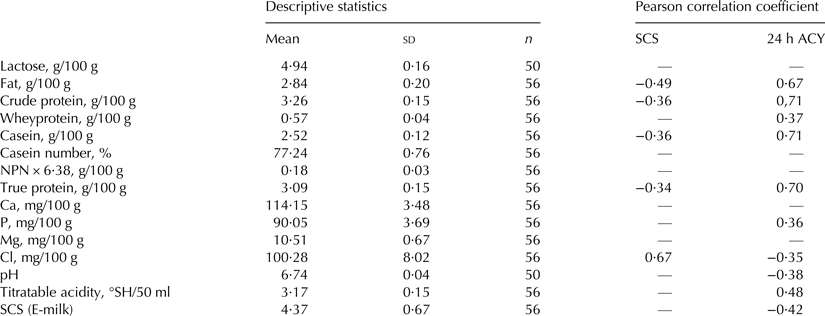
The mean values of the V-milk characteristics and their correlation coefficients with both E-milk SCS and 24 h actual cheese yield (24 h ACY) are shown in Table 1. The contents of the protein fractions and the value of titratable acidity are higher and lower, respectively, than those reported for Parmigiano-Reggiano V-milk collected from Italian Friesian cattle herds by Malacarne et al. (Reference Malacarne, Summer, Fossa, Formaggioni, Franceschi, Pecorari and Mariani2006). The increase in milk protein is actually due to breeding programs aimed at increasing the amount of casein in milk. Conversely, the values of titratable acidity observed confirm the decreasing trend for this parameter over the years (Formaggioni et al. Reference Formaggioni, Sandri, Franceschi, Malacarne and Mariani2005; Franceschi et al. Reference Franceschi, Malacarne, Nordera, Vergnani, Ghizzoni, Formaggioni, Mariani and Summer2012; Summer et al. Reference Summer, Franceschi, Formaggioni and Malacarne2014).
Characteristics of vat milk (V-milk) and their correlations with both somatic cell score (SCS) of the full cream evening milk (E-milk) and the actual cheese yield measured after 24 h (24 h ACY)

Only significant correlations (P < 0·05) are reported
The values of fat, crude protein, true protein, casein and 24 h ACY were negatively correlated with SCS. Conversely, a positive correlation was observed between chloride and SCS. Fat, protein fractions (crude protein, casein and whey proteins), P and titratable acidity were positively correlated with 24 h ACY, while a negative correlation was observed for chloride, pH and SCS. The negative correlation between E-milk SCS and fat content in V-milk could be due to the fact that half of V-milk underwent a natural creaming process in which somatic cells are partially removed with the surfaced fat globules (Malacarne et al. Reference Malacarne, Summer, Formaggioni, Franceschi, Sandri, Pecorari, Vecchia and Mariani2008). In order to determine a possible effect of SCC on milk fat and/or the natural creaming process, the fat content values of the E-milk and the partially skimmed evening are required. Unfortunately, these parameters were not calculated in this study. An interesting result is the decrease of crude protein as the SCS increase observed in this study, since there is generally an increase of crude protein in milk with high SCC (Politis & Ng-Kwai-Hang, Reference Politis and Ng-Kwai-Hang1988a, Reference Politis and Ng-Kwai-Hangb). However, Le Marechal et al. (Reference Le Maréchal, Thiéry, Vautor and Le Loir2011) obtained conflicting results concerning the impact of mastitis on total protein. In fact the rupture of the tight junction between epithelial cells within the inflamed quarters increases the transfer of haematic whey proteins into the alveolar lumen via the paracellular route thus causing an increase in milk crude protein and a decrease in casein number (Kitchen, Reference Kitchen1981; Shennan & Peaker, Reference Shennan and Peaker2000). No significant variations of both whey protein and casein number were found in milk with different SCC in this study, even if there was a decreasing trend in the casein number in V-milk as SCS increased. The relationships between these parameters and SCC may no longer be detectable at bulk milk level due to the mixing of the milk from inflamed and healthy quarters. Conversely, the decrease in casein and the increase in chloride as the SCC increases are in agreement with previous observations. Hydrolysis of casein fractions by plasmin and somatic cells proteases are the main reasons for the lower values of casein observed in high SCC milk (Urech et al. Reference Urech, Puhan and Schällibaum1999; Somers et al. Reference Somers, O'Brien, Meany and Kelly2003). The increase in chlorides is a typical feature of milk obtained from inflamed quarters and is related to the increased permeability of the epithelial cells layer (Rogers et al. Reference Rogers, Mitchell and Bartley1989).
As rennet-cheese consists in the formation and consequent dehydration of a paracasein reticulum in which fat droplets are entrapped, the strong positive correlations between 24 h ACY and the contents of casein and fat in milk were expected and the values were similar to those reported for Grana Padano cheese-making by Pretto et al. (Reference Pretto, De Marchi, Penasa and Cassandro2013). The significant correlations observed between milk P and 24 h ACY mainly depends on the high content of P in milk with elevated casein content, since approximately half of the P contained in milk is associated with casein (Bijl et al. Reference Bijl, van Valenberg, Huppertz and van Hooijdonk2013). The negative correlation between 24 h ACY and milk pH could rely on the relationships between milk pH and its rennet coagulation properties (RCP). Although Pretto et al. (Reference Pretto, De Marchi, Penasa and Cassandro2013) did not find a significant correlation between milk pH and its 24 h ACY, these authors report that a higher Grana Padano cheese yield was obtained using milk with better RCP. In fact, there is an improvement in milk RCP as pH decreases (Ikonen et al. Reference Ikonen, Morri, Tyrisevä, Ruottinen and Ojala2004; Cassandro et al. Reference Cassandro, Comin, Ojala, Dal Zotto, De Marchi, Gallo, Carnier and Bittante2008). Therefore, a decrease of milk pH should improve its RCP and consequently its 24 h ACY. However, there is not general consensus regarding the relationships between milk RCP in its cheese yielding capacity since several studies carried out at pilot- or laboratory-scale level did not find a significant association (Ikonen et al. Reference Ikonen, Ruottinen, Syväoja, Saarinen, Pahkala and Ojala1999; Mazal et al. Reference Mazal, Vianna, Santos and Gigante2007; Bonfatti et al. Reference Bonfatti, Tuzzato, Chiarot and Carnier2014). The positive correlation between milk titratable acidity and 24 h ACY was also reported by Pretto et al. (Reference Pretto, De Marchi, Penasa and Cassandro2013). The casein content of milk probably mediates this correlation since milk with high casein levels is expected to have elevated values of titratable acidity. The increase in the proportion of milk produced from inflamed quarters in the bulk tank should be followed by a contextual increase of SCS and chloride. Therefore, the negative correlations observed between chloride and 24 h ACY confirm the reduced cheese yielding capacity of milk produced from inflamed quarters.
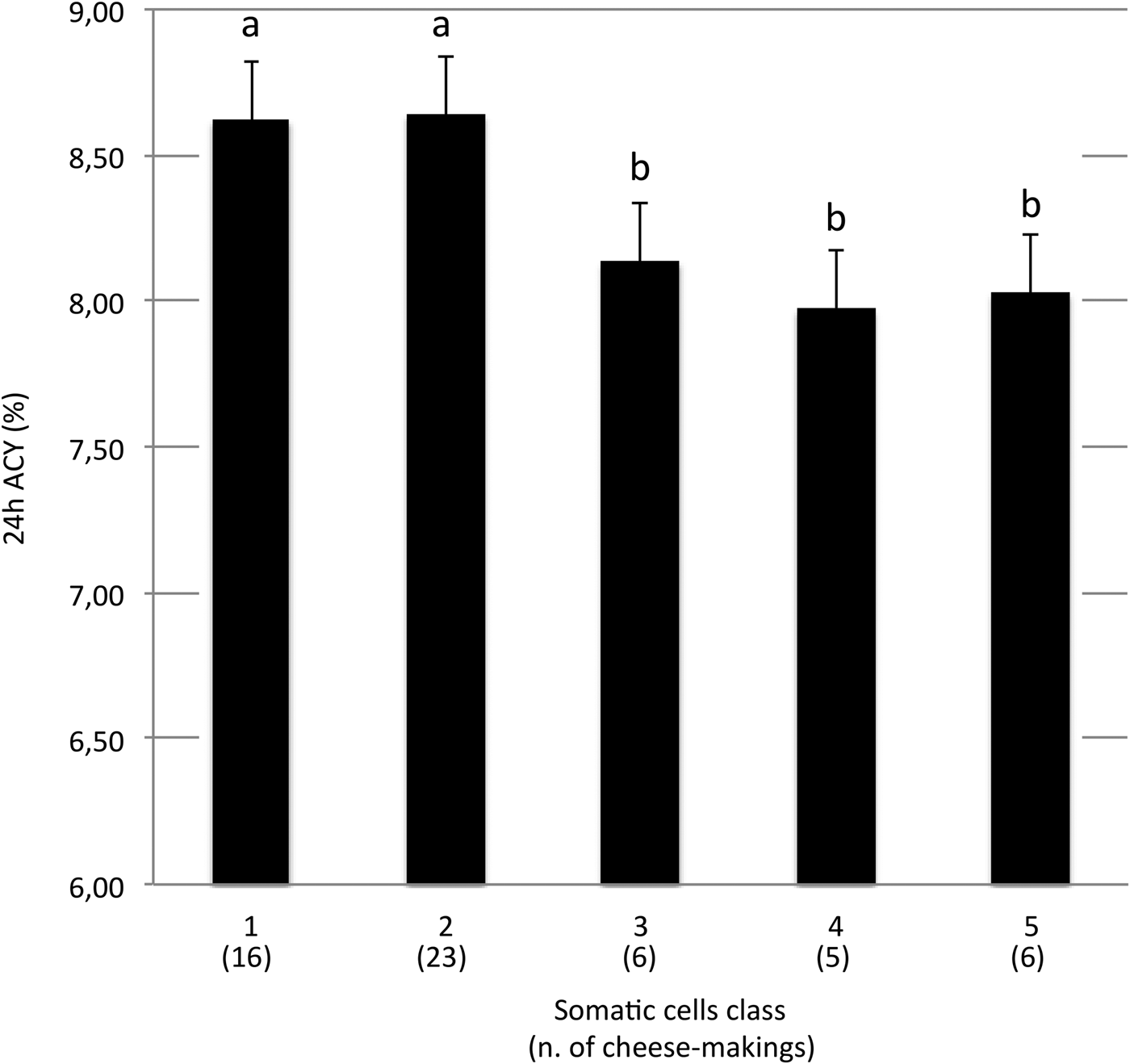
The cheese batches were divided into five classes according to the SCC contained in the E-milk. The 24 h ACY was higher in the batches of cheese in classes 1 and 2 than in the other classes, where no significant differences were observed (Fig. 1). On the other hand, no differences were observed among the classes (data not shown) when the cheese yield was corrected according to the fat and casein content in V-milk. The values of 24 h ACY observed in this study are similar to those previously observed for Parmigiano-Reggiano cheese (Malacarne et al. Reference Malacarne, Summer, Fossa, Formaggioni, Franceschi, Pecorari and Mariani2006), and other hard Italian PDO very hard cheeses, namely Grana Padano and Grana Trentino (De Marchi et al. Reference De Marchi, Bittante, Dal Zotto, Dalvit and Cassandro2008; Pretto et al. Reference Pretto, De Marchi, Penasa and Cassandro2013). The negative influence of milk somatic cells on its cheese yielding ability confirms results observed for other types of cheeses (Politis & Ng-Kwai-Hang, Reference Politis and Ng-Kwai-Hang1988a, Reference Politis and Ng-Kwai-Hangb; Barbano et al. Reference Barbano, Rasmussen and Lynch1991; Klei et al. Reference Klei, Yun, Sapru, Lynch, Barbano, Sears and Galton1998). However, it seems that variations among classes are mainly due to the difference in milk fat and casein contents as no differences were found when adjusted cheese yield was considered.
Parmigiano-Reggiano cheese yield, calculated as the kg of 24-h cheese obtained from 100 kg of processed vat milk (24 h ACY), according to somatic content of evening milk, measured prior natural creaming: class 1, from 0 to 200 000; 2, 201 000–300 000; 3, 301 000–400 000; 4, 401 000–500 000; 5, over 501 000 cells/ml. a, bAre different at P < 0·05.
The mean values of estimated cheese-making losses (expressed as concentration in cheese whey × 100/concentration in vat milk) and their correlations with E-milk SCS are reported in Table 2. The values are comparable to those reported for Parmigiano-Reggiano cheese-making by Malacarne et al. (Reference Malacarne, Summer, Fossa, Formaggioni, Franceschi, Pecorari and Mariani2006). The only significant correlation with SCS was observed for estimated fat loss (14·95%). The lower recovery of fat in cheese is attributed to increased lipolysis in high SCC milk (Barbano et al. Reference Barbano, Rasmussen and Lynch1991)
Cheese-making losses† and their correlations with both somatic cell score (SCS) of the full cream evening milk (E-milk) and the actual cheese yield measured after 24 h (24 h ACY)
Only significant correlations (P < 0·05) are reported
† Mean values expressed as follow: concentration in the residual cheese whey × 100 / concentration in V-milk
Conclusions
The increase of milk somatic cell content is associated with a reduction of its cheese yielding ability. The reduced cheese yield is the consequence of a decrease of both milk casein and recovery of milk fat in cheese, as SCC increases. The data reported suggest that there was a significant decrease in 24 h ACY when the value of SCC was above 300 000 cells/ml, therefore before milk SCC reaches the legal limit of 400 000 cell/ml. The difference observed may be relevant for the profit of the cheese factory. Assuming standard Parmigiano-Reggiano cheese-making conditions (1100 kg of V-milk processed, 15% loss of cheese weight throughout a ripening of 24 months) and a price of 9·76 euro/kg for 24 month-old-cheese, according to ACY observed in this study, it is possible to estimate a decrease in profit of 46 euro for a cheese batches made with milk SCC within the range 300 000–400 000 cells/ml compared to batches made with milk SCC below 300 000 cells/ml.
Further research is required to analyse the relationships between milk somatic cell content and quality of cheese.
The authors would like to thank Prof. Primo Mariani for the important contributions in the writing of this paper.