

1. Introduction
The Kingdom of Saudi Arabia (KSA) has high prioritised the provision of health care to its citizens since the discovery of oil. Oil-derived wealth has funded free public-sector services, including health care, for all citizens without collecting taxes or contributions. Over the past several decades, improvements have been made to both the quantity and quality of health care services (Albejaidi, Reference Almalki, FitzGerald and Clark2010; Almalki et al., Reference Al Salloum, Cooper and Glew2011). These changes can be recognised through the remarkable developments within the health care system at all levels. Economic growth has led to a major modernisation of the health care infrastructure, including facilities such as hospitals built to contemporary standards, some of which have been described as ‘hotel-like accommodations’ (Mufti, Reference Mufti2000).
Health care services are provided through both the public sector, including the Ministry of Health (MOH) and other governmental agencies, and the private sector. The bulk of health care service provision in the KSA is undertaken by the public health care sector through the MOH. The MOH, which is funded annually by the total government budget derived primarily from oil revenue, is the main provider of public health care services, operating ~60% of hospitals and primary health care centres (MOH, 2010). Recent years have witnessed an effort to improve health care services, with a significant increase in the allocated budget, ranging from 5.9% of the government’s total budget in 2006 to 7.25% in 2015 (MOH, Reference Mitchell and Carson2016). The apparent success of the KSA health care system can likely be attributed to this high level of financing (Baranowski, Reference Baranowski2009).
Despite the substantial resources that the government is currently able to allocate, the health care system is increasingly under strain as a result of the most pertinent challenges faced by all publicly funded health care systems; rapid increases in expenditures and demand while resources remain finite. These challenges include rapid demographic changes, an ageing population, an increase in sedentary lifestyles, rising costs, increasing user expectations and changing disease patterns (Walshe and Smith, Reference Walshe, Smith, Walshe and Smith2011). The present situation appears unsustainable in the medium to long term, especially with uncertainties regarding oil prices. Therefore, both academics and international health organisations have questioned the future viability of the current health care financing system (Mufti, Reference Mufti2000; WHO, 2006; Jannadi et al., Reference Jannadi, Alshammari, Khan and Hussain2008; Al Salloum et al., Reference Albejaidi2015; Al-Hanawi et al., Reference Al-Hanawi, Alsharqi, Almazrou and Vaidya2018).
Public health care services in the KSA are also characterised by an overload, overuse and shortage of medical personnel, which result in long waiting times to access health care services at all levels. A study by Al-Hanawi et al. (Reference Al-Hanawi, Alsharqi, Almazrou and Vaidya2018) indicated that the quality of public health care services has been criticised for several reasons, including the lack of available hospital beds, long waiting time, lack of available drugs and poor staff attitudes. These quality issues, the most important of which is long waiting times, have forced many Saudis to use the services of private health care services. Perhaps unsurprisingly, most private health care services were provided to Saudis who were also eligible for free health care services through the public health care sector (Walston et al., Reference Walston, Al-Harbi and Al-Omar2008). Al-Hanawi et al. (Reference Al-Hanawi, Alsharqi, Almazrou and Vaidya2018) concluded that there is a willingness to contribute to public health care financing among Saudi people if the quality of health care services is improved. However, the study does not estimate the Saudi people’s willingness to pay (WTP) for quality improvements, which this study seeks to achieve.
Using a contingent valuation (CV) method, this study aimed to assess the value and importance of improvements in the quality of public health care services in the KSA. CV is a stated preference method that has been widely used to assess public preferences through eliciting the WTP values. It is a hypothetical approach that uses surveys to place economic values on public goods by obtaining information on individual preferences and determining what they would be willing to pay for public goods and services when prices are not available (Mitchell and Carson, 1989). CV has been extensively used in the area of transport and environmental economics (Jones-Lee et al., Reference Jones-Lee, Hammerton and Philips1985; Hanley et al., Reference Hanley, MacMillan, Wright, Bullock, Simpson, Parsisson and Crabtree1998; Brouwer et al., Reference Brouwer, Akter, Brander and Haque2009). Recently, it has also become widely used in the health care sector. A recent bibliography listed over 7500 CV studies and papers conducting in over 130 countries on many topics, including transportation, environment, health care and education (Carson, Reference Carson2012).
CV can be used to elicit WTP for different purposes, including informing the budget-allocation decisions of publicly financed health care systems, assessing demand, measuring the value of certain aspects or attributes of health care services, and determining the prices of goods to be traded on the market. It can also be used to inform policymakers of the extent and source of other resources that could be mobilised to finance the health care system or health programmes (Diener et al., Reference Diener, O’Brien and Gafni1998; Klose, Reference Klose1999; Bateman et al., Reference Bateman, Carson, Day, Hanemann, Hanley, Hett, Jones-Lee, Loomes, Mourato and Özdemiroglu2002).
2. Material and methods
2.1 Study area, sampling and setting
A pre-tested interviewer-administered CV questionnaire was applied to collect data from the heads of households in Jeddah, the country’s second-largest city and its surrounding areas in the Jeddah Province of the Mecca region over a five-month period (October 2014–February 2015). The sample included participants from urban and suburban areas to obtain a diverse and representative spectrum of citizens’ perspectives.
The interviews were conducted in Arabic by a well-trained team of two female and eight male data collectors including the first author (M.K.A.). The interviews lasted between 15 and 75 min with an average of 31.4 (±7.9) min. The individuals involved in the data collection process were postgraduate students and research assistants at King Abdulaziz University in Jeddah City. All individuals involved in the data collection attended a comprehensive training workshop organised by the first author (M.K.A.). At the training workshop, the aim of the research was explained to the data collection team. All questions on the CV survey were discussed. The interviewers were trained with regard to how to administer the CV questionnaire, and the potential questions that might be raised by respondents during the interviews were discussed. The interviewers read, managed and completed the questionnaire based on the answers provided by the participants to accurately record responses and make the most efficient use of time.
The interview method for data collection was recommended by the internationally recognised National Oceanic and Atmospheric Administration (NOAA) panel for conducting CV studies (Arrow et al., Reference Arrow, Solow, Portney, Leamer, Radner and Schuman1993). This method is the most frequently employed when administering CV questionnaires in health care studies. This method is recognised as a better way to obtain valid information, to minimise the risk of misunderstanding and to increase the response rate compared with other methods such as online or mailed surveys (Cavana et al., Reference Cavana, Delahaye and Sekaran2001; Olsen and Smith, Reference Olsen and Smith2001).
A multi-stage sampling procedure was used to recruit the study sample. The sampling frame was the primary health care centres (PHCs) in Jeddah province–Jeddah city and its surroundings. The PHC network was selected as the sampling frame because all Saudi people are expected to be registered with PHCs, which act as the gatekeeper for access to health care services (Al-Hamdan et al., Reference Al-Hamdan, Kutbi, Choudhry, Nooh, Shoukri and Mujib2005). To ensure that the sample represented the population, Jeddah was divided into five regions, i.e., central, west, east, north and south, and two PHC centres were selected per region based on location and the number of registered users. A random sample of users from each PHC was selected, with the sample size being proportional to that of its catchment population. Potential participants were contacted by phone to arrange interviews at locations convenient to them.
According to the latest KSA Census, the native Saudi population is estimated as 18 million people; this figure includes three million Saudi households (Salam et al., Reference Salam, Elsegaey, Khraif and Al-Mutairi2014). The population of Jeddah and its surrounding areas is estimated as 5,339,660, which constitutes 772,151 Saudi households. A larger target sample size will result in greater external validity and better generalisability of the study (Cavana et al., Reference Cavana, Delahaye and Sekaran2001).
The current study used the double-bounded dichotomous choice with follow-up elicitation to elicit the WTP. The general recommendation is to obtain a sample size of 1000 respondents when using this method for WTP questions (Arrow et al., Reference Arrow, Solow, Portney, Leamer, Radner and Schuman1993; Bateman et al., Reference Bateman, Carson, Day, Hanemann, Hanley, Hett, Jones-Lee, Loomes, Mourato and Özdemiroglu2002). Two alternative methods were used to calculate the minimum sample size, and both gave broadly comparable results.
The representative target sample size needed and its associated sufficient statistical power was calculated using a sample size calculator (Raosoft, 2014). The sample size calculator used a margin of error of ±4%, a confidence error of 99%, a 50% response distribution, and 772,151 Saudi households to arrive at a sample size of 1024 participants. In addition, based on a one-group c 2 test with a 0.05 two-tailed significance level and a power of 90%, the minimum required sample size was 1047 participants. Nevertheless, a decision was taken to use a sample of 1250 heads of households to compensate for non-usable questionnaires.
To reach the required number of interviews, a total of 2289 heads of household were approached by phone and asked to participate in the study. To encourage participation in this study, potential participants were informed that a donation of Saudi Riyal (SR) 10 for each participant would be made to a Saudi breast cancer charity. Of those called, 1250 agreed to participate in the study, indicating a response rate of 54.6%. The main reason given for refusing to participate in the study was that they did not have time to be interviewed for 30 min or more. In total, 1187 valid questionnaires were used in the data analysis. The remaining 63 questionnaires were deemed invalid as the information provided was incomplete; some respondents refused to continue the interview, whereas others refused to provide information concerning socioeconomic characteristics, which was necessary for the analysis.
The inclusion criteria were Saudi adults aged 18 and older who were heads of household. Non-Saudi residents and expatriates were excluded because they are not entitled to access public health care services. The survey targeted only heads of household because they are considered the main decision-makers regarding important matters pertaining to the household. They are responsible for other household members, are, in most cases, the main income-earners in the household, and are the ones who made decisions on household income; all of these conditions would likely influence decisions concerning expenses and WTP.
2.2 Questionnaire design
The design of the CV questionnaire was guided by an exploratory qualitative study (Al-Hanawi et al., Reference Al-Hanawi, Alsharqi, Almazrou and Vaidya2018) and the consideration of questionnaires that had been used in other studies. The CV questionnaire included questions on basic information about the respondent’s household, use of health care services, satisfaction with the quality of public health care services, elicitation of WTP, demographic and socioeconomic characteristics.
The questionnaire was divided into four sections (Supplementary Appendix A). The first section consisted of questions about the basic information of the respondent, the respondent’s household and their use of health care services. This section was followed by the second, which collected information about the respondents’ perceptions of the quality of public health care services. In addition to investigating the status quo level of the quality attributes of public health care services, this section prompted the respondents to think about these quality attributes and reflect on what might be important to them before asking them about their WTP for quality improvements (Bateman et al., Reference Bateman, Carson, Day, Hanemann, Hanley, Hett, Jones-Lee, Loomes, Mourato and Özdemiroglu2002).
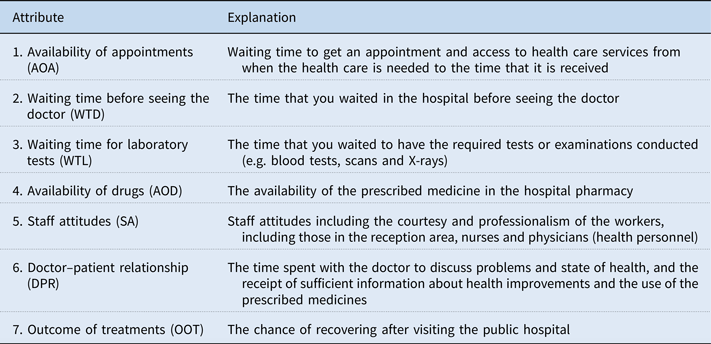
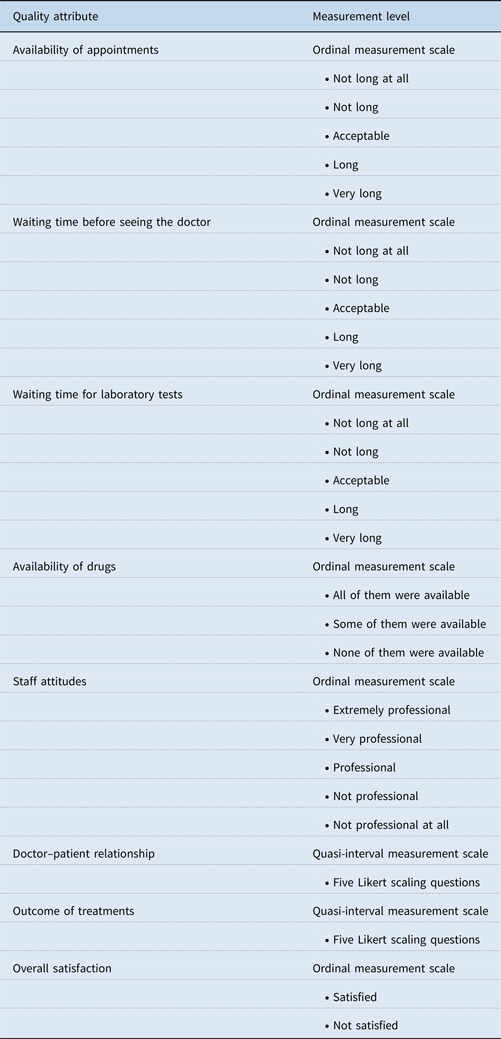
At the beginning of the second section, the respondents were introduced to the pre-selected quality attributes and were presented with a clear definition of each to avoid confusion. To be realistic and manage the evaluation process, seven quality attributes were selected and are presented in Table 1. The measurement scales of these quality attributes are presented in Table 2. These attributes were the availability of appointments, waiting times before seeing the doctor, waiting times for laboratory tests, the availability of drugs, staff attitudes, the doctor–patient relationship and outcome of treatments. The respondents assessed the status quo level of these attributes using ordinal measurement scales for the first five attributes, and quasi-interval ‘Likert’ scales for the last two attributes (Ryan et al., Reference Ryan, Scott, Reeves, Bate, Van Teijlingen, Russell, Napper and Robb2001). The respondents were also asked to assess a transition from the status quo of each of the attributes to the preferred state. The highest category on each measurement scale was treated as the preferred state of the corresponding attribute. For example, for waiting time attributes, respondents were asked to identify the waiting time that they perceived as ‘Not long at all’. Given that the status quo quality level varied across respondents and that the new proposed quality level was identical for the entire sample, different respondents assessed variable degrees of quality improvements, depending on the status quo quality level.
The seven selected attributes

The measurement scales for the quality attributes

Respondents were asked to base their assessment on their last visit to a public hospital over the previous 12 months. Despite the fact that some studies have recommended collecting data regarding all of a patient’s visits to health care facilities during a specific recall period, most surveys collect data based on the last visit (McIntyre and Ataguba, Reference McIntyre and Ataguba2011). This method was used in this study in order to limit a recall bias, where all things being equal, people are more likely to forget or confuse things the longer ago they happened; furthermore, they are more likely to provide facts in response to more specific questions. Surveys are likely to provide better results if they are related to the last visit rather than to a certain a period of time.
The third section, the key part of the questionnaire, sought to gather information regarding respondents’ WTP. Two approaches are commonly used to frame WTP questions based on payment method: user-based payment questions (fees at the point of consumption) and insurance-based payment questions (insurance premiums) (O’Brien and Gafni, Reference O’Brien and Gafni1996). The insurance-based approach was adopted in this study. The insurance premium was specified as the payment vehicle in the scenario and questions. The frequency of payment was also introduced to respondents in the questions. This study used the double-bounded dichotomous choice with follow-up elicitation method (Arrow et al., Reference Arrow, Solow, Portney, Leamer, Radner and Schuman1993), whereby respondents who are willing to contribute financially are asked to state the maximum amount that they would be willing to pay as a monthly health insurance premium for each household member. Importantly, the first bid value offered by the dichotomous choice question was determined via several factors, including the average private health insurance premium in the country, the MOH expenditure per capita and the results from the open-ended responses in the pilot study.
Participants were presented with the following hypothetical scenario: ‘Imagine that the government has decided to set up a national health insurance scheme into which citizens are required to make regular contributions. The contributions would supplement the government’s health budget to improve the quality of public healthcare services. The healthcare services that are currently available would still be available to you and your household members and would be free at the point of use. The contribution would be similar to an insurance premium, with no refund for those who do not need to use healthcare facilities.’
Following the description of the scenario, respondents were reminded about the seven attributes that they might wish to be improved. They were asked whether they would be willing to pay a monthly health insurance premium per household member in order to benefit from improvements in the quality of public health care services as follows: ‘Based on the above scenario, would you be willing to participate in the national health insurance scheme in order to benefit from ensuring access to a better quality of healthcare services for some or all of the attributes mentioned above, for yourself and each of your family members?’
If respondents answered ‘Yes’ to the above question, then they were asked to answer the double-bounded dichotomous choice with a follow-up question. In the double-bounded dichotomous choice questions, respondents were asked to state whether they would be willing to pay 50 SR [1 SR=0.27 US$) as a monthly health insurance premium per household member. If the respondent accepted the 50 SR bid, then the following question was whether he or she would be willing to pay 100 SR. If the respondent rejected the 50 SR bid, then the following question was whether he or she would be willing to pay 25 SR. If the respondents rejected the 25 SR bid, then they were asked to determine the main reason for their unwillingness to participate and contribute financially. This practice is common for double-bounded dichotomous choice questions in which if respondents accept the offered bid in the first question, then the following question is to state whether they would be willing to pay twice the initial bid; if the respondent rejected the first offered bid, then they would be presented with an offer of half of the initial bid (Neumann et al., Reference Neumann, Cohen, Hammitt, Concannon, Auerbach, Fang and Kent2012).
Participants who accepted any of the offered bids were asked to state the maximum amount that they would be willing to pay per household member to benefit from ensuring access to a better quality of health care services for some or all of the attributes. This question allowed respondents to state a WTP out of the range of bids specified in the double-bounded dichotomous choice questions (Lienhoop and MacMillan, Reference Lienhoop and MacMillan2007). The respondents were also asked to split that stated maximum amount between some or all of the quality attributes in order to benefit from the highest level of improvements.
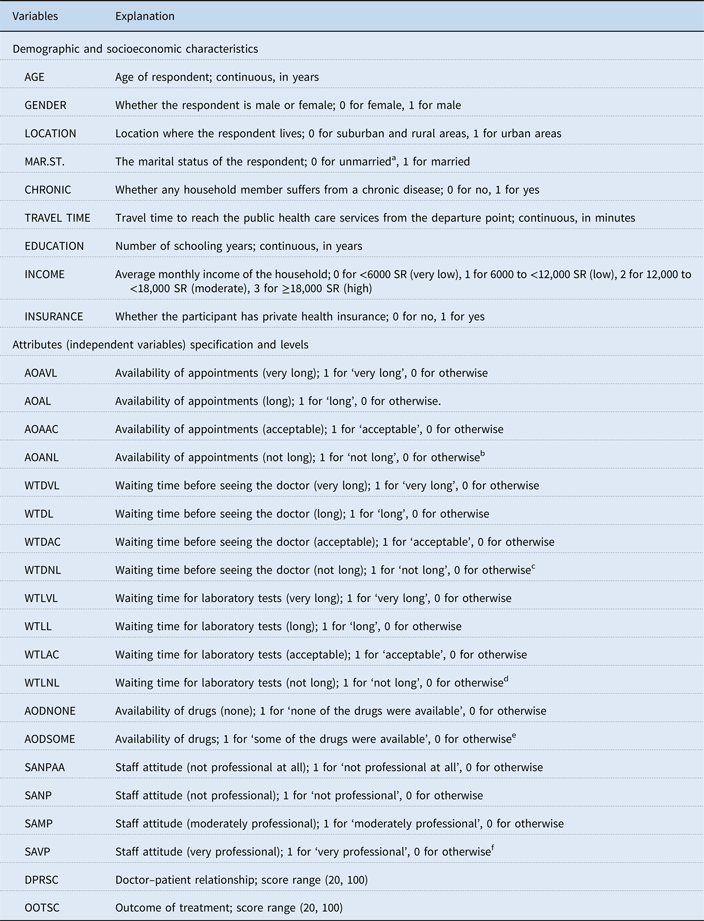
The fourth and final section of the questionnaire consisted of questions related to the demographic and socioeconomic characteristics of the respondents, including education level, household monthly income and ownership of private health insurance. A description of the variables for which data were collected and their measurements are presented in Table 3.
Independent variable specifications

Note:
SR=Saudi Riyal.
a ‘Unmarried’ includes single, divorced and widowed.
b Availability of appointments=‘not long at all’ was included in the constant.
c Waiting time before seeing the doctor=‘not long at all’ was included in the constant.
d Waiting time for laboratory tests=‘not long at all’ was included in the constant.
e Availability of drugs=‘all of them were available’ was included in the constant.
f Staff attitudes=‘extremely professional’ was included in the constant
2.3 Data analyses
The consistency of the qualitative measurement scales used to characterise the quality levels for the ‘availability of appointments’, ‘waiting time before seeing the doctor’ and ‘waiting time for laboratory tests’ attributes was assessed using an analyses of variance (ANOVA) based on respondents’ declared waiting times. The ‘doctor–patient relationship’ and the ‘outcome of treatments’ attributes were assessed using a Likert scaling in which the respondents were asked to state their position with respect to five statements relating to the same attribute (see Supplementary Appendix A). For each statement, the respondents were asked to declare whether they ‘strongly disagreed’, ‘disagreed’, ‘were undecided’, ‘agreed’ or ‘strongly agreed’ with each item’s contents. The respondents’ answers for each statement were coded as ‘strongly disagree (1)’, ‘disagree (2)’, ‘undecided (3)’, ‘agree (4)’ and ‘strongly agree (5)’ and were used to calculate a score. The score was calculated by taking the average of the participant’s answers for the five statements and multiplying it by 20 for technical reasons. This was to be able to convert the scale to be up 100 rather than 5 total points. In this way, the results can be interpreted as a variation in percentage.
Given the scale and the 1 to 5 scoring, the neutral score (undecided) would be 60, scores above 60 indicated satisfaction with the attribute (higher scores indicate more satisfaction); and scores below 60 correspondingly represented dissatisfaction with the attribute. These scores were used to assess the association between the degree of improvements in the quality of these attributes and the WTP value. The two Likert scales were assessed for internal reliability by using Cronbach’s α technique. The rule of thumb with Cronbach’s α is that the results should range between 0.70 and 0.90; if it does not, then the scale cannot be considered as internally consistent (Fetters and Tilson, Reference Fetters and Tilson2012).
Data on WTP were skewed to the right, potentially resulting in heteroscedasticity in the regression models. One approach to deal with this is to transform the WTP dependent variable; however, this makes interpreting the regression coefficients difficult because they would no longer be in the same metric as the dependent variable (Manning, Reference Manning1998). With continuous data derived from an open-ended WTP question format, the ordinary least squares (OLS) multiple regression is the most commonly used technique to examine the factors associated with WTP and assess the construct validity. However, the large number of zero WTP responses called into question the continuity of the dependent variable and therefore the use of a standard linear regression model.
OLS estimation fails to account for the qualitative differences between the limit observations (zero WTP) and non-limit observations (positive WTP) (Donaldson et al., Reference Donaldson, Jones, Mapp and Olson1998). Thus, it is subject to estimation bias and inconsistency in the estimation of the marginal effects (Greene, Reference Greene2003). When the nature of the WTP question is continuous with censoring at zero, the most appropriate estimation technique is the limited dependent variable with the Tobit model (Donaldson et al., Reference Donaldson, Jones, Mapp and Olson1998). This model has also been used in various studies (Whitehead et al., Reference Whitehead, Hoban and Clifford1995; Mataria et al., Reference Mataria, Donaldson, Luchini and Moatti2004; Ghorbani and Hamraz, Reference Ghorbani and Hamraz2009; Awunyo-Vitor et al., Reference Awunyo-Vitor, Ishak and Seidu Jasaw2013).
A Tobit regression analysis for limited dependent variables (Tobin, Reference Tobin1958) was performed to assess the construct validity of the stated WTP, which determines the extent to which the results are consistent with a priori expectations and to examine the factors associated with the stated maximum amount that respondents were willing to pay. Seven partial Tobit regressions corresponding to seven different attributes were conducted to estimate the ‘beta’ coefficients which explain the expected WTP for each attribute and show how WTP varies with the quality attribute's status quo level and the respondents’ demographic and socioeconomic characteristics. Second, the marginal effects β′ and β″ were estimated, where β′ explains the marginal effects for the probability of being uncensored, and β″ explains the marginal effects for the expected WTP value conditional on being uncensored: E (WTP|WTP>0) (McDonald and Moffitt, Reference McDonald and Moffitt1980; Ekstrand and Carpenter, Reference Ekstrand and Carpenter1998). All analyses were performed using STATA SE 14 (StataCorp LP, College Station, TX, USA).
3. Results
3.1 Descriptive statistics
3.1.1 Demographic and socioeconomic characteristics of the respondents
Of the total 1187 respondents, 152 were female (12.8%) and 1035 were male (87.2%). Their average age was 39 years old; the oldest was 75 years old, and the youngest was 20 years old. The majority (71.3%) was between 25 and 44 years old. Of all the participants, 1041 respondents were married (87.7%) and 146 were unmarried (12.3%). A total of 1084 respondents (91.3%) lived in urban areas, whereas only 103 respondents (8.7%) lived in suburban or rural areas. The average education level, ‘numbers of schooling years’, was 13.5 years (±3.5). Respondents were categorised into the following groups based on their average household income: very low income (<6000 SR), low income (6000 SR to <12,000 SR), moderate income (12,000 SR to <18,000 SR) and high income (≥18,000 SR). A total of 216 (18.2%) reported a very low income, 460 (38.8%) reported a low income, 348 (29.3%) reported a moderate income and 163 (13.7%) reported a high income.
Approximately two-thirds of the sample (62.1%) reported that none of the household members suffered from chronic diseases, compared with 37.9% who reported that either they or a family member did. ‘Travel time to the public health care facility’ was used as proxy for health care access. On average, the respondents’ travel time to the public health care facility was 21.4 (±10.1) min, with the minimum being 5 min, and the maximum being 90 min. Regarding satisfaction with health care services, 598 respondents (50.4%) were not satisfied with the quality of public health care services, whereas 49.6% reported being satisfied. Of the total sample, 116 respondents (9.8%) had private health insurance that allowed them to access private health care services in addition to their access to public health care services.
3.1.2 Quality attributes of public health care services
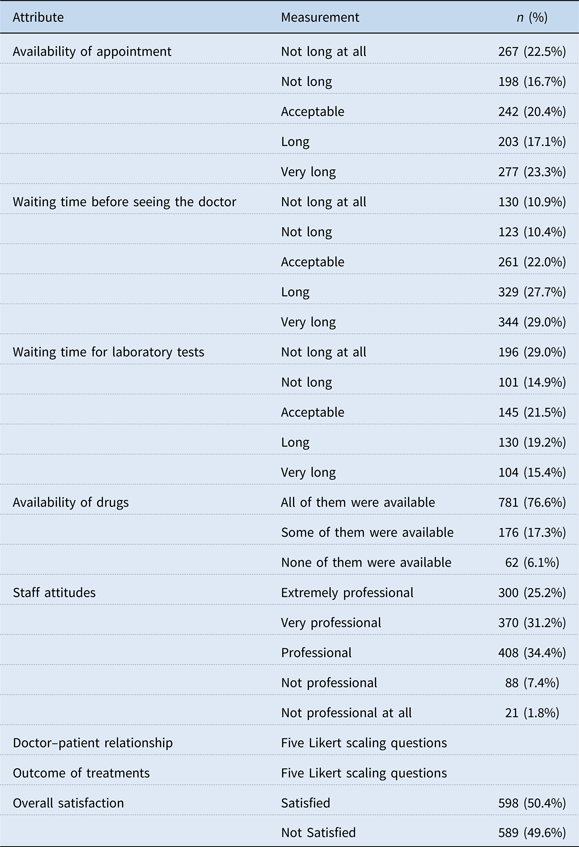
Table 4 summarises the respondents’ assessments of the status quo quality of public health care services. On average, the waiting time to obtain an appointment to access the public hospital was 17 days (maximum nine months). Nearly 40.44% of the study respondents reported ‘very long’ or ‘long’ wait times to obtain appointments to access the public hospital. The respondents stated that a waiting time of up to four days to obtain an appointment to access the hospital would be perceived as ‘not long at all’. The average waiting time at health care facilities before seeing the doctor was 50 min (maximum 240 min). More than half of the respondents (56.70%) considered the waiting time before seeing the doctor as ‘very long’ or ‘long’. Respondents considered a waiting time of up to 13 min as ‘not long at all’. The average waiting time for laboratory tests and examinations was 33 min (maximum 300 min). Nearly one-third of the respondents considered the waiting time for laboratory tests and examinations as either ‘very long’ or ‘long’. They considered a waiting time for laboratory tests of up to 15 min to be ‘not long at all’.
Respondents’ status quo level assessments of the quality attributes (relating to the most recent visit to a public hospital by any member of the household)

A medical prescription was received in 86.5% of the cases. Over three-quarters of the respondents (76.6%) did not report a lack of drug availability at the health care facility pharmacy. The rest reported that they either could not find some of the prescribed medicine at the hospital pharmacy (17.3%) or they could not find any of their prescribed medicine at all (6.1%). Respondents were also asked what they would do if some or all of their prescribed medicine was not available in the facility’s pharmacy. Nearly three-quarters stated that they would pay to obtain them from a private pharmacy, whereas 22% stated that they would ask the doctor to prescribe an alternative medicine that could be found at the facility’s pharmacy. The high percentage of respondents who stated that they would buy the drugs from a private pharmacy might indicate the ability of people to pay.
In general, most of the participants (90.8%) were satisfied with the attitude of the staff. However, a few participants (9.2%) assessed the staff attitude either as ‘not professional’ or ‘not professional at all’. Regarding the measurement of the remaining two attributes, the ‘doctor–patient relationship’ and the ‘outcome of treatments’, the responses to the first five statements led to an estimation of the mean score for the ‘doctor–patient relationship’ of 72.34 [±18.15, range (20, 100)]. The responses to the second set of five statements led to an estimation of the mean score for ‘outcome of treatments’ of 69.29 [±15.12, range (20, 100)]. The respondents were also asked to state their overall general satisfaction with the quality of public health care services. The response to this general question was either satisfied (49.6%) or not satisfied (50.4%).
3.1.3 WTP values
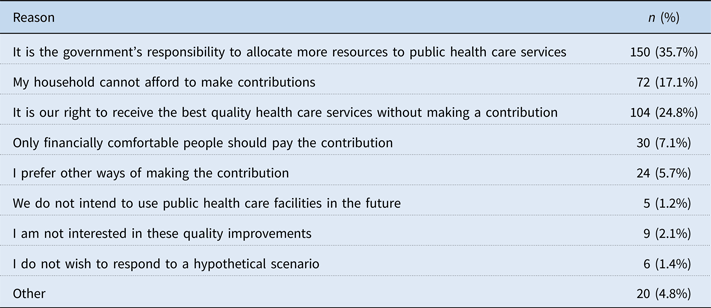
Overall, 767 respondents (64.6%) were willing to pay to access an improved quality of public health care services. The reasons for not being willing to pay in order to benefit from improvements in some or all of the selected quality attributes of public health care services among the 420 respondents (35.4%) varied. Table 5 shows the breakdown of responses. A total of 150 respondents (35.7%) said they would be unwilling to participate because they believe it is the government’s responsibility to finance and allocate more resources to public health care services. A further 72 (17.1%) mentioned affordability as the reason for their response. On the other hand, 24 respondents were not willing to participate because of the payment method, preferring other payment methods to the health insurance premium method. This indicates that they are protest ‘zero’ responses. Based on the responses shown here, only a few responses indicated protest responses. Therefore, all zero responses were included in the analysis.
Respondents’ reasons for being unwilling to pay for improved quality of public health care services

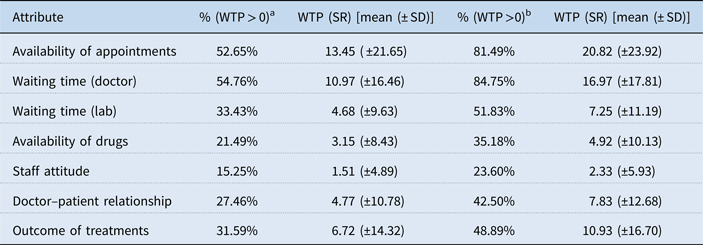
Table 6 shows the WTP for improvements for each of the attributes. Respondents were willing to pay the most (20.82 SR) for improvements in the ‘availability of appointments’, which was used to reflect the access to health care services at public hospitals when health care is needed. This was followed by ‘waiting time before seeing the doctor’, which was used to reflect the time that patients waited in the hospital before seeing the doctor, with the WTP being ~17 SR. This was then followed by ‘outcome of treatments’, which was used to reflect the doctor’s competence and experience in treating patients and helping them recover, with the WTP being ~11 SR. Among those who were willing to pay for improvement, a high number of respondents were not willing to pay for improvements for certain attributes. This varied from 18.50% for the ‘availability of appointments’ attribute up to 76.0% for the ‘staff attitude’ attribute.
The willingness to pay (WTP) for improvements to each quality attribute

Note:
SR=Saudi Riyal.
a For the full sample including those who were unwilling to pay for any attribute.
b For those who were willing to pay for improvements (including those reporting zeros in certain attributes).
3.2 Econometrics analysis: WTP for improved quality of public health care services
Analysis of variance revealed that respondents who declared waiting longer to access appointments, or waiting longer before meeting the doctor, or waiting longer for laboratory tests, experienced, longer waiting times (p<0.01). This result confirmed the suitability of the qualitative measurement scales used to specify the extent of the quality improvements to be valued by the respondents. Similar significant results were obtained based on the assessment of the Likert-scaling internal reliability by using Cronbach’s α technique (α=0.87 and 0.73, respectively). These results indicated that they achieved internal reliability.
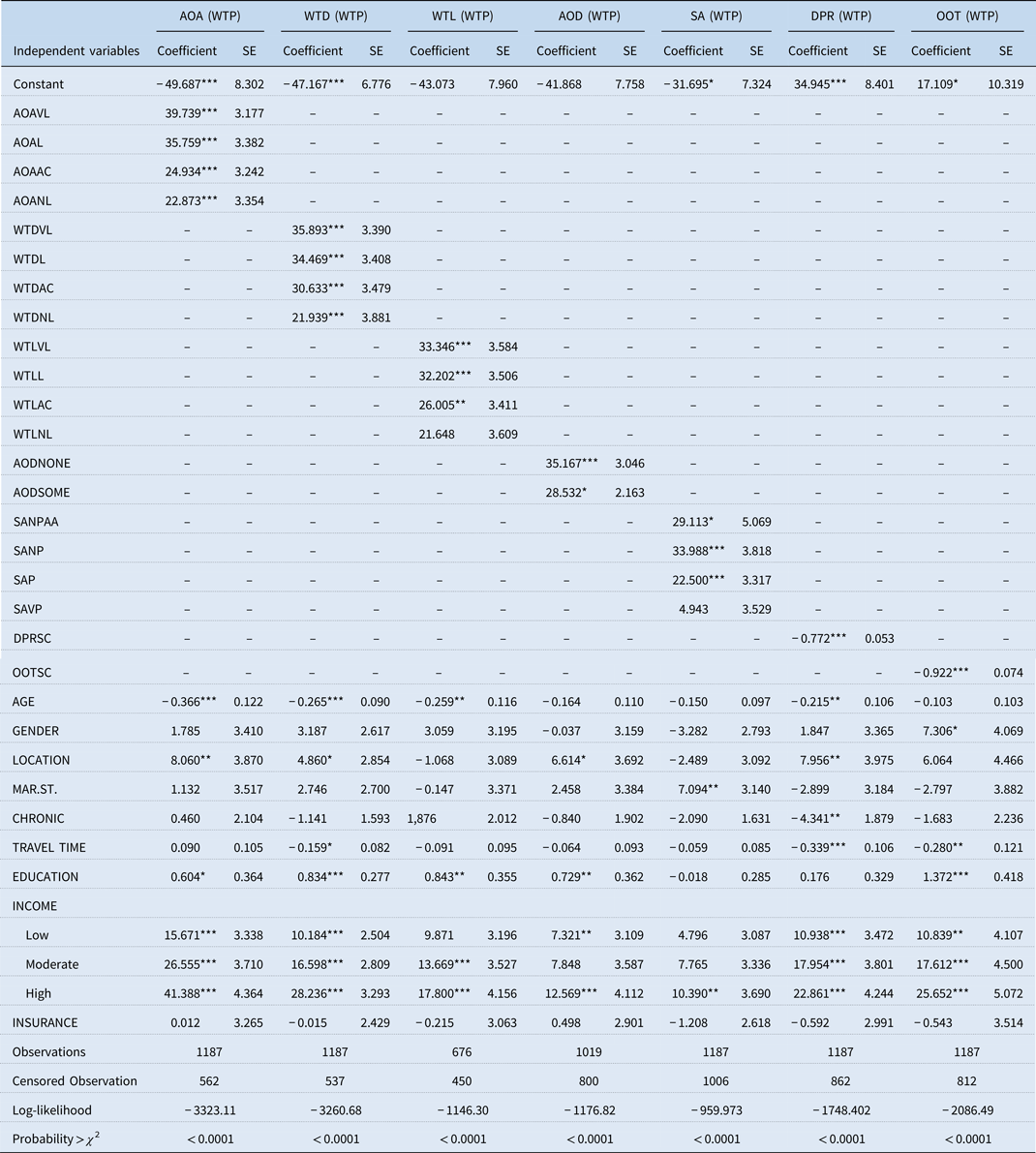
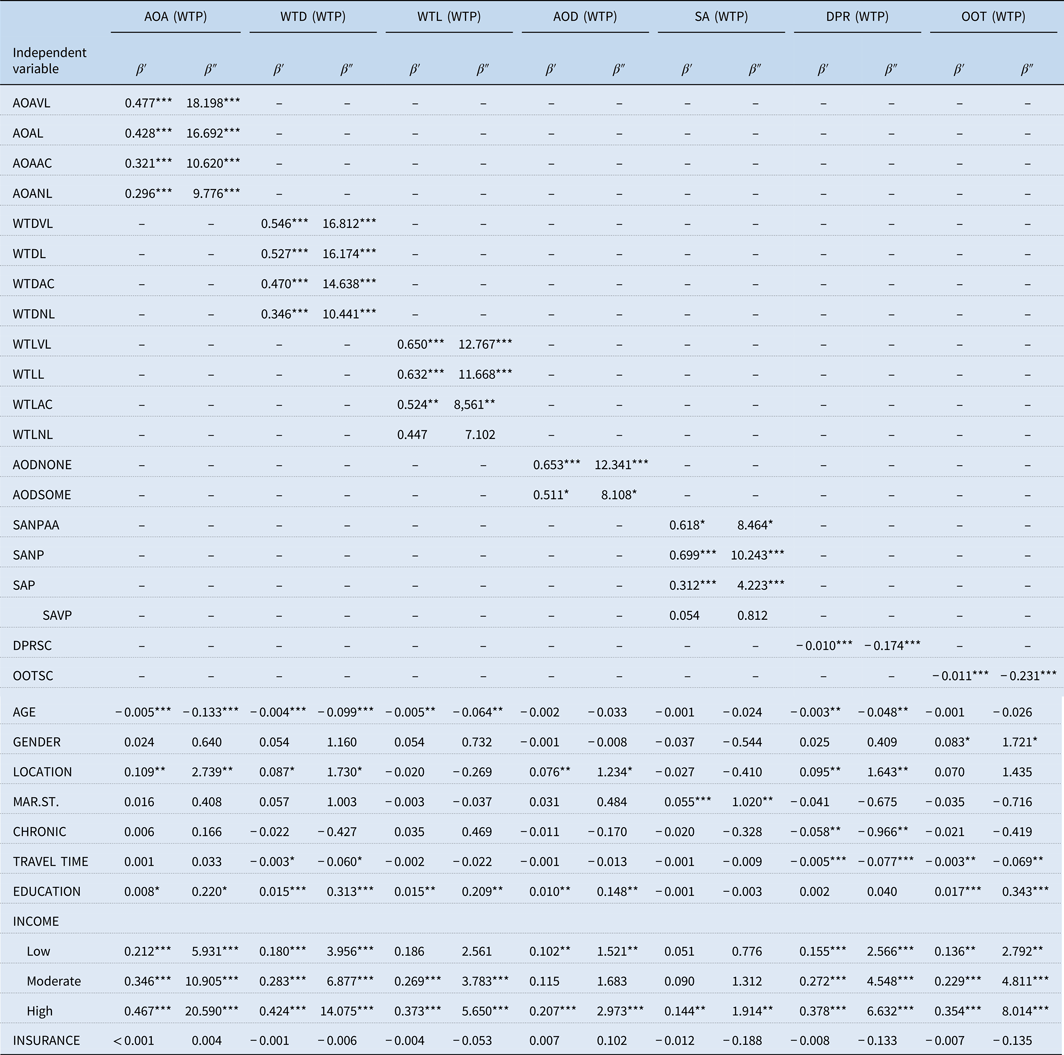
The results of the Tobit regression analyses are presented in Table 7, and the marginal effects are calculated in Table 8. Table 8 shows that, there is a statistically significant association between the degree of improvements in the quality of the attributes and the WTP values. For example, the probabilities that respondents who experienced ‘very long’, ‘long’ or ‘acceptable’ waiting times before seeing the doctor would be willing to pay to benefit from improvements in waiting time before seeing the doctor were, respectively, 0.55, 0.53 and 0.47 greater than those of respondents who declared a waiting time of ‘not long at all’. In addition, those who declared ‘very long’, ‘long’ and ‘acceptable’ waiting times before seeing the doctor were willing to pay more (16.81, 16.17 and 14.64 SR, respectively) to have the waiting time improved to the highest level of ‘not long at all’. All of the results were significant at p<0.01.
Tobit regression analyses of the factors influencing the willingness to pay (WTP) values for quality improvements to each attribute

Note:
AOAVL=availability of appointments (very long); AOAL=availability of appointments (long); AOAAC=availability of appointments (acceptable); AOANL=availability of appointments (not long); WTDVL=waiting time before seeing the doctor (very long); WTDL=waiting time before seeing the doctor (long); WTDAC=waiting time before seeing the doctor (acceptable); WTDNL=waiting time before seeing the doctor (not long); WTLVL=waiting time for laboratory tests (very long); WTLL=waiting time for laboratory tests (long); WTLAC=waiting time for laboratory tests (acceptable); WTLNL=waiting time for laboratory tests (not long); AODNONE=availability of drugs (none); AODSOME=availability of drugs (some of the drugs were available); SANPAA=staff attitude (not professional at all); SANP=staff attitude (not professional); SAMP=staff attitude (moderately professional); SAVP=staff attitude (very professional); DPRSC=doctor–patient relationship; OOTSC=outcome of treatment; MAR.ST.=martial status.
*p<0.10; **p<0.05; ***p<0.01.
Marginal effects of factors influencing the willingness to pay (WTP) values for quality improvements to attributes

Note:
AOA=availability of appointments; WTD=waiting time before seeing the doctor; WTL=waiting time for laboratory tests; AOD=availability of drugs; SA=staff attitudes; DPR=doctor–patient relationship; OOT=outcome of treatments; AOAVL=availability of appointments (very long); AOAL=availability of appointments (long); AOAAC=availability of appointments (acceptable); AOANL=availability of appointments (not long); WTDVL=waiting time before seeing the doctor (very long); WTDL=waiting time before seeing the doctor (long); WTDAC=waiting time before seeing the doctor (acceptable); WTDNL=waiting time before seeing the doctor (not long); WTLVL=waiting time for laboratory tests (very long); WTLL=waiting time for laboratory tests (long); WTLAC=waiting time for laboratory tests (acceptable); WTLNL=waiting time for laboratory tests (not long); AODNONE=availability of drugs (none); AODSOME=availability of drugs (some of the drugs were available); SANPAA=staff attitude (not professional at all); SANP=staff attitude (not professional); SAMP=staff attitude (moderately professional); SAVP=staff attitude (very professional); DPRSC=doctor–patient relationship; OOTSC=outcome of treatment; MAR.ST.=martial status.
β′ is the marginal effect for the probability of being uncensored and β″ is the marginal effect for the expected WTP value conditional on being uncensored: E (WTP|WTP>0).
*p<0.10; **p<0.05; ***p<0.01.
Similarly, respondents waiting a ‘very long’ or ‘long’ time for laboratory tests or examinations were willing to pay significantly more (12.8 SR and 11.7 SR, respectively) to benefit from an improved waiting time for laboratory tests of ‘not long at all’. Respondents who were not able to find ‘some’ or ‘all’ of the prescribed medicine at the hospital pharmacy were willing to pay more than respondents whose prescribed medications were available. They were willing to pay more (8.1 and 12.3 SR, respectively). The results were significant for ‘none of them were available’ at the 1% level and for ‘some of them were available’ at the 10% level. Respondents who were treated in an inappropriate way or perceived the attitude of the staff as ‘not professional at all’ and ‘not professional’ were willing to pay significantly more (8.5 and 10.2 SR, respectively). The first was significant at the 10% level, and the latter was significant at the 1% level.
The ‘doctor–patient relationship’ and ‘outcome of treatments’ attributes had a negative sign on the coefficient and was significant at p<0.01. In more detail, this means that the WTP for improvements in the ‘doctor–patient relationship’ and ‘outcome of treatments’ attributes decreased as the ‘doctor–patient relationship’ score and the ‘outcome of treatments’ scores increased. This is because the higher score indicates satisfaction with the relationship with the doctor and satisfaction with the outcome of the treatments.
Elderly heads of household tended to report a lower WTP for improvements with respect to all of the quality attributes of public health care services. The results were significant (varying between the 1 and 5% level), except for the ‘availability of drugs’, ‘staff attitudes’ and ‘outcome of treatments’ attributes where the results were not statistically significant. Male heads of household were more likely to express higher WTP for improvements in most of the quality attributes, including ‘availability of appointments’, ‘waiting time before seeing the doctor’, ‘waiting time for laboratory tests and examinations’, ‘doctor–patient relationship’ and ‘outcome of treatments’. However, the results for the ‘gender’ variable were not significant, except for the ‘outcome of treatments’ attribute, which was significant at the 1% level. This was not the case for the ‘availability of drugs’ and ‘staff attitudes’ attributes where male heads of households were willing to pay less for improvements to these attributes; however, the results were not significant.
Although not statistically significant, households living in urban areas had a tendency to state a lower WTP for improvements over the ‘waiting time for laboratory tests and examinations’ (−0.02), and ‘staff attitude’ (−0.03), and they were willing to pay 0.27 and 0.41 SR less than household respondents living in suburban or rural areas. On the other hand, households living in urban areas had a higher probability of reporting higher WTP over the ‘availability of appointments’ (+0.11, significant at p<0.05), ‘waiting time before seeing the doctor’ (+0.09, significant at p<0.10), ‘availability of drugs’ (+0.08, significant at p<0.05), ‘doctor–patient relationship’ (0.10, significant at p<0.05) and ‘outcome of treatments’ (+0.07). They were also willing to pay 2.7 SR (p<0.05) for the ‘availability of appointments’, 1.7 SR (p<0.10) for the ‘waiting time before seeing the doctor’, 1.2 SR (p<0.10) for the ‘availability of drugs’, 1.6 SR (p<0.05) for the ‘doctor–patient relationship’ and 1.4 SR for the ‘outcome of treatments’ more than those respondents living in suburban and rural areas.
Although the WTP stated by married heads of household and unmarried heads of household did not differ significantly for any of the quality attributes except the ‘staff attitudes’ attribute, which was significant at p<0.01, married heads of household had a higher probability of declaring a higher WTP over the ‘availability of appointments’ (+0.02), ‘waiting time before seeing the doctor’ (+0.06), ‘availability of drugs’ (+0.03) and ‘staff attitudes’ (+0.06, significant at 1% level) than were unmarried heads of household. Married heads of household expressed a positive WTP more for the ‘availability of appointments’ (0.4 SR), ‘waiting time before seeing the doctor’ (1.0 SR), ‘availability of drugs’ (0.5 SR) and ‘staff attitudes’ (1.0 SR, significant at p<0.05) than unmarried heads of household. These results suggest that married heads of household had a higher probability (+0.06) of expressing a higher WTP to be treated appropriately and experience ‘extremely professional’ staff attitudes (p<0.01). They were also willing to pay 1.0 SR (p<0.05) more than unmarried heads of household to benefit from improvements in staff attitudes. On the other hand, married heads of household had a lower probability of expressing a positive WTP over the ‘doctor–patient relationship’ (−0.04), and the ‘outcome of treatments’ (−0.03). They were willing to pay 0.6 and 0.7 SR less, respectively, than unmarried heads of household. However, these results were not significant.
Significant differences were observed between the WTP values stated by the households where at least one member in the family suffered from a chronic disease and households without chronic diseases for the ‘doctor–patient relationship’, which was significant at p<0.05. The former had a tendency to state a lower WTP for improvements in the ‘doctor–patient relationship’ attribute. These results suggest that respondents with chronic diseases who usually seek health care services for their chronic issues had a lower probability (−0.06) of expressing a positive WTP for an improvement in the doctor–patient relationship attribute (p<0.5). They were also willing to pay 1.0 SR (p<0.05) less than respondents without chronic diseases.
Respondents with more years of schooling were more likely to express a higher WTP for most of the quality attributes, with variation in the significance level between 1 and 10%. They had a higher probability of expressing a positive WTP for the ‘availability of appointments’ (+0.01; significant at p<0.10), ‘waiting time before seeing the doctor’ (+0.02; significant at p<0.01), ‘waiting time for laboratory tests and examinations’ (+0.02; significant at p<0.5), ‘availability of drugs’ (+0.01; significant at p<0.5) and ‘outcome of treatments’ (+0.02; significant at p<0.01). They were also willing to pay 0.22 SR more for the ‘availability of appointments’, 0.31 SR for ‘waiting time before seeing the doctor’, 0.21 SR for ‘waiting time for laboratory tests and examinations’, 0.15 SR for the ‘availability of drugs’ and 0.34 SR for the ‘outcome of treatments’. However, this was not the case for the ‘staff attitude’ attribute. Higher-educated respondents had a tendency to express a lower WTP for improvements in the ‘staff attitudes’ attribute. They were also willing to pay 0.003 SR less than those with less education for this purpose; however, this result was not statistically significant.
The income levels variable had the expected sign on the coefficient in the Tobit regression analysis for the seven attributes. The results suggest that respondents with a high household income had a higher probability (+0.47) of expressing a positive WTP to benefit from improvements in the ‘availability of appointments’, that is, to have a ‘not long at all’ wait for an appointment (p<0.01). They were willing to pay 20.6 SR (p<0.01) more than those with very low incomes. In addition, they also had a higher probability (+0.14 to +0.42) of expressing a positive WTP for the other quality attributes, being willing to pay 1.9 SR to 14.1 SR more than households with very low incomes.
Finally, although the WTP stated by respondents who had private health insurance and those without private health insurance did not differ significantly, respondents who had private health insurance were less likely to express a positive WTP. They were also willing to pay less for improvements for most of the quality attributes.
4. Discussion
This study provides important information about the monetary valuation of seven quality attributes of public health care services amongst Saudi health care users. This study also has important implications for policymakers because it provides insights into those attributes that are valued the most, thereby indicating where they should focus their attention. Respondents’ valuations of improvements in the quality of public health care service attributes were varied, with improvements in ‘availability of appointments’, i.e., a reduction in the time that people waited in order to access health care services, ‘waiting time before seeing the doctor’ and ‘outcome of treatments’ being those for which participants were prepared to pay the most. Therefore, the implications of these findings are that policies should be directed towards improving access, increasing the number of health care facilities and their capacity, including hospital beds, and the number of qualified and specialised medical staff. Otherwise, it will not be possible to reduce the long wait times to access and obtain health care services.
Few people were in favour of improving staff attitudes and drugs availability compared with the other five quality attributes. This result reflects the existing high level of satisfaction with these attributes, as shown in Table 4. With regard to staff attitudes, it is worth noting that only a few respondents complained about staff attitudes; thus, the preferences for improving this attribute were low. One potential explanation for the low preference for improving the availability of drugs is that the results revealed that 76.6% of the respondents found that all of the drugs prescribed to them by physicians were available in the health facilities pharmacy. Importantly, even in cases where the drugs were not available, some respondents, especially those in the high-income group, did not rate this as important. This result indicates that these aspects should not be priority areas for policymakers.
The results of the econometric models applied to analyse the data were consistent with our a priori expectations, and the estimated results are in line with the theoretical predictions. The income variable, for example, was found to be positively associated with the WTP in all of the seven Tobit regressions performed for the seven attributes. Welfare economic theory suggests that households are more willing pay for goods or services as household income increases (Mitchell and Carson, 1989; Viscusi and Aldy, Reference Viscusi and Aldy2003). This income effect supports the construct validity of the CV survey. In addition, the degree of improvement in the quality of the attributes and WTP values were statistically significant associated. This is additional evidence to support the construct validity of the CV used in this study.
The CV questionnaire used in this study was developed in accordance with internationally recognised design and methodological standards (Gafni, Reference Gafni1991; Arrow et al., Reference Arrow, Solow, Portney, Leamer, Radner and Schuman1993; Klose, Reference Klose1999; Venkatachalam, Reference Venkatachalam2004). The survey administration, the information provided to respondents, the selection of the elicitation method, the payment vehicle, the reminder to participants to consider their disposable income and other obligations and the expenditure in the WTP question were given particular attention.
The CV method is primarily criticised because of the potential biases associated with it. Nevertheless, eliminating the biases associated with the CV method yields valid and reliable results. This study attempted to eliminate the hypothetical bias that can threaten the validity of the CV technique (Mitchell and Carson, 1989). A hypothetical bias refers to the extent to which respondents find the valuation scenario realistic, understandable and believable. In this study, the valuation scenario was realistic and believable in the sense that a simple scenario was provided, and respondents were asked about a recommended insurance-based approach rather than a user-based (i.e., user fees) approach (Arrow et al., Reference Arrow, Solow, Portney, Leamer, Radner and Schuman1993; O’Brien and Gafni, Reference O’Brien and Gafni1996). The insurance-based approach was preferred over the user-based approach because the respondents were familiar with the insurance system, together with the fact that there was a high level of rejection of the user-based approach during the testing stage of the CV design process.
This study also used a sample from a wider section of the population in contrast with most studies that have selected ‘in site’ samples to avoid the bias encountered by the many WTP studies that have selected such samples, which have therefore omitted the opinions, views and preferences of people who were not ‘in site’ at the time of the study. Therefore, it can be argued that the sampling method used in our study is one of its strengths. In addition, although this study was conducted at a household level and the heads of household in Saudi Arabia tend to be male for cultural and religious reasons, the voices of women were represented in this study.
The main contribution of this study exceeds the use of the standard CV method by trying to elicit from respondents how the amount of money that they are willing to pay for an improvement in the overall service should be allocated to particular features of the service. The CV questionnaire used a holistic valuation scenario approach by presenting the respondents with a complete description of the scenario, followed by a semi-decomposed valuation scenario approach in which the respondents focused on each attribute to be valued (O’Brien and Gafni, Reference O’Brien and Gafni1996). The evaluation design of the quality improvement assessments followed the successful methodology used by several scholars (Kathiravan et al., Reference Kathiravan, Thirunavukkarasu and Selvam2012; Kathiravan and Thirunavukkarasu, Reference Kathiravan and Thirunavukkarasu2013; Pavel et al., Reference Pavel, Chakrabarty and Gow2015).
The limitation of the semi-decomposed valuation scenario approach is the possibility of introducing an estimation bias if the total value of the commodity under investigation is needed (O’Brien and Gafni, Reference O’Brien and Gafni1996). Therefore, to eliminate such a bias, this study first used a holistic approach to estimate the total value of the commodity and then used the semi-decomposed approach to assess the components of the commodity. This approach was operationalised by asking the respondents to value the commodity under investigation in a normal way, then asking the respondents to split the amount that they would be willing to pay for the commodity between some or all of the components (attributes) of the commodity. The advantage of this approach is the avoidance of the estimation bias that could be introduced by the decomposed valuation scenario approach and help to obtain a valid value of the commodity in total and of its components (Mitchell and Carson, 1989).
5. Conclusions
Most previous studies using the CV method have been applied to contexts in which people already contribute in one way or another to the financing of public services. This study applied the CV method to a previously unstudied context in which people are accustomed to having free public services, including health care. Before this study was conducted, it might have been argued that, as a result of the way in which the health care system in the KSA is financed, the CV method might not have been a feasible or valid method to elicit public preferences and WTP for health care provision and financing. In contrast, the current empirical findings regarding WTP demonstrate a strong construct validity of CV studies in the context of health care in Saudi Arabia. Therefore, this study demonstrated that the CV method can be applicable in numerous nations that have non-contributory health care systems in the Middle East, especially the Gulf countries including the KSA. Hence, this study contributes to knowledge and adds to the existing body of literature on the empirical applications of the CV method.
5.1 Study limitations
Because of budget and time constraints, the study sample was selected from Jeddah city and its surrounding areas. This might raise the question of the validity of extrapolating the results to the entire country. The current study tried to minimise the effects of this limitation by using a multi-stage sampling procedure that selected participants from different areas in and around Jeddah to reflect population diversity. Nevertheless, additional research covering the different regions and provinces of the country to attain more representative results are warranted to produce a nationally representative result. Moreover, to eliminate a starting point bias in CV studies, the use of multiple starting point values, randomly assigned to the respondents, is recommended. This approach was not adopted in the current study because it would have made the study design more complicated, and would have required a much larger sample size, therefore making it unfeasible for this research. In the current study, only one starting point value was used to elicit WTP for the entire sample. However, the starting point value used in this study was based on several factors, including the average cost of private health insurance premiums in the country, the MOH expenditure per capita, and the results from the pilot study. In addition, it is worth noting that this study did not vary the order in which the characteristics of the service were discussed and investigated, which might limit the study to the ordering effects. Furthermore, it is worth noting that this study was conducted at the household level, and the assessment of the quality attributes was based on their perspective; thus, it would be beneficial to conduct more WTP studies to provide a complete picture and a comprehensive assessment of the quality attributes. For example, a study that seeks to elicit the individual’s or patient’s WTP for quality improvements of public health care services will allow for a better generalisation of the findings.
Supplementary Material
To view supplementary material for this article, please visit https://doi.org/10.1017/S1744133118000191
Acknowledgements
This work is supported by King Abdulaziz University, Jeddah, Saudi Arabia. M.K.A. greatly appreciates the support from King Abdulaziz University in Saudi Arabia and the Saudi Arabian Cultural Bureau (SACB) in London for the PhD scholarship and associated financial support. The authors are grateful to all respondents who participated in this study, and appreciate the unconditional support of Anderson Loundou during the data analysis.
Conflicts of Interest
The authors declare that they have no conflicts of interest.
Informed Consent
Consent was secured from all of the respondents who participated in the study.
Ethical Standard
All procedures performed in studies involving human participants were in accordance with the ethical standards of the institutional and/or national research committee and with the 1964 Helsinki declaration and its later amendments or comparable ethical standards. This research study has been reviewed and given a favourable opinion by Aston University Research Ethics Committee. The study was designed and conducted in accordance with the ethical principles established by Aston University. In addition to Aston University ethical approval, the study has also received ethical approval from the MOH in Saudi Arabia.