1 Introduction
Complexity and uncertainty often animate the desire for regulatory approaches seeking to fix, limit and constrain. But what if, instead of doubling down on ‘solid’ regulation, we consciously make room also for ‘liquid’ regulatory approaches? To explore this further, we develop the term ‘liquid regulation’, inspired by a range of scholars across multiple disciplines seeking to better conceptualise the possibilities and problems caused by embracing notions of constant change, instability, reconfiguration, improvisation and contingency (see Bauman, Reference Bauman2012; Krisch, Reference Krisch2017; Neimanis, Reference Neimanis2017). Liquid regulatory approaches navigate complexity rather than aiming to eliminate it. They seek inspiration from an interplay of multiple perspectives, sources of power, knowledge and normativity, while remaining dynamic and responsive.
We investigate the conceptual potential of liquid regulation through an authentically liquid case-study: the regulation of water music. Water music is also known as ‘liquid percussion’ in its localised expression of Ëtëtung in the Melanesian archipelagic country of Vanuatu. Encompassing eighty-three islands in the Pacific Ocean, Vanuatu is one of the most culturally and linguistically diverse places on Earth.Footnote 1 Here, water music is performed by a group of women standing waist-deep in a body of water, usually the sea or a river, splashing, slapping, pounding and scooping the water in rhythmic forms, generating an original and stunning visual and aural performance. Originally a freeform women's ‘game’, passed down from mother to daughter for centuries, in the past three decades, it has become increasingly artistically codified and viewed as a form of cultural property and performance for tourists and festival audiences. While this has generated much-needed revenue for performers and communities, the financial gains are controlled largely by men.
The regulatory framework over water music is contested, as is common across many forms of ‘cultural property’ (the term we use to include all intangibles connected to societies at different scales through webs of cultural significance and attachment).Footnote 2 These contestations can partly be explained by today's world of identity politics (Comaroff and Comaroff, Reference Comaroff and Comaroff2009; Fukuyama, Reference Fukuyama2018) that lead to the proliferation of possessive claims to and over cultural property of all types; the fact of global intellectual-property frameworks and discourses encountering customary systems of sociality and exchange; and the enmeshment of relational economies with cash economies.
These contestations give rise to two increasingly unproductive regulatory trends. The first is a strong tendency towards discursive dichotomies. Debates and regulatory strategies are framed in terms of binaries: modernity vs. tradition, state vs. custom, insiders vs. outsiders, formal vs. informal. The second trend is a strong push towards more ‘solid’ forms of regulation, which in practice translates into the legislative and international treaty expansion of proprietary rights, registers of intangible cultural heritage (ICH), Memorandums of Understanding and new local discourses of possession and exclusion.
Drawing on Krisch's (Reference Krisch2017, p. 238) concept of liquid authority, we conceptualise liquid regulatory strategies as being able to flow, lacking in fixed shape, spread out and in constant flux, ‘spurred by the informality and multiplicity of governance institutions and tools’. Whilst we recognise that there is a potential for an unproductive dichotomy to emerge from our conceptualisation of solid and liquid, we stress that these should be conceptualised as being on a spectrum. We draw from cultural psychologist Michele Gelfand's (Reference Gelfand2018) work on tightness and looseness to help us to further think about relative degrees of liquidity (looseness) and solidity (tightness).
From empirical observation, we found strategies orienting towards both the liquid and the solid in customary and state law, tradition and modernity, and formal and informal practices. In other words, these different tendencies cross-cut the standard binaries often used to frame regulatory discussions, particularly in post-colonial contexts. As a matter of regulatory theory, we saw room for exploring more deeply: (1) the benefits and limitations of conceptualising regulation along a spectrum of solidity and liquidity; (2) the importance of paying attention to which factors lead to phase transitions from solid to liquid and vice versa; and (3) the significance of the ways in which different combinations of solidity and liquidity dynamically work together in any given regulatory challenge. The insights developed here resonate with new explorations in regulatory scholarship to identify ways to ‘harden’ soft governance in different settings (see Knodt and Schoenefeld, Reference Knodt and Schoenefeld2020).
Through the water-music case-study, we show how such an analytical approach can be applied in practice. We utilise a situated methodology – a collective and relational approach that aligns with radical empiricism and draws on Manning and Massumi's (Reference Manning and Massumi2014) idea of an ‘ecology of experiences’. We aim to breach the arbitrary boundaries of disciplinary understanding and normative frames of perception, in an affirmation of Indigenous modes of thought and experience.
The overall intent of this paper is to urge resistance to responding to uncertainty through increased regulatory rigidity. This message is directed to deliberative actors at all scales seeking to bring about behavioural change through regulatory design. We advance the case for crafting regulatory designs that locate satisfactory resonance points in between solidity and liquidity, ensure a balance of both adequate certainty and flexibility, and enable actors to adapt and change across a multiplicity of scenarios. In particular, we draw on some critical feminist literature to reflect upon the types of accountability that can be produced through convergence of the liquid strategies that we identify.
Finally, our discussion highlights questions of power, especially gendered power, and the ways in which it interacts with solid and liquid regulation. Gender has been largely overlooked in enquiries into the proliferating new norms and commodity relationships characterising the field of cultural property.
2 Pluralist patchwork: current regulatory approaches to cultural property
We begin by situating our discussion within the ongoing debates over the regulation of cultural property. We argue that a ‘pluralist patchwork’ has gradually developed, forming an assemblage of varied intellectual-property instruments each addressing different aspects of regulatory challenges facing cultural property (see also Forsyth and Farran, Reference Forsyth and Farran2015). A common feature of most components of the assemblage is a focus on solid or tight forms of regulation, such as legislation and conventions, and registers that encode categories or rights to fixed-membership groups.
This emphasis on order-making and the setting of limits is congruent with Krisch's (Reference Krisch2017, pp. 252–253) observation that ‘under conditions of liquidity, institutional normative orders will invest significant resources into the stabilization and clarification of meaning’. Regulation of cultural property is intensely uncertain, complex and, in many cases, threatening the sense of identity and belonging of different communities. As Gelfand's (Reference Gelfand2018) work demonstrates, threats often provoke an impulse towards tightness and boundaries to establish clear and fixed order. We show how this impulse can be counter-productive through being insufficiently attentive to the need for flexibility and responsiveness in times of change and contingency. We propose a new conceptual framework of liquidity to enable a productive ebb and flow of regulatory possibilities that can wash over the dichotomies that have tended to dominate, and limit, the field to date.
Conceptually, philosophically and practically, profound difficulties surface in regulating cultural property. In the two decades since Michael Brown's (Reference Brown2004) seminal work Who Owns Native Culture?, a substantial body of literature has fleshed out the challenges.
Many scholars have agreed with propositions, such as that by Picart and Fox (Reference Picart and Fox2013, p. 319), that the ‘Western assumptions’ about ownership and rights built into conventional intellectual-property law make it a fundamentally ‘problematic tool’ for protecting the traditional knowledge of Indigenous people. Scholars such as Shiva (Reference Shiva2016) observed over two decades ago that while seeking to address problems such as bio-piracy and bio-colonialism, the intellectual-property system facilitates and legitimises the very problems it regulates. Twenty years on, Rahaman (Reference Rahaman2019, p. 421) can make the same claim, noting that although farmers’ rights and collective claims over bio-genetic resources and local knowledge are intended to protect the interests of those marginalised by the Euro-American intellectual-property system, the ‘inclusionary rights regime’ remains paradoxical because of its hidden exclusionary agendas.
Despite, or because of, the complexities involved, the past three decades have witnessed a proliferation of regulatory responses orienting towards solidity. This is exemplified by the creation of new rights allocated to defined ownership groups, taking the forms of draft and finalised international and national conventions, treaties, novel property rights, registers of traditional knowledge and ICH, and sui generis legislative regimes seeking to protect traditional knowledge.Footnote 3 Geographical indications of origin, trade secrets and trademarks have been increasingly promoted and adopted as vehicles to protect cultural heritage, often presented as neutral mechanisms that allow particular groups to exert better control over products embodying elements of their ICH (Forsyth, Reference Forsyth2016).
The concept of free prior informed consent (FPIC) has emerged as a gold standard for protecting community rights over their bio-cultural resources. This model is based on the logic of ownership of particular rights by an identified group that can be contracted out by representatives of that group at a particular point in time, with continued binding force into the future. The advocacy of many Indigenous groups seeking to embody exclusive proprietary rights over cultural property in legislation, treaties and other rigid forms is an impulse that must be understood in the context of the historical disempowerment of Indigenous groups. Solid forms of regulation are seen as more powerful and therefore preferable for actors seeking to empower a subaltern position.
The totality of the response as it exists today can be characterised as a pluralist patchwork. It instrumentally draws upon assorted regulatory tools, without paying heed to theoretical or philosophical congruence. This approach is illustrated by Deacon and Smeets's (Reference Deacon, Smeets, Akagawa and Smith2019, p. 46) claim that it is ‘possible to use conventional IP rights protection for ICH safeguarding, even where the property-oriented thinking behind these rights regimes does not fit well with local norms or modes of ICH stewardship’. Bowrey (Reference Bowrey, Bowrey, Handler and Bowrey2011, p. 66) has convincingly argued that failures to develop more discerning protection of cultural property have not been due to lack of legal interest or disagreement about the need for reform, but rather ‘uncertainty about how to achieve this objective’ (emphasis in original).
The gendered dimension to the current positivist patchwork is frequently overlooked. The fora mentioned tend to reify and homogenise categories, such as global and local, and Indigenous groups and majority settler societies. As well as obscuring more fluid possibilities (discussed below), this approach gives insufficient attention to how some of the more solid regulatory responses actively disempower minority groups within Indigenous societies, despite their potential to be precisely the right tool for empowering minorities within majorities.
Since rights and other tight forms of regulation are dependent upon a rights-holder's financial and informational resources to claim and enforce them, they often privilege male claimants in the absence of specific mechanisms designed to identify and address unintended gendered consequences. As Deacon and Smeets (Reference Deacon, Smeets, Akagawa and Smith2019, p. 48) note:
‘[p]roof of free, prior and informed community consent, for example in nomination files to the Lists of the Convention …, is often treated as evidence of fair treatment, without asking who is regarded as a steward or beneficiary and on what basis.’
New regulatory regimes in this area have often failed to develop effective mechanisms capable of addressing gender-blindness.
A desire to move past the current regulatory stasis drew us to investigate the more fluid praxis that has bubbled up in the past two decades during which the solid structures and academic discourses were developing. We follow the insight that when conceptual dilemmas and irreconcilable positions appear to have policy-makers and scholars stumped, it is valuable to learn from the people organically resolving such conundrums in daily life (Coombe, Reference Coombe2009).
3 Case-study: water music
3.1 Methodology: our journey with water music
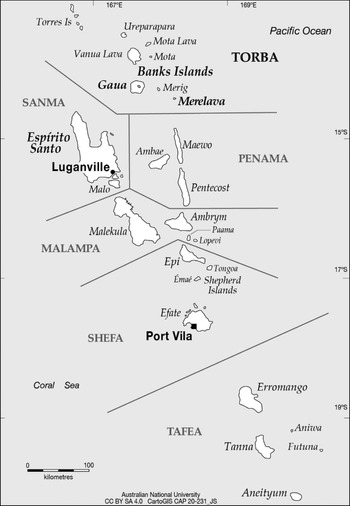
Due to the diasporic nature of the communities involved, our fieldwork is multisited, following the phenomenon of water music throughout Vanuatu and to Australia. The study includes people living on the remote island of Gaua; in a peri-urban community on the island of Espirito Santo (Santo); and in the capital-city of Port Vila on the island of Efate (see Figure 1). While water music is performed in several communities in Vanuatu, the communities we focused on are part of a diasporic assemblage of people with direct links to the language community of Mwerlap on the island of Merelava and the language community of Lakon on the Western side of of Gaua (see Figure 1). Both Merelava and Gaua form part of the Banks Islands grouping in the Torba province.
Map of Vanuatu showing the communities of Gaua, Santo and Port Vila.

The authors conducted three semi-structured interviews in Australia and five multi-hour semi-structured interviews in Luganville, the main town on the island of Santo. All eight interviews were undertaken with people who are either related to or involved in some way with two small neighbouring cultural villages (Leweton and Turgor) that are the main commercial providers of water-music performances.
We conducted a further series of less structured interviews in Luganville (Santo's main town) and other parts of Santo, through a fluid and embedded process of ‘participant engagement’ (Bolton, Reference Bolton2003). These occurred during a trip designed to coincide with a major gathering of people for the Northern Islands Kastom Music Festival and Forum, which we also observed. Many participants in these interviews, events and observations told a similar story: that if we wanted answers to the questions that we were asking, we needed to visit West Gaua to talk to the women there. In response to this urging, one author travelled to Gaua, accompanied by another key authority figure in relation to kastom music from Gaua,Footnote 4 with the hope of interviewing any women participants willing to speak to the origins of the practice of water music. We also worked closely in our data gathering with a ni-Vanuatu kastom-trained researcher, Dely Roy Nalo. One of the key people at the heart of cultural renewal in northern Vanuatu, Dely is the leader of a grassroots Indigenous-led movement established specifically to promote and preserve northern Vanuatu's diverse cultural practices.
In sum, we present this paper in writing, which we acknowledge has its own challenge for peoples whose histories exist principally (if not exclusively) as oral and performative artefacts, and in an academic forum, which, despite recent decolonising shifts, remains a site of profound inequity. In doing so, we acknowledge the histories of multivocal and collaborative research in and about Vanuatu, with the hope of contributing valuable insights to this emergent corpus (Taylor and Thieberger, Reference Taylor and Thieberger2011).
3.2 Situating water music in Vanuatu
Regulation in Vanuatu is deeply pluralistic, with multiple interweaving and hybridising strands. Two of the most prominent of these strands are kastom and state law, the latter introduced originally through colonisation by both the English and the French in the nineteenth century, and continued by the independent government of Vanuatu since 1980.
A contested term, kastom refers to an Indigenous system of law, and also of governance, religion, Indigenous knowledge and practice in general (Bolton, Reference Bolton2003). In everyday speech and political rhetoric, kastom is frequently specifically contrasted with introduced systems of law, governance and selected Western ways of life and with a different basis of legitimacy from institutions and systems created by the state.
Since colonisation, chiefs in Vanuatu have increasingly become both the de facto and the de jure voice of kastom. Both kastom and chiefs are the products of dynamic processes of change, resulting from interactions with colonialism, globalisation, capitalism and development. Yet, both are often spoken about and portrayed as being traditional, ancient, immutable and static; indeed, these values often provide the foundation for the chiefs’ claims of legitimacy and authenticity.Footnote 5
Vanuatu is a knowledge-based society in which knowledge is valued more highly than moveable, tangible property. Regulation of cultural property has traditionally been the exclusive domain of kastom, involving highly detailed regulatory structures. To generalise, a wide variety of claims and relationships, both individual and communal, flow through various aspects of cultural property, such as medicinal knowledge, songs, dances, designs and costumes, some of which are alienable and some transmitted through secret arrangements. These regulatory structures are imbricated within human and non-human relationships, including both the land itself and the spirit world. Attempts to put a dollar value on traditional currencies (such as pigs, mats, strings of shell money) often gives rise to conflict, especially when addressing how these items themselves reflect the cultural value of a dance, a song or a costume. From an outsider's perspective, it seems like these things have always been ‘free’, but, for ni-Vanuatu, they are dynamic and priceless – the value exists in the exchange and in the relationship brokered by the exchange.
The past two decades have also seen increasing incursions by the state and the international legal order into regulation of cultural property in Vanuatu. The first instance involved two parties bringing their dispute over whether or not Vanuatu's famous ‘land dive’ could ‘travel’ from one island to another.Footnote 6 Then, in 2002, the ni-Vanuatu art form of sand drawing was registered on UNESCO's ICH register. In terms of state legislation, specific provisions relating to Indigenous cultural property were enacted in the national copyright, trademark and patents acts, which came into force in 2012, largely driven by Vanuatu's accession to the World Trade Organization (WTO). This legislation uses the language of ‘ownership’ of cultural property by particular customary groups. In 2019, following a process that lasted over a decade, the Protection of Traditional Knowledge and Expressions of Culture Act came into force.Footnote 7 It creates a state-based cultural authority responsible for managing all requests to use traditional knowledge through identifying the ‘owners’ and assisting in negotiating written user agreements in appropriate forms. The Vanuatu Kaljoral Senta (VKS) combines a museum with an ongoing local cultural fieldworker programme to preserve and transmit physical and intangible cultural property. It has also claimed regulatory control through its research-permit process, which contains extensive provisions on ‘traditional copyright’.
In 2015, a Memorandum of Understanding (MOU) was signed between the Vanuatu Intellectual Property Office (established in 2013 under the WTO Accession package commitment) and the Malvatumauri, the National Council of Chiefs. A constitutional body, the Malvatumauri is the formal head of a network of chiefly councils with various powers under the Chiefs Act 2006. The purpose of the MOU is to involve the Malvatumauri in determining owners of certain ICH over which claimants wish to register trademarks or assert copyright. In 2020, Vanuatu's Chief Registrar of Trademarks called for the Ministries of Justice and Trade to work together on forming a Traditional Knowledge Authority (Kalsakau, Reference Kalsakau2020).
3.3 Water music as a site of solid and liquid regulation
In Gaua, the older women told us stories from their childhood, about playing in streams and mimicking sounds of the environment. The late Warren Wevat Wessergo observed that for as long as anyone can remember, the women of Gaua and Merelava have known how to create music from the river and the ocean:
‘This practice, called vus lamlam or slapping water, is something that belongs to the women. Dressed in their traditional costumes made from flowers and leaves, coconuts and pandanus, they stand waist deep in the ocean and create music. This practice has been handed down from grandmother to mother to daughter for generations. Women from other islands in the Banks and Torres groups, and as far away as the Solomon Islands and Malekula, have also been known to playfully make sounds in the water by splashing, scooping, and slapping the water.’Footnote 8
In 1975, some of the female elders who held the appropriate authority through the culture of Gaua and Merelava came together and identified the discrete elements of vus lamlam, essentially codifying it.Footnote 9 This innovation gave the music a structure, creating chord-like qualities from the various beats, rhythms and textures, previously applied in a more random, playful fashion.Footnote 10 Importantly, for the women themselves, this allowed them to create an ensemble and to make and teach compositions to other local performers for the purposes of performing in unison.
In the 1970s and 1980s, many people from the Banks Islands migrated to Santo and Port Vila. This generated a pattern of circular migration that continues to this day. The Merelava diasporic community in Santo coalesced into a particular geographic area in Luganville known as the ‘showgrounds’ area. During this period, there were some intermarriages between people from the West coast of Gaua's village of Dolap, a place with the strongest origin story about water music, and those from Merelava.
In 2008, Sandy Sur, an enterprising man from Merelava, formalised the informal grouping of members of the Mwerlap-speaking diaspora living in the showgrounds area into a collective community that he termed an ‘urban village’. Sandy explained to us that it was called Leweton, deriving this naming from the first few letters of each of the six Mwerlap villages in Gaua and Merelava from where its members originated. One key figure of the newly created village was Hilda – a woman from Merelava and Sandy's sister. Her husband Warren (originally from Dolap) has a sister who is one of the creators of the codified water music and, through him, his wife Hilda assumed (and claimed) authority to perform water music.
As a means of livelihood through tourism, the Leweton community constructed a ‘cultural village’ within its ‘urban village’, as a space for tourists. It contained a purpose-built pool for water-music performances by most of the women and girls of Leweton. As tourist visits increased, the Leweton community augmented the women's performances of water music with other elements of their cultural heritage, including the preparation and cooking of food and other kastom music and dance performances. These additional cultural performances included the men and boys of Leweton. The cultural village became more established, popular and profitable, performing to growing numbers of tourists, especially cruise-ship passengers. Over the last decade, members of the Leweton community also recorded a feature-length documentary film about water music and toured internationally several times.Footnote 11
Between 2008 and 2011, many hundreds of tourists from cruise ships enjoyed the water music and other performances at Leweton village.Footnote 12 Then, due to disagreement over pricing and customer management, the major cruise line that had channelled tourists to Leweton stopped doing so. Yet, tourist demand for water-music performances remained.
To meet this demand, a local cruise-line agent encouraged and supported relatives of Leweton community members who also lived in the same showgrounds area (but had not become part of Leweton) to establish another water-music-based cultural village. They did so under the leadership of a man called Daniel Redmond, originally from Merelava. He named this new cultural village the ‘Turgor Group’, situating it only a few hundred metres away from Leweton's cultural village. Many members of the Turgor Group were related to the Leweton group and also originated from Merelava and Gaua.
This split crafted by the cruise line's financial interest engendered two significant separate sets of conflict. The first ongoing dispute was between Leweton and the cruise company due to the company's continued use of images of Leweton productions in both their promotional material and business name (‘Magical Water Music’). Second, an ongoing dispute arose between the two neighbouring water-music cultural villages, particularly between their two male leaders. These disputes took place within a larger set of contestations concerning which individuals and groups have authority to perform water music, in which contexts and under what conditions.
Making sense of this larger contestation requires understanding the spatial placement of the different groups and their relationships with one another and with ples – a Bislama term referencing the importance of land or ‘place’ in constructing identity (of individuals and social groups) in Vanuatu. This reciprocal relationality is neatly expressed in the Bislama concept of man ples, ‘person of the place’ – a condensation of place and person (Rodman, Reference Rodman1987, p. 35; Jolly, Reference Jolly1997, p. 253; Bolton, Reference Bolton2003, p. 68).
In addition to man ples, there are also man Bankis (a person from the Banks group) and man-Gaua (a person from Gaua Island). These are identity labels that illustrate the deep significance of ples and its potential for scaleability (Dick, Reference Dick2016; Reference Dick2014). In reference to the people of Pentecost (another of Vanuatu's eighty-three islands), Taylor (Reference Taylor2008, p. 105) writes that they ‘orient themselves as persons through reference to a corpus of relational categories that, like the mazy lines of a sand drawing, intersect and link with each other to provide an intricate mesh of social identity’. This holds true for people throughout Vanuatu, as it is through relational interweaving of ground and place, and the people with whom one shares the ground of a place, that ni-Vanuatu personhood and identity are continuously imagined and reiterated. These flows of persons and place as a self-productive process call to mind what Torres Islanders refer to as ‘living growth’ (Mondragón, Reference Mondragón and Kirby P2009).
We now turn to the complex ways in which these fluid relationships play out in the dynamic development of the regulatory framework around water music. The community in Dolap, on Gaua's West Coast, lays claim to be the community from whom water music was initially ‘born’. The Leweton and Turgor groups contain female members whose knowledge of water music and customary claims to it flow indirectly through their connections to the island of Merelava, which, while situated within the Banks group, is not Gaua. The more direct connection occurs via marriage, in which brothers of the Merelava women have married into the Dolap village, Gaua community. Additionally, the Leweton and Turgor groups who moved to Santo (and later to Port Vila) are viewed as ‘man kam’ (outsiders – literally, people who have come). This means that customary leaders from Santo and Port Vila have authority in determining what kinds of cultural performances can be performed in their ples.
People from Gaua have repeatedly raised concerns that their traditions around water music are being commercially exploited, without benefits passing to them. Male customary leaders from Gaua have also claimed that water music should not travel from Gaua. Moreover, although women are the originators, creators and performers of water music, most of the contestations around its practice are driven and controlled by men. On occasion, the site of the contestation has moved to the actual bodies of the women. One of the women water-music performers in Santo told us about occasions on which a ‘brother’ physically assaulted her for her active role in the performance. Her first response was to stop performing with the group but, after a while, she said she felt compelled to perform again.
We now consider these three sets of contestations (village/island, village/village and village/international) in depth. In so doing, we draw attention to the extent to which the regulatory responses developed feature liquid or solid characteristics, in order to set up the analytical framework in section 4.
3.3.1 Contestation 1: Urban cultural village and home island
As discussed, unsettled tension exists between the people, ples and associated spirits from which water music is widely acknowledged to have been ‘born’ (Gaua) and the groups today making an income from water-music performances in urban Santo (and Port Vila). This tension creates multiple sets of expectations that are satisfied to greater or lesser extents in various conflicting and emerging ways.
One forum demonstrating how these expectations play out is that of the costumes worn by both the women and men who perform dances and songs, often on land near the water. Primarily comprising leaves of different species, the leaves symbolise an entitlement to sing a certain song or dance a particular dance. A person wanting to wear the leaves needs to ‘pay’ for this right; this entitlement is bestowed through a ceremony undertaken with a relative who has the right to wear that species of leaf in a performance. Payment in the ceremony both acknowledges the relationship and demonstrates appreciation of restrictions on the use of the cultural property. A spiritual dimension passes through the ceremonial bestowal, with one interviewee noting that had she not made a payment, then her song would have failed to sound nice or attract people; she noted further that if the right channels are followed though, then it will have ‘power’ over the audience.
Turning to the water-music songs themselves, these are new musical works developed by the women seeking to represent particular sounds, such as sogor (the sound of big fish chasing the bait fish) and worworok (the rhythm of the creek or river coming from the hills and running over the volcanic stones). For the Leweton group, the names and meanings are all assigned in the Mwerlap language – the language of Merelava and East Gaua (Wessergo et al., Reference Wessergo, Dick and Sur2014). Through using Mwerlap language, the songs link to place, creating a genealogy of the water-music innovations.
Exploitation of water music as a cultural product for financial gain presents the biggest challenge for the emerging normative framework around the regulation of water music. All interviewees were unanimous that there was an obligation to seek permission to perform it from West Gaua, the birthplace of water music. However, many differences arose about the correct pathway for seeking permission. Before setting up in Leweton, Sandy, Leweton's leader, went to West Gaua to pay for the right to perform water music; he did this by killing a pig for those members of his family related to one of the women involved in the original codification.
In contrast, Turgor Group's leader Daniel paid for the right in a custom ceremony in Santo during a visit from a chief and two witnesses from West Gaua who were emissaries from the Gaua Island Council of Chiefs. After sending a series of letters to both Sandy and Daniel making demands that payments be made for the commercial exploitation of water music, the emissaries eventually came in person. One action they took while present was to plant a namele leaf in the ground, signifying their exercise of a tabu over water music.Footnote 13 While Daniel acceded to these demands and paid, he was primarily motivated by concerns about being required to pay compensation in a customary court if he did not. Sandy, on the other hand, rejected the legitimacy of the chiefs’ claims, instead standing by his initial payment in Gaua as being sufficient.
In addition to these initial permission-seeking performances and payments, consciousness of ongoing obligations to West Gaua pervades, particularly evident in the need to maintain a relationship with the place and its people. Daniel referred to the power of the spiritual world, expressing it in terms of enforcing obligations owed to West Gaua, and invoking the concept of black magic or nakaemas. He said that ‘kastom i strong i gat spirit blong hem [kastom is powerful, it has got its own spirit]’ and further explained that if he does not make payments back to West Gaua, then some misfortune may happen to a member of his family, caused through the agency of the spirits.
Such an interconnectedness of all things is understood among these communities through the supernatural being of Qat. The Qat world is an assemblage of the human and non-human, meaning that the interactions of island, people and environment create culture. While this culture has immeasurable value, in some contexts, homage to it can be expressed with nominal or token value in cash or customary forms of currency.
One such context is revealed in the practice of the Leweton performers putting something aside from each performance (‘throwing money in a basket’ was a common metaphor) to send back to Gaua Island, ‘so that we can work together; to make the relationship work’. We were told about concrete payments made by the Leweton community, such as providing funds for new water tanks on Gaua and a new church roof in Dolap, Gaua. When Leweton is invited to go on tour, they take with them some of the women from Gaua in their ensemble – a valuable opportunity for these women who would otherwise never have a means by which to travel internationally. One interviewee in Santo explained that taking the women from West Gaua with them is a form of showing respect. She noted: ‘we understand that it is through them that we can play the water music, and so we should include them.’
Respect is a central concept in Vanuatu kastom, arguably analogous to the way in which legality is said to lie at the heart of law in Western tradition (Fuller, Reference Fuller1964). Although there are many components to respect, at its core it is about ensuring correctness of relationships between people and people, between people and ples, and between people and the world of the spirits.
Sandy explains homage payments to the people from Gaua in terms of being dynamic markers of their relationship. This concept of dynamic markers struck us as a potently helpful insight, suggestive of a moving point of resonance created by the interaction of solidity and liquidity. It holds the promise of both substantive agreement at a fixed point of time and recognition that the ways of actioning the agreement will fluctuate over time, dependent on the prevailing conditions as understood by all parties. This gives rise to a sense of need for adaptive change and need for ongoing responsiveness. We return to this below.
Different individuals and groups from West Gaua have felt aggrieved at times that their cultural property is being profited from while they are not (adequately) benefitting. However, this grievance has more recently been identified as partial by those who occupy the liminal spaces between different interest groups. Dely made an important observation on this point, saying: ‘When I work on the islands, I hear valid complaints; but when I work in town, I see real effort.’ As someone who travels between the two groups, she is uniquely placed to see the issue from both perspectives, and to also play a role as a mediator and an interpreter.
There is a strong gendered component to the relationship between home-island and urban groups. An island needs someone to speak on its behalf – a role largely assumed by different chiefly bodies, principally the Gaua Island Council of Chiefs. As these chiefly bodies comprise entirely men, it enables men to exercise control over the financial revenues generated from water music, even though it is quintessentially women's creative output and performance. This extends the claim of control by men beyond women's bodies and into women's imaginations.
Some male interviewees justified their control through conceptualising water music as having initially being in the male domain; others did so through kastom stories that give men control in other ways. One interviewee stated: ‘we [all men] give it olsem plei plei blong ol mama [we gave it as a game to the women].’ He also recounted a story by which one chief told a kastom story passed down from his grandfather about women performing water music who were turned into stone when observed by a man.
These claims of right to control by the chiefs are further strengthened by reference to Western copyright law, as terms such as ‘kastom kopiraet’ gain traction. When it was just a ‘game’, then engagement with it was more liquid and women could exercise it; but when it becomes a source of cash income, then a more solid rights-based framework serves as a way of appropriating the financial rewards by those with the power and resources to lay claim.
Male chiefs also exert control through their claim of the rights to control activities occurring within their jurisdiction (i.e. in their ples), allowing them to leverage financial advantages. This has particular relevance to ongoing contestations over whether water music can be performed in the urban areas of Santo and Port Vila. Of relevance are not only the views of the chiefs of West Gaua (who increasingly assert limitations in this regard as the number of tourists who make their way up to Gaua to observe water-music in situ dwindles), but also the chiefs of the urban locales where water music is sought to be performed. In our case-study, the Tabwemasana Council of Chiefs (the paramount authority on Santo, comprising men) authorised the performance of water music in their area. Sandy also paid 10,000 vatu (AUD$125) to the Malvatumauri for a one-off certificate stating that he is allowed to organise the women to perform water music in Vila, although the legitimacy of the Malvatumauri as the appropriate authority was questioned by some interviewees.
These contestations and assertions highlight the discursive dimensions that foster development of the normative framework over water music. Interviewees frequently used the word ‘copyright’ in reference to various possessory claims over water music. Discussing visual artwork, Dely observed that whereas previously people would look at and appreciate patterns and designs, the penetration of ‘copyright’ ‘wakes up’ possessory ideas and causes people ‘to ask who has the rights to do this?’. In her opinion, the new concept has changed the emotions around artwork from those of appreciation to disappointment and anger. Similar observations are relevant to water music. Concurrently, discursive use is also made of ‘kastom’ in relation to water music. One member of Leweton community noted that she had asked ‘is water music kastom or not?’ and that the old men had found it hard to answer the question.
3.3.2 Contestation 2: Cultural village and cultural village
The Leweton and Turgor groups had an ongoing dispute over who had authority to perform water music for over eight years. Situated side by side in Luganville, each cultural village consciously claims their spaces as a contemporary approach to maintaining their cultural heritage and expresses this heritage in a format able to create income for the village. This competition has given rise to hostility, cessation of relationships and threats of physical violence. Over the years, both sides had tried to enrol various state and customary fora to help resolve their disagreements, but neither gained purchase over the other, instead commonly avoiding any determination through failing to appear at the times and dates set by the magistrate's court and the chiefs.
The main impetus to resolve the dispute, or at least to bring about temporary peace, between Turgor and Leweton came from broader community pressure and the need to maintain respect for their whole-of-island community within Santo. Each 30 July, one of the provincial diaspora groups is called upon to organise the Independence Day festivities. In 2015, it was the Torba province's turn, with Daniel nominated to be in charge. He could not manage it alone; moreover, no one within the Merelava community wanted other communities to think that they could not cooperate with each other, as this would result in great shame.
This concern, and the desire to end the dispute between people who are essentially family members, led Daniel to perform a ceremony to ask for peace. He took a hermaphrodite pig, which is extremely highly valued in kastom, and went to Leweton village to apologise, expressing his emotions and regret through crying. There are mixed views about whether or not this ceremony was actually completed; Daniel noted that his apology was not reciprocated and Sandy has raised concerns that the full processes were not gone through, particularly formal public explanation for the ceremony and the ritual of naming certain parts of the pig, then giving them to different people. As we discuss below, the incompleteness of the dispute is a marker of a liquid approach.
Two important insights emerge from contestation 2. First, there is the strong regulatory force driven by the importance of unity (and relationships) of family/people in kastom. This is evidenced in the kastom expression that when a group needs to do something ‘yumi mas wan [we have to be united]’ and its corollary that shame would be wrought upon the members of the community if their obligation is neglected. Second, in the absence of achieving formal resolution of an issue as nuanced and dynamic as claims to water music, the strategy employed is deferral to a more efficacious kastom process.
3.3.3 Contestation 3: Cultural village and international cruise-line company
For rural communities in Vanuatu managing their local tourism operations and negotiating price, proprietary controls and intellectual-property rights, it is particularly the scale that is new and problematic. Negotiations with multinational tourism firms, such as the cruise-line company involved here, are characterised by enormous power imbalances. Foreign corporations are seldom equipped with the cultural awareness competencies that would enable them to deal sensitively and effectively with village communities. In the case of water music, the cruise-line company generated huge local conflicts through their dealings with Leweton, worsened by their attempts to satisfy customer demands for water music through encouraging the creation of a competing cultural village.Footnote 14
In this corporately imposed context, Sandy was unable to gain any traction from referencing kastom obligations with the company; instead, he tried a range of strategies that called upon ‘hard’ state law and institutions. One strategy was to register his business name (‘Magical Water Music’) with the Vanuatu Financial Services Commission. He also sought to enrol the tourism office in advocating on his behalf. Through using these solid strategies, as well as drawing upon his international networks of professional colleagues, Sandy was able to write a letter of claim to the company, requiring it, at the very least, to desist from using photos of his village in its advertisements for Turgor tours. Eventually, either his efforts worked or the company, independently of his claims, decided to renew its publicity using pictures of the Turgor Group instead. This suggests the importance of context in assessing the degree of purchase that liquid or solid regulatory strategies are able to acquire.
4 The dynamic markers of liquid and solid regulation
In this section, we outline our conceptual model of liquid regulation. It serves three broad purposes. First, it helps to observe what is going on through a different perspective by reframing the enquiry around the degrees of solidity or liquidity that exist in the regulatory strategies available to the actors involved.
Second, it helps to analyse the different impacts, uses of and relationships between different regulatory strategies. It does this through identifying some of the key markers and differences between liquid and solid regulation. In particular, we focus on the ways in which these differences manifest in relation to questions of temporality, relationality and situatedness, and identify liquid strategies in each domain.
Third, it helps to facilitate interventions by assisting decision-making and regulatory reform for those seeking to change or guide the overall regulatory system. These actors may be state governments, national customary institutions or local community groups seeking to better regulate their cultural property. We help guide actors to determine which regulatory interventions can best be combined, and movement along the solid–liquid spectrum to occur, to enable more desirable ‘structured looseness’ or ‘flexible tightness’ (Gelfand, Reference Gelfand2018).
4.1 Observing solidity and liquidity in regulation
Multiple systems of value exchange and creation currently animate the field of cultural property in Vanuatu (and elsewhere). While kastom and Western intellectual-property rights are often framed by scholars as being in conflict (e.g. see Leach and Stern, Reference Leach, Stern, Morcom and Taylor2019), viewing the varied approaches as being in active dialogue, contestation and negotiation creates more opportunities to see the whole picture.
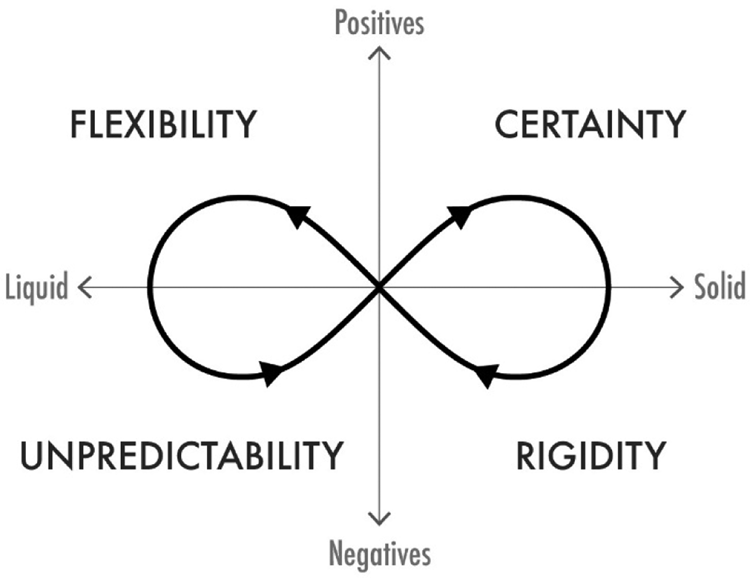
We chose to explore this insight visually. Figure 2 provides our first iteration, drawing upon the concept of polarity management (Johnson, Reference Johnson1998), to show how regulatory systems dynamically move between solidity and liquidity. It reveals how the weaknesses of one framing often become the advantages of another: solidity produces certainty, but too much certainty may create rigidity; liquidity allows flexibility, but too much flexibility can be problematically unpredictable. In practice, regulators often lurch from one extreme to the other, rather than finding ways to manage competing priorities and demands.
Polarity management of positives and negatives of solid and liquid regulation

Polarity management is concerned with finding ways to move from this unproductive see-sawing generated by ‘either/or’ thinking towards seeking to maximise the positives and minimise the negatives through using ‘with/and’ thinking – moving the ‘butterfly’ figure on the graph up the ‘y’-axis. Such an insight resonates with our invitation in this paper to regulators to deepen their understanding of both solid and liquid approaches to regulation to use both more productively.
However, after creating Figure 2, we became conscious of its limitations; in particular, its Cartesian fixedness and availability of limited numbers of axes ran contrary to our meta-argument of complexity. Whilst it was helpful for demonstrating the relationship between certain features of liquid and solid approaches, it was not able to further advance or illustrate our more integrative insights.
Somewhat unsettled by this discovery, our development of conceptual images has been an important analytical journey as we sought to explore what visual representations made clear and what they obscured or misrepresented. In noting similar problems of a static dichotomous chart, Haraway (Reference Haraway1988, p. 588) opined that ‘[f]eminist accountability requires a knowledge tuned to resonance not to dichotomy’. Inspired by Haraway, we dove into critical feminist theory and found resonance in post-human hydromateriality: specifically, what Neimanis (Reference Neimanis2017, p. 96) calls an ‘ontologic of amniotics’. Neimanis identifies the term ‘bodies of water’ in reference to the confluence of two ideas: first, that two-thirds of the human body is constituted by water and, second, that more than 70 per cent of the planet is covered in water. In the same way as we resisted the simplicity of Figure 2, it is important to resist the temptation to sink into facile interpretations of these ideas. The metaphors are devices for visualising analysis, they are not an endgame in themselves and ‘the figuration of “bodies of water” might enable us to create a more capacious aqueous imaginary for being responsive to other human and non-human bodies with whom we share a planetary existence’ (Neimanis, Reference Neimanis2017, p. 182). She urges readers to ‘come to understand bodies of difference as also bodies that flow into and through one another’ (Neimanis, Reference Neimanis2017, p. 99, emphasis in original). We dive into further visual exploration below.
4.2 Analysing liquidity and solidity in regulatory approaches
We identify four core features or static markers of solid regulatory approaches: (1) there are rights-bearing subjects, such as individuals or legal entities or (in some recent contexts) ethnically bounded groups with clearly defined possessive rights over cultural property; (2) rights are enforceable through state legal processes; (3) rights are fixed in form, knowable in advance and not contingent upon place or particular relationships; and (4) agreements about claims over those rights are prima facie final.
For example, we conceptualise current regulatory regimes based upon securing FPIC as a predominantly solid approach. Regimes based on FPIC recognise that cultural property may ‘belong’ to a group (rather than to an individual as in standard Western intellectual-property frameworks). However, FPIC regimes focus on securing written agreements upon clearly defined terms enforceable in national courts. Once given, consent is presumed to be binding on all members of the group and not open for renegotiation even if conditions change. Further, the place in which these agreements are made, and the language in which they are negotiated, has no bearing on their legal effect; in other words, place and language are extraneous rather than central to questions of legality. Similar analysis can be made about traditional knowledge laws in Vanuatu's intellectual-property legislation discussed above.
These key defining features of an archetypal solid regulatory approach are of course conceptually very distinct from what they produce in practice. It may well be that a solid approach leads to greater uncertainty and complexity in practice. In this regard, perhaps the work of Branlat and Woods (Reference Branlat and Woods2010, p. 29) on resilience engineering is useful. They develop the notion that ‘going solid’ – by which they mean working a system to its maximum capacity and so eliminating redundancy and flexibility – can give rise to a state in which situations become both hazardous and difficult to control. In other words, regulating for solidity can give rise to an opposite reaction, in the same way as rigid buildings crack and fissure during earthquakes whilst supple trees bend and sway.
We now contrast these core static features with examples of liquid regulation from the case-study. We stress that we are not arguing that customary systems have a monopoly on liquid forms of regulation, and try to counter any such interpretation by highlighting examples of liquescence within national and international legal systems.
4.2.1 Temporal: responsive deferral
Solid and liquid regulation operate according to different conceptions of temporality. A solid approach centres upon concrete decisions being taken at a point in time that spurs fixed, ongoing repercussions. An example is a one-off vote, such as Brexit. In practice of course, this solid strategy ironically gave rise to a situation of intense uncertainty and complexity. A liquid approach accommodates relationships driven by different temporalities, prompting a need to accommodate change over time. A more liquid version of Brexit is the New Caledonian independence vote, structuring three separate votes over an extended time.
An example of a liquid regulatory strategy from the case-study is what we term ‘responsive deferral’. This involves place-holding through immediate responsiveness, coupled with deferral of substantive decisions.
Deferral is a conflict-management mechanism that postpones final resolution of a dispute through making temporary arrangements. This is, of course, a widely recognisable strategy. In Papua New Guinea, another Melanesian country, it has a particular name – bel kol – literally ‘to cool the stomach’, typically used as part of negotiating cessation of conflict. As we saw above, deferral has a particularly interesting inflection in Vanuatu generally, and in the case-study specifically. It was demonstrated in the ceremony between Leweton and Turgor where everyone involved in the conflict between the two villages cried and shook hands (signifying a resumption of relations), yet certain aspects were deliberately left uncompleted, leaving open both the possibility of future iterations of the dispute and more complete finalisation processes.
The strategy of deferral recognises the contingent and unknowable nature of obligations at particular points in time. It enables relationships to be continued and respect shown while creating space for future claimants and obligations to emerge. As Dely observed, in the field of cultural property, it is often unclear initially who should pay whom, but this becomes clear over time. If the wrong person is paid, then many people hear about it, allowing the right person to come forward so it can be fixed. In the nakamal (customary meeting ground), this can be straightened out – the person who accepted the payment may not have told the whole story and may be required (by notions of respect, reciprocity, sanction, accountability, etc.) to share it.
Responsive deferral provides a structured way of building in feedback loops and adaptability – a critical feature of liquid regulation, allowing space for modification to overcome obstacles or respond to unanticipated consequences. A similar concept exists in state law in the Global North, for instance through use of ‘sunset’ clauses that require legislation to be renegotiated, temporary legislation (Bar-Siman-Tov and Harari-Heit, Reference Bar-Siman-Tov, Harari-Heit, Ranchordas and Roznai2019) or semi-stationary contracts in which parties renegotiate in each new period (Watson et al., Reference Watson, Miller and Olsen2020).
4.2.2 Relational: emergent relationality
Liquid forms of regulation entail an open and dynamic approach to the question of who are the parties involved, and the nature of obligations and responsibilities created, assumed and owed by and to them. In solid forms of regulation, such as contract law and Western intellectual-property law, the parties and their obligations are clearly delineated and fixed. Rules, such as standing to sue, limit who can become invested in any particular dispute.
In contrast, we identify a liquid regulatory strategy in the case-study that we term ‘emergent relationality’. It involves actively scanning for, and acknowledging, a wide variety of relational obligations, including those towards the non-human, such as ples, spirits, ancestors, animals, wind and so forth. Emergent relationality shares a resonance with the ‘ontologic of amniotics’ and our human responsibility to consider our ethical entanglements with the other-than-human world (Neimanis, Reference Neimanis2017). Relationships are central to both the ongoing creation of obligations and ongoing demands to fulfil obligations. As demonstrated in the case-study, the ways in which relationships create demands and expectations, and the extent to which those demands are perceived as being fulfilled, are often contingent and unknowable at certain points in time. In the context of cultural property such as water music, which is fluid and evolving, this is especially pertinent. Not all of the potential relationships and obligations can be identified in advance – therefore they cannot be contracted over in advance. The only way to know about the obligations, and appropriately attend to them over time, is through paying active attention to the wide range of human and non-human relationships within which people are enmeshed.
Our case-study drew out differing sets of obligations that arose as water music travelled from ples to ples; it showed the various ways in which obligations were recognised and attempts were made to honour them. For example, as well as payments made from Leweton in Santo to the community in West Gaua, we saw how payments were made to the man ples, chiefs or landowners in Santo (and Vila), to allow the performance to occur in that ples. Two streams of insights emerge from this.
The first relates to how these payments highlight what Southern theorists suggest is a fundamental question: ‘On whose land is this happening?’ (Connell, Reference Connell2007). This question shaped the theoretical framework for our research, as well as grounding the ways in which ni-Vanuatu become located in the economic, political and social structures of their world, and how ‘place reciprocally shapes individuals and society through human agency’ (Rodman, Reference Rodman1992, p. 647). In Vanuatu, obligations are often satisfied performatively, meaning that both the place and the people who perform and witness are crucial to the effectiveness of meeting the obligation. Inclusion of a relationship with place creates patterns of behaviour and patterns of regulation that orient towards either liquidity or solidity.
The second stream relates to the subjectivity of regulation: who is doing the regulating and who is being regulated? The case-study revealed how the intersectionality of gender, community of birth and geography creates minorities-within-minorities. The gendered dimensions of strategies of control (such as sharing of income) can be relationally problematic in more solid settings. They speak to a hierarchy of power, with urban men (self-)regulating the activities of rural/remote women. This hierarchy of power traces its heritage to exogenous sources through missionisation and colonisation, rather than through any endogenous gender normativity (Jolly, Reference Jolly1997). While the melting or loosening of solid regulatory structures might not offer clear and firm strategies for more equitable and inclusive states, it at least destabilises the liberal theory of the individual subjectivity of regulation and invites researchers and regulators to question where power is being concentrated. In doing so, they might also consider other historical and contemporary situations in which women's bodies are regulated (by men), such as abortion-restrictive regulation in the nineteenth century that was ‘justified with arguments concerning women's bodies’ (Siegel, Reference Siegel1992, p. 265).
Liquid approaches to creating obligations can also be found outside the customary context. For instance, liquid regulation can be seen in creation by some states of a general duty not to cause environmental harm, replacing the approach of contracting for the right to pollute.Footnote 15 Further, liquid regulation resonates with restorative justice and the concept of a social licence to operate (the latter requiring increasing attentiveness by corporations worldwide); both approaches reflect the underlying assumption that relationships must be maintained throughout changing circumstances, requiring frequent ‘checking in’ and feedback loops.
4.2.3 Situated accountability through presence and absence
The third patterning of liquid regulation attends to how parties and obligations are situated, acting as a point of convergence of relationality and temporality. In one sense, situated presence means knowing where one is and understanding the relationships (including non-human) constituting the particular moment – a love letter to the present. In another sense, it is equally about absences: bodies/spirits/obligations being there and/or being elsewhere. As Dely emphasised, wherever one is, one's presence is one of the strongest signifiers of intention and belonging. This resonates with Lindstrom's (Reference Lindstrom2010, p. 2) reflections about conflict resolution on the island of Tanna, in which ‘[b]eing there, wherever there is, signifies a lot about who one is and who one belongs to’, and, according with Dely's insights, Lindstrom further notes:
‘But the alternative, not being there, also makes a crucially significant statement about the course of one's affairs. Absence and avoidance are the counterparts of presence and connection, and they are also strategic and immediate responses to village conflict and dispute.’ (Lindstrom, Reference Lindstrom2010, p. 3)
To illustrate further, we bring these ideas into dialogue with feminist critical theorist, Rosi Braidotti. We take from Braidotti (Reference Braidotti2006) the idea that accountability is manifest in the relationships that arise in this situated, grounded presence. Being there, and orienting to liquid, opens up space for a more ethical response to and engagement in regulatory practices.
The case-study illustrates the way in which relationships can be leveraged to enable certain uses of water music and how this, in turn, creates different forms of accountability. For instance, accountability came through acknowledgement and awareness of the spirit world (Qat) to signify the proper use of water music. Often invoked as a unifying element of Banks Islanders’ cosmology, by referencing Qat at the start of performances, the men and women reinforce the connection between water music and the Banks Islands, at the same time referencing the unity of Banks Islands culture – regardless (or perhaps, because) of any tensions and conflicts that might exist.
Awareness of, and respect for, differences in the relational temporality in which an activity is situated are ways of exercising accountability. Differences in experiencing history seriously impact how regulation guides behaviour, as the men's and women's experiences in the case-study showed. We see this viscerally in the men's (historically situated) assumption of a right of access to command, limit, regulate, commercialise and exploit the women's performance of water music – that all bodies and imaginations are penetrable by men: an idea that resonates throughout colonial history (Haraway, Reference Haraway1988; Braidotti, Reference Braidotti2006). We see it in the fact that, despite sharing their performance fees, women's bodies became the site of contestation, with one woman beaten by her brother and another feeling so trapped that she preferred to escape and burn her passport to avoid having to return.
The types of accountability that a liquid approach opens up are relevant when examining the limits of the extractive approach to cultural property. There is no ‘due diligence’ exception here – if a critical relationship (human or non-human) is not acknowledged and tended, significant ramifications cannot be contractually sidestepped or justified on the grounds of ‘legality’, as so tragically occurred in 2020 when a mining company irrevocably blasted a 40,000-year-old rock-art site in Western Australia (Allam, Reference Allam2020). Instead, what is required is making use of liquid relational strategies, such as Drahos's (Reference Drahos2014) regulatory convening, which recognises the importance of bringing people together for dialogue.
We began this section by specifying four characteristics of solid regulatory approaches, followed by examples of three liquid approaches. If we understand regulation as a patterning of forces acting on human behaviour that combine at certain resonance points – and understand those forces as being capable of being mobilised in creative and generative ways – then how can we design regulatory systems to be more ethically active, more equitable, more innovative?
4.3 Working with solidity and liquidity in regulatory design
Our starting observation is that both solid and liquid forms of regulation exist across all different normative orders, whether state, customary, religious or other. We do not view categories of solid and liquid as absolutes: one co-author conceives of them as existing along a spectrum, while the other sees them in patterns of forces or affects that exist in the relational space between actors.
Second, regulatory mechanisms that orient towards liquidity and those that orient towards solidity are both frequently needed for effective regulation, similarly to how a combination of rules and broad principles is argued to be preferable to either rules or principles alone (Braithwaite, Reference Braithwaite2002). As our case-study showed, genuine progression through conflicts often arose from combining liquid and solid approaches. For example, Sandy's attempt to hold the cruise company accountable for its actions through invoking perceived authority in statutory bodies and letters couched in Western legal terms relied on the solid approach. But he also used non-deterrent, liquescent approaches to assert his claims, and in many ways those claims could only be validly made through leveraging other relationships reliant on the more liquid approach.
Third, the overall degree of liquidity or solidity of a regulatory system – what we earlier called its resonance point – is dynamic and will shift over time as it is impacted by a range of endogenous and exogenous factors. To account for this dynamism, applying a complex adaptive systems (CAS) approach is helpful in coming to grips with unanticipated consequences, feedback loops and network effects that emerge, sink and re-emerge from regulatory contestations over time (Bar-Yam, Reference Bar-Yam2004). We further see an opportunity existing in the confluence of CAS with the idea of ‘transformative ethics’ (Braidotti, Reference Braidotti2006, p. 238) that encourages focus on the multiple and complex agents and their powers to act and express their dynamism and creativity.
A CAS approach starts with accepting uncertainty and change; it then works with principles suited to broad, evolving contexts, such as: accounting for multiple perspectives; building resilience; and the emergence of innovation through collective behaviour. It builds in the need for ongoing checks, tweaks and monitoring as part of the regulatory design. Consistently with CAS, the regulated subjects in transformative ethics are ‘complex and mutually depended co-realities … and mutually embedded nests of shared interests’ (Braidotti, Reference Braidotti2006, p. 241). The opportunity that arises is for intervention through designing regulatory systems and practices attuned to more generative, equitable and empowering ecologies of experiences.
One insight of CAS theorists relevant to this opportunity is the concept of phase transitions, whereby complex systems change from one state into another due to the collective behaviour of many moving parts in a system. Applying this insight to our liquid–solid conceptualisation, the phase transition would occur when a regulatory system switches from being primarily oriented towards solidity to being primarily oriented towards liquidity (and vice versa).
Ongoing checks, tweaks and monitoring involve looking for ‘thresholds of sustainability’ (Braidotti, Reference Braidotti2006, p. 238), the threshold indicating that a transition is immanent and sustainability indicating the transition is favourable, enduring and empowering. In both CAS and transformative ethics frameworks, regulatory subjects are ‘open to being affected by and through others, thus undergoing transformations in such a way as to be able to sustain them and make them work towards growth’ (Braidotti, Reference Braidotti2006, p. 241).
We explored above how this resonance point of the system is a function of the overall patterning produced by interactions between different temporal, relational and situational factors in any given regulatory context. For instance, as our case-study showed, the looseness with which water music was regulated decades ago when it was viewed only as a women's game accommodated and encouraged innovations on the practice, which in turn led to the replicability of water music in different places.
However, the regulations tightened dramatically once the practice of water music encountered the myriad obligations, logics and traps of the cash economy, bringing with it new possessive and exclusionary discourses of copyright, and arguably causing a phase transition to solidity. Creative motivation and expression became yoked to economic control when the first cultural village was established. Similarly, Bovensiepen (Reference Bovensiepen2020) writes about how the advent of resource extraction among rural people in Timor–Leste's south coast produced the articulation of clear-cut (solid) positions between animism and naturalism, displacing previous more ambivalent (liquid) relations with the inhabited environment.Footnote 16
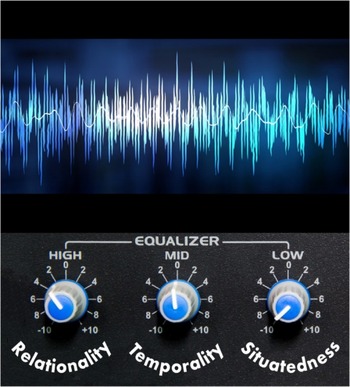
Returning to our visualisation experiment, we illustrate this transitioning phase in Figure 3, presenting a stylised equaliser with dials representing relationality, temporality and situatedness that can be turned up or down.
Dialling up liquidity in regulatory systems

In this depiction, varying the combination of degrees of tightness or looseness will have flow-on impacts at a systems level. The dials reflect a critical element of our conceptualisation – that is, regulatory agency is located in the actors involved. This regulatory agency is capable of being exercised in ways that are both direct and indirect, and intentional and inadvertent. (As critical legal pluralists have long argued, all legal subjects are makers as well as takers of law (Kleinhans and MacDonald, Reference Kleinhans and MacDonald1997).)
The possibility of deliberate intervention in the shaping of regulatory systems makes it important to consider two questions. First, what intervention will likely change the resonance point of a system – in other words, how in practice can we increase binding forces (which favour rigidity) or entropy (which favours sloshing around)? Second, how can we monitor the predictable and, more importantly, unpredictable consequences of deliberate interventions?
In developing Figure 3, we were conscious that it risks overemphasising an element of grand regulatory control, which would be misleading. To address this real concern, we used a ‘fuzzy spectrum’ that does not have absolutes or fixed markers, but continuing our tradition of experimenting, we consider whether perhaps an even better visualisation of the resonance patterns of different confluences of dynamic markers is observable in the cymatic patterns in Chladni images (Figure 4). These images are produced through combinations of sand, vibration and sound. Cymatic patterns in sand or water appear on vibrating plates; the particular pattern formed depends on the shape and size of the plate and the frequency of the vibrations. When the patterns were first observed by Europeans in the seventeenth century, they were (incorrectly) thought to be randomly generated, but were later identified to be completely determined. In Figure 4, the patterns depict varied ripples of interactions, interrelational meeting points and divergent crossovers.
Chladni images

These cymatic patterns offer another dimension to our visual experiment, albeit one more indicative than prescriptive. The fact that these patterns are predetermined by characteristics of the plates and the frequency of vibrations is suggestive of solid features of regulatory design, while the variability of those characteristics reflects the liquid features of regulation. The different patterns reflect the possibility of diverse outcomes and impacts for actors in the regulatory ecosystem. The visual complexity of these images is more consistent with the actual complexity of regulatory intervention, and the predetermined nature of the patterns points to the possibility of interventions having specific outcomes.
The resonance point of a regulatory system, in terms of its relative degree of liquidity, will have multiple, varied consequences. One is freedom, in terms of the degree to which one group is able to dominate or resist power. More solid forms of regulation will tend to benefit groups such as foreign companies or male community leaders (as in our case-study). Liquid forms of regulation may favour more diffuse forms of power. We acknowledge that often neither tendency will be true; however, an analytical understanding of the different ways in which power is mobilised in more liquid or more solid regulatory contexts illuminates dynamics in the distributions of power and unearths strategies to level or intensify power imbalances.
A second consequence is the type of accountability achievable. Liquid accountability often goes beyond questions of legality and official orders – it is frequently activated diffusely through collective agency. Liquid accountability is based on the notion of situated presence, knowing where one is, being where one is and understanding the relationships – including with non-human, between institutions as well as individuals – all constituting the being-in of presence, in this particular place, in this particular moment.
5 Conclusion
Many promising rivulets have sprung forth in our exploration of water music in Vanuatu and liquid regulation. While we intend to develop these further, we hope our analysis has created inspiring ripples with the potential to spread in exciting and unanticipated directions, perhaps channelled equally by solid and liquid architectures. We have shown how seeking to uncover resonance points within regulatory systems as a whole can productively replace dichotomies with a balance that encourages adaptability and accountability. Further, particular combinations of solid and liquid interventions are most likely to yield better results than reliance on such interventions separately. For example, in Vanuatu's conservative sociocultural environment, with no women currently in parliament, liquid interventions (like social media campaigns, workshops) aimed at restructuring or reimagining gendered power relations are unlikely to succeed as standalone strategies; and while interventions oriented towards solidity, like gender quotas, may usefully stimulate restructuring frameworks for new relationalities, they are not enough by themselves. Instead, we cite our example of the women's inclusionary relationship-maintaining strategies in contractually-bounded overseas performances, which displayed their power regarding water music through reliance on both liquid and solid strategies.
Overall, our paper has tried to steer away from normativity. However, situated in this historical moment in which solid approaches prevail, our concluding observation is that consciously ‘orienting to liquid’ does appear to open up space for a more grounded, informed and ethically attuned response to, and engagement in, regulatory practices.
Conflicts of interest
None
Acknowledgements
This research was partially supported by the Australian government through the Australian Research Council's Linkage Projects funding scheme (project LP150100973) and the Discovery project funding scheme (project DP110102440).