Introduction
Female genital mutilation/cutting (FGM/C) comprises all procedures involving partial or total removal of the external female genitalia or other injury to the female genital organs for non-medical reasons(WHO, 2018). The extent and severity of these procedures vary and have been categorized into four types by the World Health Organization (WHO). Type I is the partial or total removal of the clitoral glans (the external and visible part of the clitoris, which is a sensitive part of the female genitals), and/or the prepuce/clitoral hood (the fold of skin surrounding the clitoral glans). Type II is the partial or total removal of the clitoral glans and the labia minora (the inner folds of the vulva), with or without removal of the labia majora (the outer folds of skin of the vulva). Type III (infibulation) is the partial or total excision of the external genitalia and stitching or narrowing of the vaginal opening through the creation of a covering seal. Type IV includes all other harmful procedures to the female genitalia for non-medical purposes, for example, pricking, piercing, incising, scraping and cauterization (WHO, 2018).
The United Nations Children’s Fund (UNICEF) estimates that more than 200 million girls and women have had FGM/C worldwide (UNICEF, 2022). Although today FGM/C is common globally as a result of immigration to areas such as Europe, and North and South America (Johnsdotter & Essén, Reference Johnsdotter and Essén2016; Leye et al., Reference Leye, Mergaert, Arnaut and O’Brien Green2014), it is practiced predominantly in Africa where more than three million girls are at risk every year (UNICEF, 2022; WHO, 2022). This practice is widely acknowledged to be a violation of human rights and has been described as a severe form of discrimination against women and girls (Adam et al., Reference Adam, Bathija, Bishai, Bonnenfant, Darwish, Huntington and Johansen2010). FGM/C is against the right to health and life as in some cases it may cause serious medical complications and even death due to excessive bleeding (Bjälkander et al., Reference Bjälkander, Bangura and Berggren2012). Therefore, many international and regional human rights policies and treaties have been developed to tackle this problem.
In Tanzania, the FGM/C usually performed during infancy and childhood especially below reproductive age (Galukande et al., Reference Galukande, Kamara, Ndabwire, Leistey, Valla and Luboga2015). Because it is performed during that age, most of the time no room of consent is provided to these children (UNICEF, 2013). Therefore, as in other countries, the government of Tanzania is against the practice of FGM/C. In 1998 it established a Sexual Offences Special Provision Act, an amendment to the penal code, which specifically prohibits FGM/C (United Republic of Tanzania (URT), 1998). However, even though FGM/C has been outlawed for almost two decades, it is still prevalent in Tanzania (may be due to lack of multi-sectorial interventions to enforce that law). While about eight million women and girls are reported to have undergone FGM/C (Galukande et al., Reference Galukande, Kamara, Ndabwire, Leistey, Valla and Luboga2015), prevalence varies dramatically between regions. For example, the Manyara region has the highest FGM/C prevalence (58%), followed by the Dodoma (47%) and Arusha (41%) while other regions such as Kagera, Katavi and Ruvuma are dramatically lower (< 1%) (Ministry of Health, Community Development, Gender, Elderly and Children (MoHCDGEC), 2016).
Previous studies have made efforts to identify the factors associated with FGM/C and major predictors were found to be related to socioeconomic status (SES); women’s education, residence, wealth, and marital status were most reported in Tanzania (Klouman et al., Reference Klouman, Manongi and Klepp2005; Msuya et al., Reference Msuya, Mbizvo, Hussain, Sundby, Sam and Stray-Pedersen2002) along with other countries in Sub-Saharan Africa (SSA) (Sakeah et al., Reference Sakeah, Debpuur, Oduro, Welaga, Aborigo, Sakeah and Moyer2018; Setegn et al., Reference Setegn, Lakew and Deribe2016). These variables/factors have been used previously as indicators of SES which mostly influencing the women’s health including FGM/C in SSA (Ahinkorah et al., Reference Ahinkorah, Hagan, Ameyaw, Seidu, Budu, Sambah, Yaya, Torgbenu and Schack2020; Batyra et al., Reference Batyra, Coast, Wilson and Cetorelli2020; Morhason-Bello et al., Reference Morhason-Bello, Fagbamigbe, Kareem and Ojengbede2020). In Tanzania, patterns of SES factors vary between regions due to differences in household subsistence practices, for example, agriculture, pastoralism and fishing, along with differences in lifestyle, tradition, culture, language and religion. For example, tribal diversity translates into linguistic diversity which presents itself in the nearly 120 languages spoken in the country and existence of different cultural practices. Therefore, these variations may explain the observed differences in FGM/C prevalence between regions. However, despite the available evidence of such regional differences little is known about intra-regional diversity. Within in Tanzania, as in other SSA countries, there may be greater diversity within regions themselves, particularly regarding SES factors.
The current analysis aimed to assess the contribution of between region and neighborhood (intra-region) variations in SES to the prevalence of FGM/C in Tanzania. The findings of the present study will pave the way for an understanding to what extent such region and neighborhood variations in SES factors may contribute to the practice of FGM/C.
Materials and Methods
Data source
The current study pooled and analyzed data from the 2004, 2010 and 2016 Tanzania Demographic Health Surveys (TDHSs). Beginning in 1991, these surveys are conducted every four years. The TDHSs were undertaken by Tanzania’s National Bureau of Statistics (NBS) in collaboration with the Office of the Chief Government Statistician (OCGS), Zanzibar, the Ministry of Health, Community Development, Gender, Elderly and Children, Tanzania Mainland, and the Ministry of Health (MOH), Zanzibar. Technical support for the survey was provided by ICF International under the Demographic and Health Survey program.
Study sample and sampling technique
The TDHSs used a multistage cluster sampling technique to obtain a representative sample. Before individual information was collected, sampling frames were first created which included all primary sampling units (clusters) covering all regions country. A total of 475 clusters in 2004 and 2010 and 608 clusters in the 2016 survey were selected. A complete listing of households was established in all selected clusters. In each cluster, 22 households were systematically selected. Then, all eligible women and men between the ages of 15 and 49 years who were either residents or visitors in the household on the night before the survey were interviewed. Responses from 33734 women were collected: 10329, 10139, and 13266 women in 2004, 2010 and 2016 respectively, yielding an average response rate of 96.6%. A total of 6147 women were excluded because they reported never having heard of FGM/C, therefore, they did not meet the inclusion criteria. A total of 27587 women were included in the current analysis.
Data collection and processing
The TDHSs used four main types of questionnaires during data collection, however, the current study analyzed data obtained from the Women’s Questionnaire only. To ensure data integrity during TDHS primary data collection, data entry was done concurrently with data collection in the field. After the paper questionnaires were completed, edited and checked by both the field editor and the supervisor, the data was entered into a tablet equipped with a data entry program. The data entry process included 100% double entry to minimize keying errors and entries were corrected whenever necessary.
Measurement of Variables
Outcome variable
The primary outcome variable of interest was FGM/C prevalence, categorized as “Yes” for women who reported have been circumcised and “No” for those who reported not having been circumcised.
Independent variables
We considered four SES variables (women’s education level, residence, marital status, and household wealth) as previous studies have shown their correlation with FGM/C (Klouman et al., Reference Klouman, Manongi and Klepp2005; Msuya et al., Reference Msuya, Mbizvo, Hussain, Sundby, Sam and Stray-Pedersen2002; Sakeah et al., Reference Sakeah, Debpuur, Oduro, Welaga, Aborigo, Sakeah and Moyer2018; Setegn et al., Reference Setegn, Lakew and Deribe2016). Education level was grouped into “none,” “primary,” “secondary” and “highest” (including college and all university level). The area of residence was grouped into “urban” and “rural.” Marital status was categorized as “never married,” “married/living together” and “divorced, separated or widowed.” Household wealth was calculated based on household assets and housing characteristics. During the calculation, households were given scores based on the number and types of consumer goods they owned, ranging from a television to a bicycle or car, plus housing characteristics, such as source of drinking water, toilet facilities and flooring material. These scores were derived using a principal component analysis. National wealth quintiles were compiled by assigning the household score to each usual (de jure) household member, ranking each person in the household population by their score, and then dividing the distribution into five equal categories (“poorest,” “second,” “middle,” “fourth” and “wealthiest”). This means, household score is recoded into the quintile variable so that each member of a household also receives that household’s quintile category (MoHCDGEC, 2016).
Neighborhood in this study refers to an Enumeration Area (EA) which was delineated by the 2002 and 2012 Tanzania Population and Housing Census (NBS and OCGS, 2013). Tso limit the size of EAs for the purpose of the census, each is considered to contain an estimated one hundred households, for both urban and rural areas. In isolated areas, a fewer number of households may be considered. A total of 53071 EAs are listed in Tanzania, however, this is periodically revised to keep it as up-to-date as possible by improving descriptions in EA boundaries, physical features and list of heads of households.
Statistical analysis
Creating a hierarchical data structure in which individuals (level 1) were nested within neighborhoods (level 2) and within regions (level 3), we performed a series of three-level logistic regression analysis with random intercept models to describe individual and population components of variance in practices of FGM/C. Each model was controlled for the fixed effect of the survey year. The first analysis involved estimating a regional-level and neighborhood-level intercept-only model (null model). The second model adjusted for age-related differences. The third model introduced SES variables (residence, marital status, education, and wealth quintile) adjusted by age. As the past SES is missing, instead the current one was used as a proxy indicator. Because, previous studies suggested that SES inequalities in health during childhood or younger ages seem to persist to old ages(Darin-Mattsson et al., Reference Darin-Mattsson, Fors and Kåreholt2017), while others support for an interactionist model of the relationship between SES and family life(Conger et al., Reference Conger, Conger and Martin2010).
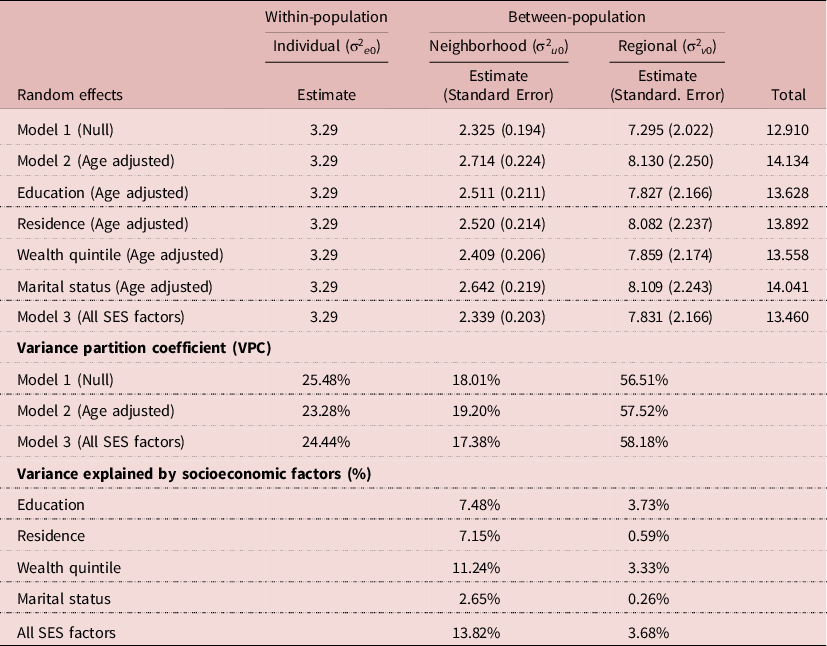
Then, we measured the proportion of FGM/C prevalence that is due to between region and neighborhood variations, also referred to as the Variance Partition Coefficient (VPC). Unlike multilevel linear regression, level 1, level 2 and level 3 variances are not directly comparable. Therefore we used the linear threshold model method by fixing the level 1 (individual-level) variance (σ2 e0) at 3.29 to compute VPC.
 $$VPC = \left( {{{\sigma _{v0}^2} \over {\sigma _{v0}^2 + \sigma _{u0}^2 + \sigma _{e0}^2}}} \right) \times 100$$
The term σ2 v0 is the regional-level residual, σ2 u0 is the neighborhood-level residual while σ2 e0 is the individual-level residual. As per the logit link function, we fixed the individual-level variance.
Finally, we estimated the proportion of variance in FGM/C practice explained by socioeconomic factors at each level by taking the variance of model 2 (age-adjusted) minus the variance of model 3 (age-adjusted and SES factors) then dividing by variance of model 2 (age-adjusted).
 $${\rm{Percentage}}\,{\rm{explained}}\,{\rm{by}}\,{\rm{SES }} = \left( {{{\sigma _{ageadjusted - }^2\sigma _{ageadjusted + SES}^2} \over {\sigma _{ageadjusted}^2}}} \right) \times 100$$
We performed multilevel modeling using Stata 15 (StataCorp, College Station, TX). All estimates were weighted to correct for non-responses and disproportionate sampling.
Ethics considerations
This study was based on an analysis of existing public domain survey datasets that are freely available online with all identifier information removed. The surveys were approved by the Ethics Committee of the ICF Macro at Calverton in the United States and by the National Institute of Medical Research Ethics Committee in Tanzania. Therefore, ethics approval for the current analysis was automatically deemed unnecessary. Informed consent was requested and obtained from the participants before the TDHS interviews. For participants under 16 years old the consent was obtained from their parent or guardian. All participants who accepted to participate in the surveys were provided a signed written informed consent.
Results
Baseline characteristics of the respondents
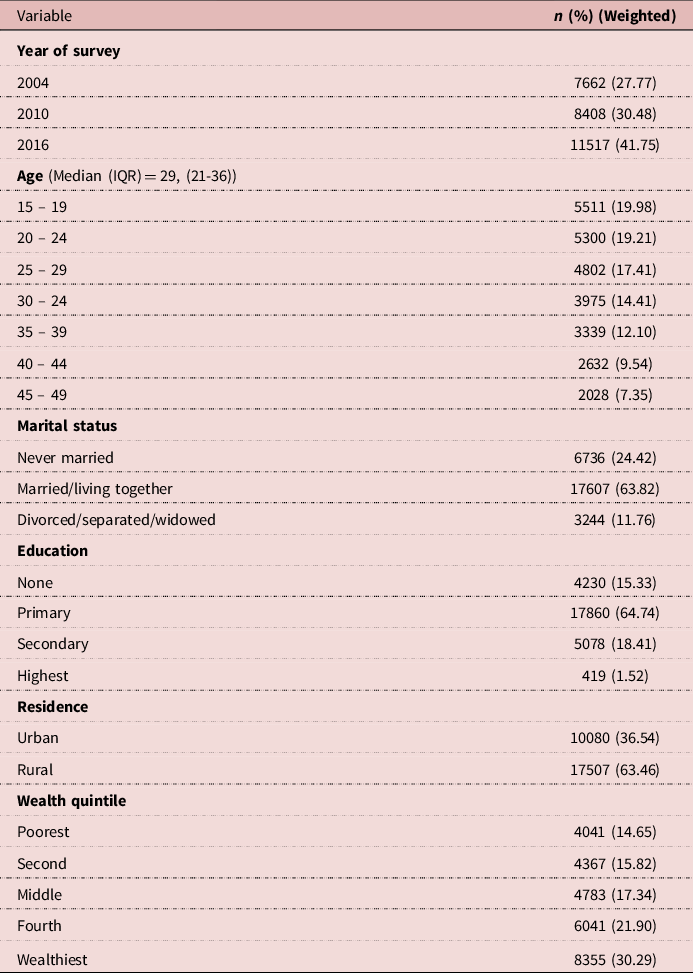
As shown in Table 1, the median age (IQR) of the respondents was 29 (21 – 36) years. The majority (64%) of the respondents were living with their partners at the time of the interview. About 15% did not attend any formal education and nearly two-thirds were living in rural areas. Furthermore, about one-third of the respondents were in the two poorest quintiles for household wealth.
Distribution of women between the ages 15 – 49 years by selected background characteristics, Tanzania TDHS 2004 – 2016 (n = 27587)

The trend of FGM/C practices in Tanzania
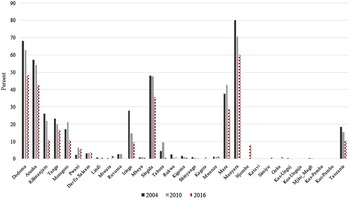
Fig. 1 shows the trend of between region variances in FGM/C practice from 2004 to 2016. We observed a decrease in FGM/C reported practices in almost all regions and a reduction of overall prevalence by 8% for the past decade. However, the overall prevalence indicates that for every hundred women about 15 reported having ever been circumcised.
Regional differences in FGM/C prevalence in Tanzania from 2004 to 2016.
Note: For 2004, 2010, 2016 and overall, the sample size n = 7873, 8510, 11204, and 27587 respectively.

Differences in SES factors by region
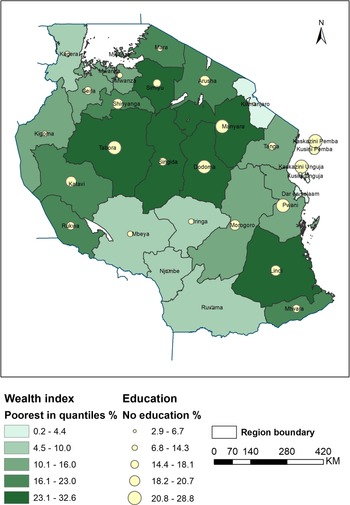
Fig. 2 presents a map of Tanzania showing variations of wealth and education according to region. The regions of Dodoma, Manyara and Tabora have the highest proportion of women belonging to both the poorest wealth quintile and the lowest attendance to any kind of formal education.
Distribution of women in Tanzania belonged to poorest wealth quintile and had no formal education.

Association between FGM/C and SES factors
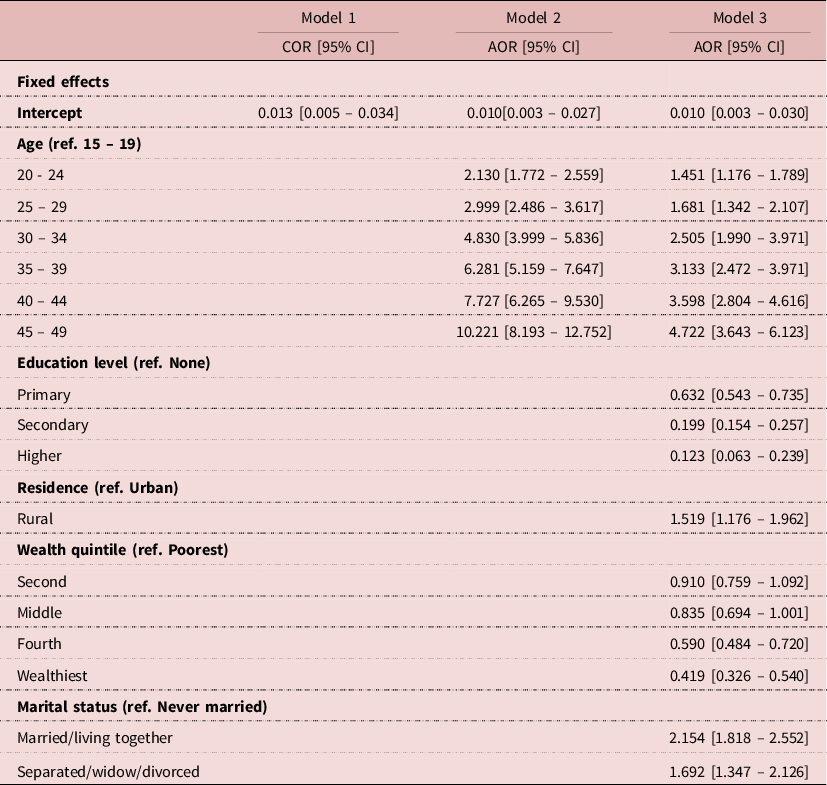
Table 2 presents the fixed part estimation shown by model 2 after controlling for between context differences. The odds of FGM/C practice was higher among older age groups compared to those between 15 and 19 years of age. After introducing all SES variables (model 3) the odds of FGM/C practice were less among women with primary, secondary, and higher education compared to those without any kind of formal education. Similarly, the odds of FGM/C practice were significantly less among women in the fourth [AOR = 0.590; 95%CI, 0.484 – 0.720] and wealthiest [AOR = 0.419; 95%CI, 0.326 – 0.540] quintile compared to those in poorest. However, the odds of FGM/C practice were one and half times higher among women residing in rural areas and those reported having or ever having had spouses compared to those who never had a spouse.
Parameter estimates from the three-level random intercept logistic regression models for association between FGM/C and SES factors (n = 27587)

Between region and neighborhood variations
Table 3 summarizes the random effects part of the three-level random intercept model for FGM/C and the proportion of variance explained by SES factors. We found a significant difference at both the neighborhood-level [σ2 u0 = 2.325(0.194)] and the regional-level (σ2 v0 = 7.295) from model 1 (Null), which remained significant after adjusting for age (model 2) and later for all SES factors (model 3). The random-effects results revealed that of the total age-adjusted variance in FGM/C, 76.7% was attributed to the between region and neighborhood differences (i.e., 57.5% for region and 19.2% for neighborhood). Despite the large between region variations, only 3.7% was explained by SES factors (i.e., reduction of variance estimates from 8.13 to 7.83). In contrast, 13.8% of between neighborhood variances were explained by SES factors (i.e., changes in variance estimates from 2.71 to 2.34).
Variance estimates of the three-level random intercept model for FGM/C and proportion of variance explained by socioeconomic factors

Discussion
The current study aimed to explore to what extent the between region and neighborhood variation of SES factors contributes to the practice of FGM/C in Tanzania. To our knowledge, this is the first study to explore the contribution of such differences to FGM/C prevalence. Furthermore, the study used pooled data from three consecutive surveys with nationally representative samples and used multilevel analysis to accurately estimate the contribution of such variation on the practice of FGM/C. The findings of this study show a slow decline in the reported prevalence of FGM/C for the past decade. Also, it provides evidence that much of the unexplained variation in FGM/C practice in Tanzania may be contributed primarily to between-context differences. However, variations in SES factors contribute more to between neighborhoods than to between regional differences in FGM/C practice.
The significant decline in the prevalence of FGM/C in Tanzania reported by this study was consistent with the findings of a previous study in the same region in Kenya (Koski & Heymann, Reference Koski and Heymann2017). The observed decline in this region could be due to the legal ban and penalties for violating the legislation against FGM/C practices in these countries (National Council for Law Reporting, 2011; URT, 1998) as well as a result of information provided in schools or communities about the obstetric complications for girls and women who practice FGM/C and their offspring (Babalola et al., Reference Babalola, Brasington, Agbasimalo, Helland, Nwanguma and Onah2006; Galukande et al., Reference Galukande, Kamara, Ndabwire, Leistey, Valla and Luboga2015). These acts and community sensitization might have affected the traditional and cultural issues related to FGM/C practices such as marking rites of passage, and indicating social superiority or proper upbringing. In 2018 a study conducted in Kenya highlighted that the majority of women interviewed believe that FGM/C practices are dangerous and inhuman and they should be stopped immediately (Muchene et al., Reference Muchene, Mageto and Cheptum2018). On the other hand, the observed decline might be due to underreporting, as previous studies argue FGM/C activities may have been driven underground (Galukande et al., Reference Galukande, Kamara, Ndabwire, Leistey, Valla and Luboga2015). Moreover, the decline varies between regions and countries with a high prevalence observed in northern and central parts of Tanzania and the western part of Africa respectively (Kandala et al., Reference Kandala, Ezejimofor, Uthman and Komba2018; Koski & Heymann, Reference Koski and Heymann2017). The persistent high practices of FGM/C in these regions may be because it plays an integral in female initiation ceremonies and the passage into adulthood and marriage.
The current analysis revealed the significant variation in SES factors between regions and neighborhoods in Tanzania. It is possible that these variations mark other differences in subsistence, lifestyle, culture, belief, language and religion that exist in the country. As other studies in SSA highlight the correlation between SES factors and FGM/C (Karmaker et al., Reference Karmaker, Kandala, Chung and Clarke2011; Sakeah et al., Reference Sakeah, Debpuur, Oduro, Welaga, Aborigo, Sakeah and Moyer2018; Setegn et al., Reference Setegn, Lakew and Deribe2016; Sipsma et al., Reference Sipsma, Chen, Ofori-Atta, Ilozumba, Karfo and Bradley2012), in line with this existing evidence, our study found that education, wealth status, residence, and marital status were significantly associated with the practice of FGM/C. This might be because, as is often assumed, uneducated, rural, and poor women may have little reproductive education (Horowitz & Jackson, Reference Horowitz and Jackson1997), therefore, they may be less aware of complications associated with FGM/C and tend to accept the practice (Ahmed et al., Reference Ahmed, Shabu and Shabila2019; Fikrie, Reference Fikrie2011; Van Rossem et al., Reference Van Rossem, Meekers and Gage2015). However, the current study estimated the contribution of between region and neighborhood variation in SES factors on the practice of FGM/C in Tanzania. Though the variation between regions and neighborhoods explain (76.7%) to the practice of FGM/C, only a small proportion (3.7% between regions and 13.8% between neighborhoods) of that variation is explained by SES factors. Therefore, the most unexplained variations in FGM/C practice that are related to regional or neighborhood differences might be due to other factors not related to SES characteristics.
One strength of this study is that it is the first to estimate the percentage contribution of between region and neighborhood variation in SES factors on FGM/C prevalence. We employed nationally representative datasets with a large sample and high response rate that provides greater statistical power and generalizability to areas with a similar context.
Limitations
The study had some limitations, as the cross-sectional surveys meant that causality assumptions could not be inferred. Therefore, results should be interpreted with caution. As this analysis relied on secondary data, it missed important variables such as past SES of women when FGM/C were performed. This resulting to the use of current SES as proxy indicator that indirect approximate the past SES. This might have distorted the association between SES and FGM/C. Furthermore, the risk of misclassification bias, which may have been introduced as a result of the lack of external validation of self-reported FGM/C practices, could have compromised the categorization of outcome variables.
Implications for Practice and/or Policy
It is known that FGM/C is against the right to health and life as in some cases it may cause serious medical complications and even death due to bleeding. In Tanzania, patterns of FGM/C is varying between regions due to differences in household subsistence practices. The hypothesis suggested that variation in regional and neighborhood SES factors might be contributing to differences in FGM/C practices in Tanzania. However, the findings of this study shows that regional and neighborhood variation of FGM/C practice are less explained by difference in SES factors. Therefore, current SES status as determinant for FGM may not be highly prioritized when designing interventions for reduction or elimination of FGM/C practices in Tanzania
Conclusion
The findings add to the current literature by documenting that between region and neighborhood variation in FGM/C practice are less explained by SES factors. There is a possibility that other factors such as cultural and/or traditional, ethnic, religious, and linguistic differences may contribute greater to these differences. Therefore, we suggest qualitative surveys to explore these factors as the initial step to understanding the remaining unexplained differences (86%) in FGM/C practice in Tanzania. Furthermore, regional interventions should address the drivers of FGM/C by considering intra-regional and neighborhood differences. It is possible that maternal and reproductive educational programs tailored to such neighborhood differences, beyond SES factors alone, could contribute to a radical shift in perspective for areas with high prevalence.
Availability of data and materials
The datasets generated during the current study are available in the Demographic and Health Survey Program repository: http://dhsprogram.com/data/available-datasets.cfm
Funding
The authors have no funding to report.
Competing interests
The authors do not have a commercial or other association that might pose a conflict of interest.
Ethics approval
This study was based on an analysis of existing public domain survey datasets that are freely available online with all identifier information removed. The surveys were approved by the Ethics Committee of the ICF Macro at Calverton in the USA and by the National Institute of Medical Research Ethics Committee in Tanzania. Therefore, ethics approval for the current analysis was automatically deemed unnecessary. Informed consent was requested and obtained from the participants before the TDHS interviews. For participants under 16 years old the consent was obtained from their parent or guardian. All participants who accepted to participate in the surveys were provided a signed written informed consent.