Two broad interpretations of developing country participation in the GATT currently prevail. The first portrays developing countries as having spent most of their time in the GATT negotiating to be relieved of various commitments, hell-bent on pursuing industrialization through import substitution and/or free-riding on the commitments made by their industrial counterparts. Jagdish Bhagwati, for instance, sees the exclusion of developing countries' interests from the GATT to have been the consequence of their choice not to engage in reciprocal tariff bargaining, which allowed the industrialized states to maintain high levels of protection on developing countries' exports (Bhagwati, Reference Bhagwati2005: 26). Similarly, T. N. Srinivasan argues that developing countries, ‘in their relentless but misguided pursuit of the import-substitution strategy of development, in effect opted out of the GATT’ (Srinivasan, Reference Srinivasan1998: 27). He claims that they were ‘ambivalent toward the GATT and, until the Tokyo round, did not participate actively in it’ (Srinivasan, Reference Srinivasan1998: 99). Moreover, they demanded and received a ‘permanent status of inferiority’ through seeking special and differential treatment, which limited the benefits they could receive from the Agreement (Srinivasan, Reference Srinivasan1998: 27). In a less unequivocal fashion, Bernard Hoekman and Michel Kostecki argue that, although ‘the rationale for S&D [special and differential treatment] was based on prevalent theories that import substitution was a necessary element in effective development strategies’ and that the GATT was for a long time ‘a club that was primarily of relevance to OECD countries’, developing countries nevertheless opted not to participate fully in the GATT – a decision that precluded developing countries from getting their interests on to the agenda of the GATT (Hoekman and Kostecki, Reference Hoekman and Michel2001: 389).
The second interpretation portrays developing countries as a group that spent their time in the GATT either as ‘quiet bystanders’ lacking the expertise or political representation to participate fully, or else as contracting parties attempting to redress biases in the institution's design. Diana Tussie and Miguel Lengyel suggest that developing countries acted in this way because they perceived the GATT to be neither a ‘friendly’ nor a ‘fruitful institution in which to promote their interests’ and because many ‘failed to maintain [an] official representation in Geneva’ (Tussie and Lengyel, Reference Tussie, Lengyel, Hoekman, Mattoo and English2002: 485–486; see also Youssef, Reference Youseff1999). Similarly, Amrita Narlikar argues that many developing countries chose not to participate in the GATT because of (i) a distrust of GATT rules; (ii) a perception that the GATT was a ‘poor substitute’ for the more development friendly but ultimately unrealized International Trade Organization (ITO); (iii) a decision-making system that, despite the nod to one-member-one-vote and a pursuit of decisions by consensus, crowded out developing countries and gave rise to a range of untoward activities designed to generate consent (see, also, Jawara and Kwa, Reference Jawara and Kwa2003); (iv) the use of bilateral negotiations between the two main suppliers of a good (the so-called principal supplier rule) as the basis for negotiations (see, also, Kock, Reference Kock1969: 63–64; Rhodes, Reference Rhodes1995: 86; Wilkinson, Reference Wilkinson2000: 100–114); and (v) the deliberate stacking of the agenda with issues of benefit only to the industrial states (Narlikar, Reference Narlikar, Hocking and McGuire2004: 135). Likewise, Paul Collier sees the ‘success’ of the GATT as resulting, in part, from the way in which developing countries were excluded from the institution. As he puts it, ‘[t]he GATT was not a global institution. It was basically a marketplace for OECD countries to strike deals for reciprocal trade liberalization’ (Collier, Reference Collier2006: 1425, emphasis in original). Those few developing countries that were members ‘were marginalized, or chose to marginalize themselves, through the formula of “Special and Differential Treatment”. In substance, this meant that such countries did not participate in bargains’ (Collier, Reference Collier2006: 1425).
Both of these interpretations inform current perceptions of developing country participation in the World Trade Organisation (WTO). Those preferring the first version of events are keen to move beyond the special and differential treatment previously enjoyed by developing countries to a situation of full reciprocity and active participation in tariff negotiations (see, for instance, Hart and Dymond, Reference Hart and Bill2003; Bhagwati, Reference Bhagwati2005). Whereas, for adherents to the second interpretation the task at hand is now to find ways to help developing countries participate in the multilateral trading system – usually through capacity building measures and addressing short falls in supply-side factors through increased technical assistance packages or aid for trade however packaged – as well as undertaking a measure of reform of the WTO to correct various anomalies in its rules and decision-making procedures (see, for example, Narlikar, Reference Narlikar, Hocking and McGuire2004; Reference Narlikar2005; Collier, Reference Collier2006).
The problem with both of these interpretations is that neither is entirely accurate. While each has merit, and empirical evidence can be found to support both cases, neither interpretation offers a sufficiently rounded representation of developing country participation in the GATT. It is certainly the case that the GATT was crafted and evolved in such a way that industrial state interests were pursued at the expense of those of developing countries (see, for instance, Hudec, Reference Hudec1990; Ostry, Reference Ostry1997; Wilkinson, Reference Wilkinson2006); developing countries did attempt, from the very outset, to negotiate exception clauses to the GATT that better suited their economic circumstances; few beyond the largest developing countries were able to maintain a delegation in Geneva; import-substitution was pursued as the basis of industrialization policies in much, but not all, of the Global South; and the WTO does require considerable reform to correct anomalies in its design and operating practices and procedures. It is, nevertheless, the case that these interpretations present too narrow a view of developing country participation.
Our purpose in this paper is to offer an alternative and, we believe, a more rounded account of developing country participation in the GATT that shows more accurately the extent and variation of that participation. It is important to stress at the outset that our focus is on participation – that is, on the extent to which developing countries were actively involved in the GATT. Our purpose is not to determine whether that participation was effective or influential – as the historical record testifies, in both relative (vis-à-vis the industrial states) and absolute terms developing country participation was generally neither particularly effective nor significantly influential, albeit that some important successes are evident. Rather, we argue that throughout the development of the GATT developing countries were active participants that consistently sought to have an impact on the nature and direction of the multilateral trading system.
Similarly, we do not limit our understanding of participation to trade rounds alone as is the case in some of the literature. While rounds are the most high profile events in the GATT/WTO and receive the greatest share of attention, they do not constitute the sum of all GATT/WTO activity. To limit our study to such would be to misrepresent the industry of all contracting parties. Moreover, we do not consider, as some authors do, only those countries that agreed to be bound by the final outcome of a round as having participated in the negotiations (see, for example, Oyejide, Reference Oyejide and Moore2004: 76). Of the eight rounds held under GATT auspices only the final Uruguay round was agreed to by all of the participants. Of the others, many more countries participated in the negotiations than finally agreed to be bound by the round's outcome (see Wilkinson, Reference Wilkinson2006: 56). As such, we do not take the relatively small number of developing countries agreeing to be bound by the results of earlier rounds as evidence of their participation or non-participation in the GATT.
We also argue that while the energy of developing countries was often directed towards negotiating more favourable treatment for themselves, this was a result more of the biased nature of the GATT and a consequence of their relative underdevelopment than of a desire to free-ride willy-nilly on the favourable trading conditions created by the concession exchanging activities of others and conveyed to them under the most-favoured-nation rule. That said, our purpose is not to portray the behaviour of developing countries in a distorted or rose-tinted light, to support or apologize for the policy decisions of developing countries or to offer judgement. We seek merely to offer a small but important corrective to the historical record. We, nevertheless, believe that our purpose has importance beyond an adjustment to the history of the multilateral trading system. Much of the debate about the rights and responsibilities of developing countries in the WTO, both within and beyond the Doha round, draws from one or other of these two interpretations. This, in turn, inevitably has an impact on contemporary policy discussion and formulation. Our task, then, is also to inform these debates.
In pursuit of our aims, the paper unfolds as follows. In the next section, we investigate the historical record of developing countries in the GATT. We begin our analysis with the negotiation of the ill-fated ITO, out of which the GATT emerged, and end with the run-up to, but do not include, the Uruguay round. We choose to begin and end where we do for the following reason. Our aim is to illustrate how developing countries sought to participate in the day-to-day running of the GATT from the very outset as well as to influence the major events in its institutional development. We do not, however, deal in detail with the Uruguay round, as this is the point at which developing country participation in the GATT is dealt with reasonably well in the literature. That said, we do not give a blow-by-blow account of the participation of developing countries in the GATT, as such an account would run into volumes. Instead, we offer an account of the involvement of developing countries that gives a more rounded appreciation of their participation. We do this by exploring some of the major events in the development of the GATT pointing to the role that developing countries – as individuals and as groups – played therein (including, but not limited to, the ITO negotiations and the creation of the GATT, each of the first seven negotiating rounds, the 1955 review of the GATT, the Haberler Report and the annexation of Part IV, and Uruguay's 1961 dispute settlement complaint). Our choice of historical events is neither arbitrary, nor is it designed merely for the sake of constructing an alternative argument. Rather, we focus on those events that clearly illustrate the extent of developing country participation. In the final section of the paper, we offer our concluding comments.
The participation of developing countries in the GATT: an alternative view
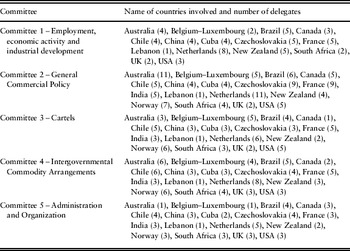
Developing countries have always been active participants in the GATT. They were heavily involved in the negotiations for the ITO out of which the GATT emerged; they were active participants in the first round of tariff cutting negotiations and played a role in subsequent negotiations; they attempted to adjust the shape of the General Agreement so that it better reflected their interests as well as those of the industrial states, albeit that the efforts of developing country delegations were often ‘given short shift’ (Patterson, Reference Patterson1966: 15); they sought to use all means available to them under GATT law to make the institution more relevant to their needs; they provided chairs and vice-chairs for trade negotiating committees from the outset (including for the six committees of the original ITO negotiations);Footnote 1 they were well represented in the negotiating committees established ahead of the United Nations Havana Conference on Trade and Employment (1947–1948 – see Table 1); and even after an alternative institution was established that was intended to deal with trade and development in a more satisfactory fashion (in the shape of the United Nations Conference on Trade and Development – UNCTAD) they remained active participants in the GATT.Footnote 2 This is in spite of the well-known and widely documented shortfalls that developing countries have always had in technical expertise, personnel, finance, and influence. But before we illustrate the extent to which developing countries were active participants in the GATT, four preliminary observations are necessary.

First, it is important to note that conceptions of which states are ‘developing’ have changed over the course of the GATT's development. This is most obviously the case with the industrialization of Japan, South Korea, Singapore, Taiwan, and so on; but it is also important to note that large-scale agricultural producing nations such as Australia, New Zealand, and South Africa were considered to be developing countries at the GATT's inception. In 1956, for instance, Richard Gardner argued that Australia was one of a number of states (including India and Brazil) taking a lead in representing the interests of fellow developing countries (see Gardner, Reference Gardner1956: 365; also Patterson, Reference Patterson1966: 329–332).
Second, many of the world's developing countries were still under colonial domination when the GATT was created and remained in a position of subordination during the General Agreement's formative years. Inevitably, this meant that the interests of these not-yet-independent developing countries were ‘represented’ by the colonial states during the initial GATT negotiations as well as during the early rounds. This, in turn, served to influence the behaviour of these developing countries with regard to the GATT (almost always negatively), and wider world politics, upon independence. In addition, a number of those developing countries represented as separate entities during the negotiation of the ITO and GATT (and the trade liberalization that took place thereafter) were merely satellite regimes of their colonial or former colonial masters (as was the case with, for example, Southern Rhodesia, now Zimbabwe).
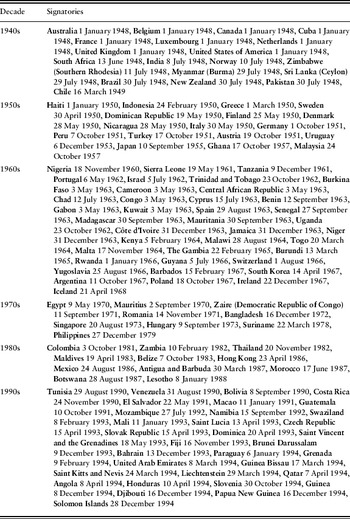
Third, the number of developing countries involved in the GATT has grown significantly over time (see Table 2). When the GATT was first negotiated 11 of the 23 original contracting parties would widely be regarded as developing countries today.Footnote 3 A further three could be added to this number given the context in time (Australia, New Zealand, and South Africa – see first point above). As the GATT developed through time, its membership grew. In the early years, a good deal of this growth came from the industrial states. By the late-1950s, however, the lion's share of the growth in membership came from newly independent countries seeking to assert and cement their political independence by signing up to major international treaties and organizations.
Countries acceding to the GATT (by date)

The relative lateness of developing countries' accession to the GATT had a number of important consequences. The GATT had always been an instrument for pursuing the trade (and related) objectives of the leading industrial states (primarily the US but also Western Europe). By the time most of the developing countries joined, the GATT's character had been refined in such a way that it took little account of the needs of developing countries. As Robert Hudec puts it, the GATT was the ‘property’ of the industrial countries ‘and they did not have to accommodate the rest of the world’; it provided ‘a place where the leading countries could go off to do business by themselves’ (Hudec, Reference Hudec1990: 57). Post-war liberalization had proceeded on the principle that agriculture would be excluded (see Brown, Reference Brown1950: 15; 22–28); this was reflected in both the ITO and the GATT and it was the source of much irritation among the developing countries. By the mid-1950s, the GATT's industrial contracting parties were also actively seeking to protect their textiles and clothing industries from liberalization. Moreover, the political climate in which developing countries joined was markedly different from that at the GATT's inception. Not only was the cold war in full swing (and developing country sympathies were being bought off by the largesse of the superpowers), the politics of decolonization and the assertiveness of independence saw western models of development and the supporting apparatus of large financial institutions come in for considerable criticism from developing countries. Inevitably, this shaped the way developing countries perceived, as well as interacted with and within, the GATT. They nevertheless remained active participants.
Creating the GATT
The role of developing countries in the creation of the GATT is more complex than first appears to be the case. The GATT negotiations were themselves part of a wider set of negotiations designed to establish the ITO. As such, much of the discussion concerning the creation of the GATT took place in those meetings dealing with the ITO Charter rather than in the meetings on the General Agreement itself. Once the GATT was created, its provisional nature and the intention that the General Agreement would be subsumed into the ITO once the Organization was up-and-running ensured that many of the discussions relating to GATT business continued to take place under the auspices of the ITO. As such, those disputes that arose over the nature of the trading system occurred mainly in the ITO negotiations.
Yet, it is precisely because most of the negotiations took place under the auspices of the ITO that in the GATT negotiations developing countries appeared to be relatively more peripheral than was actually the case. This was the case, for instance, with the requirement that reciprocity be a core principle of tariff negotiations. In the ITO negotiations, the principle's inclusion led to a large amount of discussion, with developing countries arguing that their bargaining power was insufficient to enable them to extract concessions of value from other countries on a reciprocal basis (Evans, Reference Evans1968: 73). India, Cuba, and Chile argued in the Charter drafting process that there should be some way of recognizing that developing countries undertaking industrialization policies may not be in the position to grant reciprocal tariff cuts of equal value to those of other, more advanced countries (UNCTE, 1946f: 66–67; UNCTE, 1946c: 49–52; UNCTE, 1946d). As the Indian delegation enquired at the time, ‘are we going to declare the country to be a defaulter merely because the performance made by it does not came up to the performance made by other countries which may be in an entirely different position, in an entirely different state of economic development, or because the performance is not what can be described as “substantial”?’ (UNCTE, 1946c: 50). By contrast, because the principle's inclusion had been debated at length in the ITO meetings it was included in the GATT without comment (see UNCTE, 1947a; UNCTE, 1947b: 12; note also that Article XXVIII bis on Tariff Negotiations was added only in 1955).
Needless to say, developing countries were active participants in the ITO negotiations. An important example can be seen in the first meeting of the UN Preparatory Committee on Trade and Employment of 1947, which assembled in London to discuss a charter for an International Trade Organization. It is well known that the basis for the Charter was provided by the ‘Suggested Charter for an International Trade Organization of the United Nations’ put forward by the US (see UNCTE, 1946a: 52–67) – itself the result of war-time discussions between the US and UK and the development of the ‘Proposals for Expansion of World Trade and Employment’ that had been published by the US in December 1945 (UNCTE, 1946a: 52). What is less well known is that Brazil also put forward a Proposed Charter (UNCTE, 1946b). There were striking similarities between the American and the Brazilian Charters: both were based on the principle of most favoured nation (MFN) (though in the Brazilian case this was to be granted unconditionally only by countries in advanced stages of development – see UNCTE, 1946b: Article 4a); both banned the use of quantitative restrictions, with certain exemptions such as during balance of payments crises and for facilitating the transition away from a war-economy; and both banned the practice of dumping and sanctioned certain anti-dumping measures. However, there were also notable differences. Unlike the Brazilian proposal, the US proposals contained a broad exemption from the ban on quantitative restrictions for ‘any agricultural product, imported in any form, necessary to the enforcement of governmental measures’ of certain kinds (UNCTE, 1946a: Article 19e). The Brazilian proposal, in contrast, included a recognition of the problems faced by less-developed countries as well as provisions designed to meter out special treatment to those countries to help them with their development drives (see UNCTE, 1946b: Articles 1–3).
The Brazilian Charter was also replete with acknowledgements of the problems facing developing countries. It recognized the problems faced by those countries for which custom duties constituted a major part of government revenues (Article 13a) – an issue mostly affecting less developed countries. The Brazilian Charter did not exempt less developed countries from making tariff concessions but granted them a reasonable period of time to adjust before the agreed reductions came into effect. It also explicitly indicated that the stage of economic development of each member country should be taken into account during tariff negotiations. This was conspicuously absent from both the ITO Charter and the GATT and was a significant bone of contention in both the ITO discussions (see UNCTE, 1946c: 50) and the 1955 review (to which we will return below). Recognition of the importance placed on maintaining tariffs on infant industries was also built into the rules governing negotiations. Moreover, the Brazilian Charter drew a distinction between ‘fiscal tariffs’, defined as those levied upon products for which imports formed only a small part of the national consumption of that product, and ‘protective tariffs’ which encompassed all other duties (UNCTE, 1946b: Article 12). The latter included those imposed on products critical to national security and those in which a country was in the process of attempting to develop greater productive capacity (UNCTE, 1946b: Article 13b). Signatories would agree to ‘begin negotiations as soon as possible to … substantially reduce fiscal tariffs’ (UNCTE, 1946b: Article 13a), thus exempting countries from having to cut rates protecting infant industries.
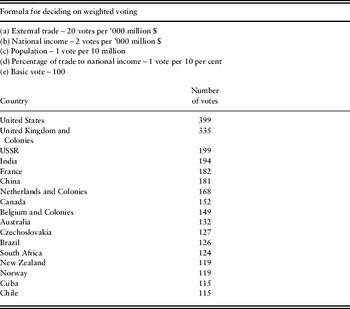
Although the Brazilian proposal lost out to its American counterpart (indeed, it was never in the running), Brazil and other developing countries nevertheless sought to exercise an influence in the ITO's construction. One example can be found in discussions surrounding the method of decision-making to be employed in the ITO. The developing countries were vociferous in their resistance to a system of weighted-voting being adopted, as they feared that such a system would institutionalize their secondary status. Two proposals were put forward for such a system – a proposal from the UK covering all decision-making subject to voting based on a formula for translating economic size into actual numbers of votes (UNESC, 1947b – see Table 3) and a second proposal from the US delegation proposing the adoption of the same system of weighted voting as used in the International Monetary Fund (IMF) in instances relating only to balance of payments matters to ensure consistency between the actions of the IMF and the ITO (see UNESC, 1947a: 13–21).
British formula for weighted voting in the ITO and its translation into votes

Source: UNESC (1947b).
During the debate that ensued, the majority of developing countries came out against a system of weighted voting (as did a number of industrial states). A range of arguments was deployed. Australia argued that the US proposal was problematic because it would enable the IMF to impose its will upon the ITO (UNCTE, 1947d: 3). Czechoslovakia argued that as the US's suggested Charter (the lion's share of which was acceptable to all of the delegations involved) proposed that each member should have one vote in matters other than those relating to balance of payments, it followed that ‘we are on principle opposed to any suggestion for weighted voting’ (UNESC, 1947c: 1). Turkey argued that any system of weighted voting would have to be based on ‘an arbitrary selection of statistics and would be contrary to the principles of Article 55 of the United Nations Charter’ further commenting that ‘[t]here had been a time when the system of weighted voting had been the last refuge of the nobility; the economic order which the Organization aimed at establishing should not be based on prosperity, but on equality’ (UNCTE, 1947c: 2). Developing this point further (and more forthrightly), Australia put it that ‘it would be impossible to arrive at any reasonable basis for a system of weighted voting’, commenting that it was unbelievable that ‘this contention was seriously advanced or entertained’ (UNCTE, 1947c: 4) – a sentiment echoed by New Zealand (UNCTE, 1947c: 4). Lebanon and Iraq put it that the complexity of such a system prohibited its use (UNCTE, 1947c: 5, 6); Syria emphasized the importance of democratic equality among the nations involved (UNCTE, 1947c: 5); El Salvador supported the formula ‘ “one vote for each member” because it was based on the principles of international public law, equity and justice’ and because a ‘parallel could be drawn between the status of persons in a state and that of states in an international organization’ (UNCTE, 1947c: 6). Venezuela and Mexico argued likewise (UNCTE, 1947c: 6, 8). Indeed, of the developing countries only China and Southern Rhodesia came out in favour of weighted voting. China's argument was based upon the need for population to be factored into the voting system, thereby enabling it to use its vast population to offset its relatively poor economic data; whereas Southern Rhodesia argued that a system of voting wherein each member had an equal vote would ‘create equality where there is inequality’ (UNCTE, 1947c: 6).
The point here is that developing country pressure played a role in the decision not to include a weighted system of voting in the ITO and that the developing countries were actively engaged in the task of shaping a new international organization, the negotiations for which were an organic part of the decision to create the GATT. Moreover, their endeavours were not confined to the decision-making system alone. Developing countries were heavily involved in all other aspects of the Organization's creation. Indeed, it was precisely because developing countries were so engaged, among other reasons, that the organization that emerged from the negotiations failed to represent US interests and that the US chose not to ratify the Havana Charter, deciding to persevere with the GATT instead (see Diebold, Reference Diebold1952; Zeiler, Reference Zeiler1999: 147–164). As John Evans noted, 32 developing countries used their greater numerical presence to insist ‘on, and obtain … many changes in the Geneva draft of the Charter’ (Evans Reference Evans1968: 74).Footnote 4 Economic advisor to the US State Department at the Havana conference Herbert Feis noted that ‘[a]lmost every one … [was] trying to re-write important sections of the [Charter], in the service of its special necessities, ideas, wishes or prejudices’. Feis continued, ‘[t]he number of suggested amendments runs into hundreds … the smaller countries which have little industry and small variety of natural resources … [seem to be] most assertive of all; they seem carried away by the hope of rapid development’ (Feis, Reference Feis1948: 51; see also Knorr, Reference Knorr1948: 20). Clair Wilcox, Vice Chair of the US delegation, put the number of suggested amendments at over 800 (Wilcox, Reference Wilcox1949: 47–49).
In the end, the negotiations saw the Charter altered in ways that reduced its usefulness to the leading industrial states and its lead architect – the US – in particular. The result was the stillbirth of the Organization. Indeed, only two states sought to ratify the Havana Charter (both of which were, at the time, developing countries – Australia and Liberia). The stillbirth of the ITO did not, however, put an end to post-war efforts to liberalize trade. Frustrations at the pace of the negotiations had emerged long before the Havana Conference and the members of the Preparatory CommitteeFootnote 5 (established in February 1946 to discuss the creation of the ITO) shared a view that it was important to agree among themselves the fundamental principles of the Charter in order to give contractual force to the tariff concessions already negotiated (Fawcett, Reference Fawcett1951: 270). The result was the negotiation and subsequent adoption of the GATT.
The early rounds and tariff negotiation rules
The assertion that developing countries chose not to participate in the GATT is based primarily on the claim that developing countries were unwilling to engage in reciprocal tariff negotiations. While it may be true that developing countries agreed to lesser tariff cuts than the developed countries (data are in fact very hard to find to confirm this), this view does not give sufficient weight to the effects of the rules governing the tariff negotiation process that excluded developing countries from participating fully. Indeed, the reliance on reciprocity, the principal supplier rule and the focus solely on tariffs, all had a detrimental effect on the capacity of developing countries to participate in tariff negotiations. We examine each of these factors in more detail.
The US required reciprocity to be a foundational principle of the GATT, such that any gains from tariff cuts agreed would have to be paid for by reciprocal tariff concessions, helping to ensure that the US would maintain its industrial comparative advantage. That is, any increased market access to the US had to be paid for by opening up markets to US-manufactured industrial goods. As noted above, developing countries, led by India, felt that the limited size of their domestic market meant that their bargaining power was inadequate to induce concessions from other countries; moreover, they wanted to be able to protect infant industries during the early stages of industrialization (UNCTE, 1946c: 50–52; UNCTE, 1946d; UNCTE, 1946e: 20). Although a great deal of discussion took place on the subject of how to assess whether or not countries had made a sufficient contribution to tariff cuts (UNCTE, 1946f: 66–67; UNCTE, 1946c: 49–52; UNCTE, 1946d), the problem was essentially left unresolved. With no formal method of assessment, this calculation was left up to the contracting parties in the negotiations, with the inevitable consequence that the calculation would be subject to the power politics that accompanies such negotiations.
Exacerbating matters was the product-by-product, principal supplier method of tariff negotiations, by which a country could only be requested to make tariff cuts on a particular product by the principal supplier of that product to that country (UNCTE, 1946d: 6; GATT, 1947). In early discussions on the ITO Charter it had been planned that a formula for across-the-board tariff reductions would be used; but by 1945, it had been accepted that this would prove to be unacceptable to the US Congress. Such a system would have ensured a levelling of high US tariffs and was strongly supported by Britain. At US insistence, however, it was abandoned and replaced by the system of reciprocal, bilateral bargaining over specific tariff lines that the US had traditionally used. This included the principal supplier rule, which stipulated that
Each country would be expected to consider the granting of tariff or preference concessions only on products of which the other countries, members of the Preparatory Committee, are, or are likely to be, principal suppliers (GATT, 1947: 6).
Thus, ‘for any particular product the importing country negotiates its tariff rate with its principal supplier and not with all suppliers of the same product’ (GATT, 1950: 13–14). Developing countries, however, were seldom principal suppliers of anything. Their exports were mostly concentrated in raw materials, which generally entered the industrialized countries duty-free anyway (Kock, Reference Kock1969: 232). It was only at the fourth round (Geneva, 1956) that the rules were altered to allow countries to act collectively in requesting concessions (GATT, 1956: 80; Kock, Reference Kock1969: 101). Even then, developing countries were at a disadvantage in that they had to co-ordinate action among a potentially large number of countries in order to meet the requirements of constituting a collective principal supplier. Furthermore, they were effectively prevented from requesting concessions on items that they did not produce in large quantities but in which they hoped to expand production. So, rather than resulting in reductions in barriers to trade that would have been to the benefit of all contracting parties, the principal supplier rule structured the negotiations around the commercial interests of the dominant powers. This, in turn, ensured that the smallest and most vulnerable of the contracting parties were locked out of setting the tone and agenda of the negotiations (Winters, Reference Winters1990: 1291). As Harry Johnson put it:
the real trouble with GATT [is] not the institution of bargaining for tariff reductions, but the techniques of bargaining and especially the procedure of bargaining between dominant suppliers on a basis of bilateral balancing of balance-of-payments effects. This technique [belongs] to the 1930's; if bargaining could be computerized, it could be made truly multilateral, on a basis of over-all balancing of balance-of-payments effects … this would enable the small countries to aggregate individually small concessions in the bargaining process. (Johnson, Reference Johnson1968: 368)
The idea behind the use of the principal supplier rule was that the marginalization of non-principal suppliers would be mitigated by the process of extending tariff concessions on a MFN basis, allowing tariff cuts to trickle down (UNESC, 1946c: 7). The problem with this, however, was that very little of the liberalization achieved under GATT auspices proved beneficial to developing countries. This was because the GATT was deployed primarily as a mechanism for facilitating an increase in the volume and value of trade among the industrial states in manufactures, semi-manufactures, and capital goods and not agriculture and textiles and clothing (see Brown, Reference Brown1950; Hudec, Reference Hudec1990: 57; Wilkinson, Reference Wilkinson2006: 67–68). The GATT was not designed to be, nor were claims made that it would become, an instrument for facilitating economic development in the periphery. As a result, developing countries were not only locked-out of negotiations by the fact that they were not principal suppliers, their plight was compounded by a perception that this situation would be rectified by the gaining of concessions without reciprocation through the multilateralization (that is, the extension of concessions on a MFN basis) process. This problem would only begin to be recognized in the review of the GATT undertaken in 1955, by which time three tariff rounds had already taken place.
Exacerbating the reliance on reciprocity and the principal supplier rule was the GATT's focus on tariffs as the only trade restriction that could be discussed at trade negotiations. For those developing countries exporting tropical products, the primary impediments to their exports were often internal taxes in importing markets rather than tariffs. Such internal taxes were often as high as an ad valorem equivalent in excess of 100% (GATT, 1961c: 129) and in particularly heavily protected areas such as sugar reached 500% (GATT, 1962a: 166). Internal taxes, however, were not on the agenda for discussion and no requests could be made for their reduction. Also, many exports from developing countries were restricted in the post-war years by quotas put in place ostensibly to protect balance of payments, which likewise were not a part of the negotiations. As each country's balance of payments improved these restrictions were supposed to be lifted. However, as the industrialized countries undertook this process they tended not to lift quotas on products exported by developing countries. As a consequence, in 1961 the Committee on Trade and Development found that ‘less developed countries, as a group, have not benefited significantly from the widely observed movement towards trade liberalization by industrialized countries as a result of their emergence from balance of payments difficulties’ (GATT, 1962a: 187).
In combination, the reliance on the principle of reciprocity, the use of principal supplier rule, and the exclusion of some key trade restrictions from the negotiations proved inherently prejudicial to the participation of less economically powerful countries. Developing countries were left unable, not unwilling, to negotiate concessions in sectors that would benefit them. Given the difficulties they faced in the early tariff rounds, it was hardly surprising, and indeed perfectly rational, that many developing countries began to view the GATT as being inimical to their interests and its tariff negotiations as a waste of their limited resources. There was, therefore, relatively little for them to gain from tariff bargaining, which was reflected in the marginalization they experienced from the benefits of expanding trade.
Inevitably, these circumstances induced declining rates of developing country participation in the tariff negotiations. In the Geneva round of 1956 and Dillon round of 1960–61, for instance, only eight developing countriesFootnote 6 (including Australia and Japan) exchanged concessions (and, it should be noted, MFN was withheld from Japan by 40% of the contracting parties following their enactment of Article XXXV (non-application) – see Patterson, Reference Patterson1966: 285–286). However, to reiterate, it is critical to place this within the context of the difficulties developing countries faced in the earlier rounds, which prevented them from gaining significant benefits from the negotiations. Their opting not to exchange concessions in later rounds was not the result of an unwillingness to participate, but a consequence of them being prevented from doing so.
The 1955 Review
In 1953 at the eighth session of the Contracting Parties,Footnote 7 by which time it had become clear that the project to create the ITO had failed and the GATT would therefore play a more substantial role than originally envisaged, the contracting parties agreed to undertake a thorough review of the GATT framework. This was undertaken between 1954 and 1955. While the industrialized countries were largely satisfied with the GATT, the wording of the resolution approving the review (GATT, 1953a: 18–19) was criticized by some developing countries, particularly Chile and Brazil, for implying, as the Chilean delegate Mr Oldini put it, that the GATT experience ‘had been unfailingly good in the past years’ and thereby failing to reflect the difficulties that had been encountered (GATT, 1953b: 8–10).
Throughout the review process, the developing countries highlighted the inadequacy of the GATT with respect to their economic needs (see, among others, GATT, 1954a, 1954b, 1954c). Mr Dias Carneiro of Brazil made the case against reciprocity and the differing effects of tariff cuts on developing and advanced countries. He ‘emphasized the economic inequality between countries who now wished to protect their infant industries, and countries which no longer needed such protection, but had in fact provided it at a time when international obligations did not stand in the way’ (GATT, 1954c: 3). The Cuban delegate, Mr Vargas Gomez, was critical of the exclusion of agriculture from the remit of the GATT, particularly of the exemption afforded the agricultural sector from the ban on the use of quantitative restrictions. As he put it:
The underdeveloped countries, by acceding to the General Agreement, were fettered by the severe obligations of keeping their markets open to absorb industrial products, in exchange for which they enjoyed no protection for their basic exports [i.e. agricultural goods and raw materials], and received tariff concessions of doubtful value. When these countries requested some tariff flexibility or other exceptional treatment to protect their economic development, they were told that they were seeking a privileged position and trying to deviate from the main principles of the Agreement. That attitude seemed hardly reasonable. (GATT, 1954c: 8)
The case was made repeatedly, as it had been during the ITO negotiations, for developing countries to be afforded the opportunity to make use of those trade-restricting measures to protect infant industries that the advanced nations had used during their own periods of industrialization (see Chang, Reference Chang2002). Much discussion took place surrounding Article XVIII (Governmental Assistance to Economic Development and Reconstruction), which provided for countries to raise bound tariff rates for the purposes of economic development or post-war reconstruction. Only Cuba, Haiti, India, and Ceylon had made use of Article XVIII, with Ceylon being by far the most prolific user. Ceylon therefore contributed a great deal to the discussions surrounding the review of the article.
The developing countries were, however, highly critical of Article XVIII (GATT, 1955a: 2; GATT, 1954d). Any developing country seeking to apply measures under Article XVIII was required to meet a number of criteria, provide compensation for affected countries (generally the developed countries – see GATT, 1955b: 59–60; GATT, 1958b: 115, 121 for examples) in the form of withdrawn concessions, and seek the approval of the Contracting Parties through a long process of consultation. Developing countries resented having to seek permission from, and provide compensation to, their former colonial masters to implement their development policies, particularly when they were only seeking to use exactly those policies used by the advanced nations during their industrialization. This provision also contrasted with the provisions of Article XII on Restrictions to Safeguard the Balance of Payments, which was included primarily at the request of those European industrialized countries that had faced severe dollar shortages following World War Two. This required no prior notification, no consultation with the Contracting Parties, and no compensation to be made to affected parties. The contrast was not lost on developing countries (Curzon, Reference Curzon1965: 214). The 1954 Review altered Article XVIII, making it exclusively for use by developing countries and not reconstructing European states, and introducing provisions for restrictions to be used to protect balance of payments. Other than this, the changes made were slight and did little to alter the perception of developing countries that the GATT was essentially an ‘industrial nations’ club'.
Throughout the 1954–1955 Review developing countries played an active role. Many of the debates currently underway in the Doha Development Agenda are echoed in the discussions that took place more than 50 years ago, such as the importance of agriculture and the need for providing developing countries with policy space. Throughout, far from showing no interest in the trading system, developing countries were highly engaged in the process, pushing changes to the Agreement that would make it more conducive to their needs. The political and institutional dominance of the advanced countries, however, ensured that few such changes materialized.
The Haberler Report
By November 1957 the situation facing developing countries had become such (in terms of the unfavourable trends in commodity trade, the widespread growth in agricultural protectionism, and the lack of inward investment but not their relative marginalization from negotiations and the GATT's administrative apparatus) that an ‘expert examination of past and current international trade trends and their implications with special reference to … the general state and prospects of international trade … [and] the failure of the trade of less developed countries to develop as rapidly as that of industrialized countries’ was commissioned (GATT, 1958b: 18). The result was the production of the 1958 report on Trends in International Trade (GATT, 1958a) – known as the ‘Haberler Report’ (after the chair of the panel of experts commissioned to produce the report Gottfried Haberler).
Little, however, resulted from the Haberler Report (for a contrary view see Curzon, 1969). The report concluded that, although no evidence of a general tendency toward specific discrimination in trading relations with the developing world was found, factors did exist that were detrimental to the terms of trade of less developed countries (GATT, 1958a). In particular, it suggested that the high incidence of trade barriers faced by these countries, coupled with unfavourable price trends, had significantly affected the terms of trade performance of developing countries. The response of the contracting parties was to embark upon a programme of action designed to address these trends through the ‘further reduction of barriers to the expansion of international trade’. Yet while the contracting parties committed themselves to exploring the ‘possibilities of further negotiations for the reduction of tariffs’, identifying the ‘problems arising from the widespread use of non-tariff measures for the protection of agriculture, or in support of the maintenance of incomes of agricultural producers’, and rendering visible other ‘obstacles to international trade, with particular reference to the importance of maintaining and expanding the export earnings of the less developed countries’ (GATT, 1959: 28), they did not seek to make alterations to GATT rules or their deployment as a vehicle for liberalization. Moreover, some of the barriers identified as problematic by the one of the three committees established to look into the problems facing developing countries post-Haberler (such as tariffs on tropical products, tariff escalation, quantitative restrictions and internal taxes) were still in force 30 years later at the start of the Uruguay round (see Srinivasan, Reference Srinivasan1998: 23). Ultimately, it was political will, not an absence of knowledge that was proving to be the biggest obstacle to readjusting the way in which the GATT was deployed. As the Haberler report put it:
The only chance of a successful outcome is a negotiated settlement involving a gradual shift away from undesirable policies on both sides. This is without question to the long-term advantages of both sides [developed and developing countries]; but it requires on both sides a broad-minded approach as to the elements in their total economic and financial policies they would be willing to make the subject of international discussion and negotiation. (GATT, 1958a: 127)
Uruguay's dispute settlement complaint
In the wake of the publication of the Haberler Report Uruguay sought to use the dispute settlement mechanism to build on the head of steam that was developing for the industrialized states to redress some of the inequities of the GATT. Developing countries had found themselves the subject of a number of GATT disputes, particularly in the early years following the signing of the Agreement but had seldom made use of the dispute settlement procedures themselves. Four of the first five disputes were, for instance, industrial countries pursuing complaints against their developing counterparts.Footnote 8 Following the disappointments of the early GATT years and the lack of success developing countries had in using moral suasion in the Committee on Trade and Development to improve matters, Uruguay decided to increase the pressure on the industrialized countries to conform to GATT rules through the dispute settlement process.Footnote 9 Uruguay's chief interests lay in the area of temperate agricultural produce, which was precisely the area most excluded from GATT oversight. In 1961, they filed a complaint against 15 developed countries – to all intents and purposes, the entire developed country membership – listing 576 restrictions applied by those countries that, Uruguay claimed, restricted their exports (GATT, 1961a; GATT, 1961b; Hudec, Reference Hudec1987: 46–48). The complaint was filed under Article XXIII, ‘Nullification or Impairment’, alleging that Uruguay was not receiving the overall benefits that it was due by the Agreement, since its exports were subject to a variety of restrictions, many of which were clearly GATT-inconsistent.
As Hudec argues, ‘[t]he Uruguayan complaint was showpiece litigation – an effort to dramatize a larger problem by framing it as a lawsuit’ (Hudec, Reference Hudec1987: 47). The complaint carefully avoided declaring any of the restrictions to be illegal, even when they obviously were. Their wish to avoid direct confrontation significantly reduced the extent to which the panel ruled on the issues. Since Uruguay refused to take a position on the illegality of the 576 measures, whenever the defending country claimed that they were GATT-conforming the panel accepted this as uncontested. A number of measures were argued by the defendants to be GATT-inconsistent but exempt from GATT disciplines due to the ‘existing legislation’ provisions of the Agreement; that is, the ‘Grandfather Rights’ which exempted existing legislation from having to be altered upon signing the Agreement (GATT, 1962b: 5; see Jackson, Reference Jackson1997: 40 and 2000: 24–27). On those measures that were obviously illegal and which were not claimed otherwise by the defendants, the panel made a finding of nullification of benefits and issued a recommendation that they should be removed (GATT, 1962b: 6). Overall, the process was somewhat disappointing. As Hudec puts it:
At the conclusion of the proceeding, Uruguay noted the removal of certain restrictions, but said that others had been added in the meanwhile and that consequently Uruguay's overall position was no better than before. The lesson to be drawn, according to Uruguay, was that GATT law did not protect developing countries. (Hudec, Reference Hudec1987: 49)
The Uruguayan episode shows that developing countries were willing to use the full range of channels the GATT offered to pursue their aims. However, the realities of a highly asymmetric power structure and the desire not to be overly belligerent towards much more powerful trading partners prevented Uruguay and the other less economically influential states from demanding their rights, but this should not be mistaken for a disengagement from the multilateral trade system. Furthermore, the experiences of the last two rounds, with the watered-down Agreement on Agriculture of the Uruguay round and the difficulties that the DDA has run into over agriculture, illustrate that it cannot reasonably be claimed (as it sometimes, unreasonably, is – see for instance Srinivasan, Reference Srinivasan1998: 100) that the developing countries had any possibility of bringing an end to the agricultural protectionism of the advanced states through offering reciprocal tariff cuts.
The Dillon round
The lack of remedial action in the wake of the Haberler report and Uruguay's recourse to the General Agreement's nullification and impairment provisions did not, however, dissuade developing countries from actively participating in the GATT. The lack of action did, however, contribute to an increasingly fractious and politically charged trade climate.
In the run-up to the Dillon round Australia lobbied hard, with reasonable success, to focus contracting party attentions on the need to address non-tariff barriers in the negotiations on agriculture and to have an acknowledgement of such in the negotiation's rules and procedures. The Australian delegation also proposed that the negotiating rules should explicitly recognize that negotiations could take place on subsidy levels, including any form of price or support mechanism that ‘operated directly or indirectly to reduce imports’, though it only succeeded in securing a recognition that ‘there was nothing that prevented negotiations on subsidies simultaneously with negotiations on tariffs’ but that this would not be made explicit in the negotiation's rules themselves (GATT, 1960: 107). Again, the contracting parties proved reluctant to legislate, particularly in those areas that threatened to curtail practices that were central aspects of their commercial behaviour (as price and support mechanisms were to the US and Europe). The Haberler Report had recommended the inclusion of internal taxes in negotiations, which, with pressure particularly from India and Brazil, helped to facilitate the explicit inclusion of internal taxes in the rules of negotiation for the Dillon round. The inclusion, however, was contrary to the wishes of, and was met by protests from several industrialized countries, particularly the US and the newly formed European Economic Community (EEC). Indeed, both the US and EEC made it clear that they would not negotiate on internal taxes (GATT, 1959: 6–7; GATT, 1960: 108–109).
More generally, agricultural exporting countries bemoaned the growing nullification and impairment of tariff concessions negotiated during early rounds by the increasing number of non-tariff measures being implemented in importing (largely industrial) countries. Their concerns were, however, met with arguments that the removal of such protection would ‘take many years and [would] only [be] possible if this took place parallel with improvements in the structure of agricultural markets in industrial countries’ (GATT, 1960: 126). Again, the industrial countries refused to take any action.
The problems facing developing countries were compounded by a growing nervousness among their number regarding the commitment to reciprocate for concessions granted to them. In 1965, reviewing the requirement to reciprocate, Indian Ambassador Lall commented that:
The developing countries of course [have] had no bargaining power, politically or economically. The rule of reciprocity has required them to give a matching concession, but clearly they were not in a position to give any. While over the last fifteen years, tariffs on industrial products of interest to industrial nations have been gradually brought down, those on products of interest to developing countries have remained at a high level. (Lall, Reference Lall1965: 174–179)
It was not just, however, the requirement to grant concessions in return for those received that was troubling. Many developing countries argued that should products of interest to them become the subject of negotiation (which, given that they were seldom principal suppliers, was in itself problematic), they were unlikely to be in a position to reciprocate. This was because reducing barriers to entry would (i) remove any protection for infant industries they may have, and (ii) reduce valuable sources of government revenue. Or else, the industries in which developing countries were interested were in decline in the industrial states and as such their tariffs were not entered into the negotiations (Johnson, Reference Johnson1968: 367). Ironically, however, once pressure eventually resulted in the removal of the commitment for developing countries to reciprocate (with the introduction in 1965 of Part IV of the GATT – see below), this actually had the effect of further isolating developing countries from discussions over the shape and direction of negotiations (see Srinivasan, Reference Srinivasan1998: 24).
Predictably the focus on negotiating among principal suppliers combined with the exclusion of agriculture from the GATT and the growing use of non-tariff barriers to protect agricultural markets in the industrial states saw disappointing results for developing and agricultural exporting countries during the Dillon round. At the 30 November 1961 ministerial meeting it was noted that ‘a number of contracting parties found that [the] recent negotiations had been disappointing, as they had produced no substantial results in respect of agricultural products because no significant concessions had been offered on these products in [the] negotiations’ (GATT, 1962a: 26). The failure to provide benefits in the area of agriculture contributed to the growing recognition among the contracting parties that conducting negotiations on a commodity-by-commodity and country-by-country basis was no longer adequate and future tariff rounds required instead the adoption of new techniques, in particular some form of linear tariff-reduction.
In recognition of the continuing plight of developing contracting parties, the ministerial meeting also adopted a declaration on the Promotion of the Trade of Less-Developed Countries. Yet like two previous statements of intent purporting to assist developing countries,Footnote 10 the declaration failed to commit contracting parties to substantive action. Instead, it requested, among other things, that:
(i) industrial contracting parties give special attention to the reduction of barriers to trade for exports from less-developed countries;
(ii) governments from less-developed countries expand their export portfolios;
(iii) industrial states seek the speedy removal of quantitative restrictions (QRs);
(iv) developed contracting parties seek to limit the use of export subsidies in products that directly compete with those from less-developed states;
(v) industrial contracting parties remain mindful of the negative consequences of dumping surplus produce that directly competes with products from less-developed countries;
(vi) a ‘sympathetic attitude’ on the question of reciprocity be kept in mind during negotiations for reductions in less-developed country trade barriers;
(vii) less-developed countries seek to improve their marketing and production techniques; and
(viii) less-developed countries endeavour to expand trade among themselves (GATT, 1962a: 28–32).
In 1963, a Nigerian led Group of 21 (G21) developing countries proposed a programme of action urging the contracting parties to focus their attentions on targeting those barriers to trade identified as directly affecting the less-developed states (GATT, 1963: 204–6).Footnote 11 This programme was, in turn, adopted as a resolution (Measures for the Expansion of Trade of Developing Countries as a Means of Furthering their Economic Development) at the May 1963 GATT ministerial meeting. The resolution called for:
(i) a standstill on the erection of new tariff and non-tariff barriers by industrial states;
(ii) the elimination within one year of all QRs;
(iii) duty-free entry into industrial markets for tropical products;
(iv) the removal of tariffs on primary products;
(v) the reduction and elimination of tariff barriers affecting exports of semi-processed and processed goods from developing countries; and
(vi) the progressive reduction of internal taxes in developed states on products wholly or mainly produced in developing countries (GATT, 1964: 36–47).
Perhaps predictably, the Resolution's adoption was subject to a number of caveats from the industrial contracting parties. The standstill on new tariff and non-tariff barriers was generally accepted with the notable exception of the EEC (which was in the process of sorting out a common external tariff); Austria and Japan ‘regretted’ that while they were committed to the removal of QRs, they were unlikely to be able to meet the 31 December 1965 deadline; the US wished it to be noted that its national legislation required tariff reductions to be staged over a five-year period; and a number of primary producing countries, though welcoming the Resolution, suggested that they ‘would have difficulty in accepting inflexible tariff commitments on certain products’ (GATT, 1964: 38–9). Needless to say, these responses drew sharp criticism from the sponsoring developing countries.
The most concrete outcome of the 1963 Resolution was the decision to establish a committee to investigate the revision of the GATT with a view to ‘safeguarding the interests of [developing countries] in their international trade and development programmes’ (GATT, 1964: 45). Though there was far from widespread support for an amendment of the GATT (the suggestion was initially supported only by the 21 sponsoring countries and the six members of the EEC), there nevertheless existed a general acceptance that something had to be done beyond yet another report into the problems facing these countries.
Despite some initial resistance, and with more than an eye on the threat to the GATT from efforts to create an alternative trade machinery in the form of the UN Conference on Trade and Development (UNCTAD) (Whalley, Reference Whalley1990: 1320), at a special session in Geneva in November 1964 the contracting parties drew up a protocol amending the GATT by introducing a fourth section (known as Part IV – in force on a de facto basis from 8 February 1965 and formally from 1966) dealing with trade and development. Part IV was not, however, the panacea the developing countries had hoped. As Evans notes, it ‘was essentially a qualified, and at some points emasculated, version of a set of provisions submitted by the less developed contracting parties themselves to the drafting committee’ (Evans, Reference Evans1971: 121). For Srinivasan, under Part IV the ‘less developed countries achieved little by way of precise commitments … but a lot in terms of verbiage’ (Srinivasan, Reference Srinivasan1998: 24). In the end it committed developed countries (and their less developed counterparts in relation to trade among themselves) to: (i) give high priority to the reduction and elimination of barriers to trade for goods of export interest to their developing counterparts; (ii) refrain from introducing or increasing customs duties or non-tariff barriers on those goods; and (iii) refrain from imposing or making any adjustments in existing fiscal measures that would hamper demand for products from developing countries. It also removed the requirement for reciprocity for any concessions made during trade negotiations; and it put into place a reporting and surveillance mechanism under the auspices of a Committee on Trade and Development (GATT, 1965: 2–11).
The annexation of Part IV to the GATT did, however, open up the possibility of creating preferential trading systems that favoured developing countries. Although such agreements were not mentioned explicitly within Part IV, they were clearly consonant with the aims of expanding the trade of less developed countries as expressed in its Aims and Objectives (Article XXXVI). This led to the subsequent creation of the Generalized System of Preferences (GSP) granting preferential tariff rates to exports from developing countries into the markets of the industrialized countries.
The case of the GSP is covered extensively in the literature (see, among others, Santos et al., Reference Santos, Rogério and Raphael2005; Johnson, Reference Johnson1967: ch. 6; Hudec, Reference Hudec1987: 108–116; Srinivasan, Reference Srinivasan1998: 24–27; Williams, Reference Williams1991: 109–130). What is less frequently mentioned is the trade preference system that was agreed among developing countries to facilitate greater trade among their number. On 8 December 1971 a Protocol Relating to Trade Negotiations Among Developing Countries was finalized (GATT, 1971a) to bring this into effect, along with the concessions to which they had agreed (included as Annex B to the Protocol). A new Committee on Participating Countries was created to oversee the functioning of the Protocol and extend its coverage (see, for instance, GATT, 1973e; GATT, 1978b). Pressure from developing countries in the Tokyo round led to both the GSP and the inter-developing country preference system being given a legal footing through the Enabling Clause, rather than requiring a specific waiver from Article I (Most favoured Nation) obligations as was previously the case (GATT, 1979e). This act finally introduced to the GATT the right for developing countries to grant one another preferential tariff rates that they had fought doggedly (and successfully) for in the ITO negotiations but which had been left out of the GATT in 1947 (see above).
The Kennedy round (1964–1967)
The negotiation of the Kennedy round shortly after the agreement of Part IV provided an opportunity to put the new provisions into effect. The results, however, were disappointing. The Dillon round had made it clear to the US that the traditional method of reciprocal, product-by-product, principal-supplier-based negotiations that had been required by the Trade Agreements Act was no longer adequate. The Kennedy administration therefore put together the Trade Expansion Act, passed by Congress in 1962, allowing the President much greater power to negotiate tariff cuts (Evans, Reference Evans1971: 141–159). It conferred authority on the President to reduce existing tariffs by 50% from existing levels, staged over five years, and to eliminate entirely tariffs of 5% or less. This facilitated the introduction of across-the-board, formula-based negotiations.
The developing countries were expected to benefit from the linear approach to tariff cuts since products of export interest to them would be included by default in the reductions. However, the new method constituted a hybrid approach to tariff negotiations based on an automatic formula combined with substantial bilateral bargaining over the exceptions list. This bargaining usually took place between the principal suppliers of the product in question to ensure the achievement of reciprocity (Winham, Reference Winham1986: 62–67). In this process, developing countries were still hampered by their lack of bargaining power and their inability to offer reciprocal tariff concessions. In the industrial products negotiations, for instance:
[t]he most serious loss of potential benefits to less developed countries resulted from the demand of industrialized countries for “reciprocity” from their developed partners. Too often, a developed country achieved the desired balance by the withdrawal of a previous offer concerning a product of which another developed country was the principal supplier – a process which secondary suppliers, whether developed or not, were in no position to prevent. (Evans, Reference Evans1968: 90, emphasis in original)
The result was that despite the linear approach and the formal commitment from developed countries that they would not require reciprocity from developing countries, the Kennedy round followed the previous pattern of achieving far greater results for products of interest to industrialized countries. Tariff cuts on cotton textile products were low compared to other manufactured goods, with tariff cuts of 18% from the US and UK and 22% from the EEC (Preeg, 1970: 230). This was significantly lower than the approximately 35% average reduction in industrial nations' tariffs on manufactured goods as a whole (Preeg, 1970: 206–223). Moreover, both the EEC and the US made their offers in the textiles sector conditional on the renewal of the Long Term Arrangement (LTA), which had been due to expire in October 1967, rendering the tariff cuts largely irrelevant at least for the largest supplying developing countries as they would be unable to make use of the tariff cuts to expand exports due to the LTA's quotas (Evans, Reference Evans1971: 231–232). Furthermore, in the final days of the round, the EEC and the US made it clear that tariffs might even ‘snap back’ to their former levels if the LTA was discontinued at some future date (Preeg, 1970: 108).
Although developing countries had sought and obtained in Part IV a provision that explicitly relieved them from reciprocating tariff concessions, it would be a mistake to see this as a refusal to contribute anything to the tariff reduction process. In the Kennedy round, 23 countries declared themselves to be participating under the terms established for developing countries and 14 of those (Argentina, Brazil, Chile, Dominican Republic, India, Israel, Jamaica, Republic of Korea, Malawi, Peru, Spain, Trinidad and Tobago, Turkey, and Yugoslavia) made tariff bindings or concessions included in the Schedule (GATT, 1968: 6–7). Thus, although Part IV may be seen to have further marginalized developing countries from the GATT, they nonetheless continued to contribute to the tariff negotiation process.
Despite this contribution, the results of the round nevertheless proved to be disappointing for developing countries. Although the round had opened with a general agreement that all sectors should be covered by the negotiations – including agricultural and primary products, as well as tariffs and non-tariff barriers – the results fell far short of these aspirations. Little progress was made on market access; agricultural support programmes remained highly restrictive; the production of synthetic fabrics in the industrial states continued to replace demand for natural products from developing countries; attempts to create commodity agreements for cocoa and sugar were unsuccessful; the terms of trade of primary producing countries in 1967 were less favourable than they had been in 1958; the price of rubber, tropical oils and oil seeds, jute and sugar continued to fall; and developing countries continued to face relatively high tariffs on finished and semi-finished products (Wells, Reference Wells1969: 75). As The Economist commented, the concessions made by developed countries to developing countries were, ‘no more than apologetic’ (The Economist, 1967: 813).
The Tokyo round
The Tokyo round expanded the agenda away from purely tariff issues to address the growing incidence of non-tariff barriers (NTBs), which had been examined in the Kennedy round but with very limited success. Developing countries had a keen interest in these discussions, both because of the impediments to their exports that NTBs created and the fact that the NTB codes moved beyond the border to place restrictions on how the domestic economy was run. As such, they participated in the negotiations to the greatest degree allowed them by their technical capacity and the exclusionary negotiation process. Importantly, this was not merely focused on gaining exemptions for themselves from the negotiated rules under SDT, although there was inevitably an aspect of that. They made proposals for agreements and accepted the need to agree to restrictions in certain areas.
One of the most important areas of the NTB discussions for developing countries was that on quantitative restrictions, particularly so-called Voluntary Export Restraints (VERs). These dominated not just the cotton textiles sector but were increasingly a part of many other areas, including such diverse products as chinaware, aluminum foil, paint brushes, watercolours in tubes, electric batteries and many others. VERs were considered to be the most significant threat to the prospects of developing countries increasing their exports of semi-industrial and industrial products (Meier, Reference Meier1980: 241). By the time of the Tokyo round there were between 800 and 850 different NTBs in force. As Robert Berger puts it, ‘[t]heir diversity and in many cases their illusive quality made them the crux of the plight of the LDCs’ (Berger, Reference Berger1979: 547–548).
The committee charged with examining quantitative restrictions and attempting to create some multilateral agreement on restricting their use produced two draft texts for consideration (GATT, 1974b). The first was a synthesis of proposals put forward by various developing countries, including that of Brazil (GATT, 1973f) and that of the Group of Three.Footnote 12 This called for an overall gradual liberalization and elimination of quantitative restrictions and VERs (GATT, 1974b). The second draft text was presented by the US. It made a distinction between legal and illegal quantitative restrictions and proposed that nations maintaining the latter eliminate them at the beginning of the round or pay compensation. The former would then be subject to negotiation during the round. However, few countries accepted the US distinction between legal and illegal quantitative restrictions.
The impasse that followed led to an abandonment of the multilateral approach in favour of a bilateral request-and-offer process, but despite this the Tokyo round achieved very little by way of limits on quantitative restrictions (Winham, Reference Winham1986: 114–115). The industrialized countries made the extension of the multi-fibre arrangement (MFA) a precondition of any reduction of tariffs on textiles. Moreover, the US, fearful of getting Congressional approval for the round, made it even more restrictive than before, slowing the quota growth rate from 6% to the rate of domestic market expansion, which was approximately 1–3% a year (Meier, Reference Meier1980: 245–246). The EEC required the largest developing country exporters to reduce their textiles and clothing exports below the 1976 level, dictating cuts of 9% for Hong Kong, 7% for Korea, and 25% for Taiwan (Balassa, Reference Balassa1978: 414).
The other NTB group in which developing countries had the greatest interest was that on safeguards. Again, developing countries put forward suggestions for a multilateral agreement, such as those presented by Brazil (GATT, 1973a) and Nigeria (the latter ‘with the concurrence of the majority of the developing countries’ – GATT, 1973b). However, the negotiations broke down because of the refusal of developing countries to accept the EEC's demand that each member should have the right to impose unilateral safeguards on individual countries without multilateral approval (Meier, Reference Meier1980: 253). As before, an instructive contrast may be drawn with the provisions of Article XVIII, which, as noted above, required that any developing country seeking to raise tariffs for the purposes of economic development must obtain prior approval from the Contracting Parties and compensate affected countries.
There were a number of other issues on which the talks on safeguards might have broken down, however, in which the divisions between parties were too large to be readily surmountable (Winham, Reference Winham1986: 240–247). For instance, the developing countries insisted that the appropriate remedy for instances in which their products became more competitive than those from developed countries was for developed countries to provide adjustment assistance for their producers, rather than import relief (GATT, 1978a). This was wholly unacceptable to the industrial countries, which tended to blame the ‘aggressive exporting practices’ of the developing countries for creating the conditions for requiring safeguards in the first place. There was movement in the negotiations, leading to a compromise position in which the developing countries accepted the principle of selectivity (by which restrictions could be placed on specific countries) but in which any safeguard measures would have to be approved by a committee before implementation. This, however, continued to be opposed by the EEC, which saw it as constituting a derogation of economic sovereignty. Consequently, there was no agreement on safeguards in the Tokyo round and developed countries were left to continue their previous practices limiting imports from developing countries in self-diagnosed cases of ‘market disruption’, despite their dubious GATT legality.
In both Safeguards and Quantitative Restrictions, the contracting parties ultimately failed to reach a conclusion. It is noteworthy that these two areas were those in which the developed countries had least desire to see strong multilateral rules. In the groups discussing other NTBs, such as those on Customs Valuation, Subsidies, and Countervailing Duties, in which the advanced nations had a greater commercial interest, developing countries again played an active role, involved themselves in the negotiations when they were allowed to do so, but ultimately saw their positions largely ignored (Winham, Reference Winham1986: 168–189).
It is worth noting that during the negotiations developing countries were not relentlessly demanding exemptions from the disciplines under discussion. For instance, in the negotiations concerning health and safety regulations, the developing countries explicitly specified that ‘their requests for differential treatment did not imply that developing countries should be exempted from the application of health and sanitary regulations, or that less strict standards should apply to imports from their countries’ (GATT, 1974a: 13). Rather, they argued that as ‘peripheral suppliers distant from main markets’, they had difficulties in complying with the regulations of importing countries and needed technical assistance to enable them to do so (GATT, 1974a: 13–14).
In many of the NTB Code discussions and in the negotiations on tariffs and agriculture, developing countries were largely excluded from the process. The US and EEC negotiated a mutually acceptable outcome before opening it out to the other members of the Quad (Japan and Canada). The rest of the contracting parties were informed of the outcome as a fait accompli via what Gilbert Winham has termed a pyramidal process (Winham, Reference Winham1986: 174–175). Developing countries lacked the political and economic might to influence the discussions. They put forward proposals for how the GSP, in which most developing countries (backed by UNCTAD) saw their interests lying, could be improved or at least not eroded by reduced preference margins (GATT, 1973c; GATT, 1973d).
In the tariff negotiations themselves, as had taken place in the Kennedy round, while demanding non-reciprocity in line with the provisions of Part IV, the developing countries did not by any means universally abstain from making concessions. The Tokyo round schedules included concession bindings from Czechoslovakia, Yugoslavia, Argentina, Jamaica, Romania, and Hungary (GATT, 1979a: 3–4). Many other developing countries were unhappy with the balance of the agreement as it stood in April 1979 and negotiations therefore continued after the official completion date. A supplementary protocol was added to the Tokyo round documents in November 1979 comprising the extra tariff bindings negotiated, which included concessions made by Brazil, Chile, the Dominican Republic, Egypt, Haiti, India, Indonesia, Ivory Coast, Korea, Malaysia, Pakistan, Peru, Singapore, Uruguay, and Zaire (GATT, 1979b; GATT, 1979c; GATT, 1979d).
The picture that emerges is not one in which developing countries simply opted out of the negotiations. A significant number of developing countries, including some least developed countries such as Haiti and the Ivory Coast, made tariff concessions as part of the round. Furthermore, they pushed their own interests throughout but were, like the other industrial countries that were not in the Quad (though to a lesser degree), simply barred from much of the negotiations. The result was that the developing countries were highly critical of the round's results, believing them not to reflect their interests, a view in which they were backed-up by UNCTAD (1979). Economic analysis further supported this claim, indicating that the effect of the round was to increase imports, exports and employment for industrialized countries but to have a negative impact on such variables for a number of developing countries, making the Tokyo round ‘of limited significance to many developing countries and for many it may be detrimental’ (Deardorff and Stern, Reference Deardorff and Stern1983: 621).
Laying the foundations for the Uruguay round
The weak results of many of the Tokyo Codes and the failure once again to agree to anything on agriculture set the stage for another round of negotiations. Just two years following the completion of the Tokyo round, the US set in motion the process that would lead, five years later, to the launch of the Uruguay round. Here again developing countries played a role in shaping the GATT's agenda.
The majority of developing countries were opposed to the US proposal for a new round and the proposed extension of the GATT's remit into services, intellectual property, and investment. Led by India and Brazil, developing countries strongly opposed the inclusion of services. Realizing that previous rounds had done little for their interests, they wanted action to be undertaken outside of a traditional round. They pushed for action on the growth of GATT-inconsistent restrictions such as VERs, the MFA, and agriculture (Croome, Reference Croome1999: 6–17; Cohn, Reference Cohn2002: 132–160) and argued that the developed countries' fulfillment of earlier commitments to reduce their trade barriers affecting the exports of developing countries was a higher priority than launching a new set of negotiations (Cohn, Reference Cohn2002: 125). Uruguay, for instance, in a communication made on behalf of developing countries argued that until such action had been taken, ‘a new round of negotiations in GATT would be lacking in credibility and devoid of relevance particularly for developing countries’ (GATT, 1984: 3).
The opposition of developing countries to the expansion of the GATT's remit contributed to the collapse of the November 1982 ministerial meeting, although the division between the EEC and the US was also an important factor. A number of developing countries' delegates left the meeting early, dismayed at the pressure being put on them by the US to accept an agenda that was clearly not in their interests (Wilkinson, Reference Wilkinson2006: 85). Following the 1982 ministerial, there was a concerted effort on the part of the US to push the rest of the contracting parties towards a new round. The US threatened a move to bilateral agreements, backed up by the recent completion of the US–Canada free trade agreement, and pressurized recalcitrant countries, including Japan, Brazil, India, and South Korea, with unilateral import restrictions under Section 301. Europe was threatened with a full-scale trade war in agriculture, backed up by the introduction of agricultural export subsidies from zero in 1984 to $256 million in 1986, which was small compared to the $7,094 million paid by the EEC (Preeg, Reference Preeg1995: 95) but was a message of intent from the US that they would be challenging the EEC's agricultural export markets (Wiener, Reference Wiener1995: 93).
The threat of unilateral action by the US weakened a number of developing countries' opposition to a new round, since they preferred to deal with the US in a multilateral setting rather than bilaterally. Furthermore, the onset of the debt crisis and the influence of World Bank and IMF conditions attached to bail-out loans had induced many developing countries to undertake unilateral liberalization and they wanted to extract reciprocal concessions from other countries in recompense. By the 1985 General Council meeting all industrial countries were in favour of a new round, as were, to varying degrees, a number of developing countries, though a group of 24 developing countriesFootnote 13 remained firmly opposed to the expanded agenda. These countries continued to oppose the inclusion of services and wanted confidence-building measures to be undertaken before a new round was launched, principally to begin the phase-out of GATT-inconsistent measures and recognition of the inadequacy of the MFA (GATT, 1985; Croome, Reference Croome1999: 17). They argued that:
There is little evidence to show that [a new round] would reduce or eliminate the basic asymmetry in trade relations between developed and developing countries. There are, however, indications that these negotiations would go far beyond the charter of GATT and divert attention to new themes alien to the jurisdictional competence of the General Agreement. (GATT, 1985: 3)
Instead, the 24 called for a round that was confined to industrial products and agriculture, coupled with a ‘stand-still and roll-back’ of protectionist measures that were not consistent with the GATT.
The inability to find consensus led the US to take what was for the GATT an extraordinary action. Convinced that there was a majority in favour of a new round, the US announced that since the Council was incapable of making a decision it would request a meeting of GATT's highest body – a session of Contracting Parties – to decide the matter (Croome, Reference Croome1999: 19). This was undertaken as a postal ballot and required the support of 50%+1 of the contracting parties. Although it was on the surface a purely procedural request, it was in effect a test of support for a new round. The decision to call for the special Session, which had by August 1985 received the required number of votes, showed that the necessary majority support for a new round could be found if required. If India, Brazil and the other hard-liners did not want to attend, that was their choice, but the round would go ahead without them. The formal decision to establish a Preparatory Committee to set the objectives and modalities of the new round was taken at the Session for Contracting Parties on 28 November (Croome, Reference Croome1999: 18–20; Wiener, Reference Wiener1995: 117).
A hard-core of developing countries continued to oppose the new-issues, although their number shrank to ten. Almost all developing countries would have preferred to leave services, intellectual property, and investment off the agenda, but with the US threatening to walk away if they were not included they thought that the intransigence of the group of ten was ill-advised (Croome, Reference Croome1999: 21–24). The group of ten eventually caved in, after agreeing that the new issues would proceed on a separate track to the negotiations on goods.
The picture that emerges is, once again, of developing countries making a significant input into the proceedings leading up to the launching of the Uruguay round and consistently pushing forward their interests through this process. However, mounting sentiment in the US that its market was more open than those of its competitors, coupled with the realization that its comparative advantage had shifted into areas that were not part of the GATT's remit, led the US to coerce the developing countries into submitting to its proposed agenda. Nevertheless, the process illustrates the degree to which developing countries were active in GATT proceedings, and the way in which those interests were largely ignored.
Conclusion
In reviewing the activities of developing countries, it becomes clear that they were indeed active participants in the GATT throughout its 47-year history. During the ITO negotiations, they were fully engaged with the drafting process, putting forward not only amendments for consideration but also, in the case of Brazil, advancing a whole draft Charter. They consistently opposed those elements of the ITO Charter that they felt conflicted with their programmes of economic development and put forward amendments that they felt would make the ITO more amenable to their needs. Indeed, this engagement with the project contributed to the US decision not to ratify the Havana Charter since the US felt the proposed organization no longer represented American interests sufficiently. The active role developing countries played in the ITO negotiations was carried over into the GATT negotiations, in which those developing countries that were invited to participate in the drafting process did so to the greatest degree allowed to them. The smaller number of developing countries involved in the process and the provisional nature that was envisaged for the GATT meant that their input appeared to be more muted than it really was.
As we have seen, the contention that developing countries opted not to engage in tariff negotiations is exaggerated. Key aspects of the GATT, notably the principal supplier rule, reliance on reciprocity, and the exclusion of trade restrictions other than tariffs, had the effect of excluding developing countries from the early rounds of negotiations. It is true that they pushed for non-reciprocity, but it is not the case that developing countries refused to make tariff concessions during GATT rounds. Furthermore, they had pushed determinedly in the ITO negotiations to be afforded the opportunity to create preferential tariff rates for other developing countries without having to multilateralize these through the MFN principle to the industrialized countries also. They were, however, prevented from doing this by the exclusion of this clause from the GATT. It was, therefore, only with the introduction of the Enabling Clause in 1979 that such South–South preferences became GATT-legal. Such an inter-developing country preference system is currently being somewhat belatedly advocated as a way of making the world trade system more development friendly (see, for example, Stiglitz, Reference Stiglitz2007: 83).
Moreover, at key moments in the GATT's evolution, such as the 1955 Review, the creation of Part IV and the critical later rounds that pushed the GATT's remit into new areas, developing countries were continually present and active, pushing their interests and seeking changes to the GATT system. They also sought to use the mechanisms within the GATT to enhance their interests, notably through the Uruguayan dispute settlement case. The picture that emerges is that at no point in the GATT's evolution did developing countries opt out or choose not to participate in the institution.
We have also shown that the claim that developing country interests were excluded from the GATT as a consequence of their own behaviour is at best exaggerated. It does not pay sufficient attention to the degree to which developing countries were active members of the GATT, nor acknowledge the way in which the rules of the GATT prevented them from making a more substantial contribution to tariff rounds. We have also shown that it is not accurate to say that developing countries were primarily bystanders in the GATT. From the time at which the shape of the post-war commercial system began to be discussed, through to the Uruguay round that created the WTO, developing countries participated to the greatest degree allowed them by the exclusionary negotiation processes that have been a continual feature of the GATT and by their capacity. Throughout its existence, developing countries have continually sought to shape the GATT in a direction that better suited their interests.
The role developing countries have played in the GATT must therefore be re-appraised. They have been both more active than is frequently suggested and their actions have often been more nuanced than is argued, comprising more than just a demand for special and differential treatment. Also, the various points in time that are put forward as being the moment when developing countries finally began to participate fully (which different commentators suggest to be the Tokyo round, the Uruguay round or indeed the WTO's Seattle ministerial meeting) all downplay the substantial involvement developing countries had with the GATT/WTO up to that time.
Yet, while it is our contention that developing country participation far exceeds, and is qualitatively different from that currently portrayed in the literature, we have only just scratched the surface. In a paper of this size, we have only been able to give the broadest of overviews. Limitations of space preclude us from illustrating the full extent to which developing countries were active participators in the everyday life of the GATT. We have not, for instance, been able to give a full account of the number of amendments, interjections, suggestions, or proposals that developing countries put forward through the course of the GATT, or the energy they expended in their participation in committee meetings, dispute settlement cases as well as each of the trade rounds. What we have been able to show, however, is that developing countries were active participants in the GATT and that this needs to be recognized and appropriate account taken.