Introduction
Tetrahedrite-group minerals are the most common sulfosalts in many hydrothermal ore deposits. These chalcogenides form a complex isotypic series, with the general structural formula M (2)A6 M (1)(B4C2)X (3)D4 S(1)Y12 S(2)Z, where A = Cu+, Ag+, □ (vacancy) and (Ag6)4+ cluster; B = Cu+ and Ag+; C = Zn2+, Fe2+, Hg2+, Cd2+, Ni2+, Mn2+, Cu2+, Cu+ and Fe3+; D = Sb3+, As3+, Bi3+ and Te4+; Y = S2– and Se2–; and Z = S2–, Se2– and □ (Biagioni et al., Reference Biagioni, George, Cook, Makovicky, Moëlo, Pasero, Sejkora, Stanley, Welch and Bosi2020a). Thus, tetrahedrite-group minerals are characterised by different homo- and heterovalent substitutions and represent an interesting link between mineralogy and ore geochemistry. The classification and nomenclature of the tetrahedrite-group minerals was published recently by Biagioni et al. (Reference Biagioni, George, Cook, Makovicky, Moëlo, Pasero, Sejkora, Stanley, Welch and Bosi2020a). Silver-rich members with 3 to 6 Ag atoms per formula unit (apfu) (A-site constituent, freibergite/arsenofreibergite series) have been known for a long time. Indeed, ‘freibergite’ was first described from the Hab Acht Mine near Freiberg, Saxony, Germany by Weissenbach (Reference Weissenbach1831) and named by Kenngott (Reference Kenngott1853). The Commission on New Minerals, Nomenclature and Classification of the International Mineralogical Association (IMA–CNMNC) currently lists the freibergite series as argentotetrahedrite-(Fe) (Welch et al., Reference Welch, Stanley, Spratt and Mills2018), argentotetrahedrite-(Hg) (Wu et al., Reference Wu, Gu, Qu, Yang and Wang2021), argentotetrahedrite-(Zn) (Sejkora et al., Reference Sejkora, Biagioni, Števko, Raber, Roth and Vrtiška2022), kenoargentotetrahedrite-(Fe) (the former freibergite – Welch et al., Reference Welch, Stanley, Spratt and Mills2018; Biagioni et al., Reference Biagioni, George, Cook, Makovicky, Moëlo, Pasero, Sejkora, Stanley, Welch and Bosi2020a) and kenoargentotetrahedrite-(Zn) (Qu et al., Reference Qu, Sima, Gu, Sun, Fan, Hou, Ni, Wang, Yang and Wang2021). The arsenofreibergite series comprises fewer species, being currently populated only by argentotennantite-(Zn) (Spiridonov et al., Reference Spiridonov, Sokolova, Gapeev, Dashevskaya, Evstigneeva, Chvileva, Demidov, Balashov and Shulga1986; Biagioni et al., Reference Biagioni, George, Cook, Makovicky, Moëlo, Pasero, Sejkora, Stanley, Welch and Bosi2020a) and kenoargentotennantite-(Fe) (Biagioni et al., Reference Biagioni, Sejkora, Moëlo, Makovicky, Pasero and Dolníček2020b). The most common C-site constituent in minerals of the freibergite series is Fe (Riley, Reference Riley1974; Pattrick and Hall, Reference Pattrick and Hall1983; Peterson and Miller, Reference Peterson and Miller1986; Johnson et al., Reference Johnson, Craig and Rimstidt1986; Welch et al., Reference Welch, Stanley, Spratt and Mills2018; Biagioni et al., Reference Biagioni, George, Cook, Makovicky, Moëlo, Pasero, Sejkora, Stanley, Welch and Bosi2020a) but some Cd-dominant chemical compositions have been reported previously (see a brief review below). Pattrick and Hall (Reference Pattrick and Hall1983) studied Ag substitution into synthetic Zn-, Cd-, and Fe-bearing tetrahedrites and for Cd members found the maximum Ag content of 7.02 apfu. The recent findings of a mineral specimen corresponding to argentotetrahedrite-(Cd) at the Rudno nad Hronom deposit, Slovak Republic, allowed the submission of a formal proposal to the IMA–CNMNC and the mineral and its name (symbol Attr-Cd) were approved (IMA2022-053, Mikuš et al., Reference Mikuš, Majzlan, Sejkora, Vlasáč, Steciuk, Plášil, Rößler and Matthes2022). Holotype material of argentotetrahedrite-(Cd) from Rudno nad Hronom is deposited in the collections of the Department of Mineralogy and Petrology, National Museum in Prague, Cirkusová 1740, 19300 Praha 9, Czech Republic, under the catalogue number P1P 8/2022.
Occurrence and physical properties
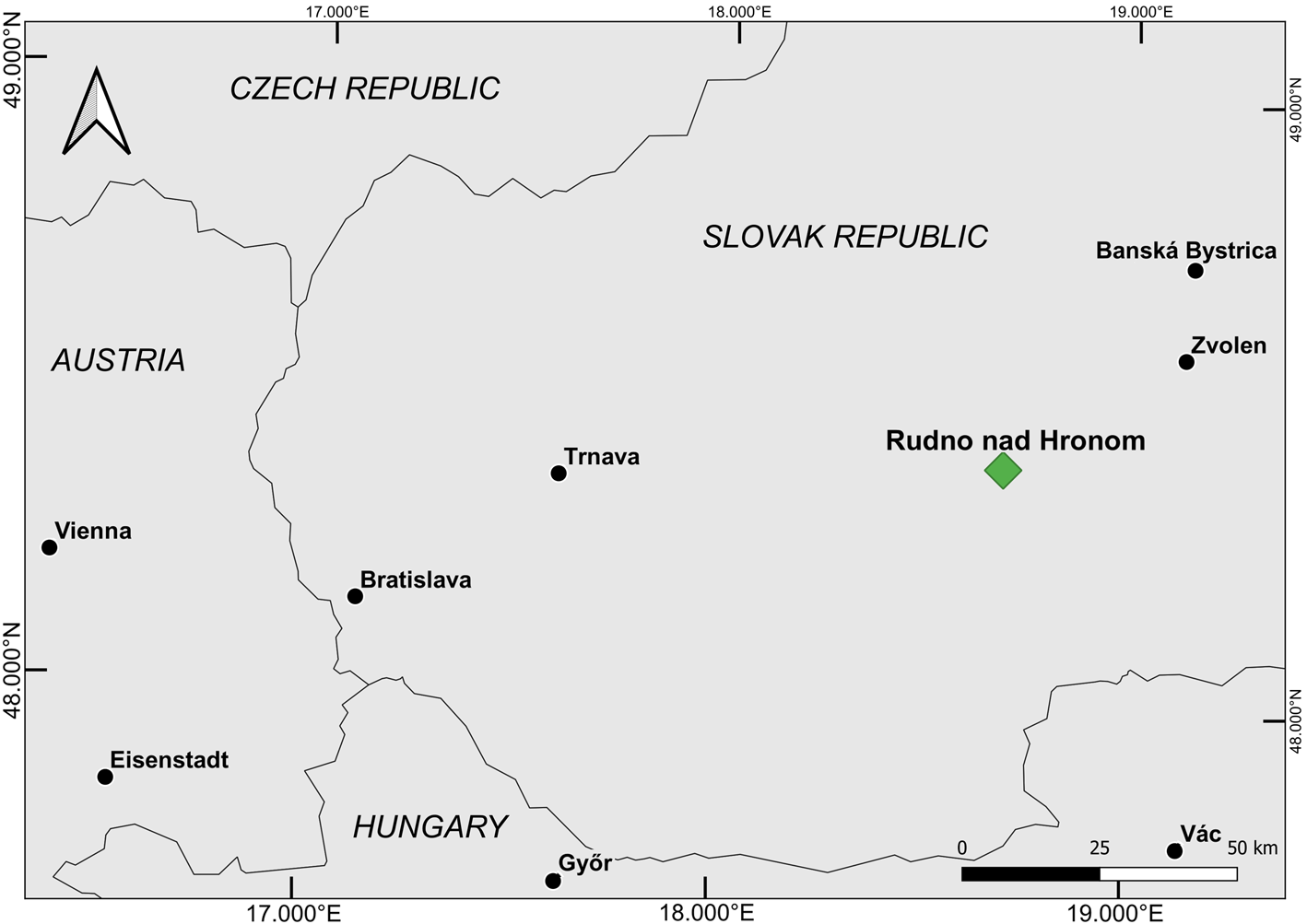
Argentotetrahedrite-(Cd) was found at the Au–Ag epithermal deposit Rudno nad Hronom, Žarnovica Co., Banská Bystrica Region, Slovak Republic (48.396446°N, 18.682611°E) (Fig. 1).
Location of the Rudno nad Hronom, Banská Bystrica Region, Slovak Republic.

The epithermal veins with Ag–Au mineralisation at this deposit are located in the western part of the Middle Miocene Štiavnica stratovolcano, represented mainly by andesitic rocks. The deposit is located in the southern and eastern slope of the Chlm hill extrusive complex over an area of 1.5 × 3 km. The mineralisation is situated in three large vein systems with a general S–N to NNW–SSE direction hosted in the first-stage andesitic complex of stratovolcano evolution related to a local horst structure (Lexa et al., Reference Lexa, Štohl and Konečný1999). Deeper parts of the mineralisation are developed in the basement rocks represented by sandstones, shales and Permian basalts of the Hronic unit (Smolka et al., Reference Smolka, Skaviniak, Valko, Kámen, Daubner, Petr, Gwerk, Novák, Kováč, Ružiaková and Mjartanová1988). The western flanks of the deposit host numerous swarms of granodiorite/quartz-diorite porphyry dykes (second stage of stratovolcano evolution) devoid of ore mineralisation. In the northern part of the deposit, a rhyolite dyke of the fifth stage of stratovolcano evolution penetrated the contact of the Chlm hill extrusive complex and the sills of andesite porphyry. According to Štohl et al. (Reference Štohl, Lexa, Kaličiak and Bacsó1993), the mineralisation in Rudno nad Hronom area is genetically associated with the rhyolite volcanism of the fifth stage. The samples with argentotetrahedrite-(Cd) were collected from the Johan de Deo and Priečna vein accessible via the Johan de Deo adit. The ore shows a typical signature of low-sulfidation epithermal mineralisation with brecciated textures composed of fragments of the altered host rock, quartz, and disseminated precious and base-metal minerals. After the initial base-metal stage, the early precious metal stage of mineralisation starts by precipitation of argentotetrahedrite-(Zn) and tetrahedrite-(Zn) followed by greenockite together with argentotetrahedrite-(Cd) and ‘tetrahedrite-(Cd)’. Argentotetrahedrite-(Cd) is replaced by later galena, acanthite, polybasite, pyrargyrite, bornite, stromeyerite, mckinstryite and Cu–S phases (chalcocite, digenite and covellite). Its crystallisation is related to the short activity of hydrothermal fluids rich in Cd (formation of greenockite and Cd members of the tetrahedrite group) during a precious metal stage of the formation of the Rudno nad Hronom Au–Ag epithermal deposit. The veins are located in hydrothermally altered rocks with abundant secondary K-feldspar, quartz, carbonates and smectites.
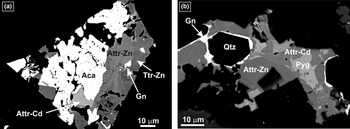
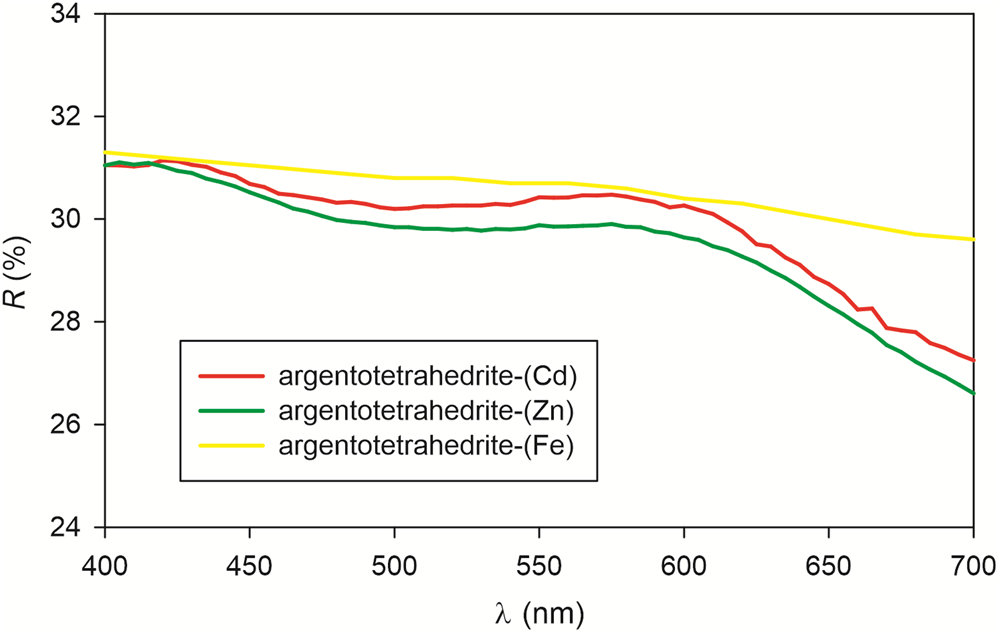
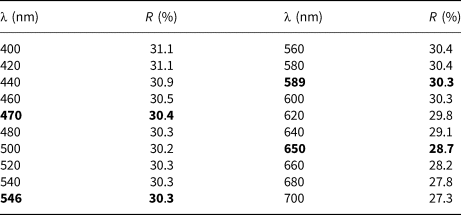
Argentotetrahedrite-(Cd) occurs as anhedral grains, up to 30 μm in size (Fig. 2), steel-grey in colour, tarnished to black and with a black streak. Lustre is metallic. The Mohs hardness may be close to 3½–4, as for other members of the tetrahedrite group. Argentotetrahedrite-(Cd) is brittle, with indistinct cleavage and conchoidal fracture. Density was not measured, owing to the small amount of available material; on the basis of the empirical formula and the single-crystal unit-cell parameters, the calculated density is 5.580 g/cm3. In reflected light, argentotetrahedrite-(Cd) is isotropic. It is grey, with creamy tint and fast (tens of minutes) tarnishing to orange–brown. Internal reflections were not observed. Reflectance values, measured in air using a spectrophotometer MSP400 Tidas Leica microscope, with a 100× objective, are given in Table 1 and shown in Fig. 3, where they are compared with published data for argentotetrahedrite-(Zn) and argentotetrahedrite-(Fe).
(a) Argentotetrahedrite-(Zn) (Attr-Zn) and tetrahedrite-(Zn) (Ttr-Zn) associated with argentotetrahedrite-(Cd) (Attr-Cd) replaced by acanthite (Aca) and galena (Gn), Johan de Deo vein, Rudno nad Hronom, back-scattered electron (BSE) image (holotype, P1P 8/2022). (b) Argentotetrahedrite-(Cd) (Attr-Cd) associated with pyrargyrite (Pyg) are replacing argentotetrahedrite-(Zn) (Attr-Zn). The association is rimmed by younger galena (Gn), Priečna vein, Rudno nad Hronom, BSE image (specimen number is PR 0751). Symbols based on Warr (Reference Warr2021).

Reflectance curves for argentotetrahedrite-(Cd) compared with data for argentotetrahedrite-(Zn) from Kremnica, Slovak Republic (Sejkora et al., Reference Sejkora, Biagioni, Števko, Raber, Roth and Vrtiška2022) and argentotetrahedrite-(Fe) from Keno Hill, Yukon, Canada (Welch et al., Reference Welch, Stanley, Spratt and Mills2018).

Reflectance data for argentotetrahedrite-(Cd) from Rudno nad Hronom.*

*The reference wavelengths required by the Commission on Ore Mineralogy (COM) are given in bold.
Chemical data
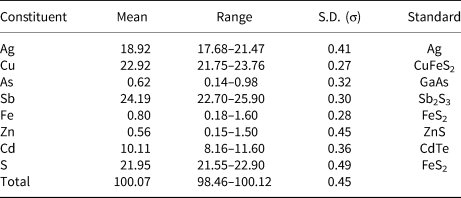
Quantitative chemical analyses were carried-out using a Jeol JXA 8530 FE electron microprobe at the Geological Institute of Slovak Academy of Sciences, Banská Bystrica, Slovak Republic. Experimental conditions were: wavelength-dispersive spectroscopy mode, accelerating voltage 20 kV, beam current 15 nA and beam diameter 1 to 5 μm. Standards (element, emission line) were: pyrite (FeKα and SKα), chalcopyrite (CuKα), ZnS (ZnKα), GaAs (AsLβ), Ag metal (AgLα), Sb2S3 (SbLα) and CdTe (CdLα). Peak counting times were 20 s for all elements, and 10 s for each background. Matrix correction by ZAF software was applied to the data. Due to possible vacancies at the S(2) site in the Ag-rich members, the chemical formula was calculated according to Biagioni et al., (Reference Biagioni, George, Cook, Makovicky, Moëlo, Pasero, Sejkora, Stanley, Welch and Bosi2020a) and Sejkora et al. (Reference Sejkora, Biagioni, Vrtiška and Moëlo2021), where normalisation on the basis of ΣMe = 16 apfu, assuming that no vacancies occur at M(2), M(1) and X(3) was used. The results of our study indicate that only very minor vacancies possibly occur at M(2), M(1) and X(3) sites and therefore this approach was selected for calculation.
Chemical data for the argentotetrahedrite-(Cd) from Rudno nad Hronom (Table 2, Supplementary Table S1) give the formula Cu6.74Ag3.28Cd1.68Fe0.27Zn0.16(Sb3.71As0.15)Σ3.86S12.79. Taking into account the results of the crystal structure refinement (see below), the crystal-chemical formula can be written as (Ag3.28Cu2.72)Σ6.00[Cu4(Cd1.68Fe0.27Zn0.16)Σ2.11]Σ6.11(Sb3.71As0.15)Σ3.86S12.79. The end-member formula of argentotetrahedrite-(Cd) is Ag6(Cu4Cd2)Sb4S13 (Z = 2), which requires (in wt.%) Ag 31.88, Cu 12.51, Cd 11.08, Sb 23.99, S 20.54, total 100.00.
Chemical data for argentotetrahedrite-(Cd) (in wt.%, n = 14).

S.D. – standard deviation
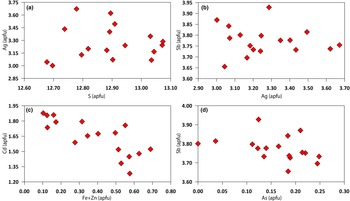
The Ag content in the sample studied lies in the range 3.04–3.79 apfu and does not correlate with S (Fig. 4a). The positive correlation between Sb and Ag is indistinct (Fig. 4b), similarly as described for Ag-rich tetrahedrite by Johnson et al. (Reference Johnson, Craig and Rimstidt1986) and Sejkora et al. (Reference Sejkora, Biagioni, Števko, Raber, Roth and Vrtiška2022). All samples studied have Cd as the dominant C-site constituent (Fig. 4c). Samples are mostly Fe-poor, with contents in the range of 0.08–0.49 apfu Fe. Moreover, the samples contain 0.04–0.30 apfu Zn. The extent of SbAs–1 substitution is limited to 0.25 apfu As (Fig. 4d). The determined S contents in the range 12.51–13.08 apfu indicates only minor possible vacancies at the S(2) site, consistent with the results of crystal structure refinement (see below).
Chemical relationships (in apfu) between Ag vs. S (a), Sb vs. Ag (b), Cd vs. Zn+Fe (c) and Sb vs. As (d) in argentotetrahedrite-(Cd) from Rudno nad Hronom.

Crystallographic data
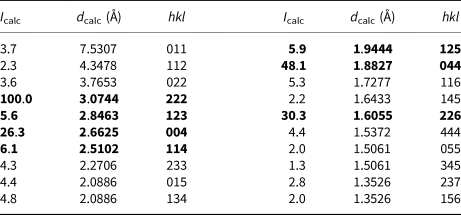
Powder X-ray diffraction data could not be collected, owing to the small amount of the available material. Consequently, powder X-ray diffraction data, given in Table 3, were calculated through the software Diamond v4.0 (from Crystal Impact, see Table 3) using the structural model of the sample from Rudno nad Hronom discussed below.
Calculated powder X-ray diffraction data for argentotetrahedrite-(Cd).*

* Calculated with Diamond v4.0 (Diamond – Crystal and Molecular Structure Visualization, Crystal Impact – Dr. H. Putz & Dr. K. Brandenburg GbR, Kreuzherrenstr. 102, 53227 Bonn, Germany, https://www.crystalimpact.com/diamond). Intensity and d hkl were calculated based on the structural model given in Table 5. Only reflections with I calc > 2 are listed. The seven strongest reflections are given in bold.
Slicing and polishing of lamellae for transmission electron microscope (TEM) analysis were carried out using a scanning electron microscope (SEM) coupled with a gallium-focused ion beam (FIB) source located at the Bauhaus University in Weimar, Germany. The SEM-FIB (Helios G4 UX, ThermoFisherScientific) is equipped with a high-performance FIB source (Phoenix) that allows polishing of TEM lamella at very low acceleration voltage or beam current. This feature is essential for obtaining undisturbed thin lamella suitable for high-resolution TEM imaging. Thin sections of samples as used for optical light microscopic investigation and other analyses were sputtered with ≈8 nm gold layer to ensure electric conductivity of the full sample and to reduce sample abrasion during ion-beam imaging. Sites for extraction of the lamellae were selected according to previous microscopic and spectroscopic characterisation of the samples. Areas of interest were covered with an approximately 15 μm × 15 μm × 3 μm layer of platinum as a further protection for the sample surface against ion beam damage.
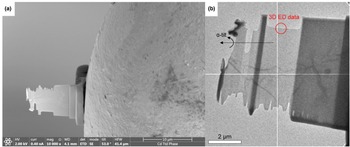
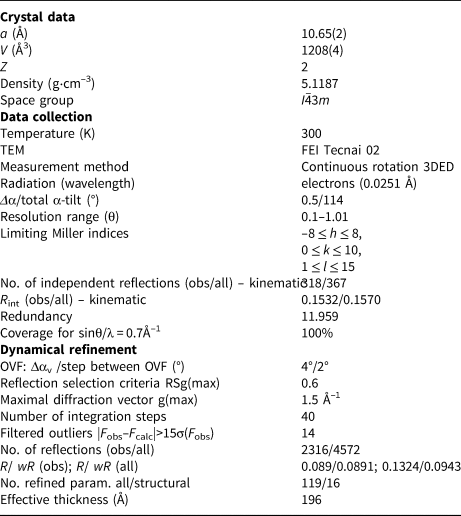
The structure analysis was carried out at the ambient temperature using 3-dimensional electron diffraction (3DED) techniques. The 3DED data were collected on the lamella made from the argentotetrahedrite-(Cd) phase (Fig. 5a), with a continuous rotation mode in an FEI Tecnai 02 transmission electron microscope (TEM) (LaB6 and acceleration voltage of 200 kV) equipped with a side-mounted hybrid single-electron detector ASI Cheetah M3, of 512 × 512 pixels with high sensitivity and fast readout (Institute of Physics, Czech Academy of Sciences, Prague, Czech Republic). A series of non-oriented patterns are continuously collected using a 0.5° step on all the accessible tilt range of the goniometer (Gemmi and Lanza, Reference Gemmi and Lanza2019; Gemmi et al., Reference Gemmi, Mugnaioli, Gorelik, Kolb, Palatinus, Boullay, Hovmoller and Abrahams2019). The area of the lamella where data were collected is defined by the size of the 500 nm beam (nano-diffraction mode) (Fig. 5b). The data collection was automated by the in-house software, including the tracking of the crystal following the procedure described by Plana-Ruiz et al. (Reference Plana-Ruiz, Krysiak, Portillo, Alig, Estrade, Peiro and Kolb2020). Continuous-rotation 3DED data (cRED) reduction was performed using the computer program PETS2 (Palatinus et al., Reference Palatinus, Brázda, Jelínek, Hrdá, Steciuk and Klementová2019; Klar et al., Reference Klar, Brazda, Krysiak, Klementova and Palatinus2021). The specific data processing for cRED data used in the structure solution and the refinement is extensively detailed in Klar et al. (Reference Klar, Brazda, Krysiak, Klementova and Palatinus2021). It includes the introduction of overlapping virtual frames (OVF) for the dynamical refinement that aims to model experimental intensities from continuous rotation data by summing consecutive experimental diffraction patterns into a set of virtual frames. Each OVF is characterised by its angular range Δαv covered by the virtual frame and the angular step between two virtual frames (see experimental details in Table 4).
(a) General view of the FIB lamella used for structure solution of argentotetrahedrite-(Cd). (b) Detail of the lamella, showing the region where the diffraction data were collected.

cRED data collection and structure refinement details for argentotetrahedrite-(Cd).

The data reduction for the structure solution leads to an hkl-type file with Rint(obs/all) = 0.1532/0.1570 and 100% coverage for sinθ/λ = 0.72 Å–1. For the dynamical refinement, another hkl-type file is generated where each OVF is considered independent in the refinement (Palatinus et al., Reference Palatinus, Petrícek and Corrêa2015a, Reference Palatinus, Corrêa, Steciuk, Jacob, Roussel, Boullay, Klementová, Gemmi, Kopeček, Domeneghetti, Cámara and Petříček2015b; Klar et al., Reference Klar, Brazda, Krysiak, Klementova and Palatinus2021). The structure was solved using Superflip (Palatinus and Chapuis, Reference Palatinus and Chapuis2007; Palatinus, Reference Palatinus2013) in Jana2006 (Petříček et al., Reference Petříček, Dušek and Palatinus2014) and refined using DYNGO and Jana2006.
Results and discussion
Crystal structure determination
The initial model obtained from the charge-flipping algorithm using Superflip, confirmed a tetrahedrite isotype structure with three independent cation sites M(1), M(2) and X(3) and two anion sites S(1) and S(2), in agreement with the general features of the tetrahedrite structure (Biagioni et al., Reference Biagioni, George, Cook, Makovicky, Moëlo, Pasero, Sejkora, Stanley, Welch and Bosi2020a). Both sites S(1) and S(2) with Wyckoff positions 24g and 2a are attributed to S.
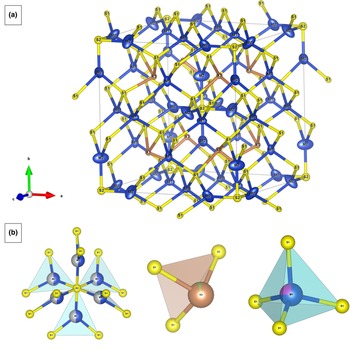
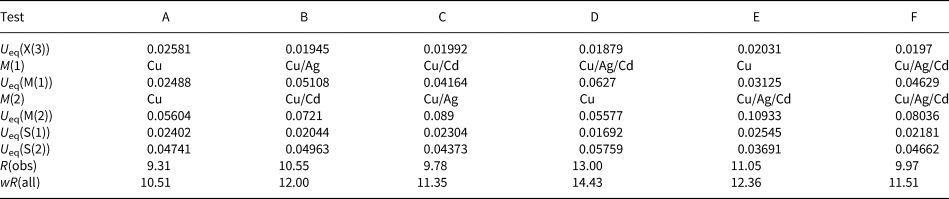
According to the electron microprobe (EMP) results, X(3) (8c) is fully occupied by 96.1% of Sb3+ and 3.9% of As3+. The substitution of Cu (Cu, Fe and Zn) by Ag and Cd in M(1) (12d) and/or M(2) (12e) was tested with dynamical refinement (see Table 5) using the composition from the chemical analysis. For well crystallised samples measured by 3DED, the best accuracy is reached when the dynamical effects (multiple scattering) are considered in the refinement (so-called ‘dynamical refinement’) (Palatinus et al., Reference Palatinus, Petrícek and Corrêa2015a, Reference Palatinus, Corrêa, Steciuk, Jacob, Roussel, Boullay, Klementová, Gemmi, Kopeček, Domeneghetti, Cámara and Petříček2015b). Despite high quality data, the accuracy of the substitution tests remain limited as M(2) tends to be disordered with a very high atomic displacement parameter value. The best compromise is found for the test in which Cd and Ag substitute for Cu in M(1) and M(2), respectively. After the last optimisations, the final refinement gives R(obs)/wR(obs) = 0.089/0.0891 and R(all)/wR(all) = 0.1324/0.0943 for 2316 observed reflections and only 14 outliers omitted following |F obs–F calc|>15σ(F obs). No restriction was applied in the refinement. The structural parameters are presented in Table 6 and the interatomic distances in Table 7. The crystallographic information file has been deposited with the Principal Editor of Mineralogical Magazine and is available as Supplementary material (see below). The structure is represented with the atomic displacement parameters in Fig. 6a and the different sites in Fig. 6b.
(a) The structure of argentotetrahedrite-(Cd) represented with anisotropic atomic displacement parameters. (b) The geometry of individual sites M(2), X(3) and M(1). Drawn using Vesta 3.0 (Momma and Izumi, Reference Momma and Izumi2020).

Refinement tests (A–F) of the substitutions in M(1) and M(2) sites (without final optimisations or outlier filtering). Test C shows the best final statistics.

Positional parameters and atomic displacement parameters.

s.o.f. – site occupation factor.
Interatomic distances (in Å).

Symmetry codes: [i] z, x, y; [ii] y, z, x; [iii] –x + ½, –y + ½, z – ½; [iv] –x + ½, y + ½, –z + ½; [v] y, –z + 1, –x; [vi] z, –x, –y; [vii] –x + ½, –y + ½, z + ½; [viii] –x, –y, z; [ix] –y, z, –x.
The split option was tested from 3DED but it did not improve the model and the R factors were higher. The best compromise remained the non-split model. The accuracy limitation does not come from the 3DED data but the disorder that shadows a possible substitution by heavier atoms. X-ray data would show the same limitation in that case because none of those refinements (X-ray or 3DED) takes into account the inelastic scattering due to the disorder. The occupancies of the sites were constrained by the chemical results from the electron microprobe and varied to a degree that is reasonable for the data obtained. For this reason, the 3DED refined occupancy on the M(2) is (Ag0.55Cu0.45)6; here we rely on the EMP analyses which gave a better idea of this occupancy as Ag3.28Cu2.72. (Table 2, 8). The sulfur sites appear to be fully occupied, thus providing no evidence for the existence of a (Ag6)4+ cluster. The EMP data indicate a small deficit on the anionic site, though, but not large enough to prove prevalence of the (Ag6)4+ clusters over the (Ag+6S2–)4+ groups in the structure. Thus, combination of the electron-microprobe data and the structural model led to the classification of this mineral as argentotetrahedrite.
The determined unit-cell parameter for argentotetrahedrite-(Cd) from Rudno nad Hronom, a = 10.65(2) Å, agrees very well with the value a = 10.643 Å calculated from our EMP data by relations proposed by Johnson et al. (Reference Johnson, Craig and Rimstidt1987) and is in line with parameters published for synthetic Cd–Sb dominant tetrahedrite by Patrick and Hall (Reference Pattrick and Hall1983): a = 10.631 Å (2.90 apfu Ag) and a = 10.693 Å (3.41 apfu Ag).
Comparison between argentotetrahedrite-(Cd) and other members of the freibergite series
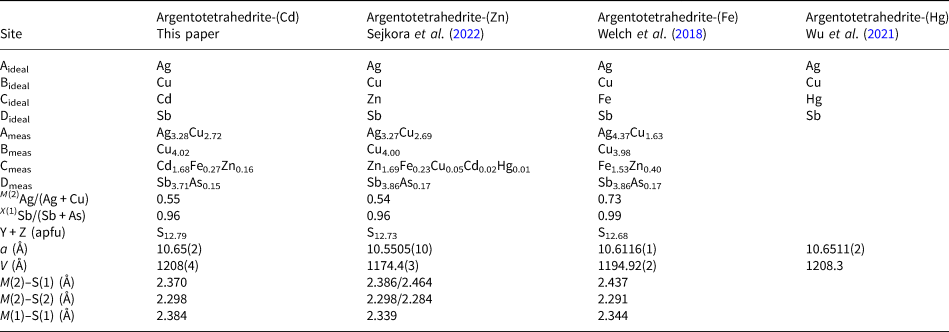
Argentotetrahedrite-(Cd) belongs to the freibergite series within the tetrahedrite group (Table 8) (Biagioni et al., Reference Biagioni, George, Cook, Makovicky, Moëlo, Pasero, Sejkora, Stanley, Welch and Bosi2020a). It is the Cd-isotype of argentotetrahedrite-(Fe) (Welch et al., Reference Welch, Stanley, Spratt and Mills2018), argentotetrahedrite-(Zn) (Sejkora et al., Reference Sejkora, Biagioni, Števko, Raber, Roth and Vrtiška2022) and argentotetrahedrite-(Hg) (Wu et al., Reference Wu, Gu, Qu, Yang and Wang2021).
Comparison of minerals of the argentotetrahedrite group*.

*The general structural formula of minerals belonging to the tetrahedrite group is: M (2)A6 M (1)(B4C2)Σ6 X (3)D4 S(1)Y12 S(2)Z (Biagioni et al., 2020).
Selected data for the argentotetrahedrite-(Cd) sample and valid (Zn/Fe/Hg)-members of the freibergite series are compared in Table 8. The Ag/(Ag + Cu) atomic ratio of 0.55 is similar to those in argentotetrahedrite-(Zn) (0.54) (Sejkora et al., Reference Sejkora, Biagioni, Števko, Raber, Roth and Vrtiška2022). In the sample studied, the Sb/(Sb + As) ratio is >0.96. The increasing Cd/(Cd + Zn + Fe2+) ratio also increases the unit-cell parameter, similarly as does increasing Hg2+ content (Table 8) because Cd2+ and Hg2+ have similar ionic radii (Johnson et al., 1998). The M(1)–S(1) bond distance is not affected significantly by the Cd content. For argentotetrahedrite-(Fe) and -(Zn), the M(1)–S(1) distance is 2.34 Å (Table 8). In argentotetrahedrite-(Cd), this distance is only slightly longer, 2.38 Å. In the M(2) polyhedron, the M(2)–S(1) distance is definitely longer and more sensitive to the Ag content than the M(2)–S(2) distance, in agreement with previous studies (e.g. Peterson and Miller, Reference Peterson and Miller1986; Welch et al., Reference Welch, Stanley, Spratt and Mills2018, Sejkora et al., Reference Sejkora, Biagioni, Števko, Raber, Roth and Vrtiška2022). Only few crystallographic data are available for the keno-members of the freibergite series. What is clear is that a detectable contraction of the unit-cell parameter can be observed for these keno-phases. For instance, kenoargentotetrahedrite-(Zn), having an Ag/(Ag + Cu) atomic ratio of 0.63, has a unit-cell parameter a = 10.4624(4) Å (Qu et al., Reference Qu, Sima, Gu, Sun, Fan, Hou, Ni, Wang, Yang and Wang2021), significantly shorter than that given by Rozhdestvenskaya et al. (Reference Rozhdestvenskaya, Zayakina and Samusikov1993) for argentotetrahedrite-(Zn) with Ag/(Ag + Cu) = 0.60, i.e. a = 10.576(3) Å. This difference probably reflects the contraction of the S(2)-centred M(2)-octahedron. In the two keno-members of the freibergite series, S ranges between 11.93 and 12.01 apfu, agreeing with the vacant nature of S(2). Indeed, the volume of the M(2)-octahedron is 10.8 Å3 in kenoargentotetrahedrite-(Fe) (Welch et al., Reference Welch, Stanley, Spratt and Mills2018), to be compared with 16.2 Å3 (+ 33%) in argentotetrahedrite-(Cd). This seems to be a clear structural feature allowing for the distinction between argentotetrahedrite and kenoargentotetrahedrite.
Previous findings of Cd-bearing tetrahedrite and tennantite: a brief review
The first Cd-member of the tetrahedrite group – tennantite-(Cd) was described recently by Biagioni et al. (Reference Biagioni, Kasatkin, Sejkora, Nestola and Škoda2022). Tetrahedrite-group minerals having chemical compositions corresponding to that of argentotetrahedrite-(Cd) have been reported previously. To the best of our knowledge, the first chemical data corresponding to argentotetrahedrite-(Cd) were reported by Pattrick (Reference Pattrick1978), who gave microprobe analyses on samples from the Tyndrum, Perthshire, Scotland, showing 3.17 Ag apfu and 1.47 Cd apfu. In addition to this occurrence, other Cd-dominant members of the tetrahedrite series were reported from Xitieshan, Qinhai Province, China (Jia et al., Reference Jia, Fe, Zhang and Zhao1988) with Cd content 1.82 apfu and Evia Island, Greece (Voudouris et al., Reference Voudouris, Spry, Sakellaris and Mavrogonatos2011) with Cd up to 1.95 apfu. However, these tetrahedrite specimens do not belong to the freibergite series because their Ag content does not exceed 3 apfu. A phase similar to argentotetrahedrite-(Cd) was reported by Voropayev et al. (Reference Voropayev, Spiridonov and Shchibrik1988) from the Ushkatyn-III deposit in central Kazakhstan. Cadmium content varied between 0.93–0.99 apfu (recalculated on the basis of ΣMe = 16 apfu), Ag ≈ 3.1 apfu, and a Sb/(Sb + As) atomic ratio was 0.96. Dobbe (Reference Dobbe1992) reported microprobe data corresponding to composition varying between argentotetrahedrite-(Fe), ‘argentotetrahedrite-(Mn)’, and ‘argentotetrahedrite-(Cd)’. Škácha et al. (Reference Škácha, Sejkora, Palatinus, Makovicky, Plášil, Macek and Goliáš2016) described ‘Cd-hakite’ [ideally Cu6(Cu4Cd2)Sb4Se13] from Příbram in Czech Republic.
Synthetic analogues of Cd–Sb dominant tetrahedrite were studied by Pattrick and Hall (Reference Pattrick and Hall1983) who reported their unit-cell parameter a = 10.631 Å for a sample with 2.90 Ag apfu, and a = 10.693 Å for a sample with 3.41 apfu Ag.
Conclusions
Following the approval of the new nomenclature of the tetra-hedrite group (Biagioni et al., Reference Biagioni, George, Cook, Makovicky, Moëlo, Pasero, Sejkora, Stanley, Welch and Bosi2020a), a renewed interest in this group of common sulfosalts has allowed for the definition of several new mineral species. Argentotetrahedrite-(Cd) is one of the latest additions to this group. In addition to the new mineral, new structural data have been collected, thereby improving our knowledge on the crystal chemistry of these chalcogenides.
Weathering of this mineral could release Cd into the environment and contaminate soil and water. Yet, the mineral is too rare, even at the type locality, to cause serious environmental damage. In addition, Cd has been shown to associate with CO2 or carbonate ions in the environment (Lattanzi et al., Reference Lattanzi, Zuddas and Frau1998, Reference Lattanzi, Maurizio, Meneghini, Giudici and Podda2010). In samples like those studied in this work, abundant carbonates in the altered host rocks can buffer pH of the aqueous solutions in contact with the sulfides at relatively high values and supply the carbonate ions. Hence, the assemblage of Cd minerals in our samples (greenockite and argentotetrahedrite-(Cd)) is not expected to be of environmental concern.
Acknowledgements
The authors thank Peter Tuček, Peter Žitňan and Jakub Bukovina (Prospech Ltd, Banská Štiavnica) for their help with the field work and Kai Qu (Tianjin Centre, China Geological Survey, Tianjin) for unpublished information on kenoargentotetrahedrite-(Zn). The helpful comments of Martin Števko and an anonymous reviewer are greatly appreciated. The study was supported financially by the Ministry of Education, Science, Research and Sport of the Slovak Republic (project VEGA 2/0028/20) for TM, JV. JM acknowledges financial support from the Deutsche Forschungsgemeinschaft grant KI 2131/2–1. JS acknowledges financial support from the Ministry of Culture of the Czech Republic (long-term project DKRVO 2019–2023/1.II.e; National Museum, 00023272). GS acknowledges the CzechNanoLab Research Infrastructure supported by MEYS CR (LM2018110) and the support the Operational Programme Research, Development and Education financed by European Structural and Investment Funds and the Czech Ministry of Education, Youth and Sports (Project No. SOLID21 CZ.02.1.01/0.0/0.0/16_019/0000760).
Competing interests
The authors declare none.
Supplementary material
To view supplementary material for this article, please visit https://doi.org/10.1180/mgm.2022.138