Introduction
Issues plaguing child protection service delivery are complex because they are ambiguous, involve multi-faceted social problems, are hard to define, frame and solve and it is difficult to resist over-reacting to error in one way or another (Bessant & Broadley, Reference Bessant and Broadley2016; Mansell, Ota, Erasmus, & Marks, Reference Mansell, Ota, Erasmus and Marks2011). In this paper, we explore how questions and commentary about statistics and numbers were deployed to frame and debate solutions to the problem of child protection in the West Australian Parliament in the aftermath of Coronial findings into the preventable death of an infant which was subsequently portrayed in the media as a scandal. Butler and Drakeford (Reference Butler and Drakeford2012), in their study of the media coverage and subsequent policy developments following the death of Maria Colwell, observed that scandals need to be discovered and pursued, usually with press support, and is the policy equivalent of an earthquake reflecting tensions in the social landscape. Parton (Reference Parton2007) observes that debates about child protection have become emotionally charged, politicised and characterised as a scandal, a proxy for much wider political debates. This paper is based on one such child death and is referred to as a scandal because of the themes of blame and failure which subsequently constructed the event as evidence of a deeper problem. This paper focuses on one feature of this construction, the use of numbers in political debate.
Numerical information is frequently used in debates about complex problems to develop a causal story and influence a solution because numbers symbolise precision, accuracy and objectivity (Birkland, Reference Birkland2016; Stone, Reference Stone2012). Scholarly works on political communication suggest that the use of numbers and statistics in political debate is a rhetorical strategy; it is how arguments are invented, embellished, made memorable and persuasive and provide the grounds for claims (Bickford, Reference Bickford2011; Connor, Reference Connor2013; Gormley, Reference Gormley2012; Gottweiss, Reference Gottweiss, Fisher and Miller2006; Meyer, Reference Meyer2007; Van Djik, Reference Van Djik2003; Vliegenthart & van Zoonen, Reference Vliegenthart and van Zoonen2011). In the context of political debates, Birkland (Reference Birkland2016, p. 195) argues that it is important to know about numbers because:
First, advocates for policy positions will choose numbers that put their arguments in the best light. . .
Second there is a difference between a number (that is a data point) and the interpretation of that data. . . information is very much subject to the interpretation of those with a stake in the meaning of that information.
There is much to be gained from exploring policy making from a rhetorical perspective, becoming sensitised to its presence and learning the art of rhetoric. A skill that can create belief and communicate the means of achieving a goal and do so seemingly with a moral and ethical intent is worth acquiring, especially by those working with complex social problems and marginalised groups.
The research that informed this paper was undertaken as part of a doctoral thesis examining the interplay between child welfare policy making and newspaper coverage in the aftermath of a child abuse scandal. The larger study drew on debates in The West Australian Parliament and the daily newspaper, The West Australian over a six year time period from 2004 to 2010. This time frame was considered an appropriate time frame from which to identify the themes and the ebb and flow of media and political attention to a complex social problem such as child abuse. Such a time frame allowed the research to address the contextual issues, especially the political landscape. This paper is based on an analysis of debates over a 5 month period, 10th August 2006 until 31st December 2006 out of those 6 years, when the debates about child abuse was most intense. An initial reading of debates showed that the death of an infant, ‘Wade Scale’, was the trigger. Intense focus by politicians in Parliament from August till December 2006 was related to the coronial findings in what was described as a preventable infant death triggering intense media coverage. A more detailed description of the death of this infant as the trigger for a scandal and the process which set the boundaries for this case study are provided later in this paper. This paper foregrounds the political debate and the use of numbers as rhetoric in the policy making debates during those 5 months.
While this paper is about how numbers are used to convey a version of reality, define a problem and promote its solution, it is also about communication and language because language strongly shapes and frames meaning and, ‘while policy changes are of course, the result of a confluence of factors, it is words that signal and embody the changes’ (Lens, Reference Lens2002, p. 138). This paper therefore foregrounds numbers and the role of language in social construction and the values and assumptions that underpin both the definition of the problem and argumentation for solutions. Lens (Reference Lens2002, Reference Lens2005) and Gormley (Reference Gormley2012) argue that adopting numbers as rhetoric is both a social and political act conducted to make sense of complex problems and persuade others of the legitimacy of a policy perspective. Stone (Reference Stone2012, p. 196) lists the ways in which counting and numbers are used for political purposes:
1. Counting requires decisions about categorising, about what or whom to include and exclude.
2. Measuring any phenomenon implicitly creates norms about how much is too little, too much or just right.
3. Numbers can be ambiguous, and so leave room for political struggles to control their interpretation.
4. Numbers are used to tell stories, such as stories of decline (we are approaching a crisis).
5. Numbers can create illusion that a very complex and ambiguous phenomenon is simple, countable and precisely defined.
6. Numbers can create political communities out of people who share some trait that has been counted.
7. Counting can aid negotiation and compromise by making intangible qualities seem divisible.
8. Numbers, by seeming to be so precise, help bolster authority of those who count.
The above list illustrates the proposition in this paper that numbers are a key feature in policy arguments; numbers as rhetoric communicate cognitive, emotional and ideological perspectives. The conceptual understanding of these dimensions of communication and their application in the qualitative analysis of the texts was guided by the concepts – rhetoric, framing and heuristics. For the purpose of this paper the detailed discussion of these concepts enabled the mapping of what Lens (Reference Lens2005, p. 232) called the ‘figurative ground’: ‘the background and starting point for any policy change the values, the so-called facts and claims about what is right and wrong’.
Key Concepts: Rhetoric and Policy Making
Rhetoric is a tool used to develop and structure frames in a contest for political support and so the use of numbers is particularly attractive, especially aggregate numbers because they are used as if they may reflect a wider phenomenon (Birkland, Reference Birkland2016; Stone, Reference Stone2012). Callaghan and Schnell (Reference Callaghan and Schnell2001, p. 185) in a study of policy making on gun control in the United States concluded that ‘rhetoric is the key to winning the policy war’. Leach (Reference Leach2016), Connor (Reference Connor2013) and Gottweiss (Reference Gottweiss, Fisher and Miller2006) describe rhetoric in the way the ancient Greek philosopher, Aristotle, proposed logos, ethos and pathos. Logos serves arguments to appear fact based, knowledgeable and reasonable. Ethos is akin to providing testimony, authority and credibility, for instance, by quoting expert sources or research reports. Pathos refers to strategies that project empathy and emotion to drive a morally compelling story. Pathos is particularly relevant with respect to child protection matters because, as Clapton, Cree, and Smith (Reference Clapton, Cree and Smith2013) state, child protection and morals have always been intertwined.
To the extent that political communication is about persuasion, rhetoric produces persuasion and persuasion is needed to produce and drive a frame. Social problems such as child abuse and neglect are inherently multidimensional with a multiplicity of positions, definitions and policy solutions and, when policy making is politicised, it is a contest over which form of reasoning will construct the frame that will prevail. Given the perspective that policy making is about the process of arguments, rhetoric is a useful and multilayered lens through which to analyse framing.
Frames and Framing
According to Entman (Reference Entman1993, p. 52). a frame features ‘problem definition, causal interpretation, moral evaluation and/or treatment recommendation’. Because political argumentation involves conflict, power and the exclusion of alternatives, this paper will also name the additional feature of silences in the framing: ‘A frame is a boundary that cuts off parts of something from our view while focusing our attention on other parts’ (Stone, Reference Stone2012, p. 252). For example, statistics about family support programs, measures of interventions that lessen the impact of disadvantage, the number of hours that staff spent with vulnerable families and relationship focused indices dominate if issues in child protection are accorded a social responsibility/family investment frame. Such framing would be underpinned by a social justice perspective. On the other hand, if the frame is a child rescue and individual wrong-doing frame, then numbers related to child harm, child placement and statistics about harmful parental behaviours may be used. Such a framing assumes individual responsibility for a problem which scholars link to a neo-liberal philosophy (Firkins & Candlin, Reference Firkins and Candlin2006; Hansen & Ainsworth, Reference Hansen and Ainsworth2013). In this paper, the aim is to explore what frames emerge when numbers and rhetoric are used to construct the solution and represent the problem.
Heuristics-Complex Made Simple
Child welfare problems and issues to do with the child protection system have ‘strong moral, political or professional dimensions particularly for failure’ (Webb, Reference Webb2006, p. 193). When an extreme manifestation of a social problem – the death of a child – becomes politicised with urgent calls for reform, anxiety and uncertainty coalesce. With issues of such complexity and ambiguity, when a way of categorising and classifying a problem is not a given, then categories are created so as to simplify casual inferences (Stone, Reference Stone2012). Kahneman (Reference Kahneman2003), Slovic and Peters (Reference Slovic and Peters2006), Slovic, Peters, Finucane, and McGregor (Reference Slovic, Peters, Finucane and McGregor2005) termed the kind of thinking and judgement that are used to reduce complex reasoning about future uncertain events to simpler and more manageable judgements, heuristics. In social planning terms problems associated with child abuse and neglect are complex, seemingly intransigent with outcomes that are not always predictable. Kearney (Reference Kearney2013, p. 57) used the work of these scholars to explain how a very rare event such as the non-accidental death of a child can dominate policy making and practice:
. . .each case that makes it into the public arena is regarded with horror, and likely to trigger ‘utopian bias’, i.e. the implicit view that no child should ever die in a non-accidental manner. Risk, in these situations, is then constructed as a moral issue. Every child's non-accidental death can come to be viewed as a failure of professionals, agencies and society itself.
In relation to concerns about children, debates using a representativeness heuristic may associate families unable to meet their household expenses, those who are homeless or parents who are suffering from a mental illness as representative of families who might seriously harm a child. The additional use of strong emotively laden language makes these categories easily remembered, increasing the perception of risk, negative stereotypes and distortions (Keller, Siegrist, & Gutscher, Reference Keller, Siegrist and Gutscher2006; Slovic & Peters, Reference Slovic and Peters2006). In this paper, emotion, risk and heuristics are the reference points for interpreting policy making argumentation in the aftermath of a child abuse scandal in Western Australia.
The Case Study – A Child Abuse Scandal
On the 10th Aug 2006, the West Australian coroner delivered his findings into the death by drowning of an 11 month old child, Wade Scale. The inquest findings were widely reported in the daily newspaper, The West Australian. The death of Wade Scale became a scandal because (i) the child's parents were known to have a problem with drug addiction, (ii) the child's father had a previous conviction for assault on his step-children, (iii) the child's grandmother and extended family had alerted the statutory child protection department known as Department for Community Development (DCD) to their concerns for the child's welfare and felt their concerns were not taken seriously and (iv) the child was already known to DCD. He had been removed previously and was recently returned to the care of his parents. This child's name and what happened to him became a metaphor for all the failings of DCD, and the government of the day.
Method
Data Collection
The primary data for this analysis were transcripts of debates in the West Australian Parliament. The debate transcripts were downloaded from the Hansard website (http://www.parliament.wa.gov.au/webcms/webcms.nsf/content/hansard). Hansard, the official record of proceedings in Parliament, is a combined record of the Legislative Assembly and Legislative Council and was accessed online and downloaded as PDF documents. As a former practitioner I was aware that during the years 2004–2010 there was intense policy and political activity around the issues of child abuse, which a search on the Hansard data base confirmed. The starting point for the search was the name ‘Wade Scale’; the significance of his name was discussed in the previous section. Added to the name ‘Wade Scale’, other search words included ‘child’, ‘child death’, ‘DCD’, ‘child protection’ and ‘coroner’. The initial search elicited 366 transcripts from 2004–2010. This large corpus of data required an orderly system to store, organise and prepare for analysis. This was done by noting features of these transcripts, such as its length, number of pages, the number of separate transcripts on a single day and the number of transcripts over the course of the 6 years and how they varied in length from one year to the next.
Defining the boundaries for Analysis
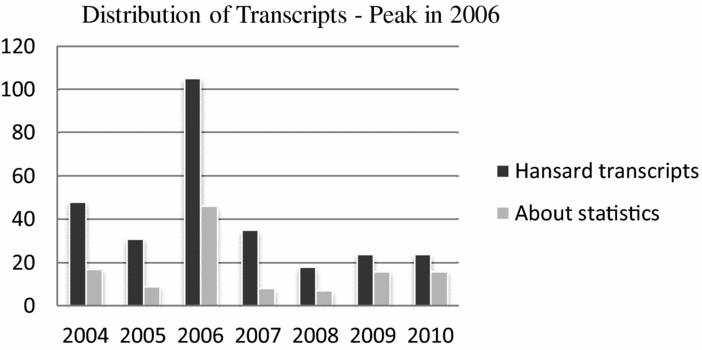
A simple frequency count of the number of transcripts constituted the quantitative aspect of the analysis. Five months from10th August 2006 to 31st December 2006 elicited 106 transcripts of the total 366 transcripts for the years 2004–2010. Nearly half of the debates occurred in just 5 months, suggesting that the issue of child protection was subject to intense scrutiny and debate during this time. These 106 transcripts were retained for more in-depth analysis and formed the boundaries of the case study.
The rest of the analysis was primarily qualitative and involved interpretating the texts to identify themes. In order to uncover themes, meanings and interpretations with a focus on language that went beyond word frequencies, the texts were downloaded to a computer-assisted qualitative data analysis software (CAQDAS), NVivo Pro 11. Creating codes and categories was an iterative process. Saldana (Reference Saldana2013) presents a repertoire of coding methods, two of which, Descriptive and In Vivo coding, provided a way to organise the data as entry points to this analysis. The texts containing questions that began with ‘How many. . .?’ were identified. It is these and the context in which they appeared in the text which are the focus of this article. Using the text search facility in NVivo Pro 11, words such as outrageous; dysfunctional; tragic and dying children; died in horrific circumstances; little baby died; disgraceful and more than disgraceful were found to be used repeatedly. Relevant to this paper, these emotive words were juxtaposed with statements about numbers, for instance ‘214 children’ with the words ‘horrific’. Any text that contained numbers was coded; the codes were ‘child deaths’, ‘family support’, ‘resources and staffing’, ‘emotive’, ‘child as vulnerable’ and ‘child rescue’. Figure 1 is an illustration of the coding and how they were categorised.
Coding illustration.

Analysis and Discussion
The above graph (Figure 2) illustrates the distribution and the intensity of the debates over 6 years; it shows that transcripts with texts featuring questions about data, comments on numbers and statistics saturated the debates in 2006.
Distribution of transcripts-peak in 2006.

The words ‘many’, ‘how many’ and actual numbers (frequencies and percentages) were identified in nearly half of the transcripts in 2006 and there were 235 references to numbers and data within these transcripts. The description provided by Bacchi (Reference Bacchi2009, p. 11) about the significance of understanding numbers in policy proposals broadly guided the analysis:
When we see statistics invoked as a part of, or defence for a particular policy, we need to ask - why these statistics and not others? Who gets counted? How do they get counted? How does their counting feed specific policy and its implied problem representation?
The qualitative analysis identified patterns of language and clusters in the way numbers and ideas about these numbers were communicated. These patterns of language were interpreted as themes. The themes were dominated by emotion and blame with evocative and affect laden language elevating the perception of risk and the vulnerability of the child. The policy proposals were dominated by control, regulation and child rescue and did not include proposals that emphasised inclusion and opportunity. The five themes were:
1. Child death numbers as logical evidence of child maltreatment concerns;
2. The ‘vulnerable child’ as the emotional and moral referent;
3. Child rescue as solution;
4. Silences-What was not counted; and
5. Political backdrop
Child Death Numbers as Logical Evidence of Child Maltreatment Concerns
The Opposition Party, in particular, asked ‘how many. . .’ type questions followed by a recounting of numbers and connecting numbers about all child deaths with other child-related problems that came to the attention of DCD. The suggestion seemed to be that adverse events such as a child death and therefore all child maltreatment were able to be understood and measured, and that child deaths were representative of a larger universe of events. These questions and numbers were repeated and injected into separate debates on the same day and over consecutive days in sequence. An assumption of causality was implied vaguely and left others to draw their own conclusions:
I will not be fobbed off because 214 children who have had some form of contact with DCD have died in this state under this government's watch. This little baby died in the same month that Wade Scale died, and she died in horrific circumstances. (West Australian Parliament, 12th September 2006, p5663b-5665a)
Notably, the cause of the deaths of those children was not specified in the statements. In reality some of those children died in traffic accidents, by drowning, sudden infant death syndrome or a medical illness. The 214 children referred to were children of whom a member of the family or relative had contact with the DCD. Two hundred and fourteen was the number of children who had died over 2 years 2005–2006 and 2006–2007 (Office of the Ombudsman, 2012). To put this figure into perspective, of all the child deaths in the year 2006–2007, 87 were reportable and more than half of these had no previous contact with DCD; in that year DCD provided one to one services to 45,000 people, so the percentage of children who had died and whose deaths were subject to review equated to 0.08% of those who had contact with DCD (Child Death Review Committee, 2007).
Additionally, statements which included figures about child deaths referred to the Child Death Review Committee as a source, another rhetorical strategy adopted to give credibility and the speaker an authoritative voice:
In light of the fact that of the deaths identified by the Child Death Review Committee 52 were children who had contact with the Department for Community Development, and in light of the damning and tragic statistics, will the Premier agree to a royal commission into these matters? (West Australian Parliament, 23rd August 2006, p5095b-5095b)
The name ‘Wade Scale’ was invoked frequently and clustered with other child abuse events, suggesting homogeneity, although they may have had different aetiologies:
The year Wade Scale died, 80 children died. Of those 80 children, 42 had some form of contact with the department. Of those 42 children, how many were aged five years and under? Please detail the age at which they died (West Australian Parliament, 22nd August 2006, p. 4872-4873).
Warner (Reference Warner2015), in her analysis of the politics amid the media, public outrage and vilification of social workers and child protection services in the UK over the death of baby Peter Connelly, described the roll-call of children as collective remembering and an integral part of the emotional engine that drives the construction of the problem of child protection. The repeated references to ‘Wade Scale’ also reconfirmed a perception of risk, because as a single event, it was evocative and easily recalled as representative of what had gone wrong and could do so again in the future, as if it were a tip of the iceberg (Kahneman, Reference Kahneman2011; Kearney, Reference Kearney2013). Butler and Drakeford (Reference Butler and Drakeford2012) in their review of the aftermath of a scandal related to Victoria Climbie in the UK observed the same roll-call phenomenon saying that it served to emphasise similarities and mask important differences. They also represent the ‘horror story’ (Wilczynski & Sinclair, Reference Wilczynski and Sinclair1999). An additional and relevant explanation for this strategy was proposed by Connor (Reference Connor2013) who suggested that repetition can have a strong influence on how new information is processed.
Arguably, child mortality statistics and continued reference to having had contact with the DCD alongside texts with evocative, emotional and vivid language made these statistics easier to recall and implied they were representative of a larger phenomenon and all child maltreatment (Stone, Reference Stone2012). Child mortality statistics reported in the Australian Institute of Health and Welfare (2017, p. 1) factsheet based on Australian Bureau of Statistics analysis suggests this emphasis to be counterfactual:
The mortality rates of infants less than 1 year of age has decreased (favourably). . .The three leading causes of death are perinatal conditions (such as maternal complications during pregnancy); congenital abnormalities; and other medical conditions including SIDs.
In statistical terms deaths from injury and child abuse and neglect have a very low statistical probability. Kearney (Reference Kearney2013) and others (Ayre, Reference Ayre2013; Butler & Drakeford, Reference Butler and Drakeford2012; Elsley, Reference Elsley2010; Keddel, Reference Keddel2014) argued that even though the probability of a child dying accidentally is statistically very low, it is an unintended consequence of crisis-driven policy making that elevated risk perception has come to dominate policy and frontline practice.
The ‘Vulnerable Child’ as the Emotional and Moral Referent
While the use of child death statistics met one feature of rhetoric that related to logos, pathos was evident by the way data was linked to emotion and moral outrage. Examples were: ‘a horrific number of. . ..’, ‘damning and tragic statistics. . .’, ‘an unacceptable number. . .’ and ‘an epidemic of child abuse. . .’. In addition to anger as a key emotion, it is argued that the juxtaposition with words such as ‘terrible’, ‘tragic’, ‘tragedy’, ‘sad’, and ‘vulnerable’ can be seen to add compassion and sympathy as sentiments by which events and actions should be judged and so extending the argument that this was not just a crime but a moral crime (Gormley, Reference Gormley2012; Warner, Reference Warner2015). The moral element was reinforced through the notion of the vulnerable child at risk. The data mainly related to children were prefaced with words such as ‘vulnerable’, ‘innocent’ or ‘little’ along with the invocation of ‘Wade Scale’. Such a rhetorical device foregrounding pathos constructed a template that constrained the alternative ways in which child protection in general could be talked about (Kearney, Reference Kearney2013). This is the kind of shortcut that can lead to biases and negative stereotyping (Kahneman, Reference Kahneman2011; Wesley, Reference Wesley, Wesley, Kaal, Maks and van Elfrinkhof2014).
Meyer (Reference Meyer2007, p. 102), in her paper on the moral rhetoric of childhood, states that (i) even though children can be vulnerable as a result of structural factors, these are concealed through silence in discourse and so (ii) issues affecting children become moral issues, shielding policies against criticism because: ‘it can be used to legitimize a range of practices and opinions’. Similarly, in a feminist analysis about how ‘the child’ is deployed in public debates, Baird (Reference Baird2008) coined a particularly evocative term ‘child fundamentalism’ to describe a discourse that portrays the child as an impermeable category that must be defended and inscribed in an adult-child binary as if they are mutually exclusive. About the dominance of child-centred social policies, Baird (Reference Baird2008, p. 293) refers to an ‘emphasis on literalness with little room for interpretation, contest or disagreement’. Numbers and statistics as rhetoric seemed to reinforce this fundamentalism.
Child Rescue as Solution
Calls for a Royal Commission into the operations of DCD and for the introduction of mandatory reporting dominated the debates. At the time, Western Australia was the only State in which reporting of concerns for a child as being at risk of having suffered abuse or neglect was not included in the Children and Community Services Act. A focus on mandatory reporting as one might a crime, implied a frame that construed all risk and child maltreatment as crimes for which an individual was responsible and in the following extract the parents seemed to be implicated:
It is estimated that at least 1000 children a year will be rescued from abusive environments if mandatory reporting is adopted in Western Australia. When we say “abuse”, we mean torture. When we say “abusive environments”, we mean homes that have become prisons and torture chambers in which little children suffer, suffer and suffer. Is $65 million too much to save 1,000 of those children every year? (West Australian Parliament, 1st November 2006,p8049-8050)
The source of the figure 1,000 was not cited, nor was there any explanation of how these children may be rescued, although the speaker describes the children's homes in metaphorical terms for added impact as ‘torture chambers’ and ‘prisons’.
Numbers of staff seemed to be a key service delivery issue and the alleged shortfall was constructed as a moral issue, the implication being that if there were enough staff trained to detect abuse and remove children, then children would not die:
Our 300 or so caseworkers are meant to detect abuse and are meant to remove children from their families even though they receive only 3.5 hours interview training to determine abuse. That is disgraceful. It is more than disgraceful.
(West Australian Parliament, 19th September 2006, p6152b-6153a)
Numbers as a metaphor to escalate the concern about staffing can also be seen in this statement; although there was no explanation as to the source of the figure ‘900’:
More resources must be given to the department and it must have more trained officers. However, there also must be a full inquiry into the structure of the department. I understand that there will be a protest at Parliament House on Thursday and that 900 pairs of shoes will be placed at the front of the house to represent the children who have not been attended to by the department (Parliament, 12th September 2006, p5695-Reference Parliament5707).
Silences: What was Not Counted
If there is a difficult question that cannot be answered then there is a simple question for which an answer can be found (Kahneman, Reference Kahneman2003; Kearney, Reference Kearney2013). So what was the more difficult question that was not being answered? Bilson, Cant, Harries, and Thorpe (Reference Bilson, Cant, Harries and Thorpe2015) in a longitudinal study of children reported to the child protection department found that the proportion of children under the age of one who were known to child protection authorities trebled from 1.0% of children born in 1990 to 2.8% of children born in 2008. They found similar prevalence rates in other Anglophone countries and identified that socio-economic deprivation was a key factor in those involved with the child protection system. In Parliament, the implication was that having ‘some kind of contact with DCD’ and risk of child death were interdependent. There was no evidence provided that the needs of these families may have been associated with risk factors that could have triggered a more serious concern for child maltreatment.
Gaps or omissions point to the perspectives that are silenced ‘as these silences can be signs of what a society chooses to ignore or is unable to discuss’ (Lens, Reference Lens2002, p. 137). In the extracts, the implication seemed to be that social disadvantage arising from poverty and risk for child abuse or death were related. In policy arguments, Tilbury (Reference Tilbury2007) pointed out that the data with regard to family support is very small relative to data about numbers of investigations, numbers of children in out-of-home placements or length of time in placement. The findings in this study confirmed her conclusion, that data reflecting a family support model, measurements about relational aspects of child and family-centred work and indices of structural inequalities, poverty and social exclusion were absent. It may be that as Lonne (Reference Lonne2013) observed, there is no clear evidence base about the effectiveness of generalised services, supports and early intervention and prevention programs and it may be added that there has been no systematic research to establish a causal link between families living in deprived circumstances and children's safety within the context of their parenting. To add to this gap, Featherstone, Gupta, Morris, and Warner (Reference Featherstone, Gupta, Morris and Warner2016) point out that there are no statistics on the numbers of children who move from investigation and having the allegations unsubstantiated to receiving any help or support. It is also arguable that the scrutiny of child welfare and maltreatment as an issue only occurs in the aftermath of a critical event or failure, so that when policy debates are conducted with such emotional intensity it is questionable whether these data would have been sought.
Political Backdrop
Featherstone, Morris, and White (Reference Featherstone, Morris and White2014); Lonne, Featherstone, and Gray (Reference Lonne, Featherstone and Gray2015) and (Parton, Reference Parton2014) describe the current individualistic orientation to children and families and concerns for child maltreatment as arising from a neo-liberal political context and as authoritarian. Similarly, Mendes (Reference Mendes2014) labels a service orientation that target individuals rather than structural inequity as conservative. Mendes (Reference Mendes2008) provides a broad generalisation of where the two political parties, the Liberal-National Coalition and the Labor Party, may stand on child protection debates and which may reflect the ideological landscape of the West Australian Parliament during the period of the study:
Historically, views have ranged from structuralists on the radical Left who view child abuse and neglect as closely linked to broader social disadvantage, to behaviouralists on the conservative Right who attribute child abuse solely to individual pathology. The former view generally holds that the provision of concrete support services - such as housing, food and payment of bills to relieve the immediate stresses of poverty – will directly prevent harm to children. The latter view suggests that individuals need treatment and/or punishment to prevent them further abusing their children. Far less attention is paid to prevention or support services.
Lonne and Parton (Reference Lonne and Parton2014) point out that there is a relationship between the politicisation of child abuse and neglect, and policy creation when there are controversies and scandals. Importantly, although they say that the deliberations over policy cannot be neatly classified as either Left or Right, rather Opposition parties are more likely to argue for an investigation of the service and act as system critics. In the emotionally charged atmosphere of blame following the death of a child, policy proposals are usually presented as a competition of ideas and beliefs, while words and language are the tools used in this argumentation (Tuominen & Turja, Reference Tuominen and Turja2007; Van Djik, Reference Van Djik2003). Policy debates based on failure of a public service department and a neo-liberal orientation arguably foreground use of data for regulation, audit and evidence of efficiency. The solutions that follow emphasise individual responsibility, individualistic service responses, regulation of social marginality and governance that foregrounds risk, offering limited family support (Broadhurst & Mason, Reference Broadhurst and Mason2017; Pollack, Reference Pollack2010). In 2006, the period of the study, the government in Western Australia was the Labour Party, considered to be a centre-left party, and the Liberal-Coalition described as centre-right was in Opposition.
Conclusion
This paper has peeled back a layer of the complexity of policy making in child abuse and child welfare. The findings suggest that it is useful to consider policy making as an art replete with symbols and emotions which, like numbers, will continue to dominate as a way of describing and constructing solutions to common social problems. The construction of the solutions and the problem of child abuse and welfare in the West Australian Parliament were invoked in the selective use of numbers and encapsulated in language that generated emotions and an ideology. The proposition that is presented as a result of the analysis in this paper is that numbers and emotion deployed by politicians as key rhetorical devices promoted child abuse within a moral crime frame. Additionally, the indignation and anxiety aroused by the prism of crime masked the daily hardships for children and their families living with structural inequalities, poverty and disadvantage and blamed these individuals and families for their circumstances and their parenting.
In order to participate more effectively in public debate, professionals and policy makers may wish to engage in reflection about the framing process and the role of rhetoric so that the politics of policy making are made more visible. One avenue for future research could be interviews with politicians and policy makers to understand how they process information. Insight into their motivations about how they articulate their choices may be a helpful step. In this search for criteria to justify visions, preferences and wishes of those with a greater capacity and power to make public their proposals, there may be common ground with which practitioners, interest groups and marginalised families can identify and from which to create their own stories.
Another avenue of useful research relates to the role of emotion, affect and heuristics alluded to in this paper. Research on numeracy and decision making and further understanding about the circumstances in which statistics, risk perception, affect and heuristics can be deployed to promote beneficial and inclusive outcomes would also be useful. An important conclusion is that those working with complex social problems learn to communicate empirical evidence through the art of rhetoric using a planned and deliberate approach. The question for researchers is ‘what symbols, narratives and affect laden language will lead to a nuanced understanding of statistics’? As Stone (Reference Stone2012, p. 183) suggests, ‘Think of numbers as a form of poetry’. Consequently, promotion of alternative framing may need drama, the use of symbols, evocative metaphors, simple arguments, communication through events and the use of moralising talk. Frames containing words such as ‘family-friendly’, ‘humane care and support’, ‘helping hand’, ‘equal opportunity’ and ‘social investment’ could be juxtaposed with a language of support to emphasise relationships and interdependence between the child and family. Alternatively, Gormley (Reference Gormley2012, p. 161) makes the case for a common sense frame: ‘rhetorically it is a way of saying – my argument is so obvious that I don't even need to make it’.
The moral imperative for those working with marginalised groups is to re-shape the debate and adopt a more public role in telling the stories of those who are distressed and marginalised and bring a balance to the countervailing language of individual responsibility and blame. Rhetoric strategically adopted to connect statistics and other forms of knowledge to societal problems will enable practitioners, professionals and policy makers to tell those stories with an emotional valence of those who have a deep understanding from working in a close relationship with these families.