1. Introduction
In recent years, ‘haze’, ‘air pollution’, and ‘environmental degradation’ have frequently appeared in news reports in China. That China pollutes the environment has become an indisputable fact, yet ruining or overusing resources, as described in Lloyd's tragedy of the commons (Hardin, Reference Hardin1968), is difficult to eliminate overnight. According to Samuelson's (Reference Samuelson1954) theory of public goods, ecological resources are non-competitive and non-exclusive, and therefore the government should regulate society's behavior with a ‘visible hand’ to ensure those resources are allocated equitably. The Chinese government has, for some time, strictly controlled the allocation of scarce resources. However, given the level of environmental degradation, the government's ‘visible hand’ is now extending to resource harm, not just distribution. For example, the ‘13th Five-year Plan for Economic and Social Development of The People's Republic of China’ states that China's government will ‘set up comprehensive environmental governance’ and ‘intensify ecological conservation and restoration’.
However, the inconsistency between the central government's willingness to improve the environment and any picture of the Beijing sky reveals a disconnect. Success in the government's plans depends not only on whether its policies are formulated and implemented completely, but also on the attitudes and willingness of the main sources of environmental harm. Most enterprises are aware of whether or not their production and operation processes negatively impact the environment, but curtailing those impacts through investment in more environmentally friendly practices does not usually come with a direct economic benefit. In fact, it may reduce profits. Hence, one would expect all economically-rational companies to minimize environmental expenditure and allocate their spending and resources to profit-making activities.
Given the increasingly stricter environmental controls imposed by China's central government, is there any heterogeneity in the decisions made by enterprises to invest in environmentally friendly practices? This question needs to be discussed in the context of the specific characteristics of the enterprise and, in this case, the unique context of China. The literature contains many studies on the various corporate behaviors influenced by government-enterprise connections (Dinç, Reference Dinç2005; Fan et al., Reference Fan, Wong and Zhang2007; Wu et al., Reference Wu, Li, Ying and Chen2018). Most studies in the Chinese context assert that: China is still in a period of economic transformation and has not yet fully formed a market-led resource allocation system; industry access restrictions have not been fully liberalized; and the government still controls a large number of scarce resources and retains administrative approval rights over their use. However, this does not mean there is no space for discretionary corporate behavior (Park and Luo, Reference Park and Luo2001; Schuler and Cramer, Reference Schuler and Cramer2002; Acquaah, Reference Acquaah2007).
Unlike Western countries, China does not have channels like lobbying to establish and maintain influential political connections. So, in a relationship-oriented society like China, political connections are instead built through personal relationships between senior executives. A senior executive in a company has a link to a senior executive in a government agency; hence, that business finds favorable conditions. These links are undoubtedly an important resource for enterprises. Relationships with governments can ease barriers to accessing scarce resources, which can improve a company's ability to compete in the market. They can reduce the cost of doing business, help secure preferential tax treatments (De Soto, Reference De Soto1989; Agrawal and Knoeber, Reference Agrawal and Knoeber2001; Chen et al., Reference Chen, Meng and Yuan2018), provide avenues to credit rationing (Dinç, Reference Dinç2005; Jing et al., Reference Jing, Li and Gu2018) or government subsidies (Johnson and Mitton, Reference Johnson and Mitton2003; Zhang et al., Reference Zhang, Li, Zhou and Zhou2014), and many other benefits. The logic is that political connections offer shelter from government interference or penalties. This raises a question: given that stricter environmental controls impose extra costs that many enterprises likely do not want to bear, do political connections affect environmental expenditure?
Property rights and the duality of enterprise structures in China is another important consideration. State-owned enterprises are essentially an extension of the government's administrative functions and, as such, are required to be more socially responsible. Additionally, the political connections were there from the beginning, and their inherent political connections often serve as a strong bargaining chip in gaining favorable business conditions. Conversely, private enterprises must constantly maintain their political connections, and being seen to support the government's agenda is a common approach. It would be interesting to explore whether these structural differences have any bearing on the level of an organization's investment into environmental practice. If so, what intrinsic motivations are behind these expenditure decisions? And are they effective?
To answer these questions, we assembled data on A-share companies listed on the Shanghai and Shenzhen stock exchange from 2008 to 2016 and conducted a quantitative analysis of the impact of political connections on environmental investment – wholly and differentiated by property rights. We further analyzed the impact of polluting category, substitution effects and expenditure efficiency. Our results show that state-owned enterprises with political connections spend significantly less on environmental concerns. Private enterprises with political connections, however, spend significantly more. A series of further analyses indicates the difference in behavior is likely due to rent-seeking on the part of private enterprises. For example, a regression study on substitution effects shows that environmental expenditure by private enterprise decreases in companies which make more philanthropic donations. In examining the correlations between political connections and resource acquisition, we find that increased environmental expenditure by politically-connected private enterprises does tend to result in more government subsidies, which shows that environmental expenditure is an effective form of rent-seeking.
However, the notion that a company may not have discretionary power over how it allocates it expenditure, despite appearances to the contrary, cannot be ignored. In a politically-connected business landscape, investments into environmentally friendly practices may not be as voluntary as they seem. Therefore, to assure the motivation is rent-seeking, we conducted further analyses finding that non-pollution-intensive companies maintain levels of environmental expenditure as high as, if not higher than, their pollution-intensive counterparts despite much lower impacts on the environment, as do private sector companies in eastern China despite less local government intervention.
Notably, an analysis of environmental expenditure versus reductions in waste gas emissions reveals that the increased investment by private enterprises has not translated into proportionally more reduction in pollutants than state-owned enterprises, especially with those that have political connections. This speaks to the low efficiency of politically-connected private enterprises' environmental expenditure and whether government pressure is effective in improving the quality of our environment.
This paper makes several contributions to the literature. Few studies examine the logic behind corporate investment in environmental practice in the context of more stringent government regulation, particularly from the perspective of corporate property rights. The insights from our analysis should help to refine the principles upon which environmental regulation is based. The existing literature discusses the influence of political connections on the capital investment behavior of enterprises. Compared with capital investment, outlay into environmental protection has costs of a different nature, expenses that do not enable organizations to derive direct income. Therefore, one question is how those political connections will affect enterprise investment in environmental practices and whether the heterogeneity of property rights exists. This study adds to the literature on the economic consequences of political connections. It adopts the perspective of a different kind of enterprise expenditure and demonstrates that government pressure to direct corporate expenditure toward environmental goals does not necessarily result in actual improvements to the environment. The empirical evidence here shows that, given the same regulatory conditions, private enterprises invested in rent-seeking behavior with poorer environmental outcomes while state-owned enterprises assumed more environmental responsibility, investing their money more wisely in creating better environmental outcomes.
2. Literature review and research hypotheses
The existing literature on corporate investment in the environment in China mainly focuses on the government's stance on environmental protection and the consequences of its policies or lack thereof. All levels of government in China are concerned with aspects of the environment, and this has provided rich fodder for examination of subsidy schemes, efficiency evaluations, regional versus national impacts and so on. Studies have found that the Chinese government has invested heavily in the environment, but the efficiency of those investments tends to be low (Zhang and Wen, Reference Zhang and Wen2008; He et al., Reference He, Liu and Wang2011) with no obvious differences in efficiency across regions (Han et al., Reference Han, Cao and Su2009). Research on corporate environmental expenditure in China shows that environmental pollution has negative externalities. Most Chinese enterprises are profit-oriented. Hence, overall, they neither care about the impact of their own behavior on the external environment nor are they motivated to invest in environmental protection. For this reason, governments need to intervene with a ‘visible hand’ (Liu et al., Reference Liu, Wei, Huang and Tsai2017; Zhang, Reference Zhang2018).
Research framed by regulation theory points out that corporate investment in environmentally friendly practices is a passive response to external pressure for organizational legitimacy. There is a wealth of empirical evidence to support this conclusion from around the globe. Ghobadian et al. (Reference Ghobadian, Viney, James and Liu1995) believe that external regulatory pressure serves to increase awareness of corporate responsibility in this regard. But, once made aware, whether an organization takes action depends on the opportunities and threats environmental issues present to their firm. Generally, enterprises tend not to invest more in environmental protection than is necessary. Fortunately, there is a positive spin to this lackluster effort because many studies have found that organizations do at least meet their minimum legal and regulatory requirements. For example, a survey of Canadian corporate executives shows that 70 per cent of respondents believe government regulation is the greatest source of pressure for undertaking environmental protection activities (Doonan et al., Reference Doonan, Lanoie and Laplante2005; Murovec et al., Reference Murovec, Erker and Prodan2012). In a study on Spanish manufacturing companies, Costa-Campi et al. (Reference Costa-Campi, Garcia-Quevedo and Martínez-Ros2017) highlight that strict government controls are the strongest impetus for corporate investment in environmental concerns. In perhaps some of the most relevant evidence, Tang et al. (Reference Tang, Li and Wu2013) find that there is a non-linear relationship between the intensity of environmental regulation and the scale of environmental investments by listed companies in China: corporations spend less when there are fewer environmental regulations. Interestingly, however, expenditure grows with more and stricter regulations but only to a point, after which investment declines. Tang et al. (Reference Tang, Li and Wu2013) conclude that organizations invest in the environment for reasons specific to themselves and, therefore, are only passively catering to government regulations. This conclusion accords with a general consensus in the literature that organizations invest in good environmental practices due to government pressure, and that government pressure in the form of regulations can increase corporate investment in environmental protection.
However, an unanswered question remains in all these studies: What role do a company's relationships with government agencies play in their decisions to invest in good environmental practices? It is generally accepted that companies can create better connections to government departments by hiring executives who are working or have previously worked in those departments. These links can bring a range of precious benefits such as tax incentives, credit rationing, government subsidies and so on (De Soto, Reference De Soto1989; Agrawal and Knoeber, Reference Agrawal and Knoeber2001; Johnson and Mitton, Reference Johnson and Mitton2003; Dinç, Reference Dinç2005; Chen et al., Reference Chen, Meng and Yuan2018). Moreover, strong links to government give firms greater power to soften regulatory controls or lessen scrutiny over their operations, at least to some extent (Macneil, Reference Macneil2002; Jia et al., Reference Jia, Tong and Zhang2016). In contrast, spending money on environmental issues is simply an additional cost that detracts from business performance for little perceived benefit.
In this context, the cost-benefit principle should dictate that enterprises will try to avoid investing in environmental protection. But, in China, the cultural dynamic of ‘guanxi’ – that is, the doctrine of trust and reciprocity in interpersonal relationships – takes precedence (Xin and Pearce, Reference Xin and Pearce1996; Park and Luo, Reference Park and Luo2001). Enterprises with close political connections to the government are treated preferentially in nearly all respects, including in how they implement environmental regulations and how their operations in this regard are scrutinized (Jia et al., Reference Jia, Tong and Zhang2016). Therefore, in the face of increasing environmental regulation, enterprises with political connections are likely to suffer lower penalty costs for harming the environment, which may reduce their environmental expenditure. Hence, the following hypothesis is proposed.
Hypothesis 1: Excluding other factors, enterprises with political connections will have lower environmental expenditure.
Another factor that must be considered in the context of China is the dual nature of corporate property rights. State-owned enterprises are an institutional arrangement that extend the government's administrative functions in different economic fields (Huang and Yu, Reference Huang and Yu2006; Li et al., Reference Li, Song and Wu2015a; Liu and Zhang, Reference Liu and Zhang2017; Xiao, Reference Xiao2018). Hence, state-owned enterprises are expected to be socially responsible, and their efforts to carry out the government's will tend to be supported readily with government resources (Wang et al., Reference Wang, Wong and Xia2008; Chen et al., Reference Chen, Li, Su and Sun2011; Li et al., Reference Li, Song and Wu2015a). Protecting the environment and improving its quality is a priority for the government. So, a state-owned enterprise will inevitably be under more pressure to demonstrate environmentally friendly behavior and will receive more government support to do so, both financially and otherwise. However, allocating resources to environmental protection can undermine profits, which affects the interests of executives and shareholders. Therefore, we argue that a state-owned enterprise will try to reduce its environmental expenditure by exploiting its political connections to bargain with the government and offset the cost of complying with environmental regulations.
Private enterprises, on the other hand, lack ‘paternalism’ from the government. Yet the government retains strong control over scarce resources. Therefore, private enterprises have a strong resource dependency on the government (Li, Reference Li2012). Given the cost exchange associated with a lack of resources (Yuan et al., Reference Yuan, Hou and Cheng2015), establishing political connections is one of the most viable approaches to continued operations (Jiang and Zhang, Reference Jiang and Zhang2017). Maintaining these connections typically comes at the cost of some form of patronage – philanthropic donations, jobs, visible support for policies, etc. Thus, it is reasonable to assume that, if environmental protection is a priority for the government, private corporations may pay tribute to this cause in the form of higher environmental expenditure. Doing so could maintain or strengthen their political connections, ensure an uninterrupted supply of resources, and attract subsidies or preferential treatment, i.e., rent-seeking.
Political connections can bring scarce resources to enterprises and, on the other hand, it can help enterprises reduce possible penalties. However, from the perspective of the nature of property rights, the degree of scarcity of political connections in different enterprises is different. Because state-owned enterprises need to bear more social responsibilities, they will acquire more resources from the government. Complementing this, their political connections are inborn and less scarce, meaning the motivation of politically-connected, state-owned enterprises to maintain this link is weak. Instead, they may use political connections to negotiate with the government to avoid punishment and finally reduce their environmental protection expenditure. However, political connections in private enterprises are scarcer. Based on the motivation of acquiring other subsequent resources, private enterprises will strive to maintain the political connections they have established by increasing environmental protection outlay. Therefore, the following hypothesis is proposed.
Hypothesis 2: Excluding other factors, political connections will decrease environmental expenditure for state-owned enterprises and increase environmental expenditure for private enterprises.
3. Research design
3.1 Sample selection and data sources
Our data sample to test these hypotheses comprised A-share Chinese companies listed on the Shanghai and Shenzhen exchange during the period 2008 to 2016. A company was excluded if: it was within a special treatment category; it operates in the finance sector; its IPO occurred less than 12 months before listing; or the company record contained missing data. All continuous variables were winsorized at the upper and lower 1 per cent quantile. The level of environmental spending by each company was sourced and manually collated from disclosed corporate social responsibility reports. Data related to environmental regulation was obtained from the WIND database. The marketization index score was taken from China's provincial marketization index report database. Other data was sourced from the CSMAR database.
3.2 Model construction and variable definitions
The study makes use of a firm-level fixed-effect regression estimation procedure with standard errors clustered in the firm level to ascertain the results of our proposed model. The following model was used to verify the proposed hypotheses and, to alleviate reverse causality problems, variables on the right-hand side of the specification are lagged one period:

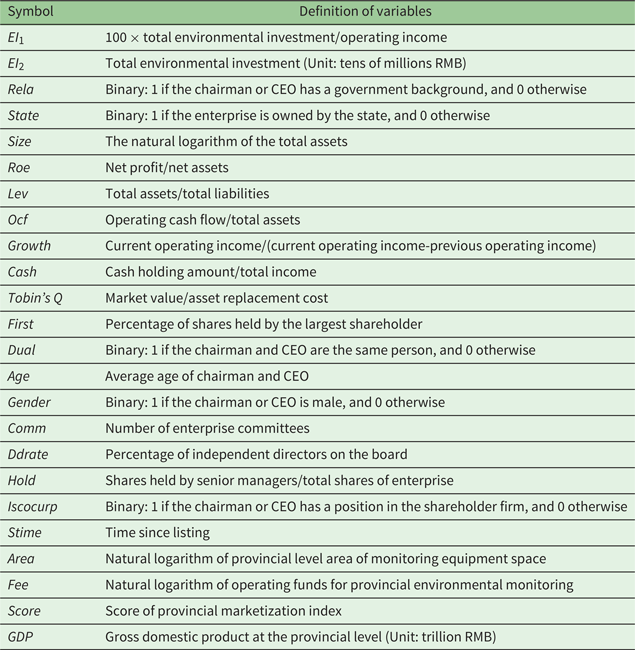
The dependent variable is the renminbi (RMB) value of the organization's environmental expenditure. This is the spending incurred by an enterprise to reduce the pollutants generated in its operation, including direct pollution-control costs and the expense of purchasing pollution-control equipment. Specifically, we constructed a relative indicator EI 1 and an absolute indicator EI 2, following Wei et al. (Reference Wei, Ding and Kong2017), Jiang and Akbar (Reference Jiang and Akbar2018) and Chi (Reference Chi2019). EI 1 represents the proportion of environmental expenditure against the company's operating income. EI 2 represents the amount of environmental expenditure in tens of millions of RMB. The independent variable, Rela, is a dummy variable to indicate whether the Chair or the CEO were, or had ever been, administration officials, NPC deputies, CPPCC members, etc. If true, a political connection exists and Rela = 1, and 0 otherwise. Following Li (Reference Li2010), Li et al. (Reference Li, Wang and Xu2015b) and Zhang et al. (Reference Zhang, Ren, Chen, Li and Yin2020), we introduced a range of control variables including: enterprise scale, net asset return rate, assets and liabilities ratio, operating cash flow rate, enterprise growth ratio, cash holding ratio, Tobin's Q, shares held by the largest shareholder, duality, age, gender of chairman and CEO, number of enterprise committees, independent director ratio, shares held by senior managers, position status in the shareholder firm of chairman and CEO, time since listing, area of monitoring equipment space, operating funds for government environmental monitoring, score of marketization index and regional GDP. We added a further control variable for year. Definitions for each variable are listed in table 1.
Definitions of the variables

4. Empirical results
4.1 Descriptive statistics of the variables
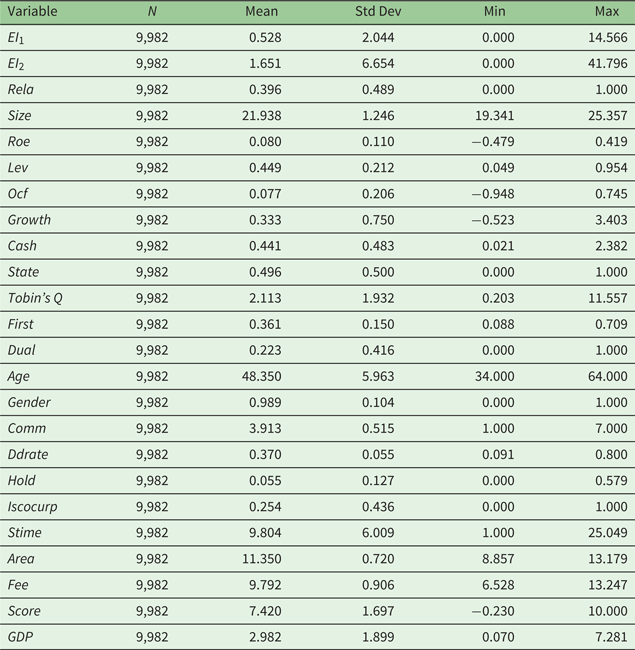
The descriptive statistics of the variables appear in table 2. The average environmental expenditure (EI 2) was RMB ¥16.51 million with a maximum investment of ¥417.96 million, and the average proportion of investments (EI 1) was 0.528 per cent with a maximum of 14.566 per cent. Notably, the amount of investment across the sample varied widely and the reasons why are certainly worth exploring. Some 39.6 per cent of the companies had political connections (Rela), which shows how common connections between government and private enterprises are in China.
Descriptive statistics of variables

The statistical analysis of the control variables shows a standard deviation in enterprise size (Size) of 1.246, which indicates great variation across the sample. The average asset-liability ratio (Lev) of 0.449 indicates that these companies are using debt financing appropriately, and the largest proportional shareholding was 0.361, on average, which is reflective of the Chinese tendency toward dominant stockholders. The statistical characteristics of the other control variables are largely consistent with the literature.
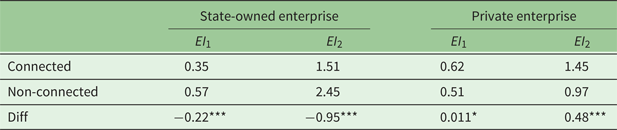
We also compared the average value difference in environmental expenditure between state-owned and private enterprises based on political connections. As shown in table 3, in the state-owned group, there is a significant difference in environmental expenditure between the politically-connected enterprises and those without such connections, with the former spending significantly less. In the non-state-owned enterprise group, there is also a significant difference in environmental expenditure between the politically-connected enterprises and those lacking political connections, with the politically-connected spending substantially more. This result provides preliminary evidence for our hypothesis.
Mean value T-test analysis of EI variables

*Significance at the 10% level, ***significance at the 1% level.
4.2 Regression analysis
4.2.1 Political connections and environmental expenditure
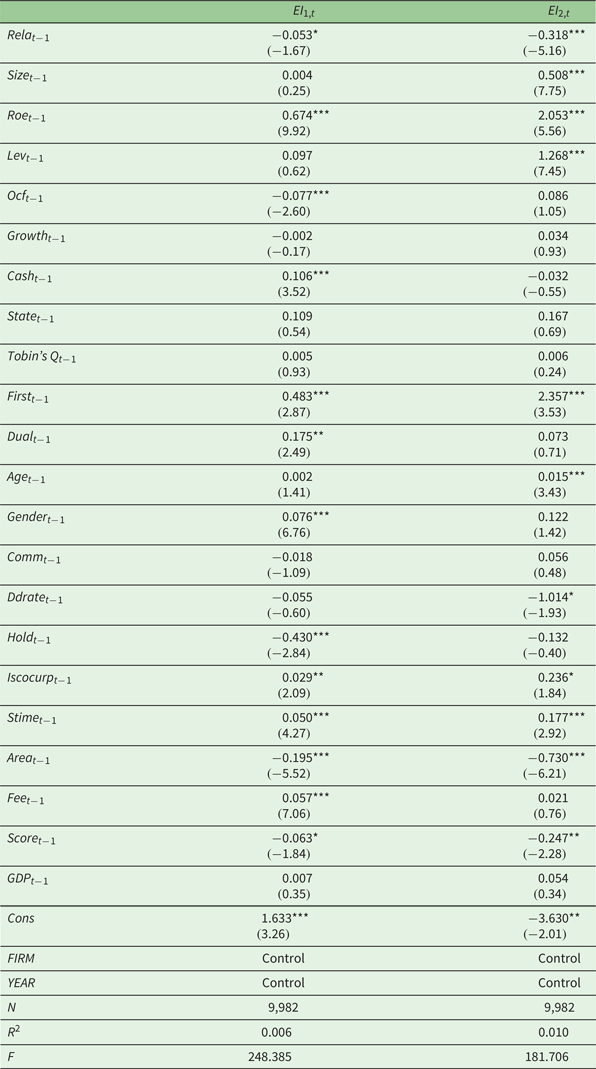
Our first hypothesis suggests that political connections will shelter enterprises from government oversight, resulting in reduced levels of expenditure on environmental concerns. We tested this notion through model (1) and show the regression results in table 4. The dependent variables are the relative (EI 1) and absolute amounts (EI 2) of corporate environmental expenditure. The results show that the coefficients for Rela are negatively correlated with both these variables at the 10 per cent (EI 1) and 1 per cent (EI 2) significance levels. In other words, a enterprise's political connections will reduce the money it invests in environmental practices. Therefore, hypothesis 1 is supported.
Political connections and environmental expenditure

*Significance at the 10% level, **significance at the 5% level, ***significance at the 1% level.
We believe the logic behind this phenomenon is that expending company resources on environmental impact undermines profit. An economically-rational enterprise will try to reduce operating costs and maximize profits where possible and, if an enterprise does not need to take responsibility for damaging the environment, investing in good environmental practices makes little sense. However, as environmental issues become more of a priority for governments, companies with political connections will need to spend less to ameliorate the effects of stricter government oversight and harsher penalties on their bottom line.
4.2.2 The influence of property rights
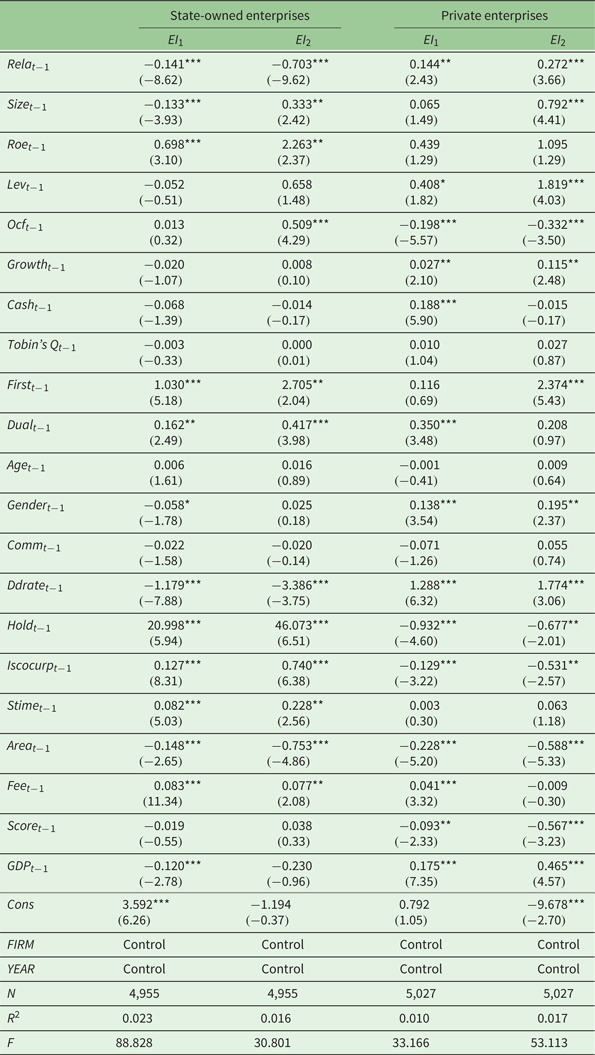
Property rights in China are dualistic. A listed company is either fully private or the state has an ownership stake in the enterprise. There are many differences between state-owned enterprises and private enterprises, which raises the question of whether a company's property rights influence its decisions over environmental expenditure. If heterogeneity exists, what is the logic behind it? The regression results for this analysis are listed in table 5. From the results, we can see clear differences in the level of environmental expenditure for state-owned versus private enterprises. For state-owned enterprises, the political connection decreases the level of environmental expenditure. However, for private enterprises, political connections significantly increase environmental expenditure. Therefore, hypothesis 2 is supported.
Political connections and environmental expenditure based on property rights

*Significance at the 10% level, **significance at the 5% level, ***significance at the 1% level.
Our assertion is that private enterprises are far more dependent on the favor they can curry with the government than state-owned enterprises. Therefore, if a company can ‘buy’ favor by appearing to support priority government issues, they will do so. The government wants enterprises to invest in developing more positive environmental practices. Therefore, companies with a need to maintain their political connections will demonstrate their support through higher levels of investment. This is rent-seeking behavior.
State-owned enterprises suffer more direct interference by the government and, being expected to bear more social responsibility, will be given additional scarce resources because they function as an extension of government in the economic field. However, their political connections are secure, which means they only need to meet their minimum regulatory requirements and will draw on informal ‘bargaining’ channels through political connections, to the greatest extent possible, to reduce their expenditure on environmental impact control.
5. Robustness tests and further analysis
5.1 Is rent-seeking through environmental expenditure effective?
With the knowledge that private enterprises invest more heavily in environmental practices to maintain political connections to leverage government benefits, the next question is: Is this effective? We chose government subsidies that the enterprise receives as the dependent variable (Sub) and conducted a regression study on the private enterprise sample to determine whether the level of environmental expenditure (EI 1 and EI 2) impacts the level of subsidies received and whether this relationship is more pronounced in politically-connected firms. In order to reduce the collinearity of the model, we centered the Rela and EI variables before regression. The results, shown in table A1 in the online appendix, indicate a significant positive correlation between proportional expenditure (EI 1) and total expenditure (EI 2) for private enterprises. The interaction terms are all positively significant (1 and 5 per cent level), meaning that private enterprises with political connections can acquire increased subsidies through higher levels of expenditure in their environmental investments. So, this rent-seeking behavior is effective.
5.2 Do the correlations change for pollution-intensive versus non-pollution-intensive enterprises?
To better understand rent-seeking in private enterprises, we conducted a study on pollution-intensive versus non-pollution-intensive private companies. Companies in pollution-intensive industries present more risks to the environment. Therefore, it is reasonable to assume that they would devote more expenditure to environmental concerns as a natural countermeasure. Additionally, the significant positive impact of political connections on environmental expenditure should still exist. However, non-pollution-intensive industries have less scope to engage in environmentally friendly practices: their expenditure is more ‘voluntary’ in nature. Hence, if environmental expenditure in a non-pollution-intensive company remains high, it is likely for the purposes of maintaining political connections. Referring to the works of Cui and Jiang (Reference Cui and Jiang2019) and Lu et al. (Reference Lu, Deng and Yu2019), we accordingly define the pollution-intensive companies as those in the following industries: mining, food and beverage, textile, clothing and fur, paper making, printing, petroleum, chemical plastics and plastics, metal and non-metal, medicine, biological products, electricity, and gas and water production and supply. Companies in other industries are defined as non-pollution-intensive companies. The regression results of this analysis are provided in online appendix table A2.
The results show that politically-connected private companies in pollution-intensive industries do invest more in environmental issues. However, politically-connected private companies in non-pollution-intensive industries also have more environmental expenditure. These results offer further support for rent-seeking motivations.
5.3 Is tacit government intervention a factor?
A further factor to consider is whether there is hidden intervention by the government to ensure that private companies are seen to be taking its agenda seriously. In China, the government maintains strong institutional control over business, which might – below the surface – translate into demands for certain environmental action, especially for politically-connected enterprises. Such tacit pressure is not beyond the realm of possibility. Therefore, an alternative explanation for the positive correlations between political connections and environmental expenditure in private enterprises is passive feedback by private enterprises to meet government requirements. One way to test this is through geography. China is a vast territory with fundamental differences between its eastern, central, and western regions. The eastern region is more open, progress toward marketization is more advanced, and the degree of local government intervention is lower. Hence, if government interference is responsible for the positive correlations found in this study, private companies in the eastern region should prove the exception with significantly lower environmental expenditure.
However, the results of a regression analysis with only private enterprises in China's eastern region show that support for hypothesis 2 has not changed (see online appendix table A3). Political connections are still significantly correlated to the level of environmental expenditure for these companies. From these results, we draw the conclusion that environmental expenditure is not a passive feedback mechanism in response to strong intervention by the government.
5.4 Are corporate efforts to improve the quality of the environment effective?
Another way to test the motivations behind environmental expenditure is to test the efficiency of that spending. If a company was genuinely interested in improving the environment, one would expect that its investment in good environmental practices should provide ‘value for money’; that is, the improvements to the environment should be proportional to the amount of expenditure. However, if there are other reasons behind the investment, such as rent-seeking, the efficiency of that investment becomes somewhat moot. To test this notion, we conducted a regression study with dust removal (Reduce) as the dependent variable, and the relative (EI 1) and absolute levels (EI 2) of environmental expenditure as the independent variables. Dust removal data comes from the China Stock Market & Accounting Research Database. The results are shown in online appendix table A4. Here, we see that environmental expenditure (EI 1 and EI 2) only significantly reduces emissions (at the 1 per cent level) for state-owned enterprises. For private enterprises, environmental expenditure has no significant impact on positive environmental outcomes and, in fact, may bring increased waste emissions given that EI 2 has a significantly negative correlation. The coefficients of the interaction terms of enterprise expenditure and political connections all show no significant impact on the dust removal in state-owned firms, although the political connections help to save the environmental expenditure. The politically-connected, state-owned operations can still protect the environment because of their duty to fulfill the will of the government. They can target their environmental expenditure astutely. This not only can reduce environmental safeguarding costs but can also bring positive protection results. But, for private enterprises, the coefficients of the interaction terms are significantly negative, indicating environmental protection results are even worse in private enterprises that are politically-connected. We believe these results reflect a fundamental motivational difference between state-owned and private enterprises. Even though state-owned enterprises reduce their environmental expenditure through political connections, the money they do spend is more effective. As part of the government's administrative system, their ultimate goal is to improve quality of life for the public. Private enterprises have different goals – such as survival, a competitive edge, profit – all of which require political connections to achieve. Environmental expenditure is not aimed at improving the environment; it is aimed at maintaining government relationships for benefits and favorable operating conditions in return.
5.5 Is substitution a factor in the private enterprise correlations?
Without taking property rights into consideration, the results of the overall regression analysis show that political connections do reduce the level of corporate environmental expenditure. However, this negative correlation does not hold in the analysis for private enterprises. Yet it stands to reason that some private companies should follow the overarching trend of the full sample. In this context, it is interesting to explore the factors that have allowed some private enterprises to behave more like state-owned enterprises and reduce their environmental expenditure in line with the strength of their political connections. Assuming that the rent-seeking motivation stands, we should find that these companies have or are maintaining their political connections in other ways.
Philanthropic donations are an alternative means to gain favor from the government. Therefore, private companies that have donated more should show a corresponding drop in environmental expenditure. We tested this substitution effect and provide the results in table A5 (online appendix). Corporate donation data comes from the Chinese Research Data Services Platform. Taking the average value of donation amount as the grouping basis, it is clear that the companies with relatively low donations followed the same trend as found in the property rights analysis, i.e., private companies with political connections have significantly higher environmental expenditure. However, private companies with higher donations spent significantly less on environmental concerns. This is similar to the overall and state-owned trends. Donations appear to be a more cost-effective means of maintaining the relationship. This confirms a substitution effect and offers further support for rent-seeking as a motivation behind environmental expenditure of private enterprises.
5.6 Other robustness checks
To verify the reliability of the baseline results, we used the level of political connections to quantify an enterprise's political relationships. Level measures the strength of the political connection, designed to better grasp the influence political connections have on environmental expenditure. A score of 0 indicates that the Chair or CEO hold no government position, 1 indicates that the Chair or CEO hold/held a government position at the town level or below, 2 means county level, 3 is municipal level, 4 is provincial level, and 5 is the central government. The results in online appendix table A6, indicate that the above findings have not changed.
Then we changed the measure of enterprise environmental expenditure: (1) defined as 100 × total environmental investment/operating income in the first sample year. (2) defined as 100 × total environmental investment/total assets in the first sample year. (3) defined as 100 × total environmental investment/total assets. (4) defined as the natural logarithm of the amount of total environmental investment plus one. Again, the results stay the same.
To overcome the potential for endogeny in the baseline results, following Ma et al. (Reference Ma, Novoselov, Zhou and Zhou2019) and Luo and Liu (Reference Luo and Liu2019), we employed an instrumental variable – the mean value of Rela in the same industry year – and carried out a 2SLS regression. The results in online appendix table A7 indicate that Rela still correlated with reduced environmental expenditure in both the full sample regression and state-owned enterprise sample regression, and Rela maintained correlation with increased environmental outgoings in private sample regression (EI 2 is verified). From this we determine that the baseline conclusion is largely unchanged.
6. Conclusion and discussion
The serious pollution problem in China has not escaped the government's attention. Enterprises that negatively impact the environment are falling under increasingly stricter regulations and harsher penalties for environmental damage. Making appropriate investments in environmentally friendly practices can offset these penalties; however, in China, so can closer political connections. So, what choices will enterprises make? We examined the behavior of listed companies in China to determine whether the underlying logic of decisions about environmental expenditure holds true. Our statistical analysis reveals that a company's political connections do significantly reduce expenditure levels, but only for state-owned enterprises. Private enterprises invest more in environmental practice.
This dichotomy is characteristic of the nature of property rights. State-owned enterprises do not need to curry favor with the government through political connections. However, for private enterprises, fully embracing the government's agenda is a means to maintaining the valuable political connections they have sought to create. In other words, rent-seeking behavior sits at the core for private enterprises.
A good relationship with the government is an important link to accessing scarce resources, especially for private companies that do not hold other forms of leverage and, hence, need to spend more. Several of our further analyses show strong support for the rent-seeking motivation of private enterprises. For example, environmental expenditure is lower in private companies with higher philanthropic donations, and the efficiency of environmental spending is lower in private enterprises, especially those with political connections, which speaks to the authenticity of their commitment to environmental concerns. It is interesting to note that our results show that rent-seeking through environmental spending is not an empty pursuit. Private companies with higher environmental expenditure find this does help them use political connections to receive more government subsidies.
The efficiency of environmental expenditure is worthy of further discussion. Politically-connected private enterprises invest more but their expenditure has less impact, while state-owned enterprises spend less for more effect. Governments should be aware that playing on rent-seeking motivations may well increase corporate efforts, but those efforts may not translate into actually improving the environment. Existing research on corporate expenditure toward creating environmentally friendly behavior in China is based on a passive response to the pressure of environmental regulation by governments. Our research reveals the deep-seated logic behind environmental expenditure by Chinese corporations in a political context. Under the shadow of government paternalism, state-owned enterprises have ‘baked in’ access to rents like resource access and subsidies. Private enterprises lack this inherent shelter and so must do more to stay in the government's good graces. Supporting priority initiatives, like environmental concerns, is a means to this end. It is a signal motivated by rent-seeking, not a sign of commitment to environmental protection. As shown, private companies immediately substitute environmental expenditure for a cheaper option if it is available.
Efforts by enterprises to reduce their negative impacts on the environment are critical to environmental quality and protection. However, in China, these good governance efforts appear to have been co-opted by economic motivations, especially in private enterprises, which is not conducive to genuine environmental protection. Our analysis reveals a great deal that needs further investigation. How can private enterprises establish political connections through more standardized and more appropriate channels? How can governments allocate scarce resources more equitably to avoid the need for political connections? How can environmental expenditure be made more efficient? Most crucially, how can Chinese enterprises develop more awareness of the importance of genuine corporate social responsibility given the current state of their environment? These are urgent calls to researchers, enterprises and government policymakers.
Supplementary material
The supplementary material for this article can be found at https://doi.org/10.1017/S1355770X20000327.
Acknowledgements
The authors acknowledge financial support from the National Natural Science Foundation of China (71502174: 71702193), the Humanities and Social Sciences Youth Fund project of the Ministry of Education (18YJC630058, 20YJC630063), Open Project of Wuhan Research Institute (IWHS20192061) and ‘the Fundamental Research Funds for the Central Universities’, Zhongnan University of Economics and Law (2722019JCT029), Huazhong Agricultural University (2662017QD022). The usual disclaimer applies.