Associational resistance occurs when host plants experience reduced attack when in the presence of other plant species (Atsatt & O'Dowd Reference ATSATT and O'DOWD1976, Tahvanainen & Root Reference TAHVANAINEN and ROOT1972). The issue is most studied in agriculture and forestry because of the potential benefits to pest control (Andow Reference ANDOW1991, Brown & Ewel Reference BROWN and EWEL1987, Tahvanainen & Root Reference TAHVANAINEN and ROOT1972), but recent research indicates that associational resistance may be relatively common in natural systems as well (Hjältén et al. Reference HJÄLTÉN, DANNELL and LUNDBERG1993, Karban Reference KARBAN2007, Vehviläinen et al. Reference VEHVILÄINEN, KORICHEVA and RUOHOMÄKI2007, Wise et al. Reference WISE, YI and ABRAHAMSON2009; but see Östergård & Ehrlén Reference ÖSTERGÅRD and EHRLÉN2005, White & Whitham Reference WHITE and WHITHAM2000), especially against specialist herbivores (Hambäck et al. Reference HAMBÄCK, ÅGREN and ERICSON2000, Reference HAMBÄCK, PETTERSSON and ERICSON2003; Stenberg et al. Reference STENBERG, HEIJARI, HOLOPEINEN and ERICSON2007).
Although pest pressures are generally much higher in the tropics (Ewel Reference EWEL1999), the importance of associational resistance in tropical systems is less clear. There are examples of associational resistance from agricultural systems (Brown & Ewel Reference BROWN and EWEL1987, Letourneau Reference LETOURNEAU1986, Risch et al. Reference RISCH, ANDOW and ALTIERI1983), but its importance in natural tropical systems remains unexplored. While host plant density is often positively correlated with rates of herbivory in the tropics (Angulo-Sandoval & Aide Reference ANGULO-SANDOVAL and AIDE2000, Norghauer et al. Reference NORGHAUER, MALCOLM and ZIMMERMAN2006), it is unknown whether specific neighbours might alter this pattern. Here we examined the effect of neighbour identity on associational resistance. Moreover, because closely related neighbours are chemically and morphologically more similar (Ehrlich & Raven Reference EHRLICH and RAVEN1964), we determined whether patterns of associational resistance might depend on the relatedness of neighbours. We expected that the presence of congeneric plant species would facilitate long-distance attraction of specialist herbivores. The fact that host shifts by specialist herbivores are most common when congeneric species are present (Dalin & Björkman Reference DALIN, BJÖRKMAN and Paine2006) provides evidence that congeneric species do attract specialists. Once in the habitat, the herbivore could use species-specific cues to locate their host plants. If neighbours are unrelated, however, visual and volatile cues may be absent or sufficiently low to limit long-distance attraction. To examine the importance of neighbour identity, we quantified the abundance and distribution of a specialist gracillariid leaf-miner when their host plant, Piper reticulatum L, was imbedded in habitats dominated by conspecifics, by congenerics or by unrelated neighbours.
The sedentary nature of leaf-miners makes them ideal for the study of associational resistance. Larvae develop in the leaf on which the adult females lay their eggs. Even if larvae are parasitized or removed by predators, the mines can still be counted. Historically, tests of associational resistance have focused on the effects of neighbours on herbivore density. We suggest that, for sedentary species such as leaf-miners and galling insects, patterns of aggregation may also be important because of density-dependent mortality (Vercher et al. Reference VERCHER, FARIAS, MARZAL, SOTO, TENA and GARCIA-MARÍ2008, Whitham Reference WHITHAM, Denno and Mcclure1983). In leaf-miners, for example, both intraspecific competition (even cannibalism) and predation contribute to density-dependent mortality (Bultman & Faeth Reference BULTMAN and FAETH1986, Eber Reference EBER2004, van Veen et al. Reference VAN VEEN, MÜLLER, ADRIAANSE and GODFRAY2002). Neighbour identity is likely to affect patterns of aggregation, especially of short-lived herbivores. If neighbours interfere with host location, short-lived females may be forced to oviposit several eggs on the same leaf or to oviposit on leaves already attacked by other mothers. Even under ideal conditions, leaf-miners are relatively short-lived (Facknath Reference FACKNATH2005, Hespenheide Reference HESPENHEIDE1991). In addition, neighbours might further increase aggregation if few leaves are suitable in the habitat. In many leaf-miner systems this is the case (Liu et al. Reference LIU, MEATS and BEATTIE2006, David Wagner pers. comm.).
While it can be difficult to isolate the role that neighbours play in associational resistance in the most diverse forests of the tropics, the understorey of undisturbed forests are often dominated by a few species (Griffiths et al. Reference GRIFFITHS, MOHOMMAD and VEGA2007, Rasingam & Parthasarathy Reference RASINGAM and PARTHASARATHY2009, Richards Reference RICHARDS1996, Tsvuura et al. Reference TSVUURA, GRIFFITHS and LAWES2007). Species within Acanthaceae and Asteraceae, for example, are well known to dominate many tropical and subtropical understorey plant communities (Rasingam & Parthasarathy Reference RASINGAM and PARTHASARATHY2009, Richards Reference RICHARDS1996, Tsvuura et al. Reference TSVUURA, GRIFFITHS and LAWES2007).
The tropical wet rain forest at Sirena Biological Station in the Pacific lowlands of Costa Rica (8°30′N 83°30′W, Corcovado National Park, Osa Peninsula) is well suited for a study of associational resistance. While the tree species composition of the canopy is diverse, areas of the understorey community are often dominated by specific plant species: Aechmea magdalenae (Bromeliaceae), Aphelandra golfodulcensis (Acanthaceae), several species of Piper (Piperaceae) and various understorey palms (Arecaceae) (Griffiths et al. Reference GRIFFITHS, MOHOMMAD and VEGA2007, pers. obs.). Our focal species, Piper reticulatum, is a common understorey shrub in Costa Rica and Panama and can be found in dense stands with 50+ individuals, or may be interspersed with other species, such as Piper hispidum Swartz and Aphelandra golfodulcensis McDade, that also form dense stands of 50+ individuals. Of the three plant species, only Piper reticulatum is attacked by the specialist gracillariid leaf-miner. This provides a unique opportunity to examine whether neighbour identity might alter the distribution and abundance of a specialist herbivore.
We expected that in a patch of conspecifics, high host density should increase the number of ovipositing females and lead to high mine densities and high dispersion (low aggregation) because of the abundance of suitable leaves. In contrast, we predicted that in the presence of heterospecifics, especially unrelated neighbours, densities will be lower and herbivores will be more aggregated. To test these ideas, the abundance and distribution of leaf-miners were quantified on P. reticulatum sampled from habitats dominated by conspecific P. reticulatum (n = 15 individuals), congeneric P. hispidum (n = 10 individuals) or the unrelated A. golfodulcensis (n = 10 individuals). All plants, non-reproductive and 1–2 m tall, were at least 30 m from other sampled individuals. To determine the abundance and distribution of leaf-miners, we examined every leaf and counted the number of mines on each leaf on each P. reticulatum individual. Mine abundance was calculated as mine density (total number of mines/total number of leaves) or as proportion of leaves with mines (number of leaves with mines/total number of leaves). Differences in distribution were calculated using a standard index of aggregation (variance/density). High values indicate greater aggregation (contagious distribution). A one-way ANOVA was used to test for significance of habitat type on leaf-miner density and aggregation. Significance of differences among habitat types was determined using Fisher's LSD.
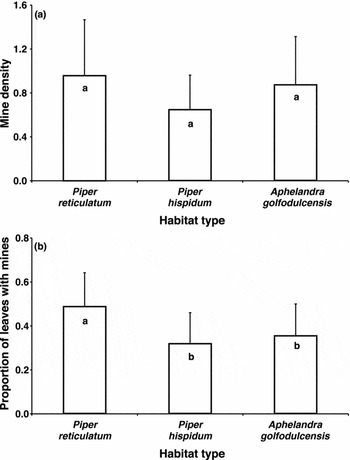
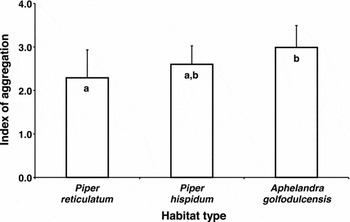
Mine density did not differ among habitats (F2,32 = 1.5, P = 0.24, Figure 1a) with a mean density of approximately 0.8 mines per leaf for all treatments. The proportion of leaves with mines did, however, differ among habitats and was greater in the P. reticulatum habitat (F2,32 = 4.6, P = 0.02, Figure 1b). Nearly 50% of the leaves had mines in the P. reticulatum habitat as compared to 35% in the other habitat types. Dispersion was significantly influenced by neighbour identity. The index of aggregation was highest in the A. golfodulcensis habitat, intermediate in the P. hispidum habitat and lowest in the P. reticulatum habitat (F2,32 = 4.85, P = 0.01, Figure 2).
Effects of habitat type (neighbour identity) on the abundance of a gracillariid leaf-miner of Piper reticulatum; density (a) and per cent leaves with mines (b). Values are mean plus 1 SD. Bars with different letters are significantly different at P < 0.05.

Effects of habitat type (neighbour identity) on the extent of aggregation of a gracillariid leaf-miner of Piper reticulatum. High values indicate greater aggregation. Values are mean plus 1 SD. Bars with different letters are significantly different at P < 0.05.

Although densities were slightly higher in the P. reticulatum habitat, there was no significant difference in density of leaf mines among the habitats. This result is quite surprising given the importance of host plant density on herbivory (Angulo-Sandoval & Aide Reference ANGULO-SANDOVAL and AIDE2000, Norghauer et al. Reference NORGHAUER, MALCOLM and ZIMMERMAN2006). Although this result suggests that P. reticulatum does not escape herbivory when associated with other plant species, we did find that more leaves were attacked (nearly 50% of all leaves) in conspecific stands, indicating that developing leaves rarely escape attack by female leaf-miners when there is an abundance of conspecific host plants and are more likely to escape attack in the presence of heterospecific species. This supports the indication that associational resistance to specialist herbivores is quite common (Hambäck et al. Reference HAMBÄCK, ÅGREN and ERICSON2000, Reference HAMBÄCK, PETTERSSON and ERICSON2003; Stenberg et al. Reference STENBERG, HEIJARI, HOLOPEINEN and ERICSON2007, Tahvanainen & Root Reference TAHVANAINEN and ROOT1972).
Leaf-miner dispersion provides further evidence for the possibility of associational resistance. Mines are more aggregated when P. reticulatum is associated with heterospecific neighbours, especially in the presence of the unrelated A. golfodulcensis. The greater aggregation in the A. golfodulcensis habitat is expected to increase density-dependent mortality due to competition or predation (Bultman & Faeth Reference BULTMAN and FAETH1986, Eber Reference EBER2004).
In conclusion, to our knowledge no previous studies have investigated associational resistance in tropical forests. This is somewhat surprising given the high number of interacting species, the high diversity of specialist herbivores, and the fact that areas of the understorey are often dominated by specific plant species. All of these facts suggest that associational resistance may be quite common in understorey tropical communities. Our study indicates that associational resistance may operate in these habitats. We found that heterospecific neighbours, especially unrelated ones, affect the per cent leaves attacked and patterns of aggregation, but not the density of leaf mines. Since leaf-miners can have significant effects on plant fitness (Magalhães et al. Reference MAGALHÃES, GUEDES, LIMA and DEMUNER2008, Wagner et al. Reference WAGNER, DEFOLIART, DOAK and SCHNEIDERHEINZE2008) our findings suggest that if predation and parasitism pressures are higher in aggregated populations, it could lead to higher plant performance in heterospecific stands. Given the importance of aggregation in tritrophic interactions (Gripenberg & Roslin Reference GRIPENBERG and ROSLIN2008, Whitham Reference WHITHAM, Denno and Mcclure1983), these results suggest that future work should examine if and how herbivore dispersion contributes to associational resistance in this and other systems.
ACKNOWLEDGEMENTS
Without the help of Andres Vega this research could not have been completed. CMO thanks SLU for support during his sabbatical and both authors are grateful for the financial support of SLU. We thank Johan Stenberg and two anonymous reviewers for comments on a previous version.