Bipolar disorder (BD) in childhood and adolescence is much more common than once thought. In a recent study of 642 adults with BD, 50–66% reported that their onset was prior to age 18 and 15–28% before 13 (Perlis et al., Reference Perlis, Miyahara, Marangell, Wisniewski, Ostacher and DelBello2004). A study of the Amish population found that between 10 and 20% of adults reported the onset of symptoms before age 10 (Egeland, Hostetter, Pauls, & Sussex, Reference Egeland, Hostetter, Pauls and Sussex2000; Lish, Dime-Meenan, Whybrow, Price, & Hirschfeld, Reference Lish, Dime-Meenan, Whybrow, Price and Hirschfeld1994). The recent large-scale National Comorbidity Survey—Revised found that about 2% of the population has bipolar I or II disorder, and another 2.4% has subsyndromal forms of the disorder within the bipolar spectrum (Merikangas et al., Reference Merikangas, Akiskal, Angst, Greenberg, Hirschfeld and Petukhova2007). Rates among bipolar children and adolescents are lower but still significant (1–2% in most studies, depending on the ascertainment method; Lewinsohn, Klein, & Seeley, Reference Lewinsohn, Klein and Seeley2000; Verhulst, van der Ende, Ferdinand, & Kasius, Reference Verhulst, van der Ende, Ferdinand and Kasius1997). In referred clinic samples, the rates vary from 0.6 to 15% (Pavuluri, Birmaher, & Naylor, Reference Pavuluri, Birmaher and Naylor2005). There have been dramatic increases (by one estimate, 40-fold) in the diagnosis of pediatric BD in community settings within the past 10 years, leading some to question the reliability and validity of the diagnosis in clinical practice (Moreno et al., Reference Moreno, Laje, Blanco, Jiang, Schmidt and Olfson2007).
Although the average age at illness onset is 18 years in epidemiological samples (e.g., Merikangas et al., Reference Merikangas, Akiskal, Angst, Greenberg, Hirschfeld and Petukhova2007), the onset of subsyndromal symptoms is much earlier. For example, Egeland et al. (Reference Egeland, Hostetter, Pauls and Sussex2000; Egeland, Blumenthal, Nee, Sharpe, & Endicott, Reference Egeland, Blumenthal, Nee, Sharpe and Endicott1987) observed that in the Amish population, subsyndromal affective symptoms (e.g., hypersensitivity, anger dyscontrol, episodic mood lability) were observable at least 9–12 years before the illness was diagnosed.
Longitudinal studies have repeatedly documented the highly recurrent course of child and adult BD, its significant impact on functioning and quality of life, and its high association with suicide as an eventual outcome (Birmaher et al., Reference Birmaher, Axelson, Strober, Gill, Valeri and Chiappetta2006; Coryell et al., Reference Coryell, Scheftner, Keller, Endicott, Maser and Klerman1993; Isometsa, Reference Isometsa1993; Suppes et al., Reference Suppes, Leverich, Keck, Nolen, Denicoff and Altshuler2001). Before the onset of the full syndrome, youth with a family history of BD often experience subsyndromal mood swings. If untreated, these “prodromal” youths often develop comorbid disorders such as substance or alcohol abuse or anxiety disorders and various levels of psychosocial or academic impairment. When they are eventually treated, it is often with antidepressants or psychostimulants instead of mood stabilizers or atypical antipsychotics, which may increase their risk of manic onset (Altshuler et al., Reference Altshuler, Post, Leverich, Mikalauskas, Rosoff and Ackerman1995; Leverich et al., Reference Leverich, Post, Keck, Altshuler, Frye and Kupka2007).
Given the high prevalence and damaging effects of early-onset bipolar illness, researchers need to more systematically elucidate the developmental pathways to the disorder and evaluate the effectiveness of early interventions. A young population should be targeted for early identification and intervention because of the window of opportunity represented by the short prodromal period before the fully debilitating syndrome begins.
This article addresses a key set of questions from the perspective of developmental psychopathology: how do bipolar symptoms emerge during development in the context of different risk and protective factors in the social, emotional, cultural, cognitive, biological, or familial domains (Cicchetti & Toth, Reference Cicchetti and Toth1998)? Are there developmental organizations of systems that place an individual at risk for the illness? What are the various components of this disorganization, and are they amenable to intervention? In addressing these themes, we pose four subsidiary questions: first, what is known about early signs of mood or behavioral disturbance in children who are at risk for BD by virtue of family history? Second, what symptoms appear to “hang together” as a unique syndrome defining risk? Third, which genetic, neuroanatomical, neurophysiological, or environmental variables place children at additional risk to develop BD onset or recurrences, and which factors are compensatory when potentiating factors are present? The disorder clearly has a genetic basis, but genetic vulnerability only translates into phenotypic expression in a minority of cases (Smoller & Finn, Reference Smoller and Finn2003). Possibly, biological markers of risk will increase the predictive accuracy of measurable genetic vulnerabilities to the disorder.
As an example of a neuroanatomical marker, the size of the amygdala is smaller than average in bipolar children and larger than average in bipolar adults, suggesting that the disorder may be associated with abnormal amygdalar development (DelBello, Reference DelBello2006). As an example of an environmental potentiator, early sexual abuse is associated with an earlier age at onset of BD, a greater frequency of comorbidity, more suicidal thinking, and more treatment resistance (Leverich et al., Reference Leverich, McElroy, Suppes, Keck, Denicoff and Nolen2002).
Fourth, and finally, what kinds of early interventions might serve a protective function in delaying the onset of the disorder or minimizing its severity, and whom would we target for such interventions? What variables in the social, emotional, interpersonal, genetic, biological, or cultural domains should be the hypothesized mediators to determine whether early interventions are successful? Like depression, there are multiple causal pathways to an early onset of BD, and multiple patterns of individual adaptation, some of which may be amenable to alteration through psychosocial interventions. In turn, what we learn from prevention trials may inform our understanding of risk mechanisms that initiate or maintain the disorder (Garber, Reference Garber2006).
Equifinality and Multifinality
In reviewing the literature on risk for BD, we must keep in mind two principles of developmental psychopathology: equifinality and multifinality. Equifinality, the process by which multiple developmental pathways converge on the same phenotypic outcome, complicates efforts toward creating truly homogenous biologically based groupings based on external behaviors (Cicchetti & Rogosch, Reference Cicchetti and Rogosch1999). The diagnosis of BD in late childhood or early adulthood, even when strictly defined, is probably the end result of a number of different pathways affected by genetic variables, environmental variables, Gene × Environment interactions, and other risk and protective processes at different phases of development. Both genetic and nongenetic factors clearly play a role in the disorder, given that concordance rates between identical twins range from 40 to 97% depending on the definition of BD (Alda, Reference Alda1997; Hasler, Drevets, Gould, Gottesman, & Manji, Reference Hasler, Drevets, Gould, Gottesman and Manji2006).
An implication of the equifinality concept is that the search for uniform risk factors (e.g., single genes) common to all presentations of the illness is likely to fail. The accuracy of predicting “caseness” is likely to be improved by examining Gene × Environment interactions and how these change across the lifespan, as well as the moderating effects of psychological processes such as coping skills or self-esteem.
Multifinality creates further heterogeneity in pediatric bipolar samples because individuals with the disorder are affected to different degrees. Different constellations of risk and protective factors result in a dispersion of symptomatic and functional outcomes over the lifespan of the individual. The principle of multifinality operates when considering the outcome of children diagnosed with “prodromal” BD, which may or may not eventuate in development of the full bipolar I syndrome (e.g., Lewinsohn et al., Reference Lewinsohn, Klein and Seeley2000).
As an example of the concept of multifinality, consider the role of high expressed emotion (EE) attitudes in parents (high levels of criticism, hostility, or emotional overinvolvement as expressed during an interview) and their relations to the symptomatic outcomes of BD adults and adolescents over 1- to 2-year periods (Miklowitz, Biuckians, & Richards, Reference Miklowitz, Biuckians and Richards2006; Miklowitz, Goldstein, Nuechterlein, Snyder, & Mintz, Reference Miklowitz, Goldstein, Nuechterlein, Snyder and Mintz1988; Miklowitz et al., Reference Miklowitz, Simoneau, George, Richards, Kalbag and Sachs-Ericsson2000; O'Connell, Mayo, Flatow, Cuthbertson, & O'Brien, Reference O'Connell, Mayo, Flatow, Cuthbertson and O'Brien1991; Yan, Hammen, Cohen, Daley, & Henry, Reference Yan, Hammen, Cohen, Daley and Henry2004). Parental EE attitudes are correlated differently with age at onset in boys versus girls, such that parents express more criticisms toward childhood-onset boys and adolescent-onset girls (Coville, Miklowitz, Taylor, & Low, Reference Coville, Miklowitz, Taylor and Low2008). In addition, the degree to which parental EE attitudes are associated with later recurrences of BD may be moderated by variables such as the intactness of the biological family unit or the degree to which EE attitudes are expressed in verbal interactions between the parent and offspring (Geller, Tillman, Craney, & Bolhofner, Reference Geller, Tillman, Craney and Bolhofner2004; Miklowitz et al., Reference Miklowitz, Goldstein, Nuechterlein, Snyder and Mintz1988). Thus, the same context (a high EE environment) may eventuate in a wide dispersion of outcomes depending on the range of moderating and mediating variables in the social, biological, or cultural context. The concepts of equifinality and multifinality will be revisited in later sections of this review.
Genetic Origins of BD
How do we know which children will later develop BD? Twin and family studies report that the disorder has 59–87% heritability, and first-degree relatives of probands with BD are at very high risk for BD themselves (Smoller & Finn, Reference Smoller and Finn2003). Concordance rates among identical twins average 57% and among dizygotic twins 14% (Alda, Reference Alda1997). Averaging across studies, and using the narrow DSM-IV criteria for bipolar I or II disorder, the morbid risk of major affective disorder to first-degree relatives if an individual has BD is about 23% (about 9% bipolar and 14% major depressive disorder; Smoller & Finn, Reference Smoller and Finn2003). Familial rates are higher when one includes the spectrum conditions. Notably, the risk of bipolar spectrum disorders in the offspring of parents with BD I or II disorder ranges from 14 to 50% across studies, and the risk of major depressive disorder ranges from 7 to 43% (Chang, Steiner, & Ketter, Reference Chang, Steiner and Ketter2003).
These numbers, while confirming the role of genetic transmission, point to the existence of numerous risk and protective factors in moderating the appearance of BD in at-risk children. The majority of children with first-degree bipolar relatives do not develop BD (multifinality).
Although twin and family studies support the position that BD has genetic roots, they tell us little about the nature of its origins. As Kendler (Reference Kendler2005) explains, evidence from twin, adoption, and family studies only show that “genes that affect risk for these disorders must exist somewhere on the human genome” (p. 1248). In all likelihood, BD will be associated with the cumulative effects of numerous genes of small effect (none of which code directly for the illness) and which interact with different contextual factors. Nonetheless, multiple loci have been identified in linkage studies (Mathews & Reus, Reference Mathews and Reus2003).
Evidence for Mood and Behavior Disturbance in At-Risk Children
When a child has a first-degree relative with bipolar I or II disorder, what mood or behavioral risk indicators increase the likelihood that the child will develop BD, or at least that developmental continuities will be observed from youth to adulthood? Various internalizing or externalizing disorders appear with high frequency in genetically susceptible samples. A meta-analysis of studies conducted before 1997 found that offspring of bipolar parents were at 2.7 times higher risk for development of any psychiatric disorder and four times higher risk for developing a mood disorder than children of parents without psychiatric illness (LaPalme, Hodgins, & LaRoche, Reference LaPalme, Hodgins and LaRoche1997). Between 50 and 60% of the offspring of BD parents have some type of psychiatric disorder, especially mood, anxiety, and disruptive behavior disorders (Carlson & Weintraub, Reference Carlson and Weintraub1993; Chang, Steiner, & Ketter, Reference Chang, Steiner and Ketter2000, 2003; Wals et al., Reference Wals, Hillegers, Reichart, Verhulst, Nolen and Ormel2005).
The risk to offspring is also observed cross-culturally. A Turkish study examined the prevalence of mood and disruptive behavior disorders in 35 children of 29 adult outpatients with a DSM-IV diagnosis of bipolar I disorder, compared with 33 children of 29 healthy adults (Emiroglu, Ozerdem, Miklowitz, Baykara, & Akay, in press). The offspring of bipolar patients had a 9.48-fold higher risk of receiving a psychiatric diagnosis than the controls. Only two children of patients with BD were diagnosed with a mood disorder, but 30.9% displayed mild depressed mood, compared with 8.8% of the controls. The bipolar offspring also scored significantly higher on the hyperactivity and conduct problems subscales as well as the ADHD index of the Conners' Teacher Rating Scale.
From the perspective of risk computation, the children of parents with BD are the most relevant population in which to implement early interventions. The presence of mood or behavioral disturbance increases the likelihood of identifying “true positive” cases. However, aiming an early intervention at all children of bipolar parents who show mood disturbance would lead to an unacceptable number of unnecessary treatments, because the majority of these children will not develop the disorder. Thus, researchers must go a step farther and examined putative markers that moderate risk among children who are genetically predisposed to BD. Knowledge of these markers would make early intervention programs more cost effective.
Defining the Initial Symptom Presentation
Risk markers can take a variety of forms, although they do not necessarily tell us how individuals develop the disorder (risk mechanisms). At the simplest level are subsyndromal forms of the disorder, such as early cyclothymic cycling patterns, or the presence of disorders that are often comorbid with BD (e.g., attention-deficit/hyperactivity disorder [ADHD]). Some investigators have examined the constellation of symptoms that predates the first onset of BD and distinguishes it from the onset of other psychiatric disorders when a family history of BD is also present.
Studies of BD, not otherwise specified (BD-NOS) and cyclothymia
A group of children who are theoretically at the highest risk for developing BD are those who, in addition to having an immediate family history of BD, have significant symptoms of depression and mania that do not meet full criteria for BD I or II. Retrospective studies have found that BD commonly begins with subsyndromal mood symptoms (depression, mania, suicidality; Lish et al., Reference Lish, Dime-Meenan, Whybrow, Price and Hirschfeld1994). For example, a child may have periods of significant irritability plus three associated manic symptoms that may not last an entire week, but instead last for 4 hr on 2 consecutive days. These youths are commonly diagnosed with BD-NOS if they are significantly impaired by their symptoms (Carlson et al., Reference Carlson, Jensen, Findling, Meyer, Calabrese and DelBello2003; NIMH, 2001).
A cross-sectional study with a large sample (N = 400) of children aged 5–17 years clarified the nature of this high-risk phenotype (Findling et al., Reference Findling, Frazier, Youngstrom, McNamara, Stansbrey and Gracious2005). Children of bipolar parents were more likely to have symptoms of mania or hypomania than were children without a bipolar parent, but were not at higher risk for ADHD or disruptive behavior disorders than children without a bipolar parent. The combination of elevated mood with irritability, rapid mood fluctuations, and psychosocial dysfunction identified a high-risk group that the authors referred to as “cyclotaxic.”
A similar cluster of prodromal behaviors was identified by Egeland et al. (Reference Egeland, Hostetter, Pauls and Sussex2000, Reference Egeland, Shaw, Endicott, Pauls, Allen and Hostetter2003; Shaw, Egeland, Endicott, Allen, & Hostetter, Reference Shaw, Egeland, Endicott, Allen and Hostetter2005) in a 7- to 10-year follow-up of Amish children. Few of the children of bipolar I or II parents actually developed BD within the time frame. Compared to children without a bipolar parent, children with a bipolar parent were distinguished at the 7- and 10-year follow-up by episodic mood lability, anxiousness, hyperalertness, distractibility, easy excitability, school role impairment, somatic complaints, and “stubbornness.” With 3 years of additional follow-up, features that distinguished the groups included fewer internalizing and more externalizing “maniclike” behaviors including high energy, sleep disturbances, excessive and loud talking, and problems with thinking and concentration. Many of these features, of course, are key features of ADHD as well as BD. Thus, the diagnostic specificity of early bipolar spectrum symptoms is still in question.
Longitudinal studies
What early symptomatic states have developmental continuity and are longitudinally associated with adult BD? A 2-year prospective study in France examined 80 children and adolescents (7–17 years) with DSM-IV major depressive disorder (Kochman et al., Reference Kochman, Hantouche, Ferrari, Lancrenon, Bayart and Akiskal2005). Of the 80 children, 35 (43%) converted to BD I or II within 2 years. Youths with cyclothymic temperaments (n = 47) were highly likely (64%) to experience at least one full-blown hypomanic or manic episode within 2 years, compared to only 15% of youths without cyclothymic temperaments (n = 33). The cyclothymic children also had more depressive episodes at follow-up, more psychotic symptoms, more suicidal ideation and attempts, and more instances of antidepressant-induced hypomanic or manic episodes. Cyclothymic children were described, at baseline, as highly mood-labile and emotionally overactive, explosively angry, impulsive, aggressive, and emotionally hypersensitive, much as the studies by Findling et al. (Reference Findling, Youngstrom, McNamara, Stansbrey, Demeter and Bedoya2005) and Egeland et al. (Reference Egeland, Hostetter, Pauls and Sussex2000, Reference Egeland, Shaw, Endicott, Pauls, Allen and Hostetter2003) had described. Young adults with these cyclothymic temperaments have been found to have a high familial loading for affective disorder (Akiskal, Reference Akiskal1995). The Kochman et al. study, while underscoring the validity of cyclothymia as a prodromal manifestation of BD, also illustrates the diverse outcomes of children initially diagnosed with major depressive disorder (multifinality).
Lewinsohn et al. (Reference Lewinsohn, Klein and Seeley2000; Lewinsohn, Seeley, & Klein, Reference Lewinsohn, Seeley and Klein2003) at the Oregon Research Institute conducted one of the few longitudinal high-risk studies of BD. Cases were chosen based on positive responses of high school students to a structured diagnostic interview. A follow-up into young adulthood of the adolescents who had a narrow bipolar phenotype (at least one clear-cut manic episode) revealed continuity of the narrow phenotype with BD in young adulthood, although not in every case. It is of interest that a much broader phenotype (defined as meeting the “A” criteria but not the “B” criteria by DSM-III-R) was more often associated with major depressive disorder in adulthood than with bipolar illness. This study is limited by its sole reliance on adolescent instead of parental report. The results may generalize to community high school student samples but not necessarily to clinical samples.
The findings of the Course and Outcome in Bipolar Youth study most clearly document that children with well-defined BD-NOS and a first-degree relative with BD are at high risk to progress to BD I or II (Birmaher et al., Reference Birmaher, Axelson, Strober, Gill, Valeri and Chiappetta2006). A total of 131 children were identified with BD-NOS, defined as a distinct period of abnormally elevated, expansive, or irritable mood plus two (three if irritable mood only) DSM-IV symptoms of mania that caused a change in functioning, lasted for at least 1 day, and were present for a total of at least 4 days in a child's lifetime. Children with BD-NOS were at significant risk for switching to BD I (14.5%) or II (9.2%) over 22 months, with the highest rates among those children with a first- or second-degree relative with mania or hypomania (30.6 vs. 17.4%). Children with BD-NOS were also at high risk for a variety of adverse outcomes at follow-up, including rapid mood changes, suicidality, and psychosocial dysfunction. In fact, children with BD-NOS took longer to achieve remission and had more weeks with subsyndromal manic or depressive symptoms than children with BD I (Birmaher et al., Reference Birmaher, Axelson, Strober, Gill, Valeri and Chiappetta2006). It is of interest that even though the BD-NOS children fell short of the diagnostic criteria for the full bipolar syndrome, they did not differ from BD I or II children in the number or type of medications given by community practitioners.
A related question is whether moods that dramatically fluctuate from a euthymic baseline to a severely high or low mood are pathognomonic for developing BD. Some investigators, however, have argued that children with BD can have nonepisodic, chronic mania and irritability (Biederman et al., Reference Biederman, Mick, Faraone, Spencer, Wilens and Wozniak2003). More generally, there is disagreement among researchers as to what constitutes an episode (Tillman et al., Reference Tillman, Geller, Craney, Bolhofner, Williams and Zimerman2004).
Leibenluft, Cohen, Gorrindo, Brook, and Pine (Reference Leibenluft, Cohen, Gorrindo, Brook and Pine2006) analyzed data from the longitudinal Smoky Mountain Youth study which, although not a study of BD, had a considerable sample size assessed with multi-informant structured diagnostic interviews. Seven hundred seventy-six youth were evaluated at three time points: mean age 13.8, mean age 16.2, and mean age 22.1. The best predictor of mania onset at both Time 2 and Time 3 was episodic irritability at Time 1. Depression in early adolescence also predicted later mania onset. It is of interest that chronic, nonepisodic irritability predicted later onset of ADHD and major depression, but not mania, a result that parallels the Lewinsohn et al. (Reference Lewinsohn, Klein and Seeley2000) study. Thus, episodicity of mood symptoms seems an important variable to consider in defining risk.
The prodrome to mania and depression
Two studies have retrospectively focused on the prodrome to first onsets of mania or hypomania. A retrospective study of 34 bipolar youths (Correll et al., Reference Correll, Penzner, Kafantaris, Nakayama, Auther and Lencz2006, Reference Correll, Penzner, Frederickson, Richter, Auther and Smith2007) revealed that a lengthy symptomatic prodrome often precedes the first episode of full mania. When defining prodromes as three or more manic symptoms of moderate severity or greater, which is subthreshold for DSM-IV mania, the mean manic prodrome duration was 10.8 ± 14.7 months. For most of the youths, the onset was slow with gradual deterioration (58.8%) or slow with quick worsening (29.4%) rather than rapid (11.8%). The most common prodromal features of subsequent manic episodes were a drop in school functioning (69%), irritability (59%), racing thoughts (59%), and mood swings (57%).
The most reliable symptom complex predating mania is depression. In a study of children (mean age = 10.3 years) with prepubertal major depressive disorder, Geller, Zimerman, Williams, Bolhofner, and Craney (Reference Geller, Zimerman, Williams, Bolhofner and Craney2001) found that 33% had developed BD I by a 10-year follow-up, compared to none of a group of age-matched healthy controls. In a 5-year prospective study of 129 children of bipolar parents in The Netherlands, 12 of the 13 offspring who developed hypomania at follow-up had had a major depressive episode an average of 5 years earlier (Hillegers et al., Reference Hillegers, Reichart, Wals, Verhulst, Ormel and Nolen2005). However, childhood depression is associated with a multifinality of outcomes in adulthood (Cicchetti & Toth, Reference Cicchetti and Toth1998). In the Geller study, high rates of major depressive disorder (36%) and substance abuse disorders (31%) were also observed in young adulthood. Thus, the specificity of depression as a risk factor in the absence of other risk factors (e.g., family history of BD; mood cyclicity) is probably minimal.
ADHD as an early risk indicator
A more controversial question is whether ADHD is a harbinger of the later development of BD among genetically at-risk children. Because ADHD generally has an earlier age at onset, ADHD symptoms may reflect an early manifestation of BD (or perhaps a developmentally specific phenotype) in some children (Singh, DelBello, Kowatch, & Strakowski, Reference Singh, DelBello, Kowatch and Strakowski2006). In this view, ADHD reflects the same “molar organization” that mania reflects in adulthood: hyperactive behavior, inattention, impulsiveness, irritability, distractibility, and excessively goal-driven behaviors. ADHD generally has an earlier onset than BD, making its appearance in the context of a positive family history of BD a potentially fruitful way of identifying high-risk youths.
Bipolar patients retrospectively report high rates of ADHD symptoms as children, and often report that inattention was their first symptom (e.g., Lish et al., Reference Lish, Dime-Meenan, Whybrow, Price and Hirschfeld1994). Virtually every study finds a high rate of comorbidity between childhood BD and ADHD (Chang, Steiner, & Ketter, Reference Chang, Steiner and Ketter2003; Fergus et al., Reference Fergus, Miller, Luckenbaugh, Leverich, Findling and Speer2003; Geller, Warner, Williams, & Zimerman, Reference Geller, Warner, Williams and Zimerman1998; Perlis et al., Reference Perlis, Miyahara, Marangell, Wisniewski, Ostacher and DelBello2004). The significance of this overlap is uncertain, however. One view is that the psychostimulants used to treat ADHD increase the likelihood that mania will appear earlier in high-risk children. A study in The Netherlands found only 1/6th the rate of BD in prepubertal children that is reported in the United States; the authors attributed this difference in prevalence to the lower use of stimulants in The Netherlands (Reichart & Nolen, Reference Reichart and Nolen2004). However, in a 6-year follow-up of US children (average age = 9.7 years) with ADHD, 29% “switched” to BD I by average age 16, butthose who switched were less likely to have been treated with stimulants (Tillman & Geller, Reference Tillman and Geller2006). Other predictors of switching included a paternal family history of recurrent depression and high psychosocial impairment.
The issue of overlapping diagnostic criteria has not been resolved, although several studies find that there is a high rate of comorbidity between BD and ADHD even when overlapping symptom criteria (e.g., increased energy) are removed from consideration (Kim & Miklowitz, Reference Kim and Miklowitz2002). Finally, the high rate of ADHD in the family pedigrees of bipolar children suggests a degree of overlap in the genetic etiology of the two conditions (Faraone, Biederman, Mennin, Wozniak, & Spencer, Reference Faraone, Biederman, Mennin, Wozniak and Spencer1997). Brain areas involved with mood regulation overlap with attentional circuitry (i.e., the dorsolateral prefrontal cortex [PFC], anterior cingulate cortex, and striatum). Disruptions in these areas and connections between them could lead to disruption of mood regulation and attention.
Summary
The emerging evidence suggests that certain symptomatic constellations are prodromal risk indicators for the onset of BD I or II later in childhood or in early adulthood. Children at highest risk for developing BD have a first-degree relative with BD and (a) a subsyndromal form of BD (BD-NOS or cyclothymic disorder), (b) fully syndromal DSM-IV major depressive episodes with a history of significant but subsyndromal manic symptoms, or (c) possibly, ADHD with significant mood fluctuation. All three risk definitions require that the child show evidence of cyclicity of symptoms (return to baseline or to another mood state following the offset of subsyndromal manic or depressive symptoms). However, this literature is limited by the small number of long-term follow-up studies into adulthood. Thus, we cannot say for certain whether the clinical presentations observed in youth are truly prebipolar syndromes or time-limited “phenocopies.” Ongoing interactions between individual genotypes and environmental–contextual factors in the transition to adolescence or early adulthood are likely to lead to a diversity of outcomes among youth with similar prodromal presentations.
Neurobiological Markers of Risk
Neurobiological risk markers for BD would serve many functions: (a) to aid in more precise diagnosis of bipolar spectrum disorders, (b) to shed light on the etiology of BD, and (c) to aid in detection and quantification of risk for BD development. Although biological studies of BD have revealed genes and brain regions thought to be involved with the pathophysiology of the disorder, no single or combination of such biological findings has been found to be specific to or predictive of a bipolar diagnosis. Therefore, future use of genetic or biological markers will be dependent on understanding the relative degree of contribution from many different biological risk processes. Based on prior research, these may include amygdalar size, prefrontal activation in response to affective stress, and the short allele of the 5-HTTLPR gene (Chang, Howe, Gallelli, & Miklowitz, Reference Chang, Howe, Gallelli and Miklowitz2006). Understanding the cumulative effects and interactions among different neuropathophysiological factors may help us to tailor preventative interventions.
Our current understanding regarding the neuropathophysiology of BD centers on disruption in circuitry within the prefrontal–limbic network (Phillips, Drevets, Rauch, & Lane, Reference Phillips, Drevets, Rauch and Lane2006; Strakowski, Delbello, & Adler, Reference Strakowski, Delbello and Adler2005). For example, certain abnormalities in the limbic system, such as altered amygdalar structure and functionality, could exist early in childhood in at-risk individuals, whether inborn or because of excessive neuronal pruning/apoptosis during childhood and adolescence (Blumberg et al., Reference Blumberg, Kaufman, Martin, Charney, Krystal and Peterson2004; Chang et al., Reference Chang, Howe, Gallelli and Miklowitz2006; Karchemskiy et al., Reference Karchemskiy, Garrett, Howe, Adleman, Simeonova and Reiss2008). Further disruptions in the network, particularly in prefrontal regions, may develop with continuing mood episodes, stress, and or exogenous substances such as alcohol. Neurovegetative symptoms, including changes in sleep, appetite, and energy, associated with BD are hypothesized to result from the effects of dysregulated anterior limbic network activity on hypothalamic nuclei (Strakowski et al., Reference Strakowski, Delbello and Adler2005).
This model of BD development is supported by neuroimaging studies in pediatric BD, which find abnormalities in subcortical–limbic brain regions, especially in the amygdala and basal ganglia (Caetano et al., Reference Caetano, Olvera, Glahn, Fonseca, Pliszka and Soares2005; Chang et al., Reference Chang, Howe, Gallelli and Miklowitz2006; Karchemskiy et al., Reference Karchemskiy, Garrett, Howe, Adleman, Simeonova and Reiss2008). Whereas studies in adults with BD have reported increased, decreased, or unchanged amygdalar volume, studies in pediatric BD have been more consistent in finding relatively decreased amygdalar volume (DelBello, Reference DelBello2006). This decreased volume may mean a heightened activity in the amygdala in response to affective stress, as demonstrated in functional imaging studies in healthy adults (Yurgelon-Todd et al., Reference Yurgelun-Todd, Gruber, Kanayama, Killgore, Baird and Young2004) as well as children with BD (Rich et al., Reference Rich, Vinton, Roberson-Nay, Hommer, Berghorst and McClure2006). Theoretically, such heightened activation without compensatory prefrontal regulation could lead to a heightened experience of mood states (euphoria or sadness), which could then continue to a fully syndromal mood episode. Preventive interventions geared toward decreasing limbic hyperactivity might serve to prevent mood episodes and the development of full mania.
The PFC also represents a useful target when considering preventative interventions. The PFC likely suffers neurodegeneration with prolonged bipolar illness (Gallelli et al., Reference Gallelli, Wagner, Karchemskiy, Howe, Spielman and Reiss2005; Manji & Duman, Reference Manji and Duman2001; Rajkowska, Halaris, & Selemon, Reference Rajkowska, Halaris and Selemon2001; Strakowski et al., Reference Strakowski, DelBello, Zimmerman, Getz, Mills and Ret2002). Stress from repeated mood episodes has been postulated to be causal to this process (Hashimoto, Shimizu, & Iyo, Reference Hashimoto, Shimizu and Iyo2004; Rajkowska, Reference Rajkowska2000), leading to less prefrontal mood regulation and greater cycling and treatment resistance (Chang et al., Reference Chang, Adleman, Dienes, Simeonova, Menon and Reiss2004). This model fits the theory of kindling as applied to the progression of affective disorders (Post, Reference Post1992). Kindling refers to the process where the combination of psychosocial stress and genetic vulnerability gradually leads to a full mood episode, after which stress plays a decreasing role in triggering recurrences until episodes occur autonomously. Interventions early in the course of kindling may reverse this course. For example, in animal studies, rats given sodium valproate prior to onset of electrical stimulation will not develop seizures (Post, Reference Post2002).
The developing juvenile brain may be especially susceptible to neuronal cell loss with repeated manic episodes (Chang et al., Reference Chang, Adleman, Dienes, Simeonova, Menon and Reiss2004; Kochman et al., Reference Kochman, Hantouche, Ferrari, Lancrenon, Bayart and Akiskal2005). Thus, an intervention that decreases stress and improves cognitive control of mood could have a combined effect on preserving prefrontal function and neuronal integrity. Furthermore, pharmacologic or psychotherapeutic interventions that prevent excessive substance abuse and promote adherence to mood stabilizer regimens may prevent neurotoxicity in subsceptible areas (such as the PFC and hippocampus). Much needs to be done, however, to specify the components of these interventions, the neural circuitry they are targeting, and when in the development of the disorder they will have their optimal preventative effects.
The Role of Stress and Early Adversity in Illness Onset and Recurrences
As indicated earlier, BD can be conceptualized as a heterogeneous condition that is the result of many different developmental trajectories. These trajectories comprise interactions of the genetic, biological, social, familial, and cultural systems at different points of development. Among these systems, early adversity appears to moderate risk for a negative course of mood disorder, especially among genetically predisposed persons.
In considering the role of stress and adversity, one must consider the backdrop against which these factors operate. Tilman and Geller (Reference Tillman, Geller, Nickelsburg, Bolhofner, Craney and DelBello2003) reported that preadolescent and early adolescent bipolar children had more independent and dependent life events than healthy controls. Although the social alienation associated BD may increase the likelihood of dependent negative life events (e.g., peer rejection), the cause of the greater occurrence of independent events is less clear. Possibly, the increased incidence of mood disorders in the child's family makes the child more likely to be exposed to events beyond his or her control. The occurrence of uncontrolled stressful events may account in part for the high rates of anxiety comorbidity observed among childhood bipolar patients (e.g., Masi et al., Reference Masi, Perugi, Toni, Millepiedi, Mucci and Bertini2004).
Studies of early adversity and family conflict
In a study of 58 bipolar I adults evaluated every 3 months for 1 year, Dienes, Hammen, Henry, Cohen, and Daley (Reference Dienes, Hammen, Henry, Cohen and Daley2006) found that childhood adversity moderated the association between life stress and recurrence among bipolar adults. Patients with more severe early adversity (particularly sexual abuse and parental neglect, but not physical abuse) had earlier ages at onset and reported lower levels of stress prior to new episodes than patients with less severe early adversity. These findings, although based on adults, suggest that some early-onset bipolar patients are more reactive to stress because of preexisting vulnerablities (Hammen & Gitlin, Reference Hammen and Gitlin1997).
In a large-scale longitudinal study of adult BD, Post and Leverich (Reference Post and Leverich2006) reported that early age at illness onset was associated with sexual abuse in childhood and adolescence. Abuse and earlier illness onset were associated with more impairments in social, educational, and occupational functioning, a worse course of bipolar illness, more suicidal thinking and attempts, more illness comorbidity (notably Axis II), and a poorer response to pharmacological treatments in adulthood. It is not clear from this correlational research whether adversity is a direct cause of poor outcomes of bipolar illness, or indeed whether it plays a causal role in the disorder's onset. It may be part of a larger developmental pathway. Notably, early adversity may mediate the relationship between genetic vulnerability and early onset of the illness, which in turn, may predict a less favorable prognosis.
Miklowitz et al. (Reference Miklowitz, Biuckians and Richards2006) found an association between highly critical EE attitudes among parents of bipolar teenagers and a more deteriorative course of illness over 2 years in a treatment program. Parents expressed more highly critical attitudes toward girls, especially those with adolescent onset (Coville, Miklowitz, Taylor, & Low, Reference Coville, Miklowitz, Taylor and Low2008). Geller, Tillman, Craney, and Bolhofner (Reference Geller, Tillman, Craney and Bolhofner2004) found that low ratings of maternal warmth were associated with earlier recurrences over 4 years among childhood and preadolescent bipolar patients.
By what mechanisms would adversity or family conflict influence the onset or course of bipolar illness? Among children who are genetically and neurobiologically at risk for BD, emotional, physical, or sexual abuse or severe, ongoing family conflict may interfere with the development of secure attachment relationships, emotional self-regulation skills, modulation of arousal and attention, and the development of a coherent self-organization (Cicchetti & Toth, Reference Cicchetti and Toth1998). Parents who themselves have mood disorders are likely to confer risk to their offspring via environmental–psychosocial as well as genetic mechanisms. In particular, the self-critical styles of depressed parents can be transmitted to infants in the form of negative affect and low acknowledgment of infant agency, which may interfere with cognitive and emotional development (Cicchetti & Toth, Reference Cicchetti and Toth1998; Murray, Kempton, Woolgar, & Hooper, Reference Murray, Kempton, Woolgar and Hooper1993).
The early experiences of adversity are likely to make transitions to subsequent developmental challenges more difficult. Thus, high levels of adversity are a potentiating factor that should be considered when identifying high-risk samples and designing preventive interventions.
How May Preventive Interventions Proceed?
The foregoing sections have made the case that risk for BD is genetically mediated and can often be observed as subsyndromal signs of the illness. Moreover, the interpersonal and family stress associated with the development of symptoms (both the stress caused by the symptoms and uncontrollable stressors or adversity that interferes with the child's successful developmental adaptation) may interfere with prefrontally mediated mood regulation. In turn, poor emotional self-regulation may be associated with increased cycling and greater resistance to pharmacologic interventions. Thus, preventive interventions (i.e., those administered before the first fully syndromal manic episode) that alleviate early symptoms, enhance the ability to cope with dependent and independent stressors, and restore healthy prefrontal neural circuitry should reduce the likelihood of adverse outcomes of the disorder (Chang et al., Reference Chang, Howe, Gallelli and Miklowitz2006). With these assumptions, the researcher or clinician planning interventions could intervene at the level of biological markers (e.g., brain-derived neurotrophic growth factor), environmental stressors (e.g., aversive family interactions), or subsyndromal mood or ADHD symptoms.
Some early interventions are likely to be pharmacological and aimed at decreasing biological vulnerabilities (Post & Leverich, Reference Post and Leverich2006). Several studies have examined the impact of pharmacotherapy on the early course of symptoms among children at risk.
Pharmacotherapy for treating mood symptoms in high-risk cohorts
Three pharmacological studies have been conducted with youths at risk for BD. Chang, Dienes, et al. (Reference Chang, Dienes, Blasey, Adleman, Ketter and Steiner2003) provided open treatment with divalproex for 24 children (average 11.3 years) with a first-degree relative with BD. The youths were diagnosed with major depressive disorder, cyclothymic disorder, dysthymic disorder, or ADHD, and had at least moderate current affective symptoms. All youths were treated with divalproex for 12 weeks with careful dosage titration to achieve therapeutic serum levels. Of the 23 who completed the trial, 18 (78%) were considered “very much improved” or “much improved.” This study provides evidence for the utility of pharmacological intervention for youths with two risk markers (a first-degree relative with BD and current mood disorder symptoms), but in the absence of a randomly assigned placebo group, it is impossible to determine whether symptoms would have stabilized with time.
A similar conclusion was drawn by DelBello, Adler, Whitsel, Stanford, and Strakowski (Reference DelBello, Adler, Whitsel, Stanford and Strakowski2007) using quetiapine. Twenty adolescents who had at least one bipolar first-degree relative, a DSM-IV diagnosis of bipolar NOS, bipolar II, or dysthymia/major depression, and active mood symptoms were given quetiapine for 12 weeks. Eighty-seven percent of the subjects responded at week 12, with reductions observed on the Young Mania Rating Scale and the Child Depression Rating Scale.
Only one study has examined the effectiveness of pharmacotherapy in a randomized, placebo-controlled design. Findling et al. (Reference Findling, Youngstrom, McNamara, Stansbrey, Demeter and Bedoya2005) recruited 56 youths who averaged 10.7 years, met DSM-IV criteria for BD-NOS or cyclothymia, and had at least one biological parent with BD. The youths were randomly assigned to divalproex monotherapy or placebo and followed for up to 5 years. The groups did not differ in survival time to medication discontinuation (the primary study outcome variable) or discontinuation because of a “mood event.” Both groups improved over time in mood and psychosocial functioning, suggesting that subsyndromal symptoms naturally stabilize over time, even without active medications. Thus, research on the utility of pharmacotherapy early in the onset of the disorder is inconclusive.
Psychosocial intervention to prevent or delay the onset of BD
Arguably, the treatment of a child at risk for BD should begin with psychotherapy, and only progress to pharmacotherapy if the child continues to be unstable or worsens. Although requiring more time and effort than psychopharmacology, psychotherapy can be a precise, targeted intervention with sustained effects even after it is completed (Vittengl, Clark, Dunn, & Jarrett, Reference Vittengl, Clark, Dunn and Jarrett2007). Psychotherapy generally does not induce potentially harmful side effects. In contrast, medications such as the atypical antipsychotic olanzapine (which is frequently used as a mood stabilizer), while reducing rates of conversion to psychosis among at-risk teens, can be associated with substantial weight gain and the “metabolic syndrome” (McGlashan et al., Reference McGlashan, Zipursky, Perkins, Addington, Miller and Woods2006).
Medications will probably have little effect on the intensity of external stressors and will not buffer the at-risk person against stress once he or she has discontinued taking them. In contrast, psychosocial interventions have the potential to reduce the severity of psychosocial vulnerability factors and increase the at-risk person's resiliency and coping skills when faced with adversity. When involving the family in treatment, one can also assist the caregiving parent to recognize how his or her own vulnerabilities, such as an individual history of mood disorder, translate into aversive parent/offspring interactions that may contribute to the offspring's liability to episodes.
Family-focused therapy (FFT)
FFT for adult and childhood BD begins with the assumption that negativity in the family environment, although often a product of the stress and burden of caring for an ill relative, is a risk factor for subsequent episodes of bipolar illness. FFT has three objectives: (a) to increase the family's ability to recognize the escalation of early subsyndromal symptoms, (b) to decrease family interactions characterized by high EE (criticism and hostility), and (c) to enhance the at-risk person's ability to cope with stress and adversity. This is done through three treatment modules: (a) psychoeducation for the child and family about the nature, causes, course, treatment, and self-management of bipolar illness; (b) communication enhancement training to reduce aversive communication and maximize the protective influences of the family environment; and (c) problem-solving skills to more directly reduce the impact of specific family conflicts. The application of FFT to high-risk individuals is described below.
FFT has been tested in several randomized controlled trials of adult bipolar patients. When combined with standard pharmacotherapy and compared to treatment as usual, FFT delays mood disorder recurrences (Miklowitz, George, Richards, Simoneau, & Suddath, Reference Miklowitz, George, Richards, Simoneau and Suddath2003; Rea et al., Reference Rea, Tompson, Miklowitz, Goldstein, Hwang and Mintz2003), hastens recovery from bipolar depressive episodes, elongates periods of stability, and enhances functioning following an episode (Miklowitz, Otto, Frank, Reilly-Harrington, Kogan, et al., Reference Miklowitz, Otto, Frank, Reilly-Harrington, Kogan and Sachs2007; Miklowitz, Otto, Frank, Reilly-Harrington, Wisniewski, et al., Reference Miklowitz, Otto, Frank, Reilly-Harrington, Wisniewski and Kogan2007). FFT and medication also enhanced family communication and decreased instances of medication nonadherence relative to brief psychoeducation and medication in one study (Miklowitz et al., Reference Miklowitz, George, Richards, Simoneau and Suddath2003).
FFT has been examined in two open trials involving bipolar teens (Miklowitz et al., Reference Miklowitz, Biuckians and Richards2006; Pavuluri et al., Reference Pavuluri, Graczyk, Henry, Carbray, Heidenreich and Miklowitz2004), both of which showed that combining FFT with medications led to stabilization of mania and depressive symptoms and parent-rated behavior problems. A randomized trial of FFT and medication versus brief psychoeducation and medication is currently underway (Miklowitz et al., Reference Miklowitz, Biuckians and Richards2006).
FFT for high-risk children (FFT-HR)
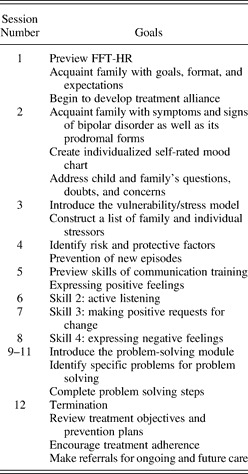
How would FFT be adapted to the developmental requirements of high-risk children, given that they have not yet developed bipolar illness? In the following sections, we outline the structure and content of a version of FFT-HR. FFT-HR consists of 12 sessions over 4 months (8 weekly and then 4 biweekly; see Table 1). This treatment, which is carried out with the high-risk child, his or her parents, and siblings is currently being evaluated in a treatment development study by the University of Colorado, Boulder, and the Stanford University School of Medicine (D. Miklowitz [PI] and K. Chang [Co-PI]; NIMH Grant R34-MH077856). Consistent with the literature reviewed above, children are chosen for the study if they (a) have at least one first-degree relative with BD I or II, (b) have a diagnosis of BD-NOS, cyclothymic disorder, or major depressive disorder, and (c) currently have active symptoms of mania or depression.
Session by session plan for the family-focused treatment for high–risk youth (FFT-HR)

The objectives of FFT-HR are to assist families to (a) recognize the symptoms of recurrent mood disorder, notably the prodromal symptoms of developing episodes; (b) understand the child's potential vulnerability to future significant mood episodes or variability; (c) accept the potential role of medications in managing mood states (where applicable); (d) distinguish mood-dysregulated behavior from normative child or teen behavior; (e) identify stress triggers for mood swings and develop plans to arrest mood escalations or deteriorations; and (f) operate at a more effective level in family communication and problem solving.
Psychoeducation (Sessions 1–4)
Families are first acquainted with the goals and expectations of the FFT program. The family is given a self-care manual (Miklowitz & George, Reference Miklowitz and George2008) that outlines the major symptoms of mood disorder in children, the risk factors, the most effective treatments, and self-management tools. The goal of Session 2 is to acquaint the family with the signs and symptoms of severe mood disorder and its subsyndromal and prodromal forms. This task is aided by a handout that distinguishes, in three columns, “mood disorder symptoms,” “mood dysregulation symptoms,” and “ordinary moodiness.” The handout structures the discussion of how the at-risk child's moodiness does and does not differ from what is normative for his or her age. The child is also encouraged to chart her moods and sleep/wake rhythms on a daily basis using a mood chart (www.bpkids.org).
In Session 3, the family is acquainted with the FFT vulnerability/stress model. The clinician explains that “genetics is not destiny” and the trajectory the child follows will depend on his or her individual balance of risk and protective factors. The role of medications in stabilizing mood and addressing biological vulnerabilities is discussed. Clinicians then ask participants to identify stressors that are currently affecting the child: family conflicts, sibling rivalries, peer or romantic relationships, or school, neighborhood, or extended family stressors.
Next, clinicians explain the nature of risk factors (e.g., alcohol and drug usage; provocative interpersonal interactions) and protective factors (e.g., compliance with medications; regular sleep/wake cycles; effective family communication and problem solving). Methods to decrease the occurrence of behaviors that put the child at even higher risk for adverse outcomes (e.g., substance abuse, unsafe sex, drunk driving) are discussed as appropriate. A handout gives recommendations for stress reduction strategies relevant to the home environment (e.g., maintaining a tolerant and low-key family atmosphere; using emotional self-regulation techniques).
In Sessions 4–5, the family develops a plan for controlling the escalation of mood swings. The relapse drill, conducted when the child is in a stable mood, outlines strategies for medical or behavioral intervention if the child's moods start to deteriorate. Parents, index children, and siblings recall previous periods of mood instability (their own and the index child's) and identify sequences consisting of triggers, early warning signs of mood episodes, and palliative measures. With the aid of a flip chart, the clinician guides the family toward an early intervention/prevention plan, typically involving no suicide/no harm contracts, emergency psychiatric reevaluations for medication changes, reducing stress triggers at home, and stabilizing sleep/wake rhythms.
Communication enhancement training (Sessions 5–8) acquaints families with four skills: expressing positive feelings, active listening, making positive requests for change, and expressing negative feelings/constructive criticism. The clinician first emphasizes the link between effective family communication and mood stability (Simoneau, Miklowitz, Richards, Saleem, & George, Reference Simoneau, Miklowitz, Richards, Saleem and George1999; Snyder, Castellani, & Whisman, Reference Snyder, Castellani and Whisman2006). As each skill is introduced, the family is taken through six steps: (a) learn the components of the skill with the aid of a handout (e.g., for active listening: paraphrasing, keeping eye contact), (b) observe the clinician modeling the skill, (c) practice the skill with each other, (d) obtain feedback from the paired partner, (e) practice the skill again with the same or a different family member, and (f) complete a between-session homework task involving practicing the skill.
Problem-solving skills training (Sessions 9–12) encourages families to dialogue about difficult problem topics, break down large problems (i.e., “we don't get along”) into smaller ones (“we need to use lower tones of voice”), generate and evaluate the pros and cons of various solutions, agree upon a best set of solutions, and choose one or more solutions to implement (e.g., alert each other when tones of voice become aggressive). Problem solving focuses on enhancing functional capacity and quality of life as well as symptom control. Examples of issues covered in problem solving include strategies to increase consistency with medications, complete school homework, resolve disagreements over housework, get along with teachers, and reduce overstimulation before bedtime. Problem solving also involves instruction in strategies for the parents or siblings to manage their own tempers or emotions (e.g., using self-talk or relaxation techniques).
The protocol is being developed on the basis of a 12-case open trial at the two sites. Feedback from these initial cases will be used to develop a clinicians' treatment manual. Once the manual has been finalized, a small-scale randomized trial (N = 40) at the University of Colorado and Stanford University will examine the efficacy of FFT-HR and regular meetings with a psychiatrist versus psychiatrist meetings alone in improving the longitudinal trajectory of mania and depression symptoms, delaying the onset of first manic or hypomanic episodes, and enhancing the family's ability to advocate for appropriate care for their child.
Conclusions and Future Directions
This review has expressed the hopeful view that BD can be recognized in its earliest stages and treated such that the first onset of the disorder is delayed or even prevented. Family-focused treatment is one of many possible ways that early intervention could proceed; other alternatives might include interpersonal therapy to focus on management of social problems and regulation of social and circadian rhythms, or individual or group cognitive–behavioral therapy to teach adaptive thinking and emotional self-regulation skills.
Despite important advances, relatively little is known about the actual constellation of risk and protective factors that most accurately predict the onset of BD, or the weighting of genetic, neurobiological, social, familial, or cultural factors at different stages of development. Arguably, elucidation of these developmental trajectories is a necessary precursor to fully effective preventive interventions, especially if therapeutic targets at different developmental phases could be specified. Studies that examine the interactions of genetic, neurobiological, and environmental factors should be helpful in specifying these intervention targets.
We have long known that differences in the social environment can lead to differences in gene expression and variations in brain structure or function, and recursively, that variations in genetic vulnerability or brain function can lead to the differential selection of environments. The puzzle is how best to examine the role of environmental variables while controlling for the role of genetic factors, and the reverse. Studies of the role of the environment in sibling pairs or identical twins can help control for the role of shared environmental factors and enable examination of the role of nonshared familial or other environmental factors. To borrow an example from the literature on antisocial behavior, Caspi et al. (Reference Caspi, Moffitt, Morgan, Rutter, Taylor and Arseneault2004) showed that, among identical twin pairs, the twin to whom the mother expressed more emotional negativity and less warmth was at greater risk for the development of antisocial behavior than the twin to whom the mother expressed less negativity and more warmth. Similar experimental designs could be usefully applied to sibling or twin pairs in which one has BD, to clarify how different stressors lead to differences in gene expression and the likelihood of developing mood episodes.
Understanding these diverse developmental pathways would help us to tailor our early intervention and prevention efforts, which may mean designing interventions differently for children with different prodromal presentations. For prodromal children with the highest genetic loadings for mood disorder, early intervention with medications may have a tremendous impact on later outcomes. In contrast, youths for whom environmental–contextual factors play a central role in episode onset (e.g., adolescent-onset girls with a history of sexual abuse and high current family conflict) may benefit most from interventions that focus on enhancing the protective effects of the immediate social environment, with pharmacotherapy introduced only as a rescue strategy.
Finally, the results of studies of preventive interventions may elucidate the nature of genetic, biological, social, and cultural mechanisms. Indeed, if early intervention trials show that modifying family interactions reduces the risk of earlier bipolar onsets, we will have evidence that family processes play causal rather than reactive roles in some of the developmental trajectories to BD. In parallel, if treatment-associated changes in neurobiological risk markers (such as amygdalar volume) ameliorate the trajectory of early mood symptoms or comorbidities, we can develop hypotheses about the causal primacy of these biological risk markers. The next generation of developmental research on BD should address these questions.