Introduction
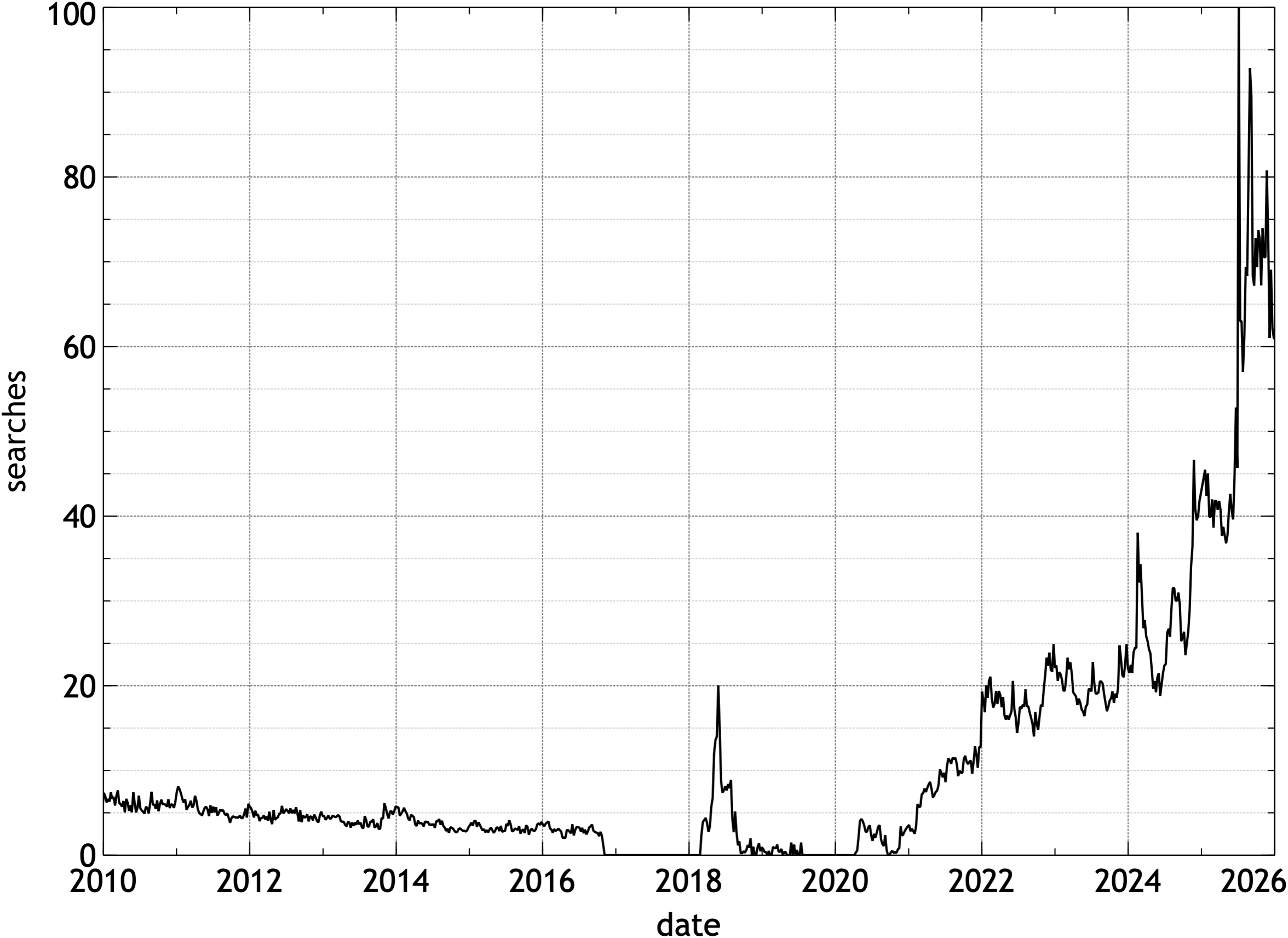
Although scientific interest in the Arctic has been strong, and internationally coordinated, for some decades, it has not been much in the public eye until recently. Science has generally been grateful to operate in a low-tension geopolitical backwater. This situation has changed rather dramatically over the last few years, as public interest in the region has accelerated (Figure 1). Recent controversy about the status of Greenland has obviously contributed to geopolitical fragility, but destabilising pressures had been growing for years before this, and it can be argued that the Greenland debate, and the realigned strategic thinking around it, is only the second shock of the 21st century administered to peaceful scientific cooperation in the Arctic. The first of these was the international response to Russia’s full-scale invasion of Ukraine in February 2022, which led to sanctions imposed on research collaboration between many countries and Russia. While it is geographically obvious that Russia comprises half of the Arctic region (Figure 2), the current rupture in international relations is more than merely a diplomatic inconvenience. For environmental scientists, this isolation has created an acute problem not least because we are losing the ability to accurately monitor and predict climate impacts in a region containing several of the planet’s climate “tipping elements” (Armstrong McKay et al., Reference Armstrong McKay, Staal, Abrams, Winkelman, Sakschewski, Loriani and Lenton2022). In practical terms, this means that large parts of the Arctic system, including extensive permafrost regions, river basins and long-term environmental monitoring networks, have become significantly more difficult for the international scientific community to access, analyse or integrate into collaborative research programmes. The interruption of collaboration therefore risks fragmenting the observational and analytical networks on which long-term Arctic climate research depends. The terrestrial Arctic has a marked hemispherical asymmetry (in climate history, distribution of permafrost and of plant functional types, and in human settlement patterns), and it has been argued that effective climate science requires sustained international collaboration, in the Arctic as least as much as elsewhere (Büntgen & Rees, Reference Büntgen and Rees2023; Rees & Büntgen, Reference Rees and Büntgen2024). The world is also waking up to the idea that “what happens in the Arctic does not stay in the Arctic” (Whiteman & Yumashev, Reference Whiteman and Yumashev2018), that is, that the region has an impact on, and ability to indicate the state of, the earth’s climate disproportionate to its size.
Figure 1.
Number of worldwide Google searches for the topic “Arctic,” 2010–2025. Weekly data extracted from Google Trends, scaled to a maximum value of 100.
Despite the rapidly increased interest in the Arctic, and the urgency of studying it collaboratively, it has become very much harder to do so in recent years. The abrupt severing of links between Russia and many of the world’s liberal democracies has severely degraded the landscape for international collaboration in the region. Links between institutions have been most heavily impacted, and while those between individuals have proved more resilient, there are still serious obstacles to working in the “grey zone” of international collaboration (Nielsen & Kaisto, Reference Nielsen and Kaisto2024). Negative impacts on individual researchers are becoming alarmingFootnote 1.
Why is this important? The scientific significance of the Arctic is not in doubt, and anything that weakens our ability to properly investigate and understand it is highly regrettable. But science in the Arctic has traditionally (i.e. since the end of the Cold War) been more than just a means for enhancing our collective understanding of the natural world. It became tightly linked with the wish to depoliticise the Arctic as a region and to see it as a forum for constructive engagement between countries that were otherwise politically not well aligned. The conceptual framework for science diplomacy was often defined by the joint Royal Society (RS) – American Association for the Advancement of Science (AAAS)’s 2010 joint report (Koppelman et al., Reference Koppelman, Day, Davison, Elliott and Wilsdon2010) which championed scientific engagement as a tool for building bridges and projecting “soft power.” All three aspects of this traditional view of Science Diplomacy – “Science in Diplomacy,” whereby scientists provide advice to their foreign ministries, “Diplomacy for Science,” where diplomatic activity facilitates international collaboration, and “Science for Diplomacy,” where research cooperation improves international relations – were strongly represented during the period from around 1990 into the 2010s. Geopolitically valuable networks of trust were constructed, tension was reduced, and the sense that the Arctic could function almost as a region free from politics was widespread (Young, Reference Young2000).
Notwithstanding increasing militarisation, the Arctic is probably not about to become a battlefield in the immediate future, but the political atmosphere has become denser. Trust has decreased; suspicion has increased, and activities that would once have been regarded as politically neutral can now be reframed as security risks (Szkarłat, Reference Szkarłat2025). In a significant updating of the consensus view of science diplomacy, the RS/AAAS report (Royal Society, 2025) emphasises the change in function of science diplomacy to reflect the need to actively defend scientific neutrality against a background of increased strategic competition. While this is a global phenomenon, it is telling that the first case study provided in the RS/AAAS report of 2025 is about the Arctic. In this article, I will reflectFootnote 2 on these changes and whether Arctic science diplomacy has entered a new, post-exceptionalism, phase in which cooperation is still possible, but no longer axiomatic (Landriault, LaFortune, & Poelzer, Reference Landriault, LaFortune and Poelzer2024).
A note on terminology is necessary here. This paper draws heavily on the author’s own experience and observation within European and UK research networks, and the concept of international cooperation will often be interpreted with reference to Western–Russian links. As discussed in more detail below, sanctions and restrictions on research collaboration were very widely adopted by Western states in 2022, but this was not through UN-mandated international law. Indeed, many other countries maintained, expanded or developed scientific and diplomatic engagement with Russia in the subsequent years.
How exceptional was Arctic exceptionalism in science?
The idea of “Arctic exceptionalism” initially emerged as a geopolitical concept, whereby the High North could operate as a zone of peace and stability across international boundaries, largely insulated from international rivalries. Translated into science policy, this promoted the idea that research cooperation could act as a depoliticised channel for dialogue across borders, while also benefiting from reduced diplomatic friction (Berkman et al., Reference Berkman, Kullerud, Pope, Vylegzhanin and Young2017; Bertelsen, Reference Bertelsen2020). Within this framework, from roughly the end of the Cold War, and into the early 21st century, Arctic science occupied a distinctive diplomatic position. Modern-era cooperation in the Arctic can be traced to the 1987 Murmansk Initiative of Mikhail Gorbachev, which proposed that the region be transformed from one of tension and confrontation into a “zone of peace” focused on environmental protection, scientific research and building of confidence (Devyatkin, Reference Devyatkin2023). Political and scientific cooperation developed in tandem. The International Arctic Science Committee (IASC) was established in 1990. The Rovaniemi Process (Arctic Environmental Protection Strategy) was established by the then eight Arctic states in 1991. IASC’s International Science Initiative in the Russian Arctic (ISIRA) was founded in 1994 on the initiative of Odd Rogne, first Executive Secretary of IASC, as an advisory body and contact group between Russian and Western Arctic science (Pavlenko et al., Reference Pavlenko, Zaika, Cooper, Yoshihiro and Rees2021). The Arctic Council (AC) was established in 1996 as a political forum, with the eight Arctic states as permanent members, represented by their respective foreign ministers, together with non-governmental and intergovernmental members. In 1998, four non-Arctic states (Germany, the Netherlands, Poland and the United Kingdom) were admitted as observers, a list which has grown substantially over subsequent years (Figure 3).
Figure 3.
State membership of the Arctic Council (AC) and the International Arctic Science Committee (IASC) as at the end of 2025.
Note: Singapore (not visible at the map scale) is an AC Observer. Background map: Natural Earth.
Collaborative research in the Russian Arctic was encouraged and facilitated directly by IASC, with guidance from ISIRA, and also through the Working Groups of the AC. The foundation of the University of the Arctic in 2001 (Nicol, Beaulieu, and Hirshberg, Reference Nicol, Beaulieu, Hirshberg, Sellheim and Menezes2022; Poelzer, Reference Poelzer2007) and the creation of the EU INTERACT transnational access scheme in 2011 (Johansson & Callaghan, Reference Johansson and Callaghan2025) especially facilitated the development of peer-to-peer, “bottom-up” research collaborations in addition to policy-driven “top-down” projects. Most Arctic states, and some non-Arctic states, explicitly or implicitly recognised the value of Arctic science diplomacy and directed resources to it from the 1990s onwards. In many cases, scientific cooperation was embedded within formal strategic Arctic policy documents, and Arctic science was recognised not only as a neutral knowledge-gathering activity but also as a diplomatic lever.Footnote 3 The fourth International Polar Year (IPY), whose activity culminated in 2007–2008, provided a major focus for Russian – as well as other – engagement in international Arctic science (Rees & Büntgen, Reference Rees and Büntgen2024).
This period of “exceptionalism” was set against a favourable geopolitical background as much as it depended on the implementation of scientific norms. Strategic interests in the Arctic did not exactly disappear, but they operated in the background, and scientific collaboration across borders took place within – but also helped to enhance – the relatively stable geopolitical environment and high levels of trust that existed (Young, Reference Young2019). From the late 2000s onwards, however, the strategic dimensions of Arctic politics began to re-emerge more visibly (Dodds, Reference Dodds2010). Russian military modernisation in the Arctic (Boulègue et al., Reference Boulègue, Bronk, Hird, Kerr, Lee and Petersen2024), renewed NATO attention to northern defence (Olsen, Reference Olsen2018), and growing international interest in Arctic shipping routes and natural resources (Humpert & Raspotnik, Reference Humpert and Raspotnik2012) gradually reframed the region as one of strategic competition as well as environmental cooperation. These developments did not immediately disrupt scientific collaboration, but they weakened the political assumptions that had helped sustain the idea of exceptionalism (Berkman, Reference Berkman2020).
Arctic exceptionalism was not unique in integrating Russian science and technological development into international endeavours. Other notable examples that could be considered include the International Space Station (ISS), CERN and the ITER nuclear fusion reactor programme (Payette, Reference Payette2012), as well as Russian participation in Antarctic research under the Antarctic Treaty System (ATS). The last named provides the closest parallel to the Arctic, but there are important differences (Konyshev, Reference Konyshev2023). While endeavours such as the ISS maintained focused cooperation across geopolitical and ideological divides, the ideals of both Arctic and Antarctic collaboration provided a space in which to engage in research beyond specific disciplinary or institutional focus. However, while Antarctic research takes place within a governance regime in which territorial sovereignty claims are suspended, Arctic exceptionalism in science was a less formal political narrative, perhaps well summarised in the phrase “High North, Low Tension” adopted by the Norwegian government in 2005 under foreign minister Jonas Gahr Støre (Østhagen, Reference Østhagen2021).
The long turn from 2007 to 2022
Erosion of this settlement can be argued to date from February 2007, when Vladimir Putin addressed the Munich Security Conference. Putin argued that the USA was replacing UN-centred international law with a Western-dominated “rules-based order” and signalled a more confrontational stance by Russia against US-dominated institutions, firming up Russia’s 1990s-era Primakov foreign policy doctrine, according to which Russia, China and India should collectively aim to provide greater balance in international affairs. Arctic policy was affected almost immediately (Gosnell & May, Reference Gosnell and May2025): within half a year, Artur Chilingarov placed a titanium Russian flag on the sea bed at the north pole, declaring that “The Arctic is Russian.” While the flag-planting episode was legally meaningless, it was an evident manifestation of Russia’s new assertiveness in the region. At the same time, the Arctic itself was becoming more strategically significant. Declining sea ice increased expectations of new shipping routes and resource development, while technological advances made previously inaccessible regions more reachable. The Arctic began to feature more prominently in national security and economic planning among both Arctic and non-Arctic states.
Russian annexation of Crimea in 2014, and the beginning of war in the east of Ukraine, represented a second point of inflection, though the impact on Arctic-focused cooperation was mixed (Byers, Reference Byers2019; Klimenko, Reference Klimenko2014). Military-to-military cooperation in the region ceased, and some technological sanctions against Russia were introduced by Western countries which had the effect of reducing Russian access to the Arctic Ocean, amongst others. On the other hand, the AC became more active. In 2017, the eight permanent members of the AC (i.e. including Russia) signed the Agreement on Enhancing International Arctic Scientific Cooperation (the “Arctic Science Agreement”), which entered into force in May 2018. This was intended to facilitate movement of people, equipment and materials across borders, to enhance access to research infrastructure and data, and to promote education, career development, training and activities associated with traditional and local knowledge, across the (broadly drawn) Arctic (Arctic Science Agreement – International Arctic Science Committee, no date). In 2019, a survey conducted by the University of the Arctic (Ward, Vlasova, & Latola, Reference Ward, Vlasova and Latola2019) suggested that the agreement had been largely effective in its aims, with increased cross-border research and appreciation of its importance.
State engagement with Arctic science diplomacy continued through this period. An illustration is provided by UK involvement. A significant strand of British science diplomacy was managed through the Science and Innovation Network (SIN), funded jointly through the Foreign, Commonwealth and Development Office (FCDO) and the Department for Business, Energy and Industrial Strategy (BEIS). While high politics between the UK and Russia suffered serious setbacks during this period (especially following the fatal poisoning of Alexander Litvinenko in 2006 and the near-fatal poisoning of Sergei Skripal in 2018) (Ilbiz, Yilmaz, & Edwards, Reference Ilbiz, Yilmaz and Edwards2026), the Moscow office of SIN maintained effective contact at a lower level. Arctic science diplomacy formed a significant part of this, facilitated through Arctic Science Workshops, implementation of the UK’s 2013 Arctic Policy Framework, enacting the AC’s 2017 agreement (Berkman et al., Reference Berkman, Kullerud, Pope, Vylegzhanin and Young2017), and support of bilateral research projects through bursaries and larger matched-funding grants (Rees, Reference Rees2021). Other Arctic-engaged countries operated similar mechanisms, and networks of trust and understanding between peers in Russia and the Western world continued to develop and be maintained. At the same time, the USA appeared at times as an unpredictable partner, with shifting rhetoric and climate policy contributing to decreased confidence in global science (Olesen, Reference Olesen2020).
The last scene in this act came in 2022, immediately following Russia’s full-scale invasion of Ukraine that began on 24 February. Political relations that had been deteriorating were abruptly severed. Borders were closed, sanctions were imposed mainly by EU, UK, USA and allied states, and military alliances and deployments in the north were changed (Koivurova & Shibata, Reference Koivurova and Shibata2023). Very rapidly, global scientific collaboration with Russia transitioned from open science to something more like “strategic securitisation” (Szkarłat, Reference Szkarłat2025), regionalising something like this. Strictest and most immediately, many European countries, led by northern and Baltic states and strongly influenced by the EU, introduced an institutional freeze on scientific collaboration (“Commission suspends cooperation with Russia on research and innovation”, 2022). The UK and USA (Guidance On Scientific and Technological Cooperation with the Russian Federation for U.S. Government and U.S. Government Affiliated Organizations | OSTP, 2022) not only severed institutional links rapidly but also allowed a broader “grey zone” in which peer-to-peer communication could operate. Indo-Pacific nations generally adopted more limited and strategically targeted sanctions, on specific institutions, economic sectors and technologies (Heng and Freymann, Reference Heng and Freymann2023). On the other hand, Russian scientific collaboration with the Global South and BRICS+Footnote 4 nations increased, at least at institutional and diplomatic levels. For example, Moscow proposed developing a dedicated Arctic research hub in Svalbard (Moe & Jørgensen, Reference Moe and Jørgensen2025). In practice, however, this reorientation of research collaboration was uneven and dominated by Sino-Russian oceanographic and satellite monitoring activity focused on the Northern Sea Route (Jüris, Reference Jüris, Kirchberger, Sinjen and Wörmer2022).
However, even in Western countries such as the UK where continued peer-to-peer contact was permitted, effective collaboration shrank very rapidly (Nielsen and Kaisto, Reference Nielsen and Kaisto2024; Rees and Büntgen, Reference Rees and Büntgen2024; Zaika, Reference Zaika2024). While the official position could sometimes be regarded as “constructively ambiguous” (“don’t ask me to say yes so I won’t have to say no”), individual researchers were generally nervous of maintaining contact with Russian colleagues – who were often also their friends – for fear of placing them in danger, or inhibited from acting in a way that could be taken to imply endorsement of Russia’s actions. Travel to Russia to participate in fieldwork or conferences, while legally possible, was generally impractical since universities and research institutes would not endorse or insure travel to countries identified as unsafe by foreign ministries. Some workarounds were developed, such as meeting Russian colleagues in neutral countries, or even using such countries as geographical substitutes for Russia itself. On the other hand, travel to such countries could become difficult for Russian researchers, especially those at early and less secure stages of their careers. Data collected from instruments in Russia could sometimes be smuggled out of the country, although this could place Russian colleagues at risk of legal process. Where the decision was taken to maintain contact, online communication channels, in whose use many had become adept during the worldwide disruption of the SARS-CoV-2 pandemic just a few years earlier, remained for the most part reliable, and it was possible to discuss, for example, agreed measurement protocols so that new data could be collected, in the hope of meeting in person to discuss them at a later date. Although academic journals adopted varying policies regarding Russian authorship, peer-reviewed publication with authorship shared between Russian and Western scientists remained possible, and existing datasets could be worked up for peer-reviewed publication. Some countries even maintained early career exchange schemes, permitting Russian researchers to travel temporarily to Western countries (although the reverse mostly ceased to be possible). However, none of these workaround solutions solved the problem of extending the “networks of trust” on which peer-to-peer collaborative research depends. Existing networks began to atrophy, while new ones could scarcely be contemplated. While hugely damaging within the physical sciences, this was clearly catastrophic in the social sciences.
Institutions under strain
The AC and peaceful collaboration were historically mutually reinforcing. Major assessments such as the Arctic Climate Impact Assessment demonstrated the capacity of scientifically informed processes to shape global governance. However, the AC is now functioning only in a diminished mode. At the time of the full-scale invasion of Ukraine, the chair of the AC was coincidentally held by Russia. The other seven countries (the “Arctic Seven,” A7) issued a joint statement just seven days after the invasion, declaring a temporary “pause” in all the Council’s activities (Regeringskansliet, Reference Regeringskansliet2022). All formal meetings of the Senior Arctic Officials and the six Working Groups were suspended.
This initial, absolute stance relaxed somewhat into a more pragmatic one, on both sides. In June 2022, the A7 announced a limited resumption of projects that “did not involve Russian participation” (Madani, Reference Madani2022) – a development driven in part by recognition that complete paralysis was contrary to Western environmental and scientific interests. Russia, for its part, exercised restraint and allowed the legal framework of the AC to persist. This mutual interest in preventing complete collapse of the AC facilitated the orderly transfer of chairmanship of the council to Norway in May 2023, when all eight member states agreed a written procedure for decision-making that bypassed the need for in-person meetings (Balton and Haig, Reference Balton and Haig2026). In February 2024, the AC reached a consensus to resume activity of the Working Groups, although these can currently meet only online rather than in person. This “working-level” mode was further formalised when the Kingdom of Denmark assumed the chair of the AC in May 2025, prioritising technical and human-centred issues such as indigenous health, while maintaining the suspension of high-level political meetings (Council, 2025). The overall function of the AC can be described now as primarily technical, rather than diplomatic.
Although IASC also underwent a seismic shift in 2022, its experience has been somewhat different from that of the AC (Enomoto, Reference Enomoto2022). As a non-governmental scientific organisation, it is less politically constrained than the AC. However, it was also forced to adopt a position extremely quickly in response to the February invasion and its immediate geopolitical consequences, since the Arctic Science Summit Week (ASSW), the big annual international meeting run by IASC that sets the agenda for Arctic research, was scheduled to take place in Norway in March 2022 (IASC Statement on Ukraine – International Arctic Science Committee, 2022). The ASSW local organising committee in Tromsø condemned the invasion but proceeded with the conference and declared that it would remain open to individual Russian researchers, provided that they were not acting as representatives of Russian institutions (ASSW 2022 Statement on Ukraine, 2022). This hybrid approach to sanctions was adopted by IASC in an attempt to maintain peer-to-peer collaboration, at least in latent form. However, the functioning of IASC was still compromised (López-Blanco et al., Reference López-Blanco, Topp-Jørgensen, Christensen, Rasch, Skov, Arndal and Schmidt2024). While the IASC Council continued to allow and indeed encourage Russian participation, in practice none took place until March 2026, and it remains impossible for Russia to make the required financial contribution to IASC as a result of prohibition on banks in Iceland (where IASC is legally registered) receiving money from Russia.
Other institutions and organisations with a brief for facilitating transborder research and educational links in the Arctic were inevitably also profoundly affected by the 2022 invasion and its consequences. UArctic, whose membership is defined institutionally, paused the membership of all 55 Russian institutions (Russian Membership Paused, 2023) and cancelled its annual congress scheduled to take place in Moscow in 2022. Like IASC, it attempted to find a way to keep sub-institutional links open by declaring that collaborations between researchers within its Thematic Networks could continue, provided they did not breach national sanctions, and by allowing Russian students who were already enrolled in exchange programmes to continue, although it did not permit new activity of this kind. The INTERACT network was placed in an even more difficult position in 2022. As a consortium bound by European Commission grant agreements, its response was legally mandated. All 21 Russian research stations were officially placed “on pause” from 9 April 2022 and were removed from Phase III of the project (Johansson & Callaghan, Reference Johansson and Callaghan2025). Both transnational access agreements and flow of data from field stations ceased (Figure 4). Although the legal status of INTERACT has changed subsequently, its activities remain strongly bound by EU law, and its Russian activities remain frozen (Figure 4).
Figure 4.
Locations of active and paused INTERACT sites and UArctic members (headquarters or main campus if geographically distributed). Some Southern Hemisphere UArctic members are not included within the mapped area.
Figure 4. Long description
A map displaying the locations of active and paused INTERACT sites and UArctic members across the Arctic region. The map includes markers for both active and paused sites, with blue dots representing active sites and red dots representing paused sites. The map covers a large portion of the Northern Hemisphere, including parts of North America, Europe, and Asia. Key labeled locations and geographic features such as major landmasses and bodies of water are visible. The map uses a grid overlay to help locate the sites more precisely. The purpose of the map is to show the distribution and status of scientific research sites and members in the Arctic region.
Practical suggestions for resilience in Arctic institutions have begun to emerge, and there may be reasons to hope for better weather in future, but, for now, it seems likely that Arctic cooperation will remain regional and subregional, with more bilateral agreements and perhaps more significance attached to the constructive roles that can be played by non-Arctic states. Here, what seems to be a clear division is emerging as the traditional, principally European, AC observer states maintain subregional science networks across the Arctic, while Asian and BRICS+ non-Arctic states, such as India and China, are increasingly active as operational partners in the Russian north (Argüello & Rafaly, Reference Argüello and Rafaly2023).
Strategic research planning under constraint
The two principal mechanisms by which international strategic planning and coordination of Arctic research take place operate on somewhat different timescales and with different remits. ICARP, the International Conference on Arctic Research Planning, provides a consensus-based framework for articulating research priorities, while the IPYs mobilise global participation and visibility (and are, self-evidently, not concerned solely with the Arctic). The ICARP process began in 1995, and conferences have taken place at decadal intervals with the most recent, ICARP IV, in Boulder, USA, in 2025 (ICARP IV Summit Statement: The ICARP IV Summit marked a critical moment to shape the future of Arctic research – International Conference on Arctic Research Planning – ICARP, 2025). The first IPY was organised in 1882–83, since when there have been three more (1932–33, 1957–58 [also known as the International Geophysical Year] and 2007–08), at intervals of 25 or 50 years. The fifth IPY is now being planned for 2032–33, 25 years after the previous one, with an urgency of timing dictated at least in part by accelerating climate change (IPY5, no date).
The coincidence in timing, with the decadal meeting of ICARP occurring just seven years before the next IPY, has been advantageous. ICARP’s mission has evolved since its establishment in the mid-1990s, from setting broad scientific agendas to addressing governance, resilience and societal role of Arctic research systems themselves. However, throughout this evolutionary process, it has maintained a focus on identifying research priorities and strengthening international collaboration. ICARP IV introduced the Research Priority Team (RPT) structure as a mechanism to translate consultation across the broad community (which itself evolved and enlarged during the evolution of ICARP) into focused analytical outputs. Among these teams, RPT4 focused specifically on conditions that enable or constrain Arctic research cooperation, including the role of science diplomacy, institutional structures and broad geopolitical realignments (Spence et al., Reference Spence, Barry and Smieszek-Rice2026). RPT4 identified several key drivers reshaping Arctic research cooperation, notably environmental shifts alongside rapid societal transformations (in demography, community adaptation and the growing assertion of indigenous sovereignty), increased strategic competition, vulnerability of research infrastructures, data systems and partnerships to political and funding instability, persistent imbalances in who participates in Arctic research and who benefits from it, and the opportunities and challenges created by emerging technologies such as satellite observing systems and digital infrastructures. Priority areas identified by RPT4 are to better understand Arctic science diplomacy in practice – how collaboration serves as a channel for cooperation, dialogue and confidence-building, to assess how Arctic research networks, infrastructures and funding mechanisms respond to political or institutional disruption, to evaluate the impacts of new technologies and governance arrangements on research collaboration and to embed indigenous leadership, co-production of knowledge and equitable participation within Arctic research systems.
A notable feature of the ICARP RPT4 report is its analytical treatment of geopolitical fragmentation. Rather than presenting current geopolitical tensions as a crisis or a collapse of cooperation, or indeed focusing on the actions of any particular country, the report frames them as a structural condition that Arctic research systems must learn to manage, with emphasis on strengthening institutional resilience, diversification of partnerships and funding structures, protecting critical research infrastructures and data systems, and maintaining multilateral coordination mechanisms.
After exceptionalism
The durability of Arctic science diplomacy over three decades following the end of the Cold War can be attributed to both shared scientific values and institutional design, but it was also influenced by favourable structural conditions. The Arctic was seen as something of a political “backwater” – geographically remote from political decision-making, relatively economically marginal and politically peripheral to the main geopolitical “hotspots” of the era (such as Eastern Europe, the Middle East and the Indo-Pacific). At the same time, the environmental challenges facing the region were increasingly widely understood to be complex and transboundary, which encouraged cooperation in data collection and research infrastructure. Arctic science was not unique in integrating Russia into international “big science” endavours, and being recognised for the diplomatic value of doing so, (Bertelsen, Reference Bertelsen2020), but Arctic science diplomacy was also distinctive through its cross-facility, cross-disciplinary character, grounded in low politics and exercised across inhabited and soverign territories. To a significant degree, then, Arctic exceptionalism reflected a particular geopolitical epoch rather than a permanently insulated domain of international relations.
Arctic science diplomacy has not ended. Working-level contacts persist across national boundaries, research continues and new forms of cooperation are emerging. What has changed is the enveloping atmosphere. Exceptionalism, understood as the assumption that Arctic science was insulated from geopolitics, has given way to a more conditional mode of engagement and perhaps shifted the balance of advantage between the different aspects of science diplomacy. The challenge now faced by research collaboration is not just to preserve existing institutions but also to adapt them to this new atmosphere in which trust cannot be presumed and neutrality may be contested. Science can still be a bridge between countries, but no longer automatically (Bertelsen, Reference Bertelsen2020; Konyshev, Reference Konyshev2023). At the same time, Russia has increasingly sought to deepen Arctic cooperation with partners outside the “Western” scientific community, notably with China through the intensified “Ice Silk Road” framework and through the expanded BRICS association, which held its 7th Polar Science Working Group in May 2025 (Strelnikova, Reference Strelnikova2025). Although these new Arctic connections are still largely focused on the marine environment, with limited engagement involving terrestrial field-based research, they do suggest further evolution of the configuration of Arctic research collaboration, potentially further fragmenting what was formerly a largely unified international scientific system.
Looking ahead, the trajectory of Arctic science diplomacy is likely to be defined by its ability to function within a multipolar system. The 28th ASSW in Århus, in March 2026, adopted the ICARP reports as the roadmap for the next decade of Arctic research, with a shift in focus towards a more resilient, but also more fragmented, approach. While the forthcoming fifth IPY, culminating in 2032–33, provides an exceptionally powerful opportunity to put this map into practice, Russian voices have been almost totally absent from the planning process till now. The challenge to fully integrate Arctic research across both the traditional east–west divide and along the burgeoning south–north axis led by the expanded BRICS and the Sino-Russian “Ice Silk Road” (Lanteigne, Reference Lanteigne2024; Strelnikova, Reference Strelnikova2025) has become more pressing. A further challenge is to embed indigenous leadership and equitable participation into these new configurations, as called for at the Boulder and Århus summits.
Conclusion
The arc of Arctic science diplomacy over the last 30 years has moved from a hopeful exceptionalism to a less optimistic realism and fragmentation of the “One Arctic” paradigm. The “Zone of Peace” was not a permanent feature of the geography but a managed diplomatic achievement of a specific epoch. Science is no longer planning for a unified Arctic but rather managing the effective continuation of research within a fragmenting system.
The challenge for the next decade, and specifically for the fifth IPY (2032–33), is to move beyond the dichotomy of total cooperation or total silence. The “conditional engagement” model recognises that while high-level diplomatic trust has evaporated, the technical and societal necessity of Arctic data remains absolute. As Russia deepens its collaborations through the BRICS Polar Science Working Group (Strelnikova, Reference Strelnikova2025) and its strategic pivot towards Asia (Lanteigne, Reference Lanteigne2024), Western institutions need to adapt to a much less integrated research landscape. Ultimately, the durability of Arctic science diplomacy will depend on our ability to maintain these technical activities through the persistence of peer-to-peer networks – ensuring that even in a fragmented political world, our collective understanding of the changing Arctic does not become a casualty of the new Cold War.
About the author (positionality statement)
This article is informed by over 30 years of collaborative research in the Russian Arctic and 25 years of direct engagement in Arctic science diplomacy, most notably through long-term membership of ISIRA and as a member of the ICARP IV RPT4 on Scientific Cooperation and Diplomacy. Having participated in the transition from the “high cooperation” era that culminated in the fourth IPY (2007–08) to the current fragmented landscape discussed at the 2025 Boulder and Århus summits, the author offers these reflections from a somewhat auto-ethnographic – and admittedly Western – perspective. Observations of peer-to-peer collaboration in the Russian Arctic, and discussions with many colleagues, provide the empirical basis for the description of the “grey zone” of collaboration and the “conditional engagement” model proposed in this paper. Any opinions expressed are, however, entirely the author’s.







 You have
Access
Introduction
Although scientific interest in the Arctic has been strong, and internationally coordinated, for some decades, it has not been much in the public eye until recently. Science has generally been grateful to operate in a low-tension geopolitical backwater. This situation has changed rather dramatically over the last few years, as public interest in the region has accelerated (Figure 1). Recent controversy about the status of Greenland has obviously contributed to geopolitical fragility, but destabilising pressures had been growing for years before this, and it can be argued that the Greenland debate, and the realigned strategic thinking around it, is only the second shock of the 21st century administered to peaceful scientific cooperation in the Arctic. The first of these was the international response to Russia’s full-scale invasion of Ukraine in February 2022, which led to sanctions imposed on research collaboration between many countries and Russia. While it is geographically obvious that Russia comprises half of the Arctic region (Figure 2), the current rupture in international relations is more than merely a diplomatic inconvenience. For environmental scientists, this isolation has created an acute problem not least because we are losing the ability to accurately monitor and predict climate impacts in a region containing several of the planet’s climate “tipping elements” (Armstrong McKay et al., Reference Armstrong McKay, Staal, Abrams, Winkelman, Sakschewski, Loriani and Lenton2022). In practical terms, this means that large parts of the Arctic system, including extensive permafrost regions, river basins and long-term environmental monitoring networks, have become significantly more difficult for the international scientific community to access, analyse or integrate into collaborative research programmes. The interruption of collaboration therefore risks fragmenting the observational and analytical networks on which long-term Arctic climate research depends. The terrestrial Arctic has a marked hemispherical asymmetry (in climate history, distribution of permafrost and of plant functional types, and in human settlement patterns), and it has been argued that effective climate science requires sustained international collaboration, in the Arctic as least as much as elsewhere (Büntgen & Rees, Reference Büntgen and Rees2023; Rees & Büntgen, Reference Rees and Büntgen2024). The world is also waking up to the idea that “what happens in the Arctic does not stay in the Arctic” (Whiteman & Yumashev, Reference Whiteman and Yumashev2018), that is, that the region has an impact on, and ability to indicate the state of, the earth’s climate disproportionate to its size.
Number of worldwide Google searches for the topic “Arctic,” 2010–2025. Weekly data extracted from Google Trends, scaled to a maximum value of 100.
Spatial extent of the Arctic as defined by three of the Arctic Council’s Working Groups: AHDR, AMAP and CAFF. Map created by Arto Vitikka, Arctic Centre, University of Lapland. Reproduced with permission (https://arcticcentre.org/en/arctic-region/maps/definitions-of-the-arctic-region/).
Despite the rapidly increased interest in the Arctic, and the urgency of studying it collaboratively, it has become very much harder to do so in recent years. The abrupt severing of links between Russia and many of the world’s liberal democracies has severely degraded the landscape for international collaboration in the region. Links between institutions have been most heavily impacted, and while those between individuals have proved more resilient, there are still serious obstacles to working in the “grey zone” of international collaboration (Nielsen & Kaisto, Reference Nielsen and Kaisto2024). Negative impacts on individual researchers are becoming alarmingFootnote 1.
Why is this important? The scientific significance of the Arctic is not in doubt, and anything that weakens our ability to properly investigate and understand it is highly regrettable. But science in the Arctic has traditionally (i.e. since the end of the Cold War) been more than just a means for enhancing our collective understanding of the natural world. It became tightly linked with the wish to depoliticise the Arctic as a region and to see it as a forum for constructive engagement between countries that were otherwise politically not well aligned. The conceptual framework for science diplomacy was often defined by the joint Royal Society (RS) – American Association for the Advancement of Science (AAAS)’s 2010 joint report (Koppelman et al., Reference Koppelman, Day, Davison, Elliott and Wilsdon2010) which championed scientific engagement as a tool for building bridges and projecting “soft power.” All three aspects of this traditional view of Science Diplomacy – “Science in Diplomacy,” whereby scientists provide advice to their foreign ministries, “Diplomacy for Science,” where diplomatic activity facilitates international collaboration, and “Science for Diplomacy,” where research cooperation improves international relations – were strongly represented during the period from around 1990 into the 2010s. Geopolitically valuable networks of trust were constructed, tension was reduced, and the sense that the Arctic could function almost as a region free from politics was widespread (Young, Reference Young2000).
Notwithstanding increasing militarisation, the Arctic is probably not about to become a battlefield in the immediate future, but the political atmosphere has become denser. Trust has decreased; suspicion has increased, and activities that would once have been regarded as politically neutral can now be reframed as security risks (Szkarłat, Reference Szkarłat2025). In a significant updating of the consensus view of science diplomacy, the RS/AAAS report (Royal Society, 2025) emphasises the change in function of science diplomacy to reflect the need to actively defend scientific neutrality against a background of increased strategic competition. While this is a global phenomenon, it is telling that the first case study provided in the RS/AAAS report of 2025 is about the Arctic. In this article, I will reflectFootnote 2 on these changes and whether Arctic science diplomacy has entered a new, post-exceptionalism, phase in which cooperation is still possible, but no longer axiomatic (Landriault, LaFortune, & Poelzer, Reference Landriault, LaFortune and Poelzer2024).
A note on terminology is necessary here. This paper draws heavily on the author’s own experience and observation within European and UK research networks, and the concept of international cooperation will often be interpreted with reference to Western–Russian links. As discussed in more detail below, sanctions and restrictions on research collaboration were very widely adopted by Western states in 2022, but this was not through UN-mandated international law. Indeed, many other countries maintained, expanded or developed scientific and diplomatic engagement with Russia in the subsequent years.
How exceptional was Arctic exceptionalism in science?
The idea of “Arctic exceptionalism” initially emerged as a geopolitical concept, whereby the High North could operate as a zone of peace and stability across international boundaries, largely insulated from international rivalries. Translated into science policy, this promoted the idea that research cooperation could act as a depoliticised channel for dialogue across borders, while also benefiting from reduced diplomatic friction (Berkman et al., Reference Berkman, Kullerud, Pope, Vylegzhanin and Young2017; Bertelsen, Reference Bertelsen2020). Within this framework, from roughly the end of the Cold War, and into the early 21st century, Arctic science occupied a distinctive diplomatic position. Modern-era cooperation in the Arctic can be traced to the 1987 Murmansk Initiative of Mikhail Gorbachev, which proposed that the region be transformed from one of tension and confrontation into a “zone of peace” focused on environmental protection, scientific research and building of confidence (Devyatkin, Reference Devyatkin2023). Political and scientific cooperation developed in tandem. The International Arctic Science Committee (IASC) was established in 1990. The Rovaniemi Process (Arctic Environmental Protection Strategy) was established by the then eight Arctic states in 1991. IASC’s International Science Initiative in the Russian Arctic (ISIRA) was founded in 1994 on the initiative of Odd Rogne, first Executive Secretary of IASC, as an advisory body and contact group between Russian and Western Arctic science (Pavlenko et al., Reference Pavlenko, Zaika, Cooper, Yoshihiro and Rees2021). The Arctic Council (AC) was established in 1996 as a political forum, with the eight Arctic states as permanent members, represented by their respective foreign ministers, together with non-governmental and intergovernmental members. In 1998, four non-Arctic states (Germany, the Netherlands, Poland and the United Kingdom) were admitted as observers, a list which has grown substantially over subsequent years (Figure 3).
State membership of the Arctic Council (AC) and the International Arctic Science Committee (IASC) as at the end of 2025.
Note: Singapore (not visible at the map scale) is an AC Observer. Background map: Natural Earth.
Collaborative research in the Russian Arctic was encouraged and facilitated directly by IASC, with guidance from ISIRA, and also through the Working Groups of the AC. The foundation of the University of the Arctic in 2001 (Nicol, Beaulieu, and Hirshberg, Reference Nicol, Beaulieu, Hirshberg, Sellheim and Menezes2022; Poelzer, Reference Poelzer2007) and the creation of the EU INTERACT transnational access scheme in 2011 (Johansson & Callaghan, Reference Johansson and Callaghan2025) especially facilitated the development of peer-to-peer, “bottom-up” research collaborations in addition to policy-driven “top-down” projects. Most Arctic states, and some non-Arctic states, explicitly or implicitly recognised the value of Arctic science diplomacy and directed resources to it from the 1990s onwards. In many cases, scientific cooperation was embedded within formal strategic Arctic policy documents, and Arctic science was recognised not only as a neutral knowledge-gathering activity but also as a diplomatic lever.Footnote 3 The fourth International Polar Year (IPY), whose activity culminated in 2007–2008, provided a major focus for Russian – as well as other – engagement in international Arctic science (Rees & Büntgen, Reference Rees and Büntgen2024).
This period of “exceptionalism” was set against a favourable geopolitical background as much as it depended on the implementation of scientific norms. Strategic interests in the Arctic did not exactly disappear, but they operated in the background, and scientific collaboration across borders took place within – but also helped to enhance – the relatively stable geopolitical environment and high levels of trust that existed (Young, Reference Young2019). From the late 2000s onwards, however, the strategic dimensions of Arctic politics began to re-emerge more visibly (Dodds, Reference Dodds2010). Russian military modernisation in the Arctic (Boulègue et al., Reference Boulègue, Bronk, Hird, Kerr, Lee and Petersen2024), renewed NATO attention to northern defence (Olsen, Reference Olsen2018), and growing international interest in Arctic shipping routes and natural resources (Humpert & Raspotnik, Reference Humpert and Raspotnik2012) gradually reframed the region as one of strategic competition as well as environmental cooperation. These developments did not immediately disrupt scientific collaboration, but they weakened the political assumptions that had helped sustain the idea of exceptionalism (Berkman, Reference Berkman2020).
Arctic exceptionalism was not unique in integrating Russian science and technological development into international endeavours. Other notable examples that could be considered include the International Space Station (ISS), CERN and the ITER nuclear fusion reactor programme (Payette, Reference Payette2012), as well as Russian participation in Antarctic research under the Antarctic Treaty System (ATS). The last named provides the closest parallel to the Arctic, but there are important differences (Konyshev, Reference Konyshev2023). While endeavours such as the ISS maintained focused cooperation across geopolitical and ideological divides, the ideals of both Arctic and Antarctic collaboration provided a space in which to engage in research beyond specific disciplinary or institutional focus. However, while Antarctic research takes place within a governance regime in which territorial sovereignty claims are suspended, Arctic exceptionalism in science was a less formal political narrative, perhaps well summarised in the phrase “High North, Low Tension” adopted by the Norwegian government in 2005 under foreign minister Jonas Gahr Støre (Østhagen, Reference Østhagen2021).
The long turn from 2007 to 2022
Erosion of this settlement can be argued to date from February 2007, when Vladimir Putin addressed the Munich Security Conference. Putin argued that the USA was replacing UN-centred international law with a Western-dominated “rules-based order” and signalled a more confrontational stance by Russia against US-dominated institutions, firming up Russia’s 1990s-era Primakov foreign policy doctrine, according to which Russia, China and India should collectively aim to provide greater balance in international affairs. Arctic policy was affected almost immediately (Gosnell & May, Reference Gosnell and May2025): within half a year, Artur Chilingarov placed a titanium Russian flag on the sea bed at the north pole, declaring that “The Arctic is Russian.” While the flag-planting episode was legally meaningless, it was an evident manifestation of Russia’s new assertiveness in the region. At the same time, the Arctic itself was becoming more strategically significant. Declining sea ice increased expectations of new shipping routes and resource development, while technological advances made previously inaccessible regions more reachable. The Arctic began to feature more prominently in national security and economic planning among both Arctic and non-Arctic states.
Russian annexation of Crimea in 2014, and the beginning of war in the east of Ukraine, represented a second point of inflection, though the impact on Arctic-focused cooperation was mixed (Byers, Reference Byers2019; Klimenko, Reference Klimenko2014). Military-to-military cooperation in the region ceased, and some technological sanctions against Russia were introduced by Western countries which had the effect of reducing Russian access to the Arctic Ocean, amongst others. On the other hand, the AC became more active. In 2017, the eight permanent members of the AC (i.e. including Russia) signed the Agreement on Enhancing International Arctic Scientific Cooperation (the “Arctic Science Agreement”), which entered into force in May 2018. This was intended to facilitate movement of people, equipment and materials across borders, to enhance access to research infrastructure and data, and to promote education, career development, training and activities associated with traditional and local knowledge, across the (broadly drawn) Arctic (Arctic Science Agreement – International Arctic Science Committee, no date). In 2019, a survey conducted by the University of the Arctic (Ward, Vlasova, & Latola, Reference Ward, Vlasova and Latola2019) suggested that the agreement had been largely effective in its aims, with increased cross-border research and appreciation of its importance.
State engagement with Arctic science diplomacy continued through this period. An illustration is provided by UK involvement. A significant strand of British science diplomacy was managed through the Science and Innovation Network (SIN), funded jointly through the Foreign, Commonwealth and Development Office (FCDO) and the Department for Business, Energy and Industrial Strategy (BEIS). While high politics between the UK and Russia suffered serious setbacks during this period (especially following the fatal poisoning of Alexander Litvinenko in 2006 and the near-fatal poisoning of Sergei Skripal in 2018) (Ilbiz, Yilmaz, & Edwards, Reference Ilbiz, Yilmaz and Edwards2026), the Moscow office of SIN maintained effective contact at a lower level. Arctic science diplomacy formed a significant part of this, facilitated through Arctic Science Workshops, implementation of the UK’s 2013 Arctic Policy Framework, enacting the AC’s 2017 agreement (Berkman et al., Reference Berkman, Kullerud, Pope, Vylegzhanin and Young2017), and support of bilateral research projects through bursaries and larger matched-funding grants (Rees, Reference Rees2021). Other Arctic-engaged countries operated similar mechanisms, and networks of trust and understanding between peers in Russia and the Western world continued to develop and be maintained. At the same time, the USA appeared at times as an unpredictable partner, with shifting rhetoric and climate policy contributing to decreased confidence in global science (Olesen, Reference Olesen2020).
The last scene in this act came in 2022, immediately following Russia’s full-scale invasion of Ukraine that began on 24 February. Political relations that had been deteriorating were abruptly severed. Borders were closed, sanctions were imposed mainly by EU, UK, USA and allied states, and military alliances and deployments in the north were changed (Koivurova & Shibata, Reference Koivurova and Shibata2023). Very rapidly, global scientific collaboration with Russia transitioned from open science to something more like “strategic securitisation” (Szkarłat, Reference Szkarłat2025), regionalising something like this. Strictest and most immediately, many European countries, led by northern and Baltic states and strongly influenced by the EU, introduced an institutional freeze on scientific collaboration (“Commission suspends cooperation with Russia on research and innovation”, 2022). The UK and USA (Guidance On Scientific and Technological Cooperation with the Russian Federation for U.S. Government and U.S. Government Affiliated Organizations | OSTP, 2022) not only severed institutional links rapidly but also allowed a broader “grey zone” in which peer-to-peer communication could operate. Indo-Pacific nations generally adopted more limited and strategically targeted sanctions, on specific institutions, economic sectors and technologies (Heng and Freymann, Reference Heng and Freymann2023). On the other hand, Russian scientific collaboration with the Global South and BRICS+Footnote 4 nations increased, at least at institutional and diplomatic levels. For example, Moscow proposed developing a dedicated Arctic research hub in Svalbard (Moe & Jørgensen, Reference Moe and Jørgensen2025). In practice, however, this reorientation of research collaboration was uneven and dominated by Sino-Russian oceanographic and satellite monitoring activity focused on the Northern Sea Route (Jüris, Reference Jüris, Kirchberger, Sinjen and Wörmer2022).
However, even in Western countries such as the UK where continued peer-to-peer contact was permitted, effective collaboration shrank very rapidly (Nielsen and Kaisto, Reference Nielsen and Kaisto2024; Rees and Büntgen, Reference Rees and Büntgen2024; Zaika, Reference Zaika2024). While the official position could sometimes be regarded as “constructively ambiguous” (“don’t ask me to say yes so I won’t have to say no”), individual researchers were generally nervous of maintaining contact with Russian colleagues – who were often also their friends – for fear of placing them in danger, or inhibited from acting in a way that could be taken to imply endorsement of Russia’s actions. Travel to Russia to participate in fieldwork or conferences, while legally possible, was generally impractical since universities and research institutes would not endorse or insure travel to countries identified as unsafe by foreign ministries. Some workarounds were developed, such as meeting Russian colleagues in neutral countries, or even using such countries as geographical substitutes for Russia itself. On the other hand, travel to such countries could become difficult for Russian researchers, especially those at early and less secure stages of their careers. Data collected from instruments in Russia could sometimes be smuggled out of the country, although this could place Russian colleagues at risk of legal process. Where the decision was taken to maintain contact, online communication channels, in whose use many had become adept during the worldwide disruption of the SARS-CoV-2 pandemic just a few years earlier, remained for the most part reliable, and it was possible to discuss, for example, agreed measurement protocols so that new data could be collected, in the hope of meeting in person to discuss them at a later date. Although academic journals adopted varying policies regarding Russian authorship, peer-reviewed publication with authorship shared between Russian and Western scientists remained possible, and existing datasets could be worked up for peer-reviewed publication. Some countries even maintained early career exchange schemes, permitting Russian researchers to travel temporarily to Western countries (although the reverse mostly ceased to be possible). However, none of these workaround solutions solved the problem of extending the “networks of trust” on which peer-to-peer collaborative research depends. Existing networks began to atrophy, while new ones could scarcely be contemplated. While hugely damaging within the physical sciences, this was clearly catastrophic in the social sciences.
Institutions under strain
The AC and peaceful collaboration were historically mutually reinforcing. Major assessments such as the Arctic Climate Impact Assessment demonstrated the capacity of scientifically informed processes to shape global governance. However, the AC is now functioning only in a diminished mode. At the time of the full-scale invasion of Ukraine, the chair of the AC was coincidentally held by Russia. The other seven countries (the “Arctic Seven,” A7) issued a joint statement just seven days after the invasion, declaring a temporary “pause” in all the Council’s activities (Regeringskansliet, Reference Regeringskansliet2022). All formal meetings of the Senior Arctic Officials and the six Working Groups were suspended.
This initial, absolute stance relaxed somewhat into a more pragmatic one, on both sides. In June 2022, the A7 announced a limited resumption of projects that “did not involve Russian participation” (Madani, Reference Madani2022) – a development driven in part by recognition that complete paralysis was contrary to Western environmental and scientific interests. Russia, for its part, exercised restraint and allowed the legal framework of the AC to persist. This mutual interest in preventing complete collapse of the AC facilitated the orderly transfer of chairmanship of the council to Norway in May 2023, when all eight member states agreed a written procedure for decision-making that bypassed the need for in-person meetings (Balton and Haig, Reference Balton and Haig2026). In February 2024, the AC reached a consensus to resume activity of the Working Groups, although these can currently meet only online rather than in person. This “working-level” mode was further formalised when the Kingdom of Denmark assumed the chair of the AC in May 2025, prioritising technical and human-centred issues such as indigenous health, while maintaining the suspension of high-level political meetings (Council, 2025). The overall function of the AC can be described now as primarily technical, rather than diplomatic.
Although IASC also underwent a seismic shift in 2022, its experience has been somewhat different from that of the AC (Enomoto, Reference Enomoto2022). As a non-governmental scientific organisation, it is less politically constrained than the AC. However, it was also forced to adopt a position extremely quickly in response to the February invasion and its immediate geopolitical consequences, since the Arctic Science Summit Week (ASSW), the big annual international meeting run by IASC that sets the agenda for Arctic research, was scheduled to take place in Norway in March 2022 (IASC Statement on Ukraine – International Arctic Science Committee, 2022). The ASSW local organising committee in Tromsø condemned the invasion but proceeded with the conference and declared that it would remain open to individual Russian researchers, provided that they were not acting as representatives of Russian institutions (ASSW 2022 Statement on Ukraine, 2022). This hybrid approach to sanctions was adopted by IASC in an attempt to maintain peer-to-peer collaboration, at least in latent form. However, the functioning of IASC was still compromised (López-Blanco et al., Reference López-Blanco, Topp-Jørgensen, Christensen, Rasch, Skov, Arndal and Schmidt2024). While the IASC Council continued to allow and indeed encourage Russian participation, in practice none took place until March 2026, and it remains impossible for Russia to make the required financial contribution to IASC as a result of prohibition on banks in Iceland (where IASC is legally registered) receiving money from Russia.
Other institutions and organisations with a brief for facilitating transborder research and educational links in the Arctic were inevitably also profoundly affected by the 2022 invasion and its consequences. UArctic, whose membership is defined institutionally, paused the membership of all 55 Russian institutions (Russian Membership Paused, 2023) and cancelled its annual congress scheduled to take place in Moscow in 2022. Like IASC, it attempted to find a way to keep sub-institutional links open by declaring that collaborations between researchers within its Thematic Networks could continue, provided they did not breach national sanctions, and by allowing Russian students who were already enrolled in exchange programmes to continue, although it did not permit new activity of this kind. The INTERACT network was placed in an even more difficult position in 2022. As a consortium bound by European Commission grant agreements, its response was legally mandated. All 21 Russian research stations were officially placed “on pause” from 9 April 2022 and were removed from Phase III of the project (Johansson & Callaghan, Reference Johansson and Callaghan2025). Both transnational access agreements and flow of data from field stations ceased (Figure 4). Although the legal status of INTERACT has changed subsequently, its activities remain strongly bound by EU law, and its Russian activities remain frozen (Figure 4).
Locations of active and paused INTERACT sites and UArctic members (headquarters or main campus if geographically distributed). Some Southern Hemisphere UArctic members are not included within the mapped area.
Figure 4. Long description
A map displaying the locations of active and paused INTERACT sites and UArctic members across the Arctic region. The map includes markers for both active and paused sites, with blue dots representing active sites and red dots representing paused sites. The map covers a large portion of the Northern Hemisphere, including parts of North America, Europe, and Asia. Key labeled locations and geographic features such as major landmasses and bodies of water are visible. The map uses a grid overlay to help locate the sites more precisely. The purpose of the map is to show the distribution and status of scientific research sites and members in the Arctic region.
Practical suggestions for resilience in Arctic institutions have begun to emerge, and there may be reasons to hope for better weather in future, but, for now, it seems likely that Arctic cooperation will remain regional and subregional, with more bilateral agreements and perhaps more significance attached to the constructive roles that can be played by non-Arctic states. Here, what seems to be a clear division is emerging as the traditional, principally European, AC observer states maintain subregional science networks across the Arctic, while Asian and BRICS+ non-Arctic states, such as India and China, are increasingly active as operational partners in the Russian north (Argüello & Rafaly, Reference Argüello and Rafaly2023).
Strategic research planning under constraint
The two principal mechanisms by which international strategic planning and coordination of Arctic research take place operate on somewhat different timescales and with different remits. ICARP, the International Conference on Arctic Research Planning, provides a consensus-based framework for articulating research priorities, while the IPYs mobilise global participation and visibility (and are, self-evidently, not concerned solely with the Arctic). The ICARP process began in 1995, and conferences have taken place at decadal intervals with the most recent, ICARP IV, in Boulder, USA, in 2025 (ICARP IV Summit Statement: The ICARP IV Summit marked a critical moment to shape the future of Arctic research – International Conference on Arctic Research Planning – ICARP, 2025). The first IPY was organised in 1882–83, since when there have been three more (1932–33, 1957–58 [also known as the International Geophysical Year] and 2007–08), at intervals of 25 or 50 years. The fifth IPY is now being planned for 2032–33, 25 years after the previous one, with an urgency of timing dictated at least in part by accelerating climate change (IPY5, no date).
The coincidence in timing, with the decadal meeting of ICARP occurring just seven years before the next IPY, has been advantageous. ICARP’s mission has evolved since its establishment in the mid-1990s, from setting broad scientific agendas to addressing governance, resilience and societal role of Arctic research systems themselves. However, throughout this evolutionary process, it has maintained a focus on identifying research priorities and strengthening international collaboration. ICARP IV introduced the Research Priority Team (RPT) structure as a mechanism to translate consultation across the broad community (which itself evolved and enlarged during the evolution of ICARP) into focused analytical outputs. Among these teams, RPT4 focused specifically on conditions that enable or constrain Arctic research cooperation, including the role of science diplomacy, institutional structures and broad geopolitical realignments (Spence et al., Reference Spence, Barry and Smieszek-Rice2026). RPT4 identified several key drivers reshaping Arctic research cooperation, notably environmental shifts alongside rapid societal transformations (in demography, community adaptation and the growing assertion of indigenous sovereignty), increased strategic competition, vulnerability of research infrastructures, data systems and partnerships to political and funding instability, persistent imbalances in who participates in Arctic research and who benefits from it, and the opportunities and challenges created by emerging technologies such as satellite observing systems and digital infrastructures. Priority areas identified by RPT4 are to better understand Arctic science diplomacy in practice – how collaboration serves as a channel for cooperation, dialogue and confidence-building, to assess how Arctic research networks, infrastructures and funding mechanisms respond to political or institutional disruption, to evaluate the impacts of new technologies and governance arrangements on research collaboration and to embed indigenous leadership, co-production of knowledge and equitable participation within Arctic research systems.
A notable feature of the ICARP RPT4 report is its analytical treatment of geopolitical fragmentation. Rather than presenting current geopolitical tensions as a crisis or a collapse of cooperation, or indeed focusing on the actions of any particular country, the report frames them as a structural condition that Arctic research systems must learn to manage, with emphasis on strengthening institutional resilience, diversification of partnerships and funding structures, protecting critical research infrastructures and data systems, and maintaining multilateral coordination mechanisms.
After exceptionalism
The durability of Arctic science diplomacy over three decades following the end of the Cold War can be attributed to both shared scientific values and institutional design, but it was also influenced by favourable structural conditions. The Arctic was seen as something of a political “backwater” – geographically remote from political decision-making, relatively economically marginal and politically peripheral to the main geopolitical “hotspots” of the era (such as Eastern Europe, the Middle East and the Indo-Pacific). At the same time, the environmental challenges facing the region were increasingly widely understood to be complex and transboundary, which encouraged cooperation in data collection and research infrastructure. Arctic science was not unique in integrating Russia into international “big science” endavours, and being recognised for the diplomatic value of doing so, (Bertelsen, Reference Bertelsen2020), but Arctic science diplomacy was also distinctive through its cross-facility, cross-disciplinary character, grounded in low politics and exercised across inhabited and soverign territories. To a significant degree, then, Arctic exceptionalism reflected a particular geopolitical epoch rather than a permanently insulated domain of international relations.
Arctic science diplomacy has not ended. Working-level contacts persist across national boundaries, research continues and new forms of cooperation are emerging. What has changed is the enveloping atmosphere. Exceptionalism, understood as the assumption that Arctic science was insulated from geopolitics, has given way to a more conditional mode of engagement and perhaps shifted the balance of advantage between the different aspects of science diplomacy. The challenge now faced by research collaboration is not just to preserve existing institutions but also to adapt them to this new atmosphere in which trust cannot be presumed and neutrality may be contested. Science can still be a bridge between countries, but no longer automatically (Bertelsen, Reference Bertelsen2020; Konyshev, Reference Konyshev2023). At the same time, Russia has increasingly sought to deepen Arctic cooperation with partners outside the “Western” scientific community, notably with China through the intensified “Ice Silk Road” framework and through the expanded BRICS association, which held its 7th Polar Science Working Group in May 2025 (Strelnikova, Reference Strelnikova2025). Although these new Arctic connections are still largely focused on the marine environment, with limited engagement involving terrestrial field-based research, they do suggest further evolution of the configuration of Arctic research collaboration, potentially further fragmenting what was formerly a largely unified international scientific system.
Looking ahead, the trajectory of Arctic science diplomacy is likely to be defined by its ability to function within a multipolar system. The 28th ASSW in Århus, in March 2026, adopted the ICARP reports as the roadmap for the next decade of Arctic research, with a shift in focus towards a more resilient, but also more fragmented, approach. While the forthcoming fifth IPY, culminating in 2032–33, provides an exceptionally powerful opportunity to put this map into practice, Russian voices have been almost totally absent from the planning process till now. The challenge to fully integrate Arctic research across both the traditional east–west divide and along the burgeoning south–north axis led by the expanded BRICS and the Sino-Russian “Ice Silk Road” (Lanteigne, Reference Lanteigne2024; Strelnikova, Reference Strelnikova2025) has become more pressing. A further challenge is to embed indigenous leadership and equitable participation into these new configurations, as called for at the Boulder and Århus summits.
Conclusion
The arc of Arctic science diplomacy over the last 30 years has moved from a hopeful exceptionalism to a less optimistic realism and fragmentation of the “One Arctic” paradigm. The “Zone of Peace” was not a permanent feature of the geography but a managed diplomatic achievement of a specific epoch. Science is no longer planning for a unified Arctic but rather managing the effective continuation of research within a fragmenting system.
The challenge for the next decade, and specifically for the fifth IPY (2032–33), is to move beyond the dichotomy of total cooperation or total silence. The “conditional engagement” model recognises that while high-level diplomatic trust has evaporated, the technical and societal necessity of Arctic data remains absolute. As Russia deepens its collaborations through the BRICS Polar Science Working Group (Strelnikova, Reference Strelnikova2025) and its strategic pivot towards Asia (Lanteigne, Reference Lanteigne2024), Western institutions need to adapt to a much less integrated research landscape. Ultimately, the durability of Arctic science diplomacy will depend on our ability to maintain these technical activities through the persistence of peer-to-peer networks – ensuring that even in a fragmented political world, our collective understanding of the changing Arctic does not become a casualty of the new Cold War.
About the author (positionality statement)
This article is informed by over 30 years of collaborative research in the Russian Arctic and 25 years of direct engagement in Arctic science diplomacy, most notably through long-term membership of ISIRA and as a member of the ICARP IV RPT4 on Scientific Cooperation and Diplomacy. Having participated in the transition from the “high cooperation” era that culminated in the fourth IPY (2007–08) to the current fragmented landscape discussed at the 2025 Boulder and Århus summits, the author offers these reflections from a somewhat auto-ethnographic – and admittedly Western – perspective. Observations of peer-to-peer collaboration in the Russian Arctic, and discussions with many colleagues, provide the empirical basis for the description of the “grey zone” of collaboration and the “conditional engagement” model proposed in this paper. Any opinions expressed are, however, entirely the author’s.
Acknowledgements
In addition to the valuable suggestions of anonymous referees, the author also gratefully acknowledges the knowledge and wisdom shared by many research colleagues in the UK, Russia and other countries, especially through long-term membership of ISIRA.
Competing interests
The author declares no conflict of interest.