Introduction
Barley (Hordeum vulgare L.) is one of the cereal founder crops, domesticated about 10,000 years ago in the Fertile Crescent (Lev-Yadun et al., Reference Lev-Yadun, Gopher and Abbo2000). In Ethiopia, barley is cultivated since ancient times. The long history of cultivation and the diverse agroecological zones and cultural practices have resulted in a wide range of barley diversity. Various researchers postulated a centre of origin and/or diversification at the Horn of Africa (Vavilov, Reference Vavilov1951; Harlan, Reference Harlan1969; Bekele, Reference Bekele1983; Negassa, Reference Negassa1985; Orabi et al., Reference Orabi, Backes, Wolday, Yahyasoui and Jahoor2007). Nowadays, barley is the fifth most important cereal crop in Ethiopia, after tef (Eragrostis tef (Zucc.) Trotter), maize (Zea mays L.), sorghum (Sorghum bicolor L. Moench) and wheat (Triticum sp.). In recent years, about 1.3 million tons were produced annually at an acreage of about 1 million hectares (CSA, 2007). Barley is the predominant cereal in the high altitudes (>2000 m a.s.l.) and cultivated in some regions in two distinct seasons: belg (February–May) that relies on the short rainfall period from March to April, and meher (June–December) that relies on the long rainfall period from June to September (Lakew et al., Reference Lakew, Semene, Alemayehu, Gebre, Grando, van Leur and Ceccarelli1997; Bekele et al., Reference Bekele, Alemayehu, Lakew, Grando and Gomez Macpherson2005). The belg barley contributes to less than 15% of the total Ethiopian barley production (Bekele et al., Reference Bekele, Alemayehu, Lakew, Grando and Gomez Macpherson2005). Compared with wheat, barley can tolerate more adverse growing conditions such as drought or lower soil fertility (Lakew et al., Reference Lakew, Semene, Alemayehu, Gebre, Grando, van Leur and Ceccarelli1997). Worldwide barley is mainly produced for feeding and malting. In Ethiopia, however, it is a main staple crop and particularly in the Ethiopian highlands barley is the only source of food and feed. Highland farmers, who manage the crop with indigenous technologies, utilize different parts of the barley crop for different purposes: the grain is used in a great diversity of traditional food preparations and for home-made beverages; the straw is used not only as feeding livestock during dry seasons, but also as material for thatching roofs of houses and for use as bedding.
In recent years, the role of cereals and their ingredients for a healthy and balanced diet is rediscovered and promoted, especially of whole-grain products. Cereal grains provide the human body not only with carbohydrates and protein, but also with dietary fibre, minerals, vitamins and antioxidants required for human health (Marquart et al., Reference Marquart, Slavin and Fulcher2002). While in ancient times barley was a major staple crop for human nutrition, major dietary shifts from barley to rice and/or wheat took place with advances in food production and agriculture. With the exception of societies relying on traditional, small-scale agricultural systems, e.g. in Ethiopia, Tibet or Korea, the usage of barley in human diets declined and barley became primarily a feed and malting crop. With the discovery of health benefits of some barley ingredients such as beta-glucans or tocotrienols, which can help to lower and/or regulate the serum cholesterol level, interest in food barley increased in recent years also in developed countries (Jadhav et al., Reference Jadhav, Lutz, Ghorpade and Salunkhe1998; Newman and Newman, Reference Newman and Newman2006; Baik and Ullrich, Reference Baik and Ullrich2008).
The conservation of crop genetic diversity in farmers' fields is important for future food security (Chambers and Momsen, Reference Chambers and Momsen2007). Only very limited information is available on ethnobotanical studies of barley in Ethiopia (Lakew et al., Reference Lakew, Semene, Alemayehu, Gebre, Grando, van Leur and Ceccarelli1997; Yirga et al., Reference Yirga, Alemayehu, Sinebo, Yirga, Almayehu and Sinebo1998; Asfaw, Reference Asfaw and Brush2000). Tsegaye and Berg (Reference Tsegaye and Berg2007) demonstrated the contribution of multiple dietary and socio-cultural uses to the on-farm maintenance of tetraploid wheat (Triticum turgidum) landraces in East Shewa. Richness in food traditions is associated with large numbers of landraces on-farm, and the farmers' appreciation and preference of special end-use-related quality traits. The present research study was carried out with the objective to document end-uses of barley and to investigate the influences of end-uses and socio-cultural lifestyle of highland farmers on the maintenance of barley landraces.
Materials and methods
The study was conducted in January 2007 in Dandi and Jeldu woreda (district) of West Shewa, Ethiopia (Fig. 1). Four kebele (peasant communities), i.e. Chilanko and Edensa Gelan (Jeldu), and Galessa Koftu and Galessa Kota Geshir (Dandi), that are known for their diverse and large area of barley production were studied. The survey area is characterized by rugged hills and a cool highland climate. All villages are located at an altitude of >2000 m a.s.l. alongside the all-weather road from Ginchi (9°2′N, 39°9′E) to Shikute (9°23′N, 38°1′E). Communities residing in the survey area have a remarkably rich socio-cultural diversity. Focus group discussions were organized in each village with the help of development agents of the district offices of agriculture. Male and female individuals coming from the same village were treated as one group during the discussions on the indigenous knowledge of barley end-use. Women were especially encouraged to actively participate because of their wealth of knowledge on end-uses. Open questions that led to getting as much information as possible on barley utilization and the impacts of culture on the preferences of various forms of barley were asked during each discussion. Farmers were relaxed and were free to voice on each point of discussion; they reached on agreements after thoroughly understanding the matters and the consolidated ideas were noted. At all the places and discussion levels, communication with the farmers was in their native Oromo language.
Map of (a) Ethiopia, and (b) West Shewa zone. Investigation areas (Jeldu and Dandi districts) are hatched.

Results
All farmers ranked barley first in acreage and production. Generally, farmers classify barley landraces according to their head row type, e.g. netela identifies two-rowed, diribi six-rowed barley. Seed colour is often identified by a suffix after the vernacular name, e.g. adi refers to white, dima to purple and guracha to black-coloured seeds. Traits such as maturity, drought tolerance, nutrient requirement, lodging and head type are used to further differentiate and define barley landraces. It is common to most farmers to grow two or more different barley landraces in one season. A total of 14 different barley landraces were reported from the four communities. The landraces were differentiated by their vernacular names. Mixtures of diverse landraces are grown under the name asharo to indicate the low quality of impure barley grain sold in the market for making home-made beverages like farso.
Farmers told that there is no other cereal crop that can be processed into so many forms of foods and beverages like barley. At least 17 diverse products that are consumed in the form of whole-grain snacks, sauces, soups, beverages and baked foods were reported. Though tef is preferred in towns to prepare injera, the famous Ethiopian pancake like thin and flat bread, it is mainly prepared from barley flour by the farmers in the study area. Except a few, most of the mentioned foods and drinks are solely made from flour or whole grains of barley. Injera is commonly served during the main meal, while other foods are mainly served on special occasions like annual ceremonies and cultural gatherings. In the following, the reported traditional foods and beverages are described in more detail.
Whole-grain snacks
Aka'i (syn. kolo) is the roasted barley grain. The grain is cleaned and soaked in water to condition the grains. Dehulling is carried out mechanically by pounding the soaked grains in a wooden mortar. The grains are then dried open air in the sun or on heated iron pans, winnowed and then roasted. The remaining hulls are removed by lightly pounding the roasted grain and final winnowing. The tasty product is consumed sole or mixed with niger (Guizotia abyssinica (L. f.) Cass.), safflower (Carthamus tinctorius L.), peanut (Arachis hypogaea L.) or chickpea (Cicer arietinum L.). It is commonly sold on roadsides at bus stops (Fig. 2) and in supermarkets. Pure roasted hulled barley is known as anshosho and this snack is used as a remedy in case of gastritis.
Selling of aka'i (syn. kolo) on the roadside at urban bus stops is a major source of income for many families.

Kori (syn. dhodhobo) is roasted, dehulled whole grain coated with spiced butter (ghee). Farmers believe that it heals broken bones and provides energy if consumed regularly. Kori is also used as a traditional medicine against ‘cancer’. The preferred landraces are Samareta-adi and Balame-adi, two-rowed barleys with white grains.
Coarse flour products
For preparing kinche, the barley grain is dehulled just as for the roasted products. The dehulled and dried grain is subsequently coarsely crushed, cooked in boiling water and finally mixed with salt and ghee before serving. Kinche is traditionally preferred by breastfeeding mothers, and by children and older people. Kinche is also prepared in mixture with cabbage (Brassica oleracea L. var. capitata L.) leaves to give a thick sauce that is eaten with injera. Hot pepper (Capsicum annuum L.) and salt can be used for seasoning the sauce.
Shorba is a soup-like gruel. Whole grains or coarse meal is cooked in boiling water in a clay pot. Sugar or table salt is added into the well-cooked soup before serving. Since farmers regard shorba as a substitute to mother's milk, it is mainly prepared to feed infants.
Flour products
For beso, dehulled grains are roasted and milled into fine flour. Subsequently the flour can be consumed in three ways: (1) in solid form after moistening it with warm water and salt, (2) mixed in cold and pure water forming a fluid seasoned with salt or sugar to drink or (3) the flour is mixed with ghee and thoroughly kneaded to make chiko. Chiko can stay for several months without losing its quality. People doing physical exercises and participating in footraces are advised to regularly take beso after training. Balame and Samareta are the preferred barley landraces for beso making.
Muk (syn. atmit) is a soup-like food prepared from fine flour of lightly roasted and preferably dehulled grains. The barley flour is mixed with cold water and poured into a pot of boiling water. The mixture is continuously stirred until it is well cooked. Salt, sugar or honey is added and the food is best served for breastfeeding mothers and sick individuals.
Wot (sama sauce) is a traditional sauce (stew) prepared in the survey area from barley flour and a wild plant known as sama (Urtica simensis Hochst. ex Steud.). This stew is served with barley injera and it is known for its medicinal value for individuals with gastritis or stomach burn. It is also served in hotels during fasting times of orthodox Christians. Moreover, cold sama sauce provides relief to pain caused by consuming too much alcohol.
Home-made baked foods
There are different forms of baked barley products, i.e. budena (injera), kita, dabo and abshilo. The latter is used as raw material for the preparation of home-made beverages, while the rest are eaten as principal or light meal. Budena (syn. injera) is the leavened spongy and pancake like, home-made thin and rolled bread served with sauces prepared from pulses, meat, vegetables, etc. Injera is usually served as principal food during lunch or dinner. Often, barley grains are mixed with sorghum seeds or enset (Ensete ventricosum (Welw.) Cheesman) roots and milled together into flour for injera. While urban people prefer injera made from tef, farmers in the study area still favour barley because of the traditional knowledge of its health benefits.
Dabo is the leavened and thick bread made from fine barley flour. Dough is prepared with warm water, mixed with leaven and left for fermentation. In the surveyed communities barley bread is not as popular as injera. For bread making usually wheat is preferred.
Kita, which at some places of the survey area is also called torosho, is a dry and brittle bread baked from unleavened barley dough (no addition of yeast, no fermentation).
Marka (syn. genfo), a stiff porridge prepared from lightly roasted barley flour is a famous food of farmers. It is mainly served with milk products, especially cheese and seasoned ghee.
Home-made beverages
Various starting materials are used for the preparation of home-made beverages. Germinated barley, locally termed bikil (malt), is a basic ingredient of almost all kinds of home-made alcoholic drinks. Black barley, e.g. Garbuguracha, is preferred for malting. To raise efficiency, barley malt is mixed with purple wheat or sorghum malt. Abshilo, a leavened bread prepared from 4 to 15 days old barley dough can also be used as raw material. Likewise, moistened and heated flour of well-roasted asharo barley is used. Dried and finely grounded leaves of gesho (Rhamnus prinoides L'Herit.) are used to provide a hop-like bitter flavour to beer. Malt and gesho are not required for preparing non-alcoholic drinks. Generally, the farmers consider barley drinks as healthy and essential components of their daily food. They also relate these drinks with their socio-cultural lifestyle. Drinks are often prepared for the use at households and occasionally for various religious and cultural gatherings. With the exception of the spirituous liquor areke, the home-made drinks are not sold at the market. In urban areas, however, home-made drinks are a major source of income for women. Seven kinds of home-made beverages were reported and described by the interrogated farmers of the two districts.
Farso-dima is a popular beverage of purple to brown colour. Finely milled malt is mixed with gesho leaves and water to initiate fermentation. After 2–3 days, abshilo is broken into small pieces and added. Two days later, heated barley flour (hunkuro) is added. The final blend is kept sealed for another 3–4 days before serving. The purity and beverage quality is improved by using asharo made from barley and maize grains.
Farso-adi (syn. nech-tela) is a white-coloured drink best prepared from white-grained wheat or sorghum malt, which is milled to fine flour and mixed with water and finely pounded gesho. The mixture is kept in clay pots for about 2 days. Then abshilo baked from a mixture of white-seeded barley and wheat or sorghum flour is cut into pieces and added to the blend and kept sealed for 3 days. Afterwards, the blend is diluted with water and then kept for another 3–4 days before use. Honey can be added to improve the taste; in this case the drink is known as katafo.
Bukuri (syn. farso-oromo) is a beverage solely made from barley. Malt flour of white-grained barley is mixed with water and kept for about 2 days. Abshilo is cut into small pieces and added to the mixture. After 4 days, water is added to the mix and then kept for another 3–4 days before use.
A whole-grain extract of barley presently getting popular among Protestant people who refuse alcohol is a barley juice locally named jusi (syn. coca or tenaye). The names are all derived from the nature of the juice. Coca is related to its black colour similar to Coca-Cola. Jusi comes from the English word ‘juice', and tenaye means ‘my health’ indicating the health benefits of the non-alcoholic and non-fermented drink. Three types of preparation were communicated. First, the cleaned barley grain is roasted to brown colour and immediately mixed with cold water in a plastic barrel or clay pot which is tightly covered with the cap or clean cloth to prohibit the exchange of air. The next morning, the remaining chaff is filtered with clean cloth. Orange or lemon juice, sugar or honey is mixed with the extract to give better flavour and taste. The drink is ready the other day. The second method is that the roasted grain is added to boiling water. The grain is cooked well and the juice is obtained by filtration using a fine sieve. Two cycles of cooking and filtration are applied. The third method is to pound the roasted grain into coarse flour, uniformly mix it with water in a pot or plastic barrel, leave it overnight, add additives and this blend will be kept until it forms a clear juice.
A home-made drink that does not take long time for its preparation is shameta. For its preparation, lightly roasted barley flour is mixed with water and malt flour. The next day boiled water is added to form a thick fluid that can be served alone or seasoned with pepper. For making shameta, white-seeded barley types are used.
Borde is made in the same way as shameta but the mixture is kept for 5 days and pepper is not used for seasoning.
The home-made spirituous drink areke is distilled from barley or other cereal ingredients. Usually malt of black barley is used in mixture with sorghum or purple wheat for fermentation. Malt flour is mixed with gesho powder and water in the container and it will be kept sealed for two nights. On the third day, abshilo is sliced into pieces and then added to the mixture. This will stay tightly sealed for about 5 days. Distillation of the mixture is done using a device locally called masaba (Fig. 3). The blend is poured into a clay pot that is connected to a small metallic (aluminium) container by a metallic tube. The clay pot is heated, the steam moves through the tube into the small container that is situated in another clay pot filled with cold water. The steam in the aluminium container condenses and forms the spirit. The alcoholic content and quality of the final product depend on the types of cereals used. Farmers reported that areke made from barley is inferior in quality to that made from other cereals such as purple wheat, tef and sorghum.
Masaba apparatus for the distilling of areke liquor.

Traditional medicinal and other uses of barley
Barley foods are regarded by the farmers of Dandi and Jeldu to have medicinal properties, to cure diseases such as gastritis, heartburn and generally improve body strength. For example, beso mixed with cold water and taken in the fluid form is a remedy for gastritis. Farmers believe that there is no need of taking other treatments for gastric problems if beso is taken regularly. Farmers' advice is also to take beso early in the morning for breakfast. Sama sauce, which is also preferably eaten in the morning, is a traditional medicine for gastritis, stomach illness and heartburn. In addition, farmers recommend eating (1) unleavened barley bread (kita), (2) roasted whole-grain hulled barley (anshosho) and (3) beso prepared in warm water to form a solid ball. Barley porridge and beso are considered as traditional medicine for healing broken or displaced bones. Kinche is given to breastfeeding mothers and old people. Farmers also reported that finely prepared barley soup is often fed to children instead of milk. Traditionally, leaves of barley are crushed by hand and a smell is taken to give relief to hunger.
Horses, especially male horses used in races and locally named sanga-farda, have significant cultural values in the highlands. Male horses are kept under special management care and fed with barley grains to build up their strength for horserace. Straw of barley landraces grown in the residual moisture system is used to feed livestock. Also the by-products of various home-made beverages are used to feed cattle. Landraces having stiff, smooth and shiny straws that do not decompose easily and repel rainwater are used for thatching roofs.
Socio-cultural significances of barley products
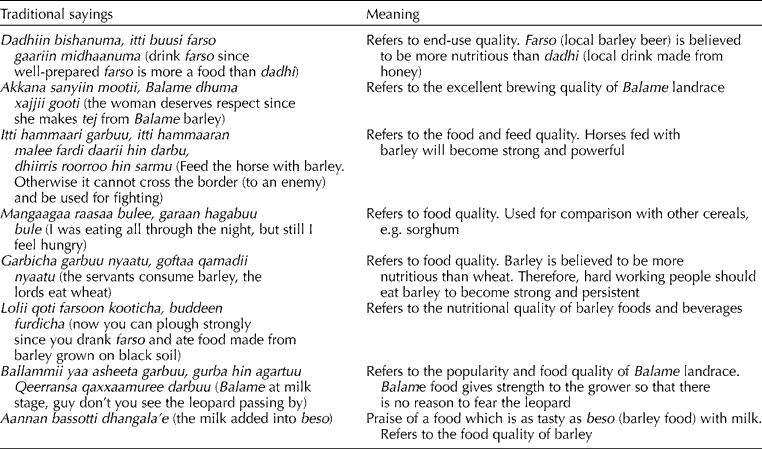
Barley foods and drinks play a key role in the socio-cultural life of Oromo communities of Dandi and Jeldu. Oral traditions like songs, riddles, proverbs and folk tales relate to the significance barley plays in the society (Table 1). Special events like wedding, traditional gatherings, festivals and/or occasional ceremonies of farmers are always followed by foods and drinks of barley. Traditionally males must send their elders to the family of the fiancée with some money for requesting the consent to the marriage. The elders place the money together with green grass or leaves on a bowl or pot which is filled with barley grains. After the visitation, germination of the grains is induced by soaking them in water. The germination of the barley grains will determine the fortune of the enquiry, i.e. well-germinated barley grains bring the fiancés luck. The landrace named Garbu-hadho is preferred for this purpose. Likewise, barley foods and drinks have cultural importance for wedding ceremonies. It is a common tradition that the bride-to-be will bring home-made kori and chiko to the house of her fiancé on the day of their wedding. Home-made barley beer and injera are served to the guests of the wedding ceremony.
Traditional songs, phrases and sayings linked to the end-use of barley landraces
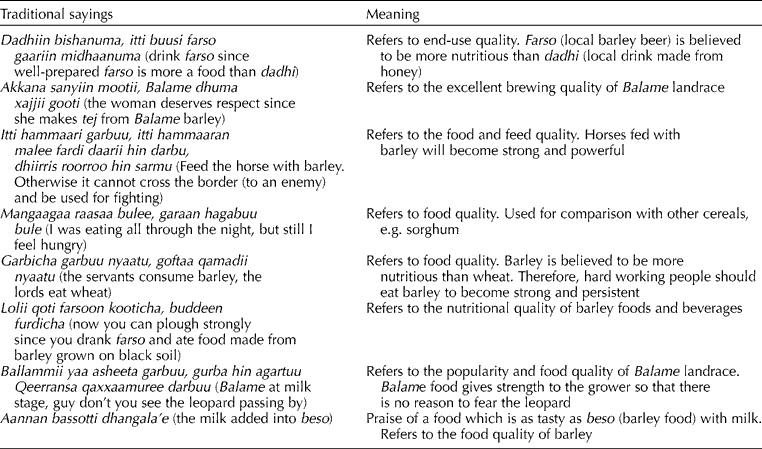
Barley food should be served also at the atete ceremony. This is the cultural ceremony of Oromo women. In this ceremony, kinche and bread made from the barley landrace Samareta buttered with ghee is served. Gada festival is celebrated in memory of a very popular and traditional governance system of the Oromo society. During gada, barley foods and drinks such as kolo seasoned with ghee, chiko and home-made beer must be served. It is believed by farmers that eating barley foods will bring good fortune. According to their traditional belief, barley bread is given to a person who got sick or scatterbrained after he has fallen down. It is believed that the demon will abandon the body of the sick person when barley bread is eaten.
Discussion
Unambiguously, daily life of humans has largely been depended on different forms of domesticated plant species, which were under cultivation since the emergence of agriculture. The present work revealed that farmers of Dandi and Jeldu have an accumulated knowledge and wide experience of barley production and utilization, passed through lots of generations. Information on barley utilization is ample and wide; and farmers value the inherent characteristics of each landraces to their preferences for myriad of end-uses. In both districts, farmers informed that they do not generally pearl hulled barley for food purposes, e.g. injera, and beverage making. Farmers think that consuming whole-grain barley provides health. Nowadays, it is well known that minerals and phytochemicals are mainly located in the outer layers of the cereal grain. Pearling, i.e. the removal of hull, germ and outer seed layers, would result in a loss of the nutritional value of the barley grain (Wang et al., Reference Wang, Xue, Newman and Newman1993; Marconi et al., Reference Marconi, Graziano and Cubadda2000; Panfili et al., Reference Panfili, Fratianni, Di Criscio and Marconi2008). This knowledge is familiar to the Ethiopian highlanders since ancient times. It is difficult to explain why farmers in the survey area prefer barley over other cereals for consumption. One reason could be the fact that barley can be prepared into various kinds of foods and drinks, and has better adaptation to their farming system. Globally barley is mainly used for feed and malting purposes. However, besides Ethiopia, food barley plays a major role in other North African, Arabian and Himalayan countries that are characterized by low rainfall or high altitude, respectively. Interestingly, the preparation of the various kinds of traditional food products (Amri et al., Reference Amri, Ouammou, Nassif, Grando and Gomez Macpherson2005; El Felah and Medimagh, Reference El Felah, Medimagh, Grando and Gomez Macpherson2005; Nigusse, Reference Nigusse, Grando and Gomez Macpherson2005; Saeed, Reference Saeed, Grando and Gomez Macpherson2005; Tashi, Reference Tashi, Grando and Gomez Macpherson2005; Upreti, Reference Upreti, Grando and Gomez Macpherson2005) are in large part similar to the Ethiopian recipes as described in this study and by Bekele et al. (Reference Bekele, Alemayehu, Lakew, Grando and Gomez Macpherson2005). The quality of barley landraces as judged by farmers can be categorized into agronomic traits that mainly include better yielding abilities with better adaptation to varying environments, and grain characteristics that affect its end-uses, e.g. grain type (hulled, naked), grain size, grain colour, flour quality, taste, etc. Previous reports by Asfaw (Reference Asfaw1988, Reference Asfaw1990) showed that Ethiopian farmers prefer landraces with big kernels for food, and with small grains for beverages.
End-use is the driving force that can motivate farmers to cultivate two or more landraces. The richness in end-uses of a crop species does have an influence on its diversity. The socio-cultural lifestyles and the utilization for different purposes have determined the type of landraces grown today in the survey area. Eyzaguirre (Reference Eyzaguirre, Cernea and Kassam2006) stated that multiple uses of a crop species is a characteristic of cultures with a long history of co-evolution of a local community with a given crop species, resulting in a rich and complex body of associated knowledge about that crop. Socio-cultural backgrounds of farmers play a significant role on the maintenance of landraces and/or wild species from one generation to the next. Milliken and Albert (Reference Milliken and Albert1996) reported the key roles of medicinal plants in the life of the Yanomami Indians of Brazil and the implications of utilization on germplasm conservation. Richmond and Ghisalberti (Reference Richmond and Ghisalberti1995) described the value of Myoporum species in cultural and medicinal uses by the Australian Aboriginals. Since this species has only a minor importance as food plant, it must have been evolved with the indigenous knowledge of the Aboriginal community. Sometimes the ritualistic, symbolic and religious associations with bio-resources are more deeply rooted in cultures than the material uses of them (Jain, Reference Jain2000). There are more than a dozen of end-uses listed in this article that dictated farmers' choices to favour some landraces over others and eventually influenced the extent to which area size they should be produced in the field. However, preferences could vary among societies and knowledge groups resulting in many landraces grown in different areas and ecological regions.
It was noticed that black barley is not preferred for food, i.e. injera or bread, but that it is desired for its good malting quality. Seed colour seems to play a vital role in barley utilization and conservation. So far, there is no scientific explanation why farmers prefer black and purple barleys for brewing. Fast germination is one criterion for the selection of a landrace for malting. Malting is a complex biological process (involving microbial fauna) in which germination of barley leads to the synthesis of hydrolytic enzymes and degradation of the grain structure, i.e. the degradation of barley endosperm cell walls. An effect of seed colour on these endogenous processes was hitherto not demonstrated. Likewise, in Tibet, purple barley grains are preferred for the preparation of the major alcoholic beverage called chang (Tashi, Reference Tashi, Grando and Gomez Macpherson2005).
In rural Ethiopia, women are responsible for food preparation and home activities in the household, but they also actively participate in the farm business. Pertaining to the responsibility they shoulder, women are more aware of the quality aspects of the grain, e.g. suitability for milling, flour quality, baking, taste, etc. Landraces with good quality seeds are retained for next season's planting, while those which do not fulfil the criteria set by the female processors are rejected from next year's planting. Chambers and Momsen (Reference Chambers and Momsen2007) demonstrated that women play the vital role in the conservation of biodiversity of Mexican maize landraces. While women focus on the household end-use of different varieties, men focus more on the production (yield) for selling on the market.
Apart from human consumption as food and drinks, barley foods are also considered as traditional medicines in curing human diseases. Likewise, Zentani (Reference Zentani, Grando and Gomez Macpherson2005) reported that it is common knowledge in Libya that barley can be effective in the treatment of diabetes, stomach and colon problems, and kidney problems. Roasted barley flour (tsangpa) plays also a major role in Tibetan traditional medicine (Tashi, Reference Tashi, Grando and Gomez Macpherson2005). Barley can contain high levels of β-glucan and tocols, phytochemicals which may be associated with a reduced risk of coronary heart disease and certain cancers (Cavallero et al., Reference Cavallero, Gianinetti, Finocchiaro, Delogu and Stanca2004; FDA, 2005). Recently, Eticha (Reference Eticha2008) demonstrated that Ethiopian hull-less barleys exhibit a medium to high level of β-glucan and anthocyanins. To the farmers of Dandi and Jeldu districts, barley means everything for them: it is their staple, culture, belief, income and many to mention. Asfaw (Reference Asfaw and Brush2000) already stated that ‘barley is considered a sacred crop by the Oromo people of Ethiopia’.
Conclusion
The present study demonstrated that barley is a golden crop to Ethiopian highland farmers. Their life is heavily dependent on it. Many landraces owe inherent characters that make them preferable for various kinds of foods and drinks. A wide range of farmers' and consumers' preferences exist in favour of the different landraces along with a great number of foods and drinks which are prepared from barley. Farmers as opposed to other consumers also consider many features of landraces such as adaptability to their farm conditions, tolerance to drought, grain yield and suitability for other utilizations like straw for feeding animals and house construction. Hence, farmers' and consumers' preferences among other constraints of barley production determined the types of landraces that should continue to be cultivated or not. Natural selections acted against farmers' wishes and desires, i.e. farmers' needs to keep old landraces are hindered by the loss in adaptability of the landrace in focus to the present farming ecology. Nevertheless, the utilization of barley and its values in the socio-cultural lifestyles of farmers have been playing vital roles for the continued cultivation and maintenance of different landraces on-farm in Dandi and Jeldu districts of West Shewa calling for future attentions for the sustainable management of crop culture.
Whereas barley is traditionally known as ‘healthy’ food to the Ethiopian highlanders, this aspect fell into oblivion in the Western World. In recent years, several health benefits of barley food were proven. However, food technologists are still searching for barley products that are accepted by the ordinary, health-conscious consumer. The present study describes a multitude of barley food products traditional to Ethiopian highland farmers. It is presumed that some of the mentioned recipes can be transferred to Western diet in a modified way, making it not only more diverse but also healthy.
Acknowledgements
F.E. acknowledges a doctoral scholarship and a field study grant from the Austrian Exchange Service (OeAD). The technical assistance of Kasahun Gemechu, Bako Agric. Res. Ctr., and of the district agricultural offices of Dandi and Jeldu is highly acknowledged. The farmers of both districts deserve gratitude for giving this valuable information.