Introduction
Having a good memory and being cognitively alert are two ways that older adults value themselves as aging well (Laditka et al., Reference Laditka2009). These cognitive resources are also related to reduced healthcare cost, decreased morbidity and mortality, and increased functional independence in old age (Thies and Bleiler, Reference Thies and Bleiler2011). Emerging perspectives suggest the likelihood that interventions to prevent cognitive decline or improve cognitive function will include non-pharmacological approaches (Fotuhi et al., Reference Fotuhi, Hachinski and Whitehouse2009). In this paper, the potential modifiable factor, subjective fatigue, was examined for its influence on cognitive and functional performances in a community-based sample of older adults.
Subjective fatigue, the feeling of being tired or having difficulty in initiating activities (Lou, Reference Lou2009), is the most common symptom in old age and is experienced by over 20% of non-disabled, community-dwelling older adults (Reyes-Gibby et al., Reference Reyes-Gibby, Mendoza, Wang, Anderson and Cleeland2003; Wijeratne et al., Reference Wijeratne, Hickie and Brodaty2007; Yu et al., Reference Yu, Lee and Man2010); in fact, the feeling of fatigue increases with age as over half of older adults aged 70+ years report experiencing subjective fatigue in their daily activities (Avlund, Reference Avlund2010). Subjective fatigue is associated with declines in physical functioning, disability, and risk of hospitalization (Eldadah, Reference Eldadah2011). Recent cross-sectional studies also found that fatigue is associated with brain functional change (e.g. hypo-metabolism, brain atrophy, abnormal activity of prefrontal cortex and frontal basal ganglia), compromise cognitive abilities (Chaudhuri and Behan, Reference Chaudhuri and Behan2004; Marrie et al., Reference Marrie, Fisher, Miller, Lee and Rudick2005; Holtzer and Foley, Reference Holtzer and Foley2009; Andreasen et al., Reference Andreasen, Spliid, Andersen and Jakobsen2011; Holtzer et al., Reference Holtzer, Shuman, Mahoney, Lipton and Verghese2011), and affect everyday functioning demanding on cognitive abilities (e.g. instrumental activities of daily living; Vestergaard et al., Reference Vestergaard2009). However, relatively few longitudinal studies have examined the prospective relationship between subjective fatigue and cognitive function or cognitively demanding everyday activities. Verdelho et al. (Reference Verdelho, Henon, Lebert, Pasquier and Leys2004), using a single item from the Montgomery and Asberg Depression Rating Scale, found that subjective fatigue was more frequently reported in patients with dementia than their healthy counterparts at three-year follow-up. In contrast, Boyle et al. (Reference Boyle, Buchman, Wilson, Leurgans and Bennett2011), using two items from the Center for Epidemiological Studies Depression (CES-D) Scale, found that subjective fatigue was not associated with cognitive decline at 12-year follow-up. The inconsistency of results between the two studies may be explained by the timeline of measuring subjective fatigue. Subjective fatigue is often considered a relatively acute state (Eldadah, Reference Eldadah2011); therefore, continuously measuring subjective fatigue over time is recommended to comprehensively understand its association with cognitive outcomes.
Furthermore, subjective fatigue has long been considered a criterion for a major depressive episode (American Psychiatric Association, 2000), a component of frailty (Walston et al., Reference Walston2006), or having a circularity with cardiovascular disease risk factors (CVDRFs; Melamed et al., Reference Melamed, Shirom, Toker, Berliner and Shapira2006; Kaltsas et al., Reference Kaltsas, Vgontzas and Chrousos2011). Depression (Huang et al., Reference Huang, Wang, Li, Xie and Liu2011), grip strength, which is another component of frailty (Boyle et al., Reference Boyle, Buchman, Wilson, Leurgans and Bennett2011), and CVDRFs (Lin et al., Reference Lin, Friedman, Quinn, Chen and Mapstone2012) have been consistently related to cognitive abilities. However, subjective fatigue may have its own casual relation with cognitive abilities through both pathophysiological and behavioral mechanisms. First, the energy homeostasis at vascular, especially endothelium, function is considered an objective assessment of subjective fatigue (Ohno et al., Reference Ohno2011). Increased subjective fatigue, possibly reflecting as vascular pathology (e.g. endothelial dysfunction, atherosclerosis, cytokines), may contribute to the cognitive decline in old age (Alexander et al., Reference Alexander2011; Panza et al., Reference Panza2011). Next, subjective fatigue may indirectly influence cognitive abilities through interfering with initiating and sustaining in self-motivated daily activities (e.g. exercise, social activities, mental activities) that are potentially neuroprotective (Kelley et al., Reference Kelley2003). Regardless, to claim the role of subjective fatigue in predicting cognitive abilities will need a clarification of the complexity between subjective fatigue, cognitive function, depression, frailty, and CVDRFs.
In this study, the hypothesis that the trajectory of subjective fatigue in old age was related to the decline of cognitive function and everyday functioning was tested. We used data from a cohort of 2,781 community-dwelling adults without dementia at baseline aged 65–94 over five years. Cognitive function and cognitively demanding everyday activities were measured by a series of laboratory-based or ecologically validated neuropsychological or functional assessments over five years, capturing abilities related to speed of processing, memory, and reasoning in laboratory settings, as well as speed of processing and problem-solving in everyday life. Subjective fatigue in this study was defined as the perception of energy imbalance, which does not simply result from sleep problems or physical exertion (Alexander et al., Reference Alexander2011), measured using the 36-item Short-Form Health Survey (SF-36) vitality subscale from the Medical Outcomes Study, a well-established measurement for the state of fatigue related to energy or vitality (O'Connor, Reference O'Connor2004). The specific aims of this study were to examine: (1) the trajectory of subjective fatigue over time; and (2) the influence of subjective fatigue on cognitive function and everyday functioning over time when controlling for depression, grip strength, CVDRFs, and other relevant confounding factors.
Methods
Participants
A secondary data analysis was performed using data from the Advanced Cognitive Training for Independent and Vital Elderly (ACTIVE) trial, an on-going prospective dataset (Ball et al., Reference Ball2002; Willis et al., Reference Willis2006). The ACTIVE trial is a randomized controlled trial designed to evaluate three types of cognitive training interventions (memory, speed of processing, and reasoning) on cognitive and functional abilities. A subset of participants in the three training groups also attended four booster training sessions, 11 months and 35 months after the original training sessions. There were 2,832 community-dwelling older adults (≥65 years old at baseline) without dementia (as screened using the Mini-Mental State Examination ≥ 23) who participated in the study. The exclusion criteria included: (1) self-reported diagnosis of Alzheimer's disease, (2) substantial decline in basic activities of daily living function, (3) certain life-threatening medical conditions (e.g. cancer), (4) recent cognitive training, (5) being unavailable during the testing and training period of study, and (6) severe sensory loss or communicative problems. Participants were recruited from six metropolitan areas in the USA, including the University of Alabama at Birmingham, Wayne State University, the Hebrew Rehabilitation Center for the Aged, the Johns Hopkins University School of Medicine, Indiana University, and Pennsylvania State University. The recruitment strategies for each site differed and details on these and other aspects of the ACTIVE trial are available elsewhere (Jobe et al., Reference Jobe2001). An analytic sample of 2,802 was randomized to one of the three cognitive training groups or a no-contact control group. Institution specific institutional review boards approved the ACTIVE protocol and consent was obtained for each participant prior to participation. The retention rate at five-year follow-up was 67% in the ACTIVE trial; participants who were older, male, and less educated, and had more health problems and lower cognitive function were less likely to be retained at five years (Willis et al., Reference Willis2006). The analytic sample of the present study was 2,781 participants who had at least two waves of data on subjective fatigue.
Measurement
Subjective Fatigue
Subjective fatigue was measured using the Vitality subscale from the SF-36 at baseline: one-, two-, three-, and five-year follow-ups (Ware and Sherbourne, Reference Ware and Sherbourne1992). The Vitality subscale included four items measuring the recalled frequency of feeling of fatigue (i.e. feeling pep, energetic, worn out, and tired) over the past month (O'Connor, Reference O'Connor2004). Participants responded to each item using a Likert scale from 1, “all of the time,” to 6, “none of the time.” The sum score was calculated, with higher scores indicating lower levels of subjective fatigue and higher levels of energy. The internal consistency reliability (Cronbach's α) of the Vitality subscale in previous large sample studies ranged from 0.85 to 0.87, and test–retest reliability was 0.80 over two weeks in patients with heart disease (Ware, Reference Ware2000). The Vitality subscale is one of the most commonly used measurements for subjective fatigue (O'Connor, Reference O'Connor2004). The internal consistency of the four items in this study were 0.84–0.86 across visits.
Cognitive Function and Everyday Functioning
Cognitive function and everyday functioning were measured using 11 neuropsychological or everyday functional tests belonging to five domains at baseline: one-, two-, three-, and five-year follow-ups. Cognitive function included three domains: speed of processing, measured using the Useful Field of View (Owsley et al., Reference Owsley, Ball, Sloane, Roenker and Bruni1991); memory, measured using Hopkins Verbal Learning Test (Brandt, Reference Brandt1991), Auditory Verbal Learning Test (Rey, Reference Rey1941), and Rivermead Behavioral Memory Test (Wilson et al., Reference Wilson, Cockbum and Baddeley1985); and reasoning, measured using Word Series (Gonda and Schaie, Reference Gonda and Schaie1985), Letter Series (Thurstone and Thurstone, Reference Thurstone and Thurstone1949), and Letter Sets (Ekstrom et al., Reference Ekstrom, French, Harman and Derman1976). Everyday functioning that demands on cognitive abilities included two domains: everyday speed, measured using Complex Reaction Time (Ball et al., Reference Ball, Beard, Roenker, Miller, Griggs, Schaie and Pietrucha2000) and Timed Instrumental Activities of Daily Living (Owsley et al., Reference Owsley, Sloane, McGwin and Ball2002); and everyday problem-solving, measured using Everyday Problem Test (Willis and Marsiske, Reference Willis and Marsiske1993) and Observed Tasks of Daily Living (Diehl et al., Reference Diehl, Willis and Schaie1995). Five separate composite scores for the three domains of cognitive function and two domains of everyday functioning were developed using the mean and standard deviation of the original ACTIVE sample (n = 2,802) in the following procedure: for tests belonging to the same domain, Z-transformation was firstly performed on the raw score of each test, and then the mean score (composite score) of Z scores of those tests was calculated. Higher composite scores indicated poorer levels of speed of processing and everyday speed but higher levels of memory, reasoning, and everyday problem-solving. The purpose of using the original analytic sample from ACTIVE (n = 2,802) instead of the analytic sample of the present study (n = 2,781) was to compare the cognitive function and everyday functioning between the subgroup excluded from the present study who did not have at least two waves of data on subjective fatigue with the participants included in the study. The subgroup excluded from the current study (n = 21) had significantly poorer performances on speed of processing, memory, everyday speed of processing, and everyday problem-solving (data was not shown).
Demographic and Health Information-Related Covariates
Data on age, sex, race, and years of education were collected. The following health variables, i.e. depression, grip strength, and history of CVDRFs, that may confound with subjective fatigue in predicting cognitive or everyday functioning were included as covariates. Level of depression was measured using 11 items from the CES-D scale, excluding one item that is often representative of fatigue (“I couldn't get going”; Radloff, Reference Radloff1977). Mean score of the 11 items was calculated. Grip strength was included as a measure of general physical robustness and was assessed using a dynamometer (Lafayette Instruments, Layfayette, Ind., USA). Participants were allowed to make their maximal effort with the dominant hand as instructed in the trial. One minute of rest was taken between two trials. The mean of the scores from the two trials was computed. Higher scores indicated greater grip strength. History of CVDRFs included heart disease, congestive heart failure (CHF), stroke, hypertension, diabetes, and high cholesterol, all collected using a single question: “Has a doctor or a nurse ever told you that you have (the health condition)?” Smoking was identified by a single question: “Do you smoke now?” Objectively measured height and weight were used in calculating body-mass index (BMI), and obesity was identified using BMI ≥ 30 kg/m2. A total number of CVDRFs was calculated. All demographic and health information were collected at baseline.
Data analysis
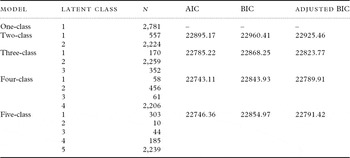
Growth mixture modeling (GMM) from Mplus 6 version was used to determine the number of classes of trajectory in subjective fatigue over five years. The purpose of using GMM was to find the smallest number of classes of respondents with similar trajectory of change in subjective fatigue. A series of models were tested beginning with a one-class model and moving to a five-class model. The optimal number of classes was decided based on the Akaike Information Criterion (AIC), Bayesian Information Criterion (BIC), and adjusted BIC (Nylund et al., Reference Nylund, Asparouhov and Muthén2007). The AIC, BIC, and adjusted BIC are commonly used fit indices, in which lower values indicate a more parsimonious model. Each class should have more than 1% of the total sample (Jung and Wickrama, Reference Jung and Wickrama2008). For each distinctive class, the model was described with the shape of the trajectory (i.e. intercept and slope) and the number of respondents belonging to the class.
After deciding the latent class (n = 4 in this study), remaining analyses were performed in IBM SPSS 19.0. Analysis of variance (ANOVA) was applied to compare the continuous variables by the class of subjective fatigue, and chi-square test was applied to compare the categorical variables by the class. Linear mixed-effects (LME) modeling was applied to assess the longitudinal relationships of visit and the latent class of subjective fatigue with cognitive function and everyday functioning adjusted for covariates (West et al., Reference West, Welch and Galecki2007).
Two separate sets of models were applied:
(1) When taking the latent class of subjective fatigue as the predictor:
 \begin{eqnarray*}
y &=& {\beta}_{\rm 0} {\rm + }{\beta}_{\rm 1} {\rm }{\it Visit}\,{\rm + }\,{\beta}_{\rm 2} {\rm }\,{\it Fatigue}\ {\rm }{\it Class}\,{\rm + }\,{\beta}_{\rm 3} {\rm }\,{\it Visit}\nonumber\\
{\rm \times }{\it Fatigue}{\rm }\;{\it Class}\,{\rm + }\,y_{\rm 1}\,{\rm + }\,y_{\rm 2} {\rm }{\it Visit}\,{\rm + }\, \varepsilon
\end{eqnarray*}
 \begin{equation*}
y{\rm = }{\beta}_{\rm 0} {\rm + }{\beta}_{\rm 1} {\rm }\,{\it Fatigue}\,{\rm + }\,y_{\rm 1}\, {\rm + }\,y_{\rm 2} {\rm }\,{\it Fatigue}\,{\rm + }\, \varepsilon{\rm .}
\end{equation*}
(2) When taking the time-dependent subjective fatigue (baseline: one-, two-, three-, and five-year follow-ups) as the predictor within each latent class of subjective fatigue:
In these models, visit refers to the baseline: one-, two-, three-, and five-year follow-ups. All βs were the coefficients for fixed-effects; γ1 and γ2 were the coefficients for the random-effects and ε is the error term; y referred to each domain of cognitive function or everyday functioning. The model fit is fitted by restricted maximum likelihood estimation. Age, sex, race, education, recruitment site, assignment of intervention group, participation in booster sessions, depression, grip strength, and a total number of CVDRFs were included as covariates.
All tests were two-tailed and values of p < 0.05 were considered as significant differences in all analyses except for the Bonferroni's correction, p < 0.0125.
Results
Latent class of change of subjective fatigue over five years
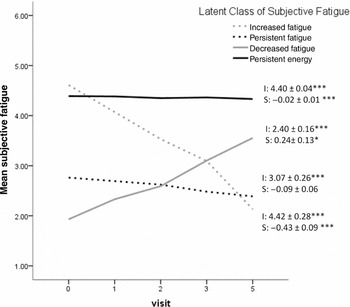
Table 1 summarizes the series of model fit statistics, indicating the four-class model was the best solution. Figure 1 displays the four classes. Class 1, comprising 58 participants (2.1%), was characterized by a high initial level of energy (mean intercept = 4.42, p < 0.001) that declined substantially over time (mean slope = −0.43, p < 0.001); we labeled this class as increased fatigue class. Class 2, comprising 456 participants (16.4%), was characterized by a constant low level of energy (mean intercept = 3.07, p < 0.001) over time (mean slope = −0.09, p > 0.05); we labeled this as persistent fatigue class. Class 3, comprising 61 participants (2.2%), was characterized by a very low initial level of energy (mean intercept = 2.40, p < 0.001) that increased over time (mean slope = 0.24, p < 0.05); we labeled this as decreased fatigue class. Class 4, comprising 2,206 participants (79.3%), was characterized by a relatively high initial level of energy (mean intercept = 4.40, p < 0.001) that slightly decreased over time (mean slope = −0.02, p < 0.001); we labeled this as persistent energy class.
Growth mixture model fit statistics for one-, two-, three-, four-, and five-class models of trajectory of subjective fatigue

Note: AIC = Akaike Information Criterion; BIC = Bayesian Information Criterion.
Graphical representation of subjective fatigue over time by the latent class. Note: I = intercept; S = slope. *p < 0.05; ***p < 0.001. Higher scores in subjective fatigue indicated higher levels of energy.

Baseline demographic and health variables by the latent class of subjective fatigue
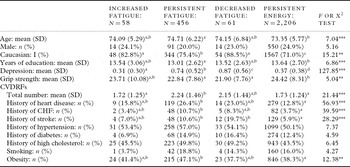
Table 2 displays the demographic and health variables at baseline by the latent class of subjective fatigue. Participants in the persistent fatigue class were significantly older than those in the persistent energy class. Participants with increased fatigue (who had lowest levels of subjective fatigue at baseline) had significantly the lowest levels of depression, while participants with decreased fatigue (who had highest levels of subjective fatigue at baseline) had the highest levels of depression. Participants with persistent energy had significantly the highest levels of grip strength than other groups. Increased fatigue and persistent energy classes had similar numbers of CVDRFs, which were significantly fewer than the persistent fatigue class. In terms of individual CVDRFs, persistent fatigue had significantly higher percentages of participants with the presence of heart disease, CHF, stroke, and obesity than the persistent energy class. There were no significant differences for other classes.
Raw scores for baseline demographic and health information characteristics at baseline by the latent class of subjective fatigue (n = 2,781)

**p < 0.01; ***p < 0.001.
Note: Each subscript letter denotes a subset of class whose column proportions do not differ significantly from each other at the 0.0125 level (Bonferroni's correct). CVDRFs = cardiovascular diseases risk factors; CHF = congestive heart failure.
Latent class of subjective fatigue and cognitive function and everyday functioning over time
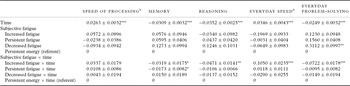
Table 3 shows the LME models of each domain of cognitive function and everyday functioning across visits by latent class of subjective fatigue, controlling for age, sex, education, race, recruitment site, assignment of intervention group, participation in booster sessions, depression, grip strength, and history of CVDRFs. Persistent energy class was considered a referent group. All domains of cognitive function and everyday functioning declined significantly over time, and the average declines per visit ranged from 0.0249 (everyday problem-solving) to 0.0352 (reasoning) units.
Relationships between latent class of subjective fatigue and cognitive function and everyday functioning (parameter estimate, β ± SE)a

a Controlling for age, race, sex, education, recruitment site, assignment of intervention group, participation in booster sessions, depression, grip strength, and the total number of CVDRFs (estimates not shown).
b Higher scores indicate lower abilities.
*p < 0.05; **p < 0.01; ***p < 0.001.
Baseline levels of cognitive function and everyday functioning were similar across latent class of subjective fatigue, except that the decreased fatigue class had significantly higher baseline level of everyday problem-solving than the persistent energy class did.
In terms of changes of cognitive function and everyday functioning over time, the increased fatigue class declined significantly faster in memory (0.0319 unit/visit), reasoning (0.0471 unit/visit), everyday speed (0.1050 unit/visit), and everyday problem-solving (0.0722 unit/visit) than the persistent energy class. The persistent fatigue class declined significantly faster in memory (0.0173 unit/visit) than the persistent energy class.
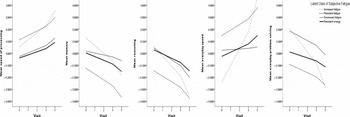
Associations of changes of subjective fatigue and cognitive function and everyday functioning
Table 4 and Figure 2 show the associations of annual rates of change in subjective fatigue with domains of cognitive function and everyday functioning within each latent class of subjective fatigue, after controlling age, sex, education, recruitment site, assignment of intervention group, participation in booster sessions, depression, grip strength, and total number of CVDRFs. There was no association between annual rates of changes in the decreased fatigue class. In the increased fatigue class, each one-unit increase in fatigue per visit was significantly associated with 0.0666–0.2178 units decline in all domains of cognitive function and everyday functioning per visit. In the persistent fatigue class, each one-unit increase in fatigue per visit was significantly associated with 0.0478–0.0730 units decline in memory, reasoning, and everyday speed per visit. In the persistent energy class, each one-unit increase in fatigue per visit was significantly associated with 0.0127–0.0408 units decline in cognitive function and everyday speed per visit. In summary, domains of cognitive function and everyday functioning declined faster in the increased fatigue group than other groups.
Graphical representation of the relationships between changes of subjective fatigue and cognitive function and everyday functioning over time by the latent class of subjective fatigue. Note: Higher scores in speed of processing and everyday speed indicated lower abilities.

Parameter estimate (β ± SE) of the relationships between the changes of subjective fatigue and cognitive function and everyday functioning over timea

a Controlling for age, race, sex, education, recruitment site, assignment of intervention group, participation in booster sessions, depression, grip strength, and the total number of CVDRFs (estimates not shown).
b Higher scores indicate lower abilities.
*p < 0.05; **p < 0.01; ***p < 0.001.
Discussion
This study examined the longitudinal relationships between subjective fatigue and five domains of cognitive function or everyday functioning in a cohort of 2,781 community-dwelling older adults without baseline dementia. We identified four distinct trajectories of subjective fatigue over five years: one group with initial relatively high level of energy that declined substantially over time (increased fatigue class; i.e. complaining fatigue “some of the time” at baseline but “most of the time” at five-year follow-up), one group with persistent fatigue (persistent fatigue class; i.e. complaining fatigue “a good bit of the time” constantly over time), one group with initial lower level of energy that increased over time (decreased fatigue class, i.e. complaining fatigue “most of the time” at baseline but “some of the time” at five-year follow-up), and the fourth group with persistent high energy (persistent energy class; i.e. complaining fatigue “some of the time” constantly over time). All domains of cognitive function and everyday functioning declined gradually but significantly over five years. The decline rates, but not the baseline levels of cognitive function and everyday functioning, differed by the latent class of subjective fatigue. Except for the decreased fatigue class, there were various degrees of significant associations between the decline rates of subjective fatigue and every domain of cognitive function and everyday functioning in each class.
Our study represents the first effort to determine the heterogeneous trajectories of subjective fatigue in old age. Subjective fatigue can be interpreted differently by individuals. To some older adults, subjective fatigue may be an acute state, while to others, subjective fatigue may actually persist or re-occur frequently enough to present as a chronic condition or part of aging process (Avlund, Reference Avlund2010). The use of GMM in longitudinal aging research was able to capture the inter-individual differences in intra-individual change of subjective fatigue over time (Hagenaars and McCutcheon, Reference Hagenaars and McCutcheon2002). As found in this study, subjective fatigue in the majority of older adults can be described as the depletion of various amounts of energy constantly over time, from small (persistent energy class) to large (persistent fatigue class). The findings are consistent with the overall devastating experienced by older adults in general from previous studies (Yu et al., Reference Yu, Lee and Man2010). Differently, the other two classes (i.e. increased fatigue and decreased fatigue) represent two distinct trajectories of subjective fatigue with particular clinical interest. The increased fatigue class had highest level of energy at baseline but declined fastest in the energy level over time, while the increased fatigue class had lowest levels of depression and smallest number of CVDRFs at baseline. The decreased fatigue class had lowest energy level at baseline but increased in the energy level over time, while the decreased fatigue class had the highest levels of depression at baseline. In the literature, two-thirds of fatigue in old age cannot be explained by any health conditions (Walker et al., Reference Walker, Katon and Jemelka1993), and the trajectories of subjective fatigue within this proportion can be complicated. The seemingly contradictory results of the increased fatigue and decreased fatigue classes with health factors in the present study suggested that the trajectory of subjective fatigue over time may be influenced by time-dependent or other unexplored confounding factors than the baseline demographic or health factors. It is equally important to explore any potential time-dependent protective factors that may interfere with baseline demographic or health factors in explaining the increase or decrease of energy level in the two classes.
This study also represents the first effort to examine longitudinal relationships between subjective fatigue and cognitive and functional abilities in older adults. In this study, data from ACTIVE trial were examined longitudinally from baseline to Year 5. According to the analysis of attrition rate in the original ACTIVE trial (Willis et al., Reference Willis2006), participants who remained at five-year follow-up may be overall healthier than those who dropped out from the study. Such data may be unbalanced because participants withdraw from the study for different reasons. LME models are thus developed to model the dependence with random-effects and to incorporate the heterogeneity among participants along with the fixed-effects for time trends and other covariates (West et al., Reference West, Welch and Galecki2007).
Our study found an independent causal relationship between subjective fatigue and decline rate in cognitive and functional abilities beyond the influence of depression, grip strength, and CVDRFs. Avlund reviewed the factors that may influence fatigue, and suggested that subjective fatigue may be seen not only as a self-reported indicator of frailty that results from decreased physiologic reserves, but also a state that can be influenced by other factors (e.g. social, mental, and biological) throughout life. Fatigue itself may be an independent indicator of aging process (Avlund, Reference Avlund2010). Findings of the present study were consistent with that from a previous study using a similar measurement of subjective fatigue, that is, subjective fatigue is not necessarily a proxy for depression, a component of frailty, or a consequence of CVDRFs in predicting cognitive function or everyday functioning, and may contribute independently to these deficits in old age (Vestergaard et al., Reference Vestergaard2009).
Along with other findings, our study suggests the importance of considering the long-term negative effect of subjective fatigue on cognitive and functional abilities, into developing interventions for older adults. Compared to other less modifiable factors that can influence cognitive plasticity (e.g. genetic influence, education, age), low energy or mental effort supply may be modifiable (Eldadah, Reference Eldadah2011). As a direction for future research, clinical trials should test whether the strategies for reducing fatigue, such as acetyl L-carnitine, yoga, and meditation, can help improve cognitive and functional abilities (Bower et al., Reference Bower2012), and importantly, whether such improvement would be mediated by the change of these underlying mechanisms (e.g. vascular energy homeostasis and the engagement in potentially neuroprotective activities). Particularly, attention should be paid to the group of older adults with increased fatigue over time who had much faster cognitive decline than any other groups, even after controlling for all potential confounding factors. In addition to examining other etiological factors that may potentially contribute to such increase in subjective fatigue, strategies to directly alleviate subjective fatigue should be initiated as early as possible.
Limitations should be considered when interpreting our findings. First, we only measured energy-based fatigue state. Other dimensions of fatigue should be measured to capture a more comprehensive understanding of the relationship between fatigue and cognitive function in community-dwelling older adults. For example, fatigability, the process of becoming tired or fatigued that results in difficulty maintaining activities at a desired level, is one such dimension that should be considered. This dimension of fatigue has been shown to be related to executive function (Holtzer et al., Reference Holtzer, Shuman, Mahoney, Lipton and Verghese2011). Second, although we controlled for depression, CVDRFs, and grip strength, other potential confounding factors of fatigue (e.g. sleepiness, lack of motivation, social participation, and beta-blockers) were not included in this examination. Third, two out of the four fatigue classes (i.e. increased fatigue and decreased fatigue) had relatively small numbers of participants. To avoid the potential over-exaction of the classes, reproducing these classes is needed in other cohort studies (Bauer and Curran, Reference Bauer and Curran2003). Finally, in spite of excluding patients with dementia at baseline, it was not clear whether any participants developed dementia at follow-up visits. To expand the findings from the present study, future studies should examine whether the difference in trajectories of subjective fatigue will predict the incidence of dementia.
Conflict of interest
Dr Karlene Ball owns stock in the Visual Awareness Research Group (formerly Visual Awareness, Inc.), and Posit Science, Inc., the companies that market the Useful Field of View Test and speed of processing training software used in the ACTIVE study. Posit Science acquired Visual Awareness, and Dr Ball continues to collaborate on the design and testing of these assessments and training programs as a member of the Posit Science Scientific Advisory Board.
Description of authors’ roles
F. Lin formulated the research question(s), designed the study, carried it out, analyzed the data, and wrote the paper; D. Chen analyzed the data and assisted with writing the paper; D. Vance assisted with formulating the research question and writing the paper; K. Ball designed the parent study, collected the data for the parent study, and assisted with formulating the research question in this study and writing the paper; M. Mapstone assisted with formulating the research question, designing the study, and writing the paper.
Acknowledgments
The original ACTIVE study was supported by grants from the National Institute on Aging and the National Institute of Nursing Research to Hebrew Senior Life (U01NR04507), Indiana University School of Medicine (U01 NR04508), Johns Hopkins University (U01AG14260), New England Research Institutes (U01AG14282), Pennsylvania State University (U01AG14263), the University of Alabama at Birmingham (U01 AG14289), and the University of Florida (U01AG14276). The authors wish to acknowledge the help from Dr. Giovanni Schifitto and Dr. James McMahon (University of Rochester Medical Center) for comments on original version of the manuscript.