Morphemes are the smallest units of meaning in language. In all languages, morphemes are combined in a rule-based manner to form morphologically complex words. It is necessary to make the basic distinction between two types of morphology: inflectional and word-formation morphology. In inflection, the output of a morphological operation belongs to the same lexical entry as the input (e.g., play > plays; played). Word formation, on the other hand, includes a number of different morphological processes such as conversion (zero derivation), derivation (addition of affixes to stems), and compounding (combination of roots), in which the input and output do not belong to the same lexical entry (e.g., play, verb > play, noun; player; playful; playfulness; screenplay). Word formation is less regular than inflection and requires attention to the lexicon and language typology, which makes it more difficult to acquire (Clark, Reference Clark, Bowerman and Levinson2001).
The purpose of the research reported in the present paper was to investigate the development of morphological awareness among young Mandarin-speaking Chinese children from kindergarten to the early primary grades. Morphological awareness is the explicit insight that words can sometimes be divided into morphemes and the ability to manipulate morphological structure (Cazden, Reference Cazden1974; also Bialystok, Reference Bialystok2007; Carlisle, Reference Carlisle and Feldman1995). Morphological awareness is essential for word identification, spelling, and reading comprehension across many languages (e.g., Carlisle, Reference Carlisle2000; Casalis & Louis-Alexandre, Reference Casalis and Louis-Alexandre2000; Ku & Anderson, Reference Ku and Anderson2003; Li, Anderson, Nagy, & Zhang, Reference Li, Anderson, Nagy, Zhang, Li, Gaffney and Packard2002; McBride-Chang, Wagner, Muse, Chow, & Shu, Reference McBride-Chang, Wagner, Muse, Chow and Shu2005; Saeigh-Haddad & Geva, Reference Saiegh-Haddad and Geva2008). It is possible that morphological awareness is particularly important for the reading of scripts that are less transparent in terms of spelling to sound correspondences, such as Chinese (cf. Ziegler & Goswami's psycholinguistic grain size theory, Reference Ziegler and Goswami2006; see also Fowler & Liberman, Reference Fowler, Liberman and Feldman1995). The seemingly all-pervasive importance of morphological awareness is likely due to the central position in language structure occupied by morphology, at the interface of phonology, syntax, and semantics (Carlisle, Reference Carlisle and Feldman1995). Carlisle surmises that morphological awareness “may provide a more general index of metalinguistic capability than [awareness of] any one of these areas considered alone” (p. 192).
Morphological awareness builds on a language user's ability to understand and accurately deploy morphologically complex forms, or their morphological competence. In general, more is known about the development of morphological competence than about the development of morphological awareness. With regard to the development of word formation, children start producing novel word forms between 18 months and 2 years of age (Clark, Reference Clark, Bowerman and Levinson2001; Tager-Flusberg & Zukowski, Reference Tager-Flusberg, Zukowski, Berko Gleason and Bernsteain Ratner2009). In English, conversion appears first, followed by root compounding, and finally derivational affixation. In Chinese, root compounding is a very important way of forming complex words, and can thus be expected to emerge early. Following these early developments, both derivation and compounding become much more apparent between ages 3 and 4 (Clark, Reference Clark, Bowerman and Levinson2001) but keep developing and being refined well into the school years.
Morphological awareness emerges in the preschool years and is significantly enhanced by overt instruction in the initial years of formal education (Carlisle, Reference Carlisle and Feldman1995). It develops in a piecemeal fashion, with the ability to decompose words into their constituent morphemes preceding the ability to identify their meanings and grammatical implications (Carlisle & Fleming, Reference Carlisle and Fleming2003) as well as constraints on their distribution (i.e., rules pertaining to what morphemes can be combined; Tyler & Nagy, Reference Tyler and Nagy1989). School-aged children show good understanding of the structure of simple noun–noun compounds (McBride-Chang, Cheung, Chow, Chow, & Choi, Reference McBride-Chang, Cheung, Chow, Chow and Choi2006; McBride-Chang, Shu, Zhou, Wat, & Wagner, Reference McBride-Chang, Shu, Zhou, Wat and Wagner2003), although the understanding of compounds that also include other word classes, such as adjectives or verbs, appears to develop more gradually (Anglin, Reference Anglin1993; Nagy, Berninger, & Abbott, Reference Nagy, Berninger and Abbott2006). Awareness of derivational morphology, on the other hand, continues to develop throughout the elementary and middle school years, and with considerable individual variation (Carlisle & Fleming, Reference Carlisle and Fleming2003).
The present study focused on one particular aspect of morphological awareness in Chinese, homophone awareness, which is the ability to distinguish between a morpheme and its homophones in compound words. Compounding is the most important way of forming words in Chinese. Over 70% of the Chinese words are bimorphemic disyllabic compounds (Institute of Language Teaching and Research, 1986). In Chinese, a morpheme is generally represented by one syllable in the oral language and one character in the written language. Chinese morphemes are very productive. A morpheme forms about 17 compound words on average (Yin, Reference Yin1984). For example, 公 (gong1; male) appears in 公 猪 (gong1 zhu1; male pig: boar), 公 羊 (gong1 yang2; male sheep: ram), and 公 鸡 (gong1 ji1) (male chicken: rooster). Chinese compounds are phonologically transparent. The phonology of constituent morphemes rarely changes in Chinese word formation (Ku & Anderson, Reference Ku and Anderson2003). These features may explain why, compared to their English-speaking counterparts, Chinese children seem to rely more on morphological analysis when learning new words (Shu, Anderson, & Zhang, Reference Shu, Anderson and Zhang1995).
Homophonous morphemes are very common in Chinese. There are approximately 5000 morphemes in daily use in Mandarin (Yin, Reference Yin1984), but there are only less than 1300 syllables. According to Tang (Reference Tang1995), 68.5% of the syllables correspond to two or more morphemes. Because Chinese has a large number of homophones, to comprehend meaning properly in the spoken language, children must distinguish between morphemes that sound identical. Likewise, in reading, children must distinguish between characters that have the same pronunciation but different visual forms and meanings. A growing body of research has linked morphological awareness to reading success in Chinese children (Chen, Hao, Geva, Zhu, & Shu, Reference Chen, Hao, Geva, Zhu and Shu2009; Chung, & Hu, Reference Chung and Hu2007; Li et al., Reference Li, Anderson, Nagy, Zhang, Li, Gaffney and Packard2002; Liu & McBride-Chang, Reference Liu and McBride-Chang2010; McBride-Chang et al., Reference McBride-Chang, Shu, Zhou, Wat and Wagner2003, Reference McBride-Chang, Wagner, Muse, Chow and Shu2005, Reference McBride-Chang, Cheung, Chow, Chow and Choi2006). In particular, two studies have examined the relationship between the ability to identify homophonic morphemes and reading in Chinese children (Li et al., Reference Li, Anderson, Nagy, Zhang, Li, Gaffney and Packard2002; McBride-Chang et al., Reference McBride-Chang, Shu, Zhou, Wat and Wagner2003). Li and colleagues (Reference Li, Anderson, Nagy, Zhang, Li, Gaffney and Packard2002) designed a morpheme discrimination task, which orally presented first grade children with three disyllabic words, for example, 红 茶 (hong2 cha2; black tea), 绿 茶 (lü4 cha2; green tea), and 检 查 (jian3 cha2; to examine), and asked them to judge which homophone had a different meaning. Li et al. found that the construct of morphological awareness, formed by a group of tasks including the morpheme discrimination task, made a greater contribution to reading comprehension than phonological awareness. McBride-Chang and coworkers (Reference McBride-Chang, Shu, Zhou, Wat and Wagner2003) used a task similar to Li and colleagues (Reference Li, Anderson, Nagy, Zhang, Li, Gaffney and Packard2002), but with the support of pictures. For example, the child was orally given a two-syllable word (laam4 lui3; boy and girl) containing a target morpheme (laam4), and was asked to choose, among three pictures, a basketball (laam4 kou1), a boy (laam4 hai4), or the color blue (laam4 cik1), the one that best corresponded to the meaning of that morpheme. Their task significantly predicted character reading in kindergarten but not in second grade because of performance ceiling effects.
The present study examines two factors that affect the development of morphological awareness in general and homophone awareness specifically: semantic relatedness and morpheme type. Semantic relatedness is the semantic proximity or distance between two words. Thus, the words headscarf and headband are closely semantically related, whereas the words headscarf and headache are not, regardless of the fact that both words share the morpheme head. In Chinese, for example, the words 水 杯 (shui3 bei1; water glass: glass) and 水 瓶 (shui3 ping2; water bottle: thermos bottle) are closely related semantically, whereas neither is closely related to the word 水 泵 (shui3 beng4; water pump: pump) in meaning. Adult priming studies have demonstrated that semantic relatedness facilitates recognition of morphologically related words under certain priming conditions (Feldman, Reference Feldman2000; Feldman & Soltano, Reference Feldman and Soltano1999; Feldman, Soltano, Pastizzo, & Francis, Reference Feldman, Soltano, Pastizzo and Francis2004; Monsell, Reference Monsell and Ellis1985). For example, Feldman and colleagues (Reference Feldman, Soltano, Pastizzo and Francis2004) observed that decision latencies to visual targets (e.g., casualness) were faster after semantically closely related primes (e.g., casually) than semantically more remotely related primes (e.g., casualty) when primes were presented auditorily and in immediate succession to the targets. Sandra (Reference Sandra1990) found that the recognition of a compound was facilitated by a prime that was semantically related to one of its roots, but only when the prime was also related to the whole compound (e.g., in English, couch might prime armchair, but not chairperson). In two studies, Marslen-Wilson and Zhou found that English compounds primed each other when they were semantically closely related as wholes (e.g., teacup/teapot), but not when they were not (e.g., headscarf/headache), both when presented auditorily and visually, with or without masking (Marslen-Wilson & Zhou, 1996, cited in Zhou & Marslen-Wilson, Reference Zhou and Marslen-Wilson2000). It is important to note, however, that because lexical access in primed lexical decision tasks does not necessarily require conscious, metalinguistic focusing on word form (although it may), findings from such research can only tentatively be extended to the domain of morphological awareness. It remains for research directly concerned with morphological awareness, such as the present study, to examine the influence of semantic relatedness on morphological awareness.
Another factor that may affect the development of homophone awareness is morpheme type. Free morphemes are potentially independent words (red, help, etc.), whereas bound morphemes cannot be words in their own right (un-, -ness, geo-, etc.). There are also free morphemes, for example, 鱼 (yu2; fish), 山 (shan1; mountain), and 走 (zou3; walk), and bound morphemes, for example, 民 (min2; 人 民 people), 劳 (lao2; 劳 动 labor), and 护 (hu4; 保 护 protect) in Chinese. Although the issue of the precise role of morphological decomposition (particularly with regard to bound morphemes) in lexical representation and processing is still unresolved (e.g., Marslen-Wilson, Tyler, Waksler, & Older, Reference Marslen-Wilson, Tyler, Waksler and Older1994; McQueen & Cutler, Reference McQueen and Cutler2001; Vannest & Boland, Reference Vannest and Boland1999), it is reasonable to assume that free morphemes are more likely to be processed as separate units and receive more activation in language use. Because free morphemes can function as independent words as well as parts of compounds, they must be represented at both the morphemic and lexical levels in the mental lexicon (Shimomura, Reference Shimomura1999; Zwitserlood, Reference Zwitserlood1994). Bound morphemes, on the other hand, can only be expected to have separate representations at the morphemic level. In the same vein, awareness of free morphemes can develop either independently or through decomposition of morphologically complex words, whereas awareness of bound morphemes can only develop through the latter route. Thus, the awareness of free morphemes is expected to develop before the awareness of bound morphemes.
We admit that a number of other properties of morphemes apart from the two described here are likely to play a role in homophone awareness.Footnote 1 Our decision to focus on semantic relatedness and morpheme type was not only based on our interests but also motivated by these two factors having received the most attention in the on-line processing literature on Mandarin, whereas other factors, such as neighborhood size and meaning relations, are only beginning to be investigated now. Moreover, an investigation of neighborhood size and thematic relations would require corpus data, which are not yet available in Chinese. Thus, we believe that it is reasonable to build on the understanding of homophone awareness in Chinese by studying two factors whose role in on-line processing is relatively well understood (see, e.g., Dronjic, Reference Dronjic2011; Myers, Reference Myers, Libben and Jarema2007).
The present study takes a development perspective: we looked at the development of homophone awareness in Chinese children from kindergarten to Grade 3. The available research sheds little light on the development of morphological awareness among Chinese children, because most studies have either included participants from one single grade (McBride-Chang et al., Reference McBride-Chang, Wagner, Muse, Chow and Shu2005, Reference McBride-Chang, Cheung, Chow, Chow and Choi2006), or have not analyzed grade differences (Li et al., Reference Li, Anderson, Nagy, Zhang, Li, Gaffney and Packard2002; McBride-Chang et al., Reference McBride-Chang, Shu, Zhou, Wat and Wagner2003). An exception is Ku and Anderson (Reference Ku and Anderson2003), who addressed the development of awareness of compound morphology and derivational morphology in a cross-cultural study of Chinese and American children. The study showed that children from both language backgrounds made large gains from Grade 2 to Grade 6 in written tasks that required them to recognize the morphological structure of words and identify the meaning of morphemes. However, because this study only used written tasks with children in the second grade and beyond, it remains unclear how morphological awareness develops in the oral language among younger children.
Our study consisted of two experiments. Experiment 1 was a cross-sectional experiment that included kindergartners from beginning (average age 3 years, 10 months [3;10]), intermediate (5;0), and senior (5;10) classes. Experiment 2 was a 7-month longitudinal investigation that followed two cohorts of children from the spring semester of Grades 1 and 2 to the fall semester of Grades 2 and 3. In combination, the two experiments examined the development of homophone awareness from the beginning year of kindergarten to Grade 3. In both experiments, homophone awareness was assessed with a morphological judgment task, which asked the participants to segment a compound word into its constituent parts, and to discriminate between cases where two compounds shared the same morpheme and cases where words contained homophonous morphemes. We chose to use this task for several reasons. First, the morphological judgment task examined morpheme identification and homophone discrimination, which was the focus of our study. Second, the morphological judgment task allowed us to examine multiple factors (age, semantic relatedness, morpheme type) with the same task. Third, the morphological judgment task was a receptive task rather than a production task, and as such, may be more suitable for younger children. Similar morphological judgment tasks had been used in previous studies (Li et al., Reference Li, Anderson, Nagy, Zhang, Li, Gaffney and Packard2002; McBride-Chang et al., Reference McBride-Chang, Shu, Zhou, Wat and Wagner2003). We improved the task by adding the low semantic relatedness condition, and varying the status of the target morpheme (free vs. bound).
Based on previous research (e.g., Li et al., Reference Li, Anderson, Nagy, Zhang, Li, Gaffney and Packard2002; McBride-Chang et al., Reference McBride-Chang, Shu, Zhou, Wat and Wagner2003; Tyler & Nagy, Reference Tyler and Nagy1989), we hypothesized that children's ability to identify and distinguish between homophonic morphemes would begin to develop in kindergarten years and would increase with age. Furthermore, we expected that both semantic relatedness and morpheme type would be related to the development of homophone awareness, as both factors would influence children's ability to identify a morpheme from compound words. With respect to semantic relatedness, we predicted that children would be more likely to judge that two words shared the same morpheme in the high semantic relatedness condition when the meanings of the words were similar. Another prediction was that children would perform better with free morphemes than with bound morphemes. However, it remained open how the impacts of semantic relatedness and morpheme type would interact with each other, and with age/grade level.
EXPERIMENT 1
Method
Participants. The participants were 114 children from a kindergarten in Beijing. There were 39 children (21 boys, 18 girls) in the beginning class, 39 children (21 boys, 18 girls) in the intermediate class, and 36 children in the senior class (21 boys, 15 girls). The average ages were 3;10, 5;0, and 5;10, respectively. All the children were native speakers of Chinese and did not have any obvious cognitive or developmental delays.
Materials and procedure. The morphological judgment task used in this experiment adopted the same format as the morpheme identification test in McBride-Chang and colleagues (Reference McBride-Chang, Shu, Zhou, Wat and Wagner2003). The experimenter showed the child three pictures and named each picture for the child. The child was then given a compound word containing the target morpheme. The experimenter pointed out that although all three picture-names shared a common syllable, only the syllable in one picture-name had the same meaning as the target morpheme; the other two were homophones. The child was asked to select the picture-name that best corresponded to the meaning of the target morpheme. For example, in one item, the picture-names were 带 鱼 (dai4 yu2; belt fish: hairtail), 袋 鼠 (dai4 shu3; pocket mouse: kangaroo), and 大 夫 (dai4 fu; doctor), and the word containing the target morpheme was 口 袋 (kou3 dai4; mouth pocket: pocket). 袋 鼠 (dai4 shu3) was the correct answer for this item because the 袋 (dai4) in this word represented the same morpheme as the 袋 (dai4) in 口 袋 (kou3 dai4). All words used in this experiment were concrete words that can be easily represented by pictures.
The morphological judgment task consisted of 20 items. The task adopted a 2 (Semantic Relatedness: High Vs. Low) × 2 (Morpheme Type: Free Vs. Bound) design, with five items in each cell. The items are presented in Appendix A. The number of items was relatively small because it was difficult to create items that met all the selection criteria. Different types of items were mixed together and administered individually in a randomized order in a quiet room by a trained graduate student majoring in psychology. The reliability (α) of the morphological judgment task was 0.95.
SEMANTIC RELATEDNESS. The test items were divided into two levels of semantic relatedness, with 10 items in each condition. In the high semantic relatedness condition, the two words sharing the same morpheme in each item were closely related in meaning as whole words, for example, 象 棋 (xiang4 qi2; elephant chess: chess) and 跳 棋 (tiao4 qi2; jump chess: checkers). In the low semantic relatedness condition, the two words sharing the same morpheme were distant in meaning as whole words, for example, 耳 机 (er3 ji1; ear machine: headphone) and 飞 机 (fei1 ji1; flying machine: plane). Twenty psychology majors at Beijing Normal University evaluated the semantic relatedness of the items on a 7-point scale, where 1 = extremely low semantic relatedness and 7 = extremely high semantic relatedness. Specifically, they were asked to judge how closely the two morpheme-sharing words in each item were related in meaning as whole words. The average rating of the items of high semantic relatedness was 4.40, and the average rating of the items of low semantic relatedness was 2.50. The difference between the two types of items was highly significant, t (9) = 3.37, p < .01.
MORPHEME TYPE. Within each semantic relatedness condition, the target morphemes in half of the items were free, for example, 棋 in 象 棋 and 跳 棋, and the target morphemes in the other half were bound, for example, 机 in 耳 机 and飞 机. Morpheme type was rated on a 3-point scale adopted from Chen and Zheng (Reference Chen and Zheng2000), where 1 = a morpheme is always free, 2 = a morpheme is sometimes free, and 3 = a morpheme is always bound. The target morphemes received consistent ratings from all the evaluators, either as free morphemes or bound morphemes.
ITEM FAMILIARITY. Only words familiar to our participants in spoken language were included in the morphological judgment task. Familiarity was determined based on two corpora of Chinese preschoolers’ spoken vocabulary that the first author created (Hao, Shu, & Xing, Reference Hao, Shu and Xing2011; Hao, Shu, Xing, & Li, Reference Hao, Shu, Xing and Li2008). The first corpus (Hao et al., Reference Hao, Shu, Xing and Li2008) contained spoken vocabulary of Chinese infants and toddlers, and the second one (Hao et al., Reference Hao, Shu and Xing2011) included spoken vocabulary of young Chinese children aged between 3 and 6 years old. In addition, participants’ teachers confirmed that all the items were familiar to the children in oral language. None of the children received systematic character instruction in this kindergarten.
Results and discussion
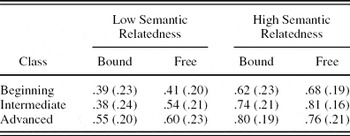
The descriptive statistics are displayed in Table 1. Six outliers that were 2 standard deviations below the mean were removed from the data analysis. As shown in Table 1, beginning kindergartners’ performance was close to the chance level (33%) in the low semantic relatedness condition. Intermediate kindergartners’ performance was also close to the chance level in the low semantic relatedness condition, but only when the target morpheme was bound. In general, the children scored higher in the high semantic relatedness condition than in the low semantic relatedness condition, higher on free morphemes than on bound morphemes. Their performance also increased with age.
Mean proportion (standard deviation) as a function of semantic relatedness, morpheme type, and age in Experiment 1

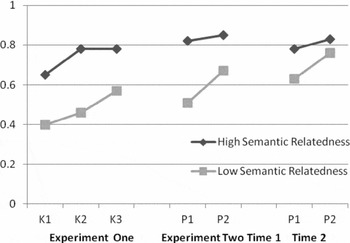
A 2 (Semantic Relatedness) × 2 (Morpheme Type) × 3 (Age) repeated-measure analysis of variance was carried out to analyze the data. Semantic relatedness and morpheme type were within-subject factors, and age was a between-subject factor. There was a very strong effect of semantic relatedness, F (1, 105) = 183.15, p < .001, η2 = 0.636, suggesting that this factor has a large impact on morpheme identification in the kindergarten years. Thus, it is much easier for young children to identify a morpheme when words sharing this morpheme are closely related in meaning. The children's age was also a significant factor, F (2, 105) = 13.06, p < .001, η2 = 0.199, pointing to continuous development of homophone awareness in kindergartner years. However, the interaction between semantic relatedness and age was not significant (see Figure 1Footnote 2). This lack of interaction suggests that there is no accelerated development in the ability to identify shared morphemes in semantically dissimilar words in the kindergarten years.
The development of homophone awareness in high and low levels of semantic relatedness with age/grade level. K1, K2, K3, beginning, intermediate, and senior class in kindergarten, respectively; P1, P2, younger and older cohort in primary school, respectively.

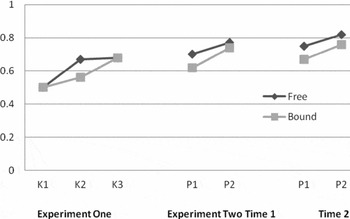
We also observed a significant main effect of morpheme type, F (1, 105) = 7.80, p < .01, η2 = 0.069. This finding confirms our hypothesis that young children are more aware of free morphemes than bound morphemes. The interaction between type of morpheme and age approached significance in this experiment, F (2, 105) = 2.79, p = .066, η2 = 0.050. In the beginning kindergarten class, children were very young and showed a low level of awareness of both free morphemes and bound morphemes. Performance on free morphemes improved from the beginning class to the intermediate class (Mdn = 0.13, p < .01). Awareness of bound morphemes, on the other hand, did not change significantly from the beginning class to the intermediate class. These findings offer preliminary evidence that the awareness of free morphemes develops before the awareness of bound morphemes. Awareness of bound morphemes improved significantly from the intermediate class to the senior class (Mdn = 0.12, p < .01). In senior kindergarten, children achieved similar levels of performance on both free and bound morphemes, probably due to the fact that the task was relatively easy and thus was not sensitive enough to differentiate between the two types of items. This marginally significant interaction is portrayed in Figure 2.
The development of the awareness of free and bound morphemes with age/grade level.

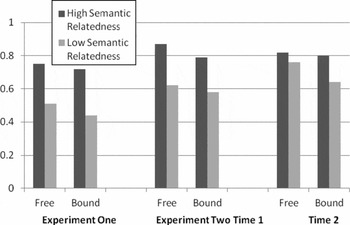
The interaction between type of morpheme and semantic relatedness was not significant (see Figure 3); neither was the three-way interaction among type of morpheme, semantic relatedness, and age. In other words, the gap between the performance in the low semantic relatedness condition and that in the high semantic relatedness condition remained large regardless of morpheme type across all three kindergarten classes. The lack of interactions provides converging evidence that semantic relatedness is the predominant factor at this stage of the development of homophone awareness.
The relationship between the type of morpheme and semantic relatedness.

EXPERIMENT 2
Method
Participants. The participants included 93 children from an elementary school in a working class neighborhood in Beijing, China. The initial testing took place in the middle of the spring semester, when the children were in Grades 1 (43 children: 24 boys, 19 girls) and 2 (50 children: 25 boys, 25 girls). The average ages were 6;4, and 7;3 at this time. The children were followed up about 7 months later, in the middle of the fall semester of Grades 2 and 3. All the children were native speakers of Chinese and did not have any obvious cognitive or developmental delays.
Materials and procedure. The children participating in Experiment 2 also received a morphological judgment task. In this task, the experimenter presented a pair of compound words to the child, for example, 门 铃 (men2 ling2; door bell: doorbell) and 门 票 (men2 piao4; door ticket: ticket), and pointed out that the two compound words shared a syllable that had the same pronunciation, for example, men2. The experimenter then asked the child to judge whether these two syllables had the same meaning. Note that there were several differences between this task and the task used in Experiment 1. First, pictures were not used in this task because the children were older. Second, the items in this task included both concrete and abstract words, which are developmentally appropriate for older children.
The morphological judgment task included 32 test items. Each test item consisted of a pair of compound words sharing the same morpheme. The characteristics of these items are described in detail below. The test items are presented in Appendix A. The task also included 40 filler items, each containing a pair of compound words sharing homophones. The homophonous morphemes had the same pronunciation but different meanings, for example, 风 扇 (feng1 shan4; wind fan: fan) and 蜂 蜜 (feng1 mi4; bee honey: honey). Because the time interval between test administrations was relatively short, different test and filler items were used at the two testing times. At each testing time, different types of test items and filler items were mixed together and presented in a randomized order. Children were tested individually in a quiet room by a trained graduate student majoring in psychology. The reliability (α) of the task was 0.97 at Time 1 and 0.92 at Time 2.
SEMANTIC RELATEDNESS. The test items were divided into two levels of semantic relatedness, with 16 items in each condition. The two words in each item in the high semantic relatedness condition were closely related in meaning as whole words, for example, 电 视 (dian4 shi4; electric vision: television) and 电 话 (dian4 hua4; electric talk: telephone), and the words in each item in the low semantic relatedness condition were distant in meaning, for example, 假 山 (jia3 shan1; artificial mountain: rockwork) and 假 发 (jia3 fa4; artificial hair: wig). Twenty psychology majors at Beijing Normal University evaluated the semantic relatedness of these word pairs on the same 7-point scale as in Experiment 1. The average rating of the items of high semantic relatedness was 4.75 at Time 1 and 4.16 at Time 2, t (30) = 1.83, p > .05. The average rating of the items of low semantic relatedness was 2.03 at Time 1 and 2.17 at Time 2, t (30) = 0.55, p > .1. The difference between the ratings of the items of high semantic relatedness and the ratings of the items of low semantic relatedness was highly significant at both testing times, t (30) = 8.87, p < .001 at Time 1, and t (30) = 7.04, p < 0.001 at Time 2.
MORPHEME TYPE. Because of an oversight in research design, the number of free and bound morphemes varied slightly at the two testing times. At Time 1, there were nine free morphemes and seven bound morphemes in each semantic relatedness condition. At Time 2, there were eight free morphemes and eight bound morphemes within each semantic relatedness condition. A free morpheme, for example, “ 腰 ” in 腰 果 (yao1 guo3; waist fruit: cashew) and 腰 带 (yao1 dai4; waist strap: waistband) can appear as an independent word, for example, 他 腰 疼 (His waist hurt). A bound morpheme, for example, “ 厨 ” in 厨 房 (chu2 fang2; cook room: kitchen) and 厨 师 (chu2 shi1; cook master: cook), cannot stand on its own. Twenty linguistics majors rated morpheme type on a 3-point scale adopted from Chen and Zheng (Reference Chen and Zheng2000), where 1 = a morpheme is always free, 2 = a morpheme is sometimes free, and 3 = a morpheme is always bound. The target morphemes in the test items received consistent ratings from all the evaluators, either as free morphemes or bound morphemes.
ITEM FAMILIARITY. Only words familiar to the children in spoken language were included in the morphological judgment task. Familiarity was first determined based on two corpora of Chinese preschoolers’ spoken vocabulary created by the first author (Hao et al., Reference Hao, Shu, Xing and Li2008, Reference Hao, Shu and Xing2011). In addition, familiarity of the test items was rated by 12 first-grade teachers from two different primary schools in the same neighborhood on a 7-point scale, where 1 = extremely unfamiliar and 7 = extremely familiar. The average ratings of words for high semantic relatedness at Time 1, Time 2, and for low semantic relatedness at Time 1 and 2 were 5.50, 5.45, 5.54, and 5.46 respectively. The difference among the four conditions was not significant, F (3, 124) = 0.69, p > .1. The participating children had not learned the characters used for these words in school.
Results and discussion
The descriptive statistics for the test items are presented in Table 2. The filler items were not analyzed. Participants who scored above 95% correct on the test items but less than 25% correct on the filler items were eliminated from data analysis because their answers appeared to have been determined by phonological similarity. That is, they may have given a positive answer simply because the target morphemes shared the same pronunciation. The number of children removed from the first and second grade groups were 7 and 2, respectively.
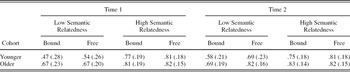
Mean proportion (standard deviation) as a function of semantic relatedness, morpheme type, testing time, and cohort in Experiment 2

As shown in Table 2, the younger cohort performed close to chance level (50%) at the low semantic relatedness condition, especially when the target morpheme was bound. In most cases, children performed better in the high semantic relatedness condition than in the low semantic relatedness condition, and better when the target morpheme was free than when it was bound. Their performance also increased with age/grade level and from Time 1 to Time 2.
A 2 (Semantic Relatedness) × 2 (Morpheme Type) × 2 (Testing Time) × 2 (Age) repeated-measure analysis of variance was conducted on the test items. Semantic relatedness, morpheme type, and testing time were within-subject factors, and age was a between-subject factor. There was a very large effect of semantic relatedness, F (1, 77) = 137.50, p < .001, η2 = 0.641. This effect showed that children's performance on the morphological judgment task was strongly influenced by semantic relatedness between words. As we expected, it is relatively easy to recognize the common morpheme when words are closely related in meaning, but the difficulty level increases when the word meanings are dissimilar. There was also a significant main effect of age, F (1, 77) = 11.26, p = .001, η2 = 0.128, and a significant main effect of time, F (1, 77) = 7.56, p < .05, η2 = 0.089. These findings again support our hypothesis that, in general, children's homophone awareness increases with age.
The interaction between semantic relatedness and age was significant, F (1, 77) = 11.96, p = .001, η2 = 0.134. Further analysis revealed that at both testing times, the two cohorts performed largely similarly on items of high semantic relatedness, but the older cohort scored significantly higher on items of low semantic relatedness, F (1, 77) = 11.48, p < .001, η2 = 0.130 at Time 1, and F (1, 77) = 12.88, p < .001, η2 = 0.143 at Time 2. The interaction between semantic relatedness and testing time was also significant, F (1, 77) = 25.48, p < .001, η2 = 0.249. Although there was no difference in performance from Time 1 to Time 2 on the items of high semantic relatedness for either cohort, both cohorts improved significantly on the items of low semantic relatedness during the time period, F (1, 33) = 11.33, p < .001, η2 = 0.256 for the younger cohort, and F (1, 44) = 12.05, p < .001, η2 = 0.215 for the older cohort. These significant interactions are illustrated in Figure 1. Thus, in Grade 1, Chinese children are already capable of identifying morphemes in closely related compounds, and consequently, there is little improvement with age/time. By contrast, children continue to develop the ability to identify shared morphemes in semantically dissimilar words in the early primary grades.
There was a significant main effect of morpheme type, F (1, 77) = 32.66, p < 0.001, η2 = 0.298, which confirms our hypothesis that children are more aware of free morphemes than bound morphemes. It is interesting that neither the interaction between morpheme type and age nor the interaction between morpheme type and time was significant. The three-way interaction among morpheme type, age, and time was also not significant. These results, shown in Figure 2, suggest that awareness of free morphemes and awareness of bound morphemes develop in a similar fashion in the two cohorts.
We observed a significant three-way interaction among semantic relatedness, morpheme type, and time (see Figure 3), F (1, 77) = 5.74, p < 0.05, η2 = 0.069. Further analysis showed that at Time 1, the effect of morpheme type on morpheme identification did not vary across the two semantic relatedness conditions. By contrast, at Time 2, children performed similarly on free and bound morphemes in the high semantic relatedness condition, but they performed better on free morphemes than bound morphemes in the low semantic relatedness condition, F (1, 77) = 16.92, p < .001, η2 = 0.180. That is to say, children in Grades 2 and 3 appear to have acquired the ability to identify bound morphemes in semantically similar words. However, they still have difficulty in recognizing bound morphemes in semantically dissimilar words.
GENERAL DISCUSSION
The two experiments reported in the present study produced several important findings. First, the experiments tracked the developmental trajectory of Chinese children's homophone awareness from the beginning of kindergarten to Grade 3. Our results suggest that homophone awareness emerges in the kindergarten years and increases steadily with age and grade level. Second, the development of homophone awareness is influenced by both semantic relatedness and morpheme type. The relative importance of the two factors changes from the beginning of kindergarten to the third grade. It is the interplay of the two factors, together with children's age, that determines the developmental trajectory of homophone awareness in Chinese children.
Results of Experiment 1 suggest that semantic relatedness is a predominant factor in the development of homophone awareness in the early years. A very strong effect of semantic relatedness was observed in kindergartners. Even children in the beginning kindergarten class, whose average age was 3;10, performed above chance level when the meanings of words were highly related. When semantic relatedness is high, however, we cannot claim with certainty that children are relying on morphological decomposition to perform correctly on the morphological judgment task because they may make a “yes” judgment simply based on whole-word meanings. In contrast, successful performance on semantically distant words is a robust indicator that conscious morphological decomposition is taking place. The kindergartners in our study, especially those in the beginning and intermediate classes, had difficulty detecting a common morpheme in the latter condition. The pronounced difference between the two levels of semantic relatedness in the kindergarten years, together with the lack of significant interaction between semantic relatedness and age, suggests that kindergartners (ages 3–5) are at the initial stages of the development of morphological awareness. For these young children, attention to whole-word meaning may serve as a springboard into awareness of morphemes.
The difference between the two levels of semantic relatedness was reduced in the early primary grades, as shown by the significant semantic relatedness by age interaction and the significant semantic relatedness by time interaction observed in Experiment 2. These developmental changes suggest that children begin to separate morpheme meaning from whole-word meaning between the first and second grade. Children in the second grade and above are more analytical of the morphological structure of words, and as a result, are less affected by whole-word meaning when asked to make decisions regarding the presence of a shared morpheme. Formal literacy instruction is likely to play a key role here. Second graders, who have already been receiving literacy instruction for more than a year, may be starting to figure out that in Chinese the same morpheme is always represented by the same character regardless of the meanings of words in which it appears. This insight likely leads to the understanding that two words can contain the same morpheme even when the word meanings themselves are not closely related.
Despite the observed progress, in Experiment 2, children's performance in the low semantic relatedness condition was still worse than that in the high semantic relatedness condition. In fact, the difference between the two levels of semantic relatedness, although much reduced, remained significant when children entered third grade (the second graders at the beginning of Experiment 2 were in third grade at Time 2). Combining the results of Experiment 1 and Experiment 2, we find that semantic relatedness has an important impact on Chinese children's homophone awareness from kindergarten to Grade 3. These findings parallel those on the importance of semantic relatedness in adults’ processing of compounds reviewed above, although routine lexical processing and language awareness cannot be equated. Research has consistently demonstrated that phonological awareness develops early and has largely reached ceiling by Grade 3 among normally developing readers (Casalis & Louis-Alexandre, Reference Casalis and Louis-Alexandre2000; Chen et al., Reference Chen, Hao, Geva, Zhu and Shu2009; Li et al., Reference Li, Anderson, Nagy, Zhang, Li, Gaffney and Packard2002; Shu, McBride-Chang, Wu, & Liu, Reference Shu, McBride-Chang, Wu and Liu2006). In comparison, morphological awareness appears to develop more slowly (Kuo & Anderson, Reference Kuo and Anderson2006). Future research needs to investigate whether the impact of semantic relatedness continues to decrease as children become more experienced readers.
Type of morpheme is another factor that influences the development of children's homophone awareness. Children were better able to identify free morphemes than bound morphemes in both experiments reported in this study. This finding likely reflects how different types of morphemes are represented in the mental lexicon (Taft & Zhu, Reference Taft, Zhu and Feldman1995; also Beauvillain, Reference Beauvillain1996; Forster & Azuma, Reference Forster and Azuma2000). A free morpheme is represented as a morpheme at the morphological level while also having a corresponding representation as an independent word at the lexical level. This increases the likelihood of identifying the morpheme as a separate unit of meaning. In contrast, a bound morpheme is always part of a compound word and therefore is only represented at the morphological level. Our study also offers some evidence that the impact of morpheme type changes with age. A marginally significant interaction between type of morpheme and age, observed in kindergartners, seems to indicate that the awareness of free morphemes emerges before the awareness of bound morphemes. However, this finding should be interpreted with caution because the interaction was not significant at the .05 level. This trend disappeared in older children, suggesting that the awareness of both types of morpheme increases at similar rates in the early primary grades.
Levelt (Reference Levelt1989) noted that speakers of agglutinative languages (such as Turkish or Hungarian) may be particularly likely to have separate representations of bound morphemes due to the enormous number of possible word forms in these languages. We would add that another reason might be the regularity of form with which morphemes tend to be realized in words in such languages. Separate representations of bound morphemes might also be expected in isolating languages, such as Chinese, because the identity of individual morphemes in polymorphemic words is not obscured by morphophonological changes. On the other hand, speakers of fusional languages, in which morphemes often have phonologically opaque allomorphs, may favor whole-word representations. Thus, awareness of bound morphemes may develop at an earlier age in Chinese than in inflecting languages. Future research needs to investigate whether the findings of the present study can be generalized to children whose first languages are typologically different.
Our study reveals that semantic relatedness and type of morpheme play different roles at different stages of the development of homophone awareness. As shown in Experiment 1, semantic relatedness is the most prominent factor in the early stages of development. Because kindergartners do not appear to have a deep and consistent explicit understanding of morphemes, it is not surprising that morpheme type has a more limited influence at this time. The relative importance of semantic relatedness and type of morpheme changes with children's age/grade level. The results of Experiment 2 reveal that, in the early primary grades, the effect of semantic relatedness varies as a function of morpheme type. The effect of semantic relatedness on free morphemes virtually disappears when children enter Grade 3, indicating that free morphemes become increasingly consciously accessible to children as units of meaning. By contrast, the effect of semantic relatedness on bound morphemes is reduced but remains significant.
To summarize, the present study sheds light on the time course of the development of homophone awareness (and, by extension, morphological awareness) in Chinese children. As previously noted, given the constraints of the morphological judgment task, children's homophone awareness is better represented by their performance in the low semantic relatedness condition, which is a robust indicator of the ability to identify morphemes as separate units of meaning. Combining the results in this condition from the two experiments, we demonstrate that awareness of morphemes begins to develop in the kindergarten years. In particular, awareness of free morphemes emerges between the beginning and the intermediate classes (ages 3;10 and 5;0), whereas awareness of bound morphemes emerges between the intermediate and senior classes (ages 5;0 and 5;10). The two types of homophone awareness continue to develop, in similar fashion, from kindergarten to early third grade (age 7;10). Awareness of free morphemes seems to be close to ceiling by early third grade. Lagging behind, awareness of bound morphemes is still developing at this time. It is reasonable to assume that awareness of bound morphemes will continue to develop past this age range, as the average performance is less than 70% in the early third grade.
Findings from a separate line of inquiry, word association research, seem to converge with our findings (Brown & Berko, Reference Brown and Berko1960; Söderman, Reference Söderman and Ringbom1993; see also Aitchison, Reference Aitchison2003; Meara, Reference Meara, Davies, Criper and Howatt1984; Pan & Uccelli, Reference Pan, Uccelli, Berko Gleason and Bernsteain Ratner2009). When asked to supply one or more words that come to mind when a target word is presented, individuals with developing mental lexicons tend to provide more associates that are related to the stimulus word phonologically (also known as clang associates) or which can collocate with it in discourse (also known as syntagmatic associates). Mature mental lexicons, in contrast, are characterized by a larger proportion of meaning-based (or paradigmatic) associations. This developmental change, commonly referred to as the syntagmatic–paradigmatic shift, takes place throughout the years of formal education. The change in response patterns appears to be the most dramatic around age 7 (Pan & Uccelli, Reference Pan, Uccelli, Berko Gleason and Bernsteain Ratner2009), which is approximately the age of our oldest participants. In addition, there is evidence that semantic categories are broadened and consolidated as the mental lexicon develops. At age 8, children are able to provide almost twice the number of examples of a semantic category compared to 5-year-olds, and the examples are more accurate (Nelson, Reference Nelson1974). The syntagmatic/paradigmatic shift likely contributes to the growth of morphological awareness, as good understanding of meaning is a sine qua non of understanding morphology.
Note that, although morphological competence is a necessary prerequisite for morphological awareness in naturalistic first language acquisition, our results show that awareness of word formation does not drastically lag behind the firm entrenchment of word formation processes in oral production (which takes place between ages 3 and 4, as mentioned above). This intimate relationship between word formation competence and awareness may be explained in light of the evidence that lexical storage and processing are linked with explicit memory, which is the only aspect of human long-term memory compatible with the concept of awareness (for recent reviews and models of the relationship between memory systems and language, see Paradis, Reference Paradis2004; Ullman, Reference Ullman2004; see also Levelt, Reference Levelt1989; Levelt, Roeloefs, & Meyer, Reference Levelt, Roeloefs and Meyer1999). In addition, because these models associate inflectional morphology with implicit memory, which is not amenable to direct conscious inspection, the interesting question arises of whether awareness of inflectional morphology emerges later and reaches lower levels than awareness of word-formation morphology, despite the fact that inflectional morphology itself emerges much earlier in spontaneous language use. This issue merits future investigation.
Our study also makes a significant methodological contribution by providing a measure of homophone awareness that distinguishes between different levels of semantic relatedness. To the best of our knowledge, this is the first study that has evaluated children's morphological awareness with semantically dissimilar words. Previous research (Li et al., Reference Li, Anderson, Nagy, Zhang, Li, Gaffney and Packard2002; McBride-Chang et al., Reference McBride-Chang, Shu, Zhou, Wat and Wagner2003) only examined morphological awareness with words that are closely related in meaning. McBride-Chang and colleagues (Reference McBride-Chang, Shu, Zhou, Wat and Wagner2003) reported that children's performance on a morpheme identification task already reached ceiling in second grade and ceased to be a significant predictor of character reading. Because the target words in this task, for example, laam4 lui3 (boy and girl), are more closely related in meaning to the words containing the shared morpheme, laam4 hai4 (boy), than to the words containing homophones, laam4 kou1 (basketball), and laam4 cik1 (blue), children may choose the correct answers based on word meanings without having to access the morphemes. In fact, the finding of McBride-Chang and colleagues (Reference McBride-Chang, Shu, Zhou, Wat and Wagner2003) is similar to our finding in the high semantic relatedness condition. As we have demonstrated, children's ability to identify morphemes develops more slowly when words are semantically distant. This ability may be predictive of character reading in Grade 2 and beyond.
Limitations and future directions
The above contributions of the present study need to be qualified by limitations in experimental design and measurement. Although the morphological judgment task was effective in assessing the role of semantic relatedness and morpheme type, there were several problems when it was the sole measure of the development of awareness. Performance in the low semantic relatedness condition may underestimate children's overall morphological awareness, because the items in this condition may be too difficult and thus were not sensitive enough to detect subtle developmental changes. Moreover, different items and task formats were used in Experiments 1 and 2. This was necessary to avoid floor and ceiling effects, because the morphological judgment task contained a large number of words, all of which had to be familiar to the children in their oral language. However, the difference in difficulty levels may have led to an underestimation of the progress that the children had made from kindergarten to the early primary grades. In future studies, researchers should use multiple measures to assess morphological awareness. A morphological construction task (e.g., McBride-Chang et al., Reference McBride-Chang, Shu, Zhou, Wat and Wagner2003; Shu et al., Reference Shu, McBride-Chang, Wu and Liu2006), which requires children to produce novel words containing a target morpheme, seems to be a good choice for examining the development of morphological awareness. Because this task does not require knowledge of a large number of words, the same items may be used for children of different ages.
Another limitation lies in the design of the two experiments. Although Experiment 2 had a longitudinal component, Experiment 1 was cross-sectional in nature, and so were the two experiments in combination. Thus, we cannot rule out the possibility that the children's progress in the kindergarten years and from kindergarten to primary grades partly resulted from cohort differences. A final limitation of our method was that we used familiarity ratings rather than corpus-based frequency data when selecting items. Although this ensured that the participants were familiar with the items, it could not guarantee that they were truly uniform in terms of corpus frequency. However, the Chinese corpora available to us at the time of the study were based on adult written language (Sun, Reference Sun2006; Sun, Huang, Sun, Li, & Xing, Reference Sun, Huang, Sun, Li, Xing and Hu1997). These corpora cannot be used to determine the frequency of words appearing in children's spoken language.
Future research needs to consider a number of other factors in morphological development, such as morpheme frequency, family size of the root morpheme, the number of homophones that a morpheme has, as well as other statistical properties of the lexicon. In order for this to be possible, the existence of extensive corpora of contemporary spoken usage will be necessary. Another factor worthy of future investigation is the level of concreteness or abstractness of a morpheme's meaning. In our study, the performance of the senior kindergartners was largely similar to that of the first graders. This may be attributed to the fact that the task used for the kindergartners only contained concrete items, whereas the task used for older children had both concrete and abstract items. Another variable is head status. Both English and Chinese endocentricFootnote 3 compound nouns tend to be right-headed (Ceccagno & Basciano, Reference Ceccagno and Basciano2007; Fabb, Reference Fabb, Spencer and Zwicky2005). The difficulty of identifying a shared morpheme may vary based on the morpheme being the head of both, just one, or neither of the words. Furthermore, the position of the morpheme in the two compounds (regardless of head status) may be a factor in awareness tasks, as it is probably easier to identify a shared morpheme when it is in the same position in both words.
One important factor that we did not consider in the present study is semantic transparency, which describes the semantic relation between a root or a base and a derivative or compound containing it (e.g., see Libben, Reference Libben1998; Marslen-Wilson et al. Reference Marslen-Wilson, Tyler, Waksler and Older1994). Although conceptually related, semantic transparency and relatedness cannot be equated. For instance, it is possible for two semantically transparent compounds not to be closely related in meaning as whole words (e.g., headscarf and headache). We decided not to focus on semantic transparency, due to the fact that Chinese compounds tend to be relatively transparent (Yuan & Huang, Reference Yuan and Huang1998), although opaque compounds do exist. Another related variable that merits further exploration is the semantic relationship between the constituent morphemes of a compound (i.e., a teapot is a pot for tea, whereas an office pot is a pot kept at an office). There is preliminary evidence that these relationships are a factor in the processing of familiar compounds (e.g., Gagné & Spalding, Reference Gagné and Spalding2004). Future studies could manipulate one of the above factors while keeping the others constant.
In terms of this study's potential implications for literacy instruction, to facilitate homophone and overall morphological awareness, it may be advantageous for teachers to begin instruction with words that are closely related in meaning and gradually introduce words that are semantically more distant. It may be necessary to draw children's attention to a large number of words that share a bound morpheme, as bound morphemes seem to become available to conscious reflection only after the child has been exposed to many different words. Furthermore, because discriminating between homophones is critical for Chinese character learning and yet difficult for young children, teachers need to take special care to ensure that children understand the concept of homophone. All of these issues need to be further examined in future intervention studies.
APPENDIX A
EXPERIMENT 1
The first word was the target word orally presented by the experimenter. The three words enclosed in brackets were words represented by pictures. The picture words within each item were presented in a randomized order.
High semantic relatedness, free morpheme
马 路 (铁 路, 梅 花 鹿, 露 珠), 象 棋 (跳 棋, 骑 马, 红 旗)
动 物 (动 画 片, 果 冻, 山 洞), 马 车 (斑 马, 蚂 蚁, 号 码)
刮 风 (风 雨, 信 封, 蜜 蜂)
High semantic relatedness, bound morpheme
袋 鼠 (袋 子, 带 鱼, 戴 帽 子), 水 杯 (茶 杯, 石 碑, 背 包)
跳 舞 (芭 蕾 舞, 五 角 星, 中 午), 花 瓶 (酒 瓶, 苹 果, 草 坪)
卧 室 (教 室, 护 士, 西 红 柿)
Low semantic relatedness, free morpheme
毛 笔 (毛 裤, 长 矛, 牦 牛), 长 城 (长 颈 鹿, 香 肠, 品 尝)
跳 高 (高 楼, 蛋 糕, 牙 膏), 花 边 (海 边, 鞭 子, 蝙 蝠)
电 视 (电 扇, 垫 子, 商 店)
Low semantic relatedness, bound morpheme
耳 机 (飞 机, 母 鸡, 簸 箕), 水 珠 (珍 珠, 野 猪, 蜘 蛛)
一 瓣 桔 子 (花 瓣, 打 扮, 伙 伴), 武 器 (电 器, 汽 车, 气 球)
按 摩 (按 钮, 岸 边, 案 板)
EXPERIMENT 2
Time 1 stimuli
High semantic relatedness, free morpheme
树 枝-树 叶, 问 题-问 号, 皮 鞋-拖 鞋, 帮 忙-帮 助, 破 坏-毁 坏, 墙 角-墙 壁,
信 封-信 纸, 茶 壶-茶 杯, 球 拍-球 赛
High semantic relatedness, bound morpheme
窗 台-窗 帘, 商 场-商 店, 盼 望-希 望, 衣 服-衣 帽, 声 调-音 调, 支 持-支 援,
武 器-兵 器
Low semantic relatedness, free morpheme
跳 棋-跳 绳, 包 围-包 装, 腰 果-腰 带, 耳 环-花 环, 地 板-地 球, 凉 席-凉 鞋,
分 散-分 配, 皮 鞋-皮 球, 指 定-约 定
Low semantic relatedness, bound morpheme
方 向-方 面, 体 温-体 育, 魔 术-美 术, 消 化-消 费, 操 场-市 场, 野 兽-野 菜,
茶 杯-奖 杯
Time 2 stimuli
High semantic relatedness, free morpheme
月 饼-油 饼, 癌 症-胃 癌, 纪 念 碑-墓 碑, 香 肠-腊 肠, 毒 蛇-毒 药, 奖 品-奖 状,
炉 灰-烟 灰, 象 棋-跳 棋
High semantic relatedness, bound morpheme
棉 鞋-棉 衣, 毛 巾-围 巾, 姿 势-手 势, 厨 房-厨 师, 莲 花-莲 子, 硬 币-纸 币,
基 础-基 本, 蛋 糕-炸 糕
Low semantic relatedness, free morpheme
电 话-笑 话, 山 顶-秃 顶, 旅 店-商 店, 鸟 窝-被 窝, 手 表-水 表, 饭 盒-饭 馆,
门 牌-名 牌, 气 味-滋 味
Low semantic relatedness, bound morpheme
茶 杯-奖 杯, 鞭 子-教 鞭, 目 标-路 标, 任 务-特 务, 阶 梯-阶 段, 摇 篮-花 篮,
电 器-武 器, 牙 齿-齿 轮