


Introduction
Social anxiety disorder (SAD) arises from a concern with how one appears to others and significant insecurity about one’s ability to appear favourable. It is specifically characterized by a fear of negative evaluation due to ‘unacceptable’ behaviour (Clark and Wells, Reference Clark, Wells, Heimberg, Liebowitz, Hope and Schneier1995). The current conceptualizations of SAD implicate the interaction of multiple cognitive and behavioural factors that maintain social anxiety (Clark and Wells, Reference Clark, Wells, Heimberg, Liebowitz, Hope and Schneier1995; Hofmann, Reference Hofmann2007; Heimberg et al., Reference Heimberg, Brozovich and Rapee2010). While there are a variety of maintenance factors discussed in the literature, the current project focuses on safety behaviour (SB) use, post-event processing (PEP), anticipatory anxiety, and perceived control in relation to the maintenance of social anxiety. We focus on these factors as they have been implicated in a number of studies to be essential in the maintenance and treatment of the disorder (e.g. Mitchell and Schmidt, Reference Mitchell and Schmidt2014; Wells et al., Reference Wells, Clark, Salkovskis, Ludgate, Hackmann and Gelder1995).
SBs have been defined as behaviours one engages in that are designed to reduce one’s anxiety in a particular situation (Salkovskis, Reference Salkovskis1991). In social anxiety, SBs are generally directly related to the specific fear of the situation (e.g. excessive rehearsing of a speech to prevent the fear of stumbling over words), and are negatively reinforced by being associated with an immediate reduction of anxiety in the moment (Piccirillo et al., Reference Piccirillo, Dryman and Heimberg2015). More recently, the concept of SBs has included the context (non-threatening situations), purpose (preventing a feared outcome), and cost (impeding rather than improving social performance) of the behaviours (Piccirillo et al., Reference Piccirillo, Dryman and Heimberg2015). These three factors are important in distinguishing maladaptive SBs from the adaptive coping responses that many people use in their daily lives (Thwaites and Freeston, Reference Thwaites and Freeston2005). These behaviours may be a way for someone to attempt to gain a semblance of control within a social situation (Taylor and Alden, Reference Taylor and Alden2010).
Theoretical model
Hofmann (Reference Hofmann2007) created a contemporary cognitive behavioural theoretical model comprehensively describing the maintenance of SAD, based upon Clark and Wells’ (Reference Clark, Wells, Heimberg, Liebowitz, Hope and Schneier1995) model. The model states that social anxiety is a result of a desire to make a positive impression in a social situation while believing that one is unable to do so due to the perception that the social standard is too high. The proposed reason for the doubt of being able to make a favourable impression is an inability to effectively define goals and utilize behaviours to reach the goals. This inability contributes to an increase in anxiety and self-focused attention. Furthermore, people with social anxiety have negative cognitions about themselves in social situations and believe they have little control over their anxious responses (perceived control), and that their social skills are inadequate. These cognitive processes lead to the anticipation of social failure. To combat this inevitable failure, people utilize avoidance and safety behaviours. These behaviours create a positive feedback loop; the SBs inhibit the individual from disconfirming their beliefs about a negative consequence occurring in the social situation, which maintains the anxiety. Following SB use in the situation, post-event processing (PEP), a detailed review of one’s social performance with a negative bias and self-perception, occurs. Hofmann’s (Reference Hofmann2007) model is specifically focused on maintaining factors of social anxiety and makes a direct connection between SB use and PEP. Thus, both utilization of SBs during an anxiety-provoking social situation, and subsequent PEP or rumination on one’s performance in the situation are emphasized in this model and are key to the maintenance of the disorder.
Perceived control
According to Hofmann (Reference Hofmann2005), it is the absence of perceived control over one’s emotions that leads to the use of avoidance behaviour as a coping mechanism. For people with social anxiety, the higher the perceived social cost, the less one believes they can control their anxiety, which in turn leads to further increases in anxiety.
Supporting the Hofmann (Reference Hofmann2007) model, Korte et al. (Reference Korte, Unruh, Oglesby and Schmidt2015) conducted a study in which participants were given a battery of questionnaires measuring perceived control, SB use, and social anxiety, among other constructs. The authors found that the relationship between SB use and social anxiety symptoms was mediated by perceived control over one’s anxiety levels and the external situation. While supportive of the Hofmann model, this study only represents an indirect test of the model, as it did not include an anxiety induction and used an undergraduate analogue sample. In the current study, the mediation model will be evaluated by measuring perceived control and social anxiety symptoms before a speech situation. This methodology is expected to provide a more direct evaluation of the role of SB usage in social anxiety as proposed by the Hofmann (Reference Hofmann2007) model.
Building upon the Hofmann (Reference Hofmann2007) model and the mediation evidence of Korte et al. (Reference Korte, Unruh, Oglesby and Schmidt2015), we propose the following theoretical link: elevated social anxiety leads to less perceived control which results in greater SB use. SB use then leads to greater levels of PEP, which, ultimately, creates greater anticipatory anxiety for future social situations. The current study examined this proposed serial mediation model in an experimental study. The variables in question are further discussed.
The impact of safety behaviour usage
While temporarily useful by reducing anxiety, SB use can lead to a misattribution of the absence of a feared catastrophe, consequently reinforcing the belief that one is staving off social danger (Wells et al., Reference Wells, Clark, Salkovskis, Ludgate, Hackmann and Gelder1995). That is, the individual believes that the reason for the non-occurrence of a feared outcome is the SB use and fails to recognize the feared outcome would not have happened regardless (Salkovskis, Reference Salkovskis1991). Furthermore, some SBs have the paradoxical effect of increasing the transparency of somatic anxiety symptoms, thereby augmenting the likelihood of the feared outcome (Clark and Wells, Reference Clark, Wells, Heimberg, Liebowitz, Hope and Schneier1995). Finally, SB use increases self-focused attention, which decreases awareness of external cues and increases awareness of internal anxiety symptoms (Clark and Wells, Reference Clark, Wells, Heimberg, Liebowitz, Hope and Schneier1995). The shift in self-focused attention results in a greater perception of threat, as well as a perception of personal social incompetency, while also preventing disconfirmation of the feared outcome (Clark and Wells, Reference Clark, Wells, Heimberg, Liebowitz, Hope and Schneier1995). Therefore, SB use can maintain social anxiety and reinforce distorted cognitive biases.
The impact of SBs on affect and performance is mixed. Some have found that individuals with high and low levels of social anxiety report that SB use is helpful in reducing their anxiety, preventing their feared outcomes, and improving their performance and impression to others (McManus et al., Reference McManus, Sacadura and Clark2008). In contrast, individuals with social anxiety have been shown to believe social performance would be worse and that their anxiety would increase and be more apparent when prompted to imagine using SBs in a social situation (McManus et al., Reference McManus, Sacadura and Clark2008; Voncken et al., Reference Voncken, Alden and Bögels2006). Similarly, participants told not to use SBs conveyed more positive and accurate judgements of their performance in comparison with control groups, which suggests that SB manipulation potentially affected individuals’ perception of their performance and anxiety more so than it affected their actual performance (Taylor and Alden, Reference Taylor and Alden2010). The conflicting results may have resulted from previous studies investigating social anxiety as a stagnant variable, such that there was minimal manipulation of the anxiety. None of the previous studies has investigated how the prospective experience of anxiety impacts the perceived usage of SBs. The current study utilized a ‘videoed’ speech situation to provoke fear of evaluation, as a speech is more likely to bring out the cognitive distortions in people with high levels of social anxiety, perhaps increasing PEP (Voncken and Bögels Reference Voncken and Bögels2008).
Post-event processing
PEP for those with elevated social anxiety has been found to be longer lasting and more negatively biased compared with PEP among those with lower levels of social anxiety (Dannahy and Stopa, Reference Dannahy and Stopa2007). It is important to note that PEP may be a critical maintaining factor in social anxiety due to its connection to anticipatory anxiety. Anticipatory anxiety occurs before a social situation and involves recall of the collection of negative memories and predictions, which begins the anxiety process (Mellings and Alden, Reference Mellings and Alden2000). While it is proposed that PEP and anticipatory anxiety may be intertwined (Brozovich and Heimberg, Reference Brozovich and Heimberg2013), there is evidence of distinct differences between the two (Chiupka et al., Reference Chiupka, Moscovitch and Bielak2012). In the current study, anticipatory anxiety was measured for a future speech task, one week after the initial speech situation, in order to examine the direct relationship between levels of negative PEP and the subsequent anticipation of a future social performance, specifically in the serial mediation model.
Studies examining SB use and PEP independently have shown that each construct is important in understanding individuals with social anxiety. However, there are few studies that have studied the concepts simultaneously to understand how the constructs interact. Mitchell and Schmidt (Reference Mitchell and Schmidt2014) proposed that the link between the two may be due to SBs being the first step in preventing the disconfirmation of maladaptive beliefs, and PEP furthers this prevention through selective retrieval about oneself in the social situation. Thus, these cognitive and behavioural processes most likely have an increased presence within a population with elevated social anxiety symptoms.
SB use is increased in samples of those with SAD and with those elevated on measures of social anxiety compared with those who score lower, across social settings (McManus et al., Reference McManus, Sacadura and Clark2008; Stangier et al., Reference Stangier, Heidenreich and Schermelleh-Engel2006). It is also found that in non-clinical populations, individuals with high levels of social anxiety report more negative PEP compared with individuals with lower levels of social anxiety (Dannahy and Stopa, Reference Dannahy and Stopa2007). It was further reported that individuals with high levels of social anxiety engage in more frequent and negatively biased PEP, and their perception of their performance worsens over time, while individuals with low levels of social anxiety show increased positivity of their performance over time (Dannahy and Stopa, Reference Dannahy and Stopa2007). Thus, the current study will utilize a non-clinical sample to examine the effect of elevated social anxiety scores on the relationship between SB use, PEP and perceived control.
Serial mediation analysis
The current study will utilize a serial mediation approach to test the relationship between perpetuating factors of social anxiety. Based upon Hoffman’s (Reference Hofmann2007) theoretical model, it is expected that we would see higher social anxiety levels leading to less perceived control, which then would lead to more SB use, leading to more PEP and finally resulting in increased anticipatory anxiety. In order to test the relationships between multiple factors it is necessary to use the statistical technique of serial mediation in PROCESS (Hayes, Reference Hayes2013). This is a novel way to approach testing the maintaining factors of social anxiety, as past research has examined the relationship between individual factors of social anxiety but not multiple factors at once (e.g. Dannahy and Stopa, Reference Dannahy and Stopa2007; Taylor and Alden, Reference Taylor and Alden2010). Thus, the advantage to this statistical method is that we can look at multiple pathways between the factors of social anxiety and examine which are significant with one model. Furthermore, we can see if the order of the factors is significant, and thus support the theoretical models. In sum, using the serial mediation is a novel way to test and examine the relationship between these factors of social anxiety, which will be employed in our study.
Study objectives
The primary aim of the present study was to examine the relationship between multiple maintenance factors of social anxiety. Specifically, we hypothesized that greater levels of social anxiety would lead to less reported perceived control, which would lead to greater levels of SB use, leading to greater levels of PEP, resulting in more anticipatory anxiety. We further predicted that individuals with high levels of social anxiety will report greater use of SBs and engage in more negative PEP than individuals with low levels of social anxiety. Accordingly, we expected that PEP would lead to greater levels of anticipatory anxiety for a future speech task. We applied a novel analysis (serial mediation) to evaluate the mediating effect of perceived control on the relationship between both SB use and social anxiety symptoms, and PEP levels and social anxiety symptoms.
Method
Participants
Power analyses using G*Power showed that a sample size of 92 participants was required to detect a medium effect for a full model with five predictors. We evaluated 100 undergraduates (68 women, 31 men, 1 other; 62% Caucasian, 4% African American, 9% Asian, 11% Latinx, 9% multi-racial, 4% other) of at least 18 years of age. All participants were college students attending a private mid-Atlantic university and were recruited via flyers, announcements and email. There were no specific exclusion criteria other than participants had to be 18 years or older. All participants completed informed consent and debriefing forms. Participants were given course credit for compensation where applicable.
Measures
Subtle Avoidance Frequency Examination
The 32-item SAFE (Cuming et al., Reference Cuming, Rapee, Kemp, Abbott, Peters and Gaston2009) is a self-report measure assessing the frequency of safety behaviours in social situations. The scale had excellent internal consistency (α = 0.91) overall. The items (e.g. ‘I avoid eye contact’) are on a 5-point scale from 1 (never) to 5 (always). The items measure three subtypes of safety behaviours, each exhibiting good internal consistency: physical symptom management (α = 0.74); restricting/inhibiting behaviours (α = 0.84); and active behaviours (α = 0.82). Seven items were removed from the SAFE for all analyses as they were not feasible behaviours to use in an impromptu speech situation (e.g. wear cool clothes that will conceal sweating if it occurs).Footnote 1
Extended Post-Event Processing Questionnaire
The 18-item EPEPQ (Fehm et al., Reference Fehm, Schneider and Hoyer2007) is a measure assessing aspects of post-event processing. Items (e.g. ‘After the event was over did you think about it a lot?’) are scored on a visual analogue scale from 0 (not at all) to 100 (very much so). This measure displayed excellent internal consistency (α = 0.95) in the current study.
Social Phobia Scale
The 20-item SPS (Mattick and Clarke, Reference Mattick and Clarke1998) is a measure that measures anxiety in a social performance. Items were scored on a 5-point Likert scale from 0 (not at all) to 4 (very much). This measure displayed excellent internal consistency (α = 0.90) with the current sample.
Subjective Units of Distress Scale
The SUDS (Wolpe, Reference Wolpe1958) is a single item measure of current anxiety levels. The scale ranges from 0 (no fear) to 100 (most severe distress or fear ever experienced).
Brief Fear of Negative Evaluation Scale
The 12-item BFNE (Leary, Reference Leary1983) is a measure that assesses the extent individuals experience anxiety in relation to situations with the possibility of negative scrutiny by others. Fear of negative evaluation has been shown to be a significant predictor of PEP, and therefore scores from the BFNE will be entered into a predictor model for PEP. Items (e.g. ‘I am afraid that others will not approve of me’) are scored on a 5-point scale from 1 (not characteristic of me) to 5 (extremely characteristic of me). This measure displayed excellent internal consistency (α = 0.90) with the current sample.
Anxiety Control Questionnaire-Revised
The 15-item ACQR (Brown et al., Reference Brown, White, Forsyth and Barlow2004) is a 15-item questionnaire that measures subjective perceived control over external stimuli. The scale consists of three subscales: emotion control, threat control, and stress control. Items (e.g. ‘I can usually relax when I want’) are scored on a 6-point Likert scale from 0 (strongly disagree) to 5 (strongly agree). The measure has shown good reliability in clinical (Brown et al., Reference Brown, White, Forsyth and Barlow2004) and subclinical (Moulding and Kyrios, Reference Moulding and Kyrios2007) populations. In the current study, the measure displayed good internal consistency (α = 0.78).
Center for Epidemiologic Studies Depression Scale
The 20-item CES-D (Radloff, Reference Radloff1977) is a self-report scale measuring depressive symptoms. The items are on a 4-point scale from rarely or none of the time to all of the time (e.g. ‘I felt fearful’). The CES-D is included in the study as a covariate in our analyses to control for depressive symptoms, due to the connection between mood, depressive rumination, and social anxiety. The measure displayed good internal consistency with the current sample (α = 0.87).
Procedure
The study was approved by the American University IRB. Following informed consent, participants completed the SPS, SAFE, ACQ-R and BFNE to measure baseline anxiety, fear of negative evaluation, typical SB use in speech situations, and a demographic questionnaire. Then they underwent a scripted interview in which they were prompted to discuss their specific fears in speech situations, as well as what SBs they engage in during these situations. They were then informed of a three-minute impromptu speech task requiring them to give a speech about their plans in the next five years. They were told the speech would be video recorded and later rated for quality by the researchers. The researcher followed a script throughout the interview and when informing the participants about the speech task to ensure consistency across participants.
The SUDS was administered prior to the three-minute speech to measure state anticipatory anxiety and again at the end of the speech to measure the participants’ highest level of anxiety during the speech. This speech was delivered in front of one research assistant who operated the video camera. Immediately after the speech participants completed the SAFE, EPEPQ and SUDS. Participants then left the laboratory and were asked to come back one week later.
At the session the following week, participants were asked to first complete the EPEPQ in relation to the speech task they had completed the prior week and were then told that they had to give another impromptu speech similar to the first one. Anticipatory anxiety for the speech was then measured with the SUDS (SUDS 3). Participants were then informed they did not actually have to give another speech and that they had completed the study. Finally, participants were given a debrief form which explained the full purpose of the study and were given the option to rescind consent to the usage of their data in the study (no participant withdrew consent).
Results
Manipulation checks
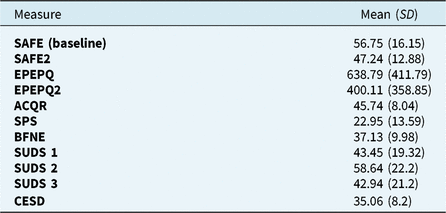
Overall means and standard deviations of the dependent variables are given in Table 1. The speech was successful in increasing anxiety as indicated by a significant increase in SUDS ratings from time 1 to time 2; F (1,97) = 69.73, p < .001.
Overall means and standard deviations of dependent variables

The scores for participants for each dependent measure for N = 100. SAFE, Subtle Avoidance Frequency Examination; EPEPQ, Extended Post-Event Processing Questionnaire; ACQR, Anxiety Control Questionnaire-Revised; SPS, Social Phobia Scale; BFNE, Brief Fear of Negative Evaluation; SUDS, Subjective Units of Distress; CESD, Center for Epidemiologic Studies Depression Scale.
Anticipated relationship between factors
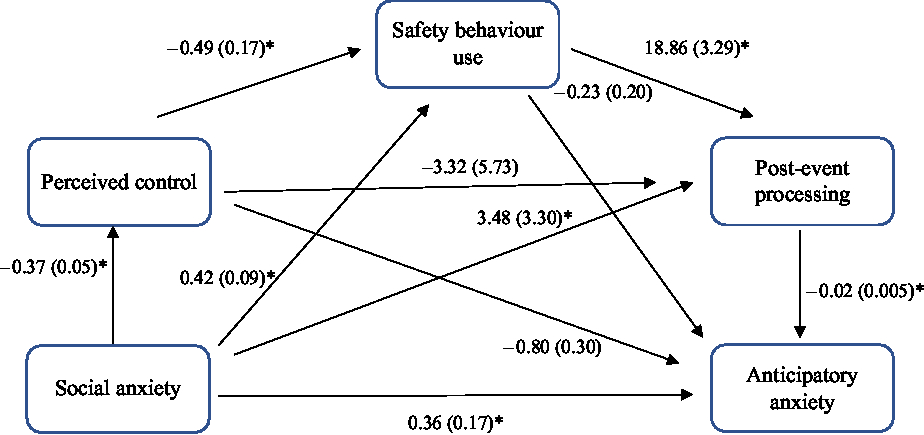
It was expected that participants with higher levels of social anxiety would report greater SB use as well as more negative PEP than individuals with low levels of social anxiety. It was further expected that participants who reported greater negative PEP, as well as individuals with high levels of social anxiety, would report greater levels of anticipatory anxiety for a future speech task. In order to test these hypotheses, we used the PROCESS macro for SPSS (Hayes, Reference Hayes2013) to test a serial mediation model using bootstrapping with 1000 samples. We added depressive scores as a covariate given the relationship between mood, depressive rumination and social anxiety. We predicted a causal chain between the variables from social anxiety to perceived control to SB use to PEP to anticipatory anxiety (see Fig. 1). In the mediation model, the longest path, testing our hypothesis, was significant: B = .04, SE = .02, 95% CI = .003, .107. We also found two other significant paths. The first path supports a causal chain between social anxiety, perceived control, and anticipatory anxiety: B = .19, SE = .07, 95% CI = .067, .331. The final significant path was between social anxiety, SB use, and PEP and anticipatory anxiety: B = .16, SE = .09, 95% CI = .028, .364.Footnote 2
Serial mediation of the relationship between factors controlling for depressive symptoms. Significant pathways: Indirect 1: Social anxiety → Perceived control → Anticipatory anxiety; Indirect 4: Social anxiety → Perceived control → Safety behaviour use → Post-event processing → Anticipatory anxiety; Indirect 6: Social anxiety → Safety behaviour use → Post-event processing → Anticipatory anxiety. *Statistically significant pathway.

Anxiety control mediation
Regression analysis using PROCESS (Hayes, Reference Hayes2013) was used to determine if anxiety control was a mediator of the relationship between social anxiety and SB use. The total effect of social anxiety (SPS score) on SB use (SAFE score), ignoring the mediator, was significant: B = .62, SE (B) = .075, t (96) = 8.18, p < .001. The bootstrapping test of the indirect effect indicated that the path from social anxiety to SB through anxiety control was significant: B = .19, SE = .071, 95% CI = .058, .337. The direct effect of social anxiety on SB use, after controlling for anxiety control, was still significant, B = .43, SE (B) = .07, t (95) = 4.69, p < .010.
Post-event processing predictors
Multiple linear regression was used to examine if fear of negative evaluation (BFNE scores), SB use (SAFE 2 scores), anxiety control (ACQR scores), and social anxiety (SPS scores) uniquely predicted post-event processing. The first model included PEP immediately after the speech as the dependent variable. The variables that uniquely predicted variance in PEP above and beyond the others were SB use [B = 19.36, t (92) = 6.17, p < .001] and fear of negative evaluation [B = 14.42, t (92) = 3.14 p < .001]. The model was significant: F (5,92) = 21.48, p < .001, R 2 = 0.54. It was found that when standardized, SB use [B = 249.37, t (92) = 6.17, p < .001, CI = 169.15, 329.59] was a stronger predictor of PEP than fear of negative evaluation [B = 143.83, t (92) = 3.46, p < .001, CI = 61.32, 226.34] when the scores were put into the multiple linear regression. This is because the B value for SB use does not fall inside the CI interval of fear of negative evaluation and vice versa. The second model included PEP one week after the speech as the dependent variable. The same predictors of SB use [B = 12.14, t (92) = 3.24, p < .001] and fear of negative evaluation [B = 9.99, t (92) = 4.3, p =.02] uniquely predicted PEP above and beyond the other predictors in the model. The model was significant: F (5,92) = 10.10, p < .001, R 2 = 0.35. In this model, when the scores were standardized for the measures, the predictors were found to not have a significant difference in strength.
Discussion
The present study investigated the relationship between multiple maintaining factors of social anxiety disorder. Consistent with previous investigations (Stangier et al., Reference Stangier, Heidenreich and Schermelleh-Engel2006), we found that higher social anxiety scores predicted greater SB use. Also, consistent with previous work (Dannahy and Stopa, Reference Dannahy and Stopa2007; Rachman et al., Reference Rachman, Gruter-Andrew and Shafran2000), we found evidence that greater social anxiety scores predicted increased PEP both immediately after the speech task as well as one week later. These findings support the position that SB use and PEP may be important in the maintenance of social anxiety. Our findings further support the notion that greater social anxiety is associated with greater post-event processing.
Importantly, we were able to examine these major tenets of Hofmann’s (Reference Hofmann2007) model of social anxiety together in one serial mediation model. In support of the model we found that SB use, PEP and anticipatory anxiety were all significantly associated with higher levels of social anxiety. Furthermore, we found that the connection between these variables fit into a serial mediation model that demonstrates the proposed theoretical progression: increased social anxiety leads to less control over one’s anxiety which leads to more SB use in situation, which increases PEP which then results in anticipatory anxiety for a future situation. This is one part of the maintenance cycle of social anxiety as described by Hofmann (Reference Hofmann2007). The serial mediation model provides a novel contribution to the literature on perpetuating factors of social anxiety, as it is a new method to examine these relationships in a single model.
Multiple studies have shown that SB use is a significant predictor of PEP (Kiko et al., Reference Kiko, Stevens, Mall, Steil, Bohus and Hermann2012; Mitchell and Schmidt, Reference Mitchell and Schmidt2014). The current study supports these findings as SB use, in conjunction with fear of negative evaluation, most significantly predicted post-event processing. This was found for PEP both immediately following the speech task, as well as one week after the speech, in a multiple regression that included fear of negative evaluation scores, SB use, dysfunctional social cognitions and social anxiety scores. This finding is consistent with a recent study by Helbig Lane et al. (Reference Helbig-Lang, von Auer, Neubauer, Murray and Gerlach2016), who found that there were increased rates of PEP after performance situations in comparison with interaction situations.
Our findings also provide further support for the significance of fear of negative evaluation in predicting PEP. This theoretically may be explained by the over-estimation of social cost in combination with anticipation of social failure. In other words, feeling as if failure is inevitable, and that the situation is critical, may lead to a fear of negative evaluation. Clark and Wells (Reference Clark, Wells, Heimberg, Liebowitz, Hope and Schneier1995) also propose that the SBs people engage in are intended to reduce fear of negative evaluation. Thus, as SBs and fear of negative evaluation are closely linked, it makes sense they would both significantly contribute to PEP. This may be more pronounced in performance situations as these situations are more evaluative than conversation settings. Further research is needed in order to examine the differences between speech and conversation settings in relation to fear of negative evaluation, and in turn if that affects SB use across settings.
Having identified both cognitive (perceived control, PEP and anticipatory anxiety) and behavioural (SB use) factors associated with the maintenance and/or exacerbation of social anxiety suggests that therapists treating people with social anxiety could intervene in multiple ways. Specifically, a therapist could address perceived control through incorporating either an acceptance-based intervention or challenging dysfunctional thoughts about control. According to our work, this may have the impact of directly affecting SB use, PEP and anxiety for a future social situation. Alternatively, a therapist could also use behavioural strategies and focus on the actual SB use to break the maintenance cycle. In this case one would expect that this would lead to less post-event rumination, which in turn would lead to less anticipatory anxiety. Understanding how these mechanisms interact is critical in treatment and suggests that it may not be necessary to attack all the various mechanisms simultaneously but could allow the therapists the freedom to tailor their intervention strategy to their patient. Of course, future work would need to address whether targeting one or multiple components is most effective.
Despite many novel findings, there are several limitations in the current study. First, a convenience and non-clinical sample was used. While there were individuals who scored high on social anxiety, there was no formal clinical evaluation to determine if participants fully met criteria for social anxiety disorder. Our lack of exclusion criteria was a limitation. Furthermore, SB use was self-reported and assessed with a standardized measure. SBs are operationally defined by their function, which is to prevent the individual’s fear from occurring, and therefore it is possible that some behaviours may not be listed on the SAFE.
Future work in this area could manipulate the use of SBs during a speech task. It would also be interesting to evaluate this methodology in a social interaction study. This would allow for comparison between the two types of social situations, and examination of the differences between SB use and PEP in different social situations could be possible. Another under-explored area is in examining the link between anticipatory anxiety and PEP. Finally, examining this model with a clinical sample will be important to further test the validity of the serial mediation. Further exploration into the construct of perceived control and its impact on social anxiety also seems warranted.
Acknowledgements
We would like to thank the participants for taking part in the study, and also the members in the Anxiety Disorders Laboratory for helping as research assistants.
Financial support
This research received no specific grant from any funding agency, commercial or not-for-profit sectors.
Conflicts of interest
Nicolette Carnahan, Michele Carter and Nathaniel Herr have no conflicts of interest with respect to this publication.
Ethical statement
The authors have abided by the Ethical Principles of Psychologists and Code of Conduct as set out by APA. Ethical approval was obtained by the Institutional Review Board at American University (reference number IRB-2017-41).



Comments
No Comments have been published for this article.