Introduction
Cochylis hospes (Walsingham) (Lepidoptera: Tortricidae) (banded sunflower moth) is a primary insect pest of cultivated sunflower, Helianthus annuus Linnaeus (Asteraceae), in the United States of America and Canada. Though C. hospes can be found as far south as Mexico, it is most common in the northern Great Plains, where it has a single generation per year (Beregovoy et al. Reference Beregovoy, Hein and Hammond1989). After mature larvae overwinter in the soil, pupation and adult emergence take place in spring, with female moths primarily laying eggs on the involucral bracts of prebloom heads (Beregovoy and Riemann Reference Beregovoy and Riemann1987). Feeding by C. hospes larvae reduces yields both by damage to florets (i.e., preventing successful fertilisation and subsequent seed development) and consumption of part or all of sunflower seeds within achenes (Charlet and Gross Reference Charlet and Gross1990; Peng and Brewer Reference Peng and Brewer1995).
Several tools are available to limit losses from feeding by C. hospes larvae. Pheromone traps and sampling plans for eggs can be used to monitor populations (Mundal and Brewer Reference Mundal and Brewer2008), and insecticides are effective with proper timing of treatment (Charlet and Busacca Reference Charlet and Busacca1986). Delayed planting is an effective cultural practice that limits adult oviposition and subsequent damage by larvae (Oseto et al. Reference Oseto, Charlet and Busacca1989). In an attempt to add to existing tools, research on host plant resistance has been conducted, emphasising wild sunflower (Helianthus Linnaeus) species (Charlet and Brewer Reference Charlet and Brewer1995), interspecific hybrids, and older, open-pollinated varieties (Charlet et al. Reference Charlet, Seiler, Miller, Hulke and Knodel2009). Interestingly, in the search for sources of resistance, it was noted that a hybrid produced by a single cross of two public inbred lines (intended to be a susceptible check) was among the materials with the lowest percentage of damaged seeds (Charlet et al. Reference Charlet, Seiler, Miller, Hulke and Knodel2009).
Additional recent screening has supported the idea that some public inbred lines may have relatively low susceptibility to C. hospes. Field trials with female lines released by the United States Department of Agriculture, Agricultural Research Service showed fourfold differences in seed damage (Prasifka and Hulke Reference Prasifka and Hulke2016), with the least damaged lines statistically similar to some putative resistance sources from Charlet et al. (Reference Charlet, Seiler, Miller, Hulke and Knodel2009). While the causes of reduced susceptibility in female lines identified by Prasifka and Hulke (Reference Prasifka and Hulke2016) are unclear, substantial variation exists for both physical (pericarp or “hull” strength; Prasifka et al. Reference Prasifka, Hulke and Seiler2014) and chemical defences (terpenoid compounds in glandular trichomes: Prasifka Reference Prasifka2015; Prasifka et al. Reference Prasifka, Spring, Cook, Palmquist and Foley2015) that are thought to limit damage by larvae of the sunflower moth, Homoeosoma electellum (Hulst) (Lepidoptera: Pyralidae), another floret-feeding and seed-feeding pest of sunflower.
The use of existing inbred lines to produce hybrids resistant to C. hospes is preferable to breeding with interspecific hybrids or open-pollinated H. annuus; already-released inbred lines often produce high-yielding hybrids in testcrosses and possess some desired agronomic qualities (e.g., high oil content, herbicide tolerance, specific fatty acid profiles). Though several female lines have low susceptibility to C. hospes, it is unclear whether this quality is also present in male lines and whether damage to inbred lines can be used to predict susceptibility of hybrids. To address these concerns, seed damage from C. hospes larvae was evaluated in field trials using natural infestations for (i) male inbred lines and (ii) hybrids produced from females tested by Prasifka and Hulke (Reference Prasifka and Hulke2016) and a common male parent.
Materials and methods
Tests of male lines
Field trials with male lines were conducted from 2013 to 2014 at the Agronomy Seed Farm of North Dakota State University, approximately 1 km southwest of Casselton, North Dakota, United States of America. Both years, selected male lines (n = 17) and commercial hybrids (n = 3; Croplan 3080, Mycogen 8H449 CL DM, Pioneer 63M80) were planted into a randomised complete block design with five replicates. Entries were planted into single-row plots 5.00 m long with 0.76-m row spacing and thinned after emergence to ≤ 25 plants per plot. Relatively early planting dates (United States Department of Agriculture, National Agricultural Statistics Service 2010) in 2013 (16 May) and 2014 (29 May) were selected to maximise potential seed damage by C. hospes larvae.
After plants reached physiological maturity, heads were harvested, dried, threshed, and seed samples rated as described in Prasifka and Hulke (Reference Prasifka and Hulke2016). In brief, five heads (= subsamples) per plot were collected and dried using forced air at 45 °C. Heads were hand-threshed and equal volumes from subsamples combined to create a composite sample from which 200 filled achenes were removed. Achenes were scored for C. hospes damage to seeds by external inspection (2013; based on the size and location of hole in achene and presence of silk near hole) or X-ray images (2014; based on the extent of feeding damage and visible presence of frass). Specimens of larvae believed to be C. hospes were not collected and reared for adult vouchers, but the presence of C. hospes and its prevalence over other moths whose larvae feed on sunflower seeds was confirmed by pheromone traps adjacent to the plots (see www.ag.ndsu.edu/ndipm/ipm-survey-archives/sunflower-insect-trap-archives).
The consistency of damage estimates was assessed in two different ways. First, samples collected in 2014 were scored for C. hospes damage independently using both X-ray images and external inspection (the method employed in 2013), with the percentage of damaged seeds estimated from X-rays regressed onto values from external inspection. Second, to see the extent of overall agreement of data across years (but using different scoring methods), the percentage of damaged seeds from male lines in 2014 was regressed onto 2013 data. Subsequently, a mixed-effects model (SAS Institute 2016; PROC MIXED) was used to test for fixed effects of year, entry (including inbred males and hybrids used as controls), year × entry interaction, and a random effect of block (within year; to account for any effects of location within the trials) on the (square-root-transformed) proportion of damaged seeds. Comparisons among the entries were made using least-squares estimated means and a two-tailed Dunnett’s test (using RHA 266, the inbred line with the lowest amount of damage over the two years as the control).
Tests of hybrids
Based on results from 2013 to 2014, the least damaged male inbred line, RHA 266, was selected as a common parent for a panel of hybrids including all of the publicly released material tested by Prasifka and Hulke (Reference Prasifka and Hulke2016), except HA 458 (which has no isoline with cytoplasmic male sterility (cms)). Hybrid seed was produced by growing cytoplasmic male-sterile lines in a greenhouse and pollinating the head of each female with RHA 266. Field trials of the 15 hybrids and resistant (RHA 266) and susceptible (RHA 386) males were conducted in 2016–2017 using methods as described for male lines in 2013–2014, except that all seed samples were scored for damage using X-ray images.
The analysis of hybrid trials followed the same general procedure as for the male lines with two minor differences. First, Dunnett’s test used the least damaged hybrid, cms HA 207 × RHA 266, as the control for two-tailed comparisons. Second, to test if C. hospes damage to inbred lines predicted damage to hybrids with a common male parent, the least-squares estimated means for 2016–2017 were regressed onto the corresponding data for female lines as presented in Prasifka and Hulke (Reference Prasifka and Hulke2016).
Results
Tests of male lines
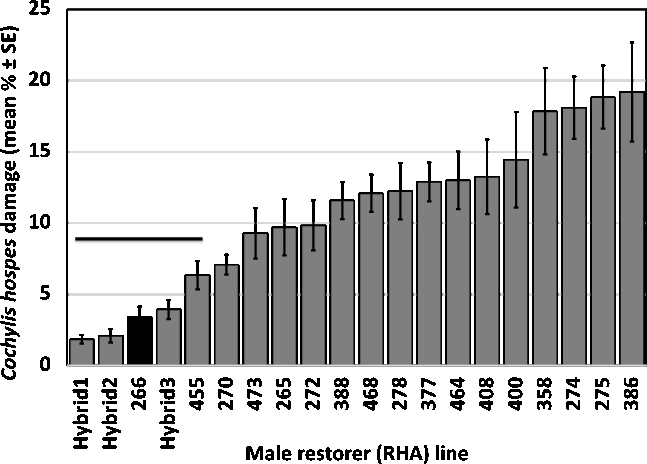
The evaluation of samples from male lines in 2014 indicated both X-rays and external examination provided similar estimates of damage by C. hospes larvae (X-ray = 0.95 × External + 1.91; n = 97, R 2 = 0.87). Relative seed damage to tested inbred lines was consistent between the years of testing (2014 = 0.54 × 2013 + 4.62; R 2 = 0.39), but suggested greater damage across the trial in 2013. However, a mixed-effects model showed no significant effects of year or year × entry interaction, but significant variation among entries (F = 14.06, df1 = 19, df2 = 149, P < 0.01) for the (square-root-transformed) proportion of damaged seeds. The percentage of damaged seeds in male lines ranged from approximately 3% (RHA 266) to approximately 19% (RHA 275 and RHA 386), while all three commercial hybrids showed little feeding from C. hospes larvae (approximately 2–4%). Using RHA 266 as the control, a two-tailed Dunnett’s test created a group of five entries with similarly low levels of damage, including all three hybrids and RHA 455 (Fig. 1).
Percentage of damaged seeds (± standard error) for 17 male (RHA) sunflower lines and three commercial hybrids evaluated in 2013 and 2014. Untransformed means and errors shown. Solid horizontal line indicates the subset of tested entries with transformed, least-squares estimated means similar to RHA 266 (P < 0.05, Dunnett’s test).

Tests of hybrids
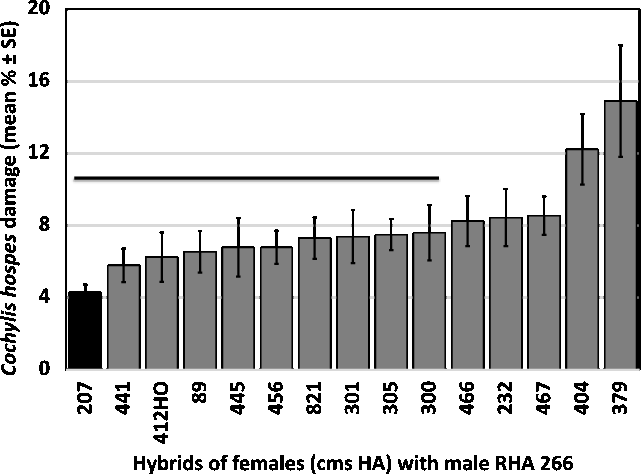
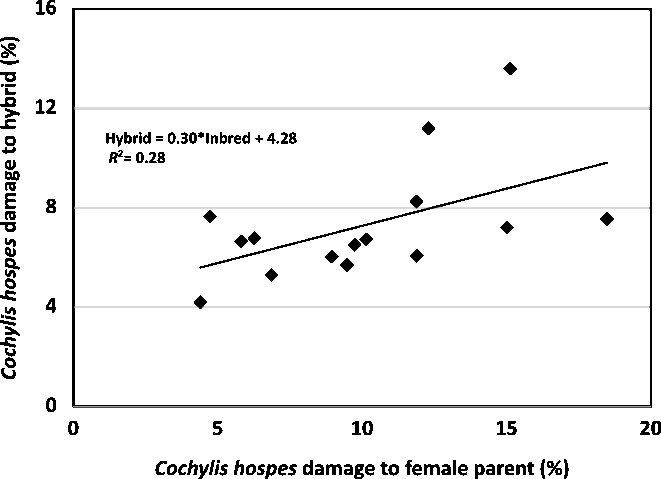
Using X-ray images to evaluate samples from hybrids, the percentages of damaged seeds over two years were related (2017 = 0.21 × 2016 + 4.00; R 2 = 0.34), but the mixed-effects model showed a year effect (F = 6.07, df1 = 1, df2 = 8, P = 0.04) with greater damage in 2016. As with the male lines, there was no year × entry interaction, but differences among entries (F = 15.33, df1 = 16, df2 = 126, P < 0.01). The percentage of damaged seeds in hybrids ranged from approximately 4% (cms HA 207 × RHA 266) to approximately 14% (cms HA 379 × RHA 266), while male lines included as resistant (RHA 266) or susceptible (RHA 386) entries, for comparison, received about 5% and 37% C. hospes damage, respectively. A two-tailed Dunnett’s test comparing other hybrids to cms HA 207 × RHA 266 showed 5 of the other 14 hybrids with significantly greater damage from C. hospes larvae (Fig. 2). When least-squares estimates of damage to hybrids were regressed onto data for female parents from Prasifka and Hulke (Reference Prasifka and Hulke2016), female parent performance explained about 28% of variation in hybrids (Fig. 3).
Percentage of damaged seeds (±standard error) for 15 hybrids of female (cms HA) sunflower lines and a common male parent, RHA 266, evaluated in 2016 and 2017. Untransformed means and errors shown. Solid horizontal line indicates the subset of tested hybrids with transformed, least-squares estimated means similar to cms HA 207 × RHA 266 (P < 0.05, Dunnett’s test).

Regression of Cochylis hospes damage to seeds of hybrids with a common male parent, RHA 266, onto data for 15 female parents. Data from hybrids (2016–2017) and females (2013–2014; from Prasifka and Hulke Reference Prasifka and Hulke2016) presented as back-transformed least-squares estimated means.

Discussion
Seed damage in field trials using natural infestations of C. hospes show approximately fivefold variation in susceptibility of male sunflower lines. Prasifka and Hulke (Reference Prasifka and Hulke2016) observed similar results for female lines and found that consistency of results across years and limited variation in bloom time supported the conclusion that differences in seed damage were not produced by variation in maturity of the tested lines (i.e., were not due to “escape” from moth oviposition). It is noteworthy that two of the three male lines with the lowest estimates of damage from C. hospes, RHA 266 and RHA 270, are single-headed males; a similar observation was made with regard to infestations of a floret-feeding fly, Melanagromyza minimoides Spencer (Diptera: Agromyzidae), in Argentina (Prasifka and Bazzalo Reference Prasifka and Bazzalo2016). However, because the pedigrees of the single-headed lines include shared parents, existing data are not sufficient to determine whether branching per se has an effect on seed damage for these pests.
Field trials also showed that susceptibility of female lines to C. hospes helps predict susceptibility of hybrids (made with a common male parent, RHA 266). Little similar work has been conducted in cultivated sunflower, though Crompton (Reference Crompton2004) examined resistance to the sunflower midge, Contarinia schulzi Gagné (Diptera: Cecidomyiidae), in several inbreds and hybrids; damage ratings showed that the most resistant inbred line produced hybrids relatively resistant to sunflower midge when used as a female in crosses with susceptible males, but another resistant line did not have the same benefit.
In other crops such as maize (Zea mays Linnaeus; Poaceae), the results are similarly variable. Damage to maize roots from western corn rootworm, Diabrotica virgifera virgifera (LeConte) (Coleoptera: Chrysomelidae), showed no significant relationship between susceptibility of inbreds and hybrids (Flint-Garcia et al. Reference Flint-Garcia, Dashiell, Prischmann, Bohn and Hibbard2009). But several measures of resistance to larval damage of the European corn borer, Ostrinia nubilalis (Hübner) (Lepidoptera: Crambidae), were significantly correlated between inbreds and hybrids over multiple environments (Kreps et al. Reference Kreps, Gumber, Schulz, Klein and Melchinger1998). For C. hospes, when inbreds or hybrids were tested over multiple years, results from the first year only explained a moderate amount (R 2 = 0.34–0.39) of variation in the subsequent year, while the amount of variation of hybrid damage explained by inbred female parents was even lower (R 2 = 0.28). One way to interpret these results is that environmental and experimental errors combined limit the inbred–hybrid R 2 at no more than 0.40, making the observed inbred–hybrid relationship stronger than it otherwise appears. Another interpretation is that the inbred–hybrid relationship for C. hospes susceptibility is too weak to be used for the selection of inbreds (or hybrids). However, because of the challenges presented by working with segregating or open-pollinated sources of C. hospes resistance (used by Chirumamilla et al. Reference Chirumamilla, Knodel, Charlet, Hulke, Foster and Ode2014), the identification of inbred lines with consistently high or low levels of damage may permit improved investigation into the broad mechanisms of resistance available in cultivated sunflower.
Surveys of grower fields conducted each year (prior to 2014) or in alternating years by the National Sunflower Association in the United States of America provide the most comprehensive data on seed damage from sunflower insect pests in North America (search term “survey” at www.sunflowernsa.com/Research/searchable-database-of-forum-papers). Summaries of the survey data (Prasifka and Hulke Reference Prasifka and Hulke2012; J.R.P. unpublished) suggest that a combination of modified planting dates and insecticide use have been very effective in managing C. hospes and other seed-feeding pests, reducing losses by 90% or more. However, for trials during 2013–2014, insecticides were not used and planting date was selected to maximise C. hospes infestation, yet three commercial hybrids received very little damage (< 3%), both in absolute terms and compared to public inbred lines (> 12% across 17 lines). Though grower management of pests may be effective and important, data from 2013 to 2014 suggest that some commercial hybrids simply have very low susceptibility to C. hospes.
Results of field tests of inbreds and hybrids confirm that cultivated sunflower has considerably greater variation in susceptibility to C. hospes than previously thought, and that information on seed damage to inbred lines provides some predictive power for hybrids. Though data from inbred lines could be useful for breeding, with the exception of discarding lines that are very susceptible (which can be detected visually by abundant frass, silk, and premature senescence of florets), it is almost certainly too labour-intensive for public or private breeders to undertake. Steps to make resistance to C. hospes a plausible target include improved understanding of the nature of resistance and, even better, easily measurable traits or genetic markers.
Acknowledgements
We appreciate help received in selecting and preparing field plots at the North Dakota State University Agronomy Seed Farm, particularly from Brian Otteson (North Dakota State University), as well as assistance in planting and managing plots from Pat Beauzay (North Dakota State University), Chris Misar, Theresa Gross, and Lisa Brown (United States Department of Agriculture, Agriculture Research Service).