The aim of this short article is to offer a belated defense of L. M. Boyd (author of a daily, nationally syndicated column ‘Trivia’ in numerous newspapers throughout the USA) against a critique published in English Today over a decade ago by Alan S. Kaye (Reference Kaye2006), and present arguments in support of Boyd's beleaguered claim. Kaye (Reference Kaye2006: 54) writes:
I do not mean to be picking on Mr. Boyd, but considering his track record, perhaps the time has come for his quitting pontificating on matters of English grammar, pronunciation, and the history of the language.
Kaye's motivation for calling on Boyd to ‘quit his pontificating’ on matters of English comes from the latter's casting of doubt, in his ‘Trivia’ column for April 27, 2004, that ‘[there is] any word in English, besides “shepherd”, that contains a “ph” not pronounced like an “f”.’ In other words, according to Kaye, there are actually (many) words in English with ‘ph’ not being pronounced like an ‘f’. Thus, he points out that,
Although it is a rare phenomenon for the diagraph < ph > to be pronounced as a sequence of the two phonemes /p/ + /h/, we can mention the following: upheave (and derivatives), upheld (and derivatives), upholstery (and derivatives), cupholder, haphazard, loophole, not to mention hyphenated words, such as top-heavy (which we are not counting here). Then there are cases of the change of [f] > [p]: diphthong and monophthong (and derivatives thereof respectively), and diphtheria (where many speakers pronounce [dɪpθɔŋ], [manɪpθɔŋ], and [dɪpθɪriə] respectively). There are probably further cases of < ph > not being pronounced as [f].
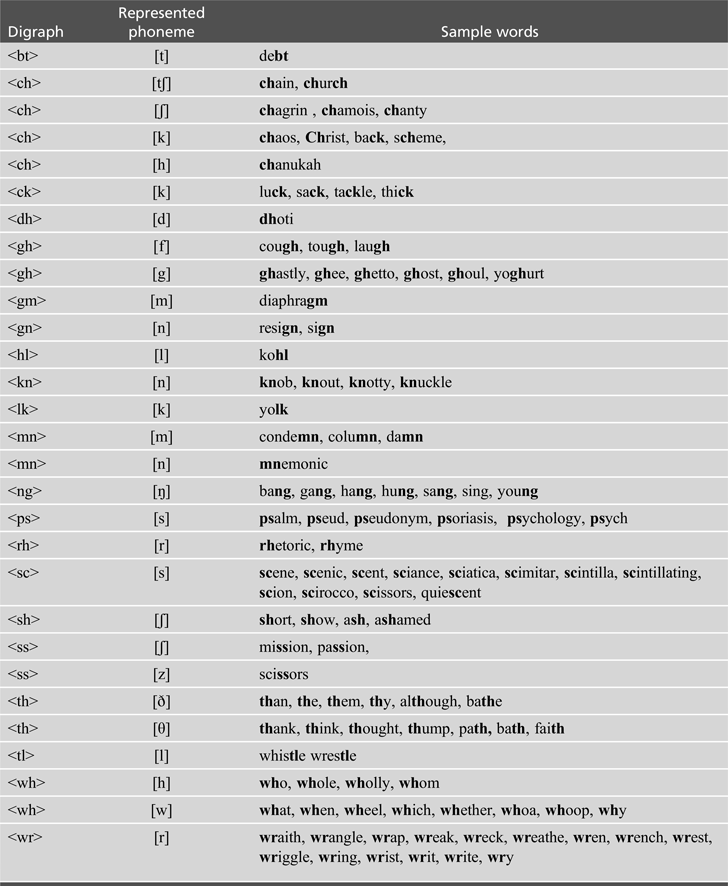
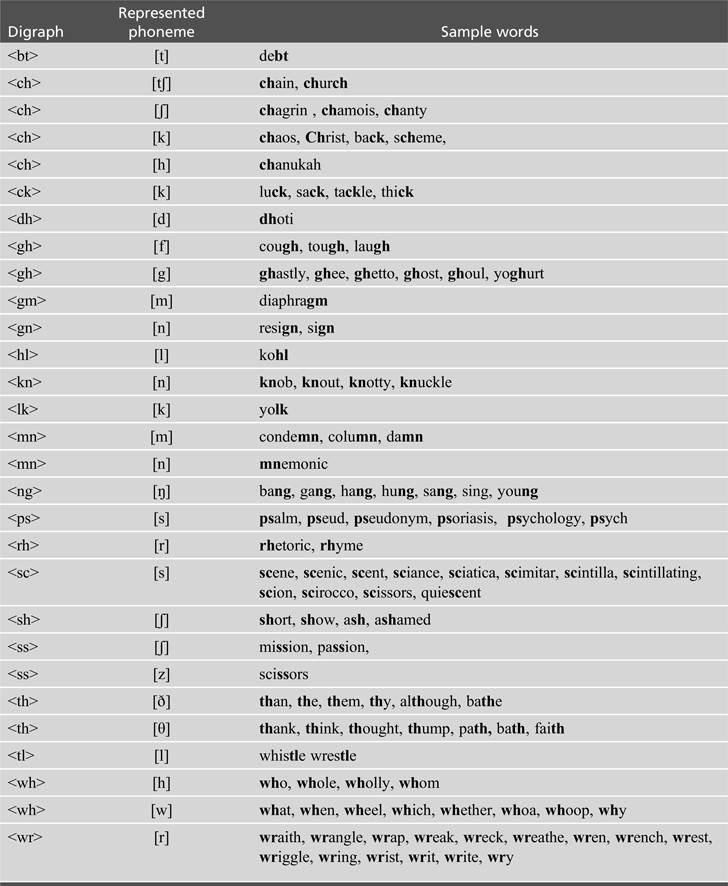
As a matter of fact, however, the context of Boyd's use of p + h is that of a digraph, as Kaye himself seems to admit in the first line of the last quotation above. A digraph is a combination of two letters of the alphabet – consonants or vowels – that represents one single phoneme within the same syllable at any given instance like < ph > for /p/ in shepherd or /f/ in alphabet, hyphen, phrase, phenomenon, and digraph. The use of digraphs is quite commonplace in English orthography. Aside from < ph>, other consonantal digraphs are shown in Table 1. There are also consonantal trigraphs, notably < ght > for [t] as in light , night , naught , <cht > for [t] as in yacht , and < sch > for [ʃ] as in sch wa and (the British English pronunciation of) sch edule. Vocalic digraphs famously include < ae > for [e] as in aesthetic and < oe > for [iː] as in diarrhoea (Korhenen, Reference Korhenen2015: 6).
More digraphs in English orthography
Note that diagraphs are similar to clusters in that, for both, all the letters involved appear within the same syllable; but a diagraph differs from a cluster in that, with the latter, the letters represent a sequence of individual phonemes, whereas with the former, the letters jointly represent one and the same phoneme. In short, when pronounced as a sequence of the two phonemes /p/ and /h/ (within separate syllables), ph is not a digraph – this is in the same way as bl in problem, bs in observe, and pt in laptop are not digraphs. Even when letters occur in a sequence (or cluster) within the same syllable, they do not constitute a digraph or trigraph as long as each of the letters represents a separate phoneme. Observe that, in examples like upheave, upheld, upholstery, cupholder, haphazard, loophole, and top-heavy cited by Kaye, p and h do not co-occur as a digraph in the same syllable (as they do in examples like alphabet, phrase, phenomenon, hyphen, and digraph); in Kaye's examples, the two rather occur in separate syllables, only meeting at syllable boundary, and are therefore not even in a sequence and do not jointly function to represent the same phoneme. With respect to the combined use of the two letters as a digraph (i.e., <ph>) to represent a single phoneme, therefore, Kaye's use of these examples in a critique of Boyd is actually misleading. In fact, it is not possible to talk of ‘the digraph < ph > to be pronounced as a sequence of the two phonemes /p/ + /h/’, as a digraph does not represent a sequence of phonemes.
Furthermore, even when he uses the right kind of examples, that is, with respect to the pronunciation of ph as a digraph, Kaye is also wrong in thinking that shepherd is not the only word with < ph > not pronounced like an f. In cases like diphtheria, diphthong, and monophthong (which he cites), the pronunciation of < ph > varies between /f/ and /p/, and he himself talks of the variation as being a ‘change of [f] > [p]’, an assumption that, in itself, implies that [f] is the underlying pronunciation of < ph > in such words. For example, it is definitely not by chance that this variation is exhibited only in words where < ph > precedes < th>, <th > standing for the phoneme [θ]. Thus, although this might require further independent verification (i.e., why would [f] change to [p] before [θ]?), if we simply stand by Kaye's implied assumption, then Boyd is right, after all. In other words, in words like diphtheria, diphthong, and monophthong, <ph > is basically pronounced /f/ in line with Boyd, and ‘there are probably [no] further cases of < ph > [other than in shepherd] not being pronounced as [f]’, contra Kaye.
In the conclusion of his critique of Boyd, Kaye writes:
I would like readers to notify me at akaye@fullerton.edu of additional examples of the phenomenon described above. I shall tabulate all of them and offer them for a subsequent issue of ET.
However, since January 2006, no subsequent issue of ET has carried any further critique of Boyd from Kaye. I suspect that this is because there are probably no English words, besides shepherd, that truly contain < ph > not pronounced like an f that readers can notify him of.
Acknowledgements
I have benefitted from a semestral research allowance from the Faculty of Arts at the University of Buea, and a quarterly research modernization allowance from the Cameroonian Ministry of Higher Education for which I am grateful.
 BLASIUS ACHIRI-TABOH holds a PhD in Linguistics, and works as a Senior Lecturer at the State University of Buea in Cameroon, where he teaches undergraduate and postgraduate courses in Generative Syntax, Semantics, and in Bantu and English Morpho-Syntax. His research affiliations lie in Bantu Morpho-Syntax, current world English and usage, English Syntax, and the syntax of the clausal left periphery. He is the author of ‘A generalized question tag in English’ published in English Today, 31(1), pp. 48–54, and he is currently exploring further into the theoretical basis of tag questions. Email: achiri.blasius@ubuea.cm.