Implications
As part of the effort to avoid tail biting, pigs are often tail docked. This study compared the tail biting risk in finisher pens where pigs had been docked, leaving either 2.9 (Short), 5.7 (Medium) or 7.5 cm (Long) of their tail, or were undocked (Undocked). The pigs in the Short treatment had the lowest risk of tail biting and received less tail-directed behaviour from their pen mates. Tail docking, regardless of docking length, has consequences for pigs, as has being tail bitten. This study provides knowledge about the effect of tail docking in relation to the docking length and input as to how these consequences trade-off against each other.
Introduction
Tail biting is an abnormal behaviour in domestic pigs. Outbreaks of tail biting are correlated to a range of environmental factors that individually and together threaten the welfare of pigs (Schrøder-Petersen et al., Reference Schrøder-Petersen and Simonsen2001). Hence, tail biting is a welfare problem for the bitten pig due to pain, but also for the biter due to inadequacy in the environment causing the pig to tail bite. One important factor to prevent tail biting is provision of manipulable material to fulfil the behavioural need of pigs to explore (van de Weerd et al., Reference Van de Weerd, Docking, Day, Breuer and Edwards2006; Pedersen et al., Reference Pedersen, Herskin, Forkman, Halekoh, Kristensen and Jensen2014). A range of other risk factors has been identified and includes high stocking density (Moinard et al., Reference Moinard, Mendl, Nicol and Green2003; Scollo et al., Reference Scollo, Contiero and Gottardo2016), diet (Fraser et al., Reference Fraser1987; European Food Safety Authority (EFSA), 2007; Taylor et al., Reference Taylor, Main, Mendl and Edwards2010), feed type and feed delivery system (Hunter et al., Reference Hunter, Jones, Guise, Penny and Hoste2001; Moinard et al., Reference Moinard, Mendl, Nicol and Green2003), slatted flooring, barn climate (EFSA, 2007; Taylor et al., Reference Taylor, Main, Mendl and Edwards2010) as well as genetic and individual factors (Breuer et al., Reference Breuer, Sutcliffe, Mercer, Rance, O’Connell, Sneddon and Edwards2005; Brunberg et al., Reference Brunberg, Jensen, Isaksson and Keeling2013). Hence, due to its multifactorial nature, tail biting can be difficult to avoid under production conditions where an inadequate environment is not unusual.
Despite the EU legislation stating that tail docking cannot be performed routinely (The Council of the European Union, 2008), the procedure is used by a large proportion of pig producers as a preventive method to limit the risk of outbreaks of tail biting (EFSA, 2007). In Denmark, most pigs in conventional indoor production systems are tail docked, whereas pigs in free-range systems, both organic and conventional, are not. Slaughter data from the two latter show tail lesions in 2.1% to 2.9% of the pigs and in 0.7% of the pigs in conventional indoor systems (Kongsted and Sørensen, 2017).
In compliance with a Danish aggravation of the EU legislation, the amount of tail that is legal to remove is restricted, as in more countries, and it is only legal to remove half the tail. The effect of tail length after docking on the prevalence of tail biting outbreaks is, however, a factor less well studied. Most experimental studies (Di Martino et al., Reference Di Martino, Scollo, Gottardo, Stefani, Schiavon, Capello, Marangon and Bonfanti2015; Lahrmann et al., Reference Lahrmann, Busch, D’Eath, Forkman and Hansen2017; Larsen et al., Reference Larsen, Andersen and Pedersen2017) and studies based on questionnaires and abattoir data (Penny and Hill, Reference Penny and Hill1974; Hunter et al., Reference Hunter, Jones, Guise, Penny and Hoste1999 and Reference Hunter, Jones, Guise, Penny and Hoste2001) suggest that docking reduces the prevalence of tail biting. However, a high level of tail biting in herds using tail docking has been reported as well (Chambers et al., Reference Chambers, Powell, Wilson and Green1995; Moinard et al., Reference Moinard, Mendl, Nicol and Green2003). Importantly, the results of epidemiological studies at herd level may be blurred by farmers responding to tail biting by increased use of tail docking.
The effect of tail length after docking on the prevalence of tail biting outbreaks is a factor less well studied. The epidemiological study by Scollo et al. (Reference Scollo, Contiero and Gottardo2016) reported a higher prevalence of tail lesions in the weaning phase if less than half of the pigs’ tail was removed compared with when more than half of the tail was removed. In the finisher phase, however, Scollo et al. (Reference Scollo, Contiero and Gottardo2016) found the same tail biting risk as in the weaner phase, but no effect of tail docking length on the prevalence of pigs with injured tail. Taken together, the available data suggest that tail docking can reduce the risk of tail biting, but how the docking length affects the risk of tail biting outbreaks is less well understood. Several hypotheses underlying the preventive effect of tail docking in pigs have been put forward. These include changes in sensitivity of the tail tip due to anatomical changes in the healed tail tips (Simonsen et al., Reference Simonsen, Klinken and Bindseil1991), difficulty for biters to get a hold of the shortened tails (Schrøder-Petersen and Simonsen, Reference Schrøder-Petersen and Simonsen2001; Paoli et al., Reference Paoli, Lahrmann, Jensen and D’Eath2016) or the presence of long tails with hair tufts being a more attractive stimulus (Simonsen, Reference Simonsen1995). Until now, only very few studies have compared tail-directed behaviour in docked v. undocked pigs, and none has compared pigs with different docking lengths. Studying finisher pigs, Simonsen (Reference Simonsen1995) did not find more ‘tail-in-mouth’ behaviour directed towards pen mates with intact tails compared with those with docked tails (two-thirds of the tail remaining), and neither did Paoli et al. (Reference Paoli, Lahrmann, Jensen and D’Eath2016) in weaners with either half-docked or intact tails. Therefore, further knowledge about spontaneous behaviour such as tail-directed behaviour and general activity of growing pigs docked at different lengths may be valuable in order to increase the understanding of the relations between tail-directed behaviour, tail docking and tail biting.
Another aspect of tail docking is whether pigs use their tail in intra-specific communication, and tail docking then may compromise the social functioning in groups of pigs. Only very few studies have focussed on pigs’ use of their tail (Kiley-Worthington, Reference Kiley-Worthington1975), but from studies on wolfs it is known that tail posture is an indicator of social status (Fatjo et al., Reference Fatjó, Feddersen-Petersen, Ruiz de la Torre, Amat, Mets, Braus and Manteca2007), and Leaver and Reimchen (Reference Leaver and Reimchen2008) found that tail length matters for the conveying of intra-specific social cues in dogs. Hence, shortening of pigs’ tails may distort communication and potentially increase the level of activity and/or aggression in groups of pigs, especially when a large part of the tail is removed.
The aim of this study was to investigate how three different lengths of tail docking as well as retained intact tails affected the prevalence of tail biting outbreaks and the latencies to potential outbreaks in pens with finisher pigs kept in commercial herds. Furthermore, we compared the aggressive behaviour, tail-directed behaviour and general level of activity across the four docking length treatments and in relation to outbreaks of tail biting.
Material and methods
Animals and management
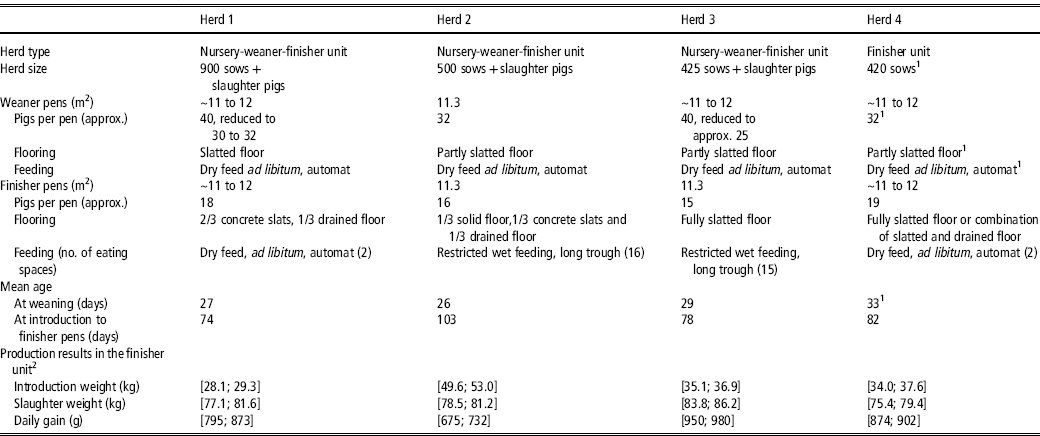
We conducted the present study in four Danish commercial finisher herds that all tail docked their piglets. Three of the herds were characterised by a high prevalence of tail biting problems and reported having tail biting problems in 30% to 40% of their finisher pens. The herds followed their normal procedures, apart from tail docking procedures and grouping the pigs in the different treatments in the weaner and finisher sections (see below). Details regarding herd sizes, housing and management procedures are presented in Table 1. Over a 2-year period, a total of 258 litters entered the study. In all four herds, the piglets were born in farrowing crates and were tail docked according to four different docking length treatments at day 3 [2; 4] pp (median (interquartile range)). In all herds, the litters were allocated randomly to the four docking length treatments, and tail docking was performed by trained technicians using a gas-heated docking iron (Taildocker, Super Pro, Kruuse Vet., Langeskov, Denmark) without any anaesthetic or analgesic treatment. The heated docking iron was fitted with a measuring tool to ensure that the length of the remaining part of the tail was standardised within treatment. All other management procedures, including iron injection and castration of the male piglets, were performed by the herd staff, who were responsible for the general caretaking, including feeding, inspection for sick animals according to Danish law and farm practice. The staff were instructed to report tail lesions in experimental pigs to the technicians (see Tail bite recording). At 26 to 33 days of age, the piglets were weaned into pens in groups of three litters belonging to the same docking length treatment. Between 74 and 103 days of age, the staff moved the pigs to finisher pens and re-mixed them across litters, but within docking length treatment, ensuring that the pigs never met pigs from other tail docking length treatment groups. As new groups were formed in both the weaner and finisher section, we excluded some pigs if the number of pigs from a specific treatment group was too low to form a group with the appropriate size. The herd staff decided which of these healthy pigs should be excluded from the study population, and grouped and housed them according to the herds’ normal procedures. If tail biting was observed in a weaner pen, all pigs from this pen were excluded from the study. In herds 1, 2 and 4, several pens were taken out of the study in the weaner section (approx. 25%) mainly due to tail biting, but also due to other health problems. Detailed data collection did not take place before the pigs entered the finisher section, and therefore we have no data to describe the exact reasons for exclusion of these pigs. The experimental period terminated at slaughter when the pigs were approximately 20 to 24 weeks of age.
Description of the four experimental herds

1 Herd 4 bought their pigs at 30 kg, and this information describes the supplying herd.
2 Shown as range of the means per pen.
Ethical considerations
As the participating animals were part of an experiment where the procedures involved removing more than half of the piglets’ tail, which is the limit in Denmark, we applied for a permit from The Danish Animal Experiments Inspectorate (Permit no. 2005/561-1013), who approved all procedures involving the animals in the study. According to the permit, we were allowed to dock the piglets as described below. Due to changed procedures required due to the participation in the project, the herds were to pay extra attention to the experimental pigs. In case of tail biting outbreaks, the bitten pigs were to be removed from the pen and treated according to the legal practice (placed in a sick pen and, in case of an infection, treated with antibiotics). If possible, the biter was identified and removed from the pen as well.
Design and treatments
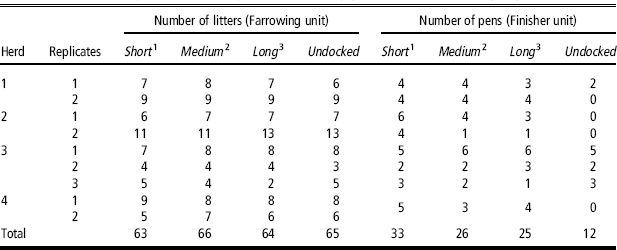
The study used a randomised complete block design (Mason et al., Reference Mason, Gunst and Hess2003) with herds as blocks, and four treatment groups regarding docking length applied to all treatment groups in all four herds. The experimental unit was the individual pen in the finisher unit. We aimed at including 15 to 20 litters per docking treatment in each herd distributed among two replicates, but in Herd 3 the farrowing batches were relatively small, resulting in a third replicate (Table 2). Treatment groups Short, Medium and Long refer to the length of the tail left on the body after docking, corresponding to 2.9, 5.7 and 7.5 cm, respectively. Pigs in the last treatment, Undocked, had intact tails. The allocation of docking treatments to litters was randomised within each replicate. The chosen docking lengths were based on a pilot study, taking into account both the age and weight of 2 to 4-day-old piglets (Department of Animal Science, Aarhus University, unpublished data), and corresponded to docking lengths used in Herskin et al. (Reference Herskin, Di Giminiani and Thodberg2015) and Herskin et al. (Reference Herskin, Thodberg and Jensen2016). A few piglets were born with tails shorter than 7.5 cm, but never shorter than 5.7 cm, and if allocated to the Long treatment they had ~0.5 cm of their tail removed in order to ensure that all piglets within this treatment were docked. This procedure was chosen, as it enabled us to allocate litters randomly to docking length treatments instead of sorting them by tail length. After tail docking, each piglet was ear tagged for individual recognition with differently coloured ear tag for each treatment.
The number of replicates, litters and pens in the finisher pig units for each tail docking length treatment

1 Short, 2 Medium and 3 Long refer to the docking length treatment of the tail left on the body of the pigs after docking, corresponding to 2.9, 5.7 and 7.5 cm, respectively.
For each of the four herds, the number of replicates, number of litters entering the study and number of pens in the finisher sections of each treatment are shown in Table 2. We allocated approximately the same number of litters to each docking length treatment, and the difference in number of experimental finisher pens within the four treatments is due to drop-out during the stay in the weaner section (see Animals and management).
Due to the exclusion of pens with a tail biting outbreak in the finisher section the number of experimental pens at slaughter decreased from 33 to 30, 26 to 17, 25 to 15 and 12 to 8 for the docking length treatments Short, Medium, Long and Undocked, respectively.
Data collection
Body weight of the pigs in the weaner and finisher period
All pigs in the study were weighed individually when introduced to the finisher pens and at slaughter (Table 1).
Tail bite recording
Experimental inspections of tail biting were done weekly by one of two experienced agricultural technicians, starting 1 week after introduction to the finisher section. We defined a tail biting outbreak as at least one pig in a pen having a bleeding wound on the tail, defined as at least one opening of the tissue with fresh blood. All pigs in each pen were inspected individually, and the weekly inspections continued until a potential tail biting outbreak was recorded. A herd was inspected by the same technician. If the staff observed pigs with tail biting wounds between the experimental inspections, we were informed and the outbreak was recorded at the next inspection. We took pens with a tail biting outbreak out of the study and made no further observations; hereafter the staff handled the outbreak according to their usual caretaking practice.
Behavioural observations. Until we recorded a potential tail biting outbreak, we made weekly behavioural observations at pen level, and observations always took place at least 1 day before the day of the weekly tail wound inspection. If the observer saw at least one pig with a bleeding tail wound in a pen, the pen was excluded from the observation. The observations were made from 0800 h until 1030 h and again from 1230 to 1600 h in order to include periods of the day characterised by relatively high levels of activity (e.g. Zwicker et al., Reference Zwicker, Gygax, Wechsler and Weber2012). We informed the staff not to enter the finisher section during behavioural observations.
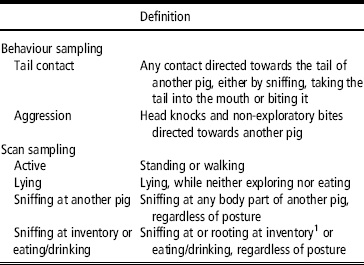
We conducted two types of behavioural observations. Each observation day, individual pens were observed for 10 min each, using behaviour sampling (Martin and Bateson, Reference Martin and Bateson2007) of aggression and tail contacts. We changed the observation order of the pens randomly for each observation day. The recorded behavioural elements are described in Table 3. In-between the 10-min behaviour sampling periods in individual pens, all pens were observed by scan sampling (Martin and Bateson, Reference Martin and Bateson2007) in order to describe the activity level in the pens. We performed a mean (±SD) number of 8.2±1.8 scans in each pen per observation day.
Ethogram for behavioural observations of the pigs in finisher pens using behaviour and scan sampling

1 Pen walls, floor, fittings.
Variables
For each of the tail length treatments, the latency to tail biting outbreaks was calculated in weeks. We present the behavioural data from the behaviour sampling as the probability of the behaviour and data sampled by scan sampling as the mean number of pigs performing the specific behaviour.
Statistics
All data were analysed using the SAS 9.3 software (SAS Institute Inc., Cary, NC, USA). We used a significance level of P<0.05 throughout. All fixed effects except docking length treatment, week after entering the finisher section and herd were removed from the final models if their P-value exceeded 0.05.
During the period of data collection, the number of experimental finisher pens where the pigs had intact tails was strongly reduced due to the high number of tail biting outbreaks. Hence, due to the low representation of pens in the Undocked treatment, we pooled pens from this treatment with the Long pens when analysing the behavioural data in order to make use of the whole data set. Furthermore, the analyses could only include the first 7 weeks in the finisher section, after which several pens from all docking treatment groups were omitted due to tail biting outbreaks (see Design and treatments). We kept all four treatment groups separate in the analysis of the latency to potential tail biting outbreaks, as the analysis method chosen for these data is less sensitive to an unequal distribution of observations in treatment groups.
Statistical model, tail biting outbreaks
The differences in the latency to and thereby risk of a tail biting outbreak was analysed by non-parametric survival analysis, using the Kaplan–Meier method and the SAS-procedure PROC LIFETEST. Survival analysis is the optimal analysis for this type of data where the response variable is latency to an event, in this care a tail biting outbreak. The analysis takes into consideration both the latency to the event (tail biting outbreak) as well as the number of censored observations, which is the pens where a tail biting outbreak does not occur within the time frame of the experiment. We analysed the equality between the four docking length treatment groups, stratified by the four herds, and the equality between the four herds, stratified by the four docking length treatments. The homogeneity of the survival curves for the four docking length treatments corrected for herd effects was tested with the Peto test, as were the four survival curves for the herds corrected for treatment effects (Klein and Moeschberger, Reference Klein and Moeschberger2003). We did post hoc, pairwise comparisons of survival curves with the Peto test, and we report the Tukey–Kramer P-values adjusted for multiple comparisons. Results are presented as median latencies, χ2-values, df and the corresponding P-values.
Statistical model, behavioural data
The variables from the scan sampling were analysed in a mixed model using PROC MIXED in SAS. In order to elucidate the main effects of docking length treatment as well as herd, the fixed effects were treatment, herd, week after entering the finisher section, whether there eventually was a tail biting outbreak in the pen or not, the interaction between treatment and herd and between treatment and week. We entered the number of pigs in a pen as a covariate. Section within herd and pen within section and herd were treated as random effects. The covariance structure used was Compound Symmetry and we calculated the degrees of freedom using Satterthwaite’s approximation.
Variables from the behaviour sampling were analysed in a generalised mixed model using PROC GLIMMIX in SAS and entered as binomial variables describing whether a given behaviour occurred or not. This model was chosen, as these variables were not normally distributed. The fixed effects and the covariates were the same as in the mixed model. The random effects were herd, treatment and pen within herd. The covariance structure used was Variance Components.
Results from both models are presented as least squares means (LSMEANS in SAS)±SE as well as F (df,treatment, df,error) and the corresponding P-values.
Results
Tail biting outbreaks
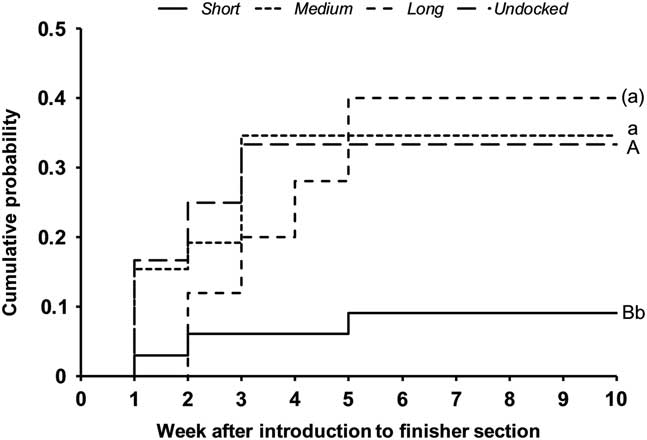
Figure 1 shows the cumulative probability of tail biting outbreaks in the four docking length treatments over weeks, summed up for the four herds. The probability of a tail biting outbreak differed significantly between treatments (χ2=15.99; df=3; P=0.001). The risk of a tail biting outbreak was significantly lower in Short pens compared with the Undocked (χ2=15.56; P<0.001) and Medium treatment pens (χ2=8.49; P<0.05) and tended to be lower compared with the pens in the Long treatment (χ2=6.10; P=0.06).
The cumulative probability of tail biting outbreaks in pens with the four docking length treatments over the experimental period, summed up for the four pig herds. Different superscript letters indicate differences between treatments: a,b P<0.05, A,B P<0.01, (a),b P=0.06.

The risk of tail biting differed between the four herds (χ2=19.90; df=3; P<0.001) and was lower in Herd 3 compared with Herd 2 (The risk of tail biting differed between the four herds =13.05; P<0.01) and Herd 4 (The risk of tail biting differed between the four herds =18.36; P<0.001) and tended to be lower than in Herd 1 (The risk of tail biting differed between the four herds =6.35; P=0.06).
Behaviour of the finisher pigs
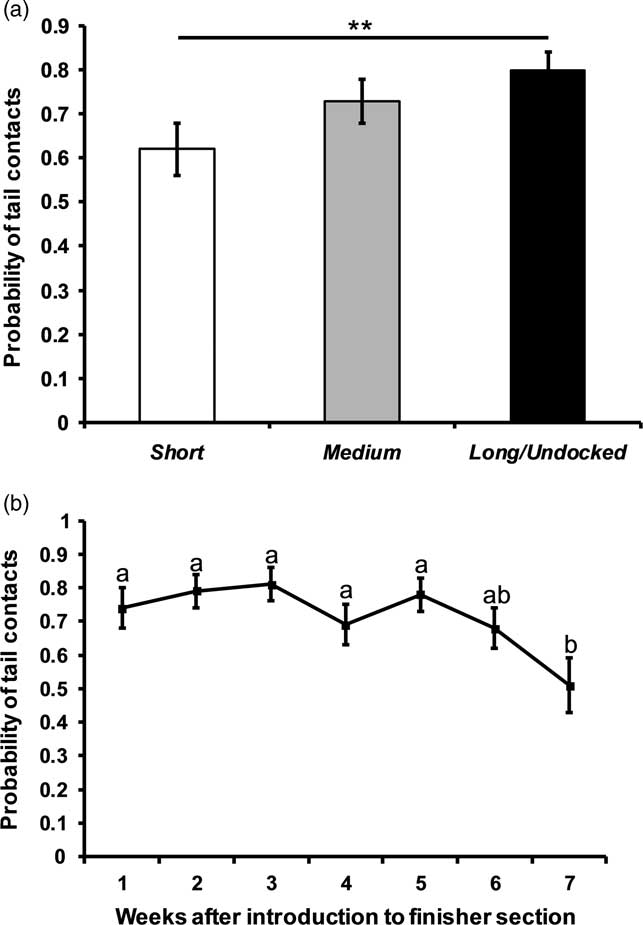
The probability of Tail contacts (either by sniffing, taking it into the mouth or biting) differed between docking length treatments (F 2,81=4.40; P<0.05; Figure 2a), and the probability was higher in the Long/Undocked treatment pens compared with pens with the shortest docking length (Short; P<0.01). Furthermore, the number of Tail contacts differed between weeks (F 6,407=2.98; P<0.01; Figure 2b), mainly due to the number of Tail contacts being significantly lower in week 7 compared with preceding weeks. Finally, we observed the most Tail contacts in Herd 1 and 4 (Herd 1: 0.81±0.04, Herd 2: 0.64±0.07, Herd 3: 0.54±0.04, Herd 4: 0.84±0.06; Herd 1 v. Herd 2, P<0.05, Herd 1 v. Herd 3, P=0.001; Herd 2 v. Herd 4, P=0.06; Herd 3 v. Herd 4, P=0.01); F 3,81=6.27; P<0.001). No other effects of the docking length treatments or prevalence of tail biting on the remaining behavioural variables were found; however, there were a number of time trends in behaviour.
(a) The probability of tail contacts (least squares means±SE) (a) in docking length treatments (Short, Medium, Long/Undocked (pooled)) during the first 7 weeks after introduction to the finisher pig unit (**P<0.01), (b) per week in the first 7 weeks after introduction to the finisher pig unit. Different superscript letters (a and b) indicate differences between weeks (0.001<P<0.05).

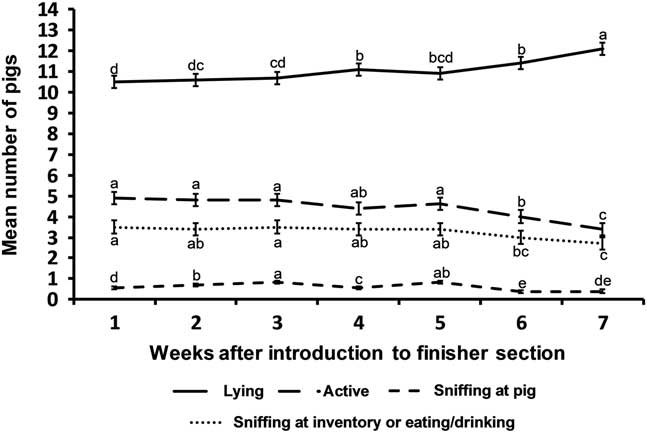
The number of pigs observed as being active decreased during the stay in the finisher pens (F 6,405=6.35; P<0.001; Figure 3), whereas the proportion of pigs lying during the first 7 weeks of the finisher period was constant for the first 3 weeks, after which it increased (F 6,405=7.43; P<0.001; Figure 3). The number of active pigs increased, and Lying pigs decreased significantly with an increasing number of pen mates (F 1,138=33.00; P<0.001 and F 1,140=47.96; P=0.001, respectively), but no differences were found between herds.
The mean number of pigs per pen (least squares means±SE) that were observed Lying, Active, Sniffing at another pig or Sniffing at inventory or eating/drinking per week in the first 7 weeks after introduction to the finisher pig unit. Different superscript letters indicate differences between weeks (0.001<P<0.05).

The number of pigs observed sniffing at inventory or eating/drinking was constant for the first 5 weeks, followed by a decrease in week 6 and 7 (F 6,403=3.51; P<0.01; Figure 3). We observed more pigs sniffing at inventory or eating/drinking the higher the number of pigs in the pen (F 1,151=20.88; P<0.001).
The number of pigs observed sniffing at another pig varied over the weeks in the finisher pens (F 6,413=16.54; P<0.001; Figure 3). The number of pigs sniffing at another pig correlated positively to the number of pigs in the pen (F 1,130=8.50; P<0.01) and differed between herds (Herd 1: 0.78±0.10, Herd 2: 0.38±0.11, Herd 3: 0.80±0.11, Herd 4: 0.46±0.15; Herd 1 v. Herd 2, P<0.05, Herd 2 v. Herd 3; P=0.01; F 3,6.57=5.05; P<0.05).
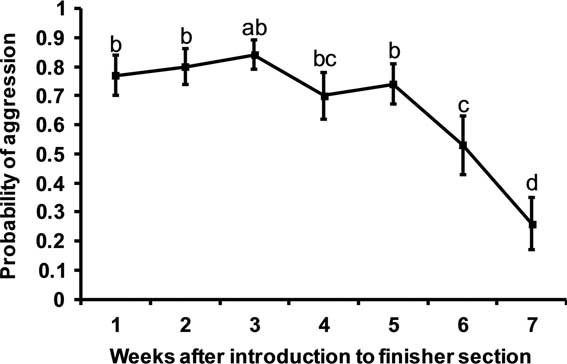
During the weekly 10-min behaviour sampling, the probability of aggression decreased after the first 3 weeks of the finisher period (F 6,406=6.44; P<0.001; Figure 4). We observed more aggression the higher the number of pigs in the pen (F 1,406=4.08; P<0.05). The probability of aggression differed between herds with the highest probability in Herd 4, followed by Herd 1 (Herd 1: 0.76±0.05; Herd 2: 0.17±0.06; Herd 3: 0.26±0.04; Herd 4: 0.99±0.01; Herd 1 v. Herd 2, P<0.001; Herd 1 v. Herd 3, P<0.001; Herd 1 v. Herd 4, P<0.01; Herd 2 v. Herd 3, P<0.001; Herd 3 v. Herd 4, P<0.001); F 3,83=13.06; P<0.001).
The probability of aggression (least squares means±SE) per week in the first 7 weeks after introduction to the finisher pig unit. Different superscript letters indicate differences between weeks (0.001<P<0.05).

Discussion
The present study demonstrated that pigs in pens with short-docked tails (Short, 2.9 cm) have a lower risk of a tail biting outbreak compared with Undocked pigs and pigs with a larger part of the tail remaining after docking. The two longer docking length treatments, Medium (5.7 cm) and Long (7.5 cm), did not differ significantly from the Undocked pigs. Pigs in the docking length treatments Long, Medium and in particular the Undocked treatment were under-represented at the introduction to the finisher section, resulting in fewer experimental finisher pens in these treatments. This also affected our statistical analysis as we had to pool the Long and Undocked treatments in the analyses of the behavioural data. Luckily, we could keep the Undocked treatment separate in the more robust analysis of the latency to tail biting outbreaks; however, the skewness in the data set was not optimal and should be considered in the interpretation of our findings. Even though we did not systematically record outbreaks of tail biting in the weaner pens, we know that several weaner pens were excluded due to tail biting. This could affect our results as pigs with a high tendency to start tail biting might have been excluded from the experiment before our systematic data collection started. Our results indicate that the representation of pens with different docking length treatments at introduction to the finisher section reflects the risk of tail biting outbreaks onwards.
Pigs in pens within the shortest docking length treatment manipulated their pen mates’ tail less compared with pigs in pens with the longest docked tails and undocked tail (Long and Undocked). However, docking length did not affect other behaviour elements. Thus, the results suggest that tail docking in practice may reduce the risk of tail biting in finishing pigs, and even more if short docking lengths are used. We found no evidence that short docking compromises the social function of groups of pigs in finisher pens.
The application of three fixed docking lengths within herd allowed comparison of pens with different docking lengths within commercial herds, which has not been presented before. The design of the study enabled us not only to study the effect of docking v. not docking, but also to compare the effect of different docking lengths.
The present results confirm earlier experimental studies with standardised docking lengths, suggesting that tail docking reduces tail biting in finisher pigs (Di Martino et al., Reference Di Martino, Scollo, Gottardo, Stefani, Schiavon, Capello, Marangon and Bonfanti2015; Lahrmann et al., Reference Lahrmann, Busch, D’Eath, Forkman and Hansen2017; Larsen et al., Reference Larsen, Andersen and Pedersen2017). Irrespective of tail docking length, however, the occurrence of this abnormal behaviour was not fully eradicated in tail docked pigs. We did only record the onset of tail biting outbreaks and not how many pigs in each pen that became tail biters or had tail lesions, which could have added to the understanding of the preventive effects of the different tail docking treatments.
Furthermore, Chambers et al. (Reference Chambers, Powell, Wilson and Green1995) and Moinard et al. (Reference Moinard, Mendl, Nicol and Green2003) found that herds with tail biting problems increased the frequency of tail docking and the proportion of tails removed, but that this step did not solve the problem completely. In the present study, we found less tail contacts in pens with the shortest tail docked pigs compared with pens where the pigs had the longest docked or undocked tails. This is in accordance with the fact that we observed the lowest risk of tail biting outbreaks in pens with the shortest docking length. In addition, it is consistent with the hypothesis that tail manipulation often precedes tail biting outbreaks, which is supported by Zonderland et al. (Reference Zonderland, Kemp, Bracke, Hartog and Spoolder2010) in a study of undocked weaner pigs where upcoming tail biters performed more tail manipulation compared with future non-biters. However, we obtained our data in relatively short sampling intervals, and the relationship between tail manipulation and actual tail biting behaviour is not necessarily straightforward. Statham et al. (Reference Statham, Green, Bichard and Mendl2009) studied 24 groups of undocked pigs, and at 11 weeks, where no tail biting outbreaks had yet occurred, they found significantly fewer instances of tail interest in pens with an upcoming severe tail biting outbreak compared with groups with no or milder outbreaks. However, more actual tail biting behaviour was observed in the pens with severe tail biting outbreaks coming up. The same study did not find differences in the total level of tail manipulation (both tail interest and biting behaviour) during the last 4 days before a tail biting outbreak. These results call for studies with more detailed observations of the different types of tail contacts and their timing in relation to actual tail biting. In our study, we did not distinguish between sniffing, having a tail in the mouth or actual biting, but compiled all contacts to tails. Simonsen (1995) found no differences in ‘tail-in-mouth behaviour’ between finishing pigs where one-third of the tail had been removed v. undocked pigs. This was confirmed in the more recent study by Di Martino et al. (Reference Di Martino, Scollo, Gottardo, Stefani, Schiavon, Capello, Marangon and Bonfanti2015) who found no difference in the frequency of tail biting behaviour in intact and docked finisher pigs with two-thirds of their tail left and in a study of weaners by Paoli et al. (Reference Paoli, Lahrmann, Jensen and D’Eath2016). However, the present results indicate that if the docking length is sufficiently short, as in the Short treatment, the amount of tail manipulation might be reduced. This could be either because the short tails were less stimulating or less noticeable, or it may have been more difficult for the pigs to get a hold of the short tails due to their posture as they are held more vertically than longer or undocked tails (Simonsen et al., Reference Simonsen, Klinken and Bindseil1991; Simonsen, Reference Simonsen1995; Schrøder-Petersen and Simonsen, Reference Schrøder-Petersen and Simonsen2001).
Another explanation for the reduced occurrence of tail biting among the shortest docked pigs may, however, be that having the tail manipulated by another individual is more painful due to neuroanatomical changes in the healed tail tips, making the pigs escape more readily from manipulating pen mates (as suggested by Simonsen et al. (Reference Simonsen, Klinken and Bindseil1991)). Herskin et al. (Reference Herskin, Di Giminiani and Thodberg2015) used the same experimental tail docking lengths as in this study and found neuroanatomical changes at slaughter in pigs docked at all three lengths. In their relatively small data set, they found no effects of the docking length on the neuroanatomical changes. Recently, Sandercock et al. (Reference Sandercock, Smith, Coe, Di Giminiani and Edwards2016) quantified spinal biomarkers of pain processing in pigs in the weeks after tail docking (removing approximately two-thirds of the tail). The presence of traumatic neuromas was confirmed, and the authors reported time-dependent changes in the spinal biomarkers through the weeks after tail docking, which seemed to have disappeared before the age of slaughter. No measures of tail sensitivity were taken. In pigs subjected to surgical resection at either 9 or 17 weeks of age, long-term hypersensitivity was observed after either 2 or 4 months, suggesting a sustained change in the sensitivity of their tail tips (Di Giminiani et al., 2017). Whether the same long-term effects are present in pigs docked within the first days of life still needs to be established. As shown by Herskin et al. (Reference Herskin, Thodberg and Jensen2016), piglets are affected by docking, not only acutely, but also in the first five post-procedural hours. Sham-docked piglets were observed in the heated creep area in less than 10% of the observations (scanning every 6 minutes), whereas docked piglets, most pronounced short-docked piglets, were observed more frequently in the creep area, suggesting that the effects of this management routine across docking lengths are more persistent than previously suggested. The results from Herskin et al. (Reference Herskin, Thodberg and Jensen2016), the present findings and previous studies of docking length call for a discussion of not just tail docking or not, but also docking length. In fact, it is possible that removing only a small part of the tail during the docking procedure subjects pigs to a painful procedure without the benefit of a reduced risk of tail biting as compared with intact pigs.
We found a slight decrease in the occurrence of tail-directed behaviour as the pigs approached slaughter weight. This result may be a simple consequence of the decreased level of activity with increasing age (Pedersen et al., Reference Pedersen, Herskin, Forkman, Halekoh, Kristensen and Jensen2014). Interestingly, Simonsen (Reference Simonsen1995) found that the occurrence of tail contacts where the tail was not in the mouth decreased, whereas ‘tail-in-mouth’ increased with increasing age. This could indicate that the motivational backgrounds for the two types of tail contacts differ and that the motivation to sniff may decrease, while the motivation to bite increases. However, further studies are needed in order to verify this, especially as tail biting can start at varying ages as also verified in the present study.
None of the other behavioural elements included in the present study differed according to the docking length treatments or to whether a tail biting outbreak would later start, as opposed to the study of undocked pigs by Ursinus et al. (Reference Ursinus, Van Reenen, Kemp and Bolhuis2014). In their study, the behaviour at pen level, especially a high activity level and an increase in pen and pig directed behaviour, correlated with the risk of tail damage. In the present study, the pigs in pens with different docking length treatments showed similar levels of activity and aggression, which indicates that the experimental docking length treatments were the cause of the differences in the risk of tail biting outbreaks and tail contact between treatments. At present, we cannot explain the different findings in Ursinus et al. (Reference Ursinus, Van Reenen, Kemp and Bolhuis2014) and the present study, but differences in genetics and housing system could be some of the involved factors. In addition, the lack of difference between the docking length treatments in behaviour, such as aggression and activity level, indicates that docking length might not have increased the risk of pigs showing unclear social signals to an extent that compromised the social function of the group.
In conclusion, we showed that docking length affected the risk of a tail biting outbreak and the frequency of tail-directed behaviour in the finishing pens of our participating herds, of which three reported a high prevalence of tail biting problems. The study found that even short tail docking did not eliminate the risk of tail biting outbreaks.
Acknowledgements
The authors wish to thank Erik Jørgensen for help with planning and designing the study, Leslie Foldager for input to the statistical analysis and Lene Juul Pedersen for very useful comments on an earlier draft of the manuscript. SEGES Danish Pig Research Centre, mainly funded from pig industry sources, financed the present project, and one of the authors worked for this organisation.
Declaration of interest
None.
Ethics statement
The experimental procedures were approved by The Danish Animal Experiments Inspectorate (Permit no. 2005/561-1013).
Software and data repository resources
Data is not deposited in an official repository.