Introduction
During their time in office, British governments’ styles of political judgement or bias in policymaking often become shorter in term and less intellectually coherent, sometimes in passive or coping ways, sometimes shifting toward imposition. The phenomenon has not been satisfactorily understood. Administrations of different parties, ideologies and personalities and experiencing different setbacks develop in this direction from very different starting points. Therefore, neither constant features of parties or individuals nor transient empirical events suffice to explain the convergence.
This article argues that the neo-Durkheimian theory of institutional dynamics (Thompson Reference Thompson1992, 6, 2003) can help to explain it. Originating in anthropology (Douglas Reference Douglas1982, Reference Douglas1986), the approach has attracted growing interest across the policy sciences (Thompson et al. Reference Thompson, Ellis and Wildavsky1990; Coyle and Ellis Reference Coyle and Ellis1994; Hood Reference Hood1998; Wildavsky Reference Wildavsky1998; Lodge et al. Reference Lodge, Wegrich and McElroy2010; 6 Reference Six2011, Reference Six2014a, Reference Six2014b, forthcoming Reference Sixa; special issue of PS, 2011). The theory argues that judgement styles are cognitively only as integrated or regulated as policymakers are socially integrated and regulated. Thus, changing informal social organisation among ministers and their most senior advisers, toward the form introduced below, explains the trajectory. It expects this kind of social organisation to be associated with particular stylistic features of decisionmaking, irrespective of ideology. This relationship should arise in any policy field affected. To examine this, develop the theory and show its range, plausibility and interest (without aspiring to test it), the study compares policy judgement styles using case studies showing contrasting pathways toward this condition in three British administrations of different parties and initial informal organisation and across contrasting policy fields. The conclusion identifies implications for understanding policymaking dynamics.
As with studies of any well-documented period, the aim is not to predict previously unknown particular facts and then reveal new empirical sources to examine those retrodictions. Rather, if the theory’s expectations are supported, the study’s contribution lies in providing an integrated, comprehensive and parsimonious explanation for variations and overarching patterns among known empirical factors. Resolving important conceptual ones such as this one can sustain scientific progress as much as solving empirical problems (Laudan Reference Laudan1977).
Neo-Durkheimian institutional dynamics
Neo-Durkheimian institutional theory argues that forms of social organisation and their conflicts cultivate particular thought styles (Douglas Reference Douglas1986) and biases in judgement and decisionmaking (6 Reference Six2011, Reference Six2014a). Decisionmakers paint their social organisation onto the faces of their problems, opportunities, opponents, and so forth. In transposed form, judgement styles replicate relations ordered by people’s informal institutions [Durkheim and Mauss (1902–1903), Reference Durkheim and Mauss1963, 11].Footnote 1
The most basic institutional forms of social organisation are, the theory argues, not indefinitely various. Durkheim’s [Reference Durkheim1951 (1897), 1961 (1925)] two fundamental dimensions capture that variety – namely, social integration, or the degree to which practices, positions and relations are strongly or weakly accountable to bonds and membership; and social regulation, or strong or weak accountability to constraint, imperative, prescription, role and given fact. Cross-tabulating them (Douglas Reference Douglas1970, Reference Douglas1982)Footnote 2 generates four elementary forms, in Durkheim’s felicitous term (Fields Reference Fields and Durkheim1995, lx), which conflict or settle in differently weighted combinations (Hood Reference Hood1998; Thompson and Rayner Reference Thompson and Rayner1998; Thompson et al. Reference Thompson, Rayner and Ney1998):Footnote 3
-
– Hierarchical (H: strong regulation and integration): access to resources is rule-bound; roles are clearly distinguished; membership boundaries are clear; decisions are made under known authorisation rules: power varies with status.
-
– Individualistic (Ind: weak regulation and integration): people find their own ways of accessing resources and brokering agreements: roles are fluid; status varies with personal power.
-
– Enclaved (E: strong integration, weak external regulation – i.e. only enough internally generated regulation to sustain strong integration without external authority: Rayner 1988):Footnote 4 collective action is sustained by shared commitment to values or principles: boundaries between with nonmembers are heavily marked to sustain commitment and collective power and status; shared resources and roles.
-
– Isolate (Isl: strong external regulation, weak integration): without status, role, incentive or shared principle, collective action is difficult; access to resources and power is by force, fraud, guileful temporary evasion of particular constraints or coping.
Most empirical settings exhibit all four in differently weighted mixes, in conflict, settlements or hybrids. Often, one form or a settlement between two is preeminent, or forms play different roles in different parts of an administration.
“Hierarchy” is neither command nor domination or just any inequality. It describes common membership in a community with unequal status roles and rule-bound authorisation for action (Dumont 1980; 6 Reference Six, Massey and Miller2015).
In isolate ordering, where strong social regulation is not tempered by strong social integration, domination can arise. Here, social regulation may or may not be concentrated around weakly bonded but strongly constrained individuals struggling to hold on to positions of high office only by passing on constraints to others by imposition. This position is “structurally despotic” (Coyle Reference Coyle1994). Those who cannot pass on or impose constraints, but must accept, cope with or try to evade the resulting losses, are in “structural serf” positions (6 Reference Six2011, Reference Six2014a, Reference Six2014b). Unable to use authority, incentive or community, both structural despots and structural serfs avoid loss acceptance from strong constraint only by guile, evasion, coping or withdrawal.
In administrations in democratic states, isolate ordering is more common than commonly imagined. It should not be confused with individual premiers being “lonely at the top”, but rather describes an institutional condition of weak social integration and strong constraint in all or part of an administration.
Such formal institutions as cabinet collective responsibility, prime ministerial preeminence, ministerial accountability to the legislature or a permanent secretary’s accounting officer role may appear initially to engender hierarchy. But, without congruent informal institutions, they do not determine judgement style. It has long been recognised that formal institutions afford great variety in informal social institutions governing relations, within which people’s styles of thought are socialised, cultivated and decultivated.
The theory’s explanandum is thought style (Fleck Reference Fleck1979; Douglas Reference Douglas1986; cf. Hacking Reference Hacking2002) or the manner by which beliefs are held (dogmatically or provisionally), emotions felt (ferociously, accommodatingly and so on), classifications employed (rigidly, or allowing for blurring), risks and losses regarded (acceptable or unacceptable), anomalies handled, past and future time horizons weighted, fall-back options structured and so on. In government, thought style reveals itself in patterns of political judgement and decisionmaking bias (6 Reference Six2011).
Thought style is not ideology and matters independently of it in political decisionmaking. Diametrically opposed ideologues may exhibit similar thought styles: strongly integrated, weakly regulated sectarian monetarists exhibit rigidity in style resembling that of left-leaning sectarians. Conversely, ideological allies may think in different styles, for example, with respect to willingness to trade short-term compromises for longer term gains, or may bear particular kinds of political risk: individualistically ordered social democrats will show contrasting styles from enclaved factions (6 Reference Six2011, Reference Six2014a, Reference Six2014b, forthcoming Reference Sixa).
Thus, the theory argues that judgement styles exhibit cognitive relations as tightly or as loosely integrated and regulated among categories as informal institutions among policymakers are socially strongly or weakly integrated and regulated (Durkheim and Mauss Reference Durkheim and Mauss1963, 11). In decisionmaking, tight or loose cognitive organisation is exhibited in relations among the kinds of reasoning used, preferences and issue linkages established, and degrees of continuity in these things over time.
Examining the theory empirically therefore requires measuring informal institutions of social organisation and thought style (and changes in these things) separately, using structural and cognitive categories, respectively.
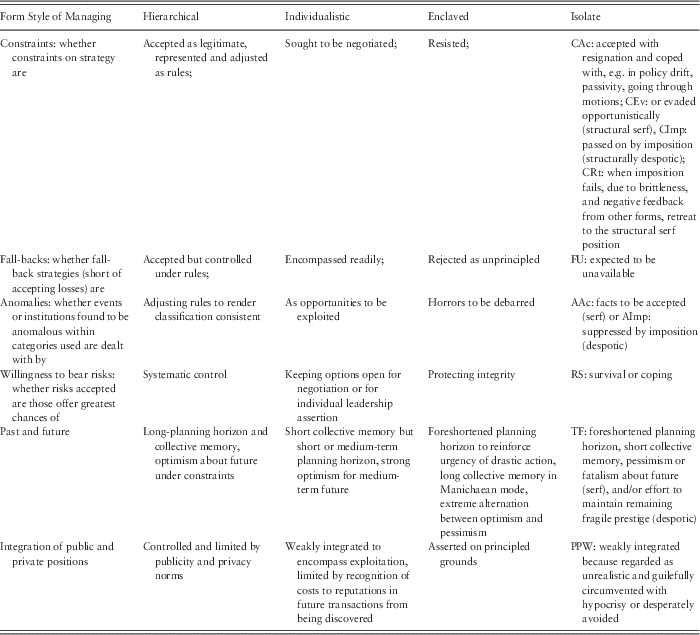
Some categories coding stylistic features of bias and framing in decisions (6 Reference Six2011, Reference Six2004) are generic (e.g. Thompson Reference Thompson1992, 199–202); others have been developed specifically for studying political judgement (6 Reference Six2011). Table 1 presents the codes used.
Codes for isolate judgement style

For present purposes, the empirical analysis focuses only on the codes identified above for isolate ordering.
That the table shows isolate thought style exhibiting both rigidity and opportunism is not paradoxical. The rigidity distinctive of structural despotism is explained by fear of loss of fragile authority. When despotic attempts to impose solutions are frustrated, “U-turns” and opportunistic coping are the only available fall-back options (6 Reference Six2011). By contrast, other informal institutional orderings allow for the preparation of richer sets of fall-back positions between these extremes. Hierarchically ordered administrations might respond with rule-based adjustment, and individualistically ordered ones with instrumental exploitation and negotiation. As administrations move deeper into isolate ordering, their judgement is expected to exhibit either increasing rigidity or opportunism or alternation between them.
The theory’s explanation of change rests on feedback dynamics in and between elementary forms (Thompson et al. Reference Thompson, Ellis and Wildavsky1990; Thompson Reference Thompson1992, 6, 2003; 6 et al. Reference Six, Goodwin, Peck and Freeman2006, 70). By the same mechanism through which institutions cultivate thought style, over time each form tends toward positive feedback, amplifying its style of organising until checked by negative feedback from others (Douglas Reference Douglas1986). “Isolation dynamics” are positive feedback processes in which isolate ordering become stronger, although weaker elements of hierarchy, individualism or enclaving continue to be articulated. These dynamics may arise by positive reinforcement of incipient isolate institution or by negative feedback against or withdrawal from institutions of other forms.
Although understanding isolate ordering’s significance is a distinctive contribution of the theory, positive feedback in isolate ordering has not been studied in government. Yet, transitions into deepening isolate ordering appear to be relatively common among British administrations, particularly in their later years, notwithstanding continuing contributions to maintaining background hierarchical ordering from constitutional accountabilities, defined roles of civil servants, statute law and so on.
Positive feedback loops have two phases (6 Reference Six2014a). First, informal institutions cultivate distinct thought or judgement styles (Durkheim and Mauss Reference Durkheim and Mauss1963; Douglas Reference Douglas1986). Second, thought styles lead people to act in ways that buttress, reinforce and exaggerate that prevailing informal ordering. Beyond a certain point, however, self-reinforcement produces anomalies (Douglas Reference Douglas1966; 6 Reference Six2013, Reference Six2014b), adversities, setbacks or weaknesses so that it begins to disorganise itself (Durkheim Reference Durkheim1951, 1984). Amplification provokes counter-reaction in other forms, as people respond with institutionally biased rejection, disappointment, anger or simply exhaustion (Thompson et al. Reference Thompson, Ellis and Wildavsky1990). However, where elementary forms depend on each other for institutional resources, negative feedback can also lead to accommodations or settlements (Thompson et al. Reference Thompson, Ellis and Wildavsky1990; Hood Reference Hood1996; 6 2003, 2014b, Reference Six2014b).
Institutional dynamics in British administrations
This study’s unit of analysis of social organisation and of exercising political judgement is the “administration”, meaning senior ministers, their political advisers and the senior civil servants working most closely with them under a given premier. This unit resembles the “core executive” concept (Rhodes and Dunleavy Reference Rhodes and Dunleavy1995) more than that of the cabinet (or secretaries of state only). However, the core executive concept emphasises the formal institutions of the prime minister’s office, the Cabinet Office and HM Treasury and their administrative centrality rather than informal relations, which matter most here. This unit is appropriate because, in British government, senior ministers appointed by the prime minister and their advisers form a field of social relations with social and reference primacy (cf. Merton Reference Merton1968) for its members: the strength or weakness of bonds and authority here is critical in specifying the collective (in)capabilities sustaining policymaking. Yet, as the empirical sections below show, senior Treasury staff and even junior Cabinet Office staff are not always part of that primary unit of social reference. Units of observation are relations among ministers and advisers in each period on the explanans, mainly reconstructed from biographical and historical sources, and decisions on the explanandum, mainly reconstructed from primary sources. Documents are used as evidence for coding, not as units (Appendix).
The expectations listed above are explored by comparing two policy fields in Harold Macmillan’s, Harold Wilson’s and Edward Heath’s administrations between the 1959 and February 1974 parliamentary elections, when they entered or moved more deeply into isolate ordering (6 forthcoming Reference Sixa). The administrations are selected not only for their difference in parties; more importantly, they exhibit diversity sufficient for a “most different design” on the “independent variables” of forms of initial informal social organisation. The analysis below demonstrates that Macmillan’s administration began in predominantly hierarchical ordering in domestic affairs with a significant difference in the organisation of foreign policy; individualistic ordering prevailed in Wilson’s 1960s administrations; isolate ordering was already significant in opposition in Heath’s shadow cabinet, and his efforts to develop hierarchy had emphasised social regulation at the expense of social integration.
Two policy fields have been chosen to explore the range of the theory’s application.Footnote 5 The analysis examines whether expected judgement styles are found in a foreign policy (Britain’s relations with the United States (US) over the Vietnam war) and microeconomic policy field (industrial relations and trade union law reform), in fields passing in and out of “high politics” and in routine and crisis situations. The study is therefore structured by a matrix of six cases – three administrations by two policy fields. If codes on informal social organisation and judgement style are consistent across such different administrations and policy fields, this provides initial support for the theory.
Three pathways into isolation dynamics are examined. First, initially strongly hierarchical administrations may undergo self-reinforcement in pursuit of greater control, but instead generate negative reactions undermining social integration: thus, seeking deeper hierarchy can result in isolate ordering. Second, administrations beginning with strongly individualistic ordering may accumulate adversities that erode capacities for negotiation and patron–client “claque” relationships (individual supporters each following a leader in expectation of personal benefit, as in ancient Roman patronage, by contrast with enclaved “cliques”, isolate clusters and hierarchical rule-based central communities). Third, administrations beginning with low levels of isolate ordering can positively reinforce it. The analysis below shows that Macmillan’s administration entered isolate ordering through the first path: aspirations to reinforce hierarchy by positive feedback were subverted by weak social integration. Heath’s administration combined the first and third paths. Isolate ordering was already significant in opposition and reinforced in office. Moreover, a structurally despotic order emerged, which made the dynamic deeper than in Macmillan’s administration. From a predominantly individualistic ordering, Wilson’s administration’s isolation dynamic took the second path in response to adversities, including unexpected policy outcomes. But, that dynamic was short and shallow: the administration returned to individualistic ordering when its opponents faced their own adversities.
We first examine changing informal social organisation in the three administrations.
Macmillan’s administration
The isolate despotic informal ordering of Anthony Eden’s Conservative administration dissolved in the aftermath of the 1956 Suez crisis and the ensuing individualistically ordered contest for the party leadership. Hierarchy was re-established in domestic policy after Macmillan became prime minister in 1957. Neither R.A. Butler, Macmillan’s unsuccessful rival, nor any minister other than Macmillan sustained a strong personal claque. However, foreign affairs were ordered differently. Macmillan could use the hierarchically specified prime ministerial authority to reserve a zone of individualistic organisation in cold war and other foreign policy where he had special interests and in which he wanted to appoint clients he could trust with discretion. This zone remained in place throughout the administration’s time in office and was indirectly important to the subsequent isolation dynamic. Macmillan reserved himself a key role in bilateral relations with the US president. He allowed his personal client, Lord Home, who was promoted to be Foreign Secretary in July 1960, a zone of individualistic discretion outside superpower relations. Edward Heath was also allowed the scope for individualistic leadership of his own team dealing with Britain’s application for membership in the European Economic Community (EEC). By contrast, Macmillan’s control over domestic affairs was more strongly based on executive authority and clear norms but with less personal control for non-client ministers.
After the Chancellor of the Exchequer and two of his ministerial team resigned dramatically in 1958, the only significant enclave was not in the administration but on the backbenches around the Tory grandee, Lord Salisbury, supporting white British colonists in Rhodesia and Kenya. Strong hierarchical ordering among ministers was exhibited in Butler’s subaltern role, in limited ministerial competition and in strong marking of role responsibilities. The few interministerial conflicts of this period were driven by departmental conflicts rather than by individual interests or power struggles. This hierarchical and individualistic ordering had affinities with – and reinforced the government’s hierarchical framing of – the ordering of the western alliance, in which Britain was a subaltern but held an honoured and significant position reinforced by individualistically ordered personal relations between the prime minister and the president. That honoured second position was repaired after the Suez debacle but became increasingly difficult financially to sustain.
By 1960–1961, the administration’s informal organisation began to shift, although the individualistic structure remained intact in foreign relations. Macmillan’s attempt to modernise the British economy and government – notably through the creation of the National Economic Development Council to promote social integration of the policy process, the introduction of a more rule-based incomes policy and a more strategic governance of the nationalised industries – expressed a will for hierarchy. It required internal changes within government to regulate and integrate relations between Number 10, Treasury, Ministry of Labour and regional development bodies. But, Macmillan became impatient with the pace at which social regulation in government grew and began to operate in ways that undermined social integration, leading unintendedly to an isolation dynamic (6 forthcoming Reference Sixb). In domestic affairs, Macmillan became increasingly interfering and occasionally coercive during 1961, especially toward the Treasury, although his worsening health limited his impact. He lost faith in Selwyn Lloyd at the Exchequer. He planned a reshuffle, yet dithered for weeks over its scope. In July 1962, Butler, whose loyalty had weakened, was indiscreet with a journalist about likely ministerial moves, causing Macmillan to panic. He undertook the most drastic reshuffle in decades, dubbed “the night of the long knives”. Seven senior ministers were sacked, including several longstanding friends. But, this weakened Macmillan further, because he could not thereafter afford to lose any other leading minister. Trust between him and his colleagues plummeted. When his health permitted, Macmillan increasingly substituted sporadic micro-interference for collegiality. His insistence on pursuing EEC membership undermined ministerial cohesion, and the French President’s eventual veto weakened his internal authority still further. In 1962 and 1963, a series of high profile scandals further eroded the administration’s authority. During the Profumo affair, Macmillan was slow to sack his war minister who was subsequently found to have lied to Parliament about an extramarital affair, which initially appeared to compromise national security. By mid-1963, Macmillan relied on formal power to retain his office rather than the accepted authority or collegial solidarity integrated into his cabinet’s less cohesive informal ordering. Yet, he lacked a structural despot’s dominance. Individualism remained significant in the institutionally buffered field of foreign affairs: even after 1961/1962, Home, Heath and then Butler (Howard Reference Howard1987, 288–294) were all allowed zones of considerable discretion while Macmillan concentrated on superpower diplomacy.
Wilson’s administration
Informal institutional ordering in Wilson’s 1960s administrations was characterised by individualistic rivalries among leading minsters and their claques (contra Bale Reference Bale1999, enclaving developed on the backbenches, not in the administration). Rivalry between Economic First Secretary, George Brown and Chancellor of the Exchequer, James Callaghan, dominated the first three years. As Callaghan’s and Brown’s stock fell, that of the new Chancellor, Roy Jenkins, rose. Wilson preserved his position as the most powerful patron, playing off these “crown princes”, breaking up their claques, promoting his personal clients (especially Richard Crossman and Barbara Castle) and shunting other ministers into peripheral zones of isolate ordering.
After substantially increasing its majority in the 1966 election, adversities beset the administration. To Labour supporters, Wilson appeared to resort to McCarthyite anti-communism to demand a settlement to the 1966 seamen’s strike; “Dissociation” from US President Johnson’s bombing of Hanoi and Haiphong in Vietnam offended both Washington and Labour’s anti-war backbenchers. In November 1967, French President De Gaulle again vetoed Britain’s EEC membership application, damaging Wilson and Brown, now Foreign Secretary. In the same month, the policy adopted in 1964 sacrificing expansion to preserve the dollar exchange rate finally became unsustainable, but devaluation undermined the administration’s economic credibility and Callaghan’s personal standing. A badly misjudged television broadcast by Wilson compounded the damage.
These setbacks for the principal patrons occasioned significant shifts in the cabinet’s informal organisation. Moving into an isolation dynamic was a response to adversity. Individualism was exhausted, as Ministers’ trust in Wilson and each other fell. Callaghan’s claque was weakened by his post-devaluation move to the Foreign Office. Brown’s erratic behaviour likewise undermined his own support. The new informal organisation was clearly shown in December 1966 when, in the nearest the isolation dynamic came to a moment of despotic ordering, Wilson rode roughshod over his colleagues on the sensitive question of selling arms to South Africa, neither negotiating nor seeking to convince them. By January 1968, after many long cabinet meetings about severe budget cuts, ministers accepted that they had no option but to pass on and accept economic constraints by imposition. Bitter backbench protest against the cuts, especially against restoring prescription charges (Bale Reference Bale1999), put great pressure on left-leaning ministers, further dividing them from both their ministerial colleagues and their backbench supporters. Yet, trust among senior ministers was so low that there was no revolt against Wilson; each feared that any move would create opportunities for rivals. In Moscow in February, Wilson went through the motions of negotiations for a ceasefire in Vietnam, but seemed to trust Washington little more than Moscow or his own Foreign Office. For weeks after his bruising January budget, Jenkins could do little to build alliances with colleagues; Brown had become semi-detached from the administration; unlike the period from October 1964 until November 1967, other ministers now largely kept to their own briefs.
The isolation dynamic in the Wilson administration resembled that of Macmillan’s in the important role played by adversity and external constraint. But, enough individualistic organisation remained in the cabinet to enable isolate ordering to be dissipated during March and April 1968. Wilson’s enemies overreached themselves. An inflammatory speech on race relations by a senior member of the shadow cabinet, Enoch Powell, plunged the Conservative opposition into greater difficulties than even the administration’s own. Brown resigned during a financial crisis in March, thus giving Wilson an opportunity to reshuffle. He promoted Barbara Castle, turning her into a major figure but one dependent on his patronage, and placed a loyalist, Michael Stewart, in the Foreign Office. But, reconstructing individualistic ordering was a collective process, not Wilson’s work alone. Jenkins began lunching his colleagues individually to negotiate support, reaching across the right–left chasm to secure Castle’s trust. Callaghan quietly used his role as Labour Party Treasurer to build personal support among trades unions. This individualistic ordering survived until the election, although there were isolates on the periphery after 1968–1969, such as Edward Short and, by then, Anthony Crosland. Not even the infamous failure of Castle’s proposals for trade union reform in 1969 returned the core of the administration to the isolate loss of cohesion, depressed competition or listless decisionmaking of early 1968.
Heath’s administration
As opposition leader from 1966, Edward Heath intended to cultivate hierarchical practice in his shadow administration, creating a baroque structure of policy committees. But, informal isolate ordering was highly significant. Heath dominated his colleagues, neither developing a personal claque nor negotiating alliances. His senior colleagues, Reginald Maudling and Iain Macleod, could neither integrate the shadow cabinet nor maintain the personal claques they had built in 1965. Maudling responded with increasing withdrawal–Macleod by concentrating on short-term parliamentary tactics. The 1966 election manifesto was little more than a fragmented list of committee proposals without an overarching theme – a problem avoided in the 1970 election only by eschewing detail.
Heath intended similarly to introduce greater hierarchy into government upon coming to power in 1970. He created the Central Policy Review Staff to undertake long-term strategic analysis, set up a formal system (Programme Analysis and Review) for budgetary control, overhauled cabinet committee machinery and ordered regular cabinet retreats for policy reviews. Like Macmillan, he sought rule-based approaches to economic governance. Pursuing greater social regulation in these ways actually undermined social integration, reinforcing the preexisting isolate ordering. Unlike Macmillan, by 1970 Heath occupied a structural despotic position. Adversities and setbacks encountered in 1971–1972 pitched the hybrid hierarchical-isolate ordering of his administration into a deeper isolation dynamic than Macmillan’s administration endured in 1962–1963.
A humiliating setback to the administration’s incomes policy caused by a national mineworkers’ strike in February 1972 occasioned alarm and despair but little collective action among both ministers and senior civil servants. Heath’s reaction was to grow increasingly domineering. More and more, he took policymaking into Number 10, especially on economic and industrial matters, delegating even less than previously. Withdrawing from engagement with political colleagues, he worked mainly with his own staff and a few senior civil servants. He personally controlled the EEC application process, seeking little advice beyond his own office. He insisted on “U-turns” in both industrial policy and prices and incomes policy.
Heath hardly cultivated backbenches and appeared haughty when reluctantly appearing in the tearooms. Macleod’s death deprived the administration of one of the few ministers with enough political support to stand up to Heath. Maudling’s resignation following a corruption scandal in 1972, together with Foreign Secretary Douglas-Home’s withdrawal from the domestic policy discussion compounded the isolation dynamic. Even Heath’s relations with loyal ministers were distant, quite unlike the instrumental offer to trade loyalty for advancement that Wilson extended his clients. After Maudling’s departure, Heath alone had the effective power to range across departmental boundaries: ministers were kept firmly to their own briefs. Several ministers, such as Education Secretary Margaret Thatcher, simply fought departmental battles for money, bringing few policy decisions to cabinet. In cabinet committees, deference to the minister with lead responsibility was common.
Some individualistic ordering was found, however, in the CPRS, before Heath clipped its director’s wings, and in Belfast after 1972, where Northern Ireland Secretary William Whitelaw had plenipotentiary negotiation powers and exercised considerable personal patronage over his staff and junior ministers. But, when Whitelaw returned to London in late 1973, he was shocked to find an almost dictatorial ordering around Number 10 (Garnett and Aitken Reference Garnett and Aitken2002, 164–185; Ziegler Reference Ziegler2010, 417). In his administration’s final months, an exhausted Heath struggled to take strategic decisions as cabinet cohesion disintegrated. Ministers engaged in disputes about the best date for an election, but neither enclaves nor claques around individual ministers emerged.
Political judgement
We now examine styles of political judgement in these administrations. The next two sections show that, as the theory predicts, they were as weakly integrated and strongly regulated in the two policy fields as was each administration itself. The effects of changing social organisation were felt in areas far from those in which setbacks and adversities arose. Codes for aspects of isolate judgement style appear in brackets. For reasons of space, the analysis concentrates on isolation dynamics periods.
Relations with the US over Vietnam
After the Suez fiasco, Macmillan and his foreign secretaries laboured to restore Britain’s position as a loyal subaltern in the hierarchically ordered western alliance, while gently probing their position’s boundaries for independent diplomacy. Vietnam ranked low in political salience until 1963, even among Home’s east Asian priorities, and the Foreign Office consulted Macmillan only on major decisions. Well before the US administration’s 1961 review of Vietnam policy, which led to increased military commitment, the British offered counter-insurgency expertise, drawing on their experience in Malaya. This offer arose from a combination of individualistic policy entrepreneurship by Robert Thompson, who would head the British Advisory Mission to Vietnam (BRIAM), and the Foreign Office goal of demonstrating subaltern usefulness in the struggle against communism in Southeast Asia, while bolstering Britain’s status as co-chair of the 1954 Geneva peace process. This goal was especially important after Macmillan advised Kennedy in 1961 against military intervention in Laos, causing many in the US military and State department to suspect the British of tendencies to “appeasement”. The formation of the Malaysian federation also caused disquiet in Washington (Busch Reference Busch2003, 66–92), although (unlike the more individualistically ordered Douglas-Home administration in 1964) neither Macmillan nor Home sought to link Malaysia and Vietnam in their talks with the Americans.
The isolation dynamic in London between the summer 1962 of and late 1963 was marked by ministerial passivity in handling deepening policy tensions. Successive British ambassadors to Saigon were pessimistic about the capacity of the South’s “strategic hamlet” programme to secure popular loyalty to the US military strategy and to overcome the insurgency. Yet, Home and his FO advisers decided to keep Britain’s head down (CAc), neither condemning Diem’s repression in the 1963 Buddhist crisis nor allowing the US administration to hear officially of Britain’s doubts. When Macmillan asked for a briefing on the deepening crisis, the FO responded with a statement in which bland optimism disguised official and diplomatic doubts (PPW).
This passivity opened space for individualistic operation in theatre, freeing Thompson to establish his own relations with Diem’s regime. He also achieved personal influence in Washington and provided independent advice to London. As the theory predicts for those operating under individualistic ordering, he remained optimistic about the counter-insurgency longer than other British officials. As the situation worsened in September and October 1963, Britain’s ambassador to Washington attempted to control Thompson’s communications with the US Government. But, Macmillan was hospitalised in early October, and Home was preoccupied with the contest to succeed him as Prime Minister. No effective political direction was given on Vietnam, which severely undermined the timeliness and effectiveness of Thompson’s contribution to Washington’s internal agonising (CAc, CP). This combination of passivity, policy incoherence, short-term reactive coping and the absence of issue linkage show precisely the judgement style expected during isolation dynamics with no structural despot.
The Labour administration’s isolation dynamic also produced passivity over Vietnam. In contrast to Wilson’s hyperactive “peace initiatives” of 1965 and his energetic efforts to find a solution in the February 1967 talks with the Soviet premier, Kosygin, no new initiatives were launched (CP). Ministers half-heartedly and listlessly persisted with irrelevant policy stances. By late 1967, occasional grandstanding aside, even the normally irrepressible Foreign Secretary George Brown had lost interest in strategic peace initiatives (FU). Yet, in December 1967, Wilson again pestered Johnson to find out whether the formula that had failed in February was still on the table, although he knew well that Johnson’s San Antonio speech in September had superseded it (CEv). In Moscow in February 1968, Wilson went through the motions of urging Soviet leaders to press the North Vietnamese for a ceasefire (CP), but had nothing new to propose, focusing entirely on the short-term (TF). Wilson appeared bemused when Kosygin told him that the Americans were lying to him. His notes show his sense of isolation in Moscow and his declining trust in both FO and US advice. Untypically, he was sufficiently maladroit to share them with the White House.
As individualism recovered by April 1968, direction, activism and the ability to recognise opportunities returned when Wilson saw chances to press for new talks under the aegis of the Geneva peace process co-chaired by the USSR and Britain: Stewart, now back at the Foreign office, worked energetically on this initiative.
For Heath’s administration, Vietnam was a very low priority. By now, Kissinger was talking directly to the North Vietnamese in Paris, leaving little scope for third-party diplomacy, even if a British government had wanted to propose it. That left few options for handling Britain’s relations with the US, not least with regard to the intermittent major bombing campaigns or the question of the relationship between an eventual peace settlement and the moribund Geneva process, of which Britain remained co-chair. The inflationary effects of financing the war without domestic tax increases were a major factor in President Nixon’s ending the Bretton Woods system of managed exchange rates in 1971. Nevertheless, Heath could have used British support for the war as a lever with Washington, but he did not (CAc, FU). Under Nixon, Washington no longer gave London full advance warnings of diplomatic or military initiatives but still expected automatic British support (CImp). Britain’s position as a respected subaltern in hierarchical ordering was proving impossible to sustain, and she was becoming the weaker party under isolate ordering. In Heath’s meetings with Nixon and Kissinger, the war was an “information only” item but Heath never sought any more than this (CAc).
For all the tensions between the Heath and Nixon administrations and despite continuing domestic criticism and protest against the policy, Heath and Douglas-Home were loyal to the US over Vietnam, going along with massive aerial bombing, “Vietnamisation” and blaming the North Vietnamese for the war. Yet, their loyalty was revealingly unenthusiastic, and Heath’s discourse suggested fatalism (AAc): he simply regarded US policy as inevitable. Answering Parliamentary questions in spring 1972, he described American bombing operations as an understandable reaction to North Vietnamese attacks: on no occasion did he offer more supportive terms (e.g. Hansard: 835 cc1273-4; 838 cc1251-3). Mining the ports was likewise described as “understandable” (CAc), although the FCO’s lawyers would have accepted “justifiable”. Even Heath’s reply to Jenkins’ demand for dissociation from the Linebacker II bombing avoided all substantive justification and appeared fatalistically to regard the vast numbers of casualties as inevitable (CAc). As in 1963, Douglas-Home kept to himself his own doubts that US strategy could succeed (PPW).
Just as during Labour’s isolation dynamic Wilson persisted rigidly with stances that had long ceased to be relevant (CP), Douglas-Home persisted for two years in making demands of the USSR that the Geneva process be reconvened although bilateral talks in Paris made it superfluous. Privately, FCO advisers thought that repeatedly asking and being refused emphasised British impotence, and that Britain should try to wind down rather than crank up the Geneva machinery (PPW). Douglas-Home knew by 1972 that the Soviets had little influence in Hanoi. He called for the Geneva process to be used, because it was there (FU) and Soviet refusal to use it put them in the wrong: efficacy and meaningful activity played second to mere presence in the issue. Far from being driven by ideological anti-communism, which the left believed to guide Douglas-Home, the FCO was keeping up appearances (PPW). The anomaly of the Geneva machinery was neither adjusted nor exploited, but simply accepted (AAc).
Industrial relations
Industrial relations differ from foreign relations because, in Macmillan’s and Heath’s administrations, anomalies and adversities experienced in this field cultivated judgement styles, which then had important feedback effects upon their social organisation. This finding reflects the centrality, in this period, of industrial relations to administrations’ fates.
Both administrations pursued increasing formal regulation in industrial relations and incomes policy. But, this demanded greater informal regulation within government itself, and the intended effect of bolstering hierarchy was not achieved. Because isolate ordering had been important in opposition from 1966, and because of the presence of a structurally despotic figure, this pathway led to a much deeper isolation dynamic after 1970 than in the Macmillan administration.
During 1961, Macmillan’s administration began to move toward an incomes policy, beginning with “the pay pause” – a 90-day public sector pay freeze. In 1962, the “pause” was replaced by a percentage increase norm known as the “guiding light”. Although far short of the comprehensive regulation of pay that subsequent administrations would introduce, the policy required settlements to be below specified ceilings. However, these ceilings gave trades unions, markets and newspapers a clear indication of what would be a major defeat of government microeconomic policy.
Managing the policy eroded integration among ministers. In October 1961, Richard Wood, Minister of Power, failed to prohibit the Electricity Council from settling above the norm (CImp, but unsuccessful). Ironically, Minister of Labour John Hare, who had suggested concessions, sought to cover his own position by rounding on Wood who was left exposed by an official statement that the agreement violated the policy (PPW). Macmillan asked another minister to “keep an eye” on Wood in subsequent negotiations with the gas industry. When the pay pause broke down, the administration felt unable to pursue a structurally despotic strategy of passing on constraints by imposition (CRt, FU). In the 1962 rail industry negotiations, the rail director, Dr. Beeching, threatened to resign if he were forbidden to make the unions a generous pay offer, effectively holding the administration to ransom. Macmillan now operated with guile, meeting Beeching in secret (PPW). In what were effectively direct negotiations, Macmillan hinted to the rail unions that settling in the spring within 3% would enable a more generous increase in the autumn. That is, in coping with a short-term problem (TF), Macmillan unilaterally undermined his own policy (AAc), and the concessions that had to be made in 1963 only added to wage inflation. Macmillan blamed (RS) his Chancellor, Selwyn Lloyd, for what he himself encouraged – namely, sending inconsistent signals and the incoherent relationship between industrial relations and incomes policy. Industrial relations therefore undermined Macmillan’s relations with Lloyd, leading to his sacking in the July 1962 reshuffle, deepening the administration’s isolation dynamic.
By 1963, policy was as weakly integrated as the administration itself. Pay settlements commonly violated policy norms (AAc), as the new Chancellor’s fiscal expansion encouraged union demands. While grandiose schemes were being developed for detailed governance of prices, incomes and even dividends in pursuit of a grand but chimerical bargain with the trades unions at the NEDC, the cabinet could not even agree on modest plans for a redundancy pay scheme (O’Hara Reference O’Hara2004, 32–37).
Wilson’s second administration was lucky in few respects, save that during its isolation dynamic no major industrial relations issues arose. Its strategy from 1966 was oriented to the short term. In the previous year, a battle over statutory incomes policy had been fought to a pyrrhic victory, causing the leading trade unionist Frank Cousins to resign from the administration. Having weathered a difficult dock strike in August, ministers agreed in December 1967 to concede the dockworkers’ renewed demands to avoid another strike in January, which would coincide with a severely deflationary budget (AAc). By March 1968, there were plans for renewing the statutory incomes legislation. Ministers were deeply divided, with several believing fatalistically that it could not work (AAc). Critical decisions were procrastinated until, after the mid-March reshuffle (TF), individualism began to revive in the administration’s social organisation.
The Heath administration’s industrial relations legislation had been prepared in extraordinary detail in opposition (Moran Reference Moran1977) and was designed to introduce heavy statutory restraints on trades unions’ powers to take industrial action. Employment and then Home Secretary Robert Carr, Solicitor-General Sir Geoffrey Howe and Heath all assumed wrongly that this legislation would be accepted by the unions (CImp) because of the administration’s electoral mandate. The unions’ refusal to comply left the legislation clearly useless, yet politically unrepealable even as it undermined the scope for talks (AAc). The administration felt it had few other options (FU). In 1972, the Act was used to impose a “cooling off” period and a strike ballot in a national rail dispute, but the strike went ahead. Private employers’ efforts to secure the imprisonment of strikers in a crippling dispute over containerisation affecting the docks provoked much bitterness, nearly leading to a general strike in July. These provisions were never used again (FU, AAc). Meanwhile, the “N minus one” nationalised sector pay rule (each year’s award was to be 1% below the previous year’s) had been dramatically broken in February 1972, when a national strike by mineworkers forced the administration to make humiliating concessions (AImp, unsuccessful).
Thus, in incomes policy and industrial relations, the administration failed in its attempt to pass on economic constraints through imposition and was forced to accept anomalies and losses (CRt). When this structurally despotic approach to imposing policy collapsed, there was no fall-back option as there might have been under an individualistic or hierarchical judgement style (FU). Heath’s political secretary, Douglas Hurd (Reference Hurd1979, 103), graphically described the growing despair (TF, PPW) and loss of cohesion among ministers, while a review by officials of the miners’ strike complained that the policy “can only break, not bend”, a phrase Heath underlined in his own copy (FU). Yet, so deep in isolate ordering was the administration that ministers learned only to pursue further social regulation with even greater determination (AImp). Reflecting his own structural location, Heath “learned” that he could not trust his ministers and that he must control policymaking more tightly from Number 10. In consequence, policymaking became steadily more focused on short-term coping (TF). Tripartite talks with the TUC and CBI in the autumn of 1972, the administration’s notorious “U-turns” in industrial policy and the imposition of a statutory prices and incomes policy were all driven by Heath and his advisors and imposed on the cabinet (AImp). When a second miners’ dispute began in late 1973, Heath was determined to maintain his baroque incomes policy. Again, events showed that it could not bend, only break, and the search for ever stronger formal regulation of incomes undermined itself. Because everyone knew the limits, the Coal Board judged that it could not credibly offer the miners less than what everyone knew was available, and to ministers’ horror, its opening offer was set at the maximum permitted level. Reacting to “mistakes” they believed they had made in handling the 1972 coal strike, Ministers announced a state of emergency early, a further piece of strong regulation (AImp). This too backfired: no one else could see why it was yet necessary. As the dispute progressed, Heath brought decisionmaking into Number 10, again allowing industrial relations to spill over onto the administration’s informal ordering. He replaced his employment secretary, but did not allow his successor, Whitelaw, access to the key meetings nor did he give him clear strategic guidance (CImp). Short-term tactics increasingly dominated decisionmaking (RS), yet ministers rejected all attempts to allow policy to bend by finding a face-saving formula (PPW). In January, ministers rejected a TUC proposal, although they could have settled on it and blamed the TUC for its subsequent breakdown (AImp). The administration then conceded a pay relativities inquiry, thus undermining their argument that an election was the only way to bring the miners to heel (CRt). Thus, another major setback was accepted (AAc), because the structurally despotic monster barring strategy had again proved brittle. Declining ministerial cohesion created new anomalies, as conflict about how best to deal with the strike spilled onto tactical disagreements about the election date.
Discussion
Before and (in the Wilson administration’s case) after isolation dynamics, an analysis of judgement in decisions exhibits almost none of these codes (6 forthcoming Reference Sixa). In these periods, they characterise decisions on the most significant policies, save in reserved individualistic zones (Macmillan, superpower relations) and policy field niches (BRIAM, Whitelaw in Belfast) where social organisation also differed; conversely, in peripheral zones (Short, Crosland, 1969–1970), isolate ordering persisted after it had waned in the heart of Wilson’s administration, cultivating weakly cohesive judgement style.
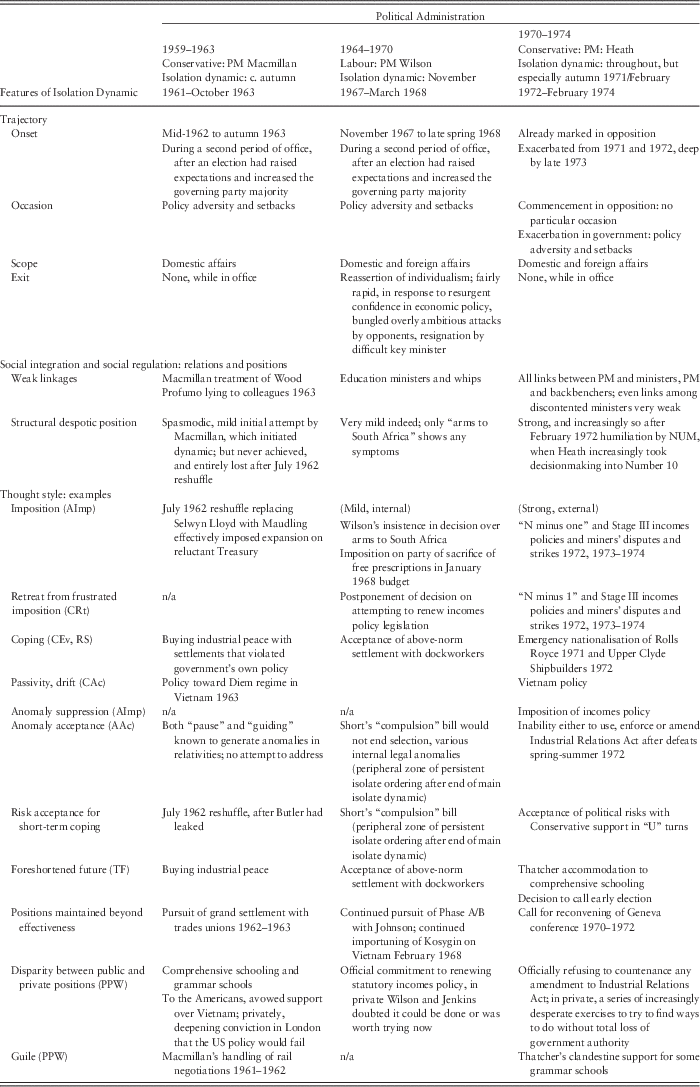
Table 2 summarises the administration’s trajectories, the degree of isolate ordering in social organisation and the dimensions of thought style the theory expects from decisions in isolate ordering. Lacking space for codes for every decision discussed, each cell instead contains examples from the text, which support the codes for particular decisions. The pattern emerging consistently from the accumulation of codes supports the expectations that, in the period of the weakening social integration and deepening social regulation within the administration, cognitive integration weakened. Thus, public and private positions diverged; anomalies were accepted except in the cases of despotic ordering where they were suppressed and imposition strategies were pursued; past and future were less integrated and planning horizons foreshortened; and setbacks could not be recovered through fall-back options.
Isolation dynamics in governments, 1959–1974
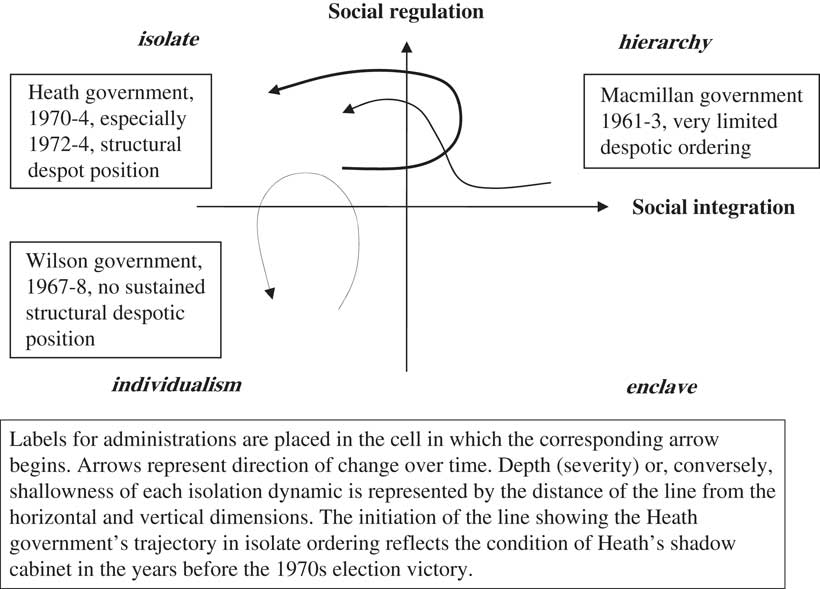
A commonly used device in the neo-Durkheimian tradition for representing change within and among elementary forms has been a transformation of the conventional matrix representation of the derivation of the forms into a continuously differentiable space in which curves represent the shifts within the space of the particular units examined (cf. Rayner Reference Rayner1982, 270, 1986, 62). In a qualitative and illustratively ordinal rather than cardinal manner, that continuous differentiability represents differences of degree in social regulation and integration. Thus, Figure 1 shows contrasting trajectories of isolation dynamics in the three administrations. It differs from previous such analyses in two ways. Unlike in Rayner’s (Reference Rayner1982) study, no claim is made that, if the administrations had lasted longer, the process would have cycled back to its starting point. Second, unlike Rayner’s (Reference Rayner1986) study, the Figure compares three administrations. Moreover, the text makes it clear that the dynamics rest on the interactions of positive and negative feedback dynamics, thus using the theory’s cybernetic machinery developed by Thompson after Rayner’s 1980s’ work appeared.
Key pathways into and, in one case, out of isolation dynamics: comparing three British governments, showing dates and trajectories of their isolation dynamics.
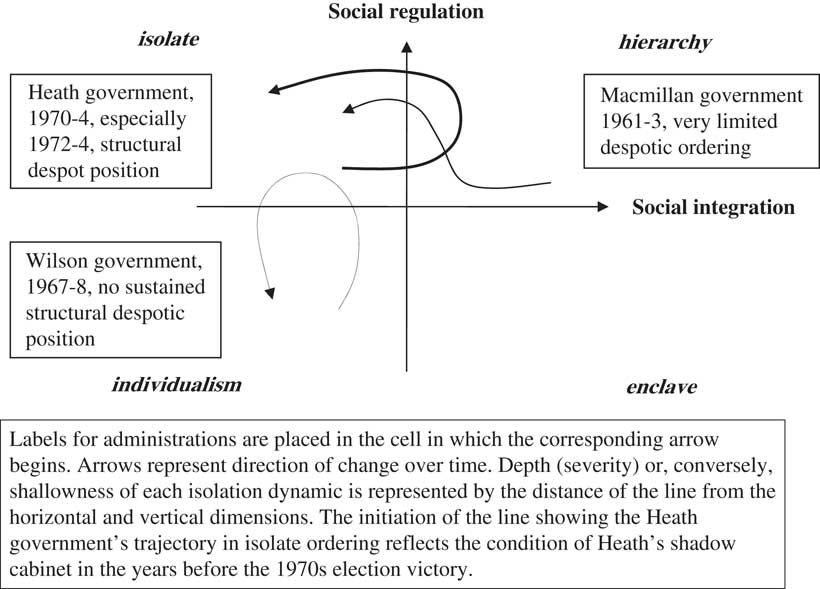
The isolation dynamic in the Heath administration began earlier, ran deeper and lasted longer, mainly because of the strong, structurally despotic element in its brittle judgement style of passing constraints on by imposition. Its pathway into isolate ordering partly resembled Macmillan’s administration’s route, resulting from a conscious attempt to build hierarchy. Yet, Macmillan himself reacted against stronger regulation by undermining the social integration he had first sought. Wilson’s administration’s isolation dynamic was brief, shallow and driven by setbacks in policies generated in an ordering that was predominantly individualistic.
These cases reveal some myths and misunderstandings about isolate social ordering. First, they show that the structural serf position is not straightforwardly passive, as is often assumed. It can promote guileful coping and adaptation to accommodate anomalies and disguise loss absorption. The incoherent but guileful coping in Macmillan’s administration’s final 18 months may have avoided a fate like Heath’s by allowing him to avoid greater rigidity in incomes policy than British politics could have borne.
Revealingly, none of these isolation dynamics was marked by internal conflict: even the apparently serious threats from his crown princes to Wilson’s premiership arose in individualistic periods of his administration’s life.
Conversely, we can see that, when faced with determined and strongly enclaved opponents, as many unions had become when Heath’s administration came to power, structurally despotic positions are especially brittle and vulnerable. Nevertheless, Heath’s structurally despotic position enabled him to force though the EEC application. His accurate estimation of his chances of doing so may have been the obverse of his erroneous judgement of his chances of holding his incomes policy intact. This point exemplifies the claim that each elementary form cultivates thought styles, which sustain positive capabilities accurately to recognise opportunities and risks, as well as the obverse incapacities and error.
Third, the case of Wilson’s administration shows that exit is possible, at least from a shallow isolation dynamic. But, this may not be typical. The other two administrations achieved no such exit before the prime minister fell, by resignation in 1963 and by electoral defeat in 1974.
The argument shows that changing informal institutions rather than ideas explain the shifts, for ideological change (e.g. after Heath’s “U-turns”) often followed developments in thought style. Institutionally driven thought styles thus provide more direct explanations of changing policies than do ideological beliefs.
Conclusion
The case-comparative design shows that isolation dynamics shape the fates of British administrations. Moreover, they arise differently and follow different trajectories to their destination. Because these dynamics can be observed in administrations in other constitutional systems, the argument merits future cross-national research.
The study shows that trajectories of change in institutional form are reflected in the styles of political judgement exhibited across many fields of policymaking. This argument shows that understanding isolation dynamics helps us to perceive how administrations’ political capabilities change over their time in office.
The comparative analysis supports the neo-Durkheimian explanations of both divergence in pathway and of consistency between social organisation and judgement style. The weighted mix of forms of administrations’ informal social organisation explains changing trajectories in judgement styles across social, industrial relations and foreign policy in very different administrations.
Methodologically, a theory originally developed for empirical examination using ethnographic methods has been shown suitable for research by comparative case designs, studying judgement styles using diaries and secondary historical evidence to analyse informal social organisation and archival sources to examine judgement style.
The study shows, too, that informal institutions within administrations can change with a speed that might surprise those who imagine institutional change to be a glacial affair, or who suppose that institutional approaches explain stability better than change.
Acknowledgements
The author gratefully acknowledges the support of the Leverhulme Trust for the research from which this paper is taken (Ref: F01374I). Earlier versions of this article were presented at the Political Studies Association conference, 4.4.12, and at a University College London seminar, 8.1.11: comments and suggestions from Kai Wegrich, Paul Furlong and other colleagues at the PSA and from Steve Ney at the UCL seminars are all gratefully acknowledged. The author is grateful to Christine Bellamy, Paul Richards, Peter John, Tony Bertelli and three anonymous reviewers for their invaluable and constructive comments on previous versions. None of these people bears any responsibility for the arguments, still less for errors that may remain.
Appendix: sources, data and coding
Available time truncates interviews; policymakers may have faulty memories or represent their past strategically. Although National Archives sources have their limitations, they are naturalistic, extensive and capture behaviour, so are preferred for researching judgement styles. Some 60,000 photographed official pages in over 500 National Archives files were analysed. Case coding focused on the recognition and management of anomaly, recognition of constraint, whether fall-back options were compassed, whether risks were willingly and knowingly run, whether issues are strongly or weakly linked, the use of any historical analogies indicating length and integration of memory, the length of planning horizon, etc. There is no systematic bias toward hierarchy in the archival data, because other forms can readily be discerned when coding focuses on the aspects of style of judgement identified in the article.
To code for changing informal social organisation, extensive use was made of ministers’ and senior civil servants’ personal papers (especially in the Churchill College Archives Centre, the Bodleian and the LSE libraries). Every major published ministerial and official diary, memoir and biography from these administrations was read and annotated to inform coding. Over 500 secondary books and another 500 articles were used. Coding focused on informal relations among ministers and their advisers on the dimensions of social integration and regulation, and on features of elementary forms (as this has an equivalent effect, but evidence for forms is sometimes easier to discern in documents than for dimensions), e.g. rule-based authority; patron–client relations; sectarian collective density and external distancing; of weak or absent bonds and withdrawal under vertical relations. Archival sources also provided information changing formal institutions. Diaries and memoirs can mislead, and biographies can be hagiographic; they must therefore be used cautiously only in triangulation and with corroboration, and focusing only on evidence of informal social relations and organisation, to minimise risks of wrongly inferring individualistic ordering.
Coding was of cases, not of separate documents. Codes from the entire set of sources were identified chronologically, aggregated and compared, and inconsistencies resolved. High level codes for elementary forms for each policy field in each administration were assembled by aggregating codes and identifying relative weighting to reveal social dynamics between phases of administrations’ lives.
Organisational forms and styles of political judgement are not stated baldly on the face of documents, but revealed, for example, in how documents are drafted, policies argued, behaviours reported and in justifications presented for decisions. So, coding could not be a mechanical exercise, but had to be done inferentially. Each source had to be read in full appreciation of its context, with alternative codes considered and full subsets of sources reexamined holistically, before evidence of the expected associations between social organisation and thought style could confidently be accepted. 6 (forthcoming Reference Sixa) presents a fuller discussion of the methodology, together with inferential arguments for and against specific codes.
For these reasons, coding had to be done manually. Detailed notes were taken on each file, document, memoir and biography. Initially hypothesised codes of features of social organisation and of judgement style were entered in annotation sheets. Codes were assembled on cases, inconsistencies identified and revisited (in fact, the few found could be resolved by closer iterative analysis of evidence).
Because there is insufficient space for citation of all primary and secondary sources used and this article’s purpose is case-comparative rather than historical, only selected citations are provided; full references are available on request.
Methodologically, the research uses congruence analysis on codes of social organisation and of judgement style. Because the analysis of industrial relations and trades union law reform cases shows the second phase of the feedback loop from judgement style in decisions back upon social organisation of the administrations, this part of the study engages in partial causal process tracing (Beach and Pedersen Reference Beach and Pedersen2013).