INTRODUCTION
Savannas are characterized by discontinuous tree canopies and a relatively continuous grassy understorey (Scholes & Archer Reference SCHOLES and ARCHER1997). In such systems, tree-grass interactions are often (though not exclusively) competitive in nature (Scholes & Archer Reference SCHOLES and ARCHER1997). Where woody cover is high, the tree canopy may suppress grass growth through light limitation (Hoffmann et al. Reference HOFFMANN, GEIGER, GOTSCH, ROSSATTO, SILVA, LAU, HARIDASAN and FRANCO2012), but under conditions of low canopy cover, grasses may exert strong competitive effects on trees by limiting access to below-ground resources such as water, nutrients or space (Cramer et al. Reference CRAMER, WAKELING and BOND2012, Scholes & Walker Reference SCHOLES and WALKER1993). Such competitive interactions have been shown to be pervasive (Cramer et al. Reference CRAMER, VAN CAUTER and BOND2010, February et al. Reference FEBRUARY, HIGGINS, BOND and SWEMMER2013, Riginos Reference RIGINOS2009, Werner & Prior Reference WERNER and PRIOR2013), but key details about the mechanisms underpinning competitive effects of grasses on trees remain uncertain (Cramer et al. Reference CRAMER, WAKELING and BOND2012).
Given that many savannas occur in climates where water is a key limiting resource (Sankaran et al. Reference SANKARAN, HANAN, SCHOLES, RATNAM, AUGUSTINE, CADE, GIGNOUX, HIGGINS, LE ROUX, LUDWIG, ARDO, BANYIKWA, BRONN, BUCINI, CAYLOR, COUGHENOUR, DIOUF, EKAYA, FERAL, FEBRUARY, FROST, HIERNAUX, HRABAR, METZGER, PRINS, RINGROSE, SEA, TEWS, WORDEN and ZAMBATIS2005), much of the research on competitive effects of grasses on trees has focused on the role of water, at least in African savannas (Higgins et al. Reference HIGGINS, BOND and TROLLOPE2000, Sankaran et al. Reference SANKARAN, HANAN, SCHOLES, RATNAM, AUGUSTINE, CADE, GIGNOUX, HIGGINS, LE ROUX, LUDWIG, ARDO, BANYIKWA, BRONN, BUCINI, CAYLOR, COUGHENOUR, DIOUF, EKAYA, FERAL, FEBRUARY, FROST, HIERNAUX, HRABAR, METZGER, PRINS, RINGROSE, SEA, TEWS, WORDEN and ZAMBATIS2005). An important frame of reference for understanding competition for water in these systems is Walter's two-layer model (Walker & Noy-Meir Reference WALKER, NOY-MEIR, Huntley and Walker1982, Ward et al. Reference WARD, WIEGAND and GETZIN2013). This model assumes that grasses (with their dense adventitious root systems and high transpiration rates) can outcompete trees for soil moisture in topsoil layers. Trees, by contrast, are assumed to have exclusive access to moisture in deeper layers (Eagleson & Segarra Reference EAGLESON and SEGARRA1985, Walker & Noy-Meir Reference WALKER, NOY-MEIR, Huntley and Walker1982). Although the current evidence largely supports the notion that water sources for trees are on average deeper than water sources for grasses in African savannas (Holdo & Nippert Reference HOLDO and NIPPERT2015, Kulmatiski & Beard Reference KULMATISKI and BEARD2013a, Kulmatiski et al. Reference KULMATISKI, BEARD, VERWEIJ and FEBRUARY2010, Priyadarshini et al. Reference PRIYADARSHINI, PRINS, DE BIE, HEITKÖNIG, WOODBORNE, GORT, KIRKMAN, LUDWIG, DAWSON and DE KROON2016, Ward et al. Reference WARD, WIEGAND and GETZIN2013), there is little evidence to support the idea that trees have ‘exclusive use’ of deep soil layers. This suggests that tree and grass rooting profiles largely overlap in terms of maximum rooting depth (Scholes & Walker Reference SCHOLES and WALKER1993), and competition between the two functional groups should generally occur.
The two-layer model has often been framed as a niche-partitioning model (Eagleson & Segarra Reference EAGLESON and SEGARRA1985, Sankaran et al. Reference SANKARAN, RATNAM and HANAN2004), whereby trees and grasses avoid competing for water by effectively exploiting different resources. The extent to which trees can exploit deep water, however, partly depends on the rate of infiltration, which in turn is affected by water uptake by grasses in the topsoil layers. In this case, vertical rooting differentiation could lead to competitive exclusion rather than niche partitioning. The importance of rooting differentiation in the context of infiltration rates was illustrated by an experiment that showed that increasing the size of precipitation events can increase infiltration and tree:grass biomass ratios relative to unmanipulated controls (Kulmatiski & Beard Reference KULMATISKI and BEARD2013a). This suggests that a fixed amount of rooting differentiation can result in contrasting competitive outcomes depending on the relative availability of soil moisture in topsoil vs. subsoil (Kulmatiski & Beard Reference KULMATISKI and BEARD2013a). This experiment did not, however, directly quantify the strength of these competitive effects. To directly test the hypothesis that the ratio of topsoil to subsoil water affects the competitive effect of grasses on African savanna tree seedlings, we designed an experiment that imposed grass competition treatments in a factorial combination with irrigation depth treatments. We predicted that grasses would have a competitive effect on tree seedlings (in terms of growth, photosynthesis and stomatal conductance) under both surface and deep irrigation, but more importantly that there would be an interaction between grass competition and irrigation depth. Our rationale was that trees, being relatively deeper-rooted than grasses, would exhibit a smaller competitive response under deep than surface irrigation. We focused on the competitive effect of grasses on trees (and not the reciprocal effect) because both field (February et al. Reference FEBRUARY, HIGGINS, BOND and SWEMMER2013) and greenhouse evidence (Campbell & Holdo Reference CAMPBELL and HOLDO2017) suggest that tree-grass competition for below-ground resources is strongly asymmetrical in favour of trees.
MATERIALS AND METHODS
Study species and experimental setup
Seeds of Acacia nigrescens Oliv. and Colophospermum mopane (Benth.) J. Leonard, two dominant lowveld savanna tree species, were collected from Kruger National Park (KNP), South Africa, in 2014. Colophospermum mopane is a broadleaved tree that often occurs in monodominant stands, while Acacia nigrescens is a widely distributed fine-leaved species. To facilitate germination, we soaked C. mopane seeds for 24 h and scarified the hard-coated A. nigrescens seeds using the point of a utility knife. We then planted all seeds in seed trays containing Pro-Mix (a peat-based, soil-less mix) in the Botany Greenhouse at the University of Missouri in June 2014. We transplanted the seedlings twice, first into larger pots to prevent roots from becoming pot-bound shortly following germination, and subsequently into experimental containers in August 2014. We used 121-l Rubbermaid® plastic containers (~70 cm deep) for the experiment, with 1.27-cm holes drilled roughly 3 cm apart around the base to allow water drainage. The containers had two different soil layers: a bottom layer consisting of sand (<5% silt and clay) overlaid by a 20-cm top layer consisting of a 7:2 sand and topsoil mixture. We designed the mixture to approximately capture the rate of drainage of KNP soils. We quantified the rate of water loss, starting from field capacity, of a number of potted soil mixtures plus a sample of field-collected KNP soil. To do so, we filled pots (45 cm in height) with soil, watered them to field capacity, and obtained volumetric water content (VWC) time series for each pot using Vegetronix VH400 (Vegetronix Inc., Riverton, UT) soil moisture sensors connected to a Campbell Scientific CR1000 datalogger (Campbell Scientific, Logan, UT), logging at 5-min intervals for a minimum of 24 h. The 7:2 mixture yielded a VWC curve exhibiting the most comparable values of field capacity and VWC decline to the field-collected soil. We limited the mixture to the top 20 cm of the containers because logistical constraints precluded the use of such a mixture for the entire soil profile.
We used 40 experimental containers arranged in four rows of 10. We randomly assigned 20 seedlings of each tree species to the containers. Each species was crossed with two other factors in a fully factorial design, randomly assigned to the containers: (1) irrigation depth, consisting either of surface (S) or deep (D) irrigation; and (2) grass competition, consisting of grass presence (G+) or absence (G−). The irrigation setup consisted of PVC pipelines connected to 1-m loops of polyethylene tubing equipped with fixed-flow drippers, each of which delivers water at a rate of 0.126 l min−1. Each loop contained four drippers. For the deep irrigation treatment, the loops were buried at 20 cm, while for the surface treatment, they were placed at the soil surface. The entire setup was supplied from a single tap. We fed water through this irrigation line once every 4 d. The amount of water administered to the containers was intended to simulate a typical wet season for KNP, consisting of 650 mm of rainfall delivered over 7 mo. This is equivalent to 12.4 mm of water per watering event.
For the grass competition treatment, we transplanted one grass tussock of each of two species into each G+ container. We used two common savanna grass species: Themeda triandra Forssk. is a widespread species that tends to grow in open areas with low tree cover, while Panicum maximum Jacq. tends to be a shade-favouring species that tends to dominate below tree canopies. At the time of tree seed collection, these two grass species were not in seed in KNP, so seeds were collected at the nearby Wits Rural Facility (24°34′00″S, 31°5′55″E) in March 2014. This site has similar vegetation characteristics to KNP, and is a field station located near Kruger National Park. We partially tied back the grasses to minimize shading effects on tree seedlings and therefore limit the possibility of confounding effects of competition for light and water (Holdo & Brocato Reference HOLDO and BROCATO2015). We planted grass seeds in seed trays containing Promix in the greenhouse in June 2014, and added them to the experimental containers in September 2014. We watered the containers to field capacity for roughly 5 wk to allow plants to adjust to the new environment until the experimental watering treatment was started in October 2014. During the early stages of the experiment, the automated timing system appeared to deliver an amount of water that was inferior to the target amount. Although this had no obvious adverse effect on any of the tree or grass seedlings (no mortality occurred), the timing was adjusted and the start date of the experiment was postponed until January 2015. The greenhouse temperature fluctuated between 21°C and 27°C, and was controlled automatically through drip coolers and radiators. We used grow lamps set to a 12:12 light:dark cycle to ensure regular levels of sunlight during the winter months. Over the course of the experiment, two containers were removed from the experiment because of aphid damage. The remaining containers were unaffected, and ladybird (Coccinella septempunctata) individuals were introduced to the greenhouse in January 2015 to avoid further infestation. We monitored the remaining plants for the presence of aphids and signs of damage but observed none during the remainder of the experiment.
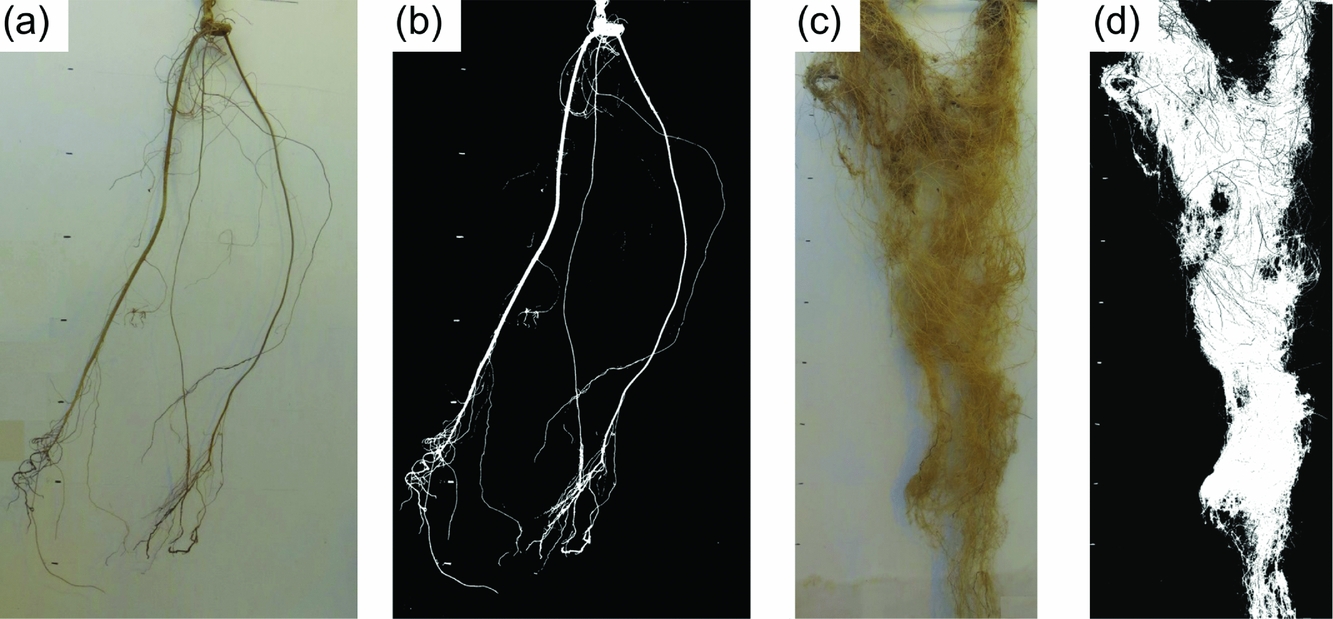
At the conclusion of the experiment in May 2015, we harvested all plants. We cut all shoots (for both trees and grasses) at soil level and oven-dried them at 60°C for 48 h before weighing to obtain above-ground biomass measurements. We left roots in the containers for roughly 3 wk to allow them to dry sufficiently to maintain their shape upon extraction from the soil. We carefully removed all soil from tree and grass roots and photographed them using a PowerShot SX260 HS Canon digital camera (Canon USA Inc., Melville, NY) against a white background containing a 10-cm scale for rooting profile analyses. We converted each photograph into a binary image using ImageJ open-source software (Figure 1). We then extracted root cross-sectional area and depth distribution metrics (median and 95% rooting depths) for each root image using Matlab R2013b (Mathworks, Natick, MA). Following rooting depth characterization, we oven-dried and weighed all root samples to obtain dry root biomass.
Examples of root profile characterization for one tree seedling and one grass tussock grown in a greenhouse experiment conducted at the University of Missouri, Columbia, USA: tree species Colophospermum mopane (a, b) and grass species Panicum maximum (c, d) roots. Original images (a, c) and binary digitized images (b, d) are shown for estimation of root depth distribution metrics.

We measured photosynthesis (A) and stomatal conductance (gs) rates on all tree seedlings at regular intervals with a LI-6400 XT Portable Photosynthesis System (LI-COR Biosciences, Lincoln, NE). To minimize unwanted variation in environmental conditions, we took measurements between 10h00 and 14h00. Time constraints (~10 min per reading individual) necessitated distributing the readings across two consecutive days following a watering event for a given time interval. We placed one fully expanded leaf in the LI-6400 leaf chamber and exposed it to a constant light regime of 1000 µmol m−2 s−1and CO2 concentration of 400 ppm. For leaves that did not take up the entire area of the analysis chamber, we normalized readings to a per-area basis by using digital photographs of the portion of the leaf that had been inserted into the chamber, taken through a 3 × 2-cm cardboard cut-out designed to match the chamber dimensions. We subsequently analysed each photograph using ImageJ to obtain the leaf fractional area present in the chamber, and adjusted all photosynthesis and conductance measurements to a unit area basis using these corrections (where necessary).
We collected soil moisture data for every container over the course of the experiment using Vegetronix VH400 soil moisture probes (Vegetronix Inc., Riverton, UT, USA) connected to a CR1000 datalogger via two AM 16/32 multiplexers. We placed two probes in each container, one at 5 cm and one at 40 cm depth, and used a CRBasic script to log voltage measurements (0–5000 mV) every 5 min. To convert voltage measurements to gravimetric soil moisture (GWC), we conducted a laboratory calibration. We filled two containers with soil corresponding to either our shallow 7:2 mix or sand from the lower part of our experimental containers. We inserted three VH400 probes into each container. We added a known amount of water to each container and obtained a 10-min time series of voltage measurements collected over 1-min intervals. We calculated a mean voltage value across time intervals and probes. We removed a subsample of the soil from the container and used it to calculate gravimetric soil moisture (GWC) following oven-drying at 105°C for 48 h. We repeated this procedure for a broad range of GWC values (~0–20%) for N = 6 samples per soil type. We then used the resulting calibrations to transform sensor voltage to GWC in the experimental data. The calibrations showed a good fit between GWC and sensor voltage (7:2 mix: R2 = 0.97, sand: R2 = 0.94).
Data analysis
We conducted most analyses using general linear models or general linear mixed models with the lm function from the stats package and the lme function from the nlme package (Pinheiro & Bates Reference PINHEIRO and BATES2000) in R v3.0.2. We first conducted an analysis of the soil moisture data time series to confirm that the irrigation treatments were delivering water differentially to topsoil and subsoil layers, and to test for grass presence effects on soil moisture availability at different depths. We used log-transformed mean values of GWC at 5-cm (GWC5) and 40-cm (GWC40) depths as response variables. We then tested for main effects of species, grass competition and irrigation depth plus a grass competition × irrigation depth interaction on the following response variables: log-transformed total biomass M (shoot plus root biomass), log-transformed median rooting depth (D50) and root/mass ratio (RMR). We excluded 95% rooting depth (D95) from the analysis because visual examination of root cross-sections suggested that maximum rooting depth had become constrained by container depth in many cases. We also tested for grass species differences (T. triandra vs. P. maximum) and irrigation depth effects on grass total biomass, RMR and D50.
To examine treatment effects on A and gs, we normalized these rates across measurement periods to control for daily fluctuations in the greenhouse environment (e.g. light conditions and vapour pressure deficit) that affect them independently of the experimental treatment effects. For each 2-d measurement period, we calculated Amean and gs,mean across all seedlings and subtracted these values from A and gs to yield Anorm and gs,norm. We used these normalized values as dependent variables in a repeated-measures analysis of variance with individual containers or seedlings as a repeated factor and seedling species, grass competition and irrigation depth as factors. We tested all main effects and interactions.
RESULTS
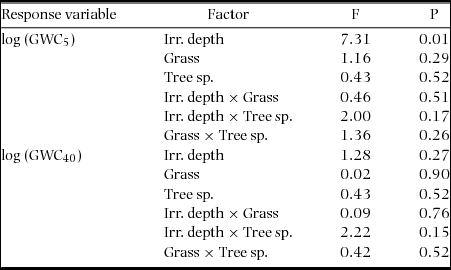
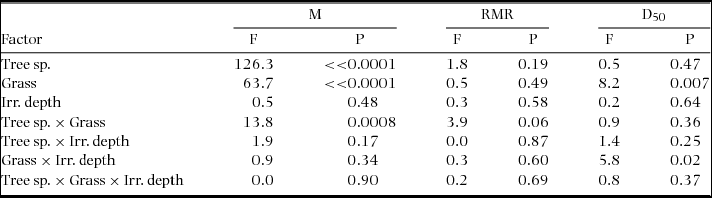
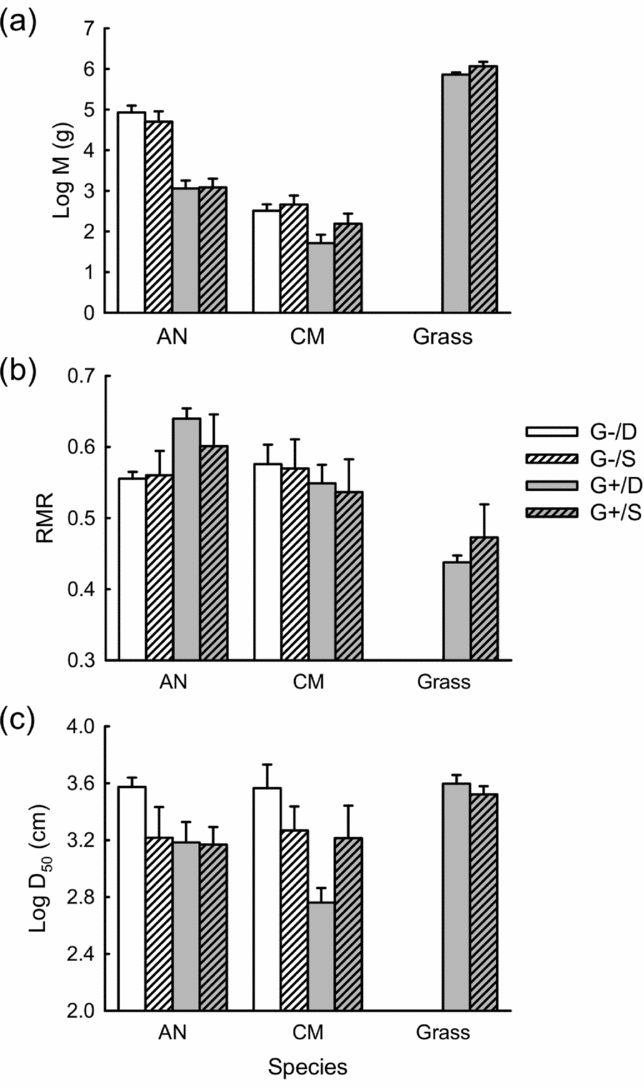
The irrigation treatment led to significant differences (P < 0.05) in GWC at 5-cm depth (but not at 40 cm) between the shallow- and deep-irrigation containers, suggesting that the irrigation protocol succeeded in delivering soil moisture profiles that differed in terms of depth distribution (Table 1). There were no significant effects of grass presence or tree species on GWC at either depth (Table 1). Grass presence had a clear negative effect (P << 0.0001, Table 2) on total tree dry mass M at the end of the experiment (Figure 2a). Species also differed in terms of final mass and there was a significant species by grass interaction (Table 2), with the relative impact of grass on seedling growth being greater for A. nigrescens than for C. mopane (Figure 2a). An analysis of simple effects by species showed that the grass competition effect, while different in magnitude between the two species, was significant in both cases (A. nigrescens: P << 0.0001, C. mopane: P < 0.01). There were no irrigation-depth treatment effects on the biomass of either tree seedlings or grasses (Table 2, Figure 2a), and there were no significant treatment main effects or interactions on RMR (Table 2, Figure 2b). Median rooting depth (D50) was relatively consistent across treatment classes (Figure 2c), but did show a significant response to grass competition and a grass by irrigation depth interaction (Table 2). Tests of simple effects on D50 in the two irrigation treatments separately revealed that the effect of grass presence on D50 only occurred under deep irrigation (D treatment: P < 0.0005; S treatment: P = 0.78), with tree seedlings exhibiting relatively shallower rooting patterns in the D treatment when grass was present. The results also suggested that grasses had a lower RMR than tree seedlings, i.e. a relatively higher allocation to shoot than root tissue (Figure 2b). Despite this, tree seedling and grasses exhibited remarkably similar median rooting depths (Figure 2c), suggesting that the two growth forms were largely exploiting similar rooting zones during the experiment.
Effects of grass competition (grass: grass competitors present or absent) and irrigation depth (Irr. depth: irrigation at surface or 20 cm depth) treatments across two species of African savanna tree seedlings (tree sp.: Acacia nigrescens or Colophospermum mopane) on mean log gravimetric water content (GWC) at 5 and 40 cm depths in a greenhouse experiment conducted at the University of Missouri, Columbia, USA.

Effects of grass competition (grass: grass competitors present or absent) and irrigation depth (Irr. depth: irrigation at surface or 20 cm depth) treatments across two species of African savanna tree seedlings (tree sp.: Acacia nigrescens or Colophospermum mopane) on tree total dry biomass (M), root mass ratio (RMR) and median rooting depth (D50) in a greenhouse experiment conducted at the University of Missouri, Columbia, USA.

Morphological responses (mean and SE) of two savanna tree species (AN = Acacia nigrescens, CM = Colophospermum mopane) grown with and without competition from grasses (G+ = grass present, G− = grass absent) under two irrigation depth treatments (S = surface, D = deep) in a greenhouse experiment conducted at the University of Missouri, Columbia, USA. Total (shoot plus root) dry mass M (a); root mass ratio (RMR) (b); median rooting depth D50 (c). Grass metrics from G+ treatments are shown for reference.

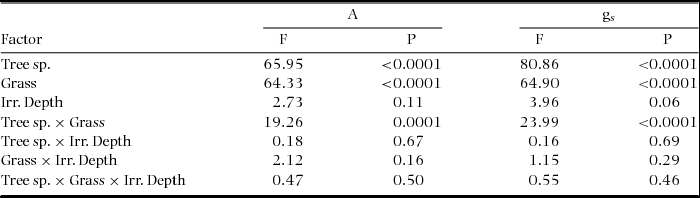
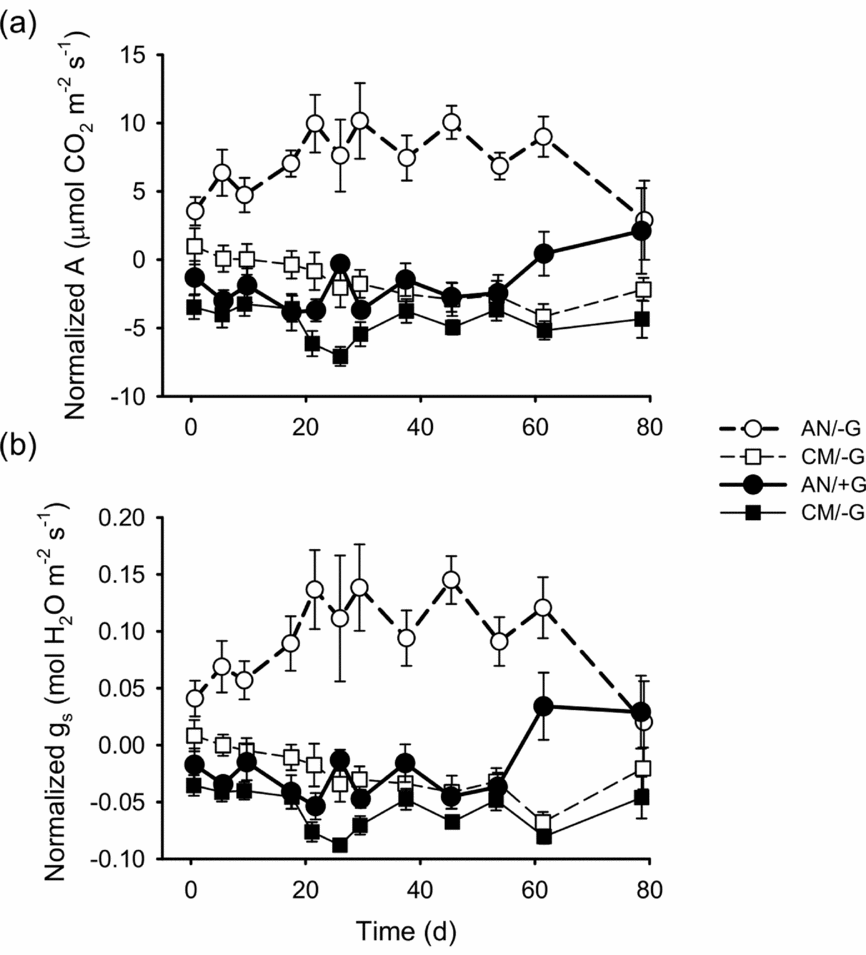
Tree photosynthesis and stomatal conductance rates were negatively affected (A and gs: P < 0.0001) by grass presence (Table 3, Figure 3), and differed significantly between the two tree species (P < 0.0001, Table 3, Figure 3). There was a highly significant species × grass presence interaction for both response variables (A: P < 0.000, gs: P < 0.0001, Table 3). When grown in competition with grass (G+), A. nigrescens experienced stronger reductions in A (56%) and gs (60%) than C. mopane (40% and 44% reductions in A and gs, respectively), compared to the G− treatment. As was the case with the morphological responses, there was no clear effect of irrigation depth (Table 3).
Effects of grass competition (grass: grass competitors present or absent) and irrigation depth (Irr. depth: irrigation at surface or 20 cm depth) treatments across two species of African savanna tree seedlings (tree sp.: Acacia nigrescens or Colophospermum mopane) on leaf photosynthesis (A) and stomatal conductance (gs) in a greenhouse experiment conducted at the University of Missouri, Columbia, USA.

Physiological responses (mean ± SE) of two savanna tree species (AN = Acacia nigrescens, CM = Colophospermum mopane) grown with and without competition from grasses (G+ = grass present, G− = grass absent) under two irrigation depth treatments (deep and shallow, pooled here for each grass competition by species combination for legibility) in a greenhouse experiment conducted at the University of Missouri, Columbia, USA: normalized photosynthesis rate (Anorm) (a) and stomatal conductance (gs,norm) (b). Values of zero on the y-axes represent mean A and gs across all seedlings for a particular 2-d measurement period.

To test for possible (unwanted) shading effects in our experiment, we re-analysed the biomass and photosynthesis data with an additional covariate: the number of neighbouring containers with grass (range = 0–5). These neighbours could have impacted the above-ground environment in any given target container while not affecting the below-ground environment, from which they were isolated. We also included container location (X and Y) as additional covariates to account for spatial variation in the greenhouse environment. We found no support for a neighbour shading effect (P>0.1) on total tree dry mass M, while finding support for a small spatial effect (P < 0.05). Accounting for this spatial variation did not modify any of our previous conclusions about grass competition or species effects. We also found evidence for a significant shading effect on (gs: P < 0.05; A: P < 0.1) leaf physiology, but the size of the effect per neighbour was about 5% of the size of the effect of having grass within the same container, suggesting that light limitation alone cannot account for the grass competition effect, suggesting that the competitive response was largely driven by below-ground competition.
DISCUSSION
Consistent with prior work (Barbosa et al. Reference BARBOSA, VAN LANGEVELDE, TOMLINSON, CARVALHEIRO, KIRKMAN, DE BIE and PRINS2014, Cramer et al. Reference CRAMER, WAKELING and BOND2012, Holdo & Brocato Reference HOLDO and BROCATO2015), we found strong support for competitive effects of these tussock grasses on tree seedlings, but found no support for rooting differentiation, at least under the controlled conditions that prevailed in our greenhouse experiment. The irrigation depth treatment had no effect on tree performance and showed no interaction with the grass treatment. Taken in conjunction with the results of the experiment that partially motivated the present study (Holdo & Brocato Reference HOLDO and BROCATO2015), this suggests that interspecific variation in tree competitive response to the perennial grasses in these experiments is unrelated to variation in tree rooting depth, and is more likely related to other tree seedling traits. An examination of the rooting profiles in the two functional groups suggests that this should not be surprising: there were no clear differences in rooting depth between both tree species and grasses, with grasses, if anything, appearing somewhat deeper-rooted than trees (Figure 1c), even though physical rooting profiles do not necessarily reflect functional rooting profiles (Nippert & Knapp Reference NIPPERT and KNAPP2007).
The lack of rooting separation and/or irrigation depth effects would suggest that no clear niche separation between tree seedlings and grasses took place over the course of this experiment, at least in terms of vertical rooting separation. A priori, the lack of an effect of the irrigation treatment was somewhat counterintuitive: the chosen irrigation depth of 20 cm for the deep irrigation treatment was based on field data (using labelled water) showing that most water uptake in grasses occurs within 10 cm of the surface (Kulmatiski & Beard Reference KULMATISKI and BEARD2013b). Our bypassing of the top 20 cm of soil should therefore have had a marked effect. There are two potential interpretations for this result. The first one is that no meaningful rooting separation occurs between tree seedlings and grasses, unlike reported observations for established trees. Our results diverge from those of Kambatuku et al. (Reference KAMBATUKU, CRAMER and WARD2013) under this interpretation. Alternatively, the extent of rooting separation may be context-dependent. It has been noted, for example, that trees can exhibit a high degree of plasticity in terms of their ability to exploit water across depths under field conditions, resorting to deeper water when it is available, while grasses consistently exploit topsoil layers (Kulmatiski & Beard Reference KULMATISKI and BEARD2013a, Kulmatiski et al. Reference KULMATISKI, BEARD, VERWEIJ and FEBRUARY2010). The relatively deep rooting profile of grasses in the experiment, however, is not consistent with the notion that grasses almost exclusively rely on the top few cm of soil. We suggest that the relatively mesic experimental conditions, coupled with the coarse soil texture, may make deep rooting a feasible strategy for both trees and grasses. Root niche separation has been shown to be more apparent in arid systems (Sankaran et al. Reference SANKARAN, RATNAM and HANAN2004, Walter Reference WALTER1971, Ward et al. Reference WARD, WIEGAND and GETZIN2013) and occurrences of niche separation in more mesic systems may be less defined or completely absent (Mordelet et al. Reference MORDELET, MENAUT and MARIOTTI1997). Our results in this respect are consistent with findings in the Pretoriuskop area of Kruger National Park (where soil and climate conditions are similar to those in our experimental setup), where evidence for tree-grass rooting separation is weak (February et al. Reference FEBRUARY, HIGGINS, BOND and SWEMMER2013, Verweij et al. Reference VERWEIJ, HIGGINS, BOND and FEBRUARY2011). A similar finding was reported for the nutrient-poor savannas of northern Australia (Werner & Murphy Reference WERNER and MURPHY2001).
Two clear patterns emerge from the first experiment: the strong negative effect of grass competition on tree seedling photosynthesis, stomatal conductance and growth, and the differential response to grass competition in the two tree species. The reductions in photosynthesis and stomatal conductance rates in conjunction with decreased growth rates are consistent with previous work on temperate savanna tree seedlings, where both competition and soil moisture were found to significantly lower seedling photosynthesis and growth rates (Davis et al. Reference DAVIS, WRAGE, REICH, TJOELKER, SCHAEFFER and MUERMANN1999). In our experiment, the lack of an effect of the grass treatment on soil moisture readings could be interpreted as an indication that a resource other than water was being competed for (e.g. nutrients). Although we cannot entirely rule out this possibility, we note that our sensors exhibited a high failure rate, and probably provided somewhat unreliable readings in the sandy soils we used for the experiment. Regardless of whether our grass tussocks and tree seedlings were competing for moisture or nutrients, our results did clearly show that, even though our deep irrigation treatment was successful, it failed to favour the tree seedlings.
Resolving how and why trees compete with grasses across a wide range of size stages is essential for parameterizing models of tree-grass dynamics across the entire tree life cycle. Our results support the notion that savanna tree seedlings confront intense competition from perennial, tussock-forming grasses during the establishment phase, and that the fast development of deep taproots may not necessarily lead to niche partitioning, at least on sandy soils. These results further support the existence of strong establishment bottlenecks during the seedling phase (Higgins et al. Reference HIGGINS, BOND and TROLLOPE2000, Werner Reference WERNER2012), with important implications for our understanding of the drivers of tree dynamics in grassy ecosystems.
ACKNOWLEDGEMENTS
We thank Barbara Sondermann for assistance in the greenhouse and Keala Cummings for help with seed acquisition and setting up the experiment. This work was partially funded by NSF through EPSCoR award IIA-355406.