




No CrossRef data available.
Article contents
Dynamics of chemical mimicry in the social parasite wasp Polistes semenowi (Hymenoptera: Vespidae)
Published online by Cambridge University Press: 05 October 2004
Abstract
Chemical cues are so important in the recognition mechanism of social insects that most social parasites (which rely on hosts to rear their brood) have been documented as overcoming the mechanism by which colony residents recognize non-nestmates, by mimicking the odour of the usurped colony. We simulated in the laboratory the process by which the obligate social parasite, Polistes semenowi, invades nests of the host species, Polistes dominulus, in the field and analysed the epicuticular lipid layer before and after host nest usurpation. The experiment documents that P. semenowi social parasites have an epicuticular hydrocarbon pattern which is very similar to that of their host but, after entering host colonies, parasites mimic the odour of the colonies they invade, to the point that they perfectly match the hydrocarbon profile peculiar to the colony they entered. However, both before and after host nest invasion, parasites show a tendency to possess diluted recognition cues with respect to their hosts.
Keywords
Information
- Type
- Research Article
- Information
- Copyright
- © 2004 Cambridge University Press
INTRODUCTION
Social insects recognize nestmates by means of chemical cues on the cuticle (epicuticular compounds) which are usually strictly species-specific blends with distinctive colony patterns (Lorenzi, Bagnères & Clément, 1996; Singer, 1998; Lenoir et al. 1999). Obligate social parasites are social insects generally unable to produce workers and they need the workers and the nests of host species to rear their own brood (composed exclusively of reproductives). Obligate social parasites often overcome species- and colony-specific differences in recognition cues by mimicking the odour of hosts (reviewed by Dettner & Liepert, 1994; Lenoir et al. 2001), i.e. by exhibiting a cuticular profile with host-specific compounds in host-specific proportions after entering host nests.
Polistes wasps have only 3 species of obligate social parasites (P. atrimandibularis, P. sulcifer and P. semenowi). They enter host nests following either peaceful or aggressive behavioural strategies of invasion (Cervo, Lorenzi & Turillazzi, 1990; Cervo & Dani, 1996), but they also exhibit chemical strategies that are likely to favour their integration in host colonies. When P. atrimandibularis usurp colonies of the host P. biglumis, parasite females mimic the odour of the invaded colony (Bagnères et al. 1996) so that colony members recognize the parasite as one of themselves (Lorenzi, 2003). P. atrimandibularis parasites also have a diluted chemical signature, which is likely to favour parasite acceptance in host nests (Lorenzi & Bagnères, 2002) and/or to facilitate the acquisition of hydrocarbons from host colonies. P. sulcifer, obligate social parasites of P. dominulus, exhibit the odour of the host colonies within a short interval of entering a host colony (Turillazzi et al. 2000) and their profile matches that of the usurped colony (Sledge et al. 2001b) and its dominant host foundresses (Dapporto et al. 2004) perfectly. Nothing is known about the chemical strategy of integration of P. semenowi, which is a rare social parasite, while knowledge of its integration mechanisms may throw light on similarities and differences among this monophyletic group (see Choudhary et al. 1994). P. semenowi is able to usurp 2 different host species, but its preferred host is P. dominulus. A few studies give indications of its life-cycle (Scheven, 1958; Cervo et al. 1990; Mead, 1991; Zacchi, 1995; Zacchi, Cervo & Turillazzi, 1996). From these studies it emerges that parasite females usurp pre-worker nests (which P. dominulus females have founded less than 2 months previously) in spring. Parasites enter nests aggressively and subdue subordinate females and usually legitimate dominant queens. Each parasite queen controls a single host colony, possibly up to the end of a colony cycle. These data suggest that P. semenowi parasites have a chemical strategy of integration in host colonies: soon after parasite usurpation, hosts tolerate their parasites as one of their nestmates and care for the parasite brood, which is composed entirely of fertile individuals. In paper wasps, a central role in recognition processes is played by the nest: newly emerged females learn their colony odour from nest paper and later use the learned template to discriminate between nestmates and non-nestmates (Pfennig et al. 1983; Gamboa, Reeve & Pfennig, 1986). Thus, social parasites should either deposit their species-specific odours on host combs, or acquire colony odours from combs or adult wasps, in order to become chemically integrated into host colonies.
The 3 species of obligate social parasites of paper wasps have a monophyletic origin (Choudhary et al. 1994) but exhibit different behavioural strategies at usurpation (Cervo & Dani, 1996). Thus, the knowledge of the chemical strategy used by each species of social parasites and data on its level of specialization will favour the comprehension of the evolution of chemical mimicry and throw light on the evolution of social parasitism in paper wasps.
The aim of this paper is to verify whether the social parasite P. semenowi mimics the host colony odour after invading it, whether it has diluted recognition cues and whether it applies odours to or absorbs odours from the host nest. We investigated these aspects by making parasites usurp host colonies in the laboratory.
MATERIALS AND METHODS
Parasite collection
Thirty-two Polistes semenowi parasites were collected in Central Italy (Monte Nerone, near Pesaro, Marche province, with the exception of 1 parasite from the West Alps) at their hibernation sites. Of these, 25 were immediately killed by freezing and used for epicuticular hydrocarbon chemical identification (GC-MS analyses), following the procedure described below. The other 7 individuals, collected at the beginning of hibernation, were left to hibernate. Hibernation was brought about keeping parasites together in 15×15×15 cm glass boxes outside the laboratory at natural temperature and photo-period conditions and supplying them with honey and water. In June (i.e. when parasites usurp host nests in the field), 3 of these parasites (ParA, ParB, ParC) were killed by freezing and used for chemical analyses, while the other 4 (Par1, Par2, Par3 and Par4) were used for usurpation tests in the laboratory. Each parasite was introduced into 1 of 4 P. dominulus colonies (colony 1, 2, 3 and 4, respectively) (see below). Parasite females easily usurp host colonies in the laboratory: when they are introduced in cages containing host nests they rapidly land on nests and attack those host wasps which defend the colonies (Zacchi et al. 1996).
Host collection
The 4 P. dominulus colonies (1, 2, 3, and 4) were collected in the surroundings of Florence (Tuscany, central Italy), at the end of May, in the post-worker phase. Each colony (i.e., nest and adult wasps) was caged in a glass cage (15×15×15 cm) and the comb was suspended from the roof of the cage. The colonies were supplied with water, honey and Tenebrio molitor larvae ad libitum and were maintained in the laboratory under natural temperature and photoperiod to be used in usurpation tests.
Usurpation tests
The 4 P. dominulus colonies were left to settle for a few days then used as host nests. Immediately before usurpation, we removed from each colony a piece of nest paper i.e. approx. 1 cm2 of nest material (which wasps make from woody fibres chewed from weathered wood and mixed with saliva) and a sample of adult female hosts (respectively, 5, 3, 4, 6 host wasps). Then a P. semenowi female was introduced into each cage. All 4 parasites successfully usurped the P. dominulus colony we had offered to them and subdued dominant females. The parasitized colonies were reared in the laboratory. Fifteen or thirty days later, the host population was composed of at least 6 females older than 24 h (so that they had acquired their colony odour, see Pfennig et al. 1983; Panek, Gamboa & Espelie, 2001; Lorenzi, Cometto & Marchisio, 1999). We then removed another piece of nest paper (approx. 1 cm2), all remaining adult female hosts (respectively, 8, 6, 7, 6 host wasps) and the 4 parasites. Removed paper and wasps were frozen and used for hydrocarbon analyses.
Hydrocarbon extractions
In order to obtain both qualitative and quantitative information on the epicuticular hydrocarbon blends of parasites and hosts we extracted cuticular lipids in solvent. Cuticular compounds were extracted by dipping each wasp in 1 ml of pentane for 90 sec and each sample of nest paper in 2 ml of pentane for 120 sec. Then 800 ng of n-nonadecane were added to each extract to calibrate the quantity of each compound. Two μl of solution were analysed by gas-chromatography on a Delsi Nermag DN200 gas-chromatograph with a flame ionization detector (FID) and a Chrompack CPSIL5 WCOT CB non-polar capillary column (25 m×0·25 mm×0·12 μm). Program temperature was as follows: from 70 °C to 150 °C at a rate of 30 °C/min after a 15-s splitless method of injection. The temperature was increased after a 5 min isotherm at a rate of 5 °C/min up to 320 °C/min (isoth. 5 min). The carrier gas (helium) was at 1 bar. Data were registered with an Enica 31 integrator.
GC-MS analyses
Epicuticular compounds were identified with a Hewlett Packard GC 5890 gas chromatograph coupled with an MS Engine HP 5989A mass-spectrometer. The whole system was controlled by a HPUX MS Chemstation.
The analysis was performed in 70 eV electronic impact (EI). Mass spectra were scanned from m/z 45 to 500 at a rate of about 1 scan/sec. Column and temperature programmes were similar as for GC. The split opened 1 min after injection. Helium was the carrier gas (2 bars). Source temperature was 250 °C, quadrupole at 100 °C, and interface at 300 °C. Extracts for GC-MS analysis were obtained from pooled extracts of individuals and nests per category (all extracts from hosts before/after usurpation, or all extracts from parasites before/after usurpation, etc.).
Data analyses
In order to compare qualitative features of the cuticular blends of hosts and parasites, we grouped the various compounds into ‘chemical classes’ which appear to have different impact on recognition processes (Dani et al. 2001). These included (1) linear alkanes and (2) branched alkanes (i.e. methylated alkanes).
Statistical analyses
Differences between the qualitative or quantitative features of cuticular hydrocarbon blends were evaluated using the Wilcoxon test when data were paired or the Mann–Whitney U-test when data were independent. Exact P values were used for small sample sizes, following Mundry & Fischer (1998).
To avoid pseudoreplication, each colony supplied a single datum (for example, the average of the total quantity of hydrocarbons per wasp) to be used in comparisons. Quantification was based upon single peak areas converting them to ng using the internal standard. The total quantity of hydrocarbons (sum of single hydrocarbon quantity) is expressed here as the quantity of hydrocarbons in ng per wasp.
To evaluate whether host and parasite chemical signatures matched with each other we used multivariate mathematical analyses (Principal Component Analysis, PCA). These analyses were performed per nest and on all colonies together (before and after experimental nest usurpation). Relative proportions of the different peaks were used for the analysis with Statgraphics (version 5.01) software and its extension Unistat II (version 1.0).
RESULTS
Epicuticular hydrocarbon profiles of P. semenowi
The gas-chromatographic profile of the epicuticular lipids of P. semenowi was composed of only 33 peaks during hibernation. This was qualitatively poorer than that which the parasites exhibited in the spring before and after the experimental host nest invasion, where we could identify 50 and 56 peaks respectively (Table 1). The identified compounds were saturated hydrocarbons, ranging from 23 to 37 carbon atoms: n-alkanes, laterally and centrally branched monomethylalkanes, dimethylalkanes and trimethylalkanes.
Table 1. List of the compounds identified in the hydrocarbon blends of hosts and parasites (epicuticle) and of nest paper (surface) before and after parasite usurpation (Asterisks indicate compounds in very small quantities (see text).)

In spring, at the moment of the host nest usurpations, all compounds identified in the parasite epicuticular extracts were present in the hosts (see Table 1). The epicuticular hydrocarbons we identified from the analysis of the blends obtained from parasites that had already usurped host colonies were in accordance with those identified by Bonavita-Cougourdan et al. (1991), by Sledge, Boscaro & Turillazzi (2001a) and by Sledge et al. (2004) for the host species P. dominulus. The most abundant chemical class is that of branched alkanes (79·8% before and 66% after host nest usurpation), the n-alkanes follow (20·2% before and 34% after host nest usurpation).
Although the reduced number of data (n=4) did not allow the application of statistical tests for paired data, we verified that, after usurpation, each of the 4 parasites had a smaller proportion of branched hydrocarbons (and a larger proportion of linear hydrocarbons) than its hosts.
The analysis of nest paper revealed that nests are covered by a rich layer of hydrocarbons that match those of the host wasps (see Table 1). Branched hydrocarbons are the most abundant chemical classes on nest paper both before and after nest usurpation (75·1% and 82·6% respectively), while linear alkanes are less represented (24·9% before and 17·4% after host nest usurpation). Some qualitative difference between the hydrocarbon blends of wasps and of nest paper may be due to a higher hydrocarbon concentration in nest paper rather than in wasps. This difference facilitates the GC-MS determination in paper blends (see Table 1, nest compounds with asterisks).
Total quantity of hydrocarbons
The (median) total quantity of hydrocarbons extracted from wasps was: 14·77 μg/parasite-wasp (n=3 parasites) before host nest usurpation; 36·04 μg/host-wasp (n=18 host females from 4 colonies) before usurpation; 13·72 μg/parasite wasp (n=4 parasites) after host nest usurpation; 21·13 μg/host-wasp (n=27 host females from 4 colonies) after usurpation (Fig. 1).

Fig. 1. The total quantities of hydrocarbon (in μg) per wasp before and after host nest usurpation. Box plots show the 75th and 25th percentiles as boxes, the median as thick lines in the box and the 95th and 5th percentiles as vertical lines.
Parasites had a lower quantity of hydrocarbons than 3 out of 4 hosts before host nest usurpation (although the difference is not significant: Mann–Whitney U-test, respectively U=3·000, P=0·289). Moreover, each parasite had a smaller quantity of hydrocarbons than their respective hosts did after usurpation (although it is not a significant difference: Wilcoxon test, n=4, z=−1·826, P=0·068).
Although no significance is reached, the amount of hydrocarbons increased appreciably on all pieces of nest paper from the first (median before usurpation: 44·172 μg/piece of nest) to the second sample (median after usurpation: 127·40) (Wilcoxon test, z=−1·83, P=0·068).
Multivariate statistical analyses
Fig. 2 shows the projections obtained with PCA for all the analysed extracts (parasites, hosts and nest paper obtained from P. dominulus colonies parasitized in the lab by P. semenowi queens). Hosts belonging to the 4 different colonies clump together in a rather undistinguished group, which contains their respective nest material as well. However, parasites position themselves as a different group before entering a host nest (see ParA, ParB and ParC in Fig. 2), while they are indistinguishable from hosts after usurpation (see Par1, Par2, Par3 and Par4).

Fig. 2. PCA projections of the three parasites analysed before host nest usurpations (Par1, Par2, Par3), and of colonies 1, 2, 3 and 4 (hosts, nest paper and parasites) both before and after parasite invasion. Hosts from the four colonies are indicated with different symbols between colonies, nest paper as ‘nest’ with the respective colony symbol and parasites as ‘par’ with the symbol of their respective colonies.
As an example of the variations of the hydrocarbon patterns within a colony with time, Fig. 3 shows the projections of PCA for a P. dominulus nest (colony 1) parasitized in the laboratory by a P. semenowi. The colony is separated over the axis 1, which represents 36·8% of the variation and distinguishes the colony by time. Here the chemical profile of hosts and nest paper is homogenous at a given time and differs with time (colony 1 was analysed before and after parasite invasion at an interval of 15 days). After usurpation the parasite queen was successfully included within the group of hosts analysed. Similar results were found for the other nests.

Fig. 3. PCA projections of colony A before (in black) and after (in grey) usurpation. Hosts and nest paper before and after usurpation are separated by the x-axis.
Our results indicate that colonies can be distinguished according to the moment of the colony cycle on the basis of the chemical variations of their colony odours and the variations in relative proportions in their cuticular hydrocarbons. Parasite queens' hydrocarbon profiles matched those of their respective host colonies.
DISCUSSION
Our experiment simulated the process by which P. semenowi parasites invade nests of the host species P. dominulus and integrate themselves in host colonies. The laboratory experiment documents that the social parasite P. semenowi has an epicuticular hydrocarbon pattern which is very similar to that of its host but, after entering host colonies, parasites mimic the host colony odours, up to the point that they perfectly match the hydrocarbon profile peculiar to the colony they entered. Such a process is likely to be relevant to the integration and acceptance of parasites within host colonies.
The cuticular blend of all parasites was quantitatively poor with respect to that of their hosts. In other social insect parasites (Lenoir et al. 2001) and in another social wasp parasite (Polistes atrimandibularis, Lorenze & Bagnères, 2002), it seems that parasites are poorer in all recognition cues than their hosts. Our data suggest that this is true of P. semenowi. The dilution in recognition cues of social parasites may in turn favour tolerance by hosts, acting together with chemical mimicry. Here, we suggest that the most probable scenario is that the parasites make few hydrocarbons on their own and are then capable of absorbing host hydrocarbons.
A number of similarities may be seen among the dynamics of the epicuticular hydrocarbon pattern of P. semenowi social parasites and that of young Polistes wasps. At emergence, young Polistes wasps have a poor hydrocarbon profile; during the first few hours after emergence, the epicuticular hydrocarbon blends of newly emerged wasps change rapidly until they match those of the members of the natal colony and of their nest paper (Lorenzi et al. 1999; Panek et al. 2001; Lorenzi et al., unpublished observations; and similar process was recently described in newly emerged honeybees, Breed, Perry & Bjostad, 2004). Similarly, in adult Polistes social parasites, the hydrocarbon profile is diluted after hibernation (Lorenzi & Bagnères, 2002 for P. atrimandibularis; and possibly in P. semenowi, this paper), but enriches in total quantities and modifies its composition after usurpation. We found that the epicuticular hydrocarbon blend of P. semenowi parasites was enriched in long-chain compounds when parasites had entered host colonies (unpublished data): this change might be linked to variations in parasite physiology. After entering host colonies parasites express their fertility traits and begin laying eggs: indeed, in P. dominulus, fertile females differ from sterile ones by a larger quantity of long-chain hydrocarbons (Dapporto et al. 2004). Then, at the end of a dynamic period (whose length is still to be investigated but which appears to last from a few hours to about 30 days, depending on the species (Turillazzi et al. 2000; Lorenzi & Bagnères, 1996; Rossi, 2001) the chemical signature of parasites matches that of the invaded colony and hosts recognize their parasites as one of themselves (Sledge et al. 2001b; Lorenzi, 2003). The modification of the epicuticular blends of the parasites could depend on physiological processes, as shown in a non-social insect Musca domestica (Mpuru et al. 2001) and/or on the seasonal variation of the host colony signature, as demonstrated in ants by Provost et al. (1995) and in termites by Bagnères et al. (1990). The parasites adapt their signature by means of an unknown lipid transport/regulation process.
P. semenowi social parasites may also acquire compounds and/or increase hydrocarbon quantities, absorbing chemicals passively from hosts or nest paper. P. semenowi females stroke their abdomen on the invaded nests (Zacchi, 1995): this behaviour may facilitate both acquisition of chemicals on the cuticle of the wasp and application of compounds to nest paper. As far as we know, there is evidence that paper wasp cuticle can absorb compounds from the combs (Pickett, McHenry & Wenzel, 2000; Lorenzi et al. 2004) but other studies suggested that paper wasps can deposit their individual odour on the comb (Dani, Cervo & Turillazzi, 1992; Van Hooser, Gamboa & Fishwild, 2002). Other studies gave evidence that both processes can occur simultaneously (i.e. Turillazzi et al. 2000; or in facultative parasites: Lorenzi et al. 2004). As we found that P. semenowi females are poorer in hydrocarbons than nest material, we suggest that in this species stroking may be functional more to the absorption of chemicals from the host nest to the parasite cuticle than to the application of parasite odour to the comb. The process of chemical mimicry is likely to favour the process by which each parasite is accepted in its host nests as a nestmate (Bagnères et al. 1996; Sledge et al. 2001b; Lorenzi, 2003). Although further studies are needed, the hypothesis may be made that one of the mechanisms that social parasites use to deceive hosts and integrate into host colonies is to retain some ‘juvenile’ traits of the epicuticular hydrocarbon pattern, namely dilution and an ample plasticity of recognition cues. These traits allow newly emerged wasps to attain the mature chemical signature of their natal colonies and allow usurping parasites to attain the chemical signature of the colonies they invade.
We wish to thank Professor Alain Lenoir and two anonymous referees for helpful comments on a previous version of the manuscript, and G. Dusticier for his help in the GC-MS analyses.
References
REFERENCES
BAGNÈRES, A.-G., CLÉMENT, J.-L., BLUM, M. S., SEVERSON, R. F., JOULIE, C. &
LANGE, C. (
1990).
Cuticular hydrocarbons and defensive compounds or Reticulitermes flavipes (Kollar) and R. santonensis (Feytaud): polymorphism and chemotaxonomy.
Journal of Chemical Ecology
16, 3213–3244.Google Scholar
BAGNÈRES, A.-G., LORENZI, M. C., CLÉMENT, J.-L., DUSTICIER, G. &
TURILLAZZI, S. (
1996).
Chemical usurpation of a nest by paper wasp parasites.
Science
272, 889–892.CrossRefGoogle Scholar
BONAVITA-COUGOURDAN, A., THERAULAZ, G., BAGNÈRES, A.-G., ROUX, M., PRATTE, M., PROVOST, E. &
CLÉMENT, J.-L. (
1991).
Cuticular hydrocarbons, social organization and ovarian development in a polistine wasp: Polistes dominulus Christ.
Comparative Biochemistry and Physiology
100B, 667–680.CrossRefGoogle Scholar
BREED, M. D., PERRY, S. &
BJOSTAD, L. B. (
2004).
Testing the blank state hypothesis: why honey bee colonies accept young bees.
Insectes Sociaux
51, 12–16.CrossRefGoogle Scholar
CERVO, R. &
DANI, F. R. (
1996).
Social parasitism and its evolution in Polistes. In
Natural History and the Evolution of Paper Wasps (
ed. Turillazzi, S. & West Eberhard, M. J.), pp.
98–112.
Oxford University Press, Oxford.
CERVO, R., LORENZI, M. C. &
TURILLAZZI, S. (
1990).
On the strategies of host nest invasion in three species of Sulcopolistes, social parasites of Polistes wasps.
Actes Colloques Insectes Sociaux
6, 69–74.Google Scholar
CHOUDHARY, M., STRASSMANN, J. E., QUELLER, D. C., TURILLAZZI, S. &
CERVO, R. (
1994).
Social parasites in Polistine wasps are monophyletic – implications for sympatric speciation.
Proceedings of the Royal Society of London B
257, 31–35.CrossRefGoogle Scholar
DANI, F. R., CERVO, R. &
TURILLAZZI, S. (
1992).
Abdomen stroking behaviour and its possible functions in Polistes dominulus (Christ) (Hymenoptera, Vespidae).
Behavioural Processes
28, 51–58.CrossRefGoogle Scholar
DANI, F. R., JONES, G. R., DESTRI, S., SPENCER, S. H. &
TURILLAZZI, S. (
2001).
Deciphering the recognition signature within the cuticular chemical profile of paper wasps.
Animal Behaviour
62, 165–171.CrossRefGoogle Scholar
DAPPORTO, L., CERVO, R., SLEDGE, M. F. &
TURILLAZZI, S. (
2004).
Rank integration in dominance hierarchies of host colonies by the paper wasp social parasite Polistes sulcifer (Hymenoptera, Vespidae).
Journal of Insect Physiology
50, 217–223.CrossRefGoogle Scholar
DETTNER, K. &
LIEPERT, C. (
1994).
Chemical mimicry and camouflage.
Annual Review of Entomology
39, 129–154.CrossRefGoogle Scholar
GAMBOA, G. J., REEVE, H. K. &
PFENNIG, D. W. (
1986).
The evolution and ontogeny of nestmate recognition in social wasps.
Annual Review of Entomology
31, 431–454.CrossRefGoogle Scholar
LENOIR, A., D'ETTORRE, P., ERRARD, C. &
HEFETZ, A. (
2001).
Chemical ecology and social parasitism in ants.
Annual Review of Entomology
46, 573–599.CrossRefGoogle Scholar
LENOIR, A., FRESNEAU, D., ERRARD, C. &
HEFETZ, A. (
1999).
Individuality and colonial identity in ants: the emergence of the social representation concept. In
Information Processing in Social Insects (
ed. Detrain, C., Denebourg, J. L. & Pasteels, J.), pp.
219–237.
Birkauser, Basel, Switzerland.CrossRef
LORENZI, M. C. (
2003).
Social wasp parasites affect the nestmate recognition abilities of their hosts (Polistes atrimandibularis and P. biglumis, Hymenoptera: Vespidae).
Insectes Sociaux
50, 82–87.Google Scholar
LORENZI, M. C. &
BAGNÈRES, A.-G. (
1996).
Hydrocarbon pattern variations in the paper of Polistes biglumis bimaculatus nests usurped or not by the social parasite Polistes artimandibularis (Hymenoptera Vespidae).
Proceedings of the XXth International Congress of Entomology, Firenze, Italy, 25–31 August 1996, p.
416.
LORENZI, M. C. &
BAGNÈRES, A.-G. (
2002).
Concealing identity and mimicking hosts: a dual chemical strategy for a single social parasite? (Polistes atrimandibularis, Hymenoptera: Vespidae).
Parasitology
125, 507–512.CrossRefGoogle Scholar
LORENZI, M. C., BAGNÈRES, A.-G. &
CLÉMENT, J. L. (
1996).
The role of cuticular hydrocarbons in insect societies: is it the same in paper wasps? In
Natural History and the Evolution of Paper Wasps
(ed. Turillazzi, S. & West Eberhard, M. J.), pp.
178–189.
Oxford University Press, Oxford.
LORENZI, M. C., COMETTO, I. &
MARCHISIO, G. (
1999).
Species and colony components in the recognition odor of young social wasps: their expression and learning (Polistes biglumis and P. atrimandibularis, Hymenoptera Vespidae).
Journal of Insect Behavior
12, 147–158.Google Scholar
MEAD, F. (
1991).
Social parasitism of a Polistes dominulus Christ colony by Sucopolistes semenowi Morawitz – changes in social activity among the queens and development of the usurped colony.
Journal of Ethology
9, 37–40.CrossRefGoogle Scholar
MPURU, S., BLOMQUIST, G. J., SCHAL, C. S., ROUX, M., KUENZLI, M., DUSTICIER, G., CLÉMENT, J.-L. &
BAGNÈRES, A.-G. (
2001).
Effect of age and sex on the production of internal and external hydrocarbons and pheromones in the housefly, Musca domestica.
Insect Biochemistry and Molecular Biology
31, 139–155.CrossRefGoogle Scholar
MUNDRY, R. &
FISCHER, J. (
1998).
Use of statistical programs for nonparametric tests of small samples often leads to incorrect P values: examples from animal behaviour.
Animal Behaviour
56, 256–259.CrossRefGoogle Scholar
PANEK, L. M., GAMBOA, G. J. &
ESPELIE, K. E. (
2001).
The effect of a wasp's age on its cuticular hydrocarbon profile and its tolerance by nestmate and non-nestmate conspecifics (Polistes fuscatus, Hymenoptera: Vespidae).
Ethology
107, 55–63.CrossRefGoogle Scholar
PFENNIG, D. W., GAMBOA, G. J., REEVE, H. K., SHELLMAN-REEVE, J. S. &
FERGUSON, I. D. (
1983).
The mechanism of nestmate discrimination in social wasps (Polistes, Hymenoptera: Vespidae).
Behavioral Ecology and Sociobiology
13, 299–305.CrossRefGoogle Scholar
PICKETT, K. M., McHENRY, A. &
WENZEL, J. W. (
2000).
Nestmate recognition in the absence of a pheromone.
Insectes Sociaux
47, 212–219.CrossRefGoogle Scholar
PROVOST, E., RIVIÈRE, G., ROUX, M., MORGAN, E. D. &
BAGNÈRES, A.-G. (
1993).
Change in the chemical signature of the ant Leptothorax lichtensteini (Bondroit) with time.
Insect Biochemistry and Molecular Biology
23, 945–957.CrossRefGoogle Scholar
ROSSI, F. (
2001).
Il raggiungimento del mimetismo chimico nel parassita sociale Polistes atrimandibularis (Hymenoptera Vespidae).
Tesi di Laurea, Università degli Studi di Torino.
SCHEVEN, J. (
1958).
Beitrag zur Biologie der Schmarotzerfeldwespen Sulcopolistes atrimandibularis Zimm., S. semenowi F. Morawitz und S. sulcifer Zimm.
Insectes Sociaux
4, 409–437.Google Scholar
SINGER, T. L. (
1998).
Roles of hydrocarbons in the recognition systems of insects.
American Zoologist
38, 394–405.CrossRefGoogle Scholar
SLEDGE, M. F., BOSCARO, F. &
TURILLAZZI, S. (
2001 a).
Cuticular hydrocarbons and reproductive status in the social wasp Polistes dominulus.
Behavioral Ecology and Sociobiology
49, 401–409.Google Scholar
SLEDGE, M. F., DANI, F. R., CERVO, R., DAPPORTO, L. &
TURILLAZZI, S. (
2001 b).
Recognition of social parasites as nest-mates: adoption of colony-specific host cuticular odours by the paper wasp parasite Polistes sulcifer.
Proceedings of the Royal Society of London, B
268, 2253–2260.Google Scholar
SLEDGE, M. F., TRINCA, I., MASSOLO, A., BOSCARO, F. &
TURILLAZZI, S. (
2004).
Variation in cuticular hydrocarbon signatures, hormonal correlates and establishment of reproductive dominance in a polistine wasp.
Journal of Insect Physiology
50, 73–83.CrossRefGoogle Scholar
TURILLAZZI, S., SLEDGE, M. F., DANI, F. R., CERVO, R., MASSOLO, A. &
FONDELLI, L. (
2000).
Social hackers: integration in the host chemical recognition system by a paper wasp social parasite.
Naturwissenschaften
87, 172–176.CrossRefGoogle Scholar
VAN HOOSER, C. A., GAMBOA, G. J. &
FISHWILD, T. G. (
2002).
The function of abdominal stroking in the paper wasp, Polistes fuscatus (Hymenoptera Vespidae).
Ethology Ecology and Evolution
14, 141–148.CrossRefGoogle Scholar
ZACCHI, F. (
1995).
Comportamento e ciclo coloniale di Polistes semenowi, parassita sociale di Polistes dominulus (Hymenoptera, Vespidae). Thesis,
University of Florence.
ZACCHI, F., CERVO, R. &
TURILLAZZI, S. (
1996).
How Polistes semenowi, obligate social parasite, invades the nest of its host, Polistes dominulus (Hymenoptera, Vespidae).
Insect Social Life
1, 125–130.Google Scholar
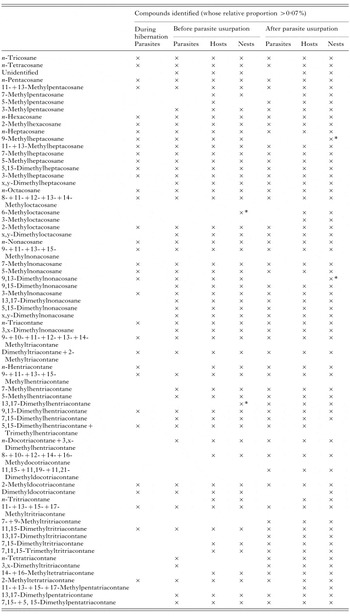
Table 1. List of the compounds identified in the hydrocarbon blends of hosts and parasites (epicuticle) and of nest paper (surface) before and after parasite usurpation
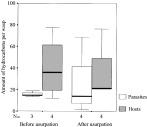
Fig. 1. The total quantities of hydrocarbon (in μg) per wasp before and after host nest usurpation. Box plots show the 75th and 25th percentiles as boxes, the median as thick lines in the box and the 95th and 5th percentiles as vertical lines.
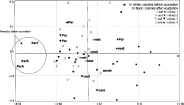
Fig. 2. PCA projections of the three parasites analysed before host nest usurpations (Par1, Par2, Par3), and of colonies 1, 2, 3 and 4 (hosts, nest paper and parasites) both before and after parasite invasion. Hosts from the four colonies are indicated with different symbols between colonies, nest paper as ‘nest’ with the respective colony symbol and parasites as ‘par’ with the symbol of their respective colonies.
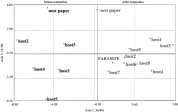
Fig. 3. PCA projections of colony A before (in black) and after (in grey) usurpation. Hosts and nest paper before and after usurpation are separated by the x-axis.
 You have
Access
- 38
- Cited by