Introduction
Spurred by concerns over personal health and nutrition, consumer interest in organic foods has grown rapidly over the past decade. In fact, the US organic food industry grew from just over $1 billion in sales in 1990 to $18.9 billion in 2007 representing 3.3% of total food salesReference Dimitri and Greene1, 2. Consumers generally cite credence characteristics, such as health and environmental concerns, as a primary motivation for organic usage3, Reference Yiridoe, Bonti-Ankomah and Martin4. Credence attributes bundled with commodity specific characteristics, such as taste and freshness, create a market premium for organic foods. Consumer awareness and knowledge about organic food and related attributes impact consumers' attitudes and their willingness to pay a premium. However, complete awareness and knowledge about organic foods does not necessarily mean a consumer will purchase the food, due to other barriers such as price or skepticism of perceived attributes3, Reference Yiridoe, Bonti-Ankomah and Martin4.
An important factor affecting the decision to purchase organic foods is the price premium that consumers must pay for attributes associated with organics and the additional costs of producing organic foods, such as increased input costs, certification costs and lowered yields. High price premiums not only discourage nonusers from entering the organic market, but also keep current users from purchasing more organics. On the other hand, high price premiums may encourage production of organic foods. Therefore, the organic premium is an important market signal, which balances the demand and supply conditions of the organic sector.
Traditionally, studies of organic foods have measured consumers' attitudes and willingness to pay an organic price premium through the contingent valuation method rather than using actual purchase choices. A comprehensive review of literature on consumer perceptions and preferences of organic foods by Yiridoe et al.Reference Yiridoe, Bonti-Ankomah and Martin4 suggested that caution should be exercised when drawing any conclusions from earlier studies with such limited short-term time-series data on willingness to pay a price premium. Although findings from the literature confirm that organic foods command a price premiumReference Wolf5–Reference Maguire, Owens and Simon11, discrepancies in the magnitude vary across products and location. For example, using survey data, WolfReference Wolf5 found that 30% of respondents in California were willing to pay a 50% premium for organically grown grapes, whereas O'Donovan and McCarthyReference O'Donovan and McCarthy6 found that about 70% of Irish consumers were not willing to pay more than a 10% premium for organic meat. Thompson and KidwellReference Thompson and Kidwell7 reported price premiums for organic produce in Arizona ranging from 40 to 175% depending on the type of produce. A focus group discussion of Australian consumers observed that most participants agreed that a price premium for organic food over nonorganic food was justified, but most of them did not know how muchReference Chang and Zepeda12.
According to the Nutrition Business Journal (NBJ)2, of the top five selling organic food categories in 2007, dairy products were second only to fruits and vegetables (16% for dairy and 37% for fruits and vegetables combined). In 2007, organic milk and cream made up 52% of the $3.1 billion US organic dairy market2. According to SPINS, a market research and consulting firm for the natural products industry, dollar sales of organic milk for the 52-week period ending November 3, 2007 increased for gallons, half gallons and quarts by 13.5, 13.2 and 12.2%, respectivelyReference Goldschmidt13. Likewise, Nielsen LabelTrends found that unit volume for refrigerated organic milk grew 18.5% for the 52-week period ending October 6, 2007Reference Goldschmidt13.
The focus of this study is a vital part of the organic dairy market: organic fluid milk, excluding buttermilk and flavored milk. Few empirical studies have investigated the organic price premiums consumers are paying in the market-place when they have a choice between organic and conventional fluid milk (e.g., see Glaser and ThompsonReference Glaser and Thompson8 and Kiesel and Villas-BoisReference Kiesel and Villas-Boas14). The objective of the study is to estimate price premiums and discounts associated with household characteristics, market factors and product attributes, focusing on the organic attribute for fluid milk using actual retail purchases from the 2006 NielsenReference Nielsen15 Homescan panel data.
Data Source
The Homescan panelists constitute a random sample that is representative of the US population and provides purchase information of food items for at-home consumption. Each household is supplied with a scanner device that the panelist uses at home to record grocery items purchased at all retail outlets, ranging from grocery stores, supermarkets, supercenters and club warehouses to natural food and specialty stores, and consumer cooperatives. The household either scans the Uniform Product Code (UPC) or a designated code for random-weight purchases for each food item. Each purchase records the date, the quantity purchased, expenditure for that quantity, promotional information including whether or not the item is on sale, and detailed product characteristics. The focus of this study is to analyze milk purchases with an emphasis on the organic attribute.
Total enrollment in the Homescan panel for 2006 was over 37,000 households, but to avoid would-be data problems resulting from incomplete reporting, only those households that reported purchases for at least 10 months were included. Panelists do not explicitly report prices; they report the total expenditure and the quantity of milk purchased. Prices for organic and conventional milk are derived as unit values—the ratio of reported expenditures, net of any promotional and sale discounts, to the reported quantities for each purchase record. In order to avoid potential problems stemming from inadvertent reporting errors, derived unit values greater than the sample mean plus three standard deviations are considered outliers and thus excluded from the sample.
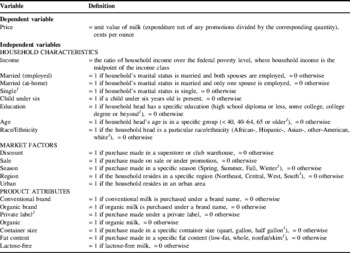
Each purchase record is identified by type (organic, lactose-free or conventional), fat content (nonfat/skim, low-fat, whole or unknown), container size (quart, half gallon, gallon or other), and branding (branded or private label). To categorize milk by fat content, classifications as defined by the US Food and Drug Administration are usedReference Kurtzweil16. ‘Nonfat/skim’ milk has less than 0.5 g of milk fat per cup, ‘low-fat’ milk has less than 4.7 g of milk fat per cup, and ‘whole’ milk has 8 g of fat per cupReference Kurtzweil16. The definition of ‘low-fat’ includes milk labeled as 0.5 to 2% and reduced/low-fat. Purchases recorded as ‘other’ container sizes or ‘unknown’ fat contents are excluded from the analysis (making up 1.6% of total records). Table 1 provides a list of variables constructed from the data to be used in the empirical estimation.
Variables included in the hedonic model, 2006.

1 Reference category.
Source: Nielson Homescan Data, 2006.
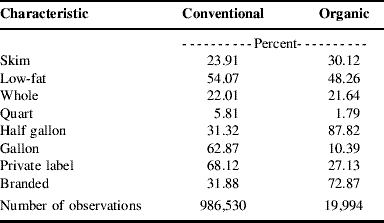
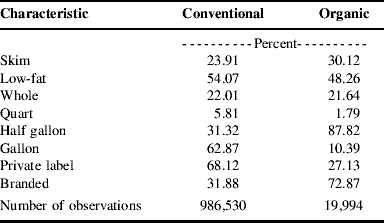
Table 2 shows the percentage of purchases across product characteristics for conventional and organic milk. Low-fat milk makes up the largest proportion of both conventional (54.1%) and organic (48.3%) milk purchases. The percentage of whole milk purchases is about the same for conventional (22%) and organic (21.6%) milk. Organic nonfat/skim milk is bought proportionally more often (30.1%) than conventional nonfat/skim milk (23.9%). However, purchase differences among container sizes across conventional and organic milk are more evident. Conventional milk is bought in gallon containers most frequently (62.9%) and the bulk of organic milk is purchased in half-gallon containers (87.8%). Purchases of organic milk in quarts are rare, making up only 1.8% of total organic purchases, whereas conventional quarts are bought 5.8% of the time. Likewise, gallon purchases of organic milk are also low (10.4%). The findings across container size are not surprising. Other studies have also found that organic milk is largely available only in half gallon containersReference Glaser and Thompson8, Reference Grebitus, Yue, Bruhn and Jensen17, whereas conventional milk is sold in a variety of container sizes. Percent of private label sales for organic milk were noticeably lower (27.1%) than conventional milk (68.1%) in 2006. Dimitri and VeneziaReference Dimitri and Venezia18 found that in 2004 only 10% of organic milk was purchased under a private label, underlining the inroads private labels are making in the organic industry2.
Percent of purchases by product characteristics, 2006.
Source: Nielsen Homescan, 2006.
Methodology
A limitation of the neoclassical theory of consumer demand is its inability to explain why consumers derive utility from commodities as well as its inability to predict demand for new products. Realizing the weaknesses of the neoclassical approach, LancasterReference Lancaster19 proposed the characteristics theory to address some of the inherent limitations found in the neoclassical demand theory. The characteristics theory assumes that consumers derive utility from the characteristics or attributes inherent in a good or service. It is the intrinsic properties of a particular good that make it different from other goods that, in some instances, may be quite similar. The model developed by LancasterReference Lancaster19 makes several modest assumptions. It is not the good itself that gives rise in utility to the consumer, but the characteristics within the good. In general, it is assumed that a good possess more than one characteristic and that many characteristics will be shared by more than one good. And finally, goods in combination may create characteristics completely different than those pertaining to the goods separately.
Agricultural economists have expanded Lancaster'sReference Lancaster19 theory to develop hedonic approaches that model price as a function of quality attributes to estimate the implicit values of product characteristicsReference Ladd and Suvannunt20–Reference Ladd and Martin22. Hedonic modeling relies on the assumption that the price of a product must be low enough relative to the prices of other products to be represented on the efficiency frontierReference Lancaster19. The theory states that the price of a product is a function of all its associated attributes z,

so that the marginal implicit values of the product's attributes sum up to the price paid by the consumerReference Ladd and Suvannunt20. The amount of attributes demanded by the consumer must be met by the amount supplied by the producerReference Rosen21. This implies that both consumers and producers distinguish product attributes approximately the same way and that the decisions made by each group leads to an equilibrium condition that neither consumers nor suppliers have any incentive to changeReference Huang and Lin9.
Given the nature of Homescan data that may contain multiple observations from the same household, the error terms are likely clustered-correlated and not independently distributed. Thus, the covariance estimates obtained from applying the standard ordinary least squares estimation are likely biased, which would yield inappropriate standard errors and misleading tests of statistical significanceReference Brogan23. The error terms in the hedonic price equation are assumed to be cluster-correlated. To estimate the hedonic equation, the Stata24 program's family of commands designed for survey data is used, which performs the regression procedure via the weighted least squares for survey data. Therefore, the price of milk, Pi, in the hedonic model is specified as
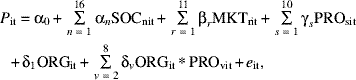
where P it is the price of milk paid by the ith household in time t; SOCit represents a household's socio-demographic characteristics; MKTit represents a set of market factors such as type of store, on sale occasion, season, region and location (urban) of purchase; PROit represents product attributes such as container size, fat content, branding and the lactose-free attribute; ORGit represents the organic attribute of milk, and e it is the error term. Interactive terms between organic purchases and selected product attributes are included to allow for price differentiation among the two types of milk.
The hedonic price model represents a reduced-form equation reflecting both the supply and demand influences simultaneously. Unfortunately, there is no rule-of-thumb for choosing the appropriate functional form a priori in regression analysis. Thus, the choice of the functional form remains an empirical issue. Due to its ease of interpretation and previous application to hedonic pricing structures for organic foodsReference Lin, Smith and Huang10, Reference Maguire, Owens and Simon11, Reference Kiesel and Villas-Boas14, the linear functional form is chosen.
Results
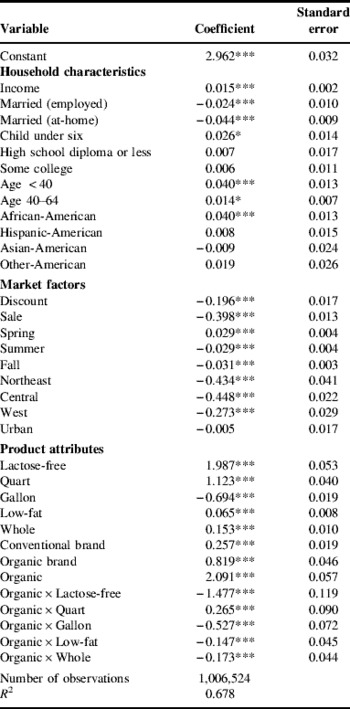
As shown in Table 3, the R-squared, a measure of goodness-of-fit, is 0.678 implying that about 68% of the variation in price is explained by the independent variables. Given that cross-sectional data are used, the reported R-squared is quite high and is deemed satisfactory. The coefficients represent a change in price (cents/ounce) relative to the reference group (conventional, private label, half gallon, nonfat/skim milk, purchased in the winter, in a southern rural area, not on sale or sold in a discount store). Overall, the estimated coefficients appear to be reasonable in magnitude and satisfactory in terms of statistical significance.
Hedonic price results of fluid milk, 2006.

Source: Nielson Homescan Data, 2006.
Note: *** and * indicate the estimated coefficients are significantly different from zero at least at the 1 and 10% significance level, respectively.
From Table 3, we can see the household characteristics exert less influence on the price of milk in terms of both statistical significance and magnitude relative to market factors and product attributes. However, some interesting findings do appear. For example, higher-income households had a higher willingness to pay for milk, possibly due to the correlation between income status and the quality of shopping venue and product offering. Our finding is consistent with Thompson and KidwellReference Thompson and Kidwell7, who found that higher household income increases the probability that a household will choose to shop at a specialty grocery store, which tends to maintain higher prices on average.
We also found that married households tended to pay less for milk, particularly those that have an unemployed spouse at home, compared with single households. Likewise, households with a child under six paid slightly more than those without. Kiesel and Villa-BoasReference Kiesel and Villas-Boas14 suggested that single mother households and households with children under the age of six have higher opportunity costs of time, and are therefore more likely to benefit from informational effects of USDA labeled organic milk. Similarly, Wier et al.Reference Wier, Jensen, Andersen and Millock25 concluded that households with children under six, rather than households with children in general, are more likely to purchase organic foods.
With regard to the remaining household characteristics, we found no significant relationship between educational attainment and the price paid for fluid milk. Likewise, only African–Americans were found to pay a significantly higher price than other races/ethnicities. Age of the household head was negatively correlated to willingness to pay for milk—younger households paid more than older households.
All market factors are significantly different from zero at the 1% significance level, with the exception of ‘Urban’. As expected, milk sold at a discount store or on sale was priced significantly lower. Milk sold at a discount store (i.e., supercenter or club warehouse) was priced 0.20 ¢/oz. (13 cents per half gallon) less than milk sold through other venues, such as a grocery store, equivalent to a 7.4% price differential. Specialty chain grocery stores are recorded in the same category as all other grocery stores in Homescan. Moreover, milk on sale was discounted 0.40 ¢/oz. (26 cents per half gallon), or 14.3% below the average regular price.
Dairy farmers in the US are paid a relatively uniform price under Federal Milk Marketing Orders according to their marketing area26. Federal Milk Marketing Orders insure a minimum price calculated on a monthly basis that the buyer, or handler, must pay the dairy farmer. To control for these monthly price variations across marketing areas, seasonal and regional variables are included in the model. Average monthly prices given to dairy farmers in dollars per hundredweight reflect the estimated seasonal and regional variation in 200627.
As anticipated, prices vary by season in a regular and cyclical way, representing the smallest variation among all market factors. Estimated prices of milk in the spring were 0.03 ¢/oz. more than those in the winter, but were 0.03 ¢/oz. less in the summer and fall. Estimated results for regional prices are consistent with previous researchReference Leibtag28, in which milk prices are significantly higher in the south as compared with the rest of the US and at their lowest in the central region. LeibtagReference Leibtag28 found that consumers in rural areas pay lower average prices for milk than those in urban areas, but we found no significant price difference. A possibility is that urban consumers purchase milk in smaller containers, whereas rural consumers may purchase milk in larger containers, thus leading to lower calculated average prices. However, our model controls for other factors such as container size, resulting in insignificant price differences between urban and rural households.
Product attributes such as the lactose-free attribute, container size and fat content all significantly affect the price of milk. As expected, consumers paid a large premium of about 2 ¢/oz. for lactose-free milk, due to the increased manufacturing costs of removing lactose. As with most goods, purchasing products in bulk packaging, or in this case—larger container size, carries a price discount. In contrast, the price of milk increases with fat content. Both the price of low-fat and whole milk was more than that of nonfat/skim milk, 0.07 and 0.15 ¢/oz., respectively. This is because milk fat, or butterfat, has a market value so that consumers have to pay a premium for the increased fat content.
Not surprisingly, the price of branded conventional and organic milk carried a premium over private label milk. However, differences in magnitude between the two types of milk appear. For example, branded conventional milk carried a premium of 0.26 ¢/oz. (about 15% above conventional private label half gallons), whereas branded organic milk carried a premium of 0.82 ¢/oz (about 26% above organic private label half gallons). In addition to the premiums associated with branded organic milk, the organic attribute itself carried the largest and significant price premium of 2.09 ¢/oz. The results suggest that consumers purchasing organic milk are willing to not only pay the large organic premium but also pay a larger ‘brand’ premium for organic versus conventional. The larger ‘brand’ premium for organic milk implies that consumers place a higher value on branded organic milk compared with branded conventional milk over their private label counterparts. Grebitus et al.Reference Grebitus, Yue, Bruhn and Jensen17 found that milk consumers in Germany were influenced by the brand of organic milk more so than the brand of conventional milk, leading them to believe that consumers may use certain brands as a cue for the credence attribute ‘organic’.
By allowing the organic attribute to interact with the lactose-free attribute, fat content and container size in our hedonic model, additional changes in price corresponding to each product attribute can be tested. The estimated negative coefficient for organic lactose-free milk (Organic×Lactose-free) suggests that when the organic and lactose-free attributes are packaged together, the bundled premium is smaller than the sum of the two individual premiums. This may be due to the fact that consumers are already paying a large organic premium and may not be willing to pay an additional high premium for the lactose-free attribute. Additionally, the organic milk industry, through economies of scale, may be attempting to capture more sales by offering the lactose-free attribute at a much lower marginal price premium than when sold as nonorganic. Nevertheless, lactose-free carries a price premium among organic milk.
As indicated in Table 3, the container size of organic milk further affected price. Price premiums and discounts associated with container size were ‘stretched’ or ‘inflated’ when sold as organic. For example, organic milk sold in quarts had an additional price premium of 0.27 ¢/oz. equating to a total price premium of 1.39 ¢/oz. above that of a half gallon. However, the opposite was true for organic milk sold in gallons, in which the total price discount equated to 1.22 ¢/oz. relative to an organic half gallon. Because organic milk carries such a high price premium due to additional production costs, we would expect the price premiums and discounts related to container size to be inflated per ounce.
Additional changes in price for organic milk associated with fat contents were also found. Contrary to the findings for conventional low-fat milk (0.07 ¢/oz. premium above conventional nonfat/skim), the negative coefficient for the interactive term between organic and low-fat (Organic×Low-fat) suggested that organic low-fat milk had a price discount of 0.08 ¢/oz. compared with organic skim/nonfat milk. Similar findings were also found for organic whole milk (0.02 ¢/oz. price discount over organic nonfat/skim). It is plausible that households pay the highest premium for nonfat organic milk because consumers with concerns about individual health and nutrition have been found to be more likely to purchase organic foodsReference Harper and Makatouni29, Reference Wier and Anderson30. The presence of butterfat in low-fat and whole milk may be viewed by the organic milk consumer as an unhealthy food choice, and thus, they are willing to pay an additional premium for the nonfat product.
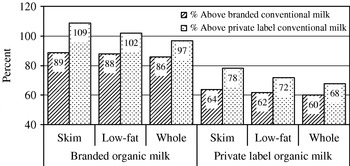
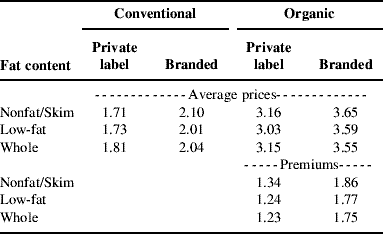
Because organic milk is predominantly sold in half gallons and such stark differences emerge between conventional and organic branding, the remainder of the discussion focuses on these types of milk. Table 4 presents average half-gallon prices and organic premiums in terms of dollars per half gallon. Holding household characteristics and market factors constant, the organic premium in absolute value is calculated by adding the relevant estimated coefficients for organic milk found in Table 3. For example, the organic premium for a half gallon of branded low-fat milk is 2.76 ¢/oz., or $1.77 per half gallon. Previous studies using the contingent valuation approach typically report organic price premiums as a percent above conventional prices instead of absolute dollars and cents, in order for respondents to report their willingness to pay for organic food in relative terms. To be consistent with the literature for comparison, the premiums as a percentage above the average actual prices of conventional milk found in Table 4 are reported in Figure 1. Therefore, the $1.77 per half-gallon premium is about 88% above the average price paid for its conventional branded counterpart and about 102% above its conventional private label counterpart.
Price premiums: half gallon of organic milk. Note: premiums reflect the percent above their respective average actual half gallon conventional milk prices within each fat content category found in Table 4. Source: Nielsen Homescan, 2006.

Average half-gallon prices and associated premiums in dollars per half gallon, 2006.
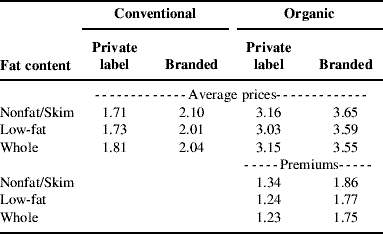
Note: All prices are in dollars per half gallon. Average prices were constructed using the Nielsen projection factor. Premiums are calculated using estimated coefficients from Table 3 and inflated by 64 ounces.
Source: Nielsen Homescan, 2006.
The results depicted in Figure 1 clearly indicate the price differences in branded and private label organic milk. The premiums for branded organic milk range from 86 to 109% above conventional prices and are wholly above the premiums for private label organic milk, which range from 60 to 78%. Previous studies on the determinants of milk consumption have found that consumers are habitual in their milk purchasing patterns and are reluctant to shift from their usual type of milk in terms of fat contentReference Tourila31, Reference Saba, Moneta, Nardo and Sinesio32. Therefore, Figure 1 can be thought of as a representation of premiums paid by consumers switching from conventional to organic within their preferred fat content category. However, our estimated organic premiums on milk seem much higher than those reported on fresh fruits and vegetables. Lin et al.Reference Lin, Smith and Huang10 estimated that price premiums for organic produce vary from 20% for grapes to 42% for strawberries and from 15% for carrots and tomatoes to 60% for potatoes. The high premium on organic milk relative to organic produce is to be expected because it reflects not only the higher cost of organic feed but also the costs of a more labor-intensive production process.
The estimated organic premiums for milk found in this study are slightly higher than that of Glaser and Thompson'sReference Glaser and Thompson8 study, but seem in agreement with that of Dhar and Foltz'sReference Dhar and Foltz33 study that showed the price differences between organic and unlabeled milk averaged about $3.00 per gallon, or about 123% above unlabeled milk, from 1997 to 2002. Glaser and ThompsonReference Glaser and Thompson8 found that a half gallon of organic milk was priced between 66 and 72% above conventional private label milk and between 50 and 63% above conventional branded milk. The lower estimated premiums of Glaser and ThompsonReference Glaser and Thompson8 may be linked to their data source that is limited to supermarket chains from November 1996 to December 1999. Considering the fact that 67% of organic sales in 1998 occurred in natural food stores34 which typically command higher prices than supermarkets, they could have very well underestimated the premiums. Estimated organic premiums presented in this study may give a more accurate representation of purchases being made in the current milk market as they represent all retail markets.
Conclusions
This study estimated a hedonic pricing model to investigate price premiums and discounts associated with household characteristics, market factors and product attributes for fluid milk. Most notably, the organic attribute carried a large and significant premium. Furthermore, additional price variation associated with container size and fat content occurred for organic milk over its conventional counterpart. Estimated organic premiums across fat contents and branding for half gallon milk ranged from about 60 to 109% above their respective conventional prices. On the supply side, a larger premium for organic milk relative to other organic foods, such as fresh produce, is reasonable and can be justified since organic milk requires higher production costs. On the demand side, consumers are willing to pay such large premiums for organic milk because of perceived health and environmental benefits from organically produced foods, as well as other quality attributes, such as freshness and taste3, Reference Yiridoe, Bonti-Ankomah and Martin4. These attributes demanded by the consumer must be supplied by the producer in such a way that the decisions made by each group leads to an equilibrium conditionReference Huang and Lin9, Reference Rosen21.
Milk free of the genetically engineered hormone somatotropin (known as rBGH- or rBST-free milk) has been demanded by some consumers, especially, those who are health conscious. Organic milk is also free of genetically modified ingredients, as well as other attributes such as being pesticide and antibiotic free. Previous studies have found that rBST-free labeled milk affects consumption of organic milk and such labels also carried a premiumReference Kiesel and Villas-Boas14, Reference Dhar and Foltz33. However, the Homescan data do not code for rBST-free labeled milk. To identify rBST-free milk, Kiesel and Villa-BoasReference Kiesel and Villas-Boas14 linked the Homescan data to secondary data sources that provide rBST-free labeling information at the brand level. Dhar and FoltzReference Dhar and Foltz33, on the other hand, used the Information Resources Inc (IRI) supermarket scanner data to identify brands of milk labeled as rBST-free and organic through interviews with processors and retailers. Moreover, previous studies have found that other product characteristics not available in the Homescan data, such as freshness, taste and quality, significantly affect purchases of milkReference Tourila31, Reference Saba, Moneta, Nardo and Sinesio32. It would be of interest for future research to link these additional consumer preferences to actual purchase data.
Given the relatively low availability of organic milk in a variety of container sizes, it might be of interest for organic milk suppliers to consider giving the consumer more container size options. Studies have shown that organic milk is a ‘gateway food’ and is one of the first organic foods that consumers purchase before entering the organic food realmReference Demeritt35. By increasing purchases of organic milk, it may bolster the organic food industry as a whole.
Additionally, studies have shown that some consumers may use certain brands of organic milk as a cue for the organic credence attributeReference Grebitus, Yue, Bruhn and Jensen17. However, as the organic market continues to mature and consumers become more familiar with other cues, such as the USDA organic seal, the market potential for organic private labels increases. The large price premium between private label and branded organically produced milk could help local venues and retailers capture some of the booming organic trend. In fact, private label sales of organic milk are already eating away at sales of branded organic milk. In 2004 according to NielsenReference Nielsen15 Homescan data, private labels made up just 10% of all organic milk purchases, while two major brands of organic milk made up 80%Reference Dimitri and Venezia18. However, the results of Nielsen'sReference Nielsen15 2006 data show that the percentage of private label purchases has increased to over 27%. In contrast, private label sales of conventional milk have increased only slightly from 64% of purchases in 2004Reference Dimitri and Venezia18 to just over 68% in 2006. This market growth is consistent with our finding that organic premiums are higher for branded milk than for private label milk.
Acknowledgements
This study was supported by USDA-ERS Cooperative Agreement No. 43-3AEM-5-80043. The views expressed in this study are those of the authors, and do not necessarily reflect those of the US Department of Agriculture. Further, the authors would like to thank two anonymous reviewers for their very helpful comments.