Introduction
Disease and non-battle injuries (DNBIs) have often resulted in higher lost person-days when compared to combat injuries in many conflicts throughout history.Reference Eastridge, Hardin and Cantrell 1 - Reference Blood and Jolly 3 The hospital resources needed for DNBIs often exceed those needed for combat injuries.Reference Blood and Jolly 3 - Reference Sanders, Putnam and Frankart 7 Disease and non-battle injuries have had a large impact on both Operation Iraqi Freedom (OIF; 2003-2011) and Operation Enduring Freedom (OEF; 2001-2014) and serve as a large category of evacuations from both operations.Reference Sanders, Putnam and Frankart 7 - Reference Mahomed, Motara and Bham 10
Previous studies describing emergency care in a combat zone have primarily focused on trauma care.Reference Eastridge, Hardin and Cantrell 1 , Reference Eastridge, Mabry and Seguin 2 There are few published studies that have described the DNBIs in the combat US emergency department (ED). Similarly, in other austere settings such as humanitarian efforts, non-traumatic diseases have not been extensively studied. Furthermore, there are few studies that report on the specific procedures, drugs, and diagnostic studies needed in these settings.Reference Bonnet, Bertani and Savoie 11 - Reference Skeehan, Tribble and Sanders 13 According to the Army Medical Department Center and School (Fort Sam Houston, San Antonio, Texas USA), the military health system in the combat environment is organized into four roles of care. Role 1 is point-of-injury care provided by various providers directly on the battlefield and/or Battalion aid stations. Role 2 care is a higher level of care compared to Role 1, but has limited inpatient bed spaces and limited advanced workup capabilities. Typically, patients who can return to duty within 72 hours can be held for treatment at a Role 2 facility. Role 3 facilities can provide hospitalization for hundreds of patients and have outpatient services for patients in theater. Role 4 medical care is provided at safe haven facilities such as the major hospitals located on US soil. Role 3 and Role 4 facilities resemble many civilian institutions and have extensive emergency medical care capabilities, sub-specialty availability, surgical capabilities, as well as many outpatient services.
Emergency physicians (EPs) have played a central role in medical care delivery in OIF and OEF. In many cases, an EP is in a unique position with the breadth of training to allow for both trauma and medical emergency management. In order to plan for future military operations and properly train physicians, the common DNBIs and complex medical procedures performed should be better understood.
The objective of this study was to describe DNBIs seen at a tertiary combat hospital and identify the types of procedures, medications, and dispositions that played a role in the management of these cases. This information can lead to a better understanding of injuries and illnesses encountered while deployed, which can help improve pre-deployment training and combat hospital readiness.
Methods
This observational study was approved by the Wilford Hall Medical Center Institutional Review Board (Lackland Air Force Base, San Antonio, Texas USA). From January 2007 to January 2008, using a convenience sample, all patients diagnosed with a DNBI by an EP at the ED of a US military tertiary hospital in Iraq were enrolled. The treating EP used a standard data collection form designed for the study to enroll the patients and record the pre-defined data points. Study collection forms did not include subject name, social security number, date of birth, or other data considered as patient identifiers.
The age of the patient, time of visit, diagnoses, diagnostic testing, emergency procedures, medications, and disposition were recorded. Subject disposition following evaluation by the EP to specify transfer to the intensive care unit (ICU), ward, operating room (OR), or discharge from hospital was annotated. All the subject data were transcribed onto a password-protected electronic database (Microsoft Access, 2010; Microsoft Corp.; Redmond, Washington USA).
The data were exported to Excel (Microsoft Corp.) and were subsequently analyzed using JMP version 10 (SAS Institute Inc.; Cary, North Carolina USA). Descriptive statistics of all variables of interest were generated.
Results
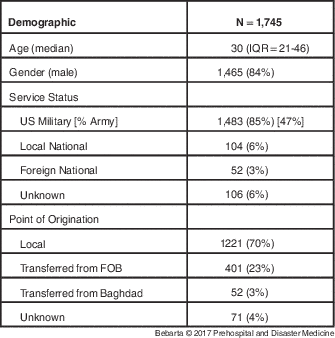
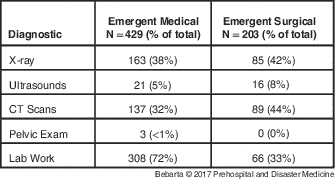
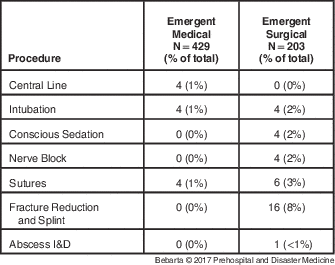
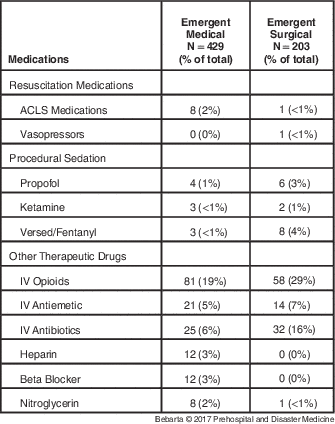
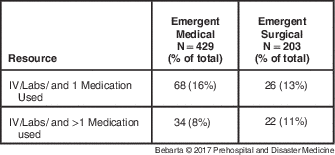
In this study, 1,745 patients were enrolled, 1,465 (84%) were male and most (1,483 [85%]) were US military members. Most patients (1,221 [70%]) were patients from the immediate area, and 453 (26%) patients were transferred from other facilities (Table 1). There was a mix of emergent surgical (appendicitis, cholecystitis, bowel obstruction, peritonsillar abscess, fracture, dislocation, penetrating injury, eye trauma, and brain injury) and emergent medical diagnoses (aortic dissection, meningitis, overdose, pulmonary embolism, gastrointestinal bleeding, acute myocardial infarction, chest pain, and atrial fibrillation). For the emergent diagnosis, 248 x-rays, 37 ultrasound studies, and 226 computed tomography scans were performed. Three hundred seventy-four of the emergent diagnosis made involved lab work (Table 2). In references to procedures, four central lines, eight intubations, four conscious sedations, four nerve bocks, 10 laceration repairs, and 16 fracture reductions were performed for the 632 total emergent diagnoses (Table 3). Different medications were used for resuscitation and analgesia; nine cases required use of Advanced Cardiac Life Support (ACLS) medications and one case required vasopressors. Sedation was performed using medications such as propofol, ketamine, and fentanyl/versed in 26 cases. Opioids were used in 139 cases, antiemetics in 35 cases, antibiotics in 57 cases, heparin in 12 cases, beta blockers in 12 cases, and nitroglycerin in nine cases (Table 4). Several cases required the use of intravenous and laboratory work (Table 5).
Summary of Demographics of the Patients Treated for DNBI

Abbreviation: DNBI, disease and non-battle injury; FOB, Forward Operating Base.
Summary of the Diagnostics Performed on Patients Treated for DNBI

Abbreviation: DNBI, disease and non-battle injury.
Summary of Clinical Procedures Performed on Patients Treated for DNBI

Abbreviation: DNBI, disease and non-battle injury.
Summary of the Medications Used in the Management of Patients Treated for DNBI

Abbreviations: ACLS, Advanced Cardiac Life Support; DNBI, disease and non-battle injury; IV, intravenous.
Summary of the Resources Used in the Management of Patients Treated for DNBI

Abbreviations: DNBI, disease and non-battle injury; IV, intravenous.
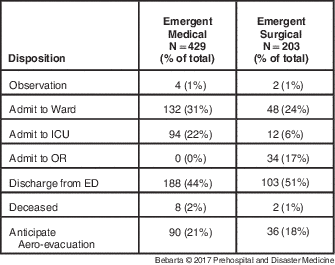
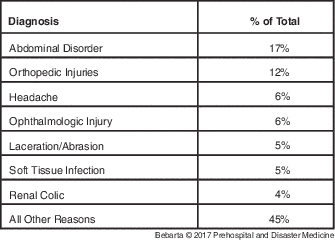
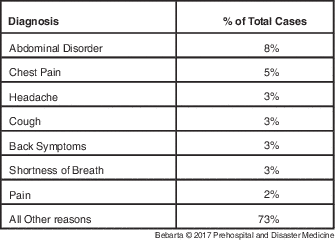
Of the emergent cases, six were observed in the ED, 181 were admitted to the ward, 107 were admitted to the ICU, 35 went to the OR, and 10 deceased. Of these patients, 126 were anticipated to be evacuated from theater (Table 6). Abdominal disorders composed 17% of cases encountered, orthopedic injuries at 12%, headache at six percent, ophthalmologic injury at six percent, lacerations at five percent, soft tissue infection at five percent, and renal colic at four percent (Table 7). This is different compared to the reported complaints encountered in the US per the Centers for Disease Control and Prevention (CDC; Atlanta, Georgia USA) where eight percent of cases were abdominal disorders, five percent chest pain, three percent headache, three percent cough, three percent back symptoms, three percent shortness of breath, and two percent pain (Table 8).
Summary of the Dispositions of the Patients Treated for DNBI

Abbreviations: DNBI, disease and non-battle injury; ED, emergency department; ICU, intensive care unit; OR, operating room.
Summary of the Most Common Diagnosis Encountered in the ED in Theater

Abbreviations: ED, emergency department.
Summary of the Most Common Diagnosis Encountered in EDs in the US (2011)

Note: Data obtained from cdc.gov.
Abbreviation: ED, emergency department.
Discussion
This study shows data that may contribute to improvements in the delivery of health care abroad. Many DNBIs were treated in the ED. This included a variety of medical and surgical diagnoses and involved the use of different medications, diagnostic imaging, and advanced procedures. In prior studies, a myriad of non-combat-related toxic exposures has been reported.Reference Maddry, Ng and Sessions 14 Combined, these studies highlight the importance of understanding the fundamentals of emergency medicine to include toxicology, poisonings, and chemical exposures in the deployed setting. 15
Blood et al in a 1995 article described the daily admission rate of DNBIs during operations in Korea, Vietnam, Japan, and Falklands.Reference Blood and Jolly 3 Like in this study, Blood et al reported that there was a significant number of DNBIs encountered at facilities during these operations.Reference Mahomed, Motara and Bham 10
In addition to the article by Blood et al, an article by Belmont et al in 2010 reported that 77% of casualties sustained by a US Army Brigade Combat Team during OIF were from DNBIs. Seventy-four percent of the DNBIs were secondary to musculoskeletal injuries and psychiatric disorders. This is in contrast to these data which do not reveal psychiatric disorders as a significant portion of DNBIs. At this point, it is unknown if this inconsistency is secondary to policy, sampling bias, or confounders. Prior studies have noted that psychiatric disorders are typically a significant portion of DNBIs encountered in theater.Reference Belmont, Goodman and Waterman 9 Given this large contrast between those prior studies and the data in this study, it is certainly an area that warrants future investigation to understand if this discrepancy in findings is secondary to effectiveness of increased Department of Defense (DoD; Arlington, Virginia USA) support for psychiatric well-being, if the differences are regional, or if the cases in this area were not captured in the ED convenience sample of this study. These are important considerations when designing future studies to further understand the impact of DNBIs.
Non-combat-related musculoskeletal injuries are described by Miller et al. In 2011, Miller et al reported on 328 non-combat-related hand injuries encountered in Baghdad from 2007-2009. The authors reported on the rates and general categories of the DNBIs encountered. They did not detail the types of procedures performed, dispositions, or medications used in those cases.
As seen, DNBIs pose a significant impact on health care abroad. Training on the management of DNBIs should be emphasized for physicians in a combat environment. Special attention should be given to the most common chief complaints that one may encounter in theater (Table 7). The list of the most common chief complaints seen in theater differ compared to a list of the most common complaints seen in US EDs (Table 8). Five hundred six (29%) were abdominal disorders and musculoskeletal complaints. These complaints contributed to 11% (abdominal/muscuolosketal) of cases seen in US EDs, as reported by the CDC.
Further meaningful comparisons between cases seen in theater versus US EDs are limited, particularly because the majority of cases per the CDC report are listed as “Other.” Further details on the proportions of specific complaints that were included into this category are important in truly comparing and contrasting the two data sets. Information on DNBIs and cases seen in the US has implications on the type of training that the emergency medicine providers should undertake before deployment. Additionally, this information can help guide how the EDs in theater are stocked. Given the limitations in storage and supplies, it is important to stock the EDs strategically in anticipation of the types of diseases that are most likely to be encountered and which medications are commonly used. For example, in theater a higher proportion of musculoskeletal/orthopedic disorders as compared to what is typically encountered in the US is expected. In anticipation for this, EDs in theater may benefit from more equipment related to musculoskeletal complains, such as crutches and immobilization equipment.
Further studies are needed to better understand DNBIs. Using data from the Congressional Research Service (Washington, DC USA), there were approximately 31,000 combat-related injuries in Iraq during this time period. Comparing that to the data in this manuscript, DNBIs consisted of approximately five percent of the cases encountered during the study period. However, some DNBIs managed during the study period were not captured. This is particularly true of the psychiatric-related cases. During the study period, most of the patients with isolated psychological illnesses or complaints were handled directly by Combat Stress Team (CST) – neurologists, psychologists, psychiatrists, and technicians dedicated to that mission. The patients often came through a separate door, or when they arrived to the ED, the CST team was called immediately to evaluate them in their “clinic” (ie, tent). A future study that involves a real-time database for collecting data on DNBIs, including data on psychiatric complaints, may be beneficial. This may allow for more detailed and more comprehensive tracking of diseases, injuries, medications, and procedures seen in theater. A better understanding of DNBIs would allow opportunity for process improvement, future planning, and detection of emerging illnesses or exposures. The database may include real-time information to help understand what resources are available or are needed in theater. This data could then be used to refine the training of EPs, nurses, and technicians in military combat or civilian humanitarian efforts in real-time and complement what is already known about diseases encountered in the deployed setting.Reference Skeehan, Tribble and Sanders 13 - Reference Gerhardt, De Lorenzo and Oliver 16
Limitations
This study has several limitations. One limitation is the use of a convenience sample. Although the study intended to capture all DNBIs, the dynamic environment of a combat hospital limited obtaining all DNBIs in the area. There was no system to capture patients if the provider did not complete the questionnaire or if the patient used other medical resources available. Physicians attended briefings on completing the questionnaire at the beginning of different rotations, but standardizing and following through with data collection was limited. Additionally, there was subjectivity in categorizing whether or not a diagnosis was urgent or emergent. The data collection form asked the provider to make this classification, but there was no standardized definition on what urgent versus emergent was. The subjectivity of making this classification needs to be addressed in future studies.
Another limitation is that there was no process to verify that the procedures that were recorded were actually performed or if the medications that were recorded as used were actually administered. In addition, because no patient identifiers were used, duplication errors may have occurred.
One must also consider that this study took place over one year. It represents a snapshot of what was encountered during this military effort. A longer study period may reveal that other DNBIs may actually be more common than what is reported in this study. Additionally, the data collected were from one hospital. Different hospitals in other environments may have a different set of chief complaints with different frequencies. This brings the generalizability of these data into question. However, because this hospital treated military members, civilian contractors, and local residents, the applicability to other military and humanitarian settings may be feasible.
Another item to consider is the military population in general. In order to qualify for military service, members must meet certain physical fitness standards, and are not limited by any duty-limiting conditions. Typically, candidates undergo an in-processing medical and mental evaluation and cannot proceed unless cleared. This process may filter out individuals with any pre-existing conditions and thus can have implications on the cases of DNBIs seen in theater where a large number of patients are active duty military members that have gone through this screening process.
In these data sets, the percentage of cases coming from each of the patient populations encountered (ie, DNBIs in the military versus foreign national versus local national population) was not characterized. These data would be useful to further characterize what is seen in theater and if there are specific things unique to certain populations that the provider needs to be aware of. In future studies, it would be important to analyze any of these differences.
Lastly, the demographics of this study population show that males were predominantly treated. There are many emergent diagnoses that are specific to women that the ED provider must be prepared to manage. Further studies obtaining data to characterize female-specific diagnoses are needed so that physicians and facilities can be adequately prepared.
Conclusion
In this study, life-threatening DNBIs were managed in a tertiary combat hospital ED in Iraq during the study period. Providers used advanced medication, performed procedures, and used advanced diagnostics in them management of DNBIs.
Acknowledgements
The authors thank Dr. Robinson Ferre, Dr. James Eadie, and the other emergency physicians deployed to Iraq during this study period with efforts on patient enrollment. They also thank Ms. Rebecca Pitotti for her efforts in organizing the data and creating the data base.