Introduction
Chickpea is considered a very important nutritious crop for people in the Western Himalayas of Jammu and Kashmir. Therefore, efforts have been made by us to procure large collections of chickpea germplasm from various national/international institutions followed by their morpho-molecular characterization and gene mapping for nutritional traits, flowering, seed coat colour, biotic and abiotic stresses (Fayaz et al., Reference Fayaz, Rather, Wani, Tyagi, Pandey and Mir2019, Reference Fayaz, Mir, Tyagi, Wani, Jan, Yasin, Iqbal, Mondal, Khan and Mir2021, Reference Fayaz, Tyagi, Wani, Pandey, Akhtar, Bhat, Chitikineni, Varshney, Thudi, Kumar and Mir2022; Ortega et al., Reference Ortega, Hecht, Freeman, Rubio, Carrasquilla-Garcia and Mir2019; Sivasakthi et al., Reference Sivasakthi, Marques, Kalungwana, Carrasquilla-Garcia, Chang, Bergmann and Penmetsa2019; Mir et al., Reference Mir, Bhat, Dar, Sofi, Bhat and Mir2021). In the present study, efforts were made to characterize a set of genotypes for seed physical characteristics for the first time in the Kashmir Valley. Seed physical characteristics are considered important for storage, processing, milling and marketing (Ramasamy and Harte, Reference Ramasamy and Harte2009; Sastry et al., Reference Sastry, Upadhyaya and Srinivas2019). The quality of chickpea is essentially determined by several factors including physico-chemical characteristics and cooking quality (Patane et al., Reference Patane, Iacoponi and Raccuia2004). A longer cooking time consumes more fuel and causes loss of nutrients thus limiting the use of dry grain as a food in developing countries (Barampama and Simard, Reference Barampama and Simard1995). The acceptability characteristics, which are strongly associated with the physico-chemical properties of the product, have not received enough attention in breeding programmes (Reyes-Moreno et al., Reference Reyes-Moreno, Okamura-Esparza, Armienta-Rodelo, Gomez-Garza and Milán-Carrillo2000). A strong correlation was observed between water absorbed and texture of the cooked cowpeas (Vigna unguiculata) at room temperature (Sefa-Dedeh and Stanley, Reference Sefa-Dedeh and Stanley1979), the hydration coefficient and cooking ability index in faba bean (Vicia faba) (Youssef et al., Reference Youssef, Bushuk, Murray, Zillman and Shehata1982) and swelling capacity and hydration capacity related to cooking time in chickpea (Williams et al., Reference Williams, Nakoul and Singh1983). The weight, volume and density of seeds are important qualitative traits influencing cooking quality (Waldia, Reference Waldia1996; Mehla et al., Reference Mehla, Waldia and Dahiya2001) suggesting that a selection among populations on this basis would lead to a useful reduction in cooking time. Hence, it becomes essential to study the seed qualitative/physical traits of chickpea in the present study, which in turn determines the cooking properties.
Experimental details
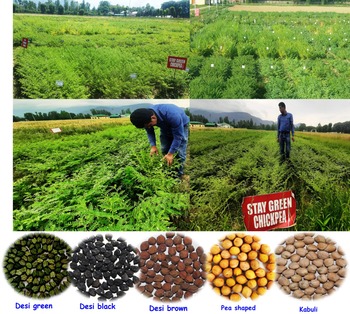
The experimental assessment of variability for seed qualitative traits in a set of 35 chickpea genotypes (for details see online Supplementary Table S1) was conducted at the Sher-e-Kashmir University of Agricultural Science and Technology of Kashmir (SKUAST-K), Jammu and Kashmir, India during 2017. The 35 genotypes included 17 desi green genotypes, seven desi brown, two desi black, three pea-shaped genotypes and six kabuli genotypes (Fig. 1). The qualitative/physical traits including seed weight, seed volume, seed density, hydration capacity, hydration index, swelling capacity and swelling index of the seeds of these genotypes were recorded following Khattak et al. (Reference Khattak, Khattak, Mahmood, Bibi and Ihsanullah2006). Three random samples of 100 seeds from each cultivar per replication were weighed. Seed volume was determined by the water displacement method. Seed density was calculated as seed weight (g) divided by seed volume (ml). Hydration capacity was recorded as gain in weight (g) after overnight soaking in distilled water. The hydration index was calculated as the hydration capacity divided by the original seed weight (g). The swelling capacity was determined as gain in volume (ml) after overnight soaking in water, and the swelling index was calculated as the swelling capacity divided by the original seed volume (ml) (for details see Khattak et al., Reference Khattak, Khattak, Mahmood, Bibi and Ihsanullah2006). The descriptive data were statistically analysed using MS-Excel 2010, and the data are presented as the means ± S.D. of three independent determinations.
Field view of chickpea trials at Faculty of Agriculture (FoA), Wadura, SKUAST-Kashmir and different seed types evaluated during the present study.

Discussion
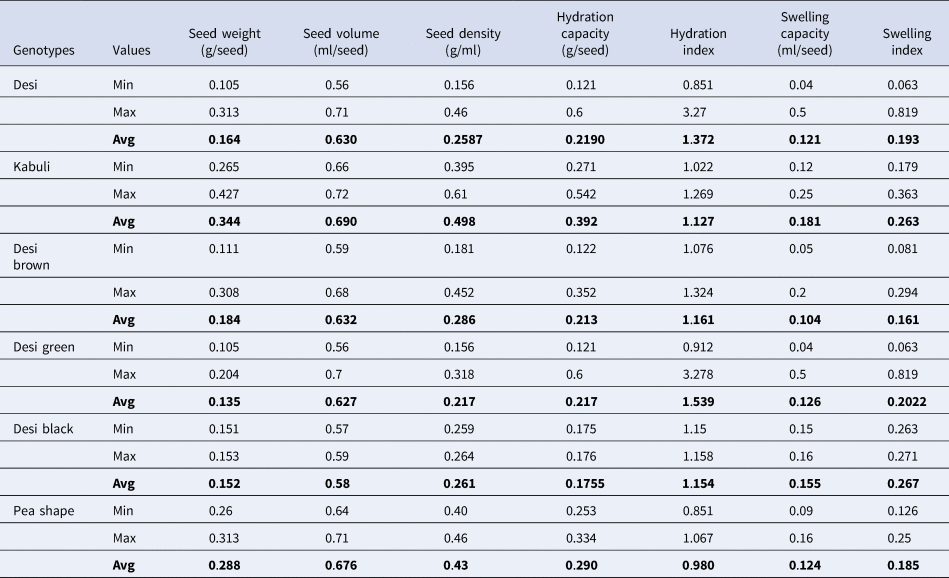
Chickpea is known for its nutritional traits, especially for seed micro and macronutrients (Fayaz et al., Reference Fayaz, Rather, Wani, Tyagi, Pandey and Mir2019; Fayaz et al., Reference Fayaz, Tyagi, Wani, Pandey, Akhtar, Bhat, Chitikineni, Varshney, Thudi, Kumar and Mir2022). Seed physical characteristics also form important traits in crop plants including chickpea. Therefore, the genetic variation for seed qualitative/physical traits was assessed using different genotypes within the cultivated gene pool of chickpea. While comparing the desi type with the pea-shaped and kabuli type, it was noticed that the kabuli type shows superior trait performance and possesses a higher average seed weight, seed volume, seed density, seed hydration capacity, swelling capacity and swelling index (Table 1). The research findings are in agreement with the findings of earlier studies (Gil et al., Reference Gil, Nadal, Luna, Moreno and Haro1996; Sastry et al., Reference Sastry, Upadhyaya and Srinivas2019), where higher seed volume, hydration capacity, hydration index and swelling capacity were observed in kabuli type chickpea. Sefa-Dedeh and Stanley (Reference Sefa-Dedeh and Stanley1979) suggested that the higher permeability may be due to the soft seed coat, softer cotyledons and seed coat thickness of kabuli type chickpea. The water absorbing capacity of the seeds also depends on the cell wall structure, seed composition and compactness of the cells (Muller, Reference Muller1967; Kaur et al., Reference Kaur, Singh and Sodhi2005). However, our findings show a low seed hydration index in kabuli than in desi type (Table 1) and these findings also received support from Iqbal et al. (Reference Iqbal, Ateeq, Khalil, Perveen and Saleemullah2006), where a higher hydration index value was reported in desi chickpea (1.083) than in kabuli chickpea (0.947).
Variation for seed physical characteristics in different cultivated chickpea types/colour classes

While comparing different desi genotypes (desi black, desi brown and desi green) of chickpea for seed qualitative traits, it was observed that desi brown genotypes possess higher average seed weight, seed volume, seed density and seed hydration capacity. The desi green type possesses higher average seed hydration index, while the desi black type possesses higher average seed swelling capacity and swelling index (Table 1). Such findings could be explained by the greater seed size in the desi brown type than in the desi green and desi black types. The higher hydration index in the desi green in comparison with other two desi types may be due to less seed weight in desi green type. The greater swelling capacity in desi black may be due to a more porous seed coat, which gives them more water adsorption capacity. Similarly, higher values for the swelling index in the black type may be due to more swelling capacity. Furthermore, it is important to note that the pea-shaped chickpeas which are considered hybrid type chickpea between desi and kabuli types possess average seed qualitative/physical traits between desi and kabuli types (Table 1). Our findings were supported by an earlier study (Iqbal et al., Reference Iqbal, Ateeq, Khalil, Perveen and Saleemullah2006). It was reported in this study that hydration capacity for pea-shaped (0.290) was intermediate between desi (0.219) and kabuli type chickpea (0.392). The results similar to our findings were also reported by Özer et al. (Reference Özer, Karaköy, Toklu, Baloch, Kilian and Özkan2010). They reported that chickpea genotypes with greater hydration and swelling capacity would have softer seed coats and cotyledon, and in our study, greater hydration and swelling capacity was also shown by the kabuli types having softer seed coat cotyledons.
Supplementary material
The supplementary material for this article can be found at https://doi.org/10.1017/S1479262123000084.