Perceived position of objects is often distorted in the presence of motion. In addition to the flash-lag effect discussed in the target article, other examples include flash-drag effects (Whitney & Cavanagh Reference Whitney and Cavanagh2000) and illusory boundary distortion by motion (Anderson & Barth Reference Anderson and Barth1999; De Valois & De Valois Reference De Valois and De Valois1991; Ramachandran & Anstis Reference Ramachandran and Anstis1990; Weiss & Adelson Reference Weiss and Adelson2000). The same neural circuits that carry out directional selectivity, motion integration and segmentation computations are suggested to underlie phenomena of distortion of positional maps (Berzhanskaya et al. Reference Berzhanskaya, Grossberg and Mingolla2004).
The model 3D FORMOTION (Berzhanskaya et al. Reference Berzhanskaya, Grossberg and Mingolla2007) is based on formotion (Grossberg et al. 2001) and employs feedforward and feedback circuits involving areas V1, V2, medial temporal (MT), and medial superior temporal (MST) to solve both the motion aperture and correspondence problems (as well as motion capture, barber-pole illusion, plaid motion, and integration of object motion across apertures). It incorporates depth-selective input from V2 (FACADE) to MT (Formotion) to simulate the separation of ambiguous boundaries in depth (chopsticks illusion) and motion transparency.
1. Description of 3D FORMOTION features relevant to the distortion of positional maps
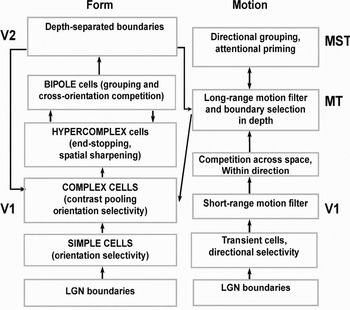
The formotion model consists of a few stages (see Fig. 1). The first stage in the motion system consists of directionally insensitive transient cells that respond briefly to a change in the image luminance, irrespective of the direction of movement. The second stage is the directionally sensitive layer. Directional selectivity results from a combination of gradient processing (Reichardt Reference Reichardt and Rosenblith1961; van Santen & Sperling Reference van Santen and Sperling1985) and an asymmetric inhibition mechanism (Jagadeesh et al. Reference Jagadeesh, Wheat, Kontsevich, Tyler and Ferster1997; Livingstone Reference Livingstone1998). Further, short-range filters accumulate motion signals in a certain direction. Finally, spatial competition weakens ambiguous signals from line interiors and also amplifies feature-tracking signals. The spatial competition kernel has an asymmetric shape with its excitation offset from inhibition in the direction of motion. On the basis of anatomical connections and directional opponency, these spatial/directional competition units are allocated to the layer 4B of V1. As will be demonstrated later, asymmetric inhibition at this motion processing stage may contribute to the flash-lag effect.
Schematic view of 3D FORMOTION.

The signal from the layer 4B of V1 is projected to MT. Long-range anisotropic receptive fields in MT accumulate evidence of motion in the direction of their elongation. The final stage of the model is a “winner-take-all” interaction between MT center-surround and wide-field motion cells (in MT or MST). The MT-MST network determines a single motion direction at each position and may incorporate attentional modulation. Unambiguous feature-tracking signals propagate to ambiguous motion regions via MST-to-MT feedback, and anisotropic receptive fields allow motion integration across occluders. Thus, only at the MT-MST level does the model solve both the aperture and motion capture problems.
The FACADE boundary computation system includes stages of contrast-dependent orientation-selective cells (simple cells in V1), contrast-independent orientation-selective cells (complex cells in V1 and V2), hypercomplex cells that support both orientation competition and spatial competition, and finally, bipole grouping cells (Grossberg & Mingolla Reference Grossberg and Mingolla1985). In the current model, the hypercomplex cell layer is the site of projection from the motion stream to the form stream, carried out by MT-V1 feedback. This projection plays a role in assigning depth order to the object boundaries in ambiguous displays. The same projection, at the MT-V1 (simulated) level and possibly also at the MT-V2 level, is suggested to influence object boundaries in the flash-drag effect.
2. Motion distortion of boundary positions: modeling insights into neuronal mechanisms
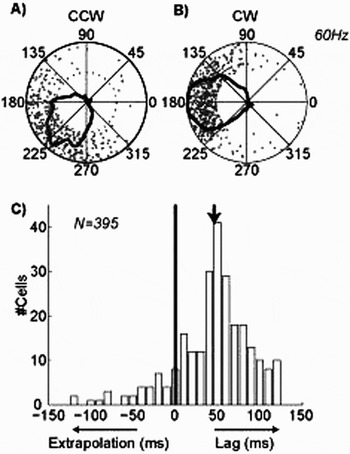
In the flash-lag effect (Nijhawan Reference Nijhawan1994), a flashed object is perceived to be lagging behind a moving one. 3D FORMOTION suggests that when a spatial/directional competition filter in V1 is activated by a moving stimulus, the trailing surround suppression shifts the peak of population activation of a flashed stimulus in the direction opposite to the direction of motion (Berzhanskaya et al. Reference Berzhanskaya, Grossberg and Mingolla2004); see Figure 2. A similar phenomenon may exist at levels higher than V1. However, based on the size of the shift (a few degrees of visual angle) and on the limited spatial scope, one can suggest that the main mechanisms are localized in V1.
Illustration of motion inhibition effect on flashed stimulus position.

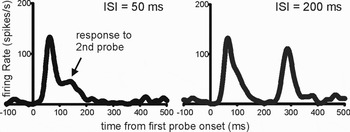
In an opposite effect, flash-drag (Whitney & Cavanagh Reference Whitney and Cavanagh2000), a flashed stimulus is shifted in the direction of motion. It can be explained by the feedback from MT to V1 (implemented in 3D FORMOTION) or MT to V2. In these experiments, a motion stimulus occupies a larger area (and presumably activates larger MT/MST fields more efficiently), and the effect, a positive peak shift in the direction of motion, can be observed at larger spatial distances (see Fig. 3).
Illustration of MT contribution to flash-drag.

Another category of visual displays, gratings with ambiguous (Gaussian envelope) boundaries (DeValois & DeValois 1991; Whitney et al. Reference Whitney, Goltz, Thomas, Gati, Menon and Goodale2003) and illusory contours formed by random dots (Ramachandran & Anstis Reference Ramachandran and Anstis1990), demonstrates that an ambiguity (low contrast, brief, or illusory) in the boundary presentation is a key to a shifted percept. Although not specifically analyzed here, differences in latencies resulting from weaker and slower-developing boundary signals may play a role at the later stages (a possibility discussed in the target article). Feedback projection from large, motion-sensitive MT receptive fields in 3D FORMOTION to lower areas such as V1 might be interpreted as carrying a predictive signal (also addressed in the target article). However, in our application of 3D FORMOTION to flash-lag and flash-drag phenomena, first presented at the Visual Science Society Conference in 2004, we were mainly interested in gaining insight into the neuronal mechanisms of these effects.
Our model makes multiple predictions: (1) It predicts that the flash-lag effect is a consequence of directional selectivity mechanisms. This effect would exist not only in V1 or later visual areas, but also in any area, sensory or otherwise, in which directionality of the stimulus can be processed. This was confirmed by flash-lag demonstrations in multiple domains (Alais & Burr Reference Alais and Burr2003; Cai & Schlag et al. 2001; Sheth et al. Reference Sheth, Nijhawan and Shimojo2000). (2) Flash-lag is a function of local motion processing and is only weakly affected by a global motion signal. An elegant demonstration by Anstis (Reference Anstis2007), in which the flash-lag is influenced by a local motion and not by (an opposite) global motion of the chopsticks, provides some support to this idea. (3) A disruption of inhibition, and therefore of directionality mechanisms, near the flashed object should cancel the flash-lag effect. (4) A disruption of feedback from MT to V1 [e.g., by transcranial magnetic stimulation (TMS)] will interfere with the flash-drag effect (McGraw et al. Reference McGraw, Walsh and Barrett2004). In agreement with the model's predictions, neurophysiological evidence of interactions between form and motion streams that may contribute to object mislocalization has been presented in both single-neuron recordings (Fu et al. Reference Fu, Shen, Gao and Dan2004; Sundberg et al. Reference Sundberg, Fallah and Reynolds2006) and fMRI (functional magnetic resonance imaging) (Whitney et al. Reference Whitney, Goltz, Thomas, Gati, Menon and Goodale2003).
In summary, motion distortion of position maps can arise as an emergent property of directionality mechanisms, and, for the visual system, via interactions between the form and motion streams. An integrative approach, including analysis of multiple position distortion phenomena, will provide an insight into possible neuronal mechanisms.
ACKNOWLEDGMENTS
I thank Professors S. Grossberg and E. Mingolla for their support and guidance during development of 3D-FORMOTION.