Although sentence repetition may superficially appear a straightforward task, repeating a sentence draws on many component language skills, including the segmentation of words and word parts, the encoding of grammatical structure, articulatory planning, and speech production (e.g., Hagoort & Levelt, Reference Hagoort and Levelt2009; Levelt, Reference Levelt2001). In this light, it is not surprising that deficits in sentence repetition, along with problems in nonword repetition, are a hallmark of language impairment (Conti-Ramsden, Botting, & Faragher, Reference Conti-Ramsden, Botting and Faragher2001). Moreover, such deficits are also observed among children with a history of speech and language difficulties even if these have apparently been resolved (Bishop, North, & Donlan, Reference Bishop, North and Donlan1996; Stothard, Snowling, Bishop, Chipchase, & Kaplan, Reference Stothard, Snowling, Bishop, Chipchase and Kaplan1998).
The most obvious skill involved in sentence repetition is arguably verbal working memory, and Gathercole and colleagues (e.g., Adams & Gathercole, Reference Adams and Gathercole2000) have proposed that problems with verbal working memory processes (i.e., phonological short-term memory as measured by nonword repetition) compromise sentence processing. It follows from this view that children with verbal memory impairments, such as children with dyslexia, might be expected to have problems with sentence processing, as argued in the processing limitation hypothesis (Shankweiler & Crain, Reference Shankweiler and Crain1986). According to the processing limitation hypothesis, constraints in verbal working memory (including limitations in verbal short-term memory and executive control) produce problems in oral and written language processing. However, the status of memory processes as predictors of language skill has been the subject of much debate (Just & Carpenter, Reference Just and Carpenter1992; MacDonald & Christiansen, Reference MacDonald and Christiansen2002; Waters & Caplan, Reference Waters and Caplan1996). Thus, rather than viewing poor working memory as a cause of poor language, Hulme and colleagues (Allen & Hulme, Reference Allen and Hulme2006; Melby-Lervåg & Hulme, Reference Melby-Lervåg and Hulme2010) have argued that, maintaining verbal information in working memory depends critically on the adequacy of linguistic representations and, in particular, output phonological representations, though such linguistic representations are derived from item-based experiences (Lieven, Reference Lieven2008).
According to MacDonald and Christiansen (Reference MacDonald and Christiansen2002), language knowledge and processing capacity are inseparable. Studies showing that the speech errors made in tongue twisters are similar to those observed in recall tasks provide evidence that verbal working memory automatically engages language representations (Acheson & MacDonald, Reference Acheson and MacDonald2009; Acheson, MacDonald, & Postle, Reference Acheson, MacDonald and Postle2011; Acheson, Postle, & MacDonald, Reference Acheson, Postle and MacDonald2010). It follows that the memory demands of sentence repetition should not be viewed as distinct from those involved in language production (Chiat, Reference Chiat2001). In a sentence repetition task, there is a confound between memory load and grammatical complexity. Producing a sentence requires the selection of lexical items followed by the assignment of grammatical roles and the retrieval of syntactic and morphological components prior to phonological encoding into a prosodic structure and the articulation of the selected items (Bock & Levelt, Reference Bock, Levelt and Gernsbacher1994; Levelt, Reference Levelt2001). In sentence repetition, although the demands of lexical selection are reduced, the processes that guide lexical access will be critical and any problems relating to segmentation of words in the speech stream will compromise the development of a memory representation of the sentence. Similarly, problems retrieving information from a language representation or in mapping morphosyntactic information onto phonological output representations will lead to grammatical errors in sentence production. Applying this framework to language acquisition, Gerken (Reference Gerken1991) has proposed that children's resource limitations affect their speech production, such that they tend to omit weak syllables, including function words, when processing resources are exceeded.
In this view, language knowledge should be an important predictor of how well sentences can be repeated, and deficits in sentence repetition are to be expected in children with limitations of language knowledge. Moreover, when processing demands are high, such children should make more omissions of grammatical markers and function words than do typically developing children. However, memory load and grammatical complexity are confounded in sentence repetition tasks. This is particularly true of the standardized tests that are used clinically in the assessment of language difficulties (e.g., Clinical Evaluation of Language Fundamentals; Wiig et al., Reference Wiig, Secord, Semel, Rust, Golombok and Lycett2006; Test of Language Development—Primary and Intermediate; Newcomer & Hammill, Reference Newcomer and Hammill2005). The main aim of the present study was to investigate the impact of both working memory and language processing demands on sentence repetition in a factorial design. An additional aim was to explore how children's sentence repetition relates to their oral and written (reading) language skills.
The paradigm we chose was based on a sentence repetition task developed by Wilsenach (Reference Wilsenach2006) for a study comparing Dutch-speaking children at family risk of dyslexia, children with specific language impairment (SLI), and typically developing children. In this task, sentences varied in morphosyntactic complexity (containing transitive, intransitive, and ditransitive verbs) and in length, depending on whether or not they contained an adjunct. Wilsenach (Reference Wilsenach2006) reported that all children omitted more closed class items (auxiliaries and determiners) when repeating more complex sentences, and the family risk and SLI groups had particular difficulty retaining these grammatical forms in ditransitive sentences. Neither the effect of sentence length nor the interaction between group and sentence length were significant. However, there was a trend for the children at family risk to be more affected by the memory demands imposed by adding adjuncts to the Dutch sentences. In our English adaptation of the task, stimuli were either active or passive ditransitive sentences that varied in length. We compared the performance of children with literacy difficulties (dyslexia) with that of typical readers. Dyslexia is a neurodevelopmental disorder characterized by deficits in word decoding and fluency. At the cognitive level, a deficit in phonological processing is considered a likely cause of the reading impairment. Phonological deficits involve problems in phoneme awareness and naming speed, and deficits in verbal short-term memory (often measured by digit span, word recall, or nonword repetition tasks). To the extent that sentence repetition depends upon verbal memory resources, children with dyslexia, as a group, should perform poorly relative to controls.
However, in recent years, a more nuanced view of dyslexia has emerged suggesting that many children with dyslexia have a history of language difficulties (Bishop & Snowling, Reference Bishop and Snowling2004; Snowling, Gallagher, & Frith, Reference Snowling, Gallagher and Frith2003). Thus, it is likely that within the sample of children with dyslexia, a subgroup will have experienced language difficulties in the past. If sentence repetition is a marker (or endophenotype) of SLI even when resolved such that children no longer reach diagnostic threshold, then this subsample should experience more difficulties with sentence repetition than the remainder of the sample.
Thus, the present study tested a number of predictions:
1. Sentence repetition should be easier for short than for long sentences. If sentence repetition depends principally on language knowledge, then manipulations of sentence complexity (i.e., syntactic structure) should affect task performance, independent of manipulations of sentence length.
2. Group differences in sentence repetition between children with and without dyslexia should reflect differences in language skills or in verbal short-term memory. If differences in sentence repetition are due to differences in language skills, group differences should vanish once individual differences in language skills are controlled. In contrast, if differences in sentence repetition reflect differences in memory capacity, group differences should still be evident when controlling for language skills but should disappear when differences in memory capacity are taken into account.
3. If group differences in sentence repetition between children with and without dyslexia are driven by a subsample of children with a history of language problems, the groups should not differ once information about language problems is taken into account, indicating that poor sentence repetition is a marker of residual language limitations.
4. At the word level, the following predictions can be made: If sentence repetition depends on language skills, then errors should reflect deficits in linguistic competence:
a. Content words should be maintained better than more abstract function words, which are semantically and phonologically less salient (Chiat, Reference Chiat2001; Chiat & Roy, Reference Chiat and Roy2008).
b. Group differences should be evident for the less salient function words. These group differences should disappear when differences in language skills are controlled.
If sentence repetition primarily depends upon working memory, then errors should depend on memory demands:
a. In line with the processing limitation hypothesis (e.g., Plaza, Cohen, & Chevrie-Muller, Reference Plaza, Cohen and Chevrie-Muller2002; Shankweiler & Crain, Reference Shankweiler and Crain1986), children with dyslexia should perform like controls when memory demands are low but should omit more items from longer sentences than do typically developing readers, resulting in a group by length interaction.
b. When sentences increase in length, children with dyslexia are more likely to retain the “gist” of the sentences and, hence, to substitute/omit adjectives more than nouns relative to typical readers.
METHOD
Participants
Participants either were drawn from families where a younger sibling was already involved in an ongoing family-risk study (N = 74) or were recruited by newspaper adverts (N = 23). The recruitment procedure focused on children with and without problems in learning to read and spell. In total, 97 children (40 with literacy difficulties, including 26 from the family risk study, and 57 with age adequate literacy skills, including 48 from the family risk study) aged 6 to 12 years participated in the current study. Children were classified as dyslexic either if they had a clinical diagnosis of dyslexia or if they gained a standard score of less than 86 (1 SD below average) in at least one out of two literacy measures (reading and spelling subtests) used for classification (Wechsler Individual Achievement Text—Second UK Edition; Pearson Clinical, 2005). This procedure resulted in a mean standard score of 82.7 (SD = 9.8) over both literacy measures for the dyslexic group. All children allocated to the control group gained a standard score of at least 88 in both literacy measures, resulting in a mean literacy standard score of 105.8 (SD = 9.9). Within the two literacy groups (dyslexia and control), children with and without familial risk did not differ with respect to their literacy difficulties (mean literacy composite for familial risk vs. no risk: dyslexia = 82.3 vs. 84.6 and control = 105.7 vs. 106.4; all Fs < 1, ps > .05).
All children were tested on a comprehensive cognitive test battery, including literacy, general cognitive ability, memory, phonological skills, and language skills. Here only the measures that are relevant for the current study are described.
Tasks
General cognitive ability
Nonverbal IQ was assessed using the Wechsler Abbreviated Scale of Intelligence (Psychological Corporation, 1999). The scale includes two subtests that provide an estimation of performance IQ: block design and matrix reasoning. The tests were administered and scored according to the manual.
Literacy
Word reading and spelling were assessed using the word reading and spelling subtests from the Wechsler Individual Achievement Text—Second UK Edition. The reading subtest requires untimed reading of a list of single words of increasing difficulty. In the spelling subtest, the child is asked to spell single words dictated in sentence frames. For both literacy measures, standard scores were calculated based on age norms. These two subtests were used for classification, and poor reading/spelling was defined by a standard score of less than or equal to 85. In order to confirm that the two groups also differ in reading fluency, the Test of Word Reading Efficiency (Torgesen, Wagner, & Rashotte, Reference Torgesen, Wagner and Rashotte1999) was administered. This test requires reading aloud a list of high-frequency words and a list of nonwords as accurately and quickly as possible within 45 s. An efficiency score using the composite standard score for both subtests was calculated based on age norms.
Phonological awareness
An adapted version of the phoneme deletion task developed by McDougall, Hulme, Ellis, and Monk (Reference McDougall, Hulme, Ellis and Monk1994) was administered. In this task, the child was asked to say a one-syllable nonword presented by the examiner after dropping a designated sound. The deletion always resulted in a word. In total, 24 items of three increasing difficulty levels (8 items for each level) were administered. Level 1 required the deletion of a beginning or end sound, which was not part of a consonant cluster (e.g., bice without /b/). At Level 2 the beginning or end sound to be deleted was part of a consonant cluster (e.g., glamp without /g/). Finally, at Level 3, the sound to be deleted was in the middle of the word and part of a consonant cluster (e.g., splow without /p/). The task structure ensured that floor or ceiling effects were avoided.
Verbal memory
Two tests were administered to assess verbal short-term memory, word recall, and nonword repetition. Both tests require the repetition of verbal material increasing in length; however, they differ according to the extent that semantics is involved in the task. In the word recall subtest of the Working Memory Test Battery for Children (Pickering & Gathercole, Reference Pickering and Gathercole2001), the child is asked to repeat sequences of words in the same order as the tester. All items are high-frequency one-syllable words, so that the influence of vocabulary knowledge on task performance is reduced (e.g., neck–nut–pool). The Working Memory Test Battery for Children subtest was administered according to the manual, and standard scores were calculated based on age norms. In the nonword repetition task, the child was asked to repeat 20 nonwords of one to five syllables in an adapted version of the task developed by Dollaghan and Campbell (Reference Dollaghan and Campbell1998). All items are based on phonemes that are acquired early in language development. In addition, the items are designed such that they do not correspond to lexical items and the predictability of phonemes is minimized (e.g., vachipe and doytauvab). The measure used for the analysis was the percentage of items repeated correctly.
Morphological awareness
To assess morphological aspects of language production, two subtests were developed. In the inflection subtest children had to inflect nonwords with three different forms of inflection (third person –s, past tense –ed, or present progressive –ing) according to the sentence frame that elicited the corresponding form (e.g., this is to sark, yesterday the boy sarked). Items were developed by changing one phoneme from regular high-frequency verbs. The 15 nonwords (5 per condition) were always introduced by a picture, and children had to repeat the base form before inflecting the nonword. Correct answers were awarded 2 points. If the child's response contained a correct tense inflection and had no more than one phonetic error, the answer was awarded 1 point. All other responses were scored 0, resulting in a maximum raw score of 30. In the derivation subtest children had to derive a word given in a sentence frame (e.g., she loves to bake, so we can say she is a baker). The 24 items varied in difficulty, with 8 items including no phonological or orthographic change in the derived word form (e.g., bake–baker), and 16 items (2 × 8 items) including a phonological change (e.g., music–musician) or a phonological and orthographic change (e.g., silent–silence). The root words used in the different conditions were matched for word frequency, bigram frequency, and number of orthographic neighbors. Items were scored as correct or incorrect (1 or 0), resulting in a maximum raw score of 24.
The tasks were introduced by three practice items each. For both tasks the percentage of test items correct was calculated. The correlations between the two tasks were moderate for each group (rs = .50, ps < .001); a composite score based on the mean percentage correct for the two morphology tasks was used in the analyses. The composite score was normally distributed (Kolmogorov–Smirnov Z < 1, p > .05).
History of language difficulty
To gauge history of language impairment and concurrent language status of the children, parents participated in a semistructured interview developed for the current study and completed a standardized communication questionnaire, the Children's Communication Checklist (Bishop, Reference Bishop2003). In the semistructured interview parents were asked if their child had received a diagnosis of language impairment in the past or if they have ever been concerned about their child's language development. The answer was scored as 1 (diagnosis or concerns) or 0 (no concerns). The Children's Communication Checklist questionnaire was scored according to the manual. For the current study, we analyzed the General Communication Composite calculated from eight subscales. The General Communication Composite reflects an index of the overall communicative competence of a child.
Sentence repetition
The sentence repetition task was constructed according to a 2 × 2 design, so that length (short vs. long) and complexity (low complexity vs. high complexity) were manipulated separately from each other, resulting in four conditions: short/low complexity; short/high complexity; long/low complexity; and long/high complexity. Sentences all conformed to a ditransitive argument structure in which the verb takes two objects (e.g., A lady passed the man a paper). Complexity was increased by using a ditransitive passive sentence structure, where subject and object were denoted by two prepositions (e.g., A sweet was offered by a boy to the girl). Sentence length was increased by the addition of adjectives to these basic structures (e.g., A friendly girl offered the new boy a purple pencil).
Table 1 presents all sentences ordered by condition. All words in the sentences were highly frequent (mean frequency = 306, all words >1 per million; CELEX database: Baayen, Piepenbrock, & Rijn, Reference Baayen, Piepenbrock and Rijn1993). The four conditions were matched for word frequency (F < 1) to rule out the possibility that differences between conditions were due to differences in vocabulary knowledge or word familiarity. All verbs were regular and presented in the past tense form in active sentences (e.g., passed) and as past participles in passive sentences (e.g., was passed), so that inflections were kept constant across conditions. In order to evaluate the likelihood of all sentences, we asked students (N = 14) to estimate how often people would say a sentence like this (frequency) and how probable the event described in the sentence seems to them (probability). Increases in sentence length and complexity were associated with lower subjective ratings of familiarity and plausibility of the sentences; in particular, the high complexity sentences received lower familiarity ratings.
Sentence repetition task with items presented by condition (length and complexity)

Sentences were given verbally by trained testers, and children were asked to reproduce the sentence as accurately as possible. The task was recorded and transcribed by the tester, and all scoring was done by one of the authors. In total, 20 sentences (5 per condition) were presented in a pseudorandomized order, divided between two sessions, which were counterbalanced across participants. There was no effect of session order on task performance for either group (dyslexic: t = 0.21, p = .83; control: t = 0.58, p = .56). The percentage of words repeated correctly was calculated over all 5 sentences for each of the four conditions (ditransitive short, ditransitive long, ditransitive passive short, and ditransitive passive long). The total score was normally distributed within the sample (Kolmogorov–Smirnov Z = 1.35, p > .05).
In addition, the detailed scoring system proposed by Seeff-Gabriel, Chiat, and Roy (Reference Seeff-Gabriel, Chiat and Roy2008) was used for the purposes of performing word-level analyses. In contrast to the analyses based on the total score, the word-level analyses allow investigation of the word types (content and function words and grammatical inflections) that are most vulnerable when repeating sentences and to investigate the influence of sentence length and complexity on omissions of words of different types. The 20 sentences were broken down into 120 content words (nouns, adjectives, and verbs), 80 function words (articles, prepositions, and pronouns), and 30 verb inflections (past tense). For each word category, the percentage of words repeated correctly was calculated over all 20 sentences. Because we only included –ed verb inflections in our task, performance on this word category was generally high and close to ceiling (means: dyslexic = 94% correct and control = 97% correct). Therefore, we did not include inflections in the additional set of word-level analyses.
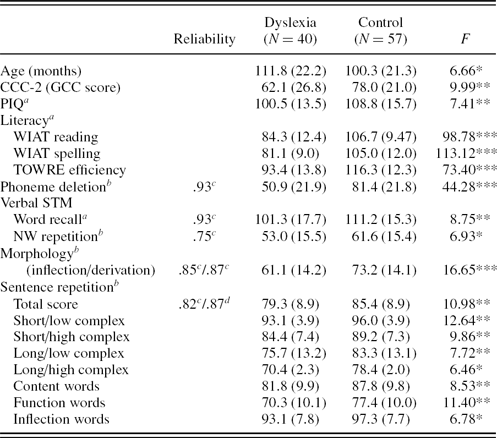
Reliability scores for all tasks were high; these scores are reported in Table 2.
Means (standard deviations) of descriptive measures for the two groups

Note: CCC-2, Children's Communication Checklist version 2; GCC, General Communication Composite; PIQ, performance IQ; WIAT, Wechsler Individual Achievement Test; TOWRE, Test of Word Reading Efficiency; STM, short-term memory; NW, nonword.
aStandard score.
bPercentage correct of age adjusted means (standard deviations). The F scores are age controlled for unstandardized tests.
cCronbach α.
dGuttman split half.
*p < .05. **p < .01. ***p < .001.
RESULTS
Group characteristics
The descriptive statistics for age, language, IQ, literacy, phonological awareness, verbal memory, and morphological awareness measures for children with dyslexia and children with age-appropriate literacy skills are presented in Table 2. As expected, the two groups differed on all literacy and verbal measures. The correlations between age and sentence repetition (rs = .45 for dyslexic, .42 for control) and performance IQ (PIQ) and sentence repetition (rs = .36 for dyslexic, .42 for control) were moderate and similar in both groups. To check for homogeneity of regression functions across groups, we conducted a regression analysis with sentence repetition as the dependent variable and age, group, and the interaction term (age by group) as predictors. The interaction term was small and did not approach significance (coefficient = 0.040, t = 0.47, p = .64), and the same was true in an equivalent analysis substituting PIQ as the predictor (coefficient = 0.038, t = 0.29, p = .77). These results confirm that the slopes were equivalent for the two groups, justifying the use of these measures as covariates in all further analyses.
Language skills within the sample
In order to differentiate children with dyslexia with and without a history of language impairment, we used data from the semistructured interview and the Children's Communication Checklist (Bishop, Reference Bishop2003). There were 10 children in the group of children with dyslexia (25%) and 3 children in the control group (5%) whose parents were concerned about their child's language development or reported that their child had previously received support from speech and language therapy services. In line with parental concerns about language difficulties, ratings for the 13 children on the Children's Communication Checklist were lower than for the group of children with no reported concerns (mean General Communication Composite: 51 vs. 75, t = 2.50, p = .026). At the time of testing, none of the 13 children received language therapy and no marked problems in receptive or expressive language skills were observed during the assessment, suggesting that language difficulties have mostly resolved. However, when comparing the 10 children with dyslexia whose parents were concerned about their language skills with the 30 children with dyslexia but no reported concerns, a highly significant difference was found between their performance on the test of morphology (means = 50% vs. 69% correct, t = 2.93, p = .006) though these two subgroups did not differ in age (means = 111 vs. 112, t = 0.18, p = .859). For the majority of the analyses, we used data from the group with dyslexia as a whole. We report an additional analysis in which we examine the impact of language status (in addition to literacy).
The relationship among sentence repetition, language, and cognitive abilities
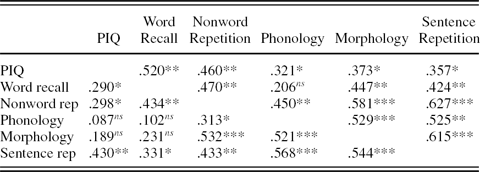
Table 3 shows the correlations among general cognitive abilities, verbal memory (word recall and nonword repitition), phonological and morphological awareness, and performance in sentence repetition (sentence repetition total score) separately for the two literacy groups. In general, the intercorrelations between PIQ and the different measures were slightly higher in the group of children with dyslexia (.32 to .52) than in the control group (.09 to .43). However, none of the differences in correlations between the groups were significant (all ps >.05) and the overall pattern was comparable between the two groups. There were moderate correlations between word recall and nonword repetition, suggesting only partial overlap between these two measures of verbal memory. The correlations among sentence repetition, nonword repetition, and morphological awareness were moderate in both groups (.43 to .54 for controls and .58 to .63 for children with dyslexia).
Correlations between general cognitive ability (PIQ), verbal memory, phonology, morphology skills, and performance in the sentence repetition task for children with dyslexia (above diagonal) and controls (below diagonal)
Note: PIQ, performance IQ.
nsp > .05. *p < .05. **p < .01. ***p < .001.
Analyses were performed using a series of mixed-effects linear regression analyses. The advantage of this approach is that it allows us to examine the impact of within-subjects effects (sentence length and complexity) and between-subjects factors (literacy group) across participants within the same analysis. By incorporating both fixed-effects parameters and random effects, mixed-effects models allow the separation of the effects of the experimental manipulation (fixed effects) from differences in the baseline performance by participants and items (random effects). In the current study, we included subjects and items as crossed random effects (see Baayen, Davidson, & Bates, Reference Baayen, Davidson and Bates2008). All analyses were run using STATA 11 (http://www.stata.com).
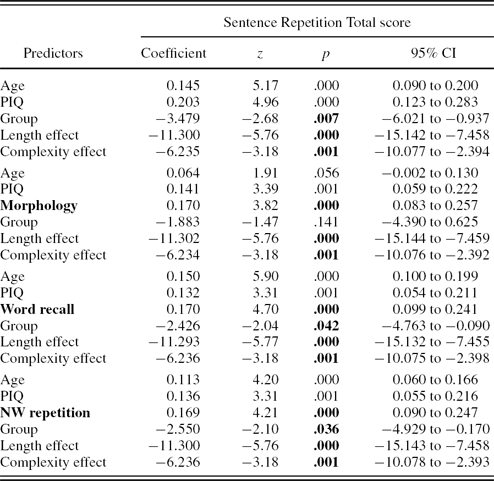
In all analyses we controlled for age and PIQ before entering the three factors we were investigating: Group (dyslexic vs. control: dummy coded 1 and 0), Length (short vs. long: coded –.5 and .5), and Complexity (low vs. high complexity: coded –.5 and .5). In a set of analyses, we also included the interaction terms Length × Complexity, Group × Length, and Group × Complexity. Because none of the interactions were significant, we report the results from models from which the interaction terms were dropped. The regression coefficients shown in Table 4, Table 5, and Table 6 indicate the size of the difference in the dependent variable (e.g., sentence repetition total score) between the factors, namely, between the two groups and between the two levels of length and complexity. In addition, the level of significance and the confidence intervals for these differences are reported.
Mixed-effects linear regression analyses: Effects of group, length, and complexity on performance of the sentence repetition task (total score)
Note: PIQ, performance IQ; NW, nonword.
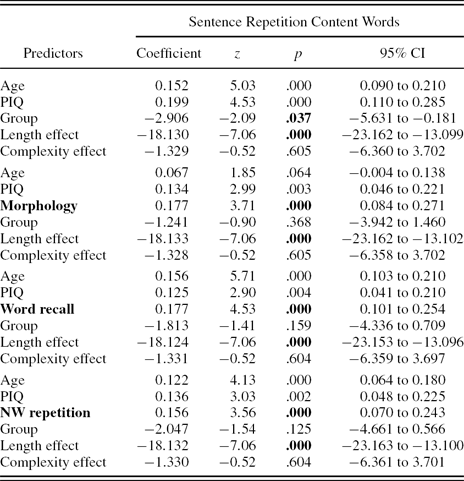
Mixed-effects linear regression analyses: Effects of group, length, and complexity on performance of content words in the sentence repetition task
Note: PIQ, performance IQ; NW, nonword.
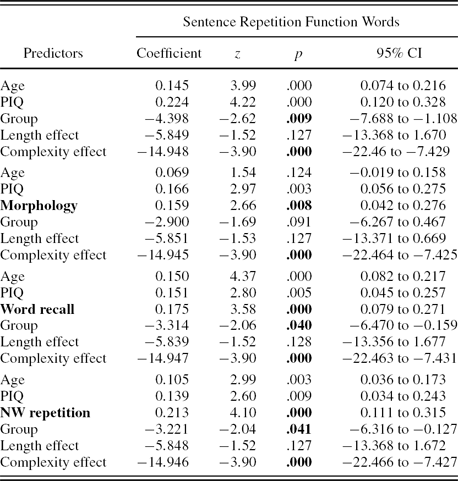
Mixed-effects linear regression analyses: Effects of group, length, and complexity on performance of function words in the sentence repetition task
Note: PIQ, performance IQ; NW, nonword.
Predictors of sentence repetition (total score)
In an initial set of analyses, we examined the effects of group, length, and complexity on the overall performance of children on the sentence repetition total score (percentage of words correct; see the top rows of Table 4). As predicted, there were significant main effects of group, length, and complexity. The negative regression coefficients confirmed that the dyslexic group was performing more poorly than the control group, and that longer and more complex sentences were more difficult to repeat correctly than shorter and less complex ones. That none of the interaction terms with group were significant indicates that the impact of length and complexity on task performance was not different for the groups. Because length and complexity were associated with lower ratings of familiarity and plausibility of the sentences, we ran an additional analysis including familiarity and plausibility as covariates. Neither factor was a significant predictor of performance, but the complexity effect diminished after familiarity, but not probability, was entered in the model, indicating some degree of shared variance between the familiarity and complexity of a sentence.
The effect of group on sentence repetition could in principle reflect the language difficulties experienced by the group of children with dyslexia or be a consequence of their memory impairments. To test these alternative hypotheses, we ran three further analyses examining the main effects but controlling for either language skills (as indexed by morphological awareness) or verbal short-term memory measures (in one analysis controlling word recall, and in another, nonword repetition). The results of these analyses are presented in the lower part of Table 4. Language skills as well as verbal short-term memory accounted for a significant amount of variance in sentence repetition skills. However, the main question was whether group differences in sentence repetition can be attributed to differences in language skills or rather reflect differences in verbal memory skills. When controlling for language skills (morphological awareness), the effect of group on sentence repetition was no longer significant, suggesting that group differences were a product of language competence. In contrast, when controlling for verbal short-term memory (either word recall or nonword repetition), the group effect remained significant, showing that the group effect in sentence repetition cannot primarily be explained by limitations of verbal short-term memory capacity.
Our next question was whether differences between the children with dyslexia and controls were actually attributable to a subsample of children with language impairments. We conducted a further analysis of the children's performance in sentence repetition, introducing an additional dummy variable that coded if children had a history of language impairment or not (based on parental report). This analysis confirmed a significant effect of language group on task performance (coefficient = –6.52, z = –3.70, p < .001); in line with findings of the regression analyses presented before, the effect of literacy group was no longer significant once language group was included in the model (coefficient = –2.30, z = –1.83 p > .05).
We next turned to test hypotheses about the pattern of errors expected in the different conditions. We investigated whether content words were repeated more accurately than semantically and phonologically less salient function words and grammatical markers. We also investigated group differences in error pattern. As evident from Table 2 and in line with our prediction, content words were retained more easily than function words in both groups (ps < .001). Group comparisons revealed that the group of children with dyslexia repeated fewer content and function words compared to typically developing children.
The group effect was further supported by the mixed-effects regression analyses investigating the effects of the three independent variables, group, length, and complexity on repetition of content and function words across sentences (Tables 5 and 6). The ability to repeat content words was predicted by sentence length but not by sentence complexity, and there were group differences in performance, indicating that the children with dyslexia recalled fewer content words. However, this group effect was not significant once either language or verbal short-term memory skills were controlled. The findings for function words differed from those reported for content words: the ability to repeat function words was predicted by sentence complexity but not by sentence length, and group was a highly significant predictor. In line with the analyses of total number of words recalled, the group difference in performance was no longer significant when language skills (morphological awareness) was entered in the model, but it remained significant when controlling either measure of verbal short-term memory.
An issue for the analyses of content and function words is that words of different grammatical class were not distributed equally across the four experimental conditions. For instance, adjectives only occurred in longer sentences, whereas prepositions only occurred in complex sentences, primarily denoting the subject and object of the verb (i.e., by, to, and for). Supplementary analyses (repeated measures analyses of covariance) were therefore conducted to investigate group differences in performance by grammatical category (a) for content words in long sentences and (b) for function words in complex sentences.
Among content words, adjectives were omitted more often (dyslexic: 60% and control: 71% correct) than nouns (dyslexic 83% and control: 89% correct) or verbs (dyslexic: 78% and control: 86% correct) in both groups (F = 14.64, p < .001, η = 0.24). Furthermore, children with dyslexia performed more poorly than typically developing children (F = 7.53, p < .01, η = 0.07) in all three conditions.
For function words, there was poorer performance for prepositions (dyslexic: 53% and control: 65% correct) than for articles (dyslexic: 73% and control: 77% correct; F = 17.41, p < .001, η = 0.16), and again children with dyslexia performed more poorly (F = 9.53, p < .01, η = 0.09). This group difference was mainly driven by the prepositions in the sentences rather than the articles, resulting in an interaction group by condition (F = 4.32, p < .05, η = 0.04).
DISCUSSION
In this study, we investigated the role of sentence length and sentence complexity on children's ability to repeat sentences, and we compared the performance of school-aged children with dyslexia to that of typical readers in the same age range. We found that both sentence length and sentence complexity affected sentence repetition, and their effects were additive. In addition, children with dyslexia as a group performed more poorly than typical readers. Because the group of children with dyslexia in this study differed from the comparison group of typical readers in language and verbal memory skills as well as in reading ability, there are several plausible reasons for their difficulties in sentence repetition. We, therefore, proceeded to control either language or verbal memory skills and to reassess the effect of group on performance. We found that when group differences in verbal memory skills (either word recall or nonword repetition) were controlled, the group difference was maintained, indicating that differences in memory capacity cannot sufficiently explain group differences in sentence repetition (contrary to what might be predicted by the processing limitation hypothesis; Shankweiler & Crain, Reference Shankweiler and Crain1986). Rather, group differences were no longer statistically significant when language differences between groups were controlled, suggesting that limitations in sentence repetition are associated with language difficulties. This was further supported by an additional analysis showing that literacy group was no longer significant once language group (assessed by parental concerns) was entered in the regression model.
The finding that poor performance of children with dyslexia was mainly associated with their language rather than their memory deficits is consistent with the view that repeating verbal material depends upon long-term language knowledge rather than reflecting general limitations in memory capacity (MacDonald & Christiansen, Reference MacDonald and Christiansen2002; Melby-Lervag & Hulme, Reference Melby-Lervåg and Hulme2010). In this light, we suggest that the difference between preschool children at family risk of dyslexia and controls reported by Wilsenach (Reference Wilsenach2006) was likely due to the inclusion of children with language impairments in the family-risk group. Alternatively, it might be that poor sentence repetition is an early developmental marker of risk of dyslexia but is not associated with the behavioral phenotype in the school years.
Error analyses at the word level allowed us to further elucidate the nature of the processing demands imposed by sentence repetition. We established that within content words adjectives were more likely to be dropped compared to nouns and verbs. Because adjectives were only added in the long sentences, it is not surprising that content words were primarily omitted in longer than in shorter sentences at both levels of complexity. This pattern was the same for children with dyslexia and for typically developing children; by dropping prenominal adjectives, both groups retained the “gist” of the sentence, and sentences were still grammatical. The results further showed that the group difference for content words was rather small and fell from significance when either language or verbal memory skills were controlled.
In contrast, we found that group differences were especially picked up by function words. Function words were more likely to be omitted from complex than from simple sentences, and in contrast, sentence length was not a predictor of performance. Interpretation of this finding is straightforward because the function words most vulnerable to error were prepositions (by, to, for), which occurred only in the more complex (passive) sentences. Furthermore, the interaction between word type (articles and prepositions) and group indicated that the group of children with dyslexia had specific difficulty with the prepositions used in the current study. These prepositions are syntactic devices that carry the meaning of a sentence (e.g., The paper was passed by a lady to the man) because the subject and the object of the verb will change when the prepositions “by” and “to/for” are confused. Because the group differences between children with dyslexia and typical readers fell from significance when language (but not memory) differences were controlled, this further emphasizes that retention of these devices depends upon the integrity of language representations.
To summarize, the present results showed that both the length and the complexity of a sentence affects the ease with which it can be repeated, and these factors have independent effects. We propose that sentence length has its primary impact on the retention of information in the sentence as conveyed by the content words, whereas complexity affects the retention of function words that mark syntactic structure. However, because both of these factors work together, most tests of sentence repetition confound their effects. The finding that differences between children with dyslexia who score poorer on verbal memory skills than typical readers depend on differences in language skill underlines the fact that sentence repetition (like other aspects of language production) depends more strongly upon language knowledge than upon verbal working memory. Moreover, poor sentence repetition is a marker of language impairment, even when resolved (Conti-Ramsden et al., Reference Conti-Ramsden, Botting and Faragher2001), and not of dyslexia. A caveat is that the present study focused on children in the middle school years; our findings do not speak to the utility of sentence repetition as a marker of dyslexia risk in the preschool years.
Finally, the current study had a number of limitations. First, the group comparison between children with dyslexia with and without a history of language difficulties has to be interpreted with caution, because the subsample of children with language difficulties was small and information about previous language difficulties was only based on parental report. Moreover, our sample covered a large age range, and developmental differences between children of different ages may therefore have been missed. Studies comparing the profiles of poor readers of different ages without language difficulties and children with SLI could add further information about the role of language skills in repeating sentences. Second, the task included only one form of inflection (–ed in past tense and as past participle), and performance was at ceiling on these items. As a result, it was not possible to test the prediction that stress is an important predictor of performance on these items (Chiat, Reference Chiat2001). Third, words of different grammatical class (i.e., adjectives and prepositions) were not distributed equally across the four experimental conditions, so that the effects of length and complexity in the word-level analyses partly reflect this fact.
In spite of these limitations, the findings of the present study highlight the utility of the sentence repetition task as a marker of language skill. Our finding that problems of sentence repetition affect children with a history of language impairment whose oral language difficulties have resolved is in line with evidence from Conti-Ramsden and colleagues (2001) and suggests it is a candidate endophenotype of SLI. An endophenotype is here defined as a marker of an underlying disorder, intermediate between the genotype and the phenotype, which is observed among affected and unaffected relatives who carry risk of the disorder (Gould & Gottesman, Reference Gould and Gottesman2006). As such, it may be a useful marker of a dimensional trait in genetic studies of dyslexia and SLI.
ACKNOWLEDGMENTS
This research was funded by the European Commission FP7 grant to the ELDEL (Enhancing Literacy Development in European Languages) Initial Training Network (ITN) and a Wellcome Trust Programme Grant. We thank the families and children whose participation made this study possible; Ariana Loff and Josie Schiffeldrin, who gave assistance at various times; and Emma Hayiou-Thomas, for discussion.