Changing health care environments have made the need more imperative for new and more responsive models of care, for which advanced practice providers are a uniquely qualified resource based on their education and licensure. However, there is substantial variability in the orientation and training for advanced practice providers entering specialty practices, such as the cardiac CICU, necessitating ongoing assessment of post-degree advanced practice provider education. Reference Justice, Callow, Loomba, Harvey, FitzGerald and Cooper1 As the highly specialised field of paediatric cardiac critical care has emerged and advanced, it has become evident that there is a need to optimise and standardise the training for all clinicians practicing in this clinical area. Reference McBride, Beke and Fortenberry2 Recommendations have been published specifically outlining training and entrustable activities for physicians in cardiac critical care. Reference Tabbutt, Krawczeski and McBride3,Reference Werho, DeWitt, Owens, McBride, van Schaik and Roth4 Utilization of advanced practice providers in critical care has been shown to contribute to improvement in patient safety and outcomes, patient and family satisfaction, staff knowledge, team collaboration, physician work-life balance, and organisational policy setting. Reference Verger, Marcoux, Madden, Bojko and Barnsteiner5–Reference David, Britting and Dalton8 The term advanced practice provider refers to either a nurse practitioner or physician assistant. Advanced practice providers are filling an increasing gap in critical care provider coverage due to decreasing specialty physicians, physician work hour restrictions, increased acuity, and volume of patients. Reference Reuter-Rice, Madden, Gutknecht and Foerster9,Reference Grabenkort, Meissen, Gregg and Coopersmith10 The Society of Critical Care Medicine published guidelines stating an attending paediatric intensive care physician may delegate care of patients to an advanced practice nurse or PA with specialised training in paediatric critical care. Reference Rosenberg and Moss11
Advanced practice provider degree programmes are designed to produce well-rounded providers equipped with the knowledge and skills to provide care for a wide array of physiologic conditions across many clinical settings. The Advanced Practice Registered Nurse Consensus Model stipulates that education for acute care paediatric nurse practitioners must consist of three comprehensive core courses: advanced physiology/pathophysiology, including general principles across the lifespan; advanced health assessment of all human systems; and advanced pharmacology, including pharmacodynamics, pharmacokinetics, and pharmacotherapeutics of all broad categories of agents. 12 The National Organization of Nurse Practitioner Faculties further outlined population-focused nurse practitioner competencies and stated that the graduate of an ACPNP programme is prepared to care for children with complex, acute, critical, and chronic illness across the entire paediatric age spectrum from birth to young adulthood, and across a continuum of care ranging from disease prevention to critical care. Reference Thomas13 However, there continues to be variability surrounding the education, qualifications, scope of practice, and specialised training needs of advanced practice providers. Reference Verger, Marcoux, Madden, Bojko and Barnsteiner5,Reference Sorce, Simone and Madden14,Reference Brown, Christie, Higgerson, Mikhailov, Stojadinovic and Forbes15 Advanced practice providers report a perceived gap between their educational preparation and the specialty knowledge required to care for higher acuity children in a specialty area. Reference Sorce, Simone and Madden14,Reference Bolick, Haut and Lefore16 Specifically, there is a lack of standardised and comprehensive training in paediatric cardiac critical care. Reference Justice, Callow, Loomba, Harvey, FitzGerald and Cooper1
The Pediatric Cardiac Intensive Care Society is a medical society whose mission is to empower a community of paediatric cardiac critical care providers to improve the lives of patients and families. Advanced practice providers within the Pediatric Cardiac Intensive Care Society perceived that the education provided for entry to practice in this specialty area was variable across institutions and did not adequately bridge the gap between general training and specialty practice. To confirm this perception, a needs assessment was performed through administration of a survey to advanced practice providers in cardiac ICUs and paediatric ICUs throughout the United States of America. Reference Justice, Callow, Loomba, Harvey, FitzGerald and Cooper1 The survey was sent to a convenience sample of 157 advanced practice providers at institutions with paediatric cardiothoracic surgery programmes identified through the Society of Thoracic Surgery database. Responses were received from 83 (53% response rate) advanced practice providers representing 36 institutions. Half of advanced practice providers had no orientation guidelines in place. Only 1% of respondents rated their orientation as extremely effective, 28% as very effective, 47% as moderately effective, 18% as slightly effective, and 6% as not effective at all. Additionally, orientation was rated as poor/fair by 58% in electrophysiology and 69% in echocardiography. Reference Justice, Callow, Loomba, Harvey, FitzGerald and Cooper1 Respondents stated they would benefit from more structured didactic education with clear objectives, standardised management guidelines, and more simulation and procedural practice. Eighty-five percent were very or extremely supportive of Pediatric Cardiac Intensive Care Society developing a standardised cardiac ICU advanced practice provider curriculum. Reference Justice, Callow, Loomba, Harvey, FitzGerald and Cooper1 Given the educational need, an advanced practice provider education committee was formed to develop a cardiac ICU advanced practice provider curriculum. The overall aim was to improve the knowledge and preparedness to practice of cardiac ICU advanced practice providers through a comprehensive review course. The goals of the review course are to (1) provide a standardised educational curriculum for cardiac ICU advanced practice providers that is endorsed by Pediatric Cardiac Intensive Care Society and (2) provide a process for self-evaluation of initial and ongoing knowledge and decision-making through the use of case-based scenarios embedded throughout the curriculum, and (3) standardise a simulation training programme for cardiac ICU advanced practice providers.
Materials and methods
A Pediatric Cardiac Intensive Care Society interprofessional subcommittee was formed, consisting of experienced paediatric cardiac ICU advanced practice providers and physicians from various institutions throughout the United States of America. The committee was led by two co-chairs, who guided the work of three groups: (1) curriculum textbook writing group, (2) didactic lecture and review course development, and (3) simulation scenario development. This multimodal review course was developed to meet the needs of adult learners, focusing on Malcom Knowles’s Andragogy and Kolb’s experiential learning theories for development of the curriculum. Reference Knowles17–Reference McBride, Almodovar, Florez, Imprescia, Su and Allan21
Curriculum textbook
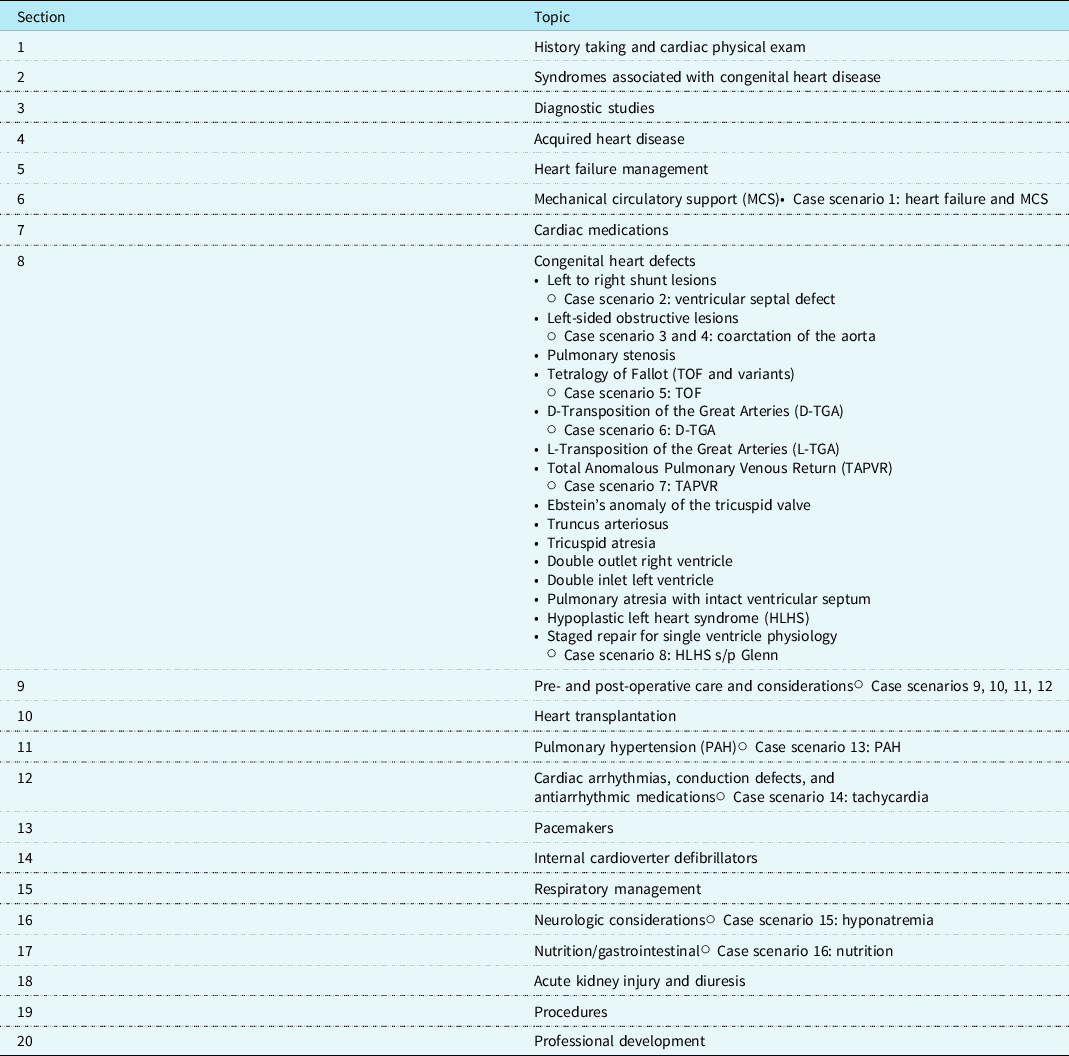
The subcommittee convened a focus group of cardiac ICU advanced practice providers who were identified through the education committee of Pediatric Cardiac Intensive Care Society. During this conference call focus group, the advanced practice providers identified educational topics necessary to practice as a cardiac ICU advanced practice provider (Table 1). The 20 identified content topics were divided amongst the subcommittee members and identified content experts, who completed reviews of literature and institutional practices, and then authored didactic chapters. Each chapter was distributed to additional advanced practice provider and physician content experts for extensive peer review. The chapters were compiled into an advanced practice provider curriculum book, which was published by Pediatric Cardiac Intensive Care Society in December 2017. Reference Callow and Justice22 The book serves as a reference for advanced practice providers regarding current practice and provides point of care education for complex cardiovascular defects, interventions, and follow-up. Embedded case scenarios encourage individual evaluation of critical thinking and decision-making, promoting confidence, and identifying areas of need for additional learning.
Topics included in PCICS APP curriculum.

Review courses
While concurrently publishing the curriculum textbook, didactic and simulation review courses were developed in order to provide in-person instruction, increase understanding of the PCICS APP curriculum content, and promote critical thinking and decision-making. Review course participants were asked to complete a post-course survey to evaluate participant demographics and the effectiveness of the course content. The Cincinnati Children’s Hospital Institutional Review Board reviewed the study and waived the need for approval (study ID 2021-0145).
The content for these courses includes three learning modalities: didactic lectures; unfolding, case-based, interactive scenarios; and simulation. The course material reviews and expands on the content of the Pediatric Cardiac Intensive Care Society advanced practice provider curriculum book. To ensure curriculum course content reflected broadly accepted management strategies and avoided institution or provider-specific bias, content underwent extensive peer-review by experts across multiple institutions. The peer-review team consisted of experienced cardiac ICU attending physicians and advanced practice providers. These content experts reviewed the review book content, unfolding case scenarios, and simulations to ensure that the educational content provided in all learning modalities was thorough, accurate, and applicable to patient management at all academic centres.
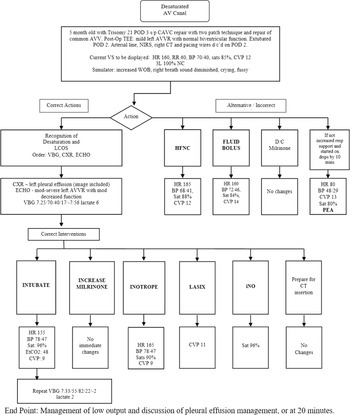
Course faculty developed eight simulation scenarios using a standardised simulation template created for the course (Fig 1). These scenarios were based on the frequency and/or high-stakes nature of critical events, including single ventricle management, acute heart failure, and post-operative emergencies. Goals and critical actions were identified for each scenario. For simulation scenarios, emergency team leadership was a focused learning point. The scenarios were reviewed by three cardiac ICU attending physicians with experience in simulation. Course faculty underwent standardised facilitator training, adapted from the Promoting Excellence and Reflective Learning in Simulation debriefing method, which was conducted by the simulation lead. Reference Bajaj, Meguerdichian, Thoma, Huang, Eppich and Cheng23 The Promoting Excellence and Reflective Learning in Simulation debriefing tool provides a framework and debriefing script to educate new simulation facilitators. The script provides open-ended questions that encourage simulation course participants to debrief their learning experience. The Promoting Excellence and Reflective Learning in Simulation method guides learners through the Reactions Phase, to reveal key areas that are important to them, the Description Phase, if needed to better understand the case scenario, and then the analysis phase. During the Analysis Phase, facilitators adapt to learners levels to guide scenario specific learning through reflection on the simulation. Lastly, the Summary Phase allows learners or facilitators to summarise the take away points learned from the scenario. Reference Bajaj, Meguerdichian, Thoma, Huang, Eppich and Cheng23 In order to standardise the scenarios across various course sites, items for simulation moulage (such as intravenous medications, central lines, and chest tubes) were collected for each scenario, organised by scenario, and transported to each course site by APP faculty. Host sites provided larger equipment including simulation manikins, ventilators, code carts, and defibrillators.
Example simulation scenario. Abbreviations in order of appearance: AV canal = atrioventricular canal defect; POD = post-operative day; AVV = atrioventricular valve; TEE = transesophageal echocardiogram; AVVR = atrioventricular valve regurgitation; NIRS = near infrared spectroscopy; CT = chest tube; d/c’d = discontinued; VS = vital signs; HR = heart rate; RR = respiratory rate; BP = blood pressure; sats = oxygen saturation; CVP = central venous pressure; NC = nasal cannula; WOB = work of breathing; LCOS = low cardiac output syndrome; VBG = venous blood gas; CXR = chest X-ray; ECHO = echocardiogram; HFNC = high flow nasal cannula; PEA = pulseless electrical activity; iNO = inhaled nitric oxide.

Results
A total of 403 participants have completed the review course and course sizes ranged from 16 to 47 participants. Participants represented 66 individual centres (63% of the Society of Thoracic Surgeons (STS) paediatric cardiothoracic surgery programmes who have APPs managing patients in the cardiac ICU). APPs did not have to be Pediatric Cardiac Intensive Care Society members to enroll in the course. The didactic review course was piloted in December 2017, and 11 additional courses have subsequently been conducted from December 2017 through January 2022. Eight of the courses were hosted in-person at host sites within the United States of America, and one of the courses took place at a hospital in Malaysia, where Pediatric Cardiac Intensive Care Society was invited to partner with Children’s Heartlink, an organisation that focuses on improving paediatric cardiology education in underserved parts of the world, to teach a group of English-speaking advanced nurses. Additionally, during the COVID-19 pandemic, three courses were hosted virtually. The didactic content continued to be provided live to participants during the virtual courses. Because learners could no longer participate in hands-on simulation, the simulation portion of the course was modified. For each scenario, a course faculty member was assigned as the bedside nurse and 1–2 participants were assigned the team leader role. Team leaders were instructed to take the lead managing patients, however the other participants were encouraged to offer suggestions and ask questions as needed. Vital signs continued to be displayed in real time through the virtual platform; however, learners had to ask the nurse questions about the physical exam, studies, and patient status to guide their management strategies. If imaging or labs (ECHO, chest X-ray, etc.) were requested, they were shared in real time through the virtual simulation platform to encourage real-time interpretation of data. As orders were given to the nurse for management, the vital signs changed appropriately as they would in an in-person simulation scenario and the nurse verbalised any changes to the patient status. In addition to the faculty member in the nurse role, there was also a second faculty member responsible for documenting patient status and interventions in real time in the chat box. This allowed learners with a strong preference for reading to be able to read the details of the scenario and review the documentation of how the patient had been managed during the simulation. Courses have varied from presenting didactic content only to a combination of didactic and simulation-based education, depending on the demographics, resources, and course time constraints.
A post-course evaluation was completed by participants at the completion of 10 of the 12 review courses (n = 314 participants). An abbreviated written survey was administered after the pilot course and more real-time verbal feedback was solicited in order to implement changes to future courses. Participants at the course in Malaysia, in lieu of completing a survey about course content, were instead asked to answer selected exam questions as part of pilot testing to collect data on item performance.
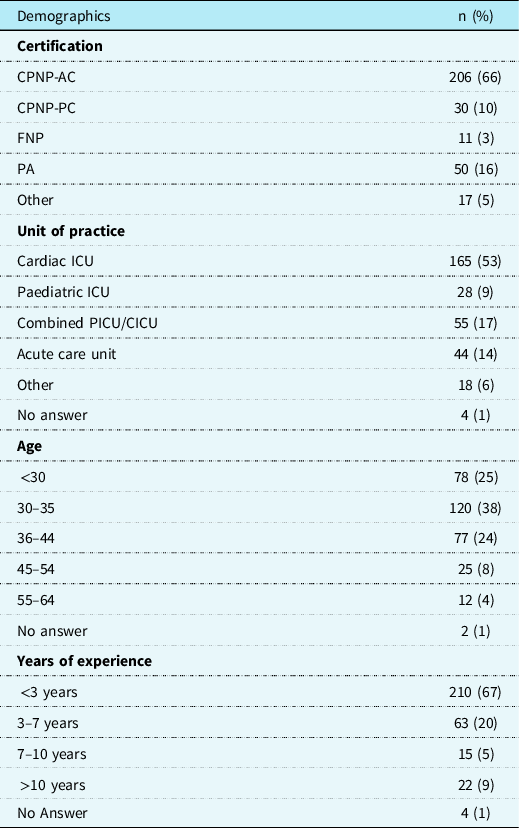
Of the 314 respondents, 206 were acute care paediatric nurse practitioners (ACPNPs, 66%), 30 primary care paediatric nurse practitioners (PCPNPs, 10%), 11 family nurse practitioners (FNPs, 3%), 50 PAs (16%), and 17 other (5%). Most participants work in a dedicated cardiac ICU (53%), are between 30 and 35 years old (38%), and have less than 3 years of experience as an advanced practice provider (67%) (Table 2). Fifty-one percent of participants reported that at the institutions where they worked, specific guidelines were not in place for orientation to their role.
Demographics of course attendees.

CPNP-AC = certified paediatric nurse practitioner, acute care; CPNP-PC = certified paediatric nurse practitioner, primary care; FNP = family nurse practitioner; PA = physician assistant; CICU = cardiac ICU; PICU = paediatric ICU.
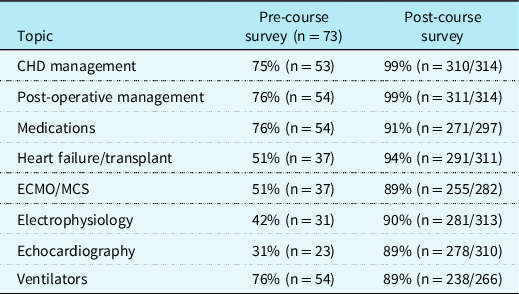
On the post-course evaluation, 97% of course attendees agreed or strongly agreed that the course improved their clinical knowledge, 97% agreed or strongly agreed that the course improved their ability to care for patients, and 88% agreed or strongly agreed that the course improved their confidence to practice. Attendees were also asked to rate the effectiveness of the course content to provide the knowledge and training needed for specific topics. The course education was rated as good or excellent by 90% of participants for electrophysiology, 89% for echocardiography, 99% for CHD anatomy, 99% for post-operative management, 91% for medications, and 89% for ventilation strategies. This was higher for all topics when compared with the responses from the pre-course survey (Table 3). For the survey question rating the overall effectiveness of the PCICS APP Curriculum course, 49% of attendees rated it as extremely effective, 42% as very effective, 6% as moderately effective, and 3% as slightly effective.
Comparison of percent of respondents who rated their training as good or excellent for specific topics.

ECMO = extracorporeal membrane oxygenation; MCS = mechanical circulatory support.
Simulations occurred at 10 of the 12 review courses (7 in-person and 3 virtual) and 270 participants completed post-course evaluations. In the survey responses specific to the simulation scenarios, 65% (n = 175) of participants strongly agreed and 31% (n = 83) agreed that the simulation scenarios were realistic. Additionally, 47% (n = 127) strongly agreed and 40% (n = 108) agreed that the course improved their ability to function in the team leader role. These results were maintained during the three virtual courses compared to the in-person courses. The simulation scenarios allowed participants to apply knowledge to clinical situations to reinforce the didactic content from the course. Course evaluations indicated that the interactive nature of the course was beneficial as learners frequently commented that simulations and unfolding case scenarios were their favourite component of the course, even when the simulations were transitioned to a virtual learning experience.
Discussion
The PCICS APP curriculum has demonstrated that standardised learning can be used to improve CICU APP critical thinking, decision-making, and confidence. The development and implementation of a CICU APP subspecialty curriculum has been a process of extensive collaboration by advanced practice providers and other multidisciplinary clinicians across various institutions. In comparison with the results of the pre-course needs assessment, attendees at the PCICS APP curriculum review courses had a higher perceived understanding of all topics that were presented compared to pre-course survey respondents. Reference Justice, Callow, Loomba, Harvey, FitzGerald and Cooper1 This was especially evident for electrophysiology, echocardiography, heart failure/transplant, and mechanical circulatory support. Reference Justice, Callow, Loomba, Harvey, FitzGerald and Cooper1 These findings align with outcomes from other critical care APP boot camps, which demonstrated improved knowledge on a pre-post course exam and a self-perceived improvement in knowledge and skills. Reference Brown, Mudd and Hunt24–Reference Ahmed, Botsch and Ballas26 In addition, the attendees of the PCICS APP curriculum courses rated the effectiveness of the education they received at the course higher than that of the education received during their worksite orientation. Feedback from course attendees emphasised the value of networking with advanced practice providers from other institutions, learning from one another, and collaborating on practice issues encountered across work settings.
Feedback also supported use of simulation and case-based scenarios for discussion, sharing of experiences and practices, critical thinking, and decision-making. These two components of the courses were cited as attendees’ favourite aspects, and were perceived as the most effective educational modalities for further building upon didactic education and enabling learners to apply the reviewed concepts to clinical scenarios. This experiential learning allows learners to have a concrete learning experience, reflect on the experience, analyse the experience and learnings, and then translate the experience, reflections, and new ideas into practice. Reference Kolb19,Reference Armstrong and Parsa-Parsi20 Additionally, simulation allows participants with different learning styles opportunity for visual, auditory, and kinesthetic processing rather than traditional didactic education. Reference Fleming and Baume27 Previous simulation studies in cardiac critical care have demonstrated that simulation improves knowledge, teamwork, communication, and subjective confidence caring for cardiac ICU patients. Reference Emani, Allan and Forster28–Reference Kane, Pye and Jones32
While the majority of cardiac ICU advanced practice providers are acute care paediatric nurse practitioners, there are a limited number of family nurse practitioners and primary care paediatric nurse practitioners who practice in the cardiac ICU or Acute Care Cardiology inpatient advanced practice provider role, and some of these individuals attended the review course. Reference Justice, Callow, Loomba, Harvey, FitzGerald and Cooper1,Reference Freed, Dunham and Lamarand33 Non-acute care nurse practitioner certifications do not include training in critical care, but participation in this course increases their knowledge of paediatric cardiac critical care, which expands on their initial nurse practitioner training. Our findings included that 10% of course participants were primary care paediatric nurse practitioners, which aligns with previously published literature regarding scope of practice for primary care paediatric nurse practitioners. Reference Freed, Dunham and Lamarand33
While other cardiac ICU institutional boot camps have been described, this is the first known mobile and/or virtual simulation experience developed for implementation at various host sites. Reference Brown, Mudd and Hunt24,Reference Allan, Tannous and DeWitt29,Reference Ceresnak, Axelrod, Sacks, Motonaga, Johnson and Krawczeski34,Reference Nishisaki, Hales and Biagas35 Collaboration with host sites went smoothly and allowed standardisation between courses. The ability to standardise simulation scenarios and learning experiences for cardiac ICU advanced practice providers throughout the country adds to the value of the PCICS APP curriculum. It has also provided a valuable simulation and cardiac critical care networking experience for host sites and course faculty. Unfolding scenarios were also an effective teaching method and offered a low fidelity option for an engaging small group experience and more exposure to complex topics beyond the lecture format. These scenarios give the learner the opportunity to think through specific physiologies in a case-based learning format to improve recognition and critical thinking, a concept previously shown to be effective. Reference Yoo and Park36 This model of mobile, standardised simulation, and case-based learning to improve critical thinking could be adopted for advanced practice providers in other subspecialties.
Future plans
In the future, a PCICS APP Curriculum exam will be offered for course participants and advanced practice providers though PCICS. Pediatric Cardiac Intensive Care Society partnered with the Pediatric Nursing Certification Board to develop a 200 question post-assessment (exam) bank using item-writing best practices. Objective data regarding comprehension of the curriculum content will be collected after initiation of the exam. Any advanced practice provider who takes the exam and receives a passing score of 80% or higher will receive continuing education credit and a certificate of completion.
In addition, it is hoped that partnerships with cardiac ICU nursing and fellow participants in simulation learning sessions will increase team collaboration. Shared medical and nursing learning models will serve to elevate decision-making in rapidly evolving clinical situations in real-life care team configurations. Also, as proven by successful implementation of the advanced practice provider curriculum in Malaysia, interest exists in low- and middle-income countries for delivery of standardised bedside nursing and advanced practice provider education; therefore, it is a future goal to have the curriculum translated into other languages. Another consideration for future study is to evaluate if there is an increased improvement in knowledge with the non-ACPNPs given their lack of acute care training, or if they are potentially less prepared to receive the content and therefore have more perceived discomfort or less knowledge acquisition.
Limitations
Evaluation of the PCICS APP Curriculum courses was limited to a single point in time at the conclusion of attendance at a course and long-term retention was not evaluated. This study sample was derived from respondents with a breadth of experience levels working at various institution sizes and unit types, but the sample is limited by representation from only 63% of possible institutions possibly leading to potential sample bias. In addition, this data may also be affected by the limitation of self-assessment, because the self-perceived improvement in knowledge was evaluated rather than testing knowledge acquisition by performing a pre- and post-course knowledge assessment exam. Furthermore, we are unable to directly compare the pre-course needs assessment with the post-course surveys completed by course attendees because they were completed by different groups.
Conclusions
Ongoing assessment of advanced practice provider post-degree didactic and simulation learning needs is necessary. The PCICS APP Curriculum Program provides standardised learning and can be used to improve cardiac ICU advanced practice provider critical thinking and decision-making. The APP curriculum book and courses have received positive feedback regarding knowledge acquisition, practice improvement, and confidence maturation. Improvement in advanced practice provider education and professional development can aid in the provision of high-quality, accessible paediatric cardiac ICU care in the dynamic, and challenging health care environment.
Supplementary material
To view supplementary material for this article, please visit https://doi.org/10.1017/S1047951122002542
Acknowledgements
None.
Financial support
This research received no specific grant from any funding agency, commercial, or not-for-profit sectors.
Conflicts of interest
None.