Introduction
The Unterberger test forms part of the formal neuro-otological assessment of most dizzy patients.Reference Grommes and Conway1 It is usually performed by asking a subject to close their eyes and march on the spot with their arms outstretched in front of them. A rotation of 30° or greater after 50 steps is considered significant, suggesting a peripheral vestibular deficit towards the side of rotation.Reference Bonanni and Newton2
The accuracy of this test, however, is entirely dependent on an observer's ability to accurately estimate the subject's degree of rotation. Whilst a number of methods have been used to accurately assess rotation, these are seldom used in everyday clinical practice.Reference Bonanni and Newton2, Reference Honakar and Shepard3 We therefore conducted this study to compare the degree of rotation recorded using a novel mobile phone application, DplusR Balance, with values estimated by clinicians and supporting medical staff.
Materials and methods
The DplusR Balance application was installed on an iPhone® 4. The application records the degree of rotation of the iPhone in the horizontal plane for a period determined by the examiner.
Staff of the ENT directorate were invited to participate in this study. A volunteer performed the Unterberger test 10 times with arms outstretched in front, holding the phone running the application with both hands in the horizontal plane (Figure 1). The volunteer was asked to deliberately rotate in either direction over the course of 50 steps. At the end of each test, observers were asked to estimate and record the degree of rotation of the volunteer.
The mobile phone was held as illustrated and the subject was asked to march on the spot for 50 steps

Estimates from assessors were entered into a spreadsheet and compared with the extent of rotation recorded by the application.
Results
Twenty-five participants took part in this study. These comprised ENT consultants (n = 3), an ENT associate specialist (n = 1), ENT staff (n = 3), ENT registrars (n = 2), foundation year trainees (n = 6), audiology staff (n = 6) and ENT medical support staff (n = 5).
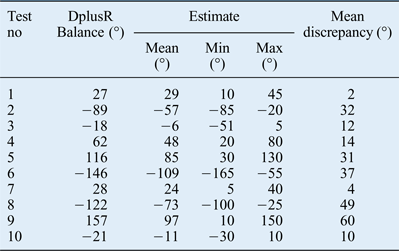
Average estimates of rotation for each of the 10 Unterberger tests and results recorded using the DplusR Balance application are listed in Table I. A wide range of estimates was obtained for each test, with individual observations differing by up to 147° from data recorded by the application. Despite this, the extent of rotation was generally underestimated. The average discrepancy in estimates from the true degree of rotation in all 10 tests was 30°. The grade, and hence seniority, of the medical staff had no bearing on the accuracy of estimates.
DplusR balance versus estimated degree of rotation
No = number; Min = minimum; Max = maximum
Discussion
A formal neuro-otological examination involves performing a variety of clinical tests.Reference Grommes and Conway1 Through a combination of history taking, clinical examination and appropriate special investigations, a diagnosis can be established and a management pathway mapped.
A stepping test, for example the Unterberger test, is often used, with rotation towards one side suggesting a peripheral vestibular deficit.Reference Bonanni and Newton2, Reference Honakar and Shepard3 A significant degree of rotation during these tests is generally accepted to be 30° and above.Reference Bonanni and Newton2 Although a variety of factors that may affect the sensitivity and specificity of this test have been described, we are not aware of any previously published data comparing observer estimates with more accurate methods of calculating the extent of rotation.Reference Hickey, Ford, Buckley and Fitzgerald O'Connor4
• Stepping tests form part of peripheral vestibular function assessment
• Hypofunction results in the patient rotating to the ipsilateral side
• Poor sensitivity and specificity of these tests has been reported
• Our results highlight the need for a more robust method of measurement for stepping tests
• We recommend the use of the DplusR Balance application or alternative objective methods to improve the accuracy of this clinical examination
The results of this study suggest that observers estimate the degree of rotation poorly, even to the extent that a test may be considered falsely positive or falsely negative. This, in turn, may compromise diagnostic accuracy and appropriate patient management. Furthermore, more experienced assessors do not necessarily estimate rotation more accurately.