





1. Introduction
Hyper-energetic supernovae, Wolf-Rayet stars, red supergiants, massive stellar black holes, neutron stars, long-duration gamma-ray bursts, and the recently detected gravitational wave sources are all direct descendants of massive OB stars (Woosley et al. Reference Woosley, Heger and Weaver2002). Despite their crucial role in driving the chemical and dynamical evolution of galaxies and the Universe, the evolutionary pathways of massive stars remain poorly known (Langer Reference Langer2012).
To fully assess the impact of massive stars on the Universe, we must understand their physics and evolutionary behaviour. However, large uncertainties still persist in our understanding of these objects that prevent us from fully understanding how massive stars impact other areas of Astrophysics. Key factors such as rotation, stellar winds and mass loss dramatically affect their evolution. In addition to uncertainties related to individual models, massive stars are usually born in multiple systems (Sana et al. Reference Sana, de Mink and de Koter2012), where the components are close enough to interact during their lifetime. As a result, the possible channels of evolution and final fate are multiplied (de Mink et al. Reference de Mink, Langer, Izzard, Sana and de Koter2013), and their frequency needs to be determined.
Star-forming regions represent ideal laboratories to study the processes of massive star formation, evolution and their interaction with the interstellar medium (ISM) as they host large populations of OB stars observable across the entire electromagnetic spectrum that can be analyzed. The availability of extensive multi-wavelength and multi-epoch observational datasets, combined with the analysis of large samples of high-quality OB-star spectra, offers a powerful means to constrain their physical properties and evolutionary states.
Multi-wavelength observations are particularly valuable, as each spectral domain probes different physical processes and layers of the stellar atmosphere and its surroundings. By combining data from different wavelength ranges, we can obtain the most reliable constraints on key stellar parameters, such as effective temperature (T $_{eff}$), surface gravity (
 $\log{g}$), rotational velocity (
 $v\sin{i}$), mass-loss rate (
 $\dot{M}$), wind clumping, helium abundance (He), and metallicity (Z), which are all key ingredients to unravel the evolutionary channels of massive stars.
Within this context, the Multi-wavelength Exploration of massIve star-forminG regions and Associations (MEIGAS) project aims at performing comprehensive studies in the major star-forming regions and OB associations through multi-wavelength observations. Benefiting from current and forthcoming data from large-scale spectroscopic surveys such as WEAVE (Jin et al.Reference Jin, Trager and DaltonJin, Trager, Dalton, Aguerri, Drew, Falcón-Barroso, Gänsicke, Hill, Iovino, Pieri, Poggianti, Smith, Vallenari, Abrams, Aguado, Antoja, Aragón-Salamanca, Ascasibar, Babusiaux, Balcells, Barrena, Battaglia, Belokurov, Bensby, Bonifacio, Bragaglia, Carrasco, Carrera, Cornwell, Domínguez-Palmero, Duncan, Famaey, Fariña, Gonzalez, Guest, Hatch, Hess, Hoskin, Irwin, Knapen, Koposov, Kuchner, Laigle, Lewis, Longhetti, Lucatello, Méndez-Abreu, Mercurio, Molaeinezhad, Monguió, Morrison, Murphy, Peralta de Arriba, Pérez, Pérez-Ràfols, Picó, Raddi, Romero-Gómez, Royer, Siebert, Seabroke, Som, Terrett, Thomas, Wesson, Worley, Alfaro, Allende Prieto, Alonso-Santiago, Amos, Ashley, Balaguer-Nú 2024), 4MOST (de Jong Reference de Jong2011), GES (Randich et al. Reference Randich, Gilmore and Magrini2022; Gilmore et al. Reference Gilmore, Randich and Worley2022), GOSSS (Maíz Apellániz Reference Maíz Apellániz2010) or IACOB (Simón-Díaz et al. Reference Simón-Díaz, Castro and Herrero2011), as well as complementary observations at different wavelength ranges (e.g., from XShootU and BLOeM, see Vink et al. Reference Vink, Mehner and Crowther2023; Shenar et al. Reference Shenar, Bodensteiner and Sana2024), the project aims to achieve crucial and complementary information to adequately characterize these regions and their stellar content, something imperative to improve our understanding of star formation and poorly known evolutionary pathways of massive stars.
2. MEIGAS I: The universality of the vsini distribution
The first phase of MEIGAS is focused on determining, for the first time ever, whether the empirical rotational distribution of massive O-type stars is universal – as theory predicts (see de Mink et al. Reference de Mink, Langer, Izzard, Sana and de Koter2013; de Mink et al. Reference de Mink, Sana, Langer, Izzard and Schneider2014) – or not, as suggested by recent findings in two of the main Galactic young OB associations, Cygnus OB2 and Carina OB1 (see Berlanas et al. Reference Berlanas, Herrero and Comerón2020; Berlanas et al. Reference Berlanas, Mahy and Herrero2025). MEIGAS will inspect rotational properties of their massive stellar populations in different environments, providing the key chance to estimate the frequencies associated to the different evolutionary channels. These frequencies are written in the rotational distribution and in the stellar properties and abundances, and although the census of possible evolutionary scenarios is not yet complete, we aim for a first empirical estimation.
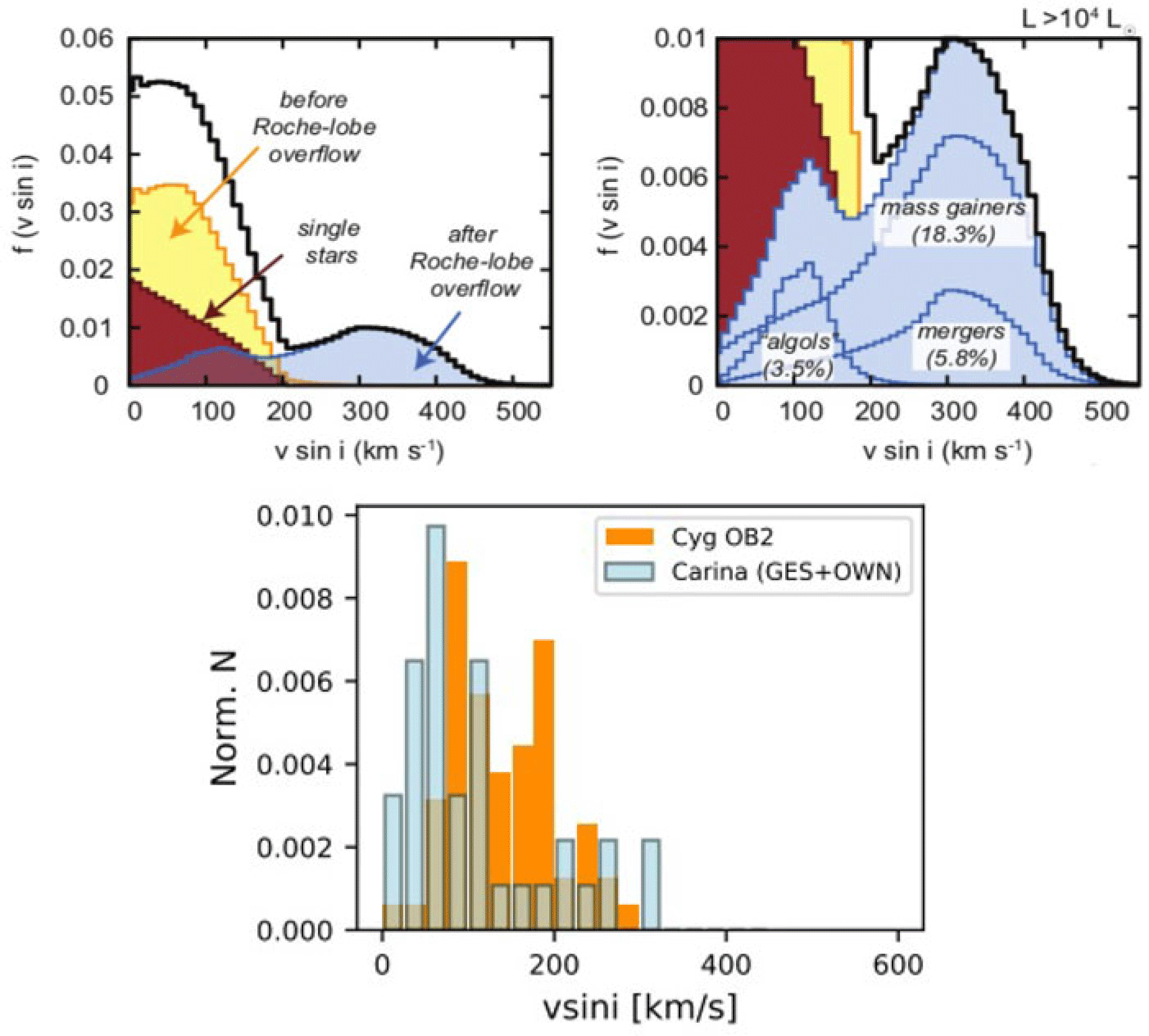
In recent years, considerable effort has been invested in empirically establishing the full distribution of rotational velocities of massive OB stars in different environments. Studies conducted in large regions such as the Milky Way (Simón-Díaz et al. Reference Simón-Díaz, Herrero and Sabín-Sanjulián2014; Holgado et al. Reference Holgado, Simón-Díaz, Herrero and Barbá2022) and the 30 Doradus region in the Large Magellanic Cloud (Ramírez-Agudelo et al. Reference Ramírez-Agudelo, Simón-Díaz and Sana2013) have reported a similar bimodal distribution, consistent with the theoretical predictions of de Mink et al. (Reference de Mink, Langer, Izzard, Sana and de Koter2013); de Mink et al. (Reference de Mink, Sana, Langer, Izzard and Schneider2014) (see top panels of Fig. 1). However, similar spectroscopic studies in young OB associations such as Cygnus OB2 (within the Cygnus-X complex, see Berlanas et al. Reference Berlanas, Herrero and Comerón2020) and Car OB1 (within the Carina Nebula, see Berlanas et al. Reference Berlanas, Mahy and Herrero2025) found a significant difference: a lack of fast rotating O stars (see bottom panel of Fig. 1), a fact that poses a serious problem for present-day evolutionary models and scenarios of massive stars.
From de Mink et al. (Reference de Mink, Langer, Izzard, Sana and de Koter2013) (top panels) and Berlanas et al. (Reference Berlanas, Mahy and Herrero2025) (bottom panel). Projected rotation rate ( $v\sin{i}$) distribution for massive O stars assuming continuous star formation. The top-right panel shows the cumulative distribution function indicating the possible evolutionary scenarios related to current rotational velocities. The top-left panel shows the full distribution function indicating the expected frequency of post-binary interaction. The bottom panel shows the empirical distribution for the O-star population in Cygnus OB2 and Carina OB1, evidencing a clear lack of fast rotators.

Figure 1 Long description
The image contains three graphs. Panel A: A histogram showing the distribution of projected rotation rates (v sin i) for massive O stars. The x-axis represents v sin i in kilometers per second, and the y-axis represents the frequency (f). The graph includes regions labeled 'before Roche-lobe overflow,' 'single stars,' and 'after Roche-lobe overflow.' Panel B: A cumulative distribution function indicating the possible evolutionary scenarios related to current rotational velocities. The x-axis represents v sin i in kilometers per second, and the y-axis represents the cumulative frequency (f). The graph includes regions labeled 'mass gainers,' 'algols,' and 'mergers.' Panel C: A histogram comparing the empirical distribution of the O-star population in Cygnus OB2 and Carina OB1. The x-axis represents v sin i in kilometers per second, and the y-axis represents the normalized number (Norm. N). The graph includes two datasets: one for Cygnus OB2 and one for Carina (GES+OWN).
MEIGAS will exploit already available data from, e.g., IACOB, GES, GOSSS, XShootU, BLOeM and our own multi-wavelength spectra, together with the imminent arrival of high-quality spectra from large spectroscopic surveys such as WEAVE and 4MOST. Complementarily, current and forthcoming Gaia data releases will provide crucial astrometric and photometric information. This combined multi-survey approach will enable the extension of the work we conducted in Cygnus OB2 and Carina OB1 (see Berlanas et al. Reference Berlanas, Herrero and Comerón2018a; Berlanas et al. Reference Berlanas, Herrero and Comerón2018b; Berlanas et al. Reference Berlanas, Wright, Herrero, Drew and Lennon2019; Berlanas et al. Reference Berlanas, Herrero and Comerón2020; Herrero et al. Reference Herrero, Berlanas and Gil de Paz2022; Berlanas et al. Reference Berlanas, Maíz Apellániz and Herrero2023; Berlanas et al. Reference Berlanas, Mahy and Herrero2025) to the whole Cygnus-X and Carina complexes, as well as a detailed exploration of other major Galactic and near extragalactic star-forming regions at different wavelength ranges. This way, it will be possible to verify whether the significant differences found in both regions are due to specific environment properties related to young OB associations, such as incompleteness, extinction, or stellar ejections. The adding of two further extragalactic environments (LMC, SMC) will serve to address possible metallicity effects on the distribution.
Main objectives of MEIGAS I: The universality of the vsini distribution are:
(1) Inspect whether the significant differences found in Cygnus OB2 and Carina OB1 arise from specific environmental properties associated with young OB associations. Since completeness on the stellar census is crucial for this study, infrared observations and the identification of possible runaway stars ejected at high velocity from the core of stellar associations must be carefully addressed.
-
(2) Assess whether the same deficiency of fast-rotating stars is found in other young star-forming regions, both within our Galaxy and beyond. Benefiting from already available high-quality spectroscopic data from surveys focused on massive stars, together with the imminent arrival of a huge amount of high-quality spectra from WEAVE and 4MOST, we are expanding research to the whole complexes, Cygnus-X and the Carina Nebula. Furthermore, we will be able to extend research to other Galactic massive associations, such as NGC 6611, NGC 3603, Westerlund 1 and 2 or the Vela, Orion and Monoceros regions. The adding of two further near extragalactic environments (LMC and SMC) to the study will serve to address possible metallicity effects on the universality of the distribution of rotational velocities.
3. Current status
We are conducting infrared observations in Cygnus OB2 and Carina OB1 using the EMIR and KMOS instruments at the GTC and VLT, respectively, to uncover the heavily obscured young massive population in these regions. Moreover, a detailed spectroscopic analysis is underway for a high-confidence sample of runaway candidates around Cygnus OB2, selected based on precise Gaia DR3 astrometry and complementary observations. Notably, both the obscured members and the confirmed runaway populations in these associations may account for the missing population of fast rotators. In that case, we would recover the predicted rotational velocity distribution, suggesting that the frequencies of the possible evolutionary pathways are intrinsically similar but modulated by environmental conditions.
In parallel, WEAVE, the new multi-object spectrograph (MOS, which is currently in its commissioning phase) for the 4.2-m William Herschel Telescope in la Palma, includes the Stellar, Circumstellar and Interstellar Physics (SCIP) survey, which will exploit its MOS capabilities to obtain mid-resolution spectra for thousands of stars along the northern Galactic disc. In addition, SCIP incorporates a dedicated high-resolution survey in the Cygnus-X complex, which will provide hundreds of multi-epoch spectra across the region. Complementarily, 4MOST, the new fibre-fed spectroscopic facility on the VISTA telescope, achieved its first light just a few weeks ago and will soon begin large-scale surveys of the southern sky, including key massive star-forming regions such as the Carina Nebula. Our membership in both collaborations will ensure early access to the datasets, allowing us to promptly integrate and analyse the forthcoming observations within the framework of the MEIGAS project.
4. Summary
MEIGAS will not only provide new empirical constraints on massive-star evolution but will produce an impact across many fields of Astrophysics, from star and planet formation to galaxy and cluster evolution. This project will assess, for the first time ever, the universality of the rotational distribution of massive O stars and establish the relative frequency of the different channels of binary evolution under well-known, homogeneous conditions, thus resolving a serious problem for present-day evolutionary models and scenarios of massive stars. Moreover, by establishing whether the distribution is environment-dependent or an universal function, this project will provide the necessary constraints for next-generation population synthesis models that are fundamental to simulating galaxy formation and evolution across cosmic time.
 vsini

 Open access

