Introduction
While adolescence is generally a period of good physical health, many young lives are lost prematurely to suicide (Hawton, Saunders, & O'Connor, Reference Hawton, Saunders and O'Connor2012; Turecki & Brent, Reference Turecki and Brent2016). Suicide is one of the leading causes of mortality in young people worldwide, ranking second for ages 10–24 years and taking more lives than any one disease-related cause (Patton et al. Reference Patton, Coffey, Sawyer, Viner, Haller, Bose and Mathers2009). While suicide is rare in childhood and early adolescence (Sheftall et al. Reference Sheftall, Asti, Horowitz, Felts, Fontanella, Campo and Bridge2016), there is a sharp increase in rates during mid-adolescence to young adulthood, especially in boys (Kõlves & De Leo, Reference Kõlves and De Leo2015; Malone, Quinlivan, Grant, & Kelleher, Reference Malone, Quinlivan, Grant and Kelleher2013; McLoughlin, Gould, & Malone, Reference McLoughlin, Gould and Malone2015; Nock et al. Reference Nock, Borges, Bromet, Cha, Kessler and Lee2008b). Such a rapid increase suggests that the transition from adolescence to early adulthood is a period of heightened vulnerability to suicide.
Non-fatal suicide attempts are more common than deaths by suicide, with lifetime prevalence in youth rates around 4–10.5% (Brezo et al. Reference Brezo, Paris, Barker, Tremblay, Vitaro, Zoccolillo and Turecki2007; McLoughlin et al. Reference McLoughlin, Gould and Malone2015; Nock et al. Reference Nock, Green, Hwang, McLaughlin, Sampson, Zaslavsky and Kessler2013). Non-fatal suicide attempts are a risk factor for subsequent attempts and mortality (Bostwick, Pabbati, Geske, & McKean, Reference Bostwick, Pabbati, Geske and McKean2016; Ribeiro et al. Reference Ribeiro, Franklin, Fox, Bentley, Kleiman, Chang and Nock2016; Wang et al. Reference Wang, Swaraj, Chung, Stanton, Kapur and Large2019). Several longitudinal studies have reported that suicidal ideation and/or suicide attempts increase during adolescence, reach a peak in mid-adolescence and decline by the end of adolescence and emerging adulthood, contrasting in pattern with the rise in actual suicide mortality observed during late adolescence/early adulthood (Dhossche, Ferdinand, van der Ende, Hofstra, & Verhulst, Reference Dhossche, Ferdinand, van der Ende, Hofstra and Verhulst2002; Lewinsohn, Rohde, Seeley, & Baldwin, Reference Lewinsohn, Rohde, Seeley and Baldwin2001; Nock et al. Reference Nock, Borges, Bromet, Cha, Kessler and Lee2008b; Rueter & Kwon, Reference Rueter and Kwon2005; Steinhausen, Bosiger, & Metzke, Reference Steinhausen, Bosiger and Metzke2006). While these studies inform on the overall prevalence of suicide attempts at the population level, they do not capture individual heterogeneity in the incidence and progression of suicide attempts over time. As far as we are aware, only one community-based study identified longitudinal developmental profiles of suicide attempts from mid-adolescence to young adulthood (Thompson & Swartout, Reference Thompson and Swartout2018). The study identified two distinct trajectory profiles: an adolescence-limited profile including youth with a high probability of suicide attempts in adolescence but not in adulthood (5%) and a persistent profile including youth with a high probability of suicide attempts lasting into young adulthood (1%). However, it is unclear which pre- and early-adolescent risk factors might predict trajectory. Clarifying whether these trajectories might be replicated in another population-based cohort and identifying independent markers in pre-and early-adolescence could inform preventive intervention and help to better identify individuals at greater risk of suicide mortality.
Using a longitudinal representative sample, we aimed to: (1) identify trajectories of suicide attempts over an 11-year period spanning early adolescence (age 12) to emerging adulthood (age 23) and (2) identify pre- and early-adolescent risk factors at/before the onset of suicide attempts.
Methods
Participants
The National Longitudinal Survey of Children and Youth (NLSCY) is a prospective cohort of Canadian children followed from childhood to early adulthood. The first cycle started with children aged 0–11 years in 1994–95. The participants were followed every 2 years, including 8 cycles of data collection (Cycle 1 in 1994–95 to Cycle 8 in 2008–09). The cohort is considered nationally representative, with the exception of children living on First Nations reserves or Crown lands, in institutions and in remote regions. Details about the cohort, including study design and response rates (above 80% for all Cycles except Cycle 8 in 2008–09) can be found online.
We studied participants age 7–11 in Cycle 1, with long-term follow-up to age 23 or Cycle 8, whichever came first. We excluded participants without an answer to the question on suicide attempts (yes or no) for at least two time points: once in adolescence (12–17 years) and once in emerging adulthood (18–23 years). Cycles 2 to 8 were linked by age to obtain a dataset with information on suicide attempts from early adolescence at age 12 years to emerging adulthood at age 23 years.
The original Cycle 1 cohort included 8698 participants aged 7–11 years. Of these, we excluded 6465 from our study sample for the lack of answers to the suicide attempts question. This left 2233 participants for analysis. As compared to the excluded group, analysed participants were less likely to be male (46.5% v. 52.9%; χ2 = 27.21; p < 0.001); to have a mother who did not complete high school (13.4% v. 18.2%; χ2 = 27.43; p < 0.001); or to come from low-income families, as defined by Statistics Canada low-income cut-offs (13.7% v. 24.3%; χ2 = 111.38; p < 0.001). We weighted all estimates to account for sampling design and non-response.
The NLSCY protocol was approved by Statistics Canada and the Social Sciences and Humanities Research Council of Canada. Written informed consent was obtained for all participants, from their mothers (or persons most knowledgeable) for child participants and from the same participants as young adults.
Measures
Suicide attempts
Participants who had seriously considered suicide in the past 12 months were asked: ‘During the past 12 months, how many times did you attempt suicide?’ The answer was coded as ‘Never’ or ‘At least one attempt’.
Pre-and early adolescent risk factors
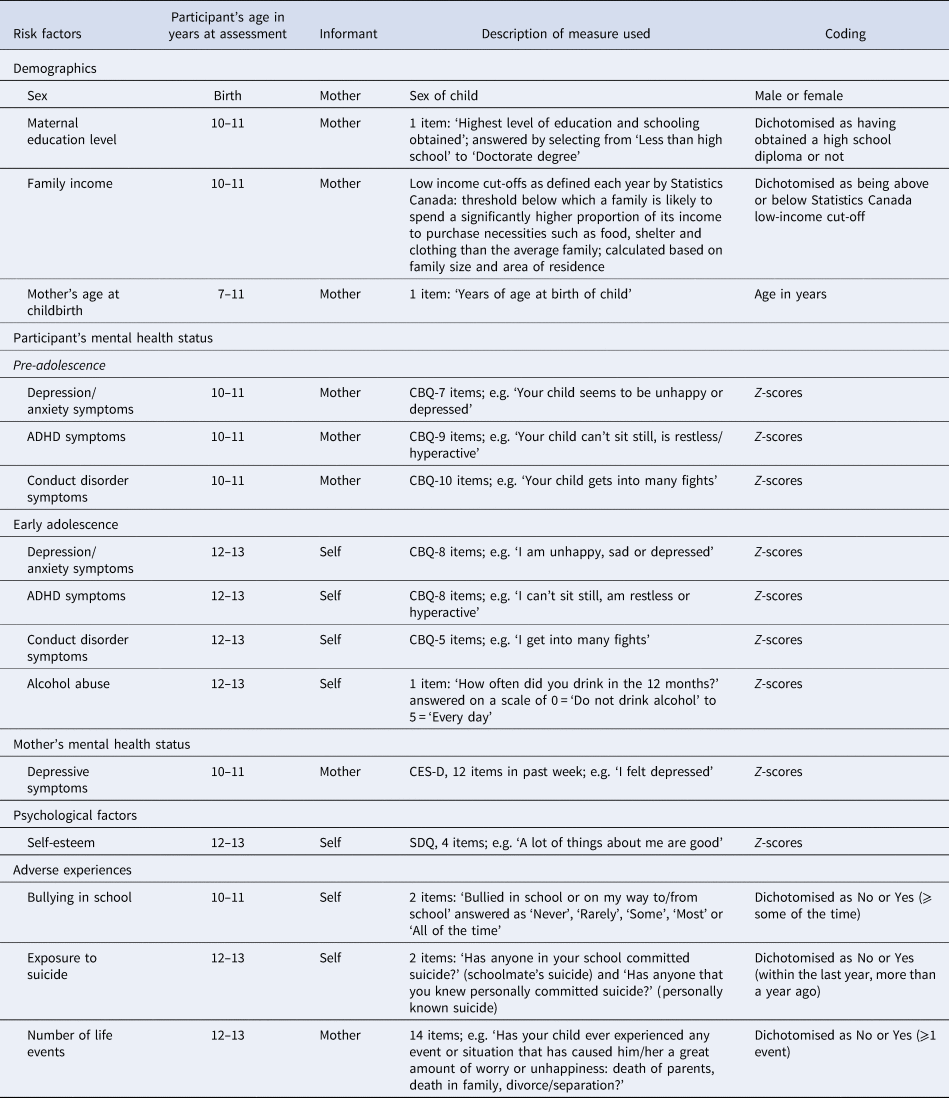
We selected a wide range of risk factors based on their association with suicide attempts in previous studies (Franklin et al. Reference Franklin, Ribeiro, Fox, Bentley, Kleiman, Huang and Nock2017; Mars et al. Reference Mars, Heron, Klonsky, Moran, O'Connor, Tilling and Gunnell2019a). These included sociodemographic factors, mental health symptoms and adverse experiences (see Table 1).
Risk factors documented in NLSCY data

CBQ, Children's Behaviour Questionnaire (CBQ, Child and Parent form) is a validated scale incorporating items from the Child Behaviour Checklist (Achenbach, Edelbrock, & Howell, Reference Achenbach, Edelbrock and Howell1987), the Ontario Child Health Study (Offord, Boyle, & Racine, Reference Offord, Boyle and Racine1989) and the Preschool Behaviour Questionnaire (Tremblay, Desmarais-Gervais, Gagnon, & Charlebois, Reference Tremblay, Desmarais-Gervais, Gagnon and Charlebois1987). All items were rated on a 3-point scale (0 = ‘Never or not true’; 1 = ‘Sometimes or somewhat true’; 2 = ‘Often or very true’); CES-D, Center for Epidemiologic Studies Depression Scale (CES-D, self-report) assessed depressive symptoms in the general population (Radloff, Reference Radloff1977). All items were rated (0 = ‘Rarely or never’; 1 = ‘Some of the time’; 2 = ‘Occasionally’; 3 = ‘Most of the time’); SDQ, Self-Description Questionnaire (SDQ, General self-scale) assessed adolescents' self-perception, level of self-confidence and self-respect and level of pride and satisfaction with themselves as individuals (Marsh, Smith, & Barnes, Reference Marsh, Smith and Barnes1983). All items were on rated on a 5-point scale (0 = ‘False’, 1 = ‘Mostly false’, 2 = ‘Sometimes false/sometimes true’, 3 = ‘Mostly true’, 4 = ‘True’); ADHD, attention-deficit/hyperactivity disorder; NLSCY, National Longitudinal Survey of Children and Youth.
Statistical analysis
Statistical analysis was a 4-step process. We first described the prevalence of suicide attempts from ages 12–23 years. Second, we used growth mixture modelling with the Mplus statistical modelling program (Muthén & Muthén, Reference Muthén and Muthén2000) to identify distinct trajectories of suicide attempts. We estimated a series of models including 1–5 trajectory groups. We identified the best-fitting model using Bayesian information criteria, Lo-Mendell-Rubin adjusted likelihood ratio tests (LMR-LRT) and entropy. Third, we conducted univariable logistic regressions adjusting for sex to determine associations between risk factors and trajectory. Fourth, we conducted multivariable multinomial logistic regressions to determine risk factors independently associated with trajectory. Risk factors with p < 0.10 in univariate analyses were selected for multivariable analyses. In all analyses, missing data were handled using the full information maximum likelihood method.
Results
Trajectories: developmental course of suicide attempts
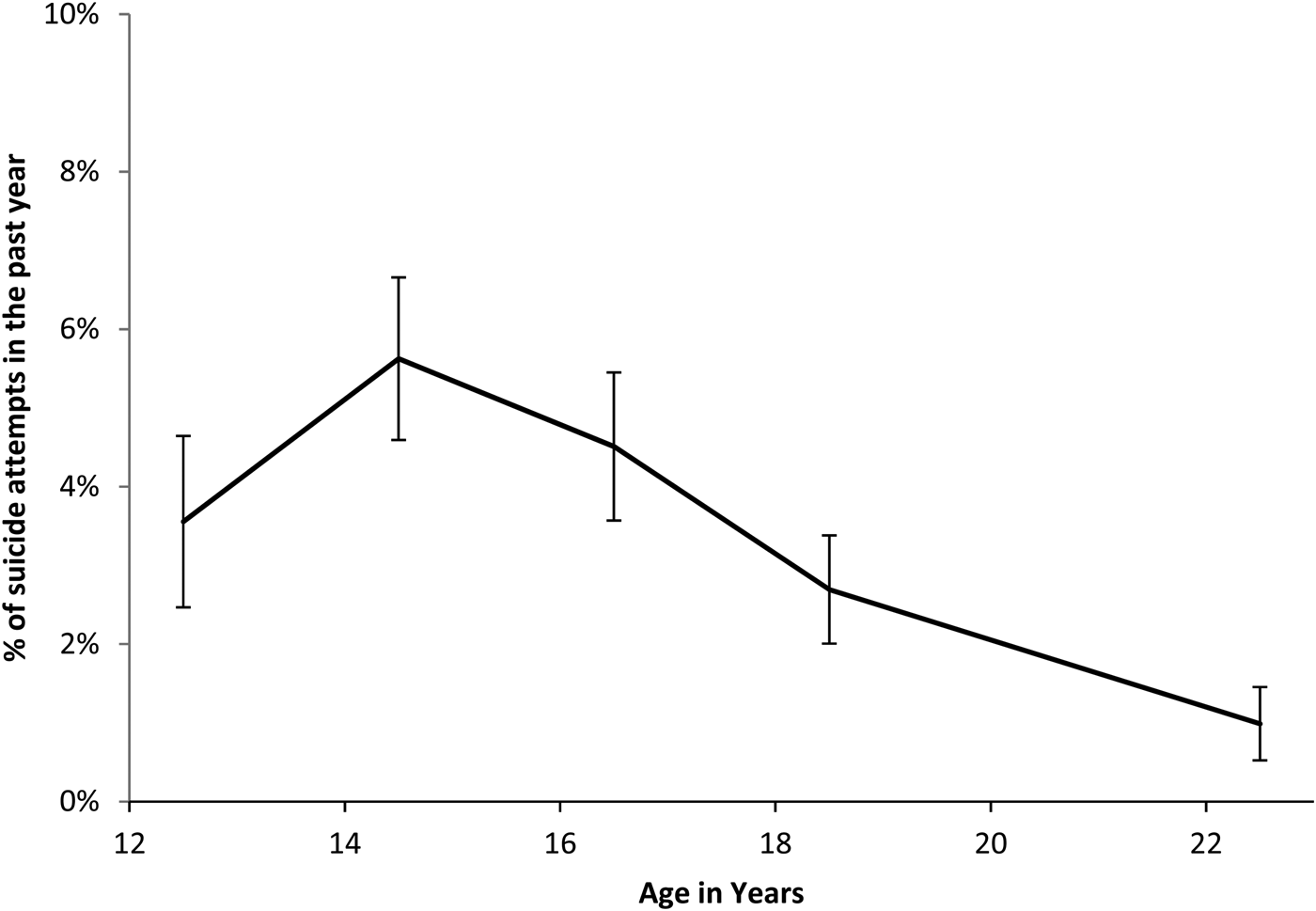
The percentage of adolescents who attempted suicide in the past year increased from 3.6% at ages 12–13 years to 5.6% at ages 14–15 years. These numbers decreased gradually during the transition to adulthood, with 1.0% of young adults reporting attempted suicide at ages 22–23 years (Fig. 1).
Proportion of past-year suicide attempts from early adolescence to emerging adulthood (N = 2233). Bars represent 95% confidence intervals.
All estimates are weighted to adjust for sample non-response and attrition.

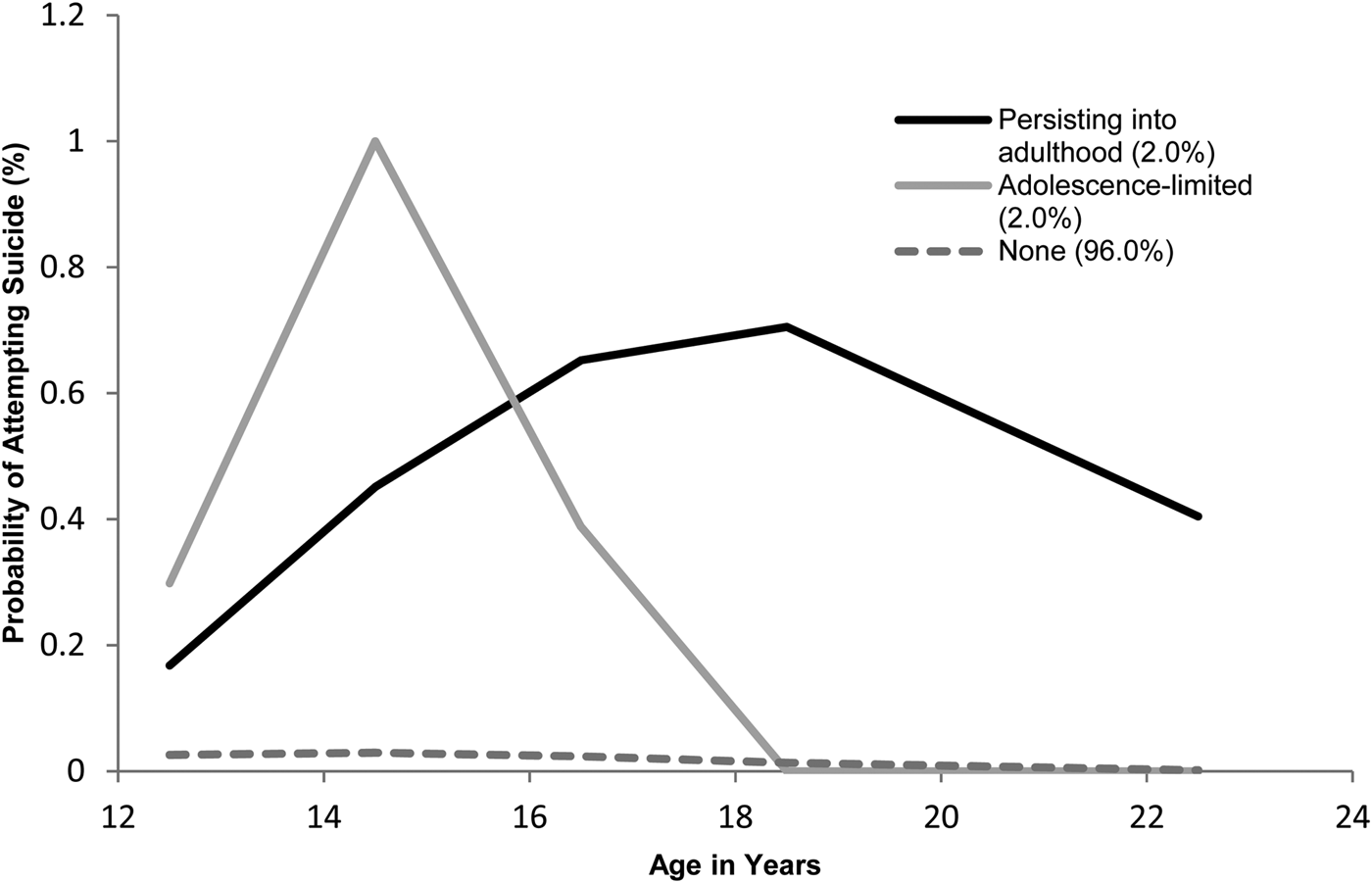
Using the criteria described in the Methods section, we obtained a 3-group model as the best fit to represent distinct trajectories of suicide attempts from early adolescence to emerging adulthood (Fig. 2). Most individuals (96.0%) had never attempted suicide, 2.0% had an adolescence-limited trajectory and 2.0% had a trajectory of suicide attempts persisting into adulthood. In the adolescence-limited trajectory, the risk of attempted suicide peaked at ages 14–15 years, decreasing gradually to 0 by young adulthood. In the persisting into adulthood trajectory, the risk of attempted suicide increased steadily during adolescence and remained high in the transition to adulthood. The age of participants in Cycle 1 (i.e. 7, 8, 9, 10 or 11 years) was not associated with trajectory profile (p > 0.05).
Three trajectories of attempted suicide from early adolescence to emerging adulthood (N = 2233). Fit indices for modelling were the following: 1-trajectory model [Bayesian information criteria (BIC) = 2602.908; entropy, not applicable; Lo-Mendell-Rubin likelihood ratio test (LMR-LRT), not applicable]; 2-trajectory model (BIC = 2431.152; entropy = 0.896; LMR-LRT, p = 0.0004); 3-trajectory model (BIC = 2425.258; entropy = 0.942; LMR-LRT, p = 0.230); 4-trajectory model (BIC = 2426.666; entropy = 0.972; LMR-LRT, p not available); 5-trajectory model (BIC = 2440.824; entropy = 0.877; LMR-LRT, p not available). All estimates are weighted to adjust for sample non-response and attrition.

Univariable analysis of risk factors
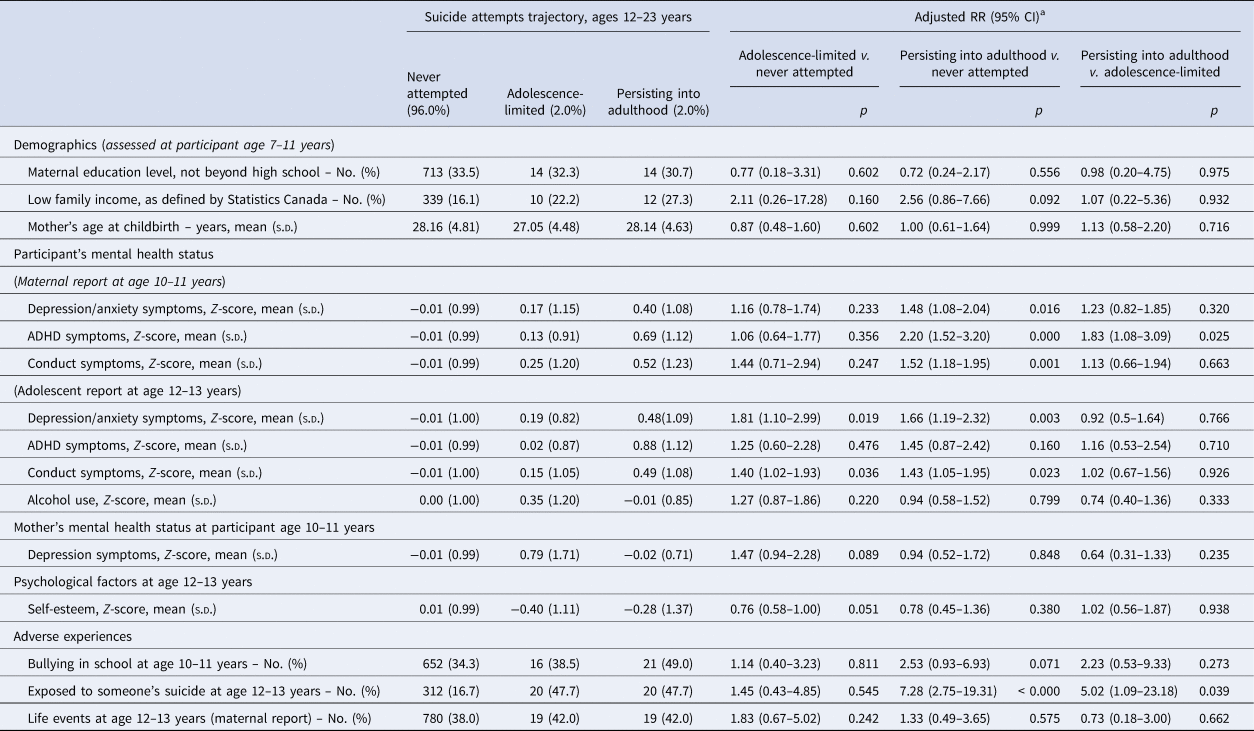
Table 2 shows univariable associations between pre- and early adolescent risk factors and trajectory profile, adjusted for sex. Of all risk factors investigated, 10 were associated (p < 0.10) with adolescence-limited and/or suicide attempts persisting into adulthood, as compared to the never-attempted trajectory. Of note, participant mental health problems reported by the mother in pre-adolescence (ages 10–11 years), such as depression/anxiety, conduct disorders, attention deficit and hyperactivity/impulsivity (ADHD) symptoms, were associated with persisting suicide attempts, but not with adolescence-limited suicide attempts. Overall, the identified risk factors tended to be more strongly associated with a trajectory persisting into adulthood than with an adolescence-limited trajectory.
Univariable associations between suicide attempts trajectory and pre- and early adolescence risk factors

RR, risk ratio; CI, confidence interval; No., number; s.d., standard deviation; ADHD, attention-deficit/hyperactivity disorder.
N = 2233 participants; all analyses are weighted to adjust for sample non-response and attrition.
a Adjusted for sex.
Descriptive statistics for risk factors are weighted by trajectory posterior probabilities.
Unadjusted estimates for sex were not available, because a cell was based on fewer than five participants.
Multivariable analysis of risk factors
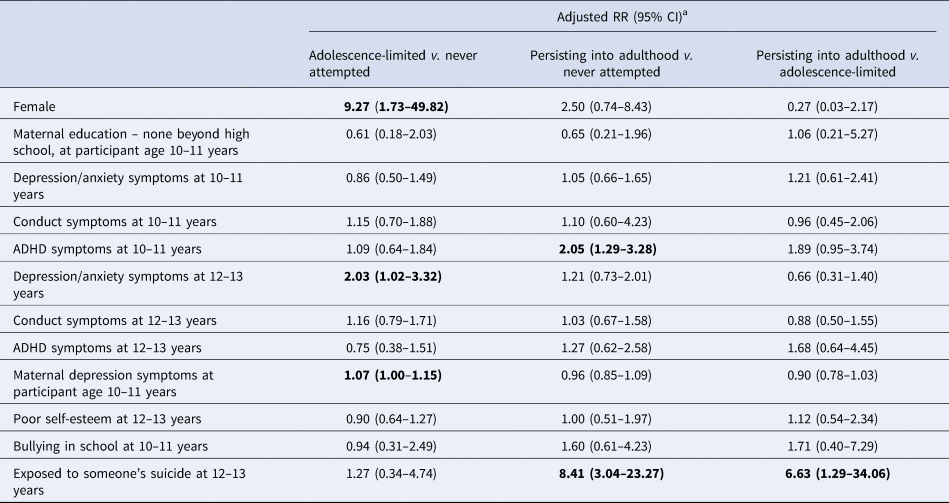
When sex and the 10 risk factors were entered simultaneously in a multivariable multinomial logistic regression model, females were about 10 times more likely than males (RR 9.27; 95% CI 1.73–49.82) to be in the adolescence-limited trajectory than in the never-attempted trajectory (Table 3). However, no sex differences were observed between the persisting into adulthood profile and the never attempted profile. After adjustment for sex and other factors, participants who reported symptoms of depression and/or anxiety at ages 12–13 were more likely to be in the adolescence-limited trajectory than in the never attempted, with a 2.03-fold (95% CI 1.02–3.32) higher risk for each standard deviation increase on the depression/anxiety symptoms scale. Adolescents whose mothers were depressed also had a slightly higher risk of being in the adolescence-limited trajectory than in the never attempted (RR 1.07; 95% CI 1.00–1.15). The strongest observed association in the trajectory of suicide attempts persisting into adulthood was exposure to the suicide of a schoolmate or acquaintance (RR 8.41; 95% CI 3.04–23.27; as compared to never attempted). Further, exposure to someone's suicide distinguished individuals in the adolescence-limited trajectory from those in the persisting trajectory (RR 6.63; 95% CI 1.29, 34.06). Finally, pre-adolescents reported by their mothers as having ADHD symptoms at ages 10–11 were at greater risk of being in the trajectory of attempts persisting into adulthood than in the never attempted (RR 2.05; 95% CI 1.29–3.28; for each standard deviation increase in ADHD symptoms).
Multivariable analysis of pre- and early adolescence risk factors and suicide attempts trajectory

RR, risk ratio; CI, confidence interval; ADHD, attention-deficit/hyperactivity disorder.
N = 2233 participants. All analyses are weighted to adjust for sample non-response and attrition.
a Fully adjusted for multivariable analysis.
Discussion
Using a population-based cohort of Canadian youth, our study captured the course of suicide attempts over an 11-year period from early adolescence to young adulthood, identifying various risk factors. We confirmed three trajectory profiles: never attempted, adolescence-limited suicide attempts and suicide attempts persisting into adulthood. The 4% of individuals with attempted suicide at ages 12–23 years were about evenly split, with half reporting attempts persisting into adulthood. These individuals were more likely to exhibit higher levels of ADHD symptoms in pre-adolescence and to have been exposed to someone else's suicide. Individuals in the adolescence-limited profile were more likely to be female, to show high levels of depression/anxiety symptoms in early adolescence, and at age 10–11, to have a mother with depressive symptoms. Compared to retrospective or single-point studies, our prospective study revealed the heterogeneity of suicide profiles during this important transition from childhood to adulthood.
Interpretation of findings
As previously reported, we found the prevalence of suicide attempts to peak at mid-adolescence and then decrease gradually to adulthood, similarly to that of suicidal ideation (Boeninger, Masyn, Feldman, & Conger, Reference Boeninger, Masyn, Feldman and Conger2010; Goldston et al. Reference Goldston, Daniel, Erkanli, Heilbron, Doyle, Weller and Faulkner2015; Kerr, Owen, & Capaldi, Reference Kerr, Owen and Capaldi2008; Nkansah-Amankra, Reference Nkansah-Amankra2013; Nock et al. Reference Nock, Borges, Bromet, Alonso, Angermeyer, Beautrais and Williams2008a; Rueter & Kwon, Reference Rueter and Kwon2005). Our results are also consistent with the number of emergency department visits for self-inflicted injuries at all ages of life, peaking at ages 15–19 years (Canner, Giuliano, Selvarajah, Hammond, & Schneider, Reference Canner, Giuliano, Selvarajah, Hammond and Schneider2018). Taken together, these findings suggest mid-adolescence to be a vulnerable period for suicide risk (Goldston et al. Reference Goldston, Daniel, Erkanli, Heilbron, Doyle, Weller and Faulkner2015; Kerr et al. Reference Kerr, Owen and Capaldi2008; Nkansah-Amankra, Reference Nkansah-Amankra2013; Nock et al. Reference Nock, Borges, Bromet, Alonso, Angermeyer, Beautrais and Williams2008a). It is noteworthy that adolescence is also a time of maturation of the developing brain; particularly, the prefrontal cortex is involved in impulse control/inhibition and risk-averse decision-making (Dahl, Reference Dahl2004; Mann, Reference Mann2003). This may explain the higher likelihood of younger adolescents to attempt suicide as compared to older adolescents and young adults (Fig. 1). Further, adolescence to emerging adulthood is associated with the onset of certain mental disorders (Kessler et al. Reference Kessler, Amminger, Aguilar-Gaxiola, Alonso, Lee and Ustun2007) which in turn may be associated with suicide attempts (Gili et al. Reference Gili, Castellvi, Vives, de la Torre-Luque, Almenara, Blasco and Lagares2018).
We identified three developmental trajectories in young people with attempted suicide, similarly to previous studies of suicidal ideation and/or suicide attempts (Adrian, Miller, McCauley, & Vander Stoep, Reference Adrian, Miller, McCauley and Vander Stoep2016; Rueter, Holm, McGeorge, & Conger, Reference Rueter, Holm, McGeorge and Conger2008; Thompson & Swartout, Reference Thompson and Swartout2018). Our trajectories are consistent with those of Thompson & Swartout (Reference Thompson and Swartout2018), who used data from the U.S. National Longitudinal Study of Adolescent Health: a low-risk group (94%), an adolescence-limited group (5%) and a persistent group (1%) with about 50% probability of attempting suicide into adulthood (Thompson & Swartout, Reference Thompson and Swartout2018). Our 2% adolescence-limited rate v. Thompson's 5% may reflect methodological differences such as age of reporting (we included younger adolescents).
Our adolescence-limited trajectory group included more females than males, while both sexes were equally represented in the trajectory of suicide attempts persisting into adulthood. A recent review showed no sex differences in the prediction of repeated suicide attempts (Beghi, Rosenbaum, Cerri, & Cornaggia, Reference Beghi, Rosenbaum, Cerri and Cornaggia2013), while Thompson and Swartout's study found that females were more at risk in both (Thompson & Swartout, Reference Thompson and Swartout2018).
We explored other risk factors as markers of trajectory. Depression/anxiety symptoms and maternal depression were more in keeping with an adolescent-limited profile than with a never-attempted profile. A recent meta-analysis of longitudinal studies also showed that depression indeed conferred a risk for later suicide attempts (Ribeiro, Huang, Fox, & Franklin, Reference Ribeiro, Huang, Fox and Franklin2018). Depression/anxiety symptoms were not associated with the persisting into adulthood profile. Thompson and Swartout (Reference Thompson and Swartout2018) also found a stronger association of depressive symptoms in mid-adolescence (mean age 15 years) with the adolescent-limited trajectory than the persistently high trajectory. It is noteworthy that in our sample, depression/anxiety symptoms in early adolescence were also predictive of a suicide attempts trajectory extending into adulthood (Table 2); the association was no longer significant, however, when risk factors such as externalising symptoms entered into the model. This is consistent with prior studies reporting that depressive/anxious mood during childhood was predictive for young adult suicidality only when combined with disruptive behaviours (Brezo et al. Reference Brezo, Barker, Paris, Hébert, Vitaro, Tremblay and Turecki2008). Interestingly, self-reported depression/anxiety symptoms at age 12–13 years, but not as reported by the mother at 10–11 years, were predictive of an adolescent-limited trajectory v. a never-attempted trajectory. While we were unable to distinguish between rater and timing effects, prior research indicates that parents tended to be unaware of psychological distress in their child (Jones et al. Reference Jones, Boyd, Calkins, Ahmed, Moore, Barzilay and Gur2019) or that the onset of depressive symptoms along with the transition to high school might be particular distressing (Mesman & Koot, Reference Mesman and Koot2000).
After mental health symptoms such as depression/anxiety and conduct were taken into account, ADHD symptoms remained associated with a trajectory of suicide attempts persisting into adulthood. Prior studies including systematic reviews in both adults and adolescents reported that mental health comorbidities largely explained the ADHD-suicide attempts link (Balazs & Kereszteny, Reference Balazs and Kereszteny2017; Conejero et al. Reference Conejero, Jaussent, Lopez, Guillaume, Olié, Hebbache and Courtet2019; Impey & Heun, Reference Impey and Heun2012). Our results partly align with a population-based study of insurance claims showing stronger associations between ADHD diagnosis and repeated suicide attempts (hazard ratio 6.5), than for any attempts (hazard ratio 3.8), above and beyond comorbidities (Huang et al. Reference Huang, Wei, Hsu, Bai, Su, Li and Chen2018). To date, the nature of suicidal associations with ADHD is unclear. Our study did not include a clinical ADHD assessment. An earlier study showed that early childhood ADHD, with or without the inattention component, predicted later suicide attempts (Chronis-Tuscano et al. Reference Chronis-Tuscano, Molina, Pelham, Applegate, Dahlke, Overmyer and Lahey2010), highlighting the role of impulsivity (Conejero et al. Reference Conejero, Jaussent, Lopez, Guillaume, Olié, Hebbache and Courtet2019). Other factors common to both ADHD and attempted suicide, such as irritability and emotional liability (Maire, Galera, Bioulac, Bouvard, & Michel, Reference Maire, Galera, Bioulac, Bouvard and Michel2020) and deficits in executive functioning (Keilp et al. Reference Keilp, Gorlyn, Russell, Oquendo, Burke, Harkavy-Friedman and Mann2013) should be investigated as potential mediators.
Of note, we found a strong association between exposure to someone's suicide and the trajectory of attempts persisting into adulthood, even after accounting for other factors. Individuals exposed to suicide have increased likelihoods of suicidal ideation and/or attempted suicide (Maple, Cerel, Sanford, Pearce, & Jordan, Reference Maple, Cerel, Sanford, Pearce and Jordan2017; Mars et al. Reference Mars, Heron, Klonsky, Moran, O'Connor, Tilling and Gunnell2019b; Swanson & Colman, Reference Swanson and Colman2013). This was confirmed by a prior study by Swanson & Colman (Reference Swanson and Colman2013) based on the same cohort as ours, with stronger associations the younger the exposure. Our study extends these findings by showing that exposure to a schoolmate's or acquaintance's death by suicide is associated with a trajectory of suicide attempts persisting into adulthood more than with an adolescent-limited trajectory. We were unable to assess whether this association differed for exposure to suicide in family relatives v. schoolmates, but Swanson & Colman (Reference Swanson and Colman2013) reported that a classmate's suicide was a stronger predictor of outcome than suicide by someone else personally known by the adolescent.
In summary, our study suggests that suicide attempts in emerging adulthood are mostly made by individuals who had already attempted suicide in adolescence. This is especially relevant considering that: (1) a prior prospective study of adolescents after psychiatric hospitalisation found that intent to die increased with number of attempts (Goldston et al. Reference Goldston, Daniel, Erkanli, Heilbron, Doyle, Weller and Faulkner2015) and (2) repeated suicide attempts were associated with greater risk of mortality (Hawton & Fagg, Reference Hawton and Fagg1988). Our results highlight the need to recognise that in half the participants, suicide attempts did not stop at adolescence. We stress the importance of preventive strategies in early adolescence.
Strengths and limitations
This population-based cohort study has a number of strengths including its prospective design with repeated measures of suicide attempts over an 11-year period, enabling the identification of distinct trajectories of suicide attempts varying in onset and persistence over time. The NLSCY constitutes a large, representative sample of Canadian children and teenagers moving forward into adulthood, ensuring dependability and generalisability of results. Further, NLSCY data include both self-reported and mother-reported assessments of key putative risk factors in pre- and early adolescence.
Nonetheless, there were certain limitations. First, despite the large sample size, the number of individuals who attempted suicide was low, limiting the statistical power to investigate further interactions between risk factors; e.g. risk of attempted suicide in girls with ADHD (Nigg, Reference Nigg2013). Second, suicide attempts in childhood or later adulthood were not documented, precluding a description over a lifetime. Third, as in all prospective cohorts, attrition may have entailed under-representation of the most vulnerable individuals; however, population weights were used to minimise such biases. Fourth, data were collected from 1994–95 to 2008–09. We recognise that in the decade since 2008–09, the prevalence of suicide attempts in young people is increasing (Burstein, Agostino, & Greenfield, Reference Burstein, Agostino and Greenfield2019) and new risk factors have arisen, such as social media (Chassiakos, Radesky, Christakis, Moreno, & Cross, Reference Chassiakos, Radesky, Christakis, Moreno and Cross2016) and cyberbullying (Perret et al. Reference Perret, Orri, Boivin, Ouellet-Morin, Denault, Côté and Geoffroy2020). While the internet and social media offer opportunities for learning and support (Frost & Casey, Reference Frost and Casey2016), a recent systematic review of cross-sectional studies reported an association between heavy social media/internet use and increased suicide attempts (Sedgwick, Epstein, Dutta, & Ougrin, Reference Sedgwick, Epstein, Dutta and Ougrin2019). Unfortunately, information on social media/internet use was not available in the cohort data. Fifth, our measure of exposure to someone else's suicide was limited to deaths by suicide; exposure to non-fatal suicide attempts was not assessed. A prior study showed an increased risk of attempted suicide after exposure to suicide attempts by a peer (Randall, Nickel, & Colman, Reference Randall, Nickel and Colman2015). Concerns have also been raised about the contagion effect through social media (Chassiakos et al. Reference Chassiakos, Radesky, Christakis, Moreno and Cross2016), including suicide announcements and Facebook bereavement pages. Further research is needed to examine these questions. Sixth, we measured suicide attempts in individuals who are still alive. As ~60% of suicide fatalities occur at the first attempt (Bostwick et al. Reference Bostwick, Pabbati, Geske and McKean2016), risk factors for fatal and non-fatal suicide attempts in young people may differ.
Implications
This study suggests that there is a group of youth that is likely to make repeated suicide attempts into adulthood, with different characteristics from those who attempted suicide in adolescence only. More specifically, risk factors for attempts persisting into adulthood include high ADHD symptoms and exposure to suicide. For other adolescents, especially girls, the risk of attempting suicide appears to be restricted to adolescence and to be exacerbated by depressive symptoms (either personal or maternal). Clinically and in school programs, these two groups of attempters may benefit from differential interventions. Future studies should investigate whether and how these two profiles differ in terms of neurodevelopment, genetics and functional outcome in adulthood.
Acknowledgements
The authors wish to thank Danielle Buch, Medical writer, Research, for critical revision and substantive editing of the manuscript.
Author contributions
Geoffroy and Girard had full access to all the data in the study and take responsibility for the integrity of the data and the accuracy of the data analysis.
Literature search: Geoffroy
Study concept and design: Geoffroy, Orri
Acquisition, analysis or interpretation of data: All authors
Drafting the manuscript: Geoffroy
Critical revision of the manuscript for important intellectual content: All authors
Role of funder/sponsor
The funders had no role in the design and conduct of the study; collection, management, analysis and interpretation of the data; preparation, review or approval of the manuscript; and decision to submit the manuscript for publication.
Conflict of interest
Dr Geoffroy holds a Canada Research Chair (Tier 2) and a Young Investigator Award of the American Foundation for Suicide Prevention. Ms. Perret received funding from the Fonds de recherche du Québec – Santé (FRQS) and Dr Orri from the European Union's Horizon 2020 research and innovation programme under grant agreement No. 793396. Dr Turecki holds a Canada Research Chair (Tier 1) and a Distinguished Investigator Award of the U.S. National Alliance for Research on Schizophrenia and Depression. Dr Geoffroy and Dr Turecki are funded by the Quebec Network on Suicide, Mood Disorders and Related Disorders through the FRQS. Girard declares that he has no competing or potential conflicts of interest.
Appendix
Mental health questionnaires
Self-reports (age 12–13 years)
Depressive/anxiety symptoms – Children's Behaviour Questionnaire (CBQ) (8 items)
Responses: Never or not true, Sometimes or somewhat true, Often or very true
(1) I am unhappy, sad or depressed
(2) I am not as happy as other people my age
(3) I am too fearful or anxious
(4) I am worried
(5) I cry a lot
(6) I feel miserable, unhappy, tearful, or distressed
(7) I am nervous, high-strung or tense
(8) I have trouble enjoying myself
Attention deficit hyperactivity disorder (ADHD) symptoms – CBQ (8 items)
Responses: Never or not true, Sometimes or somewhat true, Often or very true
(1) I can't sit still, am restless or hyperactive
(2) I am distractible, have trouble sticking to any activity
(3) I fidget
(4) I can't concentrate, can't pay attention
(5) I am impulsive, act without thinking
(6) I have difficulty awaiting my turn in games or groups
(7) I cannot settle to anything for more than a few moments
(8) I am inattentive, have difficulty paying attention to someone
Conduct disorder symptoms – CBQ (5 items)
Responses: Never or not true, Sometimes or somewhat true, Often or very true
(1) I get into many fights
(2) I assume, when another kid accidentally hurts me (such as bumping into me), that the other kid meant to do it, and then react with anger and fighting
(3) I physically attack people, I threaten people
(4) I am cruel, bully, or am mean to others
(5) I kick, bite, hit other people my age
Psychological factors
Self-esteem – Self Description Questionnaire (SDQ) (4 items)
Responses: False, Mostly false, Sometimes false/sometimes true, Mostly true, True
(1) In general, I like the way I am
(2) Overall, I have a lot to be proud of
(3) A lot of things about me are good
(4) When I do something, I do it well
Mother's reports (for participants age 10–11 years)
Depressive/anxiety symptoms – CBQ (7 items)
Responses: Never or not true, Sometimes or somewhat true, Often or very true
How often would you say that your child:
(1) Seems to be unhappy
(2) Is not as happy as other children
(3) Is too fearful or anxious
(4) Is worried
(5) Cries a lot
(6) Is nervous, high-strung or tense
(7) Has trouble enjoying himself
ADHD symptoms – CBQ (9 items)
Responses: Never or not true, Sometimes or somewhat true, Often or very true
(1) Can't sit still, is restless/hyperactive
(2) Has trouble sticking to any activity
(3) Fidgets
(4) Can't concentrate, can't pay attention for long
(5) Is impulsive, acts without thinking
(6) Difficulty awaiting turn in games/groups
(7) Gives up easily
(8) Stares into space
(9) Is inattentive
Conduct disorder symptoms – CBQ (10 items)
Responses: Never or not true, Sometimes or somewhat true, Often or very true
(1) Destroys his/her own things
(2) Steals at home
(3) Gets into many fights
(4) Is disobedient at school
(5) Tells lies or cheats
(6) Physically attacks people
(7) Vandalises
(8) Threatens people
(9) Is cruel, bullies or is mean to others
(10) Steal outside the home
Mother's mental health status
Depressive symptoms – centre for epidemiologic studies depression scale (CES-D) (12 items)
Responses: Rarely or none of the time (less than 1 day), Some or a little of the time (1–2 days), Occasionally or a moderate amount of time (3–4 days), Most or all of the time (5–7 days)
How often have you felt or behaved this way during the past week:
(1) I did not feel like eating; my appetite was poor
(2) I felt that I could not shake off the blues even with help from my family or friends
(3) I had trouble keeping my mind on what I was doing
(4) I felt depressed
(5) I felt that everything I did was an effort
(6) I felt hopeful about the future
(7) My sleep was restless
(8) I was happy
(9) I felt lonely
(10) I enjoyed life
(11) I had crying spells
(12) I felt that people disliked me