

1 INTRODUCTION
Throughout much of the first half of the Second World War in Europe, Hitler attempted to bring Spanish dictator Francisco Franco into the Axis alliance (Preston Reference Preston1990, chapter 4). The programmes organised during this period include Spanish military and labour contributions to the German war effort. On August 22, 1941, representatives of Germany and Spain signed the Acuerdo hispano-alemán para el empleo de trabajadores españoles en Alemania (Spanish-German Accord for the Employment of Spanish Workers in Germany) at the Spanish Foreign Ministry in MadridFootnote 1. This established a system of government-organized labour transfers, the second from a neutral nation to a belligerent one, following an Italian-German programme established in September 1939 (Deutsche Arbeitsfront 1941, p. 194ff). The Germans wanted Spain to provide 400,000 workers, of whom 100,000 were expected to be dispatched by Spain over the first 6 monthsFootnote 2. For many, it represented a step towards Spanish co-belligerency (see Hernández Sandoica and Moradiellos Reference Hernández Sandoica and Moradiellos2002; Bowen Reference Bowen2000, pp. 77-102); however, despite considerable pressure, the Spanish government provided at most only 9,550 workers. With a maximum of 36,529 million workers in Germany in May 1943, Spain was a minor contributor to the German war effortFootnote 3. Given its negligible effect on the war, the conflicting logic of promising to aid the Axis war effort without providing the promised resources raises the question of what the Spanish government intended to accomplish with this programme.
Works by Rafael García Pérez and José Luis Rodríguez Jiménez argue that the programme was born of a political commitment by the Spanish Foreign Minister, Serrano Suñer, to provide «voluntarios para el frente, voluntarios para las fábricas» (volunteers for the front, volunteers for the factories)Footnote 4. Reichsmark credits from the programme, as with many others, were to be used for the payment of Spanish debts to Germany. In this context, this becomes nothing more than one of several Spanish-German programmes established at the time, including the Division Azul (Blue Division), an 18,104-man contingent which fought on the Eastern Front (Kleinfeld and Tambs Reference Kleinfeld and Tambs1979, p. 355).
It is also one of the many labour programmes set up in Europe as part of the German hunt for labour. Among the neutrals, Switzerland provided a maximum of some 1,800 workers through a free trade and transit area known as the Grenzgebiet; although these numbers declined to less than half this figure by late 1943 (Golson Reference Golson2012, chapter 7). Other German-occupied and -oriented countries supplied workers, initially under similar voluntary programmes and eventually via conscription. The closest comparison is with the Italian programme, which began to transfer labourers to Germany in September 1939 (Homze 1967). Over time, the proportion of foreigners in the German labour force grew from about 1 per cent in 1939 to more than 8 per cent in 1941 and eventually more than 20 per cent in 1944 (Klemann and Kudryashov Reference Klemann and Kudryashov2012, p. 120). However, the Spanish programme marked the pinnacle of close political relations between the two countries. Spanish government insistence on its workers having similar treatment to that of workers from other Axis countries led to poor diplomatic relations and fraught negotiations. Germany's political and economic weaknesses eroded the reasons for political cooperation and the repayment of Spanish debts. The desired number of Spaniards never arrived and the official programme, suspended several times, officially ended in 1943 (Bowen Reference Bowen2000, pp. 127-142).
Spanish workers were treated poorly, but conditions were not so bad as to prevent many from going to Germany outside the programme. These Spaniards suffered inferior work conditions, a lack of access to German social welfare programmes, shorter rations and harsher workplace penalties (Bowen Reference Bowen2006, pp. 119-120). In response to the complaints regarding bad conditions, the Spanish government intermittently suspended the official programme over the course of the first year. The traditional diplomatic view has been that the flow of workers to Germany was interrupted because of conditions there (García Pérez Reference García Pérez1988, pp. 1049-1054). However, new employment statistics presented in this paper suggest that workers continued to go to Germany in 1942/1943, despite these poor conditions and even without the Spanish state sponsorship that covered transportation and equipage costs (see Table 1). Thus, while conditions did reduce the incentives for workers to make the journey, many continued to do so.
In closing the worker programme, the Spanish government was going against its own economic interests. This paper updates the existing literature to reveal that the Spanish government's monetary transfer department was profiting from the programme. It was earning a previously unnoticed transfer fee on the funds remitted, enough to exceed its costs; this was in addition to the use of the reichsmark earnings to bring down the debt to Germany. The 1941 Agreement called for the Spanish and German governments to remit the exact worker payment at the official rateFootnote 5. However, the Spanish government's transfer bureau did not remit the full transferred funds to the Comisión interministerial para el envio de trabajadores a Alemania (Inter-ministerial Commission for Workers in Germany - CIPETA) but took an illicit commission from the transfers before they reached the workers. This reduced workers’ earnings, changed incentives and made it appear that the CIPETA programme was losing money. From an overall perspective and taking these details into account, the resulting «profit» per 1 peseta remitted amounted to 0.27 pesetas, taking all costs into account (see Tables 2 and 4). This explains why the Spanish government was content to allow the monetary transfer facility to continue until December 1945, after the end of the war, ensuring that it could still collect commissions and pay off its debt to Germany.
The size, activities, composition and profitability of the programme support two findings; one domestic and one with regard to foreign policy. On the domestic front, this monetary arrangement allowed the programme to satisfy Spain's internal political balance, enabling the programme to persist for a period. From a foreign policy perspective, the end of official state-sponsored worker recruitment must be attributed to Allied pressure and the changing Spanish attitude towards Germany, starting as early as 1942 (Bowen Reference Bowen2000, p. 157ff).
Different Spanish government departments and interest groups (such as the Falange) were given incentives to support Franco's authorised limited military, economic and political collaboration with Germany. Paul Preston and Wayne Bowen suggest that there were significant tensions within the Spanish government which Franco placated (Bowen Reference Bowen2000, chapter 4). Bowen portrays Franco as holding together a fractious coalition, which included a government composed of the Falange (31.6 per cent of government positions), representatives of the armed forces (25.1 per cent), Alfonsine monarchists (21.6 per cent), Catholic activists (14.4 per cent) and Carlist monarchists (6.6 per cent) (Bowen Reference Bowen2006). The Falange and other Nazi-allied domestic political organisations were trying to bring Spain into the war, while the resistance of the others effectively threatened another civil war (Bowen Reference Bowen2000, pp. 77-80). In 1941, Franco probably saw this aid as the most that Spain could offer Germany without angering the Allies. The Falange and similar organisations, on the other hand, deemed these programmes the absolute minimum permissible for a close ally (Bowen Reference Bowen2000, p. 103). Publicly accepting such a programme mollified the Falange interests, while providing the Instituto Espanol de Moneda Extranjera (IEME) and the Treasury with a small «profit» was enough to ensure their cooperation. Meanwhile, administratively limiting the programme ensured that Spain would not be dragged closer to Germany.
Allied pressure and the changing Spanish attitude towards Germany starting in mid-1943 resulted in the closure of the programme. Allied-Spanish relations during this programme can be divided into two stages with the period from June 1940 to December 1941 in which this agreement was concluded representing the apex of the Spanish-German relationship. During this period, Germany promised Spain considerable quantities of goods and benefits in exchange for Spanish entry into the war. In the later stage, between January 1942 and August 1944, Anglo-American economic activity, both sanctions and pre-emptive purchasing, caused a shift in the position of the Spanish government enabling it to maintain a rivalry between the two belligerents. Meanwhile, Germany weakened considerably as the war was transformed slowly by the Soviet advantage on the Eastern Front and Germany's loss of North Africa and much of Italy. Although officially caused by conditions in Germany, the stoppages coincided with an increasing shift towards the Allies, including their two fuel blockades and a decree in March 1942 which opened the wolfram market to purchasing competition. The end of the official programme came in summer 1943, after the fall of Mussolini in July 1943, coinciding with the withdrawal of the Blue Division from the Eastern Front and Spain's shift from non-belligerency to neutrality (Golson Reference Golson2012, pp. 128-147). Despite the fact that it was profitable in economic terms, in its creation and termination the programme was essentially a political matter. In addition to offering these two conclusions, this paper adds to the existing literature by updating estimates for the number of workers, their skill levels and remittances; it also provides the first estimates of the Spanish costs incurred.
Before proceeding, it should be made clear that substantial shortcomings beset any attempt to outline the Spanish-German civilian labour programme accurately. The information from Spain provides some clues to the origins, systems, expected profitability and long-term political intentions of the programme, but it provides no insight into Franco's thinking. Unfortunately, some programme records were burnt in August 1943 when the Spanish Embassy in Berlin was bombed (García Pérez Reference García Pérez1988, p. 1052). Subsequent records were apparently lost in the invasion of Berlin when the Embassy was abandoned. This problem has been partially mitigated by the surviving American and German records of the programme, but these records do not provide the full picture. Most notably, the estimates of the number of workers from 1943 to 1945 in this paper depend on the continuity in frequency of workers’ transfers. It assumes that workers continued to remit their earnings 7.73 times per year as they had done in 1942. Using this method to project the figures for these years leaves open the possibility of specific bias effects. An increase in the frequency of workers’ remittances during this period could lower the number of workers; this increase could have resulted, for instance, from black market activities in Germany.
2 EMPLOYMENT OVERVIEW
This section revises the employment figures from September 1941 to June 1945. Aiming at comprehensiveness, it includes all the Spaniards working in Germany, both those formally recruited under the programme and those who travelled as individuals, as all could use the remittance facilities and were eligible for state-paid repatriationFootnote 6. This study, in line with others, excludes Spanish Republicans and Communists living in France (García Pérez Reference García Pérez1988; Bowen Reference Bowen2000; Rodríguez Jiménez Reference Rodríguez Jiménez2002, p. 119). Republicans put to work in Germany, under the various German-French worker recruitment programmes, were typically taken forcibly from French refugee camps and had no access to the Spanish government facilities (Vilanova Reference Vilanova1969; Lindquist Reference Lindquist1984).
Germany expected much of the Spanish worker programme. In April 1941, German government reports noted that Spain had as many as 500,000 unemployedFootnote 7; ∼100,000 civilians were expected to leave Spain for Germany by mid-1942 and the Germans believed that 300,000-400,000 Spaniards would finally relocateFootnote 8. However, notwithstanding the German expectations, only 8,250 Spaniards ever worked in Germany on this programme. If 1,300 Spaniards are added, those estimated to have worked independently in Germany, the total is ∼9,550 at any one time. An approximate total of 25,000 Spaniards were involved. In May 1943, when there were 36.5 million workers in Germany, the highest total since 1939, the highest Spanish contribution represented <0.02 per cent of the German workforce (Homze 1967, p. 232); this equals ∼0.1 per cent of the Spanish workforceFootnote 9.
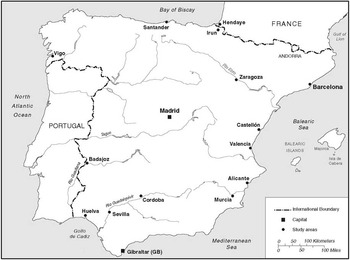
Workers in the programme were recruited in Spain by combined teams of Spanish and German officials. Workers were sent to the Spanish-French border town of Irún to be kitted out before departing for Germany via France. Their cities of origin are shown in Figure 1. Their largely urban origins suggest they would have had higher skill levels than average, as discussed below. Although planned to be continuous, the supply of workers was recruited and transported in three main phases: from October to December 1941, from spring to November 1942 and from June to July 1943. The smaller number who bypassed the state system had begun to work in Germany, using the transfer system to remit their earnings to Spain.
MAP OF SPAIN (INDICATING THE CITIES FROM WHICH THE LABOUR VOLUNTEERS ORIGINATED)

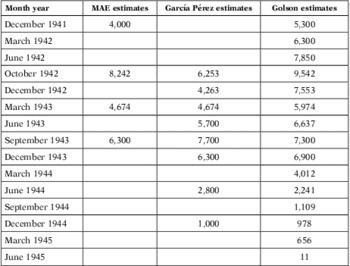
This study offers the first quarterly figures for Spanish workers in Germany, significantly expanding the limited number of post-December 1943 estimates in García Pérez's study. As seen in Table 1, apart from a period in 1942 when there was a number of independent Spanish workers in Germany, the number of workers does not significantly differ from that of García Pérez's original study (within 20 per cent). Figures from November 1941 to September 1943 are based on information held by the Spanish and German authorities; in Table 1, the data, which are taken directly from Spanish government sources administering the programme, are labelled «MAE Estimates»; estimates by García Pérez are listed in the second column from the left. The right-hand column contains the results of the present study; these estimates are typically higher than others as they include all the Spaniards temporarily working in Germany, as described above.
SPANISH WORKERS EMPLOYED IN GERMANY SHOWN BY QUARTER, SEPTEMBER 1941 TO JUNE 1945: SPANISH FOREIGN MINISTRY (MAE), GARCÍA PÉREZ AND GOLSON ESTIMATES

Notes: For October 1942, García Pérez acknowledges the 8,242 figure from the Ministerio de Asuntos Exteriores (MAE), but discounts 1,989 workers who were being repatriated by the Germans for various reasons. Golson's estimates use the higher figure since the workers were still in Germany. See García Pérez (Reference García Pérez1988, p. 1047); AMAEC R2225/1, memo dated February 5, 1942.
Sources: García Pérez (Reference García Pérez1988, p. 1057). AMAEC R2225/7, letter from Larcocino Corride to MAE, dated October 25, 1943; AMAEC R2225/7, memo, «CIPETA: Estado de las remesas de ahorros de salarios enviados por los productores a sus familias»; AMAEC R2225/2, memo, «Negociado de Transferencias»; AMAEC R2225/7, memo, «Negociado de Transferencias: Estadistica del Año 1945»; AMAEC R2225/1, «Apunte para el Sr. Ministro, MAE», date February 5, 1943; AMAEC R2225/1, letter to Embasador von Stobrer in Madrid, January 9, 1942; AMAEC R2225/1, CIPETA Memo, dated March 12, 1943; NARA RG242/T-77/243/986879-986880, Wehrwirtschafts- und Rüstungs-Amt (Wi Rü Amt), report marked «VO/Wi Rü Amt und Dienstab Ost bei OKH/Gen Ou», dated March 13, 1942; NARA RG242/T-77/243/987071-72, memo marked «Vermerk für Chef», dated November 10, 1941; NARA RG242/T-77/243/986882, memo entitled «Stand der Anwerbung ausl. Arbeitskräfte», marked Rue IVd, dated January 19, 1942; NARA RG242/T-77/243/986880, memo entitled «Arbeitseinsatz von Auslandern im Reichsgebiet», dated March 13, 1942.
Worker statistics from the end of 1943 through December 1945 are reconstructed using monthly wage remittance statistics from Spanish authorities. These statistics assume that workers continued to return money to Spain as regularly throughout the remainder of the war as they had in 1943. This represents an average of 7.73 transfers per annum for each worker. Average wages varied during the war and cannot be used as a benchmark. There seems to be no better method of estimating the number of workers than to assume that they continued to transfer funds back to Spain with the same frequencyFootnote 10.
The first phase of recruitment began in September 1941, but did not go as smoothly as the negotiators had hoped. The Germans sought to recruit 24,000 workers immediately, including a relatively high proportion of skilled labourers, but the Spanish total was only 5,000Footnote 11. Barcelona, Madrid and Huelva opened recruitment centres; further offices of the CIPETA were later established in Barcelona, Seville, Valencia and other cities throughout Spain. Thousands reportedly queued at these three offices in the first days of recruitingFootnote 12.
Five thousand workers left between mid-November 1941 and January 1942, after which shipments were halted amid reports of poor working conditions in GermanyFootnote 13. The complaints singled out poor housing, long hours and pay rates below the German wages for equivalent work; there were also unresolved financial issues between Spain and Germany, including cost reimbursements and provision for pensions, sick leave and other benefitsFootnote 14. These complaints were put to the German authorities and recruiting halted in late December 1941Footnote 15. Various outstanding items concerning conditions and pay were resolved by spring 1942, when Spain resumed the programme; by September 12 as many as 8,242 Spaniards were in Germany. However, it must be admitted that of these about 1989 were awaiting return to Spain, leaving only 6,253 by October 1942Footnote 16. The number declined by ∼1,000 when the agricultural labourers returned to Spain and was then further reduced at the turn of the year.
The total declined precipitously in late 1942. The Germans complained about both the low numbers and poor quality of the Spanish workers received to dateFootnote 17. In what was interpreted by the Spanish authorities as retaliation for the lack of new workers in the autumn of 1942, the Germans suspended the Spaniards’ next Christmas vacation. This postponed the workers’ annual holiday until after January 15, 1943. Over 40 per cent of the workers (∼650) who then returned to Spain refused to go back to Germany, no doubt as a result of the poor conditions. The Spanish government refused to enforce their contracts and did not forcibly return themFootnote 18; it also suspended its recruitment efforts. The loss of ∼650 workers resulted in a decline to 4,700 workers by February 1943. This figure stands as the base number of non-seasonal Spanish labourers in Germany until October/November 1943Footnote 19.
After trying to recruit workers through their Embassies and Consulates in Spain, the Germans finally pressured the Spanish government to reauthorize the recruitment programme from June 1943 (planning began in February 1943)Footnote 20. The third wave of recruitment saw far fewer volunteers (Bowen Reference Bowen2000, pp. 187-188). Approximately 2,500 recruits left Spain for Germany between March and June 1943 and the number in Germany in 1943 peaked at ∼7,200 between August and September of that year. By this point, the political changes were clearly a factor; the number of CIPETA recruiting officers had notably decreased, anticipating a smaller yieldFootnote 21. Competition for labour within Spain is also a possible cause as the Spanish economy was improving substantially. The number of recruits was commensurate with previous yields and remained below expectations (Catalán Vidal Reference Catalán Vidal1995, p. 111ff).
Late summer 1943 marks a turning-point in Spanish-German relations. Allied pressure on Franco to withdraw his support for Germany then reached its height. Losses in Spain's military contingent, the Blue Division, mounted as the German war on the Eastern Front became increasingly bleak (Kleinfeld and Tambs Reference Kleinfeld and Tambs1979, pp. 324-339). In August 1943, the President of CIPETA informally decided to repatriate as many Spanish civilian workers as possible, purportedly due to poor conditions in GermanyFootnote 22. Two months later, in October 1943, to satisfy Allied demands, Franco re-declared Spanish neutrality and ordered the withdrawal of Spanish support for Germany. Spain continued to allow monetary transfers from workers still in GermanyFootnote 23.
In the short term, the Spanish government's policy changes led to increased numbers of workers. In the repatriation of the Blue Division from the Eastern Front, ∼1,000 of its 18,400 members decided to stay in Germany for a time while the division was returned to SpainFootnote 24. In the last quarter of 1943, this temporarily increased the number of workers to about 6,900.
After October 1943, Spanish authorities no longer recorded the number of workers in GermanyFootnote 25. The only basis for assessment is the number of monetary transfers made by each worker; wage rates themselves are believed to have varied. Figures for the number of workers from late 1943 to May 1945 have been re-created on the assumption that workers continued to remit their earnings with the same average frequency (7.73 times per annum) as they had on average during 1943. These figures are adjusted to compensate for the one-third who reportedly did not use the transfer system, and smoothed using a 3-month moving average, to account for the large swings in transfers as a result of communication breakdowns. After December 1943, the new methodology used in this study suggests that ∼4,000 workers were still in Germany in March 1944, declining to 2,240 by June 1944; the figure halved again by September, with only 1,100 workers left in Germany. Problems in transporting workers from Germany to Spain after the Allied invasion of southern France no doubt hindered repatriation and slowed this decline; it resulted in ∼980 workers remaining in December 1944 and 650 by March 1945, based on the above figure of 7.73 transfers per annum per worker.
As this section has demonstrated, the number of civilian Spanish workers never reached the figures desired by the German government. Although the Germans had wanted 400,000 workers, they received no more than about 9,550. A significant number of workers also travelled outside the official programme. This is the first study to corroborate the 9,000 Spanish workers reported by Germany in 1943, a figure which lies between the maxima reported by García Pérez and Rodríguez Jiménez of 8,250 and 10,569, respectivelyFootnote 26.
3 WORKER PROFILES
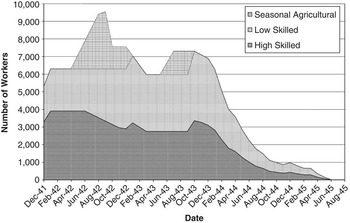
The Spaniards employed in Germany represented some of the most productive elements of the Spanish labour force. There were three principal groups of Spanish workers: full-year unskilled, full-year skilled and seasonal agricultural workers. As part of their October 1941 effort, the Germans sought to recruit a largely skilled group of workers from Spain: about 13,000 for construction, 6,000 for mining, 4,000 for metallurgical and 1,000 for agricultural workFootnote 27. Excluding temporary workers, Spanish labour consistently included an above-average proportion of highly skilled workers (Homze 1967, p. 235). As Figure 2 shows, the number of such workers in Germany dwindled slowly over time; from correspondence by the British Ambassador, holiday returns data and arrest records, the percentage of Spanish labourers in Germany classified as skilled declined from 62 per cent of the full-year workers from the start in December 1941 to 44 per cent by the end of the warFootnote 28. In comparison, it is believed that less than a quarter of domestic Spanish workers were skilled. Unskilled/agricultural workers suffered disproportionally from unemployment and should have been the Spanish government's logical targets for this programmeFootnote 29. The Spaniards also contained a higher proportion of skilled workers than was typical of foreign groups in Germany during the war, when 38.33 per cent of the workers were skilledFootnote 30. This section details the changes in the skilled, unskilled and agricultural labour groups from Spain in Germany.
SPANISH WORKERS IN GERMANY BY SKILL LEVEL, SEPTEMBER 1941 TO JUNE 1945
Sources: AMAEC R2225/1, letter from the British Ambassador, Arthur Tencken to Pelayo Garcia Olay, MAE, dated January 9, 1942; NARA RG242/T-84/466/182-189, memo entitled «An das Sondergericht bei dem Landgericht Berlin, 6PJs 1770/44 und 193 KLs 31/45»; AMAEC R2225/7, letter from Larcocino Corride to MAE, dated October 25, 1943; NARA RG242/T-84/466/190-192, memo entitled «Stafsache, Sond. IV, 6 P.K.Ls. 541.44 (3194.44).»

Many Spanish seasonal agricultural workers were recruited. Approximately 3,200 Spaniards went to Germany as temporary seasonal agricultural workers from June to October 1942 and 2,600 from June to October 1943. In both years, the number of workers increased dramatically in April and peaked in September/October, when Germany's farming season ended. These swings can be attributed only to agricultural workers, because outflows of long-term workers from Germany were strictly limited to the vacations set in their contractsFootnote 31. In 1942, the approximate trough to peak employment difference was 3,200 workers or about 39 per cent of the peak workforce; in 1943, it was 2,600 workers or about 36 per cent of the total workforce. Note that, as Figure 2 shows, in October/November 1943, ∼1,000 members of the Blue Division replaced the temporary agricultural workers who left then; these members chose to stay in Germany when their division disbandedFootnote 32. Removing the temporary agricultural labour force establishes a base figure of 4,700 full-year workers, both skilled and unskilled, from January 1942 to February 1944.
Of the full-year contract workers, three separate tests find that between 2,000 and 2,900 (44 per cent to 62 per cent) were working in skilled industrial jobs, with the remainder fulfilling less skilled or full-year agricultural roles. The first source for the number of skilled workers is a memo from the British Ambassador to the head of the CIPETA, Pelayo García Olay, concerning the recruitment of skilled industrial workers from British mines owned by Rio TintoFootnote 33; it covers the skill distribution of recruits at the end of 1941. In November 1941, CIPETA recruited 216 men from Rio Tinto's mines. Of these, the Ambassador asserts that no fewer than 133 were regarded as highly skilled and impossible to replace. This group contains a large cross-section of mine workers, including drillers, transport operators of various kinds, boilermen, furnace loaders, welders, electricians, pump operators and crane drivers. The unskilled group includes telephone operators, apprentices, labourers, carpenters, storekeepers and assistants of various kinds. The Ambassador's figures would probably have been biased so as to make his point that highly skilled workers from British mines were being recruited for the German war effort; but his figures suggest that ∼62 per cent of those recruited to German industries were highly skilled. Applying this figure to the 4,700 permanent labourers in Germany between late 1941 and early 1942 would indicate ∼2,900 as highly skilled and 1,800 with lower skills in January 1942 (see footnote 33).
The second source of relevant data refers to the 1942/1943 holiday period. As previously noted, skilled industrial workers (but not unskilled agricultural workers) employed in Germany were allowed vacations in Spain under the Spanish-German agreement. After their first year's work, they received 21 days’ vacation on full pay, excluding travel daysFootnote 34. Over the 1942/1943 holiday season, when Germany delayed their leave, records were kept of those who eventually left for Spain; many chose not to return. According to the Spanish figures, 2,191 workers, the highly skilled industrial workers who alone were entitled to these holidays, left Germany in January 1943. This figure indicates that about 46 per cent of the 4,700 full-year workers were involved; ∼2,500, or 54 per cent, low- or non-skilled labour remainedFootnote 35.
The percentage of skilled workers declined yet further. Despite a steep decline after mid-1944, ∼1,000 were still in Germany in December 1944. A fragmented set of German diplomatic correspondence regarding Spaniards arrested in Berlin in late 1944 to early 1945 provides some insight into the composition of those Spaniards who remained. The November 1944 record of Spaniards prosecuted for crimes includes complete profiles for nine Spaniards. Of the nine, six are skilled labourers and three are listed merely as Arbeiter (labourers); the six skilled workers comprise two electricians, two mechanics, one welder and one mechanical fitterFootnote 36. The January 1945 arrest record includes a further nine subjects, only seven of whom, one skilled labourer and six unskilled, were Spaniards who featured as part of this programmeFootnote 37. The skilled man was a mechanic while the remainder comprised 3-day labourers, two waiters and one busboyFootnote 38. Sixteen is hardly an ideal sample size for the ∼1,000 workers in Germany at this time; however, these are the only relevant statistics available. Of the sixteen, seven were skilled and nine unskilled; this suggests ∼44 per cent skilled and 56 per cent unskilled. When these figures are applied to the ∼1,000 Spanish workers still in Germany around the end of December 1944, they indicate ∼440 skilled workers and 560 unskilled. Note that this late figure for skilled workers is still above the maximum 38.33 per cent of German skilled workers during the warFootnote 39.
As the results suggest, the Germans were increasingly forced to accept fewer skilled and more unskilled Spanish workers in order to maintain recruitment figures. Given the rapidly improving Spanish economy and the gradually worsening situation in Germany, it is only logical that those with most to gain in Spain (i.e. the skilled workers) returned there before others with poorer job prospects.
The gender profile of the workers suggests an overwhelming male majority. German political ideology generally frowned on women in the workplace, resulting in a disproportionate recruitment of Spanish men over women (Koonz Reference Koonz1987; Elling Reference Elling1978, pp. 11-22). The number of Spanish women working in Germany at the outset of the programme was low and declined steadilyFootnote 40. Of the 1,300 Spanish workers in Germany before the formal programme began in December 1941, 16 per cent were female and 84 per cent maleFootnote 41. As the German labour recruitment programme was specifically geared to younger males, it is reasonable to assume that no women left for Germany between October 1941 and January 1944. As a result, at the September 1943 peak, only 3 per cent of the total Spanish labour contingent in Germany is estimated to be female. The skill and gender statistics are important for determining the wages to be expected, since in Germany females were paid substantially less than males.
4 TRANSFERS
One of the most important aspects of the August 1941 Spanish-German agreement was the currency exchange system known as the «Arbeiter Sonderkonto» (The Workers’ Special Account). This clearing system enabled workers to send funds home from Germany despite the currency embargoes, allowing Spaniards working in Germany to remit their reichsmark earnings in Spanish pesetas to Spain. Without this transfer system the programme would have been unable to recruit many workers, since only Spaniards who were willing to accept payment in blocked reichsmarks would have worked in Germany. The official rates agreed in August 1941 were particularly generous to the workers and penalised the government (for this particular programme), due to the overvaluation of the peseta against the reichsmark (a value which persisted because of Spain's net debtor position)Footnote 42. However, available statistics indicate that the Spanish exchange commission, the IEME, took a commission from these transfers before passing the funds on to CIPETA for payment to the workers, improving its own position in this respect. This commission was in violation of the August 1941 agreement, which called for remittances to be paid at the official rateFootnote 43.
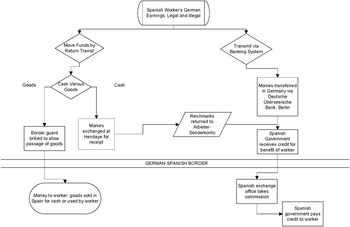
The mechanics of the Arbeiter Sonderkonto system were unfavourable to Spanish workers who wanted to send all their earnings, minus expenses incurred in Germany, back to Spain. As Figure 3 indicates, all funds had to be sent to a clearing account in favour of the Spanish governmentFootnote 44, which received a credit to its clearing account in Germany; the Spanish exchange authority, the IEME, paid a lesser amount to CIPETA, as detailed below. The Spanish Treasury, on behalf of CIPETA, then paid the worker's family an equivalent amount in Spanish pesetas at the official exchange rate from the state budget. When workers returned to Spain, they had to submit any Reichmarks or Rentenmarks held in cash at the French-Spanish border (where German control ended) for exchange, and the marks were remitted to SpainFootnote 45. The Spanish government charged no commission for these transfersFootnote 46. However, this system did not function entirely as desired. According to Spanish Foreign Ministry information, only about two-thirds of the workers transferred their earnings in cashFootnote 47. Official Spanish surveys suggest the rest remitted their German earnings to Spain as consumer goods, illustrated by the left-hand pathway shown in Figure 3Footnote 48.
SPANISH WORKERS’ EARNINGS: TRANSMISSION MECHANISM FROM GERMANY TO SPAIN
Sources: Deutsche Arbeitsfront (Amt für Arbeitseinsatz) (1941): Sammlung der Bestimmungen über den Einsatz ausländischer Arbeiter in Deutschland, p. 99. AMAEC R2225/1, letter dated October 25, 1941.

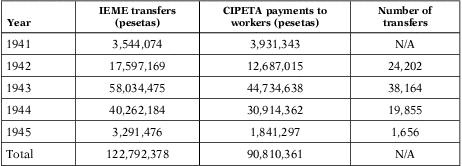
As the figures in Table 2 show, between September 1941 and December 1945 about 122.8 million pesetas’ worth of earnings were remitted from Germany to Spain through the Arbeiter Sonderkonto system. CIPETA received 90.8 million of these pesetas for transfer to the workers; this represents 427 pesetas per worker-month. The funds retained by the government total over 31.9 million pesetas or 25.9 per cent of the total amount remitted from Germany. The net value of the transfers just exceeds an average of 0.17 per cent of the Spanish annual GDP in wartime (Prados De la Escosura Reference Prados De la Escosura2003, p. 288).
TRANSFERS FROM GERMANY TO SPAIN, 1941-1945
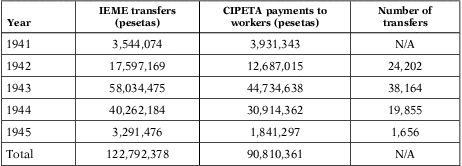
Notes: The transfers began in September 1941, before the Spanish programme workers actually arrived in Germany; they were made by volunteer, non-programme workers already in Germany. Payments continued through December 1945.
Sources: AMAEC R2225/2, memo, «Negociado de Transferencias»; AMAEC R2225/7, memo, «Negociado de Transferencias: Estadística del Año 1945; Banco de España, IEME, libros 22861, 22862, 22866 and 22868 “Rentas de Trabajo” (reported in Pounds Sterling and converted at the official rate)».
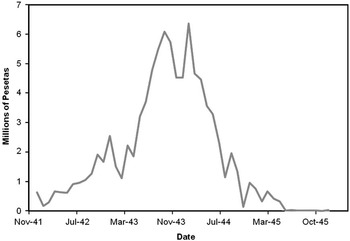
The Arbeiter Sonderkonto transfer statistics reveal general trends. Payments to workers in 1942, the programme's first full year, represent about one-seventh of the total; 1943, the peak year of transfers, saw almost exactly half and 1944 about one-third overall. Figure 4 shows the remittances to workers on a monthly basis. As the chart illustrates, total payments steadily increased from December 1941 to December 1942; they then slowed with the return of seasonal labour to Spain and recovered in spring 1943. Remittances reached a peak in January 1944. The holiday period at the end of 1944 interrupts what is otherwise a steady decline in the 3-month moving average of transfers after September 1943.
MONTHLY PAYMENTS BY CIPETA TO SPANISH WORKERS, SEPTEMBER 1941 TO DECEMBER 1945
Sources: AMAEC R2225/2, memo, «Negociado de Transferencias,» AMAEC R2225/7, memo, «Negociado de Transferencias: Estadistica del Año 1945.»

The extent to which the system actually accounted for all transfers is, however, less than clear. According to the August 1941 agreement, it should have dealt with all funds from Spanish workers, allowing the Spanish government to obtain valuable reichsmark foreign exchange and lower its debtsFootnote 49. However, according to a Foreign Ministry memo dated October 26, 1943, only two-thirds of the Spaniards in Germany used the banking system for remittancesFootnote 50. The CIPETA figures suggest that a third of Spaniards in Germany either spent all their earnings in Germany or transmitted funds to Spain by methods other than bank transfersFootnote 51. Spanish Foreign Ministry documents suggest that in the early months of the programme some workers, on returning to Spain, were remitting their funds in the form of purchased goods. Because of the difficulty of carrying large quantities of luggage or heavy consumer items on the long train journey, the transported items probably consisted of liquor, cigarettes or other small expensive items obtainable only on the German black market; due to shortages, they could resell these in Spain at cost or even above. Another complicating function is the commission taken by the Spanish government transfer department, the IEME, in the exchange process; but the precise effects of this 25.9 per cent commission are unknown. The actual earnings attributable to work are not available; we have to assume, but without any confirmation, that the transfers reflect work-related earningsFootnote 52.
The statistics may also be affected by black market activities and wage inflation. As the war dragged on, unofficial prices and wages rose quickly in Germany, but remained comparatively low in Spain. According to the written records, many Spanish workers took advantage of black-market activities to sell Spanish commodities to the Germans, using the transfer system to remit their illegal black-market earnings to Spain. When discussing the problem of illicit earnings and remittances, the Spanish Foreign Ministry officials used large and dramatic examples to highlight the potential costs to the Spanish state and to dramatise the level of illegal activities. For example, a Spaniard could carry coffee to Germany, exploiting the wide price difference between the two countries. It was estimated that a worker could carry twenty kilos of coffee from Spain to Germany after a vacation, which at 450 reichsmarks per kilo could net 9,000 reichsmarks on the German black market. At the 1943 exchange rate of 4.24 pesetas per reichsmark, this sale would yield ∼37,800 pesetas in income, equivalent to about 7 years of regular earnings in the Spanish labour programme. These illegitimate earnings could have been remitted through the Arbeiter Sonderkonto system, potentially inflating the perceived total of wages earned.
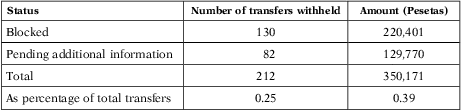
Despite concern, Spain did almost nothing to limit the transfer of illegitimate funds. As Table 3 shows, the Spanish government had blocked only 0.38 per cent of the transfers (by value) at the end of the programmeFootnote 53. Such a low percentage suggests that the government was not sufficiently concerned to take action. There are no statistics to indicate the actual levels of illicit transfers or the effects of the commission system, but, officially at least, the effects are believed to be quite small.
TRANSFERS WITHHELD AND UNDER INVESTIGATION, DECEMBER 31, 1945
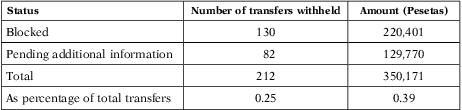
Sources: AMAEC R2225/7, memo «Comisión interministerial para el envió de trabajadores españoles a Alemania» dated January 1946; AMAEC R2225/7, table entitled «Negociado de Transferencias: Estadística del Año 1945».
5 A FINAL ACCOUNTING
The final accounts of the Spanish worker programme show that the Spanish government was profiting overall from the labourers it sent to Germany. However, different departments of the Spanish state benefited or lost, perhaps explaining why some were in favour of it and others against. The Spanish Treasury, led in 1941 by Joaquin Benjumea, was hostile towards CIPETA on the basis of his belief that the programme would be a net expense for Spain. In October 1941 he refused to disburse funds for CIPETA until an intervention from the Council of Ministers, which controlled the Spanish government. It was ultimately the IEME and the Treasury, which benefited from this worker programme, through the transfer commissions; although it is not possible to establish a quid pro quo for the release of the initial funds and the approval of the commissions system using existing sources. CIPETA and the Foreign Ministry ultimately had to pay its costs, but did not receive the benefits of the transfer commissions. However, in the following analysis, we consider the Spanish government as one for the purposes of this paper.
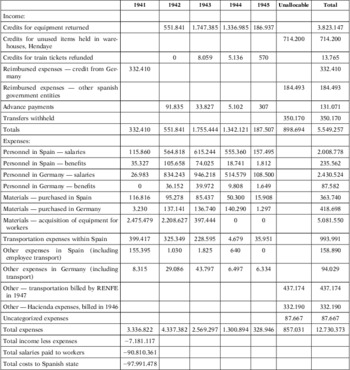
Income from Germany paid to the IEME totalled 122.8 million pesetas. The IEME transferred 90.8 million pesetas to CIPETA. Against this, there were two tiers of costs: workers’ remitted salaries of 90.8 million pesetas, which were subsequently paid from the IEME to CIPETA (an identical amount was credited to the German loan to Spain). This left IEME, and ultimately the Spanish Treasury, with a «profit» of 32.0 million pesetas. Other programme expenses in excess of German government reimbursement were paid directly by CIPETA and came to 7.2 million pesetas, as outlined in Table 4. When combined with the workers’ salaries paid from the state budget, the total costs to the Spanish state were 98.0 million pesetas or 0.68 per cent of an average year's wartime spending by Spain (Table 4; Prados De la Escosura Reference Prados De la Escosura2003, p. 453). Once the 122.8 million pesetas received by the Spanish state are credited, a «profit» of 24.8 million pesetas remains; this is equivalent to 0.17 per cent of Spain's annual wartime spending (Table 4; Prados De la Escosura Reference Prados De la Escosura2003, p. 453).
FINAL ACCOUNTING OF THE HISPANO-GERMAN CIVILIAN LABOUR PROGRAMME (IN PESETAS)

Sources: Ministerio de Hacienda: Direction General de Aduanas (1941): Estadistica del Comercio Exterior de Espana, 1941. AMAEC R2225/7, memo marked, «Negociado de Transferencias: Recibos Pendientes de Despacho» from Servicien de intervención y contabilidad, CIPETA, dated January 1946. AMAEC R2225/7, memo from Subsecretario, Presidencia del Gobierno, dated November 8, 1947. AMAEC R2225/7, memo from MAE to RENFE dated July 10, 1947. AMAEC R2225/7, «CIPETA Oficinas en el Extranjero», and CIPETA Oficinas en España», Servicio de Intervención y Contabilidad.
Expenses. Although recruitment, basic equipment and transportation within Spain and inspections in Germany were meant to be covered by German expense reimbursement, the Spanish government in effect became responsible for most of these expenses and several additional items. To begin with, it organised and transported the workers to the Spanish border where they were given clothing, footwear, rations for the journey and passports. Spanish workers were, however, not equipped with sufficient heavy winter clothing to survive the long, harsh German winters; from the autumn of 1942, the Germans did not supply these items but left Spain to do so. Food shortages led the Spanish Embassy in Berlin to request additional food for distribution to the Spanish workers in Germany. The clothing, boots and other equipment cost Spain just over half a million pesetas net after crediting for equipment returned to the warehouses during repatriation and at the time of liquidationFootnote 54. Although it eventually made this deficit up with transfer commissions, under the August 1941 agreement, it could only claim reimbursement of up to 42.40 pesetas per worker for reasonable expensesFootnote 55. Apart from the fixed German government reimbursement, there was no additional private or public reimbursement of these CIPETA expenses.
Other expenses included a billing in 1946 for excess transportation costsFootnote 56. Several memos indicate the Germans failed to return Spanish workers to the border station at Irún, but gave them tickets to the German border with France instead; the Spanish state ultimately purchased several thousand pesetas’ worth of French, Belgian and Swiss train tickets to repatriate these workersFootnote 57. Transportation cost altogether some 1.4 million pesetas which was billed by the national train operator, RENFE, through 1947Footnote 58.
After credits for the returned equipment and train tickets are recorded against the related expenses, the actual income from withheld payments and reimbursement is small (see Table 4). The income consists mostly of withholdings from the transfer programme and reimbursed expenses. The largest credit comes from transfers withheld and never paid because the recipients could not be traced and/or the funds were blocked as illegitimate earnings; these withholdings totalled 350,000 pesetasFootnote 59. Reimbursements include the sum of 332,000 pesetas, which Germany advanced to Spain in September 1941Footnote 60. Other Spanish departments reimbursed CIPETA for various expenses, totalling some 184,500 pesetas in the course of the programme. Income for the reimbursement for advance payments, of which no description is available, totalled 131,000 pesetasFootnote 61. These credits were less than the expenses.
As seen in Table 4, total income (including reimbursements and reclaimed equipment) from the programme came to 5.5 million pesetas and total expenses to 12.7 million pesetas; as a result, the direct programme costs were 7.2 million pesetas or about 0.05 per cent of an average year's state spending in wartime (Prados de la Escosura Reference Prados De la Escosura2003, p. 453). Combined with employee expenses of 90.8 million, total Spanish state expenditure for the programme reached 98.0 million pesetas.
As the structure of the agreement and these final accounts suggest, by agreeing to organise, equip and monitor the Spanish workers going to Germany, the Spanish state committed itself to spending millions of pesetas. As previously indicated, it could only claim reimbursement for reasonable expenses of up to 42.40 pesetas per worker. As seen in Table 4, actual expenses per worker were substantially higher: during the active periods of recruitment from November 1941 to October 1943, there were ∼25,000 individual workersFootnote 62. Total net programme expenditures of 7.8 million pesetas for 25,000 workers imply a net expenditure of ∼316 pesetas per worker, far exceeding the 42.40 peseta credit. As a result, the German contribution merely offset, but never fully reimbursed the expenses to CIPETA. Had the programme run to its originally expected size, CIPETA would have spent millions of additional pesetas. This gives an added reason for the early suspension of recruitment by CIPETA while the flow of remittances continued to be permitted.
6 CONCLUSIONS
The Spanish government offered Germany workers and then minimised the numbers, which it allowed to go. This change must be attributed to Allied diplomatic efforts to limit Spanish-German cooperation. The Spanish government's mediocre recruitment efforts, the low number of actual recruits and the withdrawal of the recruiting officers in 1942 reveal clear choices by the Spanish government to limit the size of the programme, despite publicly indicating otherwise. This was despite the «transfer commissions» collected by the Spanish government. The traditional diplomatic view has been that workers were not sent to Germany because of conditions there. However, the new employment statistics presented in this paper suggest that workers continued to go despite these poor conditions and even without Spanish state sponsorship to cover their transportation costs. It was the Spanish state rather than the workers themselves that wanted to stop providing labour to Germany; parallel to this, the Spanish-German government negotiations became more and more tempestuous. The Allies became more assertive in their willingness to impose trade sanctions, on oil in particular. The timeline of Spanish government actions suggests that the Allied diplomatic pressure to end the programme was successful.
In ending its recruitment for the programme, the Spanish government went against its own economic interests. Although the CIPETA organisation that was responsible for the worker programme was losing money, the Spanish transfer organisation, the IEME, was collecting sizeable commissions. With the losses and costs offset by the transfer commissions, the programme produced a modest overall «profit» of 24.8 million pesetas in favour of the Spanish government. Moreover, the reichsmarks which it earned helped to reduce Spanish debts with Germany. In addition to paying off the reichsmark debts, the small net «profit» meant the Spanish government should have been quite happy to encourage its citizens to work in Germany. Had the programme run to the base figure of 100,000 workers in early 1942, the Spanish IEME and Treasury could have earned about 1 per cent of its annual wartime GDP through transfer commissions alone, assuming that the losses of CIPETA were fully paid out of the commissions (Prados De la Escosura Reference Prados De la Escosura2003, p. 453). However, the Allied pressure clearly affected Spanish thinking. Therefore, the decisions to suspend and eventually cancel the programme were taken against Spain's best short-term economic interests, but were able to distance Spain from Germany for the post-war period.