Introduction
Burnout has received increased attention in the medical literature over the last three decades culminating in recent efforts to promote the importance of resilience training and self-care for medical providers (Meier et al., Reference Meier, Back and Morrison2001; Kearney et al., Reference Kearney, Weininger and Vachon2009; Sanchez-Reilly et al., Reference Sanchez-Reilly, Morrison and Carey2013; Gillman et al., Reference Gillman, Adams and Kovac2015; Back et al., Reference Back, Steinhauser and Kamal2016; Rotenstein et al., Reference Rotenstein, Torre and Ramos2018). Burnout, defined as a “psychological syndrome emerging as a prolonged response to chronic interpersonal stressors on the job” (Maslach and Leiter, Reference Maslach and Leiter2016, p. 103), is characterized by emotional exhaustion (EE), cynicism, and a sense of ineffectiveness, most commonly measured by the Maslach Burnout Inventory (MBI) (Maslach and Jackson, Reference Maslach and Jackson1981; Maslach et al., Reference Maslach, Jackson, Leiter, Zalaquett and Wood1997). To date, the majority of research on burnout within medicine in general, and oncology in particular, has focused on nurses and physicians and its impact on provider well-being and the delivery of patient care (Khamisa et al., Reference Khamisa, Peltzer and Oldenburg2013; Shanafelt et al., Reference Shanafelt, Gradishar and Kosty2014a; Ko and Kiser-Larson, Reference Ko and Kiser-Larson2016; Cañadas-De la Fuente et al., Reference Cañadas-De la Fuente, Gómez-Urquiza and Ortega-Campos2018; Pradas-Hernández et al., Reference Pradas-Hernández, Ariza and Gómez-Urquiza2018; Rotenstein et al., Reference Rotenstein, Torre and Ramos2018). Despite great variability in prevalence rates and marked variation in the definition of terms and assessment methods (Rotenstein et al., Reference Rotenstein, Torre and Ramos2018), the consequences of burnout include poor work–life balance, poor mental and physical health, increased staff turnover and workforce shortages, and increased errors and compromised patient care (Khamisa et al., Reference Khamisa, Peltzer and Oldenburg2013; Shanafelt et al., Reference Shanafelt, Gradishar and Kosty2014a,Reference Shanafelt, Raymond and Kostyb; Murali and Banerjee, Reference Murali and Banerjee2018).
Oncology nursing is considered a profession at risk for high rates of burnout because of the constant emotional stress of caring for ill and dying patients (Davis et al., Reference Davis, Lind and Sorensen2013). A recent systematic review of oncology nurses found that 30% experienced EE, 15% experienced depersonalization (DP) (cynicism), and 35% experienced low personal performance, as measured by the MBI (Cañadas-De la Fuente et al., Reference Cañadas-De la Fuente, Gómez-Urquiza and Ortega-Campos2018). Similarly, for oncologists, the demands associated with caring for increasing numbers of cancer patients set within the context of a rapidly changing and complex scientific field, present numerous challenges that have the potential to lead to burnout (Murali and Banerjee, Reference Murali and Banerjee2018). A large survey examining satisfaction with work–life balance and career plans of oncologists found that 45% of surveyed oncologists were “burned out” based on their scores on the MBI (Shanafelt et al., Reference Shanafelt, Gradishar and Kosty2014a). Female oncologists and those who spent more time providing patient care were less likely to be satisfied with their work–life balance (Shanafelt et al., Reference Shanafelt, Raymond and Kosty2014b). Further, burnout and satisfaction with work–life balance were the strongest predictors of an oncologist's intention to reduce their clinical hours and to leave their current role (Shanafelt et al., Reference Shanafelt, Raymond and Kosty2014b).
Ironically, even though psycho-oncology can be considered to be one of the most emotionally challenging aspects of oncological care, research in this area has almost exclusively focused on medical oncology providers. Very few studies have specifically addressed burnout in psychosocial oncology clinicians. The intense nature of the therapeutic relationship with often acutely distressed patients in catastrophic situations could also lead to other emotional consequences for psychosocial oncology clinicians, such as compassion fatigue and secondary trauma. While the terms, burnout, compassion fatigue, and secondary trauma, are sometimes used synonymously, the concepts may be more nuanced. Figley (Reference Figley2002), for example, described compassion fatigue as a type of burnout in psychotherapists and theorized that secondary trauma leads to compassion fatigue. Nonetheless, all can be thought of as “the cost of caring.”
Hence, we conducted a systematic review of burnout, compassion fatigue, and secondary trauma in psychosocial oncology clinicians, an understudied population in oncology care. A better understanding of burnout in these clinicians could facilitate the development of practices and interventions to reduce burnout in a diverse group of oncology clinicians, not limited to medical oncology nurses and oncologists. The systematic review proposed the following two questions:
1) What is known about the prevalence and severity of burnout in psychosocial clinicians who work in oncology settings?
2) What factors are believed to either contribute to or protect against burnout in our target population?
We only evaluated empirical studies that addressed burnout in psychosocial clinicians, including psychologists, psychiatrists, social workers, and child life specialists, who work in oncology settings. While our focus was on burnout, we broadened our search to include compassion fatigue, EE, vicarious trauma, and secondary trauma. We discuss the implications of our findings within the context of further research, clinical training and practice, for both current and future psychosocial oncology clinicians.
Methods
Protocol and registration
The systematic review protocol was registered with the International Prospective Register of Systematic Reviews (PROPERO) on January 7, 2019, and the registration number is CRD42019118750.
Eligibility criteria and search strategy
We conducted a systematic literature review examining burnout in psychosocial clinicians in oncology settings. Relevant studies were identified by searching PubMed/MEDLINE (National Library of Medicine), EMBASE (Elsevier; 1974–present), PsycINFO (EBSCO), the Cumulative Index to Nursing and Allied Health Literature (CINAHL, EBSCO), and the Web of Science Core Collection (Clarivate Analytics) on September 7 and 10, 2018. We updated the search on October 3, 2019. Controlled vocabulary terms were included as appropriate and when available. The search strategies were designed and executed by a Harvard Medical School research librarian (PAB). No language limits or year restrictions were applied. Exact searches for each database are shown in Supplementary Appendix 1. This review is reported following the statement of Preferred Reporting Items for Systematic Reviews and Meta-Analyses (Moher et al., Reference Moher, Liberati and Tetzlaff2009).
Inclusion/exclusion criteria
A study was included if it: (1) quantitatively measured burnout, compassion fatigue, or secondary trauma in psychosocial oncology clinicians. Psychosocial oncology clinicians were defined as social workers, psychologists, psychiatrists, child life specialists, and psychosocial nurses who primarily provide psychosocial care to patients receiving cancer treatment; and (2) was published in English. A study was excluded if it: (1) was published as an abstract only, (2) was a review paper, or (3) had no relevance to our review questions.
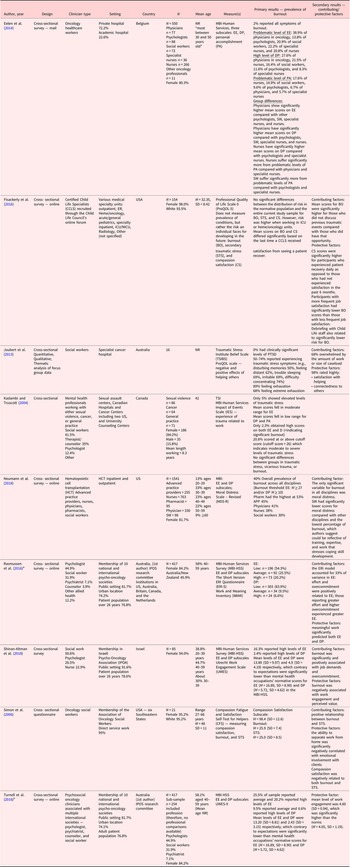
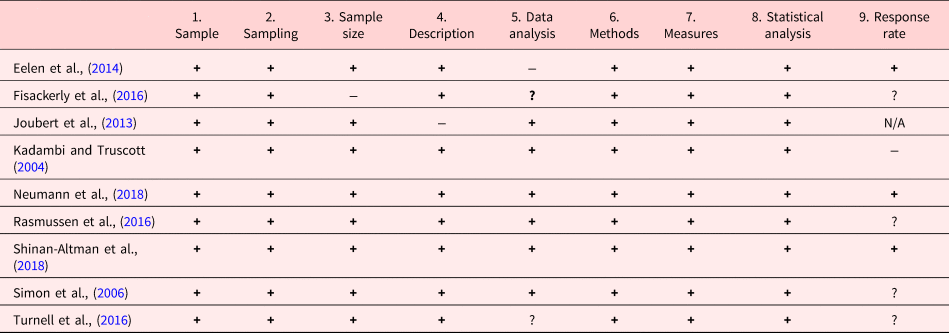
Unique records were identified and independently screened for eligibility by three pairs of authors (LN, NAB; ARC, EA; and ACM, TH) and verified by two authors (IMB and WFP). Consensus was reached for any case in which there was disagreement. Using the Covidence systematic review software, Veritas Health Innovation, Melbourne, Australia, three authors (HP, JP, and MY) screened the identified nine studies and extracted the following baseline characteristics from the original articles: lead author, year of publication, study design, clinician type, setting, country, sample size, mean age of sample, assessments used, prevalence of burnout, and factors that contribute to or protect against burnout (Table 1). Methodological quality and risk of bias was assessed for each study as shown in Table 2 using the Joanna Briggs Institute Critical Appraisal Checklist for Studies Reporting Prevalence Data (Munn et al., Reference Munn, Moola and Lisy2015).
Findings from studies included in systematic review of burnout in psychosocial oncology clinicians

NR – not reported.
a Companion papers — same data set.
Methodological quality, risk of bias, and quality assessment for the nine included empiric studiesa

+ yes; − no; ? unclear; N/A not applicable.
a Contents for this table were guided by the “Critical Appraisal Checklist for Studies Reporting Prevalence Data” from Munn et al. (Reference Munn, Moola and Lisy2015).
Results
Included studies
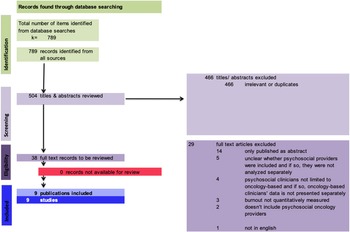
Seven hundred and eighty-nine records were retrieved by database searching resulting in 504 potential records (Figure 1). Four hundred and sixty-six records were excluded at title and abstract levels. We reviewed 38 articles at the full-text level, and of those, 9 articles met study inclusion criteria.
Flowchart of the screening and eligibility evaluation phases. Note. This flowchart has been modeled after: Moher et al. (2009).

Description of studies
All nine studies were cross sectional, and two were companion papers using the same sample of participants (Rasmussen et al., Reference Rasmussen, Turnell and Butow2016; Turnell et al., Reference Turnell, Rasmussen and Butow2016). Several countries were represented including the US, Australia, Belgium, Canada, and the Netherlands.
Risk of bias and quality assessment
According to the Critical Appraisal Checklist for Studies Reporting Prevalence Data (Munn et al., Reference Munn, Moola and Lisy2015), all nine studies met criteria 1 (i.e., the sample was appropriate to address the target population) and 2 (i.e., study participants were appropriately sampled). One of the studies did not meet criteria 3 (i.e., sample size was adequate). All studies met criteria 6–8, as valid methods were used for the identification of the condition (e.g., burnout); the condition was measured appropriately; and there were appropriate statistical analyses. Adequacy of response rate (criteria 9) was irrelevant or unknown in five studies but was adequate in three of the studies. Overall, quality assessment revealed a generally low risk of bias and high methodological quality as shown in Table 2.
Description of samples
Of the identified nine studies, five exclusively evaluated burnout (or a related construct) in samples of psychosocial oncology clinicians, including psychologists, social workers, allied health workers, and nurses who provided psychosocial care (Simon et al., Reference Simon, Pryce and Roff2006; Joubert et al., Reference Joubert, Hocking and Hampson2013; Rasmussen et al., Reference Rasmussen, Turnell and Butow2016; Turnell et al., Reference Turnell, Rasmussen and Butow2016; Shinan-Altman et al., Reference Shinan-Altman, Cohen and Rasmussen2018). Of note, work role was initially omitted from the questionnaire used in two of these studies (Rasmussen et al., Reference Rasmussen, Turnell and Butow2016; Turnell et al., Reference Turnell, Rasmussen and Butow2016), which meant that work role was only available for half of the sample. A sixth study included only child life specialists who worked in various pediatric medical settings (Fisackerly et al., Reference Fisackerly, Sira and Desai2016), and a further two studies sampled a mix of providers including psychosocial clinicians, physicians, and nurses who worked in an oncology medical setting (Eelen et al., Reference Eelen, Bauwens and Baillon2014; Neumann et al., Reference Neumann, Mau and Virani2018), the latter also including pharmacists (Neumann et al., Reference Neumann, Mau and Virani2018). The ninth study examined burnout and trauma in a sample of mental health clinicians who worked in three different settings, only one setting being oncology (Kadambi and Truscott, Reference Kadambi and Truscott2004).
Study sample sizes ranged from 16 (Joubert et al., Reference Joubert, Hocking and Hampson2013) to 1,541 (Neumann et al., Reference Neumann, Mau and Virani2018), although in the larger study, only 98 of 1,541 were psychosocial clinicians, namely social workers. In total, this review includes 678 psychosocial clinicians whose work role was reported; counting once the sample that was the basis of two studies (Rasmussen et al., Reference Rasmussen, Turnell and Butow2016; Turnell et al., Reference Turnell, Rasmussen and Butow2016). Mean age was only reported in three studies: 32.35 years (SD = 8.42) (Fisackerly et al., Reference Fisackerly, Sira and Desai2016), 42 years (Kadambi and Truscott, Reference Kadambi and Truscott2004), and 48 years (SD = 11) (Simon et al., Reference Simon, Pryce and Roff2006). Of the remaining six studies, five studies provided age ranges of the participants (Rasmussen et al., Reference Rasmussen, Turnell and Butow2016; Turnell et al., Reference Turnell, Rasmussen and Butow2016; Shinan-Altman et al., Reference Shinan-Altman, Cohen and Rasmussen2018) where the majority of participants were between 40 and 59 years of age, and one study did not report the age of the participants (Joubert et al., Reference Joubert, Hocking and Hampson2013).
Measures used
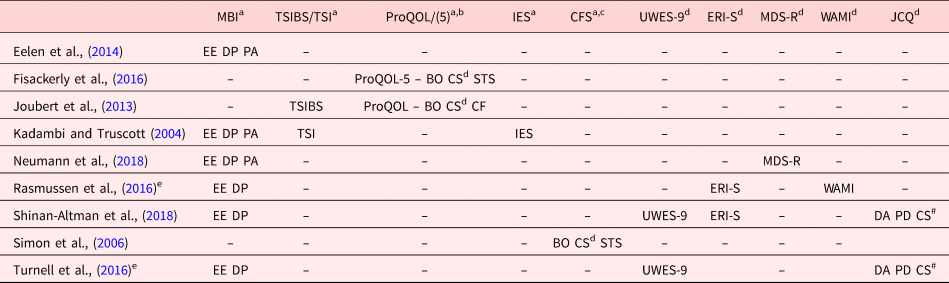
Ten validated measures were used in the studies reported in this systematic review as shown in Table 3. Three measures assessed the prevalence of burnout or a related construct as defined in this protocol and included the MBI–HSS, the TSIBS, and the IES. Two measures assessed both burnout and compassion satisfaction — the Professional Quality of Life Scale (ProQOL) and the Compassion Fatigue and Satisfaction Self-Test for Helpers (CFS or CFST), the latter according to Nimmo and Huggard (Reference Nimmo and Huggard2013) was re-developed and re-named the ProQOL, where the ProQOL-5 is the current version (www.proqol.org). Four of the nine studies also measured constructs related to burnout using five different measures (Rasmussen et al., Reference Rasmussen, Turnell and Butow2016; Turnell et al., Reference Turnell, Rasmussen and Butow2016; Shinan-Altman et al., Reference Shinan-Altman, Cohen and Rasmussen2018; Neumann et al., Reference Neumann, Mau and Virani2018).
Measures and subscales used in each of the nine included empiric studies

Subscales used: EE, emotional exhaustion; DP, depersonalization; PA, personal accomplishment; BO, burnout; CS, compassion satisfaction; CF, compassion fatigue; STS, secondary traumatic stress; DA, decision authority; PD, psychological demands; CS#, coworker support.
a Primary measures of burnout, traumatic stress, and compassion fatigue.
b ProQOL-5 is the current version of the ProQOL (www.proqol.org).
c According to Nimmo and Huggard (Reference Nimmo and Huggard2013), the CFS (also abbreviated as CFST) was re-developed and re-named the ProQOL.
d Secondary measures of factors associated with burnout.
e Companion papers — used same sample.
Prevalence and severity of burnout, traumatic stress, and compassion fatigue in psychosocial oncology clinicians
Burnout
Burnout was measured by the MBI in six of the nine studies (Kadambi and Truscott, Reference Kadambi and Truscott2004; Eelen et al., Reference Eelen, Bauwens and Baillon2014; Rasmussen et al., Reference Rasmussen, Turnell and Butow2016; Turnell et al., Reference Turnell, Rasmussen and Butow2016; Shinan-Altman et al., Reference Shinan-Altman, Cohen and Rasmussen2018; Neumann et al., Reference Neumann, Mau and Virani2018). Two of these studies used the same sample of clinicians (Rasmussen et al., Reference Rasmussen, Turnell and Butow2016; Turnell et al., Reference Turnell, Rasmussen and Butow2016). The MBI comprises three subscales — EE, DP, and personal accomplishment (PA). Three of the six studies reported data on all three subscales (Kadambi and Truscott, Reference Kadambi and Truscott2004; Eelen et al., Reference Eelen, Bauwens and Baillon2014; Neumann et al., Reference Neumann, Mau and Virani2018), while the other three reported data on EE and DP only (Rasmussen et al., Reference Rasmussen, Turnell and Butow2016; Turnell et al., Reference Turnell, Rasmussen and Butow2016; Shinan-Altman et al., Reference Shinan-Altman, Cohen and Rasmussen2018).
Eelen et al. (Reference Eelen, Bauwens and Baillon2014) using the Dutch version of the MBI, compared various groups of oncology professionals in Belgium, including psychologists, social workers, physicians, and nurses. They found that 2% of the entire sample reported all symptoms of burnout with physicians having significantly higher mean scores on EE and DP than psychologists, social workers, specialist nurses, and nurses. However, social workers reported significantly lower levels of PA compared with psychologists or specialist nurses. They concluded that the risk of burnout was associated with profession, with psychologists and specialist nurses being less at risk of burnout compared with physicians.
In a Canadian study, Kadambi and Truscott (Reference Kadambi and Truscott2004) found that only 2.3% of their sample of mental health professionals met the criteria for significant burnout as indicated by high scores on both EE and DP of the MBI. Specifically, the mean scores fell in the middle range on the EE subscale and the low range for DP. They found no differences on levels of burnout between professionals providing counseling to different client populations (sexual violence, psycho-oncology, and general practice). For PA, the participants’ mean scores fell within the low range, indicating a low sense of PA in their work.
Neumann et al. (Reference Neumann, Mau and Virani2018), in a US study of a mixed sample of hematopoietic cell transplant professionals including physicians, pharmacists, advanced practice professionals, and social workers, found that overall the prevalence of burnout was 40% with significant differences across disciplines. Pharmacists had the highest prevalence of burnout with 53% meeting criteria, followed by 45% for advanced practice professionals, 41% for physicians, 38% for nurses, and 30% for social workers.
In the same sample of 417 international psychosocial oncology health professionals reported in two studies in this review (Rasmussen et al., Reference Rasmussen, Turnell and Butow2016; Turnell et al., Reference Turnell, Rasmussen and Butow2016), 20.2% of the sample endorsed high EE and 6.6% high DP. The mean levels of EE and DP were 13.20 (SD = 8.81) and 2.43 (SD = 3.15), respectively, which were significantly lower than mental health occupations’ normative scores for EE (M = 16.89, SD = 8.90) and DP (M = 5.72, SD = 4.62) reported in the MBI-HSS manual.
Shinan-Altman et al. (Reference Shinan-Altman, Cohen and Rasmussen2018), in a survey of members of the Israeli Psycho-oncology Association (IPOA) including social workers, psychologists, and nurses who provided psychological care, found that 16.3% and 2.4%, respectively, reported high levels of EE and DP. Specifically, the means for EE and DP were 13.89 (SD = 9.97) and 4.9 (SD = 4.19), which were also significantly lower than the corresponding means reported in the MBI-HSS manual.
The Professional Quality of Life Scale (ProQOL and ProQOL-5) was used in two studies (Joubert et al., Reference Joubert, Hocking and Hampson2013; Fisackerly et al., Reference Fisackerly, Sira and Desai2016). This scale provides measures of the negative and positive effects of helping others who experience suffering and trauma (Joubert et al., Reference Joubert, Hocking and Hampson2013). The ProQOL includes subscales for burnout, compassion fatigue, and compassion satisfaction. Joubert et al. (Reference Joubert, Hocking and Hampson2013), in their sample of 16 oncology social workers, found that 89% reported feeling exhausted from their work in the helping profession with 68% stating that they experienced extreme exhaustion. Further, 68% of the sample said that they felt overwhelmed with the size of their caseload. Despite these high levels of stress, 98% of participants rated the items “satisfaction from helping” and “connectedness to others” highly.
Traumatic stress and compassion fatigue
Two studies assessed traumatic stress using either the Traumatic Stress Institute Belief Scale (TSIBS) (Joubert et al., Reference Joubert, Hocking and Hampson2013), the TSI (Kadambi and Truscott, Reference Kadambi and Truscott2004), or the IES (Kadambi and Truscott, Reference Kadambi and Truscott2004). A third study examined the impact of secondary traumatic stress (STS) resulting from working in oncology using the CFS (Simon et al., Reference Simon, Pryce and Roff2006).
The TSIBS was used by Joubert et al. (Reference Joubert, Hocking and Hampson2013) and examined the experience and management of vicarious trauma of a small sample of social workers from a specialist cancer hospital in Australia. A descriptive analysis of the scores revealed that none of the participants had clinically significant levels of post-traumatic stress disorder. The findings indicated that 50–74% of participants reported experiencing traumatic stress symptoms, categorized as intrusive thoughts, avoidance, numbing, and heightened arousal. Fifty percent said they had experienced repeated disturbing memories, thoughts, or images of a stressful experience; 50% said they avoided thinking about or talking about a stressful experience; 62% reported feeling distant or cutoff from other people; and 74% reported concentration difficulties.
Kadambi and Truscott (Reference Kadambi and Truscott2004) used both the TSI and the IES in their study of predominantly Canadian mental health professionals who worked in sexual assault centers, cancer centers (including two US centers), or university counseling centers to assess traumatic stress. They found no significant differences in assessed levels of vicarious trauma or traumatic stress symptoms between the professionals providing counseling in the three different settings. They concluded that the majority of participants in their study did not appear to be experiencing symptoms of traumatic stress or burnout with only 5% of the sample endorsing elevated levels of traumatic stress.
Simon et al. (Reference Simon, Pryce and Roff2006) in an exploratory pilot study of 21 social workers of whom 20 were female and 95% worked in direct patient care, used the CFS, which is designed to measure the potential for compassion satisfaction, burnout, and STS. The results indicated that the subscale scores for each were statistically correlated with one another. There was a positive relationship between burnout and STS (r = 0.46, P < 0.05), and compassion satisfaction was negatively related to both burnout and STS (r = −0.75, P < 0.001; r = −0.44, P < 0.05, respectively). Further, 90% of participants rated themselves as very empathic to their clients, with 52% reporting that their emotional involvement with clients was “average.” The ability to separate work from home was negatively correlated with emotional involvement with clients (r = −0.47, P < 0.03); 38% of participants rated their ability to separate work from home as average and 53% as better than average.
Two other studies also examined compassion fatigue and compassion satisfaction within helping professions using the ProQOL-5 (Fisackerly et al., Reference Fisackerly, Sira and Desai2016) and the ProQOL (Joubert et al., Reference Joubert, Hocking and Hampson2013). In a US sample of 154 Certified Child Life Specialists (CCLS) of whom 98% were female and who had worked as a CCLS for an average of 7.35 years, Fisackerly et al. (Reference Fisackerly, Sira and Desai2016) used the ProQOL-5 to measure the risk the clinicians had for developing burnout or secondary traumatization stress in the future. The ProQOL-5 does not measure the prevalence of these conditions. Of the sample, within the past seven days, 54.5% had been exposed to patients who had been traumatized and 12% had dealt with a patient death. No significant differences were found between the sample and the normative population data reported in the manual for the risk of burnout, secondary traumatization stress, or compassion satisfaction.
Factors believed to contribute to or protect against burnout related to caring
Several factors related to the cost of caring that appear to protect against the risk of developing burnout out or secondary traumatization stress were identified. In Fisackerly et al.'s (Reference Fisackerly, Sira and Desai2016) study, these were:
Exposure to patient recovery
Mean scores on both compassion satisfaction and burnout differed significantly based on the last time the CCLS saw a patient recover. The compassion satisfaction scores were higher for those participants who experienced patient recovery daily compared with those participants who had not experienced satisfaction from a patient's recovery in the past 6 months (F(5,148) = 3.65, P < 0.01).
Job satisfaction
Frequency of perceived job satisfaction also had an effect on burnout; participants with greater job satisfaction had lower burnout scores than those with less frequent job satisfaction (F(5,148) = 2.29, P < 0.05).
Discussing traumas
Debriefing with child life staff was also related to a lower risk of burnout (t(151) = 4.02, P < 0.05). Mean scores for burnout were significantly higher for those participants who did not discuss previous traumatic events, such as patient deaths, (M = 53.65, SD = 10.82) compared with those who did discuss previous events (M = 48.71, SD = 9.28).
Five additional measures also assessed factors that are associated with burnout and were reported in the studies below. These factors are categorized as moral distress, engagement and job demands, and meaning.
Moral distress
Moral distress was measured in one study using the MDS-R (Neumann et al., Reference Neumann, Mau and Virani2018). The results indicated that scores for moral distress were significantly different across disciplines with pharmacists having the largest percentage in the “high score” category followed by nurses. Physicians and social workers had significantly lower scores than advanced practice providers, nurses, and pharmacists, and physicians had significantly higher scores than social workers. Social workers had the largest percentage in the “low score” category and the lowest mean. Moral distress was the only significant variable in all disciplines that predicted burnout.
Engagement and job demands
The Utrecht Work Engagement Scale (UWES-9) was used in two studies (Turnell et al., Reference Turnell, Rasmussen and Butow2016; Shinan-Altman et al., Reference Shinan-Altman, Cohen and Rasmussen2018), where high levels of work engagement are associated with positive physical and mental health, productivity, and creativity. Shinan-Altman et al. (Reference Shinan-Altman, Cohen and Rasmussen2018) found that burnout was significantly and positively associated with job demands (r = 0.69, P < 0.0001) and overcommitment (r = 0.34, P < 0.01), and negatively associated with work engagement and perceived value (r = −0.31, P < 0.01). As such, the higher the job demands and overcommitment, and the lower the work engagement and perceived value, the higher the burnout.
Turnell et al. (Reference Turnell, Rasmussen and Butow2016) found that higher levels of job resources predicted higher levels of work engagement. The mean level of work engagement was 4.60 (SD = 0.94), which was significantly higher than the norms (M = 4.05, SD = 1.19) (as cited in Turnell et al. Reference Turnell, Rasmussen and Butow2016). The sample endorsed lower means of burnout compared with those of mental health norms, leading the authors to hypothesize that receiving professional supervision, which was reported by 57.1% of the sample, might act as a buffer in mitigating distress.
The short version ERI Questionnaire (ERI-S) based on the effort-reward imbalance model was used in two studies (Rasmussen et al., Reference Rasmussen, Turnell and Butow2016; Shinan-Altman et al., Reference Shinan-Altman, Cohen and Rasmussen2018). This scale measures effort, rewards, and overcommitment. In Rasmussen et al.'s (Reference Rasmussen, Turnell and Butow2016) study, the ERI model was only partially supported as a useful framework for examining burnout in psychosocial oncology clinicians, accounting for 33% of the variance in EE. Effort and overcommitment were positively related to EE; those reporting greater effort and higher overcommitment experienced greater EE. Higher effort and lower reward were both found to be significantly associated with great EE, though not DP. In the second study, Shinan-Altman et al. (Reference Shinan-Altman, Cohen and Rasmussen2018) used the overcommitment scale of the ERI-S and found that burnout was significantly and positively associated with overcommitment. They concluded that future research needs to strengthen positive factors that mitigate burnout, such as perceived value and work engagement.
Two studies used subscales of the Job Content Questionnaire (JCQ) to measure different aspects of the demands of a job (Turnell et al., Reference Turnell, Rasmussen and Butow2016; Shinan-Altman et al., Reference Shinan-Altman, Cohen and Rasmussen2018). Three subscales were used in both studies: decision authority (DA), psychological demands (PDs), and coworker support (CS). Shinan-Altman et al. (Reference Shinan-Altman, Cohen and Rasmussen2018) found that burnout was significantly and positively associated with job demands and overcommitment, and negatively associated with work engagement and perceived value. Turnell et al. (Reference Turnell, Rasmussen and Butow2016) found that higher levels of job demands predicted greater burnout.
Meaning
Rasmussen et al. (Reference Rasmussen, Turnell and Butow2016) also explored the impact on burnout of self-reported meaningful work characterized by work that is both significant and positive, and focused on growth and purpose rather than pleasure. Meaningful work was assessed by the Work and Meaning Inventory (WAMI), which incorporates three subscales: positive meaning in work, meaning-making, and greater good motivation, where higher scores indicate greater meaning. In their study, meaningful work significantly predicted both EE and DP but only accounted for 2% more of the variance above the ERI model. The authors concluded that burnout interventions aimed at increasing clinicians’ sense of self-efficacy may be most effective when implemented with changes at the organizational level, such as lessening workplace stressors and increasing rewarding opportunities (Rasmussen et al., Reference Rasmussen, Turnell and Butow2016).
Discussion
The findings of this systematic review suggest that psychosocial oncology clinicians are not at increased risk of burnout compared with other health care professionals working in oncology and those working in mental health. Although the data are quite limited, there is consistency across the few studies that do exist. Given the emotional intensity of psychosocial oncology, this conclusion may seem surprising. However, many factors could contribute to these observations.
This review identified six specific aspects of work that appear to be associated with less burnout: (1) exposure to patient recovery, (2) discussing traumas, (3) meaning, (4) less moral distress, (5) job engagement and less job demands, and (6) job satisfaction. Job satisfaction, engagement, and demands are general factors that vary with any position, but the other job aspects may have a more favorable profile in psychosocial oncology. Given a major focus of the work is maximizing quality of life, psychosocial oncology clinicians may have greater exposure to improvement in the issues they are treating, such as anxiety and depression, compared with oncologists caring for patients with advanced cancers. They are also probably less likely to encounter frequent moral distress around their treatment decisions, even though they may sometimes have to hospitalize a patient against their will or report suspected child or elder abuse to authorities. The training that psychosocial clinicians typically receive, involves intensive study, supervision, and self-reflection about managing difficult emotions and complicated psychosocial situations. This might often include debriefing or discussing traumatic situations with a supervisor or colleague(s). Finally, finding meaning in caring for patients is something that psychosocial clinicians frequently cite as an important part of their work.
Limitations
We believe that more research is needed using standardized measures of burnout with larger samples of psychosocial clinicians to examine both prevalence rates and how the clinician experience of burnout might change over time, especially as the majority of participants in these studies were middle aged. The nine studies included in this review were published between 2004 and 2018. The findings indicate that the empiric literature is very limited, undermined by great variability, including the definition of terms, sample sizes, sample composition, and the psychometric measures and subscales used, making comparisons difficult. While the MBI-HSS was used in the majority of the studies to assess burnout, it should be noted that the authors have eliminated cutoff scores in the current version of the MBI manual (4th edition), due to a lack of diagnostic validity (www.Mindgarden.com). Instead, new research is focused on examining patterns along the burnout–engagement continuum. The variability in terminology might have also led to some relevant studies not being identified through our search strategy, despite including the terms burnout, compassion fatigue, vicarious trauma, and secondary trauma.
Clinical implications
While this systematic review revealed that to date, there is limited knowledge about burnout in psychosocial oncology clinicians, it appears that there is a great opportunity to incorporate insights about protective factors into training and staff support at the organizational, multidisciplinary team, and individual level to help lessen the likelihood of burnout in clinicians and staff alike (Kearney et al., Reference Kearney, Weininger and Vachon2009; Sanchez-Reilly et al., Reference Sanchez-Reilly, Morrison and Carey2013; Back et al., Reference Back, Steinhauser and Kamal2016; Muriel et al., Reference Muriel, Tarquini and Morris2018; Morris et al., Reference Morris, Kearns and Moment2019).
At the organization level, in addition to tackling the issue of job demands, a clear statement endorsing the importance of self-care is needed along with regular structured opportunities for education and mentoring, such as Schwartz Rounds (https://www.theschwartzcenter.org/programs/schwartz-rounds). Team-based strategies, incorporating both formal and informal opportunities to debrief, create a safe place where clinicians can express and process their thoughts and feelings about how they have been affected by caring for their patients or their deaths (Muriel et al., Reference Muriel, Tarquini and Morris2018). Similarly, ensuring protected time to remember those patients who have died is another strategy for teams that can be incorporated into scheduled multidisciplinary team meetings (Morris et al., Reference Morris, Kearns and Moment2019). Individual strategies include receiving regular supervision in formal supervision, and formal or informal peer supervision, maintaining clear yet flexible boundaries, especially between work and home, challenging unhelpful or unrealistic thinking patterns about job role and expectations, and developing ways to “grieve” for patients, such as writing sympathy cards or making condolence calls (Worden, Reference Worden1991; Morris and Block, Reference Morris, Block, Grassi and Riba2012; Merel et al., Reference Merel, Stafford and White2015; Muriel et al., Reference Muriel, Tarquini and Morris2018).
Conclusions
While more research is needed, psychosocial oncology clinicians may not be at increased risk for burnout compared with other oncology and mental health professionals. This, however, does not mean that burnout is non-existent. Some aspects of the work may be protective, and this review identified associated factors. Psychosocial oncology clinicians are in a unique position to support both their medical colleagues and each other by drawing on the aspects of their training and practice that appear to protect against burnout.
Supplementary material
The supplementary material for this article can be found at https://doi.org/10.1017/S147895152000084X.
Conflict of interest
None.