Estimating potential health issues related to environmental change has become increasingly important,Reference Costello, Abbas and Allen 1 - Reference Springmann, Mason-D’Croz and Robinson 4 and animals including arthropods are one significant but neglected health threat that may be affected by such changes.Reference Langley, Mack and Haileyesus 5 In particular, stings caused by the Hymenoptera order are a significant arthropod-related health issue for humans and cause a systemic allergic reaction in approximately 0.8-5% of affected individuals.Reference Steen, Janniger and Schutzer 6 Numerous pathways have been suggested by which environmental changes can increase the number of encounters between humans and hymenopterans. For instance, global warming,Reference Barbet-Massin, Rome and Muller 7 unusually dry weather,Reference Park, Zhang and Landau 8 and abandonment of farmland or residential propertiesReference Michener 9 can contribute to expansion of hymenopteran habitats. UrbanizationReference Park, Zhang and Landau 8 , Reference Christie and Hochuli 10 or an increased number of outdoor workers 11 may also raise the risk of unintentional encroachment on hymenopteran habitats. An immediate effect of drastic environmental change on the risk of hymenopteran stings has been reported, with natural disasters representative of this phenomenon.Reference Brewer, Morris and Cole 12 - 14 However, in contrast to abundant knowledge of the consequences of immediate changes,Reference Brewer, Morris and Cole 12 - 14 little information is available concerning any possible associations between long-term environmental changes and hymenopteran stings.
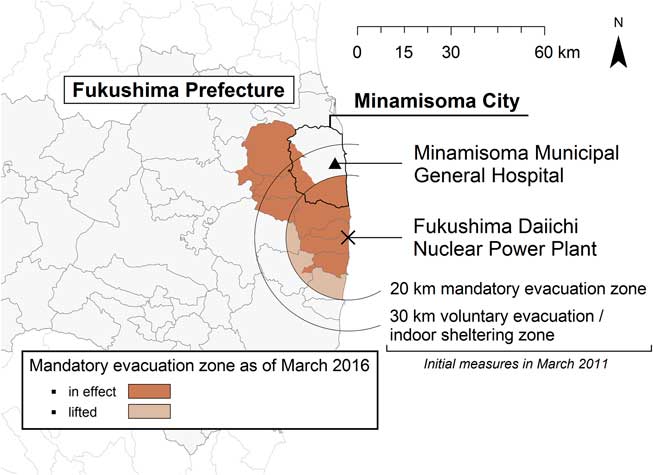
Nuclear disasters, one example of manmade environmental alteration,Reference Normile 15 are known for their effects on the natural environment through radioactive contamination.Reference Aliyu, Evangeliou and Mousseau 16 Yet, they can also result in long-term environmental transformations through mass evacuation, abandonment of land, and neglected maintenance of physical structures;Reference Ohtsuru, Tanigawa and Kumagai 17 , Reference Zhang, Yan and Oba 18 changes that can result in expanded habitats and altered behavioral patterns of insects and pose health risks to humans upon their return.Reference Ozaki, Sawano and Tsukada 19 , Reference Ozaki, Tanimoto and Leppold 20 In March 2011, Northeast Japan experienced an earthquake, followed by a tsunami and a nuclear accident, at Fukushima Daiichi Nuclear Power Plant (FDNPP).Reference Shibahara 21 Considerable radioactive contamination prompted the central government to set the 20-km radius of the power plant as a mandatory evacuation zone (MEZ), and the 20-30-km radius as a voluntary evacuation zone immediately following the nuclear accident (Figure 1).Reference Nomura, Blangiardo and Tsubokura 22 As a result, over 80,000 people evacuated, leading to the abandonment of approximately 30,000 houses and almost all farmland. 23 In the time since the MEZ was designated, there have been significant environmental and population changes. Increasing wild animals, such as wild boars and venomous snakes, have been observed, possibly due to increased prey availability or abandoned crops.Reference Ozaki, Tanimoto and Leppold 20 , 24 Furthermore, the reopening of some MEZ areasReference Nomura, Blangiardo and Tsubokura 22 (Figure 1) has led to returning residents’ exposure to overgrown nature around their properties and unintentional encounters with wild animals.Reference Ozaki, Sawano and Tsukada 19 The entry of decontamination workers is another type of population change within the MEZ. From 2012, decontamination work has been conducted in order to mitigate public radiation exposure from contaminated soil.Reference Ohtsuru, Tanigawa and Kumagai 17 , Reference Shimura, Yamaguchi and Terada 25 , 26 Decontamination work fields are diverse, including residences, roads, farmlands, and forests, 26 outdoor work which can increase the risk of hymenopteran stings. 11 Yet in the midst of these environmental and population transformations, little information is available on hymenopteran-related health issues in post-disaster Fukushima.
Geographic Location of Minamisoma City and Mandatory Evacuation Zone Around the Fukushima Daiichi Nuclear Power Plant as of March 2016.
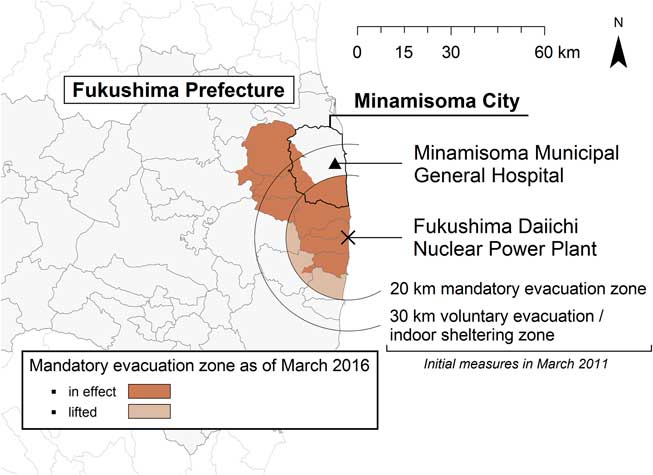
The present study was undertaken at Minamisoma Municipal General Hospital (MMGH) in Minamisoma City, Fukushima, Japan. At 23 km from the FDNPP, MMGH is a core local medical institution, bordering the MEZ and continuing to serve some of the areas most affected by the nuclear disaster (Figure 1). This study had 2 objectives: (1) to identify the patient and sting characteristics of the post-disaster patients and (2) to investigate trends in the post-disaster incidence of hospital visits for hymenopteran stings compared with a pre-disaster baseline.
METHODS
Study Participants and Analytical Data
We retrospectively reviewed the medical records of all patients with hymenopteran stings who visited the outpatient office of MMGH from 11 March 2005 to 10 March 2016. Patients stung by insects belonging to the order Hymenoptera, including bees and wasps, were assessed. We excluded patients affected by ants, owing to data limitations. Among post-disaster patients, the following variables were extracted from patient records: age, sex, date of the sting(s), address and circumstances in which the sting(s) occurred, whether the patients were decontamination workers, affected body sites, anaphylaxis, hospital admission, and death, in addition to whether epinephrine was administered.
We categorized address data to indicate whether the sting happened in a MEZ. The circumstances in which the patients were stung were additionally classified as wilderness, residential land in the MEZ, or non-MEZ residential land. The subgroup of wilderness included forest, riverside, and farmland. Anaphylaxis following stings was judged on the basis of hospital records, referring to classification of systemic reactions.Reference Ring and Messmer 27 Pre-hospital administration of epinephrine using a portable auto-injection device was also taken into account.
Data Analysis
We conducted 2 analyses. First, the patient and sting characteristics of the post-disaster patients were examined. Second, changes in the incidence of hospital visits for pre- and post-disaster hymenopteran stings were evaluated as follows. The annual post-disaster incidence was calculated by dividing the number of hospital visits for hymenopteran stings by the total number of outpatient office visits each year at MMGH from the date of the earthquake, 11 March 2011 to 10 March 2016. For comparison, we calculated the overall incidence during the 6 years before the disaster (11 March 2005 to 10 March 2011) by the same method and used this value as the pre-disaster baseline. On the basis of these data, changes in annual incidence after the disaster compared with the pre-disaster baseline were identified as an incidence rate ratio (IRR). We used the total number of outpatient office visits as a denominator because no specific department took care of patients with hymenopteran stings. Chi-squared analysis or Fisher’s exact test was used for categorical variables, and Mann-Whitney’s U-test was used for numerical variables. A P value of <0.05 was regarded as significant. Statistical analysis was conducted by using STATA/MP 13.1 (StataCorp LLC, College Station, TX).
Ethical Approval
Ethical approval for this study was granted by the MMGH Institutional Review Board on 1 October 2015 (approval no. 27-15).
RESULTS
Patient Characteristics
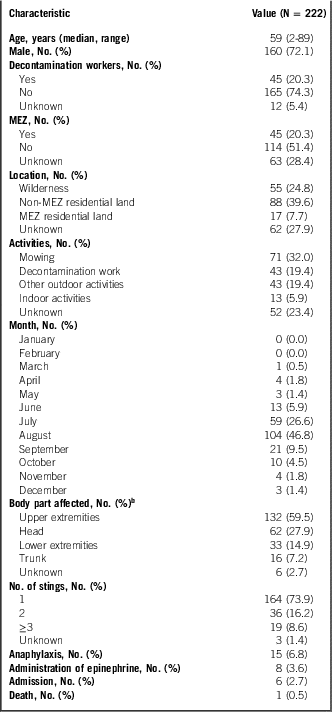
A total of 152 and 222 patients were identified before and after the disaster, respectively, and all were included in the analyses. The basic characteristics of the post-disaster patients are summarized in Table 1. After the disaster, the median patient age was 59 years (range, 2-89 years), with 160 males (72.1%), and 45 decontamination workers (20.3%) . The stings mainly occurred in the summer, peaking in August (n=104, 46.8%). The body parts mainly affected were the upper extremities (n=132, 59.5%), head (n=62, 27.9%), lower extremities (n=33, 14.9%), and trunk (n=16, 7.2%), in descending order. Only one body part was affected in 164 patients (74.9%). Fifteen patients (6.8%) developed systemic anaphylaxis following the stings, 6 patients (2.7%) were admitted to the hospital, and 1 patient (0.5%) died as a result of systemic reaction due to anaphylaxis, despite rapid resuscitation.
Participant CharacteristicsFootnote a

a Abbreviation: MEZ, mandatory evacuation zone.
b Multiple sites of hymenoptera stings could occur in each patient.
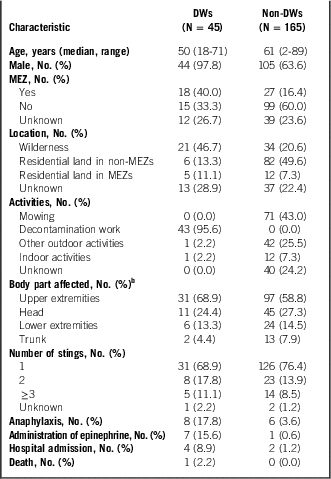
Table 2 summarizes the basic characteristics among both decontamination workers and non-decontamination-workers. Of the 45 decontamination workers, 44 patients (97.8%) were stung outdoors. Specifically, 21 (46.7%) and 5 (11.1%) decontamination workers were affected in the wilderness and residential land in the MEZ, respectively. However, of the 165 non-decontamination-workers affected, 82 patients (49.6%) were affected in non-MEZ residential land, and 11 (13.4%) of the non-decontamination-workers stung in non-MEZ residential land were affected indoors (data not shown).
Characteristics of Decontamination Workers and Non-Decontamination-WorkersFootnote a

a Abbreviations: DWs, decontamination workers; MEZ, mandatory evacuation zone.
b Multiple sites of hymenoptera stings could occur in each patient.
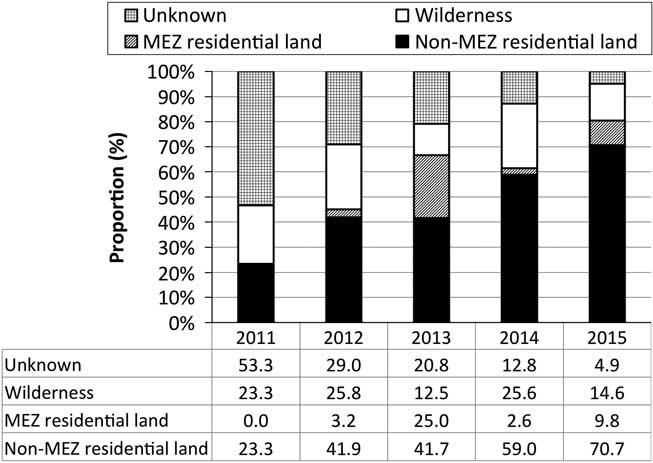
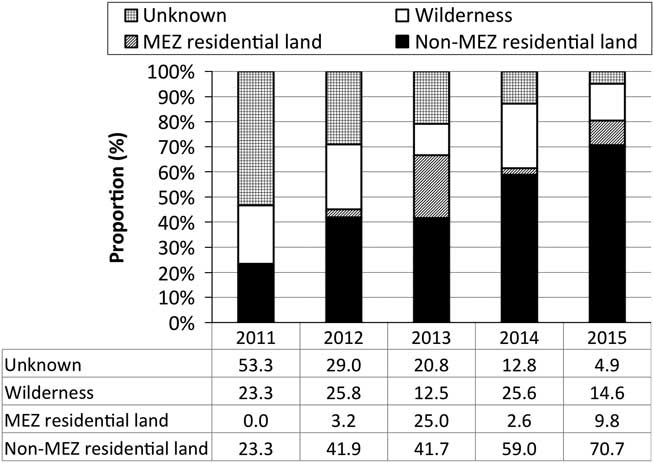
Figure 2 displays the post-disaster trends of locations where hymenopteran stings occurred among non-decontamination-workers. We took into account all patients who were not decontamination workers and found a gradually increased proportion of patients stung in non-MEZ residential land over time in the post-disaster period.
Post-disaster Trends in Locations Where Hymenopteran Stings Occurred.
Incidence of Pre- and Post-disaster Hymenopteran Stings
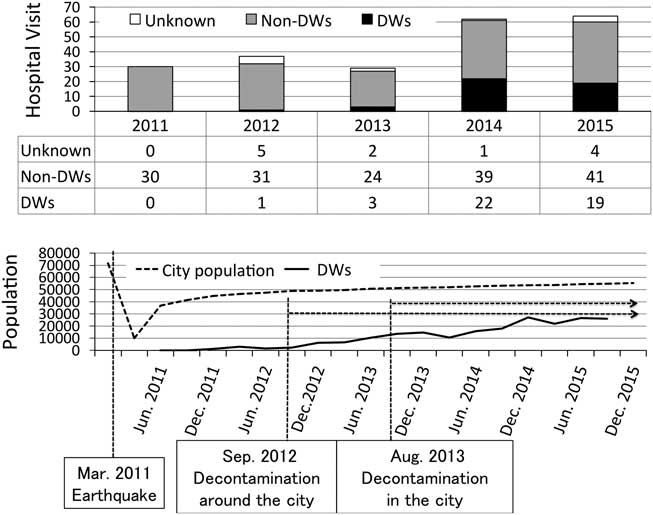
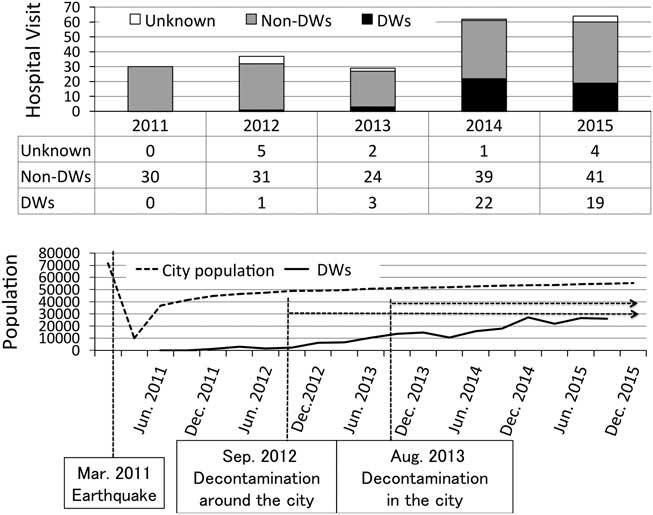
Table 3 shows the pre- and post-disaster trends in hospital visits for hymenopteran stings. There were increases in the IRR of post-disaster hymenopteran stings, with an early peak in 2011 and later peaks in 2014 and 2015. Figure 3 shows the annual number of hospital visits for hymenopteran stings after the disaster among decontamination workers and non-decontamination-workers, alongside changes in the city population and progress of decontamination work in and around the city. Among both the decontamination workers and those who were not decontamination workers, there was an increase in hospital visits for hymenopteran stings in the fourth year compared to the previous 3 years.
Annual Hospital Visits for Hymenopteran Stings After the Disaster, Change in the Population of Minamisoma City, and Progress of the Decontamination Work. The figure shows the annual hospital visits for hymenopteran stings in Minamisoma Municipal General Hospital during the 5 years after the disaster (from 11 March 2011 to 10 March 2016). The patterns of the columns denote whether the patients were decontamination workers (DWs) or not (non-DWs). The number of hospital visits by occupation is presented in the table below the column. The dashed and black lines represent the changes in the population in Minamisoma City 33 and the estimated number of DWs in Fukushima. 28 The time point of the triple disaster and the beginning of decontamination work in and around Minamisoma City 26 are also displayed.
Annual Trends in Hospital Visits for Hymenopteran StingsFootnote a

a Abbreviations: CI, confidence interval; IRR, incidence rate ratio.
b Incidence of hymenopteran stings per 10,000 total visits.
DISCUSSION
This study presented the demographics and IRR of hospital visits for hymenopteran stings in an institution serving areas affected by the Fukushima nuclear disaster, finding long-term increases in the IRR, first rising in 2011, with later peaks in 2014 and 2015. Although previous research has captured increased numbers of cases of hymenopteran stings immediately after natural disasters,Reference Brewer, Morris and Cole 12 - 14 this is the first study to investigate long-term hymenopteran stings following a nuclear disaster. Mass evacuation, land abandonment, and later reentry of residents and decontamination workers after the disaster may be related to changing hymenopteran habitats and interactions with humans, as discussed below.
An increasing influx of decontamination workers and returning residents may have primarily contributed to the long-term increased IRR of hospital visits for hymenopteran stings after the disaster. As indicated in Figure 3, the number of hymenopteran stings among decontamination workers increased as their activities proceeded in and around the city, and decontamination workers comprised 20.3% of the overall population visiting the hospital for stings in the post-disaster period. Currently, approximately 20,000 to 30,000 laborers are engaged in decontamination work in Fukushima, 28 and among them, more than 7000 are working in Minamisoma City.Reference Sawano 29 It remains unclear when this work will finish, particularly around the 337 km2 of severely contaminated land. 30 Furthermore, other laborers and residents who are temporarily returning to MEZ residential areas are mainly engaged in outdoor activities, such as restoration work and preparation for returning in the future. We should therefore be aware of a potentially high risk of hymenopteran stings both in the decontamination worker population and on residential land in the MEZ in the long-term restoration and recovery of Fukushima.
In addition, the time frame and location of sting cases are interesting components of the present findings. While in general settings, hymenopteran stings occur more frequently in the wilderness than on residential land,Reference Ariza, Gomide and Ramos 31 this study found that in the 165 post-disaster hospital visits made by the general (non-decontamination-worker) population, 82 of these stings (49.6%) occurred in non-MEZ residential land (Table 2), and of these cases, 11 (13.4%) were stung indoors. Additionally, we found a gradually increased proportion of cases affected in non-MEZ residential land after the disaster among people who were not decontamination workers (Figure 2). These findings indicate a possible invasion of hymenopterans to human settlement areas, a hypothesis consistent with the increased numbers of hymenopteran nests observed in Minamisoma City in 2015. 32 Mass evacuation and land abandonment after the disaster are 2 factors that could have been related to an increased hymenopteran presence in the city. The population of 55,327 in Minamisoma City (December 2015) 33 is still less than the original population of 71,561, 33 and vacant houses and unkept lands remain throughout the city. 34 Additionally, because of the considerable radioactive contamination of soil in Minamisoma City,Reference Zhang, Yan and Oba 18 most farmland and forest, covering 27.5% and 42.6% of the city, were abandoned after the disaster. 34 These conditions may have promoted an expansion of hymenopteran habitats into the city; however, we expect that such changes would have taken time. In the hymenopteran life cycle, the only chance for habitat expansion, reproduction and colony founding, is conducted once a year.Reference Totok, Makino and Goto 35 While immediate expansion is therefore unlikely, the movement of hymenopteran habitats into the city may have been one factor contributing to the long-term increase of stings, with a peak seen 3 years after the disaster.
Hymenopteran stings in remote areas can have severe consequences. In the present study, one laborer died of anaphylactic shock following hymenopteran stings while engaged in decontamination work. Anaphylactic reactions following hymenopteran stings can lead to cardiopulmonary arrest in 20 minutes,Reference Pumphrey 36 and it may be impossible for laborers to reach medical institutions from their position in the MEZ or wilderness in this short time period. Considering that 80% of the patients with anaphylactic reactions following hymenopteran stings have not experienced similar events previously,Reference Pumphrey 36 it can be recommended that all individuals going into wilderness and evacuation areas carry self-administered epinephrine with them, and health care providers should instruct these individuals on the proper use and importance of the equipment beforehand.
This study did not assess for any potential biological influence of radiation on hymenopterans. Radiation exposure typically causes random mutations with a detrimental influence on affected animalsReference Nohara, Taira and Hiyama 37 and was reported to have led to a variety of negative consequences on insect fauna following the Fukushima nuclear disaster.Reference Aliyu, Evangeliou and Mousseau 16 We could not collect data associated with the biological characteristics of hymenopterans; however, we note that the clinical features of the stings, including proportions of hospitalization or anaphylaxis, primary body sites affected, and seasonal patterning of hospital visits were compatible with previous studies conducted in nondisaster settings.Reference Langley, Mack and Haileyesus 5 , Reference Steen, Janniger and Schutzer 6
The observed increase in post-disaster hymenopteran stings highlights examples of environmental and occupational health burdens caused by a nuclear disaster. Following the FDNPP accident, local residents, volunteers, and laborers working outside have experienced health issues, such as trauma,Reference Sawano 29 dog bites,Reference Mori, Tsubokura and Sugimoto 38 venomous snakebites,Reference Ozaki, Tanimoto and Leppold 20 and tetanus infection,Reference Morita, Tsubokura and Tanimoto 39 alongside hymenopteran stings. In addition, decontamination workers can suffer from poorly controlled noncommunicable diseases, such as diabetes mellitus and hypertension.Reference Sawano, Tsubokura and Leppold 40 However, health care providers and disaster response teams may have not paid sufficient attention to these work-related health issues in the aftermath of the FDNPP accident.Reference Ozaki, Sawano and Tsukada 19 Now is the time to take leadership and consider necessary countermeasures for the variety of health consequences resulting from the FDNPP accident, collaborating with those engaged in post-disaster work outdoors who may have firsthand experience with issues such as hymenopteran stings. We suggest that a joint effort between the medical community and disaster response community could help to elucidate how to use the present experiences and lessons from Fukushima in preparation for any future nuclear disasters.
Strengths and Limitations
There were limitations to the present study. First, this investigation only included data from MMGH. Patients with localized symptoms might have not sought any medical attention or may have visited other medical institutions. Therefore, our findings may not represent all hymenopteran stings in areas affected by the nuclear disaster, and the incidence rate may not be generalizable outside of this institution. Second, there was a considerable proportion of missing data regarding address and circumstances where the stings occurred. Therefore, it is possible that we undervalued the number of stings that happened in residential areas that were outside the MEZ, leading to an underestimation of the extent of hymenopteran invasion into human settlement. We additionally note that the early peak of the IRR in the first year after the disaster might have been related to the immediate closure of medical institutions. In Minamisoma City, 2 of 8 hospitals (25.0%) and 13 of 39 clinics (33.3%) were forced to shut down, and 1 of 8 hospitals (12.5%) lost inpatient function promptly after the disaster. However, MMGH continuously provided medical care after the disaster, and patients with hymenopteran stings might have been more likely to visit MMGH for this reason, potentially increasing the IRR observed in the first year. The early post-disaster peak in incidence seen in this hospital may therefore not be a direct indication of increasing stings themselves, but rather a reflection of changes in medical institution availability. Yet, there were limited cases of closure or opening or reopening of medical institutions in Minamisoma City from 2012 to 2016, and we therefore suggest that increases in sting-related medical visits at MMGH were unlikely to have been influenced by changes in the city’s medical capacity during this period.
This study also had unique strong points. First, while previous studies regarding animals or arthropods in Fukushima have mainly drawn attention to the direct effects of radiation exposure,Reference Aliyu, Evangeliou and Mousseau 16 this study presents new information on health issues related to changed biological niches and human behavioral patterns of evacuation and return. Second, the long study period (6 years before the disaster and 5 years after the disaster) of the present investigation enabled us to assess for long-term changes after the nuclear disaster. Third, we assessed for characteristics that may elucidate insights on population groups at the most risk. These points have made this investigation a useful informant of local public health needs in the aftermath of this nuclear disaster.
CONCLUSION
In this investigation of the long-term trends in hymenopteran stings in a hospital significantly affected by the Fukushima nuclear disaster, we found an increased IRR of visits for stings that has continued for 5 years after the disaster. The drastic and ongoing changes following the nuclear disaster, including large-scale evacuation, natural growth in the abandoned residential properties, and the reentry of decontamination workers, other restoration workers, and returning residents to evacuated areas, may have contributed to this phenomenon. Heath care providers and disaster response teams should be aware of the potential that hymenopteran stings can increase after disasters. We suggest that collaborations between decontamination workers, other restoration workers, and the medical community could strengthen knowledge of occupational health issues such as hymenopteran stings that may otherwise be underrepresented in the disaster literature.
Acknowledgments
There was no funding or support to report for this study. We express our gratitude to Ms Yumiko Kohata and the staff of Minamisoma Municipal General Hospital for data collection and management. We also thank Mr Masatsugu Tanaki and Dr Shigeaki Kato for their constructive opinions on this study.
Author Contributions
A Ozaki, T Yokota, and K Yamamoto reviewed the patient records and collected the data. S Nomura conducted the analysis. A Ozaki wrote the manuscript. All authors conceptualized and designed the study and contributed to revision of the paper for intellectual content.