

Introduction
Long-term care (LTC) systems are one of the fundamental pillars of the contemporary welfare state (European Commission, 2021, 2022; Gori and Luppi, Reference Gori and Luppi2024; Ranci and Rostgaard, Reference Ranci and Rostgaard2025). Rapid population ageing and changing family structures have made the governance of these systems a major political and administrative challenge in advanced democracies (OECD, 2025). However, despite the growing political relevance of LTC, a fundamental paradox persists: while academic literature has extensively documented the challenges of financial sustainability, quality of care, and professionalisation in the sector (Armstrong and Armstrong, Reference Armstrong and Armstrong2019; Da Roit, Reference Da Roit and Greve2021; Österle, Reference Österle, Powell, Agartan and Béland2024), there is a significant gap in the systematic analysis of the coordination mechanisms that articulate these systems in contexts of multilevel governance, where institutional fragmentation can compromise the effectiveness and equity of LTC policies.
The literature on LTC governance has identified two critical dimensions of coordination. On the one hand, various studies emphasise the importance of intergovernmental coordination in highly decentralised territorial models to ensure minimum standards of protection throughout the territory (Arlotti et al., Reference Arlotti, Parma and Ranci2021; Pavolini, Reference Pavolini2021; Llena-Nozal et al., Reference Llena-Nozal, Barszczewski and Rauet-Tejeda2025; Guderjan et a., Reference Guderjan, Koelling and Schnabel2026). Some of these studies emphasise the benefits of decentralisation for the territorial adaptation of social policies (Andreotti et al., Reference Andreotti, Mingione and Polizzi2022; Kazepov et al., Reference Kazepov, Barberis, Cucca and Mocca2022), while others warn of the risks of fragmentation and territorial inequality (Marbán Gallego, Reference Marbán Gallego2024). On the other hand, a second line of research highlights the need for intersectoral coordination between health and social systems (Fischer et al., Reference Fischer, Frisina Doetter and Rothgang2022; Bahle et al., Reference Bahle, Ariaans, Koch and Wendt2023). These studies identify social and health integration as a fundamental requirement for ensuring continuity of care and efficient use of resources. However, comparative evidence reveals that most countries maintain marked institutional separations between the two sectors, with limited and heterogeneous integration initiatives (European Commission, 2021; Wendt, Reference Wendt, Ebbinghaus and Nelson2025).
To understand the real effectiveness of LTC systems in multilevel governance contexts, it is essential to develop analytical tools that capture the scope and quality of the intergovernmental and intersectoral coordination mechanisms that articulate them. Under this premise, this article seeks to answer two interconnected questions: (1) What is the degree of development of intergovernmental coordination mechanisms in the Spanish LTC system? and (2) To what extent is there effective coordination between the health and social sectors? To answer these questions, this article analyses the Spanish LTC system, the so-called System for Autonomy and Care for Dependency (SAAD, by its Spanish acronym), examining its institutional architecture, its multilevel governance mechanisms, and its coordination instruments and structures from its creation in 2006 to the present day.
The Spanish case is particularly relevant for several reasons. First, Spain represents a highly decentralised territorial model (Colino, Reference Colino, Muro and Lago2020), where the 17 autonomous communities (ACs) have broad powers in the areas of social services and health, which creates specific challenges in terms of coordination (Mattei and Del Pino, Reference Mattei and Del Pino2021; Hernández-Moreno Reference Hernández-Moreno and Colino2021; Hernández-Moreno and Cruz-Martínez Reference Hernández-Moreno and Cruz-Martínez2025). Secondly, the SAAD is one of the most ambitious reforms of the Spanish welfare state in recent decades, with an institutional design that establishes very intense cooperation between the central government and the ACs in areas of co-decision and co-financing that goes beyond the traditional pattern of policy coordination through intergovernmental councils.
The main findings of this research reveal a significant asymmetry between intergovernmental coordination and intersectoral coordination: while intergovernmental mechanisms show moderate development, intersectoral integration remains an unresolved structural challenge, with critical deficits in integrated information systems and referral protocols.
The present article aims to be a theoretical and analytical contribution by proposing and developing the Long-Term Care Coordination Index (LTC-CoIn), an innovative analytical tool that allows for the systematic and comparable evaluation of the scope of coordination in LTC systems in territorially complex countries. Secondly, this work provides original empirical evidence on the effective functioning of coordination mechanisms in the SAAD, beyond its formal architecture. Thirdly, the analysis and evaluation framework provides diagnostic and operational elements for the design of broader institutional and territorial reforms. Furthermore, from a social perspective, this work contributes to improving understanding of a system that in Spain affects more than 1.5 million people in situations of dependency and their families (Ministry of Territorial Policy, 2025; Ministry of Social Rights, Consumption and Agenda, 2030).
The article is organised into six sections. Following this introduction, the second section analyses the historical background and the institutional and organisational context that constitutes the genesis of the current SAAD governance model. The third section offers a comparative perspective on the governance systems of LTC in Europe. The fourth section presents the conceptual and analytical framework of the research: it first introduces the theoretical approach to coordination in multilevel governance systems, then develops the LTC-CoIn in detail, and finally describes the methodological design used to apply the index to the Spanish case. The fifth section presents the results of the empirical analysis. Finally, the sixth section presents the conclusions, limitations, and future lines of research.
Background: The role of actors, contextual pressures, and previous institutional designs in shaping the SAAD
The approval of Ley 39/2006, de 14 de diciembre, de Promoción de la Autonomía Personal y Atención a las personas en situación de dependencia (known as the Dependency Law) and the implementation of the SAAD were the result of a relatively long process of technical and political debate that began in the 1990s, albeit with a relatively low media profile (Rodríguez Cabrero, Reference Rodríguez Cabrero2007; Rodríguez Cabrero Reference Rodríguez Cabrero2011). During the last period of socialist governments led by Felipe González and under the conservative governments of the Popular Party (1996–2004), experts from central social security agencies, academia, and trade unions began to push for the development of care policies for older people. A clear example was the National Gerontological Plan (Plan Gerontológico Nacional, 1992), which provided the fundamental conceptual and political basis for the development of the SAAD. Reforms to LTC in France and Germany also helped draw attention to the issue. This cumulative process matured into a coalition of very different institutional and social actors: trade unions, business organisations, third sector organisations and a large proportion of subnational governments joined forces (with varying degrees of involvement and commitment) and agreed on a reform that was expected to strengthen the recognition and rights of dependent persons and their carers, streamline The social services system, increase funding, boost the development of private services, and relieve some pressure on the healthcare system (Rodríguez Cabrero, Reference Rodríguez Cabrero2007; Marbán Gallego, Reference Marbán Gallego2012).
At the same time, certain structural socio-demographic factors also help explain the growing importance of issues related to LTC on the political agenda (Moreno Fuentes Reference Moreno Fuentes, Fuentes and del Pino2015, pp. 58-61). On the one hand, the sustained reduction in mortality, combined with declining birth rates and increased life expectancy, has led to an increase in the proportion of older people in Europe and around the world. This ageing population, together with the higher prevalence of associated situations of dependency (Ministry of Labour and Social Affairs 2004; Valcarce García Reference Valcarce García2004), has made LTC a priority on the political agenda (Recio Reference Recio2006). Against this general backdrop, Spain found itself in a particularly complex situation that was difficult to address: although its old-age dependency ratio remained close to the European average, projections by the National Institute of Statistics (INE) indicated a rapid deterioration (24.52% in 2006 and 31.73% in 2026) (INE 2026). A second important explanatory factor was the massive entry of women into the labour market. In Mediterranean welfare systems (which include Spain, Portugal, and Greece) (Ferrera, Reference Ferrera1996), care was traditionally assumed to be the responsibility of families and, more specifically, of women. However, between the 1990s and the early 2000s, Spain underwent a profound economic transformation that changed both labour structures and family and gender dynamics (Matey et al., Reference Matey, López and García2025).
The institutional and organisational designs prior to the 2006 reform also significantly conditioned the SAAD governance model (Aguilar-Hendrickson Reference Aguilar-Hendrickson2020). Prior to 2006, public LTC policy in Spain rested, on the one hand, on supplements to the pension system and, on the other, on local and regional social services. The decision to anchor the SAAD within the social services system at the regional level – rather than within the contributory or non-contributory branches of Social Security at the national level – was the outcome of a contested political negotiation. During the drafting of the LAPAD, two alternative framings were debated: integration into the contributory branch of Social Security (as in the German model) or into the non-contributory branch. Both options were ultimately rejected. Employers’ associations opposed any increase in social contributions, and the inclusion of LTC within the contributory branch was also seen as incompatible with the law’s priority on service provision over cash transfers, which did not fit well within the contributory logic. As for the non-contributory branch, it was rejected primarily on competential grounds: a significant number of regional governments and autonomist parties – with considerable parliamentary weight at the time – argued that placing the SAAD within Social Security, even in its non-contributory branch, would grant the central government an imperative capacity that would encroach upon the exclusive regional competences in social services. The result was a tax-funded model governed through intergovernmental cooperation, which has structurally limited the central government’s capacity to compensate for regional imbalances and to ensure uniform access to benefits across the territory (Marbán Gallego, Reference Marbán Gallego2012; Moreno Fuentes Reference Moreno Fuentes, Fuentes and del Pino2015, pp. 62–63; Aguilar-Hendrickson, Reference Aguilar-Hendrickson2020; Llena-Nozal et al., Reference Llena-Nozal, Rocard and Sillitti2022).
Current overview of care governance models in Europe from a comparative perspective
The general European model of governance for LTC systems is based on more or less decentralised models (Pavolini, Reference Pavolini2021; Llena-Nozal et al., Reference Llena-Nozal, Barszczewski and Rauet-Tejeda2025). Multilevel governance is the distinctive feature of territorial organisation in Europe, where state regulation coexists with the specific implementation of programmes and policies at the subnational level (Ariaans et al., Reference Ariaans, Linden and Wendt2021). In general terms, the central administration is responsible for regulating the system and financing part of the cost, while the regions or municipalities make up the operational and direct management structure, with powers in planning, managing access to the network of public and private services, and responsibilities in financing and co-payment management (Marbán Gallego, Reference Marbán Gallego2024).
Comparative analysis allows us to identify common elements and differences in the key dimensions of LTC governance. In terms of territorial organisation, two basic models can be distinguished. On the one hand, countries such as Germany, Italy, and Austria have developed models where the leading role falls to intermediate levels of government (federal states, provincial departments or regions), while the role of local administrations tends to be residual, focusing mainly on social assistance. On the other hand, the Nordic countries assign primary responsibilities to municipal administrations, granting them broad powers and considerable autonomy in the provision and financing of LTC, albeit within a regulatory framework established by the central administration. In terms of their financing systems, European social protection systems are remarkably heterogeneous, reflecting the social traditions and political choices of each country. This diversity of models gives rise to a combination of different sources of financing, including social contributions, taxes and private contributions – countries often resort to compensatory mechanisms to address different regional and local needs and different fiscal capacities.
In terms of cross-sectoral coordination (in the social and health care sectors), there are common elements and shared challenges. For example, Germany maintains a traditional separation between health insurance and LTC insurance, with significant coordination challenges between the health and social sectors and complex interactions between different health and LTC services. Austria has a very marked institutional separation between systems, with problematic interactions between different mechanisms such as hospital care and the LTC system’s own services, as well as limited case management (Trukeschitz et al., Reference Trukeschitz, Österle and Schneider2022). Italy exhibits very limited coordination between social and health services. This fragmentation of funding and responsibilities prevents full and adequate integration of social and health services in terms of implementation (Casanova et al., Reference Casanova, Principi and Lamura2020). However, some regions have developed Multidimensional Assessment Units (UVM) and Area Plans (Piani di Zona) as instruments for local coordination (Madama et al., Reference Madama, Maino and Razetti2019). Portugal stands out for its model of social and health integration through the National Network for Integrated Continuing Care (RNCCI), which has multidisciplinary assessment teams, local coordination teams, and shared management between the health and social sectors. Denmark and Slovenia also represent examples of more integrated models: Denmark has developed a strong tradition of coordination between municipal social services and regional health services, while Slovenia has implemented a unified social and health care system at the local level that facilitates continuity of care (European Commission, 2023; Tsiachristas et al., Reference Tsiachristas, Vrangbæk, Gongora-Salazar and Kristensen2023).
The reform processes carried out before and during the pandemic reveal converging trends in public policy priorities, particularly in some of the LTC system mechanisms (such as nursing homes) (Daly et al., Reference Daly, León, Pfau-Effinger, Ranci and Rostgaard2022; Perna et al., Reference Perna, Hernández‐Moreno and Cruz‐Martínez2025). At the same time, there is also a shared emphasis on the implementation of instruments aimed at digitalisation and telemedicine, improving working conditions, and expanding home-based services and deinstitutionalisation. From a governance perspective, efforts to improve coordination through national strategies and the mobilisation of European recovery funds to strengthen LTC systems are also noteworthy. In terms of the territorial dimension, some countries have undergone municipal mergers and a certain degree of recentralisation of powers in response to concerns about local variations and the small size of municipalities; in contrast, other countries have maintained or reinforced decentralised structures, strengthening regional fiscal autonomy and transferring new powers to subnational governments in the area of LTC (Llena-Nozal et al., Reference Llena-Nozal, Barszczewski and Rauet-Tejeda2025).
Analytical framework and methodology
Conceptual approach to the notion of coordination: Why is there a need for coordination?
Coordination is one of the oldest and most persistent challenges in the field of governance and public policy (Peters, Reference Peters2018; Hooghe and Marks, Reference Hooghe, Marks, Benz, Broschek and Lederer2021). In its most classical sense, coordination can be defined as a set of decisions in which adjustments have been made in such a way that adverse consequences are avoided, reduced, counteracted, or compensated for to a certain degree and with a certain frequency (Lindblom, Reference Lindblom1965). From a broader perspective, coordination in government and public policy involves managing the interdependencies between organisations, levels of government and policy sectors to achieve collective objectives that cannot be achieved through the isolated action of a single entity (Bouckaert et al., Reference Bouckaert, Peters and Verhoest2010).
But why is it necessary to establish minimum levels of coordination in territorially complex political systems? On the one hand, over the last four decades, states have undergone a broad process of political, administrative, and financial decentralisation virtually everywhere in the world (Dardanelli et al., Reference Dardanelli, Kincaid, Fenna, Kaiser, Lecours and Singh2019; Lago, Reference Lago2021). This phenomenon has involved the relocation of power beyond the borders of the central governments of nation states: upwards (supranational organisations), downwards (subnational governments), and sideways (autonomous agencies and private actors) (Schakel and Tatham, Reference Schakel, Tatham, Lucarelli and Sperling2025). The fragmentation of power has been reinforced by New Public Management reforms that emphasised individual programme management, the creation of autonomous or quasi-autonomous agencies, and the application of private sector management principles to the public sector. While these reforms sought to improve efficiency and accountability, they also contributed to further fragmenting of already fragmented welfare states, creating organisational “silos” and hindering coordinated action (Terlizzi and Esposito, Reference Terlizzi and Esposito2023).
The second fundamental reason explaining the growing need for coordination is the emergence of public policy problems that are inherently multi-causal and highly interdependent. These problems, which transcend traditional sectoral and jurisdictional boundaries, have been conceptualised in various ways in the literature: “wicked problems” (Peters, Reference Peters2017), “complex intergovernmental problems” (Paquet and Schertzer, Reference Paquet and Schertzer2025) or, more recently, as “complex intersectoral and intergovernmental problems” (Del Pino and Moreno-Fuentes, Reference Del Pino and Moreno-Fuentes2025). The analysis of these types of political problems (such as public health crises, climate change and energy transition, migration flows or the general ageing of the population) is particularly interesting for scholars of contemporary territorial and institutional dynamics who are concerned with how to organise power and responsibilities in public policy in the most efficient and effective way.
Developing the long-term care coordination index (LTC-CoIn)
The analysis of the governance of LTC systems requires methodological tools that enable the systematic and rigorous evaluation of the scope and effectiveness of the coordination mechanisms that articulate these systems. Given that the very notion of governance is complex and operationally encompasses too many elements to be analysed jointly (Daly Reference Daly2003), this research follows the steps of previous studies on comparative federalism (Behnke and Mueller, Reference Behnke and Mueller2017; Schnabel and Hegele, Reference Schnabel and Hegele2021), territorial welfare governance (Terlizzi, Reference Terlizzi2019; Pereira-Puga et al., Reference Pereira-Puga, Hernández-Moreno and Cruz-Martínez2023; Hernandez et al., Reference Hernandez, Del Pino, Ramos and Colino2025), and several notable works on public administration and management (Trein and Maggetti, Reference Trein and Maggetti2020; Domorenok et al., Reference Domorenok, Graziano and Polverari2021; Vince et al., Reference Vince, Fudge, Fullbrook and Haward2024) for the construction and development of the LTC-CoIn. This composite index (Table 1) is structured around two fundamental dimensions of analysis.
Long-Term Care Coordination Index (LTC-CoIn)

Table 1. Long description
The table consists of three columns: Dimensions, Conceptual definition, and Operational indicators.
Row 1: Intergovernmental coordination.
- Dimensions: Additive scoring with a minimum of 0 and maximum of 18.
- Conceptual definition: Institutional structures and processes articulating relationships between national, regional, and local governments across institutional-procedural, competence-regulatory, and financial-redistributive sub-dimensions.
- Operational indicators: Includes I G C dash 1 formal relationship mechanisms; I G C dash 2 distribution of competences; I G C dash 3 shared financing mechanisms; I G C dash 4 intergovernmental transfers; I G C dash 5 harmonisation of co-payment criteria; and I G C dash 6 informal relationship mechanisms.
Row 2: Cross-sectoral coordination at the administrative level.
- Dimensions: Additive scoring with a minimum of 0 and maximum of 21.
- Conceptual definition: Organizational structures and collaborative governance between health and social sectors focusing on institutional integration and operational-procedural continuity.
- Operational indicators: Includes I S C dash 7 national integrated structures; I S C dash 8 regional integrated structures; and I S C dash 9 care continuity at the bureaucratic level such as single points of access.
Row 3: Cross-sectoral coordination at the systems and services level.
- Conceptual definition: Technological infrastructures and human capital capacities enabling collaboration between provider organizations and professional teams where social and health integration materializes.
- Operational indicators: Includes I S C dash 10 integrated clinical and social history systems; I S C dash 11 inter-sectoral referral protocols; I S C dash 12 integrated human resources and interprofessional training; and I S C dash 13 coordination between formal and informal systems like family and civil society.
Source: Authors’ own elaboration.
The first dimension focuses on intergovernmental coordination and examines the set of institutional structures, governance mechanisms, financial instruments, and interaction processes – both formal and informal – that articulate the relationships between levels of government (national, regional, local). This dimension is operationalised through six indicators (IGC-1 to IGC-6) covering three critical sub-dimensions: institutional-procedural (formal and informal mechanisms of intergovernmental relations), regulatory-competence (clear distribution of powers), and financial-redistributive (shared financing schemes, intergovernmental transfers, and harmonisation of co-payment criteria).
The second dimension addresses cross-sectoral coordination, distinguishing between two complementary levels of analysis. The administrative/bureaucratic level (indicators ISC-7 to ISC-9) examines the organisational structures, collaborative governance bodies, and formal procedures that public administrations establish to coordinate the actions of the health and social sectors, operating in three sub-dimensions: institutional integration (integrated administrative structures at national and regional level), collaborative governance (formal intersectoral committees, commissions, or councils) and operational-procedural continuity (single access point, coordinated longitudinal monitoring, critical transition management protocols). The systems and services level (indicators ISC-10 to ISC-13) focuses on the meso-operational level where social and health integration takes place, analysing technological and informational actions and infrastructures (integrated information systems, referral protocols), integrated human capital capacities (interprofessional communication systems, integrated human resources), and formal–informal articulation mechanisms (coordination between formal and informal care systems).
The analytical framework is operationalised using a total of 13 indicators that enable the scope of coordination in different territorial and temporal contexts to be assessed in a systematic and comparable manner. Each indicator is assessed using a four-level ordinal scale (0–3) that captures the degree of development and institutionalisation of coordination mechanisms (see Appendix C): 0 (non-existent or very limited), 1 (existing but weak or fragmented), 2 (existing with moderate and regular functioning), and 3 (fully institutionalised and systematically operational). This scale allows not only for the identification of the presence or absence of coordination mechanisms, but also for the assessment of their formal consolidation, operational capacity, and degree of institutionalisation. It is important to note that the LTC-CoIn measures the institutional development and operational capacity of coordination mechanisms – that is, the extent to which they are formally established, regularly functioning, and structurally embedded – rather than their ultimate policy outcomes or system-level effectiveness. Coordination is understood here as a necessary but not sufficient condition for system performance: a well-institutionalised coordination mechanism may still fall short of producing the intended policy results due to factors beyond its institutional design, such as resource constraints, political dynamics, or implementation gaps.
A deliberate methodological choice in the construction of the LTC-CoIn is the use of equal weights for each indicator within each dimension. This decision follows the standard practice of first-generation composite indices in the social sciences – including the Human Development Index (UNDP, 1990) and Esping-Andersen’s (Reference Esping-Andersen1990) decommodification index – where equal weighting is justified on grounds of theoretical parsimony and analytical transparency: in the absence of robust empirical evidence to privilege some coordination mechanisms over others, differential weighting would introduce arbitrary judgements that could undermine the index’s replicability and comparability across systems. Nonetheless, we acknowledge that equal weighting is an assumption that warrants scrutiny.
The proposed analytical framework offers significant analytical potential for comparative research on LTC policies. On the one hand, it allows for synchronous comparative analyses between different territorial systems (comparisons between ACs in the Spanish case, or between meso levels of government and different federations and multilevel systems in international studies), identifying patterns of coordination, institutional configurations, and best practices. On the other hand, it enables diachronic analyses that examine the temporal evolution of coordination mechanisms, evaluating the impact of institutional reforms, regulatory changes or exogenous crises on the institutional and organisational architecture of LTC systems.
Research design and data collection
This analysis uses different sources of evidence and data-collection techniques. Firstly, an exhaustive documentary analysis was carried out of: (a) national and regional regulations on LTC, dependency, social services and social and health coordination; (b) official documents and grey literature produced by public administrations (IMSERSO reports, Territorial Council agreements, SAAD annual reports, Ministry of Territorial Policy reports); (c) technical reports from international organisations (OECD, European Commission) and third sector organisations; and (d) specialised academic literature on multilevel governance and LTC policies. Secondly, 16 semi-structured interviews were conducted with key informants selected through purposive sampling (see Appendix A). The sample included: national-level public decision-makers (n = 3), regional-level public decision-makers (n = 8), municipal-level public decision-makers (n = 2) and experts in the LTC sector (n = 3). Gender balance was considered as a criterion in the selection of interviewees, although it was ultimately conditioned by the acceptance and availability of those contacted to participate in the study. The final sample comprised eight women and eight men, reflecting a fully balanced gender composition across the different professional profiles included. The interviews were conducted between September 2024 and April 2026 via videoconference, with an average duration of 60–90 minutes. An interview script was designed and adapted to the profile of the participants (see Appendix B), addressing aspects related to intergovernmental and intersectoral coordination mechanisms, the distribution of competences, financing instruments, integrated administrative structures, and the main challenges of the SAAD governance model.
Data analysis was performed using two complementary strategies. On the one hand, thematic content analysis was applied to the interview transcripts and official documents, identifying recurring patterns, key concepts, and causal mechanisms related to each of the 13 LTC-CoIn indicators. On the other hand, each LTC-CoIn indicator was systematically assessed by triangulating evidence from interviews, document analysis, and available secondary data. Scores were assigned based on explicit evaluation criteria that considered both the formal existence of coordination mechanisms and their degree of institutionalisation, operational capacity, and practical effectiveness. The results are presented in a disaggregated manner by dimension and indicator, including textual quotations from participants to illustrate the findings and facilitate understanding of the mechanisms identified. The choice of a qualitative design is justified by the exploratory nature of the research and the need to capture the complexity of coordination processes in multilevel governance systems. The combination of document analysis and interviews allows us not only to identify the formal architecture of coordination, but also to understand its effective functioning, informal dynamics, and key actors’ perceptions of the system’s strengths and weaknesses. Construct validity was reinforced through consultation with six academic experts and senior practitioners in LTC policies and multilevel governance during the different phases of the research. The panel included specialists in comparative welfare state analysis, Spanish social policy and the SAAD, multilevel and intergovernmental governance, and LTC policy design and management at the national level. Likewise, the diversity of the interviewees’ profiles – which includes policy makers and technical experts from the three levels of government – provides a comprehensive view of the phenomenon from multiple institutional positions, increasing the robustness of the findings.
It is important to note that the qualitative evidence collected through interviews and documentary analysis is not merely illustrative of the index – it is its evidentiary foundation. The LTC-CoIn operationalises, through an ordinal scale, what the qualitative data reveals about the institutional development and operational capacity of each coordination mechanism. In this sense, the article follows a mixed-methods logic in which the interpretive depth of qualitative inquiry and the analytical structure of composite indexing are mutually constitutive: the qualitative findings ground and justify each score, while the index synthesises those findings into a systematic and replicable framework.
The specific scoring criteria for each indicator, together with the evidentiary basis for each score assigned to the Spanish case, are detailed in Appendix C, which should be read alongside the results section.
Results
Intergovernmental coordination dimension
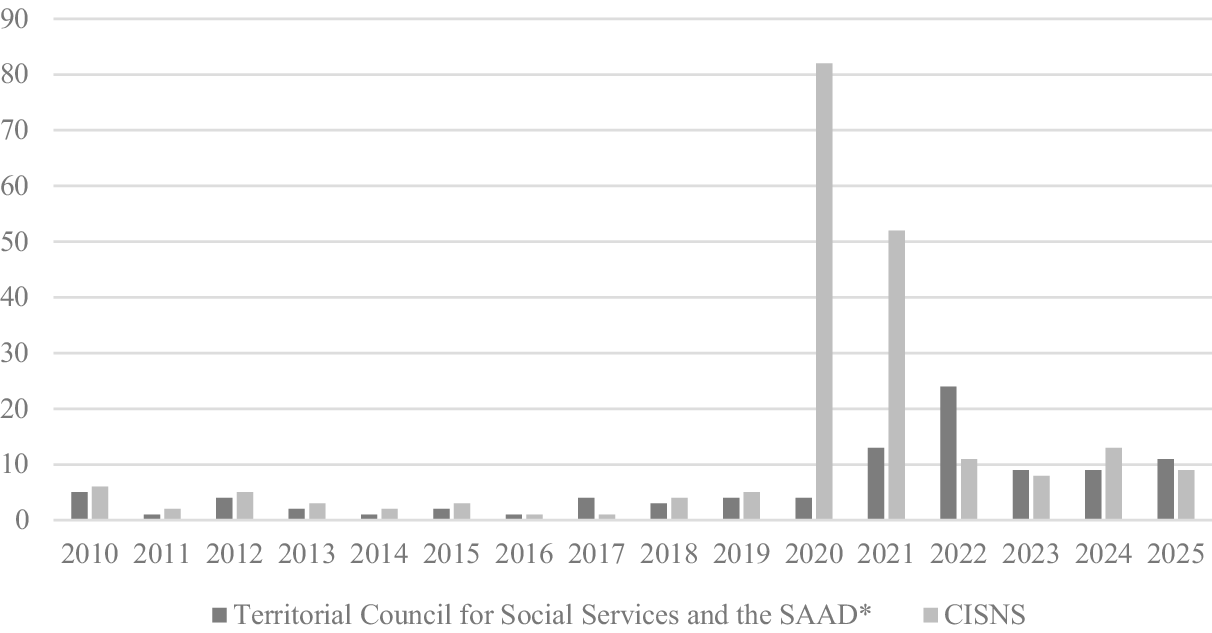
The SAAD has a consolidated ecosystem of formal mechanisms for intergovernmental sectoral coordination (Indicator IGC-1). At the top of this ecosystem is the Territorial Council for Social Services and the SAAD (hereinafter, the Territorial Council). This intergovernmental council is made up of the head of the central Ministry of Social Rights, Consumption and Agenda, 2030 and the heads of the regional ministries (consejerías autonómicas) responsible for social services and dependency. In accordance with its Internal Operating Regulations (2018), this cooperation body can perform advisory, decision-making, or coordination functions. The SAAD also has second-level cooperation bodies, such as the SAAD Delegate Commission, as well as various working groups (permanent or ad hoc) made up of middle-ranking public managers and administrators (directors and/or deputy directors-general). These types of bodies, whose purpose is to identify areas where cooperation is needed, were widely used during the COVID-19 pandemic to coordinate and resolve practical problems that arose in residential services (Del Pino et al., Reference Del Pino, Moreno Fuentes, Cruz-Martínez, Hernández-Moreno, Moreno, Pereira-Puga and Perna2020). However, despite its formal legal and administrative status, the scope and intensity of SAAD coordination through the Territorial Council is slightly weaker than that carried out by its equivalent in the health sector, the Inter-territorial Council of the National Health System (CISNS) (see Figure 1 on the frequency of its meetings).
Comparison of the total number of meetings per year (2010–2025). Source: Own elaboration based on data provided by the Ministry of Territorial Policy and Democratic Memory (Multilateral or Sectoral Cooperation). *This number considers the sum of the meetings of the Sectoral Conference on Social Affairs and the Territorial Council of the SAAD from 2010 until their integration in 2013.

Figure 1. Long description
The vertical Y-axis represents the number of meetings ranging from 0 to 90 in increments of 10. The horizontal X-axis lists years from 2010 to 2025. Two categories are represented: Territorial Council for Social Services and the S A A D (dark gray) and C I S N S (light gray).
* From 2010 to 2019, both categories show low activity, generally remaining below 10 meetings per year.
* In 2020, a massive spike occurs for C I S N S, reaching over 80 meetings, while the Territorial Council remains below 5.
* In 2021, C I S N S meetings decrease to approximately 52, while the Territorial Council increases to 13.
* In 2022, the Territorial Council peaks at 24 meetings, surpassing C I S N S which drops to 11.
* From 2023 to 2025, both categories stabilize between 8 and 13 meetings per year.
The data for 2024 and 2025 represents projected or partial data as indicated by the timeline.
In practice, political consensus and agreement in the Territorial Council are marked by tensions arising from the underfunding of the system, territorial asymmetries, and conflicts of competence between the central government and some ACs (Colino et al., Reference Colino, Del Pino and Hernández-Moreno2025; Perna et al., Reference Perna, Hernández‐Moreno and Cruz‐Martínez2025). This was pointed out by several public decision-makers at the national and regional levels:
The Territorial Council […] has a very strong political slant, which I would say makes it very difficult to reach agreements and find solutions. The way the Executive Committee and all the technical bodies operate is good, and there is a very high level of understanding […]. There is a situation of total collaboration there (Interview 12).
The distribution of powers within the SAAD has a relatively clear legal framework (Indicator IGC-2). The governance of the SAAD is based on a structure of shared powers between central government, regional governments, and local authorities. The central government has exclusive competence to establish the basic regulation of the system in fundamental aspects such as the basic catalogue of services or the criteria for the intensity of protection, among others. For their part, the ACs are responsible for the operational management of the system, and local governments are mainly involved in certain services with their own resources and regional transfers. However, the complexity of the multilevel model is a fundamental limitation to the development of effective intergovernmental coordination. The actual provisions of the Dependency Law have established de facto 17 regional LTC systems (IMSERSO, 2025). Furthermore, administrative fragmentation has led to a “vicious layering” that encourages the emergence of dysfunctions in coordinated decision-making and the adoption of joint agreements (Arlotti and Aguilar-Hendrickson, Reference Arlotti and Aguilar-Hendrickson2018). One of the people interviewed as part of this research, a public official in the central government, clearly pointed to this issue:
The central government has very few powers, and these are systematically challenged by some regions […] Management and care models vary across regions, leading to significant inequalities (Interview 11).
The SAAD also has mechanisms for shared financing between levels of government (Indicator IGC-3). This co-financing model is developed through the Inter-Administrative Cooperation Framework – a space for voluntary collaboration in which the commitments and contributions of the central government and the ACs are established – and a mechanism for intergovernmental transfers (Indicator IGC-4). Transfers are mainly organised through two levels of funding: the “minimum level,” which is distributed among the ACs according to the number of beneficiaries and the degree of dependency, and the “agreed level,” which is negotiated annually in the Territorial Council. However, in practice, these mechanisms for shared financing and intergovernmental transfers have evolved very differently from the initial provisions of the Dependency Law (Ramírez-Navarro et al., Reference Ramírez-Navarro, Revilla Castro, Fuentes Jiménez, Sanz Yagüez, Llopis, García Alonso, Cavero Cano and Fernández Ordoñon.d.). The history of instability and significant fluctuations – the Great Recession and austerity policies led to a significant reduction in state transfers, including the abolition of the agreed level between 2012 and 2021– have affected the predictability of the system, as well as the actual capacity for coordination within the SAAD (interviews 2, 3, 4, 6, 16; Hernández-Moreno et al., Reference Hernández-Moreno, Pereira-Puga and Cruz-Martínez2023).
The harmonisation of co-payment criteria in the SAAD has seen limited progress (Indicator IGC-5). Although the Dependency Law establishes a general framework for user participation in the cost of services, based on their economic capacity, the ACs have broad discretion to determine specific co-payment criteria, which has led to considerable regional heterogeneity. The Territorial Council has attempted to establish common criteria. However, these agreements have not achieved effective harmonisation, with significant differences persisting between ACs in areas such as income thresholds for exemption, user participation percentages, and the treatment of assets (Montserrat Codorniu, Reference Montserrat Codorniu2024; Zalakain, Reference Zalakain2024).
Informal (or spontaneous) coordination mechanisms within the SAAD have developed moderately (Indicator IGC-6). Unlike the health sector, the LTC sector lacks a well-established tradition of informal meetings at the political level. However, during the COVID-19 pandemic, there was a significant increase in the number of regular meetings between policymakers and technical experts from all levels of government via videoconferencing or the use of informal communication tools such as WhatsApp, Telegram, and email, which enabled agile and flexible coordination in response to the need to make quick decisions in a context of high uncertainty (Del Pino et al., Reference Del Pino, Moreno Fuentes, Cruz-Martínez, Hernández-Moreno, Moreno, Pereira-Puga and Perna2020) (interviews 5, 6, 7, 16).
Cross-sector coordination dimension
At the state level, the Spanish LTC system has traditionally lacked fully coordinated administrative structures (Indicator ISC-7). Currently, the central government maintains an operational separation between the Ministry of Health and the Ministry of Social Rights, Consumer Affairs and Agenda 2030 (despite the fact that their political leaders and technical and administrative teams share the same physical space [the same building]). However, in 2019, the Ministry of Health created the Advisory Council on Health and Social Services (Consejo Asesor de Sanidad y Servicios Sociales), which acts as a consultative body in the formulation of health and social welfare policy (Ministry of Health, 2019a). In practice, the Council operates through two separate sections – one for Health and one for Social Services – each meeting independently. The joint plenary session of both sections has only been convened once, at the constitutive meeting held on 21 February 2019 (Ministry of Health, 2019b). More recently, in 2025, the Ministry of Social Rights, Consumer Affairs and Agenda, 2030 established the Interministerial Commission to ensure the incorporation of professionals into the SAAD and accelerate the change in the LTC model – measures that demonstrate the recognition of the need for intersectoral coordination (Moncloa, Reference Moncloa2025).
At the regional level, the existence of integrated/unified administrative structures between health and social services is heterogeneous, with varying degrees of development and executive capacity (Indicator ISC-8). In 2015, 17 ACs had social and health coordination plans and programmes, and specifically, seven had created a single regional ministry to integrate the areas of health and social services. This trend towards the creation of administrative coordination and cooperation structures increased in the post-pandemic context. Thus, regions such as Cantabria and the Community of Madrid (both in 2024) have set up coordination bodies made up of management and technical teams from the regional ministries of health and social affairs. However, this structural challenge is mentioned as such by one of the regional officials interviewed:
Social and health care coordination […] is something we have been talking about for a long time, and it is one of the areas where I believe all the ACs need to make progress, despite occasional advances in some areas. We have unfinished business here, not because no one recognises the need for it, but because we, the agents themselves, are the ones doing it, and we are creating many difficulties for ourselves (Interview 9).
Continuity of care at the bureaucratic level is limited and fragmented (Indicator ISC-9). Some ACs have implemented one-stop shop initiatives or coordination centres at the municipal level. However, there is no uniform model across the country. The Draft Reform of the Dependency Law (2025) does not establish binding mechanisms or specific one-stop access structures to guarantee comprehensive and continuous care. At the national level, there are no integrated information and communication systems between the health and social sectors that allow for the exchange of information between health and social professionals (Indicator ISC-10). The COVID-19 pandemic dramatically highlighted the importance of these systems. In the specific area of the SAAD, poor knowledge of the residential sector in terms of the number of centres and their characteristics, the absence of a register of workers in the sector and an up-to-date census of residents greatly hampered the management of the crisis (Del Pino et al., Reference Del Pino, Moreno Fuentes, Cruz-Martínez, Hernández-Moreno, Moreno, Pereira-Puga and Perna2020; Abellán García et al., Reference Abellán García, Aceituno Nieto, Castillo Belmonte, Fernández Moranles and Ramiro Fariñas2021). At the regional level, there are multiple technological initiatives in different stages of development (i.e., Community of Madrid, Asturias, Community of Valencia, and La Rioja, among others). However, these initiatives are exceptional and are not part of a national strategy (interviews 1, 8, 9, 10, 12).
Although the White Paper on Social and Health Care Coordination (Ministry of Health, Social Policy and Equality, 2011) identified the need to establish formalised procedures for transitions between hospitals, primary care, and SAAD facilities, little progress has been made in this area (Indicator ISC-11). The absence of these organisational tools proved particularly problematic during the COVID-19 pandemic. The difficulties in managing the discharge of elderly people from hospital to care homes and the absence of protocols for healthcare in care homes led to critical situations of lack of coordination (interviews 3, 5, 7, 10, 14, 15). Subsequently, some regions, such as the Basque Country, Andalusia, La Rioja, the Valencian Community, and Extremadura, have developed specific procedures for action and referral between sectors and levels of care. However, the available evidence points to the existence of significant structural limitations (Ombudsman, 2024).
The integration of human resources between the health and social sectors is also very limited in Spain (Indicator ISC-12). There are no established interprofessional training programmes that prepare health professionals and social workers (one of the most widespread professions) to work together, nor have hybrid professional profiles been developed that can operate at the interface between the two systems. The SEPE’s TándEM programme, financed with Next Generation EU funds, is a recent initiative that combines specialised training with subsequent recruitment in the social and healthcare sector, offering certificates of professional competence (Ministry of Labour and Social Economy, 2023). However, training fragmentation between ACs and local authorities persists (interview 6, 16).
Finally, although the system formally recognises the role of family carers, coordination and support mechanisms are limited (Indicator ISC-13). Currently, there are no systematic training, psychological support, and respite programmes integrated into formal care services. Coordination between professionals and family members occurs informally and depends largely on the individual initiative of professionals (Zalakain, Reference Zalakain2024). The COVID-19 pandemic dramatically highlighted the shortcomings in this level of coordination. Restrictions on visits to care homes, although necessary from a health perspective, were implemented without adequate mechanisms for communication and coordination with families. Some ACs, now in a context of health and social normality, have developed initiatives to improve coordination with informal carers (e.g., Community of Madrid, Community of Valencia).
Summary of findings: LTC-CoIn scores
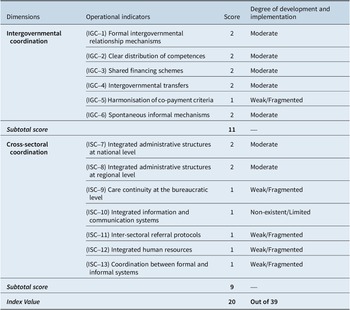
The overall LTC-CoIn value of 20 points out of a maximum of 39 (51.3 per cent) should be read primarily as a baseline reference point for future comparative applications of the index across different national systems – its interpretive weight will grow as the framework is applied to additional cases (Table 2). The substantive analytical finding of this study lies in the disaggregated dimensional scores and the structural asymmetry they reveal. The intergovernmental coordination dimension obtains 11 points out of a maximum of 18 (61.1 per cent), positioning itself as the dimension with the best relative performance in the index. This result reflects a moderate degree of development in the multilevel articulation of the LTC system, albeit with significant nuances across the indicators analysed; notably, the harmonisation of co-payment criteria performs worst within this dimension, as the absence of common standards in users’ financial contributions generates considerable territorial heterogeneity that compromises the horizontal equity of the system. The intersectoral coordination dimension presents substantially inferior performance, with 9 points out of a maximum of 21 (42.9 per cent) – a coordination gap of 18.2 percentage points that constitutes the central empirical finding of this research and points to structural deficits in the articulation between the health and social sectors. The existence of bodies such as the Interministerial Commission for Social and Health Coordination at the state level, and interdepartmental commissions or committees in various ACs, demonstrates formal recognition of the need for coordination, yet the scores reveal that formal recognition has not translated into effective institutional development across most intersectoral indicators.
Aplplying the LTC-CoIn for Spain (2006–2025)

Table 2. Long description
The table is organized into four columns: Dimensions, Operational indicators, Score, and Degree of development and implementation.
Intergovernmental coordination dimension:
* I G C dash 1: Formal intergovernmental relationship mechanisms. Score 2, Moderate.
* I G C dash 2: Clear distribution of competences. Score 2, Moderate.
* I G C dash 3: Shared financing schemes. Score 2, Moderate.
* I G C dash 4: Intergovernmental transfers. Score 2, Moderate.
* I G C dash 5: Harmonisation of co-payment criteria. Score 1, Weak or Fragmented.
* I G C dash 6: Spontaneous informal mechanisms. Score 2, Moderate.
* Subtotal score for this dimension is 11.
Cross-sectoral coordination dimension:
* I S C dash 7: Integrated administrative structures at national level. Score 2, Moderate.
* I S C dash 8: Integrated administrative structures at regional level. Score 2, Moderate.
* I S C dash 9: Care continuity at the bureaucratic level. Score 1, Weak or Fragmented.
* I S C dash 10: Integrated information and communication systems. Score 1, Non-existent or Limited.
* I S C dash 11: Inter-sectoral referral protocols. Score 1, Weak or Fragmented.
* I S C dash 12: Integrated human resources. Score 1, Weak or Fragmented.
* I S C dash 13: Coordination between formal and informal systems. Score 1, Weak or Fragmented.
* Subtotal score for this dimension is 9.
The final Index Value is 20 out of a maximum of 39.
Source: Authors’ own elaboration.
The comparative analysis between dimensions reveals a coordination gap of 18.2 percentage points. This asymmetry suggests that, whilst the SAAD has developed structures and mechanisms for vertical articulation between levels of government – inherited in part from the autonomous model and from the institutional architecture of the broader social services system – horizontal integration between sectors (health and social services) remains an unresolved structural challenge. This gap between dimensions suggests that the principal challenge of the SAAD does not lie so much in the institutional architecture of multilevel coordination, but rather in the operational translation of social and health integration at the level of services, professionals, and users.
Conclusion
This research has analysed the governance of the SAAD in Spain through the development and application of the LTC-CoIn, an innovative analytical instrument that enables systematic evaluation of the scope of intergovernmental and intersectoral coordination mechanisms in territorially complex systems. The findings reveal a system in an intermediate phase of development, where significant institutional advances coexist with persistent implementation deficits, particularly in the operational dimension of social and health integration.
In relation to the objectives set out, this work has sought to respond comprehensively to the two research questions formulated. Regarding the degree of development of intergovernmental coordination mechanisms in the SAAD, the empirical evidence demonstrates that the SAAD possesses a consolidated ecosystem of formal multilevel coordination structures, largely inherited from the social services system and articulated primarily through the Territorial Council. However, the effectiveness of these mechanisms is limited by three critical factors: the political tensions arising from chronic underfunding of the system, the administrative fragmentation resulting from the coexistence of up to five territorial levels with responsibilities over the SAAD, and the absence of harmonisation in fundamental criteria such as co-payment, which generates significant territorial inequities. Concerning effective coordination between the health and social sectors, the results demonstrate that social and health integration remains an unresolved structural challenge. The most critical deficits are concentrated at the operational level: the absence of integrated information systems that enable data exchange between health and social professionals, the lack of standardised inter-sectoral referral protocols, and the non-existence of consolidated interprofessional training programmes constitute fundamental barriers to care continuity and comprehensive care for people in situations of dependency.
The relevance of these findings transcends the Spanish case and provides significant contributions to the broader field of study of territorial governance of welfare states and LTC policies in federations and multilevel systems. From a theoretical perspective, the LTC-CoIn represents a methodological innovation in the analysis of LTC governance: it enables the systematic operationalisation of coordination dimensions that the rich qualitative evidence underlying this study reveals, translating interpretive depth into a structured, comparable, and temporally trackable framework. This is precisely the kind of analytical tool that comparative research on multilevel governance needs — one that is rigorously grounded in qualitative evidence while offering the analytical traction of systematic measurement. Its two-dimensional structure provides a replicable analytical framework for synchronic and diachronic comparative studies. From an empirical perspective, the research provides original evidence on the effective functioning of coordination mechanisms in the SAAD, beyond its formal architecture, identifying the main bottlenecks that hinder effective coordination. Furthermore, the results of this research have direct implications for the development and design of institutional, organisational, and territorial policies. In the specific case of this research on Spain, the results suggest that the most urgent interventions should not focus exclusively on the creation of new governance structures (intergovernmental coordination), but rather on strengthening the operational capacity for social and health integration through investments in interoperable technological infrastructures, standardised protocols for joint action, and interprofessional training programmes that prepare professionals for collaborative work between sectors.
This research is not without limitations. The application of the LTC-CoIn to a single national case – the Spanish SAAD – constitutes both a deliberate methodological choice and an inherent constraint. As a first-generation composite index, the LTC-CoIn follows the developmental logic of other well-established analytical instruments in the social sciences, such as the Human Development Index (UNDP, 1990), the decommodification index (Esping-Andersen, Reference Esping-Andersen1990), or the intergovernmental coordination indices developed in comparative federalism research (Behnke and Mueller, Reference Behnke and Mueller2017), which were initially applied to a limited number of cases before being extended to broader comparative frameworks. The value of the LTC-CoIn at this stage lies precisely in its capacity to operationalise and systematically measure dimensions of coordination that have traditionally been analysed in a qualitative or descriptive manner. Future research should extend the application of the index to other multilevel systems – both federal and decentralised unitary states – enabling synchronic comparisons between national LTC systems and diachronic analyses of the impact of institutional reforms. Within the Spanish case itself, a disaggregated application of the LTC-CoIn at the regional level (by autonomous community) would allow for a more granular assessment of territorial variation in coordination capacity, which remains one of the most pressing governance challenges of the SAAD.
Acknowledgements
The author would like to thank the members of the POSEB team (CSIC), Eloísa del Pino, F.J. Moreno Fuentes and Roberta Perna, as well as the late Luis Moreno, for providing the knowledge, time and space necessary to carry out this research (and so many others). He would also like to express his sincere gratitude to Gibrán Cruz-Martínez for his valuable contributions during our discussions, as well as his wise advice on the revision of this article.
Funding statement
This project has received funding from the European Union’s Horizon Europe research and innovation programme under grant sgreement no. 101132701. The views and opinions expressed are, however, those of the author only and do not necessarily reflect those of the European Union or the European Research Executive Agency (REA). Neither the European Union nor the granting authority can be held responsible for them.
Appendix A: Codes and participants’ professional profile involved in the study via expert interviews

Table A1 Long description
The table consists of two columns: Codes used for in-text citations and Participants’ professional profile.
* Interview 1: Expert.
* Interview 2: Decision-maker at regional level political level.
* Interview 3: Decision-maker at regional level political level.
* Interview 4: Decision-maker at regional level political level.
* Interview 5: Decision-maker at regional level political level.
* Interview 6: Decision-maker at municipal level political level.
* Interview 7: Decision-maker at national level political level.
* Interview 8: Decision-maker at regional level technical level.
* Interview 9: Decision-maker at regional level technical level.
* Interview 10: Decision-maker at regional level political level.
* Interview 11: Decision-maker at regional level technical level.
* Interview 12: Decision-maker at national level political level.
* Interview 13: Decision-maker at national level political level.
* Interview 14: Expert.
* Interview 15: Expert.
* Interview 16: Decision-maker at municipal level political level.
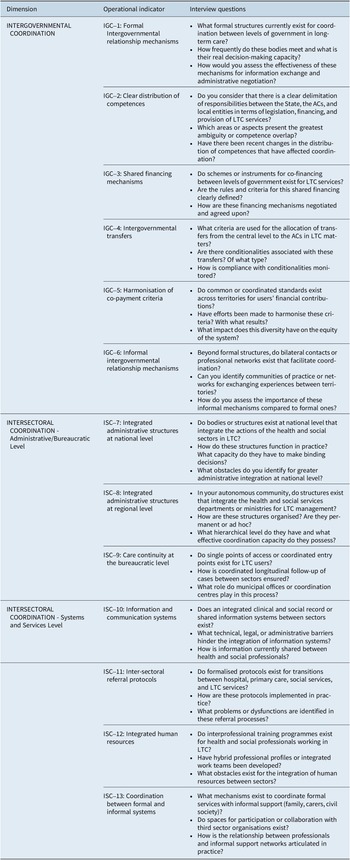
APPENDIX B: Qualitative structure of interviews: Dimension, indicator, and questions

Table B1 Long description
The table is organized into three main columns: Dimension, Operational indicator, and Interview questions.
1. INTERGOVERNMENTAL COORDINATION:
- I G C 1: Formal mechanisms. Questions focus on existing structures, meeting frequency, and effectiveness.
- I G C 2: Distribution of competences. Questions address clarity of responsibilities between State, A Cs, and local entities.
- I G C 3: Shared financing. Questions cover co-financing schemes and negotiation rules.
- I G C 4: Intergovernmental transfers. Questions focus on central-to-A C allocation criteria and conditionalities.
- I G C 5: Harmonisation of co-payment. Questions address common standards for user financial contributions and equity.
- I G C 6: Informal mechanisms. Questions explore bilateral contacts and professional networks.
2. INTERSECTORAL COORDINATION - Administrative/Bureaucratic Level:
- I S C 7: National integrated structures. Questions focus on health and social sector integration at the national level.
- I S C 8: Regional integrated structures. Questions address integration within autonomous communities.
- I S C 9: Care continuity. Questions cover single points of access and longitudinal follow-up.
3. INTERSECTORAL COORDINATION - Systems and Services Level:
- I S C 10: Information systems. Questions address shared clinical and social records and technical barriers.
- I S C 11: Referral protocols. Questions focus on transitions between hospital, primary care, and L T C services.
- I S C 12: Integrated human resources. Questions cover interprofessional training and hybrid profiles.
- I S C 13: Formal and informal systems. Questions address coordination with family, carers, and the third sector.
Note: These questions are designed to be flexible and adaptable according to the level of government of the interviewee (central, autonomous, or local) and their specific area of responsibility.
APPENDIX C: Construction of assessment scales for each LTC-CoIn indicator
This methodological note provides a rigorous and systematic guide for the operationalisation of the LTC-CoIn, ensuring the comparability, replicability, and validity of measurements in different territorial and temporal contexts.
IGC-1: Formal intergovernmental relationship mechanisms
Evaluates the existence and functioning of formal structures, instruments, and bodies (sectoral conferences, technical committees, working groups) that ensure the exchange of information and administrative and technical negotiation between levels of government.

Table C1 Long description
The table consists of two columns. The first column is titled Score and the second column is titled Assessment criteria.
* Row 1. Score 0. Assessment criteria states that no formal intergovernmental relationship mechanisms exist or they are merely nominal without real activity.
* Row 2. Score 1. Assessment criteria states that formal bodies exist such as sectoral conferences but their functioning is irregular with sporadic meetings and without consolidated capacity for coordination or decision-making.
* Row 3. Score 2. Assessment criteria states that formal mechanisms function regularly with periodic meetings and effective information exchange but with limitations in negotiation capacity or implementation of agreements.
* Row 4. Score 3. Assessment criteria states that formal mechanisms are fully institutionalised and function systematically and regularly with high negotiation capacity binding decision-making and systematic monitoring of agreements.
IGC-2: Clear distribution of competences
Evaluates the degree of clarity and explicit delimitation of responsibilities between levels of government in the functions of legislation, financing, and provision of long-term care services.

Table C2 Long description
The table consists of two columns titled Score and Assessment criteria.
* Score 0 corresponds to an ambiguous, confusing distribution of competences or with significant overlaps that generate conflicts of attributions and responsibility gaps.
* Score 1 corresponds to a formal delimitation of competences exists, but with grey areas, partial overlaps, or divergent interpretations that hinder effective coordination.
* Score 2 corresponds to the distribution of competences is clearly defined in regulations, with explicit delimitation of responsibilities, although some areas of concurrence that require coordination may exist.
* Score 3 corresponds to a fully clear, explicit, and consensual distribution of competences, with established mechanisms to manage areas of concurrence and resolve conflicts of attributions.
IGC-3: Shared financing schemes
Evaluates the existence of instruments or co-financing schemes between levels of government with clear rules for contribution, distribution, and accountability.

Table C3 Long description
The table consists of two columns: Score and Assessment criteria.
Row 1: Score 0. Assessment criteria: No shared financing mechanisms exist. Each level of government finances independently without coordination.
Row 2: Score 1. Assessment criteria: Some co-financing schemes exist, but they are informal, ad hoc, or without clear rules for contribution and distribution.
Row 3: Score 2. Assessment criteria: Formal shared financing mechanisms exist with defined rules, but their implementation is irregular or presents limitations in transparency and accountability.
Row 4: Score 3. Assessment criteria: Fully institutionalised shared financing mechanisms, with clear, transparent, and stable rules for contribution, distribution, and accountability between levels of government.
IGC-4: Intergovernmental transfers
Evaluates the existence and quality of financial transfers between levels of government with explicit allocation criteria and defined conditionalities.

Table C4 Long description
The table consists of two columns titled Score and Assessment criteria.
Row 1. Score 0. Assessment criteria states that no specific intergovernmental transfers for long-term care exist or they are completely discretionary without objective criteria.
Row 2. Score 1. Assessment criteria states that transfers exist but with unclear, opaque, or highly discretionary allocation criteria, without defined conditionalities.
Row 3. Score 2. Assessment criteria states that transfers are made with defined allocation criteria such as population, need, and fiscal capacity, but conditionalities are weak or monitoring is limited.
Row 4. Score 3. Assessment criteria states a fully institutionalised transfer system with objective, transparent, and needs-based allocation criteria, with clear conditionalities and effective monitoring and evaluation mechanisms.
IGC-5: Harmonisation of co-payment criteria
Evaluates the existence of common or coordinated standards for users’ financial contributions across territories, avoiding significant disparities in access.

Table C5 Long description
The table consists of two columns titled Score and Assessment criteria.
* Score 0. Assessment criteria states that no harmonisation exists. Co-payment criteria vary significantly between territories without any common frame of reference.
* Score 1. Assessment criteria states that some general guidelines or recommendations exist, but without binding character, resulting in high territorial heterogeneity in co-payment criteria.
* Score 2. Assessment criteria states that a common frame of reference exists with harmonised basic criteria such as income brackets or maximum percentages, but with significant margin for territorial variation.
* Score 3. Assessment criteria states that fully harmonised co-payment criteria with binding common standards that guarantee territorial equity, allowing only minor justified variations.
IGC-6: Spontaneous informal mechanisms
Evaluates the existence and relevance of spontaneous informal mechanisms (bilateral contacts, professional networks, communities of practice) that complement and facilitate formal coordination.

Table C6 Long description
The table consists of two columns titled Score and Assessment criteria.
* Score 0 corresponds to the criteria: No informal coordination mechanisms exist or they are completely anecdotal without impact on system governance.
* Score 1 corresponds to the criteria: Occasional informal contacts exist between officials or technicians from different levels of government, but without systematicity or significant impact.
* Score 2 corresponds to the criteria: Professional networks, communities of practice, or regular bilateral contacts exist that facilitate the exchange of information and good practices, complementing formal mechanisms.
* Score 3 corresponds to the criteria: Highly developed and systematic informal mechanisms (consolidated networks, institutionalised communities of practice) that play a crucial role in effective coordination and policy innovation.
ISC-7: Integrated administrative structures at national level
Evaluates the existence of bodies or administrative structures that integrate or coordinate the health and social sectors at central government level (e.g. interministerial committees, intersectoral commissions).

Table C7 Long description
The table consists of two columns: Score and Assessment criteria.
* Score 0: No intersectoral coordination structures exist at national level. The health and social sectors operate completely separately.
* Score 1: Nominal structures or ad hoc working groups exist, but with irregular functioning, without decision-making capacity, and without real impact on coordination.
* Score 2: Formal intersectoral coordination bodies exist, such as an interministerial commission, that function regularly, with proposal capacity, but with limitations in effective implementation of decisions.
* Score 3: Fully institutionalised intersectoral coordination structures, with systematic functioning, binding decision-making capacity, and a consolidated track record of policy integration decisions.
ISC-8: Integrated administrative structures at regional level
Evaluates the existence of bodies or administrative structures that integrate or coordinate the health and social sectors at regional/autonomous government level (e.g. interdepartmental committees, social and health commissions).

Table C8 Long description
The table consists of two columns titled Score and Assessment criteria.
* Score 0. Assessment criteria. No intersectoral coordination structures exist at regional level. The health and social services departments operate completely separately.
* Score 1. Assessment criteria. Nominal structures or isolated initiatives exist in some regions, but with irregular functioning and without systematicity.
* Score 2. Assessment criteria. Formal intersectoral coordination bodies exist in most regions, with regular functioning, but with variability in their operational regularity and implementation capacity.
* Score 3. Assessment criteria. Fully institutionalised intersectoral coordination structures in all or almost all regions, with systematic functioning and a consolidated track record of intersectoral coordination decisions.
ISC-9: Care continuity at the bureaucratic level
Evaluates the existence of mechanisms that guarantee care continuity from the administrative perspective (single point of access, coordinated longitudinal follow-up, continuity protocols).

Table C9 Long description
The table consists of two columns titled Score and Assessment criteria.
Row 1. Score 0. Assessment criteria states that no care continuity mechanisms exist and users must navigate independently between health and social systems without coordination.
Row 2. Score 1. Assessment criteria states that some pilot initiatives or isolated local experiences exist, such as a single point of access in some municipalities, but without extension or systematicity.
Row 3. Score 2. Assessment criteria states that formal care continuity mechanisms exist, including single point of access and follow-up protocols, which are implemented partially or with limited territorial coverage.
Row 4. Score 3. Assessment criteria states that fully developed and extended care continuity mechanisms exist, featuring generalised single point of access, coordinated longitudinal follow-up, and effective protocols with documented extension and systematic implementation across the territory.
ISC-10: Integrated information and communication systems
Evaluates the existence and degree of integration of information systems that enable sharing clinical and social data between sectors (integrated clinical/social record, information exchange platforms).

Table C10 Long description
The table consists of two columns: Score and Assessment criteria.
* Score 0: No integrated information systems exist. The health and social sectors maintain completely separate systems without interoperability.
* Score 1: Pilot projects or incipient initiatives for information systems integration exist in very limited territorial or institutional areas.
* Score 2: Information systems exist with some degree of interoperability or data exchange between sectors, but with technical limitations, coverage, or effective use by professionals.
* Score 3: Fully integrated information systems (integrated social and health record) with complete interoperability, broad territorial coverage, and effective use by professionals from both sectors.
ISC-11: Inter-sectoral referral protocols
Evaluates the existence of formalised procedures for transitions and referrals between hospital, primary care, social services, and long-term care services.

Table C11 Long description
The table consists of two columns titled Score and Assessment criteria.
* Score 0 corresponds to: No inter-sectoral referral protocols exist. Transitions are carried out informally and in an uncoordinated manner.
* Score 1 corresponds to: Some informal protocols or isolated local agreements exist, but without formalisation or systematic extension.
* Score 2 corresponds to: Formalised inter-sectoral referral protocols exist, but their implementation is irregular, with significant territorial or institutional variability.
* Score 3 corresponds to: Fully formalised referral protocols, implemented systematically throughout the territory, with monitoring and evaluation of their compliance and systematic application.
ISC-12: Integrated human resources
Evaluates the existence of human resources integration strategies between sectors (interprofessional training, hybrid professional profiles, integrated work teams).

Table C12 Long description
The table consists of two columns titled Score and Assessment criteria.
Row 1. Score 0. Assessment criteria states that no human resources integration strategies exist. Health and social professionals are trained and work completely separately.
Row 2. Score 1. Assessment criteria describes isolated interprofessional training initiatives or pilot experiences of integrated teams that lack systematicity or extension.
Row 3. Score 2. Assessment criteria notes that interprofessional training programmes or integrated work teams exist in some areas but have limited coverage and lack full institutionalisation.
Row 4. Score 3. Assessment criteria defines fully developed human resources integration strategies, including generalised interprofessional training, recognised hybrid profiles, and extended integrated teams with documented extension and full institutionalisation across the territory.
ISC-13: Coordination between formal and informal systems
Evaluates the existence of mechanisms that articulate coordination between formal care systems (health and social services and professionals) and informal systems (family, non-professional carers, civil society organisations).

Table C13 Long description
The table consists of two columns titled Score and Assessment criteria.
Row 1: Score 0. Assessment criteria: No coordination mechanisms between formal and informal systems exist. Family carers and civil society operate completely disconnected from formal services.
Row 2: Score 1. Assessment criteria: Some isolated initiatives for carer support or collaboration with social organisations exist, but without systematicity or effective articulation with formal services.
Row 3: Score 2. Assessment criteria: Carer support programmes and collaboration mechanisms with civil society exist, but with limited coverage, irregular implementation, or without full integration in care planning.
Row 4: Score 3. Assessment criteria: Fully developed coordination mechanisms between formal and informal systems (comprehensive carer support programmes, systematic civil society participation, integration in care plans) with documented extension and systematic integration in formal care planning.




 Open access

