Polyamine biosynthesis
Polyamines are small, naturally occurring, polycationic alkylamines that are essential for normal cell growth and development in eukaryotes (Refs Reference Pegg1, Reference Gerner and Meyskens2). Both their charge distribution and flexibility allow polyamines to bind to various anionic macromolecules including DNA, RNA, proteins and acidic phospholipids (Refs Reference Wallace, Fraser and Hughes3, Reference Matthews4). The vital importance of polyamines for normal cellular processes is further highlighted by their roles in maintaining chromatin structure, regulating ion-channels, maintaining membrane stability and scavenging free radicals (Refs Reference Matthews4, Reference Feuerstein5, Reference Ha6, Reference Kurata, Marton and Nichols7, Reference Schuber8).
Under normal physiological conditions, polyamines are tightly regulated by a complex network of biosynthetic, catabolic and poorly understood transport mechanisms (Refs Reference Casero and Marton9, Reference Pegg10, Reference Wallace11). Such controls aid in the maintenance of a tightly regulated concentration of polyamines in the cell. It has been well established that an increase in intracellular polyamine concentration, primarily through an upregulation of the polyamine biosynthetic enzymes, correlates with increased cell proliferation and is typically seen concurrent with tumourigenesis (Refs Reference Pegg1, Reference Gerner and Meyskens2, Reference Casero and Marton9, Reference Russell and Snyder12). For example, elevated levels of polyamines have been associated with breast, colon, prostate and skin cancers (Refs Reference Manni13, Reference Gupta14, Reference Gilmour15, Reference Upp16). Moreover, data indicate that the polyamine pathway is a downstream target of numerous oncogenes, such as Myc and Ras (Refs Reference Tobias, Shor and Kahana17, Reference Shantz and Levin18, Reference Holtta, Sistonen and Alitalo19, Reference Ignatenko20). Together, these data validate the polyamine pathway as a chemopreventive and chemotherapeutic target.
In mammals, the amino acid ornithine, a product of the urea cycle, is converted to the diamine putrescine by the rate-limiting enzyme, ornithine decarboxylase (ODC) (Fig. 1). ODC expression is tightly regulated at multiple levels including transcription, post-transcriptional processing, changes in translational efficiency and altered stability of the protein (Refs Reference Shantz21, Reference Pegg22, Reference Nowotarski and Shantz23). The extensive regulatory systems controlling ODC underscore its importance as a critical enzyme essential for normal cell growth and development. The vital necessity of ODC is further substantiated by data demonstrating that the homozygous deletion of ODC in mice is lethal at 3.5 days post-fertilisation (Ref. Reference Pendeville24).
The polyamine pathway. (a) Schematic of putrescine and the higher polyamines spermidine and spermine. (b) The amino acid ornithine is a product of the urea cycle. Ornithine is converted to the diamine putrescine by the enzyme ornithine decarboxylase (ODC). Putrescine is then converted to the higher polyamines spermidine and spermine via spermidine synthase and spermine synthase, respectively. The decarboxylation of S-adenosylmethionine (SAM) by S-adenosylmethionine decarboxylase (AdoMetDC) produces decarboxylated SAM (dcSAM), which acts as the propyl amine donor for the formation of spermidine and spermine via the spermidine and spermine synthases. Spermidine/spermine N 1-acetyltransferase (SSAT) is a propylamine acetyltransferase that converts spermine and spermidine to N 1-acetylspermine and N 1-acetylspermidine, respectively. The acetylated polyamines can be either exported out of the cell via an undetermined transport system, or act as substrates for the polyamine oxidase (APAO). APAO catalyses the conversion of N 1-acetylspermine to spermidine and N 1-acetylspermidine to putrescine. Spermine oxidase (SMO) oxidises nonacetylated spermine to form spermidine. Putrescine, spermidine and spermine can also be imported into the cell via a poorly understood transport mechanism. All polyamine pathway enzymes are in blue.

ODC is highly regulated at the transcriptional level by various factors, including growth factors, hormones and tumour-promoting agents (Refs Reference Katz and Kahana25, Reference Verma, Hsieh and Pong26). The promoter region of the Odc gene contains numerous sequences that are homologous to known transcription factor-binding sites (Refs Reference Pegg22, Reference Abrahamsen27, Reference Zhao and Butler28). For example, ODC was the first direct target to be identified for the Myc oncogene, a mediator of proliferation, differentiation and apoptosis (Refs Reference Bello-Fernandez, Packham and Cleveland29, Reference Packham and Cleveland30).
The ODC enzyme, which is active as a homodimer, has a short half-life, ranging from 10–30 min (Ref. Reference Casero and Marton9). The ODC degradation process is unique in that it is ubiquitin independent (Ref. Reference Murakami31). For degradation, monomeric ODC noncovalently associates with the ODC antizyme (AZ) protein, thus inactivating it. Subsequently, AZ directs ODC to the 26S proteasome for degradation (Ref. Reference Pegg22). The AZ family consists of at least three differently distributed proteins, all of which function as ODC inhibitors (Ref. Reference Pegg22). The best-characterised AZ family member is AZ1, which is synthesised in a polyamine-dependent manner and is translationally regulated by a +1 frameshift event that occurs when cellular polyamine content is high (Ref. Reference Nilsson32). To date, the exact mechanism of this polyamine-specific event remains elusive; however, it appears to involve a pseudoknot structure that is integral to the process (Ref. Reference Matsufuji33).
The second rate-limiting step in the polyamine biosynthetic pathway is catalysed by S-adenosylmethionine decarboxylase (AdoMetDC), a pyruvoyl-containing decarboxylase (Ref. Reference Stanley, Pegg and Holm34). The decarboxylation of S-adenosylmethionine (SAM) by AdoMetDC creates decarboxylated SAM (dcSAM), which donates its propyl amines to form spermidine and spermine from putrescine via the aminopropyl transferases spermidine synthase and spermine synthase, respectively (Refs Reference Ikeguchi, Bewley and Pegg35, Reference Korhonen36, Reference Wahlfors37). A dcSAM molecule can only be used in the synthesis of polyamines. This is potentially very significant in that SAM is also the methyl source for many transmethylation reactions, including histone and DNA methylation, critical processes that are further elaborated upon later in this review.
Polyamine catabolism
A highly regulated catabolic pathway further controls the intracellular polyamine pools. Spermidine/spermine N 1-acetyltransferase (SSAT) is a propylamine acetyltransferase that catalyses the formation of N 1-acetylspermine or N 1-acetylspermidine by transferring the acetyl group from acetyl-coenzyme A to the N 1 position of spermine or spermidine, respectively (Refs Reference Casero and Pegg38, Reference Casero and Pegg39). These acetylated polyamines can be exported or can serve as substrates for the flavin-dependent N 1-acetylpolyamine oxidase (APAO) that produces spermidine or putrescine, depending on the acetylated substrate, as well as the products 3-aceto-aminopropanal and hydrogen peroxide (H2O2) (Refs Reference Xie, Gillies and Gerner40, Reference Vujcic41, Reference Wu, Yankovskaya and McIntire42).
In 2001, a novel polyamine catabolic enzyme was discovered serendipitously. During an attempt to clone APAO, an enzyme was identified that possessed many of APAO's structural properties (Refs Reference Wang43, Reference Vujcic44). However, the newly discovered enzyme was highly inducible and oxidised unsubstituted spermine. The protein, spermine oxidase (SMO), is a flavin adenine dinucleotide (FAD)-dependent enzyme that oxidises spermine to produce spermidine, 3-aminopropanal and H2O2 (Ref. Reference Wang45). SMO induction has recently been demonstrated in inflammation-associated cancers of the colon and lung (Refs Reference Babbar and Casero46, Reference Goodwin47). It is hypothesised that SMO induction in response to tumour necrosis factor α or other cytokines results in the production of reactive oxygen species (ROS) and subsequently causes DNA damage. This sequence of events is key for both the initiation and progression steps of inflammation-associated neoplastic development and suggests that SMO may be an attractive target for chemoprevention.
Polyamine transport
As mentioned above, intracellular polyamine pools are further regulated by a poorly characterised polyamine transport system (Fig. 2). Although mammalian polyamine transport is not well characterised, it is clear that it plays a critical role in maintaining intracellular polyamine concentrations within specific ranges. Since humans consume a polyamine-rich diet [polyamines are found in high quantities in cheese and red meat (Ref. Reference Bardocz48)] and because the intestinal flora are able to excrete polyamines, a better understanding of the polyamine transport system is necessary to fully exploit the polyamine metabolic pathway for therapeutic advantage (Ref. Reference Wallace11).
Theoretical models of the polyamine transport system. (a) This model proposes that polyamines (PA) are transported into cells via a yet to be identified transporter that is powered by membrane potential. Accumulated PA localise to polyamine-sequestering vesicles (PSVs). This process is dependent on a vacuolar ATPase pH gradient and proton exchange. Yellow transporters represent vesicular polyamine exporters and brown transporters represent vesicular polyamine antiporters. A plasma membrane polyamine permease is shown in blue. (b) This model describes a mechanism by which heparan sulfate and glypican 1 (GPC1) work together to transport spermine (Spm). Spermine binds to heparan sulfate groups in GPC1 on the cell surface and is subsequently internalised (the GPC1 cell surface receptor is depicted in orange). Inside the cell, the spermine is freed by a NO-oxidation-mediated process through nitric oxide synthase-2 (NOS2). (c) This mechanism hypothesises a caveolin-1-dependent internalisation of PA that are bound to an unknown polyamine membrane receptor. In this model, only putrescine (PUT) is released from the vesicles through a SLC3A2 exporter. A NOS2-dependent reaction destabilises the spermine-receptor complex in this model. This figure was adapted from Poulin et al. (Ref. Reference Poulin, Casero and Soulet50).
Observations by several groups have shown a correlation between the polyamine transport system and ODC enzyme activity, and have linked inhibition of the two to AZ (Refs Reference Kahana49, Reference Poulin, Casero and Soulet50). In mammals, all three AZ family members are able to repress both ODC activity and the polyamine transport system (Ref. Reference Kahana49). Treatment with 2-difluoromethylornithine (DFMO) and other ODC enzymatic inhibitors has been shown to deplete cellular ODC enzyme activity while inducing polyamine transport activity via an unknown mechanism (Ref. Reference Poulin, Casero and Soulet50). It has been hypothesised, however, that this coordination between ODC enzyme activity and the polyamine transport system is not through alterations in AZ levels, but rather, through changes in the abundance of the unidentified polyamine permease (Refs Reference Poulin, Casero and Soulet50, Reference Lessard51). Interestingly, treating cells with polyamine analogues can cause an induction of AZ therein limiting their own accumulation within the cell (Ref. Reference Mitchell52). However, the exact mechanism of how the polyamine transport system is inhibited by AZ is an area of contention. Moreover, AZ inhibitors, catalytically inactive relatives of ODC, are able to activate both the polyamine transport system and ODC enzyme activity (Ref. Reference Kahana49). These findings demonstrate the self-regulating capacity of polyamines via a poorly understood mechanism.
In mammals, an energy-dependent and selective polyamine transport system has been proposed and biochemically characterised. Currently, there are three proposed models for the mammalian polyamine transport system. One model suggests that polyamines are transported into cells via a yet to be identified transporter that is powered by membrane potential. Polyamines enter the cell via a plasma membrane polyamine permease. Accumulated polyamines are then localised to polyamine-sequestering vesicles (PSVs), which closely resemble the acidic vesicles of late endocytosis, in a process that is dependent on a vacuolar ATPase pH gradient and proton exchange (Ref. Reference Soulet53). In this model, PSVs are not directly associated with the membrane components of the polyamine transporter. This model accounts for the fact that overall polyamine content in the cell is high despite a low level of free cellular polyamines. Moreover, this model suggests a system in which the free polyamine levels in the cell can rapidly change through the release of sequestered polyamines (Ref. Reference Poulin, Casero and Soulet50). A second model describes a mechanism by which heparan sulfate and glypican 1 (GPC1) work together to transport spermine. In this model, spermine binds to the heparan sulfate groups in GPC1 on the cell surface and is subsequently internalised. Once inside the cell, the spermine is freed through a NO-oxidation-mediated process (Ref. Reference Belting54). A third mechanism for mammalian polyamine transport hypothesises a caveolin-1-dependent internalisation of polyamines that are bound to an unknown polyamine membrane receptor (Ref. Reference Roy55). In this model, only putrescine is released from the vesicles through a SLC3A2 exporter, and a nitric oxide synthase 2-dependent reaction destabilises the spermine-receptor complexes (Ref. Reference Uemura56). Although there has been much recent progress in identifying the potential players in polyamine transport, there is still considerable work needed. Numerous mechanisms have been proposed to explain this process; however, none have identified all of the molecular components involved that are consistent with the observed biochemical data. The identification of the polyamine transporter components is crucial to enable the full exploitation of the transporter to both deliver drugs targeting polyamine metabolism and to use polyamine-like structures to selectively deliver drugs to targets other than polyamine metabolic enzymes.
Polyamines and cancer
There is a vast body of literature describing the relationship between increased levels of polyamines and cancer, most of which suggest an association of induced polyamine biosynthesis with neoplasia (Refs Reference Gerner and Meyskens2, Reference Casero and Marton9, Reference Casero57). In the 1960s, Russell and Snyder first demonstrated high levels of ODC enzyme activity in human cancer (Ref. Reference Russell and Snyder12). ODC activity and polyamine levels were subsequently found to be increased in familial adenomatous polyposis, a genetic predisposition to colon cancer due to an adenomatous polyposis coli mutation (Ref. Reference Giardiello58). In addition, a correlation between a single-nucleotide polymorphism (SNP) in the Odc intron 1 and human colon cancer risk was assessed. These studies revealed that individuals taking aspirin who were homozygous G or heterozygous G/A at the (G315A) SNP site were more likely to develop colon polyps than homozygous A individuals taking aspirin. The A-allele was further shown to reduce the risk of colon cancer because the c-Myc antagonist, MAD1, selectively repressed Odc expression in an A-allele-specific manner (Ref. Reference Martinez59). Pioneering work in the field of polyamines and skin carcinogenesis established that ODC is both necessary and sufficient for the onset of tumours in mice (Refs Reference Pegg10, Reference Gilmour15). ODC has been shown to be elevated in human nonmelanoma skin cancer (NMSC) (Ref. Reference Elmets and Athar60). Moreover, ODC induction and increased levels of polyamines have been associated with breast cancer (Refs Reference Manni13, Reference Manni61) and prostate cancer (Ref. Reference Gupta14). Other metabolic enzymes such as spermidine synthase and spermine synthase have yet to be convincingly coordinated with tumourigenesis in humans.
Recently, polyamine catabolic enzymes have been linked to carcinogenesis. For example, increased SMO expression has been demonstrated in inflammatory-associated cancers. Helicobacter pylori (H. pylori) infection and subsequent inflammation has been associated with gastric cancer (Ref. Reference Chaturvedi62). Xu et al. demonstrated that the infection of gastric epithelial cells with H. pylori upregulates SMO expression and results in increased DNA damage and apoptosis. Moreover, they showed that an eradication of H. pylori correlated with a reduction in SMO expression. The H. pylori-induced DNA damage and H2O2 production was attenuated upon treatment with the SMO inhibitor MDL 72 527 or by knockdown of SMO via RNAi (Ref. Reference Xu63). These studies established SMO as a downstream target of H. pylori infection and, consequently, a contributor to the development of gastric cancer. Furthermore, SMO expression was shown to be elevated in the tissue samples of patients with prostatic intraepithelial neoplasia and prostate cancer when compared with normal prostate tissue samples (Ref. Reference Goodwin64). SMO has also recently been shown to be increased in ulcerative colitis, another inflammatory condition leading to a high incidence of colon cancer (Ref. Reference Hong65).
Animal models useful in the study of polyamine metabolism and disease
Biosynthetic enzyme animal models
Transgenic animals for many of the major enzymes in the polyamine metabolic and catabolic pathways now exist. The first mouse model developed to study the polyamine pathway overexpressed ODC. Interestingly, the ubiquitous overexpression of ODC via its own promoter did not result in increased tumourigenesis in these mice (Ref. Reference Alhonen66). However, a targeted overexpression of ODC in the skin, using keratin-specific promoters, resulted in increased tumour formation (Ref. Reference Guo67). Other studies have shown that ODC haploinsufficiency dramatically lowers the tumour yield in mice. Guo et al. demonstrated that ODC+/− mice were phenotypically normal, but displayed lower levels of tumour multiplicity and tumour incidence in the skin when compared with ODC+/+ mice (Ref. Reference Guo, Cleveland and O'Brien68). Moreover, Nilsson et al. showed that reducing the ODC gene dosage by half decreased lymphomagenesis in the Eu-Myc model (Ref. Reference Nilsson69). These data underscore the complexity of polyamine enzyme gene dosage and polyamine levels as well as emphasise that the correlation between polyamine levels and tumourigenesis is tissue-specific. Mice that overexpress the other major metabolic enzyme in the polyamine pathway, AdoMetDC, have also been examined. In one study, mice that ubiquitously overexpressed AdoMetDC exhibited no pronounced phenotypic changes (Ref. Reference Heljasvaara70). By contrast, Shi et al. demonstrated that a targeted overexpression of AdoMetDC in the skin surprisingly resulted in fewer tumours when compared with control littermates (Ref. Reference Shi71). A recent study suggests a tumour suppressive role for AdoMetDC by demonstrating that the heterozygous deletion of AdoMetDC and the translational protein eIF5A occur concurrently in human lymphoma and mouse lymphomagenesis (Ref. Reference Scuoppo72). Again, these data highlight the complexity of the polyamine pathway and show that changes in the polyamines themselves can have quite different effects on normal and tumour tissues.
Using the cytomegalovirus-immediate early gene enhancer/chicken B-actin promoter to overexpress human spermidine synthase in mice resulted in no marked phenotypic changes (Refs Reference Shi73, Reference Kauppinen74). Moreover, mice that overexpressed spermine synthase displayed no changes in skin tumour susceptibility when compared with littermate controls and exhibited similar colon tumour multiplicity and size when compared with multiple intestinal neoplasia (MIN) mice (Ref. Reference Welsh75). These data demonstrate that ubiquitously altered levels of the higher polyamines spermidine and spermine alone do not promote tumourigenesis.
Mice that overexpress AZ, the endogenous inhibitor of ODC, have also been developed. In a skin chemical carcinogenesis model, Feith et al. demonstrated that a tissue-specific overexpression of AZ in the skin resulted in the development of fewer papillomas when compared with normal littermate controls (Ref. Reference Feith, Shantz and Pegg76). In addition, the overexpression of AZ in the forestomach of mice led to lower tumour incidence and multiplicity when compared with littermate controls after treatment with the carcinogen N-nitrosomethylbenzylamine (Ref. Reference Fong, Feith and Pegg77). These data support the causal role of ODC in tumourigenesis, and further highlight the potential of targeting the polyamine pathway as an antineoplastic strategy.
Catabolic enzyme animal models
Animal models for studying the catabolic enzymes in the polyamine pathway are less abundant, and no animal models for APAO or SMO have been reported to date. Mice that constitutively and ubiquitously overexpressed SSAT demonstrated a partial resistance to papilloma formation after the two-stage skin chemical carcinogenesis protocol (Ref. Reference Pietila78). However, mice that overexpressed SSAT specifically in the skin under the K6 promoter demonstrated a higher rate of tumour progression than their littermate controls (Ref. Reference Coleman79). In one study, Kee et al. crossed mice that overexpress SSAT with mice that are predisposed to prostate cancer [transgenic adenocarcinoma of the mouse prostate (TRAMP) mice]. These TRAMP/SSAT mice displayed inhibited tumour outgrowth when compared with TRAMP mice, suggesting that the induction of SSAT can exert antitumour effects (Ref. Reference Kee80). In a subsequent study, SSAT overexpressing mice were crossed with MIN mice. The progeny of this cross developed more intestinal adenomas than MIN mice. Interestingly, in a parallel study, SSAT knockout mice were crossed with MIN mice and resulted in mice that displayed fewer adenomas when compared with MIN mice (Ref. Reference Tucker81). The inconsistent data described for SSAT overexpressing mice might result from metabolic perturbations in the acetyl CoA pools of animals that overexpress SSAT in all of their tissues versus those models that have targeted expression. Further studies will be necessary to determine the role of SSAT in tumourigenesis in each of these transgenic models.
Clinical implications and applications
Cancer treatment: targeting the polyamine pathway via enzyme inhibitors and polyamine analogues
Enzyme inhibitors
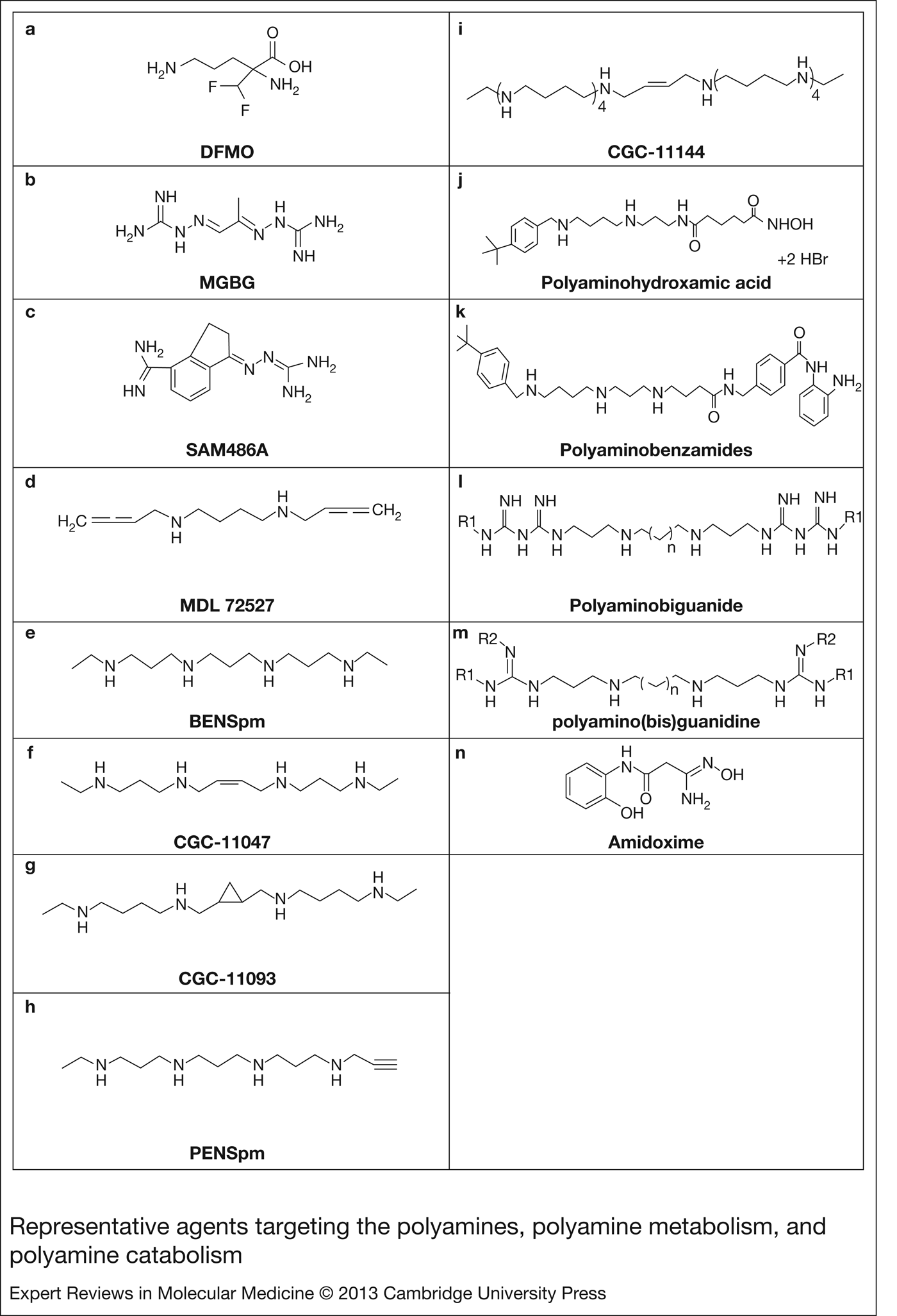
Targeting the polyamine biosynthetic pathway for antitumourigenic therapy started soon after the discovery that dysregulated polyamine levels were a hallmark for numerous tumour types (Fig. 3). Thus, the original therapies that targeted the polyamine pathway were for the metabolic enzymes ODC and AdoMetDC. DFMO, an irreversible inhibitor of ODC, was first shown in the 1970s to have antitumourigenic properties (Refs Reference Weeks82, Reference Prakash83). In vitro, DFMO depletes putrescine and spermidine, but has variable effects on spermine concentrations. In general, this depletion in the intracellular polyamine pools is associated with a cytostatic growth response (Ref. Reference Mamont84). However, the cytotoxic effects of DFMO on human small-cell lung cancer in vivo and in vitro prompted clinical trials for DFMO as a single agent (Refs Reference Luk85, Reference Luk86, Reference Abeloff87, Reference Abeloff88). Unfortunately, DFMO, alone or in combination with other agents, was largely ineffective as a chemotherapeutic agent. It was, however, demonstrated to be generally well-tolerated with mostly reversible toxicities including thrombocytopaenia, gastrointestinal anomalies and hearing loss (Ref. Reference Casero and Marton9). The lack of effectiveness of DFMO as a chemotherapeutic agent is likely due to its poor transport into the cell, the fact that it is typically cytostatic and not cytotoxic, and compensatory mechanisms such as increased polyamine transport or upregulation of AdoMetDC that occur as a result of the depleted polyamine pools. Thus, tumour cells can overcome the effects of ODC inhibition.
Representative agents targeting the polyamines, polyamine metabolism and polyamine catabolism. (a) 2-difluoromethylornithine (DFMO) is an enzyme inhibitor for ornithine decarboxylase (ODC). It causes a decrease in intracellular putrescine and spermidine pools. (b) Methylglyoxal bis(guanylhydrazone) (MGBG) is an enzyme inhibitor of S-adenosylmethionine decarboxylase (AdoMetDC). It causes a decrease in spermidine and spermine levels while increasing the level of putrescine. It competes with the natural polyamines for uptake and is a mitochondrial toxin. (c) 4-Amidoinoindan-1-one-2’-amidinhydrazone (SAM486A) is an enzyme inhibitor of AdoMetDC that has lower mitochondrial toxicity than MGBG. It decreases the levels of spermidine and spermine while increasing the level of putrescine. (d) N,N 1-Bis(2,3-butadienyl)-1,4-butanediamine (MDL 72527) is an active site inhibitor of APAO that also inhibits spermine oxidase (SMO). (e) N 1,N 11-Bis(ethyl)norspermine (BENSpm) is a symmetrically substituted spermine analogue. It induces spermidine/spermine N 1-acetyltransferase (SSAT) and SMO and causes the depletion of putrescine, spermidine and spermine. (f) CGC-11047 is a conformationally restricted polyamine analogue. It induces both SSAT and SMO and also decreases the levels of putrescine, spermidine and spermine. (g) CGC-11093 is a conformationally restricted polyamine analogue but, unlike CGC-11047, it does not induce SSAT or SMO. (h) PENSpm is a nonsymmetrically substituted polyamine analogue. It causes an induction of SSAT and cell type-specific cytotoxicity. (i) CGC-11144 is an oligoamine that has a high affinity for DNA. It competes with the natural polyamines for uptake and inhibits SMO activity and lysine-specific demethylase 1(LSD1) activity. (j) Polyaminohydroxamic acids (PAHAs) incorporate features of the polyamines spermidine and spermine and the hydroxamic acid moiety of the HDAC inhibitors suberoylanilide hydroxamic acid (SAHA) and Trichostatin A. (k) Polyaminobenzamides (PABAs) incorporate the benzamide moiety of MS-275 as well as features of spermidine and spermine. (l) Polyaminobiguanides are trypanocidal inhibitors and have recently been determined to inhibit LSD1 activity as well as cause the re-expression of some aberrantly silenced genes. (m) Polyamino(bis)guanidines are trypanocidal inhibitors and have recently been determined to inhibit LSD1 activity in cancer cells as well as cause the re-expression of aberrantly silenced genes. (n) Amidoximes were synthesised based on the success of certain polyaminobiguanide and polyamino(bis)guanidine compounds. Some from this series of compounds exhibited LSD1 inhibition as well as caused the re-expression of some aberrantly silenced genes.
In addition to targeting the biosynthetic enzyme ODC, inhibitors for the metabolic enzyme AdoMetDC have also been investigated. Methylglyoxal bis(guanylhydrazone) (MGBG) was used as a treatment for leukaemia before it was demonstrated to be a competitive inhibitor of AdoMetDC (Refs Reference Mihich89, Reference Williams-Ashman and Schenone90). In vitro, MGBG decreases the levels of spermidine and spermine while increasing the levels of putrescine, and it inhibits cellular growth. Despite its potency as an AdoMetDC inhibitor, the role of MGBG as a chemotherapeutic agent was limited due to its mitochondrial toxicities (Ref. Reference Nass91). Subsequently, a number of nucleoside-based inhibitors of the enzyme were synthesised, most of which were based on the structure of SAM (Refs Reference Secrist92, Reference Wu and Woster93). The most effective nucleoside-based AdoMetDC inhibitor, 5′([(Z)-4-amino-2-butenyl]methylamino)-5′-deoxy-adenosine (AbeAdo), is an irreversible inactivator of the enzyme (Ref. Reference Danzin, Marchal and Casara94). AbeAdo has charged nitrogen in place of the sulfonium centre and is significantly more potent than the corresponding sulfur-containing compounds. AbeAdo and its analogues have been shown to be effective against trypanosomiasis in animal models (Ref. Reference Barker95). AbeAdo reduces the spermidine and spermine levels and increases putrescine. In L1210 cells, AbeAdo was shown to be cytostatic, but this was due to the loss of hypusinated eIF5A (Ref. Reference Byers96).
More recently, 4-amidinoindan-1-one-2′-amidinhydrazone (SAM486A/CGP48664), a competitive inhibitor of AdoMetDC, was shown to produce low mitochondrial toxicity and has been tested in phase I and phase II clinical trials for multiple cancers, with partial responses exhibited in non-Hodgkin's lymphoma (Refs Reference Eskens97, Reference Zhou98, Reference Paridaens99, Reference Pless100). SAM486A/CGP48664 decreases the levels of both spermidine and spermine whereas increasing the levels of putrescine and thereby inhibits cell growth (Ref. Reference Regenass101).
Inhibitors have also been developed that target the aminopropyl transferases spermidine and spermine synthase. S-adenosyl-3-thio-1,8-diaminooctane (AdoDATO), a spermidine synthase inhibitor, caused little growth inhibition in cancer cell lines (Ref. Reference Pegg, Tang and Coward102). A similar analogue that inhibited spermine synthase was also created, but again showed little promise as a chemotherapeutic agent (Ref. Reference Pegg103).
Symmetrically substituted bis(alkyl) polyamine analogues
As indicated above, the initial focus of polyamine-targeted therapy was directed at inhibiting the biosynthetic enzymes ODC and AdoMetDC; however, this approach demonstrated minimal success in the clinic. More recently, an emphasis on exploiting the self-regulating nature of the polyamine pathway using polyamine analogues has occurred. This paradigm was initially articulated by Porter and Bergeron (Ref. Reference Porter and Bergeron104). The rationale behind using polyamine analogues was to develop compounds that were able to utilise the polyamine transport system without evoking compensatory mechanisms or functionally substituting for the natural polyamines. The subsequent accumulation of polyamine analogues results in a downregulation of the polyamine biosynthetic pathway in conjunction with an increase in the catabolic pathway. Together, these actions result in a significant depletion of all three polyamines, including spermine, which is in contrast to what is seen with the inhibitors of polyamine biosynthesis. This depletion of the natural polyamine pool ultimately produces growth inhibition and, in specific cases, cell death.
The first polyamine analogues to be extensively studied were the bis(alkyl) polyamines. These compounds are similar to the polyamines spermidine and spermine; however, their primary amino termini are protected by symmetrical bis(alkyl) groups, thereby preventing their oxidation by multiple amine oxidases. This generation of analogues downregulates both ODC and AdoMetDC through a combination of multiple mechanisms, including product inhibition and changes in mRNA translation (Ref. Reference Casero and Woster105). Furthermore, some of these analogues are able to induce polyamine catabolic enzyme activity, an induction that has been linked to cytotoxicity (Refs Reference Casero and Pegg39, Reference Casero and Woster106, Reference Ha107, Reference Pledgie108).
One compound that highly induces SSAT, N 1, N 11-bis(ethyl)norspermine (BENSpm, also denoted as BE333 or DENSpm), uses the polyamine transport system to enter the cell and downregulates both ODC and AdoMetDC. In addition to SSAT, BENSpm also induces the catabolic enzyme SMO (Refs Reference Pledgie108, Reference Casero, Gabrielson and Pegg109, Reference Gabrielson, Pegg and Casero110). Other examples of bis(alkyl) polyamine analogues include: N 1, N 12-bis(ethyl)spermine (BESpm), N 1, N 14-bis(ethyl)homospermine (BEHSpm), N 1, N 15-bis-[3-(ethylamino)-propyl]-1-17-heptane diamine (BE-3-7-3) and N 1, N 19-bis(ethylamino)-5,10,15-triazanonadecane (BE-4-4-4-4) (Ref. Reference Casero and Woster106).
Impressive in vitro work has demonstrated that BENSpm displays significant antitumour activity (Refs Reference Casero and Woster106, Reference Gabrielson, Pegg and Casero110, Reference Bernacki111). Phases I and II clinical trials were conducted with this compound (Refs Reference Bernacki111, Reference Hahm112, Reference Streiff and Bender113); however, the results were somewhat disappointing. The initial phase I trials were conducted with three different dosing schedules (Refs Reference Creaven114, Reference Davidson115), of which the most tolerated dosage was 1/day for 5 days. However, it is still not known if this dosing schedule is optimal. It is possible that alternative dosing schedules, including once weekly for a longer duration, would be more effective. The long biological half-life of these agents suggests that such scheduling might be both better tolerated and more efficacious. Although BENSpm was well tolerated with the once daily dosing, the compound failed to show significant antitumour effects against breast or lung cancer (Refs Reference Hahm112, Reference Streiff and Bender113, Reference Davidson115, Reference Wolff116). However, it should be noted that despite its failure as a single agent, studies that combine BENSpm with standard chemotherapeutic agents (Refs Reference Hector117, Reference Choi118, Reference Pledgie-Tracy119) appear promising and are likely to serve as catalysts for future combination studies using standard chemotherapeutics and polyamine analogues.
Unsymmetrically substituted analogues
A variation on the theme of alkylated polyamine analogues led to a second generation of polyamine analogues that contained unsymmetrical substitutions to the spermine and norspermine backbone. These compounds included: N 1-propargyl-N 11-ethylnorspermine (PENSpm), N 1-cyclopropyl-methyl-N 11-ethylnorspermine (CPENSpm) and N 1-cycloheptylmethyl-N 11-ethylnorspermine (CHENSpm). Both CPENSpm and PENSpm have demonstrated cytotoxicity and SSAT induction (Ref. Reference Casero120). The data from studies with these compounds demonstrate that minor structural modifications can result in significantly altered biological responses to the individual polyamine analogues. Additionally, these studies have validated the strategy that reactive functional groups can be added to the polyamine backbone to facilitate the entry of such conjugates into the cell through the polyamine transport system, leading to the synthesis of multiple compounds exploiting this strategy (Refs Reference Varghese121, Reference Varghese122, Reference Wu123, Reference Huang124).
Conformationally restricted analogues
Another variation of the bis(alkyl) polyamine analogues is characterised by synthesised compounds that are rotationally restricted at the central carbons of the polyamine chain. From this subset of compounds, CGC-11047 (PG-11047) and CGC-11093 (PG-11093) have been the most encouraging therapeutic agents (Refs Reference Carew125, Reference Hacker126). CGC-11047 is based on BESpm and is conformationally restricted by a double bond between the central two carbons of the 4-carbon methylene bridge. CGC-11093 is a BEHSpm analogue that contains a cyclopropyl ring at the central two carbons of the 4-carbon methylene bridge. These alterations to BESpm and BEHSpm increased the antiproliferative activity of these compounds as well as reduced the overall nonspecific toxicity. CGC-11047 inhibited growth in both small-cell and nonsmall-cell lung cancer cell lines and delayed the progression of established tumours in nu/nu mice (Ref. Reference Hacker126). CGC-11047 has also been reported to inhibit the growth of basal-subtype breast cancers and colon cancers in vitro (Refs Reference Kuo127, Reference Ignatenko128). CGC-11047 has been studied in phase I clinical trials as a single agent and is also in a phase Ib clinical trial in combination with bevacizumab (Avastin; Genetech), erlotinib (Tarceva; OSI Pharmaceuticals), docetaxel (Taxotere; Sanofi-Aventis) or gemcitabine (Gemzar; Eli Lilly) (Ref. Reference Dredge129). Likewise, CGC-11093 has been studied in phase I clinical trials (Ref. Reference Casero and Marton9).
Oligoamines
Polyamines have long been known to bind to DNA and other macromolecules (Refs Reference Wallace, Fraser and Hughes3, Reference Matthews4). At physiological pH and concentrations of 50–100 µm, spermine causes DNA to condense (Ref. Reference Osland and Kleppe130). Thus, it was hypothesised that increasing the number of protonatable nitrogens in the polyamine analogues would inherently increase the affinity of these molecules for DNA (Ref. Reference Valasinas131). The oligoamines, synthesised by Frydman and colleagues, contain 8–14 amines and have representative saturated, unsaturated and conformationally restricted forms. The oligoamine CGC-11144 (PG-11144) exhibited growth inhibition in a panel of prostate cancer cell lines, and this growth inhibition correlated with the ability of the analogue to aggregate DNA (Ref. Reference Valasinas131). CGC-11144 has also demonstrated antitumour effects in both in vivo and in vitro models of breast cancer (Ref. Reference Huang132). Additionally, as will be discussed below, CGC-11144 has been demonstrated to have profound epigenetic effects, leading to changes in gene expression of specific tumour cell types. However, to date there have been no clinical trials for CGC-11144.
Polyamine analogues targeting epigenetic modifications
The modification of chromatin structure is a mechanism for regulating gene expression. Post-translational modifications to histone tails facilitate the epigenetic remodelling of chromatin. For example, the mediation of histone acetylation by histone acetyltransferases and histone deacetylases (HDACs) is crucial for chromatin structure and the regulation of gene expression. The acetylation of the cationic lysine tails of histones neutralises the charge and promotes a relaxed chromatin structure, thereby increasing chromatin accessibility and potentiating gene transcription. In contrast, deacetylation of the lysine residues results in condensed chromatin, reduced accessibility and, consequently, transcriptional repression. In some types of cancer, a hypoacetylation of histones is observed. This results in the underexpression of important transcripts, such as the tumour suppressing cell cycle regulator p21, and can promote tumourigenesis (Ref. Reference Marks133). HDAC inhibitors such as entinostat (MS-275) and suberoylanilide hydroxamic acid increase histone acetylation and induce growth arrest in a variety of cancer cell lines. Unfortunately, these HDAC inhibitors lack specificity and can produce unacceptable levels of toxicity. Based on these observations, Varghese et al. synthesised polyaminohydroxamic acid (PAHA) derivatives that incorporated structural features of the polyamines spermidine and spermine and the hydroxamic acid moiety that is common amongst potent HDAC inhibitors. The rationale for this design was based on the observation that polyamine analogues maintain a high affinity for DNA and can enter the cell via the polyamine transport system. Varghese et al. observed that, at a 1 µM concentration, three of these compounds inhibited HDAC activity by at least 60% (Ref. Reference Varghese122). In a subsequent study, 15 additional PAHA analogues and polyaminobenzamides (PABAs) were studied. PABAs incorporated the benzamide moiety of MS-275 as well as some of the structural features of spermidine and spermine. Two PABA compounds and seven PAHA compounds inhibited HDAC activity by over 50%. Compound 17, a PAHA compound, was shown to selectively inhibit HDAC 6. Interestingly, PABA compound 21 demonstrated the ability to utilise the polyamine transport system, although it was not particularly strong as an HDAC inhibitor (Ref. Reference Varghese121). It should be noted that in trying to produce effective epigenetic modulators, it is hypothetically preferable to produce drugs that restore the normal growth control mechanisms of tumour cells, rather than inducing outright cytotoxic activity. Therefore, it is significant that none of the compounds tested were cytotoxic at a dose of 100 µM. The cytotoxicity data, as well as the data showing that the PABA and PAHA compounds induced cellular effects that differed from previously identified HDAC inhibitors, provide an additional rationale for the synthesis and study of this compound family.
In cancer, in addition to histone acetylation alterations, promoter-region DNA hypermethylation, either alone or in combination with other histone modifications, including histone methylation, is associated with tumour suppressor gene silencing (Ref. Reference Arrowsmith134). Until recently, the activity of histone methyltransferases and the replacement of methylated histones with nonmethylated histones was the central dogma for the dynamic balance of methylated lysines on the histone tails. The discovery of lysine-specific demethylase 1 (LSD1) that demethylates mono- and dimethyl lysine 4 of histone H3 demonstrated that histone methylation is a dynamic and complex process similar to that previously observed for histone acetylation and deacetylation. LSD1 is a FAD-dependent amine oxidase that contains an active site with 60% homology to SMO, and the demethylation of lysine residues by LSD1 occurs through this oxidase activity (Ref. Reference Shi135). These structural and functional similarities between LSD1 and SMO suggested another potential target for polyamine analogues. Based on previous data indicating that guanidine compounds are capable of inhibiting the polyamine oxidases, studies were conducted to test whether (bis)guanidine or biguanide polyamine analogues could inhibit LSD1 in vitro (Refs Reference Federico136, Reference Bianchi137). Of the 13 compounds initially tested, 9 were able to noncompetitively inhibit recombinant LSD1 activity by over 50% at 1 µM concentrations (Ref. Reference Huang124). Treatment with the most potent LSD1 inhibitor from this study, the biguanide polyamine analogue 2d, resulted in the significant re-expression of aberrantly silenced tumour suppressor genes. Four members of the secreted frizzled-related protein family (SFRP1, SFRP2, SFRP4 and SFRP5) and two GATA family transcription factors (GATA4 and GATA5) were re-expressed in 2d-treated HCT116 cells. In RKO colon cancer cells, 2d exposure caused the re-expression of SFRP4 and SFRP5 as well as induced global levels of the LSD1 substrate H3K4me2 (Ref. Reference Casero and Woster106). Recent studies have led to the synthesis of a series of urea- and thiourea isosteres of 2d that in some cases are significantly more potent (Refs Reference Sharma138, Reference Sharma139).
In addition to the (bis)guanidine and biguanide inhibitors of LSD1, specific oligoamine analogues have also been demonstrated to be effective inhibitors of LSD1. Most importantly, both classes of inhibitors have demonstrated significant in vivo inhibition of tumour growth in established tumours, and both have demonstrated a synergistic antitumour response when combined with the DNA methyltransferase inhibitor 5-azacitidine (Ref. Reference Huang140). Interestingly, a very recent study has demonstrated a synergistic effect on gene expression when CGC-11144 and DFMO were used in combination in HCT116 cells (Ref. Reference Wu123).
Most recently, a series of small amidoximes demonstrated modest inhibition of recombinant LSD1. However, these compounds exhibited profound changes to the methylation status of histone H3 at lysine 4, a well-known LSD1 target. Moreover, these compounds increased expression of the GATA4, SFRP2 and H-cadherin tumour suppressor genes. In this particular study, compound 22 promoted the re-expression of the aberrantly silenced genes in Calu-6 cells as well as increased the global H3K4me2 levels, suggesting that the amidoxime compound 22 is a good histone demethylase inhibitor (Ref. Reference Hazeldine141).
To further substantiate the link between polyamines and DNA promoter methylation it has been demonstrated that the inhibition of ODC by AZ1 causes the accumulation of dcSAM which subsequently acts as a competitive inhibitor for methylation reactions resulting in a genome-wide hypomethylation of CpG islands (Ref. Reference Tsuji142). Additionally, Yamamoto et al. showed that AZ1 causes histone H3 lysine 9 dimethylation in UMI human oral cancer cells (Ref. Reference Yamamoto143). These data further support a role for polyamines in epigenetic changes.
The above data highlight a tremendous effort by researchers in targeting polyamine metabolism, function and transport as a strategy for the treatment of cancer. The most recent efforts using polyamine analogues and polyamine-like structures to target epigenetic regulators are of particular interest because the polyamine structure naturally targets these agents to chromatin. This property is unique among the many compounds and drugs that have been designed to inhibit the various chromatin modifiers. Therefore, it is likely that there will be a continued effort to exploit the polyamine structure in the design of future antineoplastic agents.
Targeting the polyamine pathway as a strategy for chemoprevention
In addition to the focus on chemotherapy, there has been a recent increase in the interest of targeting polyamine metabolism and function as a strategy for chemoprevention. Numerous studies have described the preventative effects of various polyamine inhibitors on preventing both skin and colon cancers. For example, in a phase IIb clinical trial, the lowest oral dose of DFMO that was effective in reducing the polyamine content in human rectal mucosa was determined with minimal side effects, suggesting that DFMO is a safe chemopreventive agent (Ref. Reference Meyskens144). In a phase IIb/III clinical trial, the combination of DFMO and sulindac, a nonselective inhibitor of both COX-1 and COX-2, was shown to be effective in reducing the number of metachronous colorectal adenomas in patients with a history of adenomas (Ref. Reference Meyskens145). These data suggest that DFMO can act as an effective chemopreventive agent for colon cancer, particularly in combination with a nonsteroidal anti-inflammatory agent (NSAID). It should be noted that a four-arm clinical trial with sulindac and DFMO is currently underway. Additionally, other investigators are attempting to develop NSAIDs that are as efficacious as sulindac without some of the untoward effects; however, further studies will be necessary to determine if the newer compounds have clear benefits over sulindac (Refs Reference Huang146, Reference Mackenzie147).
A phase III clinical trial of daily DFMO oral intake (0.5 g/m2/day) was conducted over 5 years in patients with a history of NMSC in an attempt to determine if DFMO reduced NMSC occurrence. The studies showed a trend towards the reduction of NMSC in individuals taking DFMO, and a significant reduction in basal cell carcinomas was also recorded in those taking DFMO (Ref. Reference Bailey148). Furthermore, in a study in which DFMO was administered topically to individuals with a history of actinic keratosis (AK), a squamous cell carcinoma precursor, it was shown that treatment with DFMO significantly decreased the number of AKs (Ref. Reference Alberts149). These data support the role of DFMO as a chemopreventive agent for various epithelial neoplasias.
Recently, a single-arm study was conducted over 6 months for individuals with Barrett's oesophagus and mucosal dysplasia with a dosing schedule of 0.5 g/m2/day of DFMO. In those who were given DFMO (n = 10), eight individuals showed stable disease, one individual exhibited disease regression and one individual showed disease progression. Although encouraging, further clinical trials are needed to test the toxicity and efficacy of DFMO in treating this disease (Ref. Reference Sinicrope150).
Simoneau et al. conducted a phase IIb clinical trial to test DFMO as a chemopreventive agent for prostate cancer. The use of DFMO correlated with a smaller increase in prostate volume as well as a decrease in the level of putrescine. Significantly, no grade 3 or grade 4 toxicity was reported. Similar to the DFMO trial for Barrett's oesophagus, further studies are needed to determine the effects of using DFMO as a chemopreventive agent for prostate cancer (Ref. Reference Simoneau151).
Induction of SMO in response to inflammatory stimuli and the subsequent production of ROS molecules that are capable of causing DNA damage, have been documented in multiple systems (Refs Reference Babbar and Casero46, Reference Babbar, Murray-Stewart and Casero152). Together, these data suggest that SMO may be a rational chemopreventive target. H. pylori infection of gastric epithelial cells results in a rapid induction of SMO, increased ROS and significant DNA damage (Ref. Reference Xu63). Additionally, patients with active H. pylori infections demonstrate uniformly increased SMO expression compared with matched samples after eradication of infection through antibiotic treatment. Babbar et al. demonstrated that SMO induction by inflammatory cytokines could be a general inflammatory response in nontumourigenic lung epithelial cells, suggesting a role for SMO in lung and other epithelial cancers (Ref. Reference Babbar and Casero46). In an in vivo colon cancer model, Goodwin et al. demonstrated that in response to enterotoxigenic Bacteroides fragilis (ETBF) infection, there was an increase in the levels of ROS that was concurrent with increased SMO expression. Treatment of animals with the SMO inhibitor MDL 72 527 significantly reduced the ETBF-induced burden, and shows that SMO activity is a major contributor to tumourigenesis in this model (Ref. Reference Goodwin47).
The ongoing studies with DFMO and the new findings suggesting the involvement of SMO in inflammation-associated carcinogenesis underscore this new and exciting avenue for exploiting polyamine metabolism and catabolism for therapeutic benefit.
Research in progress and outstanding research questions
Over the past 40 years, much progress has been made in understanding the role of the polyamine pathway in normal cell functioning and tumourigenesis. The knowledge gained is now being used to develop new strategies for the treatment and prevention of cancer.
One important area in the polyamine field that continues to be poorly understood is the polyamine transport system. Very little is currently known regarding the molecular components of the mammalian transport system. To fully exploit the polyamine pathway and to optimise the use of polyamine analogues in a therapeutic setting will require greater knowledge in this area. As indicated above, the polyamine transport system has been used for cellular entry of molecules that are conjugated to a polyamine backbone, and several attempts using this approach have been investigated (Refs Reference Holley153, Reference Phanstiel154, Reference Wang155); however, a greater understanding of the transporter will be necessary to fully exploit this strategy.
The recent findings that the chromatin remodelling enzyme LSD1 is similar in structure to SMO and APAO and uses the same catalytic mechanism for the oxidative demethylation of the lysine tail of histone H3, combined with the findings that polyamine analogues can be effective inhibitors of this enzyme, opens up an entirely new avenue for polyamine-based antitumour drug development. The natural affinity of polyamines for chromatin makes them a perfect backbone for targeting agents such as HDAC inhibitors or other chromatin remodelling compounds.
The recognition that polyamine catabolism may play a significant role in inflammation-associated carcinogenesis has implicated SMO as a rational target for chemoprevention. The best inhibitor of SMO reported to date, MDL 72 527, has demonstrated the potential of such inhibition in a valid model for colon carcinogenesis. However, because MDL 72 527 is also an effective inhibitor of APAO, a more selective inhibitor may be preferable. Regardless, it is intriguing to consider the potential for chemoprevention in multiple inflammation-associated epithelial cancers including, colon, prostate, gastric and lung, each of which appear to have a link with increased SMO activity.
Finally, as the field moves forward and we gain a better understanding of the roles that polyamines play in growth and differentiation in the normal setting, as well as their dysregulation in neoplastic disease, it is likely that more rational targets and better agents to target them will be discovered. There is no doubt that the newly generated animal models, along with a continuing stream of polyamine-based compounds will aid in this endeavour.
Acknowledgements and funding
Portions of the work described in this manuscript were supported by the NIEHS T32 training grant, ES07141 and NCI grants CA51085, CA98454 and CA149095. The authors thank Tracy Murray Stewart for her helpful discussion and careful review of the manuscript.