On 26 September 2009, Yamaguchi Natsuo,Footnote 1 the head of Japan's Clean Government Party (CGP), told reporters that his party would propose to grant foreign permanent residents the right to vote in local elections at the next session of the Diet.Footnote 2 This announcement did not shock observers of Japanese politics because this has been a longstanding policy priority of the CGP. However, Yamaguchi's announcement was surprising in one sense: the CGP was a junior partner to the Liberal Democratic Party (LDP) in the coalition that controlled the lower house of the Diet from 1998 until the 30 August 2009 election. Why was the CGP not able to pass a bill that would grant foreign permanent residents the right to vote in local elections during this period? This is particularly puzzling because local governments representing 73% of Japan's total population have asked the central government to allow foreign permanent residents to vote in local elections.Footnote 3
One might explain CGP's failure to pass this law with reference to the senior partner in the ruling coalition: the LDP. In short, one might argue that the LDP opposed such a policy because granting foreign residents the rights to vote would allow those without Japanese ethnicity to play a more active role in Japanese society and thus challenge the idea that Japan is a tan'itsu minzoku kokka, or a ‘one-ethnicity country’.Footnote 4 This would not please politicians in the center-right LDP, as Japanese conservatives tend to be committed to the proposition that Japan is a tan'itsu minzoku kokka.
This argument is consistent with cross-national comparative scholarship that treats the LDP as anti-immigrant party and with Japan studies scholarship that focuses on international norms and/or local activism as key variables in explaining improvements to the treatment of foreign residents in Japan. However, such scholarship has ignored or paid only cursory attention to divisions among LDP conservatives about the ability of Japanese society to withstand challenges to the notion that Japan is a tan'itsu minzoku kokka. Some conservatives believe that Japanese society can handle minor challenges to the idea that Japan is a tan'itsu minzoku kokka. These ‘conservative optimists’ sometimes support policies that would create ethnic minorities in Japan or expose Japan as having ethnic minorities, as long as those policies serve Japanese society in some other way. Others, who I call ‘conservative pessimists’, are much more skeptical of the ability of Japanese society to address challenges to the notion that Japan is a tan'itsu minzoku kokka, and these pessimists tend to oppose any kind of policy that might expose ethnic minority populations that exist in Japan or create new ethnic minority populations.
In this essay, I will argue that Japan has not granted the right to vote in local elections to foreign permanent residents because such policy proposals appeals neither to conservative optimists nor conservative pessimists within the LDP. While conservative optimists have argued that, instead of granting foreign residents the right to vote, Japan should streamline the naturalization process, conservative pessimists have not supported any change that would make it easier for those without Japanese ethnicity to participate in Japanese society. Acknowledging and analyzing these distinctions among Japanese conservatives is useful for two reasons. First, it allows for a more accurate understanding of why Japan did not grant foreign residents the right to vote in local elections despite the strong desire of the CGP. Even if most LDP conservatives opposed such a policy, they opposed the policy for different reasons, and it is important to understand those reasons. Second, illuminating these divisions within the LDP gives us a tool that might prove useful in explaining other LDP policy stances toward immigrants and foreign residents. This will be discussed in more depth in the conclusion.
This paper will proceed in five sections. First, I will discuss my theory and methodology. Second, I will consider alternative explanations drawn from comparative politics and Japan studies. Third, I will examine the social context from which the ideas of legislators have emerged. I will consider articles in widely read monthly magazines that outline some of the assumptions of conservative optimist and conservative pessimist thought on a variety of issues relating to the treatment of foreign residents. Fourth, I will examine the fate of proposals to extend the right to vote in local elections to foreign residents. Finally, I will examine debates about an alternative policy that some conservative optimists have proposed: to streamline Japan's naturalization policy.
Theory and methodology
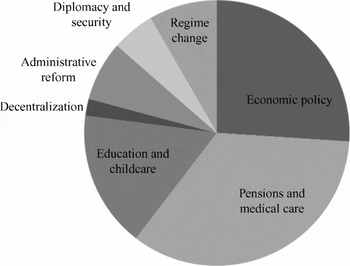
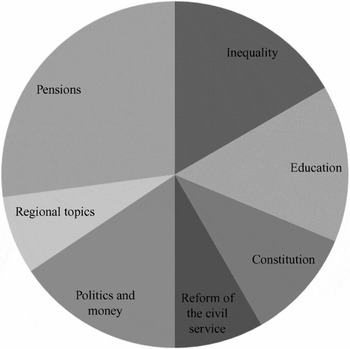
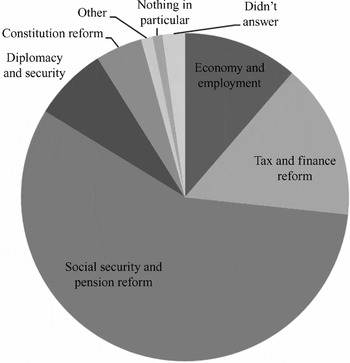
This paper makes an ideational argument; legislators with different ideas about the resiliency of Japanese society will support different policy approaches toward foreign residents. That said, I do not mean to contend that legislators are entirely free to act based on their own ideas. This is because most legislators aim to be reelected, and are thus very concerned with pleasing their constituents. However, Japanese voters have not expressed very strong preference regarding the behavior of politicians regarding granting foreign residents the right to vote in local elections in Japan. As Figures 1, 2, and 3 suggest, in recent elections Japanese voters have been concerned with issues including economic policy, education, pensions, postal reform, and constitutional reform, but not issues regarding foreign residents.
Japanese voters’ concerns before the 2009 House of Representatives election
Note: Responses by Japanese voters to the question, ‘What is the most important issue in the lower house election?’ The poll was taken on 26 and 27 August 2009, and the House of Representatives election was on 30 August 2009. Mainichi Shimbun, 28 August 2009.

Japanese voters’ concerns before the 2007 House of Councilors election
Note: Responses by Japanese voters to the question, ‘When you are voting for the House of Councilors, which issues will be most important to you?’ The poll was taken on 25 and 26 July 2007, and the House of Councilors election was on 29 July 2007. Mainichi Shimbun, 27 July 2007.

Japanese voters’ concerns following the 2005 House of Representatives election (aside from postal privatization).
Note: Responses by Japanese voters to the question, ‘In the Diet session that will soon begin, while the proposal to privatize the postal system will again be discussed, other than that, please choose one issue that you would like the Diet to make a priority.’ The House of Representatives election was on 11 September 2005, and the article does not specify the date that the poll was taken. Yomiuri Shimbun, 14 September 2005.

In democratic states such as Japan, politicians will often ignore issues that the electorate does not care about. If the government addresses these issues at all, unelected officials such as bureaucrats end up taking the initiative. The Japanese bureaucracy in particular is famous for the breadth and depth of its role in the policymaking process, and the new Democratic Party of Japan (DPJ) administration has made restraining the bureaucracy one of its priorities. However, politicians have not been able to ignore proposals to grant foreign residents the right to vote in local elections, because the CGP has regularly brought these proposals into Diet committees and to the floor of the Diet. Thus, politicians are forced to directly confront this issue. Moreover, because Japanese voters are not particularly concerned about this issue, it is relatively likely that Diet members are expressing their own ideological preferences. Thus, this is an ideal issue with which to expose ideational divisions and alliances among Japanese politicians.
Because immigration issues have not been salient to the voting calculi of the Japanese electorate, this paper does not test whether ideas or the desire for reelection are the most important determinant of legislator behavior. However, this paper contributes to comparative politics scholarship in two ways. First, this paper aims to assemble ‘detailed contextual knowledge’Footnote 5 about the debate on granting foreign residents the right to vote in local elections and, more broadly, about the appropriate role for foreign residents in Japan. This kind of detailed contextual knowledge is a prerequisite for constructing and refining strong theories in comparative politics. Second, this paper uses process tracing to inductively identify causal processes, which can then be tested deductively against other kinds of data.Footnote 6 Specifically, this paper identifies a causal link between ideas about national identity and policy stances toward foreign residents, and thus generates claims that can be tested in other national and temporal contexts.
Alternate explanations
In a recent cross-national statistical analysis of immigration politics, Breunig and Luedtke argue that ruling parties are less likely to be anti-immigrant when governing institutions insulate policymakers from the public, as publics tend to be anti-immigrant.Footnote 7 What is most interesting for the purposes of this paper is the way that they discuss Japan, which was controlled by the LDP for most of the period of their analysis (their analysis is of the years 1987–99). They code Japan as zero on their dependent variable – governing parties’ preferences on immigration – which means that between 1987 and 1999 the ruling party in Japan (usually the LDP) did not make any positive statements about minorities in its pre-election pledges. Breunig and Luedtke go on to note that ‘taking the extreme cases, it makes sense that Japan would score zero, because their immigration policy is the most restrictive in the developed world’.Footnote 8 This kind of analysis is useful for generating and testing hypotheses about immigration policy, but it also obscures important contextual knowledge about real differences among Japanese conservatives about the appropriate role for immigrants in Japanese society.
Cross-national comparative scholarship is not alone in ignoring differences among Japanese conservatives. Some Japan area specialists have argued that Japan has not granted foreign residents the right to vote in local elections because local activists have not succeeded in convincing central government officials that such a change would be in the interest of Japan. Others have argued that local activists have not been effective because they have not found appropriate global frames to use in persuading the central government to institute changes. This scholarship generally assumes that the central government is uniformly opposed to policies that would promote the integration of foreign residents into Japanese society.
Apichai Shipper's study of foreigners’ rights activism in Japan focuses on the way that cooperation between immigrant rights NGOs and local governments can challenge a central government that ‘focuses on controlling foreigners and lacks an active policy to incorporate them into society or participate in Japan's political life’.Footnote 9 In his short discussion of the movement to grant foreign residents the right to vote in local elections in Japan, Shipper focuses on efforts at the local level. While he briefly acknowledges disagreement among Japanese conservatives in the central government about how to deal with foreign residents,Footnote 10 these disagreements are peripheral to Shipper's argument about local governments and local activists.
Similarly, Jennifer Chan-Tiberghien's book about gender and human rights in Japan argues that NGOs have not succeeded in calling for changes in Japan's treatment of minority groups (including foreign minorities) because minority rights NGOs lack appropriate global frames to call on in making their arguments, and because minority rights NGOs have not been able to create alliances with important politicians.Footnote 11 Chan-Tiberghien does not explore the possibility that Diet Members might pursue minority rights in the absence of pressure from NGOs.
Chan-Tiberghien and Shipper are right to note the importance of local governments, activists, and global norms in efforts to promote integration of foreign residents into Japanese society. However, their arguments ignore, or only make cursory acknowledgment of, disagreement among Japanese conservatives about the appropriate role of foreign residents in Japanese society. In short, a reader of the Breunig and Luedtke paper, Chan-Tiberghien's book, or Shipper's book would be left with the impression that the LDP is uniformly hostile to the idea that foreign residents have any kind of role to play in Japanese society at all. Moreover, such a reader might conclude that this uniform hostility has caused the LDP to vote down proposals to grant the right to vote to foreign residents in local elections in Japan. However, as this paper will demonstrate, there is disagreement about the appropriate role for foreign residents within the LDP, and scholars must understand this disagreement in order to understand the way that the LDP has approached issues regarding foreign residents.
Conservative optimists and pessimists
The debate between conservative optimists and pessimists is not confined to conservatives within the LDP. In order to give context to the debate as it occurs within the LDP, I will now look at the way a number of public intellectuals in Japan have discussed issues relating to foreign residents through the lens of conservative optimism and pessimism.
Perhaps the first essay to make the conservative optimist case for changing the way that Japan interacts with foreign residents is written by former Bureau of Immigration bureaucrat Sakanaka Hidenori. Sakanaka's essay, ‘Zainichi Chōsenjin no Taigū’ (The Treatment of Koreans in Japan),Footnote 12 won a Ministry of Justice Bureau of Immigration Essay contest in 1975. The essay begins with the statement that ‘the reality that, as a heterogeneous group of foreigners, 640,000 Koreans exist in our country's society in an unstable situation, creates all sorts of problems from the standpoints of domestic order and international relations’.Footnote 13 Sakanaka then notes the issues of most concern to Koreans in Japan: ‘Koreans in Japan, and Korean groups in Japan, in addition to requesting future legal status, are making increasingly strong requests for lifestyle-based and economic rights including the end of workplace discrimination, financing from public banks, the end of discrimination in public housing, and the granting of child support allowances.’Footnote 14
Sakanaka notes three ways of thinking about the appropriate treatment of Koreans in Japan: ‘(1) assimilation (naturalization) policy, (2) a policy of treating them and their descendants as foreigners, and (3) encouraging and forcing them to return to their country of origin’.Footnote 15 He is critical of each approach: while he dismisses the third approach quickly, arguing that forcibly returning Koreans to the Korean peninsula or encouraging them to return is contrary to humanitarian ideals and is not likely given the current context,Footnote 16 he devotes a bit more attention to the first two ways of thinking about the treatment of Koreans in Japan. Regarding assimilation/naturalization politics, Sakanaka argues that all Koreans in Japan do not want to take Japanese nationality for historical reasons. He also claims that, even if they do take such nationality, ‘the problem remains that, as “former Koreans,” it is expected that they will still face discrimination’.Footnote 17 While this criticism suggests a degree of discomfort with assimilation-driven policies, Sakanaka's criticism of the second way of thinking about Koreans in Japan – the policy of treating them and their descendants as foreigners – suggests that he is also distressed by the idea of Japan continuing to have a large, unassimilated minority population. He argues that:
It is thought that there is a natural momentum pulling second and third generation Koreans in Japan toward ‘Japanization’ in the form of language, customs, and ways of thinking, to the extent that they can carry out a lifestyle in Japan. However, we should indicate that that things that contradict this natural tendency create a situation where ethnic consciousness provides spiritual uplift, and Koreans in Japan can effectively create an ethnic minority consciousness, and there is a strong chance that the root cause – an ethnic minority problem – will remain.Footnote 18
In short, the assimilation of a population that does not have Japanese ethnicity – Koreans in Japan – is desirable because it preserves social stability by preventing the growth of an ethnic minority consciousness. Sakanaka is a conservative optimist because he believes that Japanese society is resilient enough to withstand the challenges that the assimilation of a population without Japanese ethnicity would pose to the notion that Japan is a tan'itsu minzoku kokka. Indeed, he suggests that a non-assimilated minority group would be a larger challenge to Japanese society than an assimilated group.Footnote 19
A more recent example of conservative optimism is evident in the thinking of Tei Taikin,Footnote 20 a professor at Tokyo Metropolitan University and frequent commentator on issues relating to foreign residents of Japan. Tei recently wrote an article in the popular center-right magazine Chūō Koron about proposals to grant foreign residents the right to vote in local elections in Japan. Like Sakanaka, Tei is also primarily concerned with Koreans in Japan – by far the largest group of foreign permanent residents. As of 2004, the total population of permanent foreign residents in Japan was 742,963, and 64% of that number were ‘special permanent residents’. Special permanent residents are those who lost formal Japanese citizenship after World War II and their descendents; almost all special permanent residents are Korean, but there is a relatively small population of Taiwanese special permanent residents as well.Footnote 21
Tei argues that there is a taboo against naturalization within the Korean community in Japan. Tei traces this taboo to the notion that ‘naturalization is assimilation’, and he argues that this notion comes from Chōsen Sōren, the North Korean-affiliated group in Japan.Footnote 22 According to Tei, proposals that would grant Korean residents the right to vote, rather than encourage them to naturalize, ‘makes permanent the discrepancy between the identity and membership of Koreans in Japan’ (zainichi no aidentiti to kizoku no aida no zure wo eizokuka saseru).Footnote 23 Moreover, Tei argues that more Koreans want to naturalize than obtain the right to vote. As evidence for this claim, he cites the fact that, while 5,000 people showed up to a demonstration in favor of the right to vote for foreign permanent residents in January of 2008, twice that number – 10,000 Koreans – naturalize every year.Footnote 24
Instead of granting Korean residents the right to vote in local elections in Japan, Tei suggests making naturalization easier by streamlining the naturalization process for special permanent residents and allowing naturalization applicants to choose from an expanded set of Chinese characters that would include a larger number of characters that are common in Chinese and Korean names.
Tei justifies this proposal by arguing that, in addition to helping Koreans in Japan avoid the identity confusion that comes with holding one nationality while voting in another nation, this proposal would also benefit Japan:
One thing that is exceptional about Japan compared with other East Asian countries is that, although people have the freedom to leave, there is very little emigration. Japanese people have a feeling of trust toward their own country, and to some degree this is a thing that connects them, about which Japanese people are proud. However, because of this, we should not forget that this has averted Japan from opportunities to build feelings of solidarity with other cultures.Footnote 25
In short, making naturalization easier for foreign permanent residents would benefit Japan because it would give Japanese more opportunities to interact with those from other cultures. However, these opportunities would have their limits, as Tei only proposes to streamline naturalization for special permanent residents of Japan. As noted above, this group is almost entirely made up of Koreans who can trace their family's residence in Japan to before 1945. A very large percentage of these people speak Japanese as their first language, and are highly assimilated into Japanese society. As Erin Chung explains: ‘Korean nationality has become the last vestige of Korean identity in Japan.’Footnote 26
Tei rejects a policy that would pose a substantial challenge to the idea that Japan is a tan'itsu minozoku kokka – granting foreign residents the right to vote in local elections – in favor of a policy that would pose a relatively minor challenge – streamlining the naturalization process for special permanent residents. Tei is a conservative optimist because he believes that Japanese society could withstand this challenge.
Unlike Sakanaka and Tei, Nihon University law professor Momochi Akira is not optimistic about the ability of Japanese society to withstand threats to the idea that Japan is a tan'itsu minzoku kokka. In an essay in the popular conservative journal Seiron, Momochi discusses a recent Japanese Supreme Court decision and the subsequent revision of the immigration law to comply with that decision. Before this decision and law, a child born to an unmarried foreign mother and Japanese father was not granted Japanese citizenship unless the Japanese father acknowledged paternity before the child was born. On 4 June 2008, the Japanese Supreme Court ruled that this was a violation of the constitution's guarantee of equal protection under the law, and on 18 November, the ruling coalition agreed to pass a law that granted Japanese citizenship to a baby born to a foreign mother and a Japanese father, even if the Japanese father acknowledges paternity after the baby is born.
Momochi's essay is critical of both the Supreme Court decision and the law. He is particularly concerned with the possibility of babies fraudulently obtaining Japanese citizenship. Toward the conclusion of his discussion of the Supreme Court decision, Momochi argues:
If citizenship can be conferred with only the ‘acknowledgement’ (ninchi) of a Japanese man, then babies that are born and raised in foreign countries, and have never once been to Japan. . . can obtain [Japanese] citizenship. This is in fundamental contradiction to the principle of a citizenship policy that awards citizenship based not only on blood connections, but also on close relations with our country's society.Footnote 27
In other words, Momochi argues that Japanese blood should be a necessary but not a sufficient condition for the conferring of Japanese citizenship. While states are usually classified as conferring citizenship by blood (to those born of citizens) or by soil (to those born on the territory), Momochi suggests that Japan should use both principles to restrict access to citizenship even further. This is consistent with Momochi's conclusion, where he suggests that naturalization should be made more difficult, noting that, unlike the United States, applicants for naturalization in Japan are not asked to pledge permanent allegiance to Japan.Footnote 28
Momochi's concern about proposals that he fears make Japanese citizenship too accessible stems from his views about the stakes in this kind of argument. Momochi believes that permissive citizenship policies – policies that might obfuscate the meaning of the status of ‘Japanese citizenship’ – might well destroy Japanese society. This is evident both from the title of his essay, ‘Reform of Citizenship Law Will Dissolve Japan’, and from the concluding section, where he argues:
those that do not understand reverence for the nation (kokka no sonkei) or the weightiness of citizenship (kokuseki no omomi) have combined with those that aim to destroy the nation like bitter enemies placed in the same boat, and decided to allow citizenship to be acquired simply with an acknowledgment.Footnote 29
Although Momochi never uses the phrase tan'itsu minzoku kokka in this essay, he clearly believes that changes that make it easier for those without Japanese ethnicity to access Japanese citizenship pose an existential threat to something fundamental about Japan. In short, Momochi is quite pessimistic about the ability of Japanese society to withstand any sort of challenge or contradiction to the notion that Japan is a tan'itsu minzoki kokka.
In another recent Seiron article, Hyodo Nisohachi is critical of recent policies that allow relatively small numbers of nurses into Japan from Indonesia and the Philippines. Hyodo argues that instead of admitting foreign workers, Japan should attempt to lure disaffected Japanese, including NEETs (those Not in Employment, Education, or Training) and puutarō (vagabonds) back into Japanese society, since they are ‘on the side of Japan’ (nihon no mikata).Footnote 30 By way of contrast, ‘the idea that it is ok to shift the responsibility for Japan to cheap foreign labor power is only held by people who have not thought at all about Japanese society or Japanese civilization’.Footnote 31 Like Momochi, Hyodo is profoundly pessimistic about the ability of Japanese society to withstand challenges to the idea that Japan is a tan'itsu minzoku shakai. In short, Hyodo believes that it is unthinkable that foreign labor can solve Japanese labor shortages; it is better to entrust Japan's future to those with Japanese ethnicity who do not want to work than to entrust that future to those without Japanese ethnicity who do.
The right to vote in local elections
Activists and politicians have made a number of proposals to grant foreign permanent residents the right to vote in local elections. As of 28 February 2007, 32 prefectures, 12 ordinance-designated cities, and 1,193 non-ordinance designated municipalities have made written request to the Ministry of Public Affairs and Communications to grant foreign residents the right to vote in local elections.Footnote 32 The Supreme Court also ruled on this question in 1995, determining that Japan's constitution neither requires the national government to grant foreign permanent residents the right to vote in local elections, nor forbids the national government from granting such a right.
In the Diet, the CGP – the junior partner in a ruling coalition with the LDP between 1998 and 2009 – has unsuccessfully supported proposals that would have granted foreign permanent residents the right to vote in local elections. The CGP has been quite persistent about this, raising the issue six separate times between 2000 and 2006.Footnote 33 The most vocal proponent of extending the right to vote to foreign residents has been CGP Member of Parliament (MP) Fuyushiba Tetsuzō. In defending a proposed law that would have extended the right to vote to foreign residents in 2004, Fuyushiba makes two kinds of arguments. First, Fuyushiba discusses the desirability of foreign residents voting with reference to what that would mean for Japanese democracy: ‘it is desirable that people that live in the area can independently and autonomously make decisions regarding regional issues, and as a mature democratic country. . . the cooperative management decisions in regions with exceptionally close relationships [with foreign residents] in daily life should reflect those relationships’.Footnote 34 Noteworthy here is Fuyushiba's reference to ‘mature democratic countries’, along with the implication that mature democracies have local decision-making mechanisms with inclusive participation.
After Fuyushiba's general statement about the importance of the foreign resident vote to Japanese democracy, he specifically notes the foreign community that would be most impacted by this kind of policy change: Japan's Korean minority. When politicians speak about granting the right to vote to foreign residents in Japan, they frequently make references to Japan's relationship with the Korean peninsula and Korean special permanent residents of Japan – frequently called Zainichi Koreans. Regarding this community, Fuyushiba argues that ‘for the Zainichi Koreans who have been born, raised, made a living, and will die in this country, regarding that population with their particular historical background, if they would like to, we should treat them the same as Japanese nationals, without limit’.Footnote 35
After making this argument with reference to the specific historical and demographic circumstances of the Zainichi Korean population, Fuyushiba also argues that improving the situation of Zainichi Koreans would have a positive impact on Japan's relationship with South Korea. He notes that two different South Korean Presidents – Kim Dae-jung and Roh Moo-hyun – both discussed the issue of voting rights for Zainichi Koreans in speeches before the Japanese Diet, and he quotes passages from each speech.Footnote 36 After South Korea extended the right to vote in local elections to foreign residents (including Japanese citizens) in 2006, Fuyushiba also began to argue that the international relations principle of reciprocity obligated Japan to extend the same right at least to South Koreans.Footnote 37
Although Fuyushiba himself generally does not use the phrase ‘multi-ethnic country’ (taminzoku kokka), other members of his party have used this phrase to describe a possible and desirable result of granting the right to vote to foreign residents. CGP MP Satō Shigeki argued in a 2004 hearing on constitutional revision that ‘as we think about what kind of society twenty-first century Japan is, from now on, I can't help but thinking about the definite possibility that Japan will become a multiethnic country, where people from various ethnicities can coexist, and about how this kind of Japan could do things such as securing our labor force in an era of declining population’.Footnote 38 Satō notes that granting human rights to foreign residents could make Japan into a multi-ethnic society, and he expresses concern that the strong opposition to CGP proposals to grant foreign residents the right to vote will make it more difficult for Japan to become a multi-ethnic society. In addition to Fuyushiba and Satō, a number of other CGP MPs have spoken in favor of granting the right to vote to foreign permanent residents in local elections, including Taniguchi Takayoshi, the Vice Minister of Public Management, Home Affairs, Posts, and Telecommunications under Prime Minister Fukuda Yasuo,Footnote 39 Saitō Tetsuo,Footnote 40 Fukushima Yutaka,Footnote 41 and Yoshii Hidekatsu.Footnote 42
Aside from the CGP, the other major political party that frequently speaks in favor of granting the right to vote to foreign residents in Japan is the DPJ. DPJ Upper House MPs including Yamamoto Takashi,Footnote 43 Haku Shinkun,Footnote 44 and RenhōFootnote 45 have all spoken in favor of granting foreign residents the right to vote in local elections. In addition, the former head of the DPJ, Ozawa Ichirō, told South Korean President Lee Myung-bak that he supported extending the right to vote in local elections to foreign permanent residents in Japan in February 2008.
During the years of LDP/CGP coalition governments, DPJ MPs have attempted to use the issue of extending the right to vote to foreign permanent residents to drive a wedge through the ruling coalition, by questioning whether – despite the formal goals of the LDP/CGP alliance – LDP MPs would ever vote for a law that would grant foreign residents any kind of voting rights. In a 2007 hearing of the House of Councilors Budget Committee, DPJ MP Haku Shinkun asked CGP MP and Minister of Land, Infrastructure, Transportation, and Tourism Fuyushiba Tetsuzō several pressing questions about the CGP/LDP alliance including the following: ‘Because [the right to vote in local elections for foreign permanent residents] is in your ruling coalition agreement, even though you say things like “the LDP is a different party from mine,” I can't help but thinking that deep down you are embarrassed about [the LDP's behavior]. Can you comment on that?’Footnote 46 Haku is clearly trying to use the issue to highlight differences between the CGP and the LDP.
However, not all DPJ MPs support extending the right to vote to foreign residents. In particular, both Matsubara HitoshiFootnote 47 and Akutsu YukihikoFootnote 48 have raised concerns that extending the right to vote to foreign residents would benefit North Korea. In a Lower House Foreign Affairs Committee meeting, Matsubara asked Minister of Foreign Affairs Asō Tarō several questions about collusion between Mindan, the organization representing South Koreans in Japan, and Chōsen Sōren, the organization representing North Koreans. When Asō suggests that the two groups differ on whether the right to vote in local elections should be extended to Koreans in Japan – Chōsen Sōren does not support such a policy – Matsubara argues that ‘I have heard it said Chōsen Sōren is analyzing whether to support the right to vote for foreign residents in the future.’Footnote 49 While Matsubara does not specifically speak against granting the right to vote to foreign residents, his skepticism about the motives of the social organizations in the Zainichi Korean community suggests that he would prefer that the community not be granted a larger role in Japanese politics.
LDP leadership has been reluctant to directly criticize proposals to extend the right to vote to foreign residents in local elections – perhaps because of the LDP's coalition agreement with the CGP. The last three LDP Prime Ministers of Japan – Asō Tarō, Fukuda Yasuo, and Abé Shinzō – all made statements in Diet hearings that suggest that, while they do not support the CGP's policy proposal, they are not willing to issue direct criticisms in the Diet. Abé came the closest to a direct criticism when, as Chief Cabinet Secretary, he noted in discussing a meeting with a Korean official that ‘regarding the history problem and the issue of the right to vote for foreign permanent residents in local elections, while our opinions and understanding were different, we frankly talked to one another, and I did not think that [the differences] were important’.Footnote 50 He does not clarify what specifically these differences were, but the clear implication is that, unlike the South Korean official, Abé does not support granting the right to vote to foreign residents in local elections.
Fukuda and Asō were less direct in their discussions of proposals to grant the right to vote to foreign residents in local elections. Fukuda as Prime MinisterFootnote 51 and Asō as Foreign MinisterFootnote 52 each argued that the issue needed to be debated more, and Asō specifically mentioned that those who do not support the policy should be included in the debate.
LDP backbenchers have been much more vocal in their opposition to policies that would extend voting rights to foreign residents. In an argument with CGP MP Fuyushiba Tetsuzō, LDP MP Gotōda Masazumi takes the position of a conservative pessimist, arguing that extending the right to vote to foreign residents does not suit one-ethnicity countries like Japan and other Asian countries:
You have given America as an example, and one might also say the same thing about Europe. Compared with other countries, Japan is a one-ethnicity country (tan'itsu minzoku kokka), and America and Europe are multi-ethnic countries. I think that this is a big difference between those countries and our country Japan. Now, while there is a situation of foreign permanent residents obtaining citizenship, there are also many examples of European countries that extend the right to vote in local elections. However, in China, Japan, South Korea, and North Korea, this kind of thing is not allowed.Footnote 53
Unlike the CGP's Satō Shigeki, who sees Japan as moving away from being a one-ethnicity country (and who sees that movement as desirable for economic reasons), Gotōda treats Japan's status as a one-ethnicity country as an unavoidable and unchangeable fact. With his embrace of the belief that Japan is fundamentally a tan'itsu minzoku kokka, Gotōda is clearly a conservative pessimist.
Another LDP MP, Akimoto Tsukasa, expresses concern that a foreigner voting has two hearts (futatsu no kokoro wo motte iru). He goes on to argue that while a foreigner can definitely be loyal to Japan, those foreigners who are loyal to Japan should give up ties to their previous country by naturalizing: ‘I don't deny that [a foreigner] could love Japan, but because there is a currently a system whereby foreign residents can naturalize, if a foreigner uses that system, he or she receives the right to vote . . .’Footnote 54 Unlike Gotōda, Akimoto's statement is an example of conservative optimism because it suggests the possibility that those without Japanese ethnicity might become loyal citizens of Japan.Footnote 55
It is difficult to imagine the LDP supporting a proposal to grant foreign permanent residents of Japan the right to vote in local elections. While there may be a few LDP MPs who support the CGP's position, those individuals, if they exist, have been silent in Diet debates. That said, the differences between Gotōda and Akimoto's objections to granting foreign residents the right to vote are revealing. While Gotōda and Akimoto's different ideas about the importance of tan'itsu minzoku kokka lead them to the same conclusion about granting foreign residents the right to vote in local elections, these two differing perspectives suggest very different conclusions about the desirability of liberalizing naturalization policy.
Streamlining naturalization
Postwar Japan first formally articulated its naturalization policy in 1950 with the passage of the Naturalization Law. This law has two distinguishing features:
First . . . according to Article 4, even in cases where someone has all of the qualifications for naturalization, the Minister of Justice is permitted use his or her discretion to decide whether or not to grant naturalization . . . Second, while detailed procedures for family registration and registration offices are clearly maintained, such procedures for naturalization are not clearly specified by law.Footnote 56
The Ministry of Justice has used both the vagueness of the law and the discretion the law grants them to establish a number of procedures, including inspecting the houses of prospective citizensFootnote 57 and a name change requirement.
The phrase ‘name change requirement’ is a bit of a misnomer, since there was never formal requirement. Indeed, there was a controversy in 1983 when Asahi Shimbun reported that applicants for Japanese citizenship were required to change their names to Japanese-style names.Footnote 58 A 1974 government publication offers the following instructions for how to deal with applications for naturalization that refuse to take Japanese names:
If there is someone who wishes to use a name that is not a Japanese-style name after naturalization, you should first guide them to use an appropriate name, but when you use this guidance you should not emphasize that they will be required to change their name by naturalization administration. Instead, I think that it is necessary to obtain a thorough understanding of the presence or absence of obstacles to living as a Japanese person in Japanese society. If despite this guidance the applicant still wishes to use his or her previous name after naturalization, I think it would be equivalent to record the reason and the result of the guidance in your transmission.Footnote 59
This quote does not address the likely fate of an application for naturalization with a note from a bureaucrat that the applicant will not change his or her name to a Japanese name, but it is instructive to note that as of 1984, only two people had successfully naturalized with a foreign name.Footnote 60 Moreover, efforts by bureaucrats to persuade naturalization applicants to change their names were in all likelihood made more effective by the fact that manuals given to applicants stated that: ‘Japanese names were to be used after naturalization.’Footnote 61 By 1985, these manuals were revised, and this statement about Japanese names was removed.Footnote 62 However, the Ministry of Justice still benefits from total discretion in making decisions about naturalization.
Unlike other permanent residents, ‘special permanent residents’ benefit from a less stringent naturalization procedure. In 2000 and 2001, the LDP considered proposals that would have removed additional barriers to naturalization by special permanent residents, including adding Chinese characters common in Chinese and Korean names to the list of allowable characters in names and eliminating background checks on applicants.Footnote 63 These proposals were supported by conservative optimists, including popular Prime Minister Koizumi Junichirō.Footnote 64 In short, these figures saw liberalization of naturalization policy, a relatively minor challenge to the idea of Japan as a tan'itsu minzoku kokka, as preferable to the much more substantial challenge posed by granting foreign residents the right to vote. As Kamei Shizuka, Chairman of the LDP's Policy Research Council, explained, ‘if we liberalize the naturalization procedure, then we will separate that from the proposal to grant foreign residents the right to vote’.Footnote 65
There was little discussion of naturalization proposals in formal Diet meetings. Moreover, as of yet there has also been little Diet discussion of a 2008 proposal by a group of LDP politicians to liberalize naturalization for all foreign residents as a way to make Japan more friendly to immigrants, and thus to address Japan's declining population.Footnote 66 Very few lawmakers have overtly come out against naturalization reform. In a 2001 House of Councilors Finance Committee Meeting, LDP MP and Minister of Justice Kōmura Masahiko argued that, while the Minister of Justice is able to exercise discretion in general applications for naturalization ‘special permanent residents [are able to naturalize] so long as they meet the formal legal requirements’.Footnote 67 While Kōmura himself does not outline his reasoning for opposing naturalization reform, one can imagine conservative pessimists expressing concern that proposals that make naturalization easier for foreign residents – and particularly for foreign residents with noticeably foreign names – threaten Japanese society because they challenge the idea that Japan is a tan'itsu minzoku kokka. Indeed, Momochi suggests that naturalization should actually be made more difficult, rather than liberalized.
It is not entirely clear from available evidence why proposals to liberalize naturalization have not yet passed in Japan. It is particularly challenging to explain why this bill did not become law when opponents of the bill were not vocal about the reason for their concerns during the policymaking process. However, it is not difficult to imagine that there is a number of LDP DMs who, as conservative pessimists, are concerned about the consequences that liberalization of Japan's naturalization policy might bring to bear on an essential component of Japan's national identity.
Conclusion
As the LDP/CGP coalition moves into the opposition, observers of Japanese politics have begun to construct a post mortem on the coalition. One compelling question is in regard to the CGP: what did they get out of their alliance with the LDP?Footnote 68 Although the CGP had been known for its opposition to military force, the CGP/LDP coalition oversaw a substantial extension of the powers of the Japanese Self Defense Force, including missions to support American troops in Iraq and Afghanistan.Footnote 69 What did the CDP get in return?
One thing that the CGP did not get out of the alliance with the LDP was a policy that would grant foreign permanent residents the right to vote in local elections in Japan. A major reason for this failure is that, as far as I can tell, no LDP politicians have supported such a policy. Even if some LDP politicians did support granting foreign permanent residents the right to vote in local elections in Japan, those politicians did not make an argument in favor of such a policy in the Diet between 1998 and 2008.
However, careful examination of the reasons that LDP politicians gave for opposing granting foreign residents the right to vote in local elections reveals two very different ways of thinking about the appropriate role of foreign residents in Japanese society. These different ways of thinking within the LDP are mirrored in discussions among conservatives in Japanese mass media. Some Japanese conservatives, such as Momochi Akira, Hyodo Nisohachi, and LDP MP Gotōda Masazumi, are pessimistic about the ability of Japan to withstand any social or political changes that would allow those without Japanese ethnicity to assume a more active role in Japanese society. While Hyoto and Gotōda do not overtly speak against policies that would streamline naturalization policies, Momochi argues that naturalization should be made more difficult, rather than easier.
Other Japanese conservatives, such as professor Tei Taikin and LDP MP Akimoto Tsukashi, are optimistic about the ability of Japanese society to withstand minor challenges to the idea that Japan is a tan'itsu minzoku kokka. Thus, these conservative optimists support policies that would make naturalization easier for permanent residents in Japan, but are skeptical about policies that would allow foreign residents to vote in local elections in Japan without first formally making a commitment to the Japanese state through naturalization.
This division between conservative optimists and pessimists has the potential to explain other issues in Japanese politics as well. Future researchers might examine the extent to which immigration policies passed by the LDP/CPG coalition in the last few years, including policies to admit a relatively small number of refugees from Myanmar and nurses from Indonesia and the Philippines, were evidence of the relative ascendance of conservative optimists within the LDP. The emergence of an LDP proposal in 2008 to admit 10,000,000 immigrants might be evidence of a similar trend.Footnote 70
While this paper focused on disagreements among Japanese conservatives about the nature of Japanese society, I do not mean to suggest that there are no similar disagreements among the Japanese left, or that some on the left are not also drawn to the idea of Japan as an ethnic, rather than a civic, nation.Footnote 71 The DPJ – a center-left party – is divided on the question of whether to grant foreign residents the right to vote in local elections, and that issue was thus left out of the DPJ's policy manifesto published in advance of the 30 August 2009 election.Footnote 72
This paper does not test the claim that ideas, rather than electoral incentives, are the primary determinant of legislator behavior. However, when dealing with issues that are not particularly salient for the electorate, such as the integration of foreign residents in contemporary Japan, this paper suggests that scholars might benefit from devoting attention to the ways legislators think about the nation and the national interest. This paper highlights the way that disputes about the nature of Japanese society among Japanese conservatives in the LDP have shaped Japan's policy toward foreign residents. More broadly, this paper suggests that scholars of comparative politics should be sensitive to the possible role of ideational disputes among legislators in shaping policy.
About the author
Michael Strausz is an assistant professor of political science at Texas Christian University in Fort Worth, Texas. His past work has focused on social movements and the relationship between international norms and domestic politics in Japan. He would like to thank Mary Alice Haddad, Brian Greenhill, Robert Pekkanen, Saadia Pekkanen, Hironori Sasada, Liv Coleman, David Howell, Eric Cox, Emi Tamaki, Hironori Sasada, Kate Marshall, and three anonymous reviewers for their insightful comments on this project.