Nanoparticle products that contain particles of at least one dimension in the nanomeric region (minor than 100 μm) or systems with particles from 10 to 100 nm or with size less than 0.2 μm (Tadros et al., Reference Tadros, Izquierdo, Esquena and Solans2004; Lee et al., Reference Lee, Jun Choi, Andrew Decker and Julian Mcclements2011) are of considerable interest in milk processing. Indeed, new technological possibilities have been achieved by decreasing the size of milk particles to the nano-scale. These characteristics include improvements in the stability of emulsions, better digestibility and absorption of nutrients and new mechanisms for delivering active compounds to organisms (Baars et al., Reference Baars, Oosting, Engels, Kegler, Kodde, Schipper and Van Der Beek2016; Singh and Gallier, Reference Singh and Gallier2017; Calvo et al., Reference Calvo, Fornés-Ferrer, Heredia and Andrés2018).
Whole milk powder must have a minimum of 26% and a maximum of 42% w/w of fat, which is found as a globule in the milk (Food and Agriculture Organization of United Nations [FAO], 1999). By applying pressure, homogenisation alters the particle-size distribution of macronutrients (casein micelles and fat globules). Alterations in casein micelles and fat globule particle size can be observed and are dependent on the homogenisation pressure (Sandra and Dalgleish, Reference Sandra and Dalgleish2005; Fox and Brodkorb, Reference Fox and Brodkorb2008; Gallier et al., Reference Gallier, Acton, Garg and Singh2017; Singh and Gallier, Reference Singh and Gallier2017). By homogenising milk, it has been possible to observe the appearance of an intermediate particle-size region between the sizes of casein micelles and fat globules. This phenomenon is explained by the reorganisation of both macrostructures, which are reorganised during homogenisation, forming lipid–protein structures in which the casein micelle proteins stabilise the fat globules. The size of these particles is related to the homogenisation conditions used.
Homogenisation, usually at 20 MPa, is used during milk powder manufacturing (Walstra et al., Reference Walstra, Wouters and Geurts2005). The particles and nanoparticles created are then concentrated and dried via spray drying. Consequently, the properties of milk powder, such as rehydration, depend on the particle size resulting from homogenisation (Schuck et al., Reference Schuck, Jeantet, Bhandari, Chen, Perrone, Carvalho, Fanelon and Kelly2016; Francisquini et al., Reference Francisquini, Martins, Toledo Renhe, Cappa de Oliveira, Stephani, Perrone and de Carvalho2020). A homogenisation pressure of 20 MPa decreases the fat globules (Obeid et al., Reference Obeid, Guyomarc'h, Francius, Guillemin, Wu, Pezennec, Famelart, Cauty, Gaucheron and Lopez2019) and impacts flow properties when different pressures (0, 50, 100 and 150 MPa) are applied to the concentrated milk (Mercan et al., Reference Mercan, Sert and Akın2018) and, in addition, milk powder flavour stability is influenced by the homogenisation pressure (Park and Drake, Reference Park and Drake2017). However, to our knowledge, no study shows the variation in particle-size distribution during milk powder manufacturing and the reconstituted final product concerning the two cycles of pressure homogenisation at 0/0, 15/5 and 75/5 MPa (1st/2nd stages). Hence, our aim was to understand the effect of increasing the homogenisation pressures on particle-size distribution during the homogenised whole milk powder (HWMP) production and the rehydrated final product. We also performed electronic scanning microscopy and assessed water activity and isotherm of the final powder product.
Material and Methods
Production and storage
The HWMP production process was done on a laboratory scale, and its flow is illustrated in the flowchart shown in online Supplementary Figure S1. Pasteurised milk was purchased from the local market with 3.2% fat, pH 6.64 ± 0.17 and acidity 16.75 ± 0.99°D. This milk was heated to 70°C in a water bath (Quimis® Q334 M-28). The heated milk was homogenised at different pressures:0/0, 15/5 and 75/5 MPa, 1st/2nd stages on the homogeniser (APV® 1000). The homogenised milk was concentrated by vacuum evaporation (Buchi R-220 se) up to total solids of 45 g. 100 g−1, at 60 ± 2.0°C, and pressure below 50 ± 5 mbar. The concentrated milk was spray dried at 160.0 ± 2.0°C inlet temperature and 84°C outlet temperature (Buchi B290). The experiments were performed in triplicate for each homogenisation pressure path treatment 1 : 0/0 MPa, treatment 2 : 15/5 MPa and treatment 3 : 75/5 MPa, nine production runs in total. The 0/0 MPa product was passed through the homogeniser without homogenisation pressure (0/0 MPa).
Particle-size distribution in solution
Samples included fluid milk before and after heating, homogenised fluid milk, homogenised concentrated fluid milk and HWMP. These samples were added directly and slowly to the Beckman Coulter LS 13 320 Laser Diffraction Particle Size analyser reservoir with aqueous liquid module, which contained water at room temperature, 23.0 ± 2.0°C, until the minimum obscurity level was reached. Under recirculation, data were collected after 90 s until stable particle-size distributions were obtained. The refractive index was 1.57 for a region less than 1.0 μm and 1.47 for a region greater than 1.0 μm. The data are presented as the percentage (%) of the volume occupied by the particles as a function of size. Beckman Coulter software particle characterisation version 5.03 was applied to analyse the obtained data. The indicators D [4;3] (diameter volume average), D [5;3] (cream formation rate from particle size), Dv90 (volume in which 90% of the particles were found) and particles greater than 1.0 μm were used to assess the particle-size distribution (Francisquini et al., Reference Francisquini, Martins, Toledo Renhe, Cappa de Oliveira, Stephani, Perrone and de Carvalho2020). Analyses were performed in duplicate.
Scanning electron microscopy
The HWMP was analysed by scanning electron microscopy (sem; model: TM 3000; brand: Hitachi Ltd.) at magnitudes of 100; 300; 500; 1000; 1500; 2000×. ImageJ software was used to evaluate the lengths of the particles obtained from the images (2000×) of the sem (Marcomini and De Souza, Reference Marcomini and De Souza2011). With this evaluation, the SPAN value corresponding to the width or range of the size distribution based on the volume was obtained as follows: SPAN = (Dv90 – Dv10)/Dv50. In which: Dv90 means 90% of the particles have values equal to or less than the result found; Dv10 is the value at which 10% of the particles have values equal to or less than the result found; Dv50 is the value at which 50% of the particles have values equal to or less than the result found. The SPAN value was used to calculate the polydispersity index (PDI), which refers to the degree of non-uniformity of the particle-size distribution. A monodispersed powder sample has a high degree of uniformity with a PDI value of less than 0.4. In contrast, a polydispersed powder sample has a low degree of uniformity and a PDI value (>0.4) (Horiba Scientific, 2013). Analyses were performed in duplicate.
Sorption isotherm and water activity
To obtain the sorption isotherms, 2–3 g aliquots of each HWMP were weighed. Subsequently, these samples were stored for 21 d in environments with constant relative humidities, 11.1, 33.1, 43.2, 54.4 and 75.5%, to obtain five different water activities, 0.111, 0.331, 0.432, 0.544, and 0.755. Saturated solutions of LiCl, MgCl2, K2CO3, Mg(NO3)2 and NaCl were used to control moisture and water activities. After 21 d, the samples were weighed again, and the results obtained allowed the drawing of the sorption isotherm graph for each treatment. The water activity analysis was performed using Aqualab 4ATE equipment. Analyses were performed in duplicate.
Statistical analysis
The data obtained from all experiments were analysed using the SPSS 23.0 software (version 23, IBM Corp., Armonk, NY, USA). Significant differences between average values of replicate measurements at each data point were analysed by analysis of variance (ANOVA) using Tukey's HSD post-hoc test at a 95% confidence level.
Results and discussion
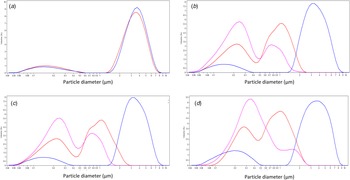
Table 1 and Figure 1 show the change in the particle-size distribution behaviour of the respective milk samples at the different homogenisation pressures. To statistically assess the impact of homogenisation pressure, D[4;3], D[5;3], Dv90, and the percentage of particles with a volume greater than 1.0 μm are used. Heating the pasteurised whole fluid milk to 70 ± 2°C lead to significant reductions in all parameters, meaning that the heated milk had a reduced particle size. Both homogenised fluid milk and concentrated fluid milk exhibited a statistical reduction in the mean values of parameters D [5;3], D [4;3] and ˃1.0 μm as homogenisation pressure was increased. These results indicate that the lower the homogenisation pressure, the larger the particle size. It is possible to observe a higher concentration in the 1.0 μm region, demonstrating the influence of increasing the homogenisation pressure. The homogenised products showed a higher particle concentration on the region smaller than 1.0 μm (which corresponds to casein micelles) and a lower particle concentration on the region higher than 1.0 μm (related to the fat globules). This may be because the homogenisation energy breaks down the lipophilic interactions on fat globules, leading to the reorganisation of smaller oil structures stabilised by proteins (Desrumaux and Marcand, Reference Desrumaux and Marcand2002). In addition, the average values of D [5;3] and D [4;3] decreased when the homogenisation pressure increased from 0/0 to 15/5 and 75/5. However, parameter D [5;3] depends on deproteinisation (Walstra and Oortwijn, Reference Walstra and Oortwijn1975), which was not performed in this study. It is possible that there was an improvement in the homogenisation process owing to the decrease in the size of the particles of the base product, as previously demonstrated by Ransmark et al. (Reference Ransmark, Svensson, Svedberg, Göransson and Skoglund2019).
Indicators D[4;3] (mean volume diameter), D[5;3] (cream formation rate from particle size), Dv90 (volume in which 90% of particles are found), and particle size greater than 1.0 μm of fluid milk before and after heating, homogenised and concentrated fluid milk, and rehydrated powdered milk.

The mean of the parameters followed by the same letters does not differ statistically in the Tukey test at the level of 5% stability applied to the same column.
**HWMP: homogenised whole milk powder.
Particle-size distribution of (a) Fluid milk before heating (blue) and fluid milk after heating (red); (b) Homogenised fluid milk (0/0 MPa blue, 15/5 MPa red, 75/5 MPa pink); (c) Homogenised concentrated fluid milk (0/0 MPa blue, 15/5 MPa red, 75/5 MPa pink); and (d) Rehydrated HWMP* (0/0 MPa blue, 15/5 MPa red, 75/5 MPa pink). *HWMP: Homogenised whole milk powder.

The only exception was found for the parameter Dv90, which demonstrated statistically different values between products without homogenisation pressure (0/0 MPa) and those with homogenisation pressure (15/5 and 75/5 MPa). This parameter was affected exclusively by the homogenisation pressure, as an average value was found with no statistical difference between the products with homogenisation pressures (15/5 and 75/5 MPa). It can be inferred that the homogenisation pressure decreased the particle size, although increasing the homogenisation pressure from 15/5 to 75/5 MPa did not lead to statistically significant mean values of Dv90. Aggregates could be dispersed by the second-stage valve, but the pressures applied in these experiments (5 MPa) were probably not sufficiently high to disperse the particles, leading to non-statistically significant mean values of Dv90 (Serra et al., Reference Serra, Trujillo, Quevedo, Guamis and Ferragut2007).
There was a significant reduction in the mean values of the parameters D[4;3], D[5;3] and Dv90 of the reconstituted (rehydrated) homogenised milk powders at pressures of 15/5 MPa and 75/5 MPa when compared to reconstituted homogenised powders at 0/0 MPa pressure (Table 1, Fig. 1). This demonstrates once again that there was a decrease in the particle size of the products homogenised at higher pressures, indicating that the unit operation played the expected role in reducing the product's particle size. It is worth mentioning that there was no statistical difference in relation to the parameter ˃1.0 μm when the homogenisation pressure was increased from 15/5 to 75/5 MPa, which evidently indicates that the highest energy expenditure to increase the homogenisation pressure is unnecessary.
Figure 1 shows non-homogenised milk with two separate populations of fat globules and casein micelles. The homogenised samples (Fig. 1b) present a small population of larger particles and higher populations of small particles, which leads to very low values of Dv90 for the HWMP, as it is the final product of the process. This measured parameter showed no differences between the two levels of homogenisation pressure on the rehydrated samples, mainly due to significant variability in the measurements (sd much larger than that for the other samples). The presence of aggregates may explain this statistical similarity (Serra et al., Reference Serra, Trujillo, Quevedo, Guamis and Ferragut2007).
The relationship between the homogenisation pressure of the second stage and that of the first stage, P2/P1, allowed us to obtain the Thoma number. If the Thoma numbers are equal for different manufacturers with different homogenisation pressures, then the conditions for cavitation in narrow slits of similar geometry are similar (Kessler, Reference Kessler2002). It can be verified that in this research, the Thoma number was 0.33 (15/5 MPa) and 0.07 (75/5), while, in Park and Drake (Reference Park and Drake2017), the Thoma number found was standardised to the different homogenisation pressures (0.25). However, Mercan et al. (Reference Mercan, Sert and Akın2018) did not specify whether homogenisation was performed in one or two stages. Therefore, comparing the results of the studies cited, it is inferred that such values were not within the Thoma number considered ideal (P2/P1 ratio between 0.1–0.20) to obtain an efficient homogenisation process (Pandolfe, Reference Pandolfe1982; Handbook, Reference Handbook2015). Therefore, we emphasise the importance of carrying out future work for milk and other food matrices, whose standardisation of the Thoma number is conducted to verify the effect of the variation in P1 and P2.
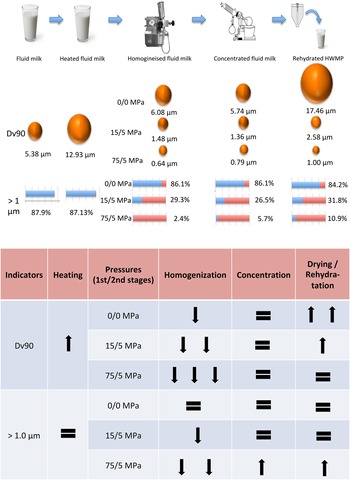
Evaluation of the percentage of particles with a volume greater than 1.0 μm in the rehydrated HWMP is of particular relevance. The samples homogenised at 0/0, 15/5 and 75/5 MPa (1st/2nd stages) demonstrated values of 84.2 ± 2.60, 31.8 ± 3.00 and 10.9 ± 4.40%, respectively. These results demonstrate that homogenisation significantly decreased the volume of the rehydrated HWMP particles. This increase in the number of particles smaller than 1.0 μm justifies the use of these homogenisation pressures to generate nanoscale products with better digestibility (Michalski and Januel, Reference Michalski and Januel2006; Garcia et al., Reference Garcia, Antona, Robert, Lopez and Armand2014; Ye et al., Reference Ye, Cui, Dalgleish and Singh2017) as well as to increase the release of fatty acids (Tunick et al., Reference Tunick, Ren, Van Hekken, Bonnaillie, Paul, Kwoczak and Tomasula2016), to be used as nutraceutical delivery systems (Oprea, Reference Oprea2017), to develop products with better fluidity (Mercan et al., Reference Mercan, Sert and Akın2018) and with better rehydration (Francisquini et al., Reference Francisquini, Martins, Toledo Renhe, Cappa de Oliveira, Stephani, Perrone and de Carvalho2020). This is summarised in Figure 2.
Particle-size variation (Dv90) and percentage of particles greater than 1.0 μm (represented in blue bars) of fluid milk during the milk powder manufacture process and rehydrated milk powder after manufacture. The milk powder was rehydrated directly on the particle-size equipment. HWMP: Homogenised whole milk powder.

We have shown previously (Francisquini et al., Reference Francisquini, Martins, Toledo Renhe, Cappa de Oliveira, Stephani, Perrone and de Carvalho2020) that the rehydration index (RI) is based on whole milk powder dispersibility and solubility by the particle-size distribution (particle sizes smaller than 1.0 μm). RI is a tool to classify the milk powder in its rehydration capacity: low (HI < 5), intermediate (5 ≥ IR ≤ 20), and high (20 > IR ≤ 100) dispersibility and solubility. Analysing the rehydrated HWMP particle-size distribution obtained here, it can be seen that particles smaller than 1.0 μm were 15.8, 68.2 and 89.1% for the homogenisation pressures 0/0, 15/5 and 75/5 MPa (1st/2nd stages), respectively. Thus, according to the RI, it can be inferred that the powders in the present study gain greater dispersibility and solubility as the homogenisation pressure increases. The rehydrated HWMP from 0/0 MPa homogenisation pressure was intermediately dispersible and soluble, while those from 15/5 and 75/5 MPa were highly dispersible and soluble. The RI can be used to choose the powder application, in which powders with an RI greater than 20 must be used directly because they can more efficiently achieve the original milk structure. In contrast, milk powders with an RI lower than or equal to 20 (low and intermediate solubility and dispersibility) must be used as ingredients by food manufacturers (Francisquini et al., Reference Francisquini, Martins, Toledo Renhe, Cappa de Oliveira, Stephani, Perrone and de Carvalho2020).
In summary, this demonstrates that increased homogenisation pressure results in fluids with different particle-size distributions. However, by rehydrating the HWMPs, there were particles without a significant statistical difference in the HWMP from 15/5 and 75/5 MPa homogenisation pressures. However, they differed statistically from the rehydrated HWMP at the 0/0 MPa homogenisation pressure. The data on the influence of homogenisation pressure on the fluid milk particle-size distribution and the rehydration profile related to the particle-size distribution agree with the literature (Hayes and Kelly, Reference Hayes and Kelly2003; Francisquini et al., Reference Francisquini, Martins, Toledo Renhe, Cappa de Oliveira, Stephani, Perrone and de Carvalho2020).
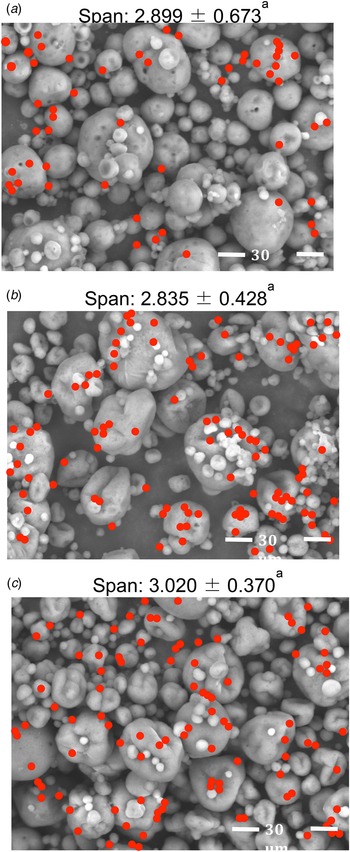
Scanning electron microscopy reported in Figure 3 shows that the analysed samples exhibited the typical structure of products formulated using a spray dryer, showing in their morphology the presence of collapse/wrinkling, agglomeration, and rounding of the particles in all the microstructures analysed. These characteristics have also been reported in coffee (rounding), yoghurt (agglomeration), eggs, and skimmed milk (collapse/wrinkling) dried using a spray dryer, as proposed by Walton and Mumford (Reference Walton and Mumford1999).
Scanning electron microscopy (sem) of homogenised powdered milk, which was homogenised at 0/0 MPa (a), 15/5 MPa (b) and 75/5 MPa (c) pressures on the resolution of 2000×*. The average of the parameters followed by the same letters does not differ statistically in the Turkey HSD test at the level of 5% of stability. Each red circle has a diameter equal to or lower than 0.1 cm.

Monodispersed powders exhibit a high degree of uniformity (PDI value less than 0.4) whereas polydispersed powders have a low degree of uniformity (PDI value greater than 0.4: Horiba Scientific, 2013). By analysing the milk powder PDI (SPAN, Fig. 3), it was observed that the powders were polydisperse. There was no statistically significant variation in the polydispersity of the powders, demonstrating that the homogenisation pressure did not have any influence. However, by marking the particles equal to or lower than 0.1 cm (Figs. 3a–c), a greater number of red marks can be observed in Figures 3b and c, which correspond to those from the homogenisation pressures of 15/5 and 75/5 MPa, respectively. This shows that even when there was no difference in the powder PDI, there was a higher number of smaller particles (equal to or smaller than 0.1 cm) as the homogenisation pressure increased.
The sorption isotherm was used to determine the powder's hygroscopicity and understand how it relates to different water activities in the environment in which it is present. The graphs in Figure 4 demonstrate that HWMPs show the same behaviour regardless of the homogenisation pressure, including lactose crystallisation, which occurs between 0.4 and 0.5 (Torres et al., Reference Torres, Stephani, Tavares, de Carvalho, Costa, de Almeida, Almeida, de Oliveira, Schuck and Perrone2017). These behaviours demonstrate the absence of constitutional chemical alterations and hygroscopicity of the HWMP due to the homogenisation pressures used. This allows a product to have an extended shelf life and maintain its sensorial features. It is known that the quality of powder during storage can be affected by moisture gain, which causes an increase in hygroscopicity, resulting in consequences such as caking, oxidative stability, physicochemical stability, dissolution, and wettability (Reh et al., Reference Reh, Bhat and Berrut2004). During the production of powdered milk, water activity in the range between 0.18 and 0.22 is sought to prevent such problems in the quality of the powder during storage. The value of water activity in the present work was within this range established as ideal, not differing statistically from each other, where 0/0 MPa (0.22 ± 0.49); 15/5 MPa (0.24 ± 0.04); 75/5 MPa (0.25 ± 0.04).
Sorption isotherms of milk powders from different homogenisation pressures (0/0, 15/5, and 75/5 MPa, 1st/2nd stages) after 21 d of storage at 25°C.

Through the sorption isotherms (Fig. 4), it can be seen that in all powders from the water activity of 0.6, there was an increase in the water absorption capacity and, on the other hand, the lower water absorption capacity was in the range of 0.1–0.2 of water activity. In a study carried out by Wei et al. (Reference Wei, Lau, Chaves, Danao, Agarwal and Subbiah2020), the sorption isotherm was performed for pasteurised whole and skimmed milk powder and values between 0.1 and 0.3 of water activity were found as the lowest water absorption range and in the range from 0.6 as the region of greater absorptive capacity. Finally, Queiroz et al. (Reference Queiroz, Rezende, Perrone, Francisquini, de Carvalho, Alves and Stephani2021) also found values between 0.1 and 0.3, where the powders absorbed a smaller amount of water. Meanwhile, in water activity with a value of 0.6, there was increased water absorption in goat milk powder with and without lactose hydrolysis.
In conclusion, heating of the milk and the increase in the homogenisation pressure from 0/0 to 15/5 MPa reduced the average particle size of the fluid, concentrated whole milk, and rehydrated powdered whole milk. The increase in the homogenisation pressure from 15/5 to 75/5 MPa did not result in a statistically significant difference in the average particle size of the same products. The Thoma number between the homogenisations was not standardised, making it impossible to standardise the process. Future work can fill this gap to understand the effect of pressure variation in the 1st and 2nd stages of homogenisation in different food matrices.
Supplementary material
The supplementary material for this article can be found at https://doi.org/10.1017/S0022029923000456.
Acknowledgements
This study was supported by Conselho Nacional de Desenvolvimento Científico e Tecnológico (CNPq) under the research project funding numbers 400864/2018-5, 307334/2020-1, 430427/2018-2 and 315337/2018-4 and Coordenação de Aperfeiçoamento de Pessoal de Nível Superior (CAPES) for doctoral and master's degree scholarships.