INTRODUCTION
Eating disorders (EDs) comprise one of the most common psychiatric disorders to affect young women in the West, with a prevalence of 0·2–0·7% for anorexia nervosa (AN) and around 1% for bulimia nervosa (BN) (Fairburn & Beglin, Reference Fairburn and Beglin1990; Hsu, Reference Hsu1996; Hoek & van Hoeken, Reference Hoek and van Hoeken2003). Despite a growing body of literature reporting disordered eating in the general population or in subpopulations of athletes of non-Western countries in recent years (Pike & Borovoy, Reference Pike and Borovoy2004; Jennings et al. Reference Jennings, Forbes, McDermott, Juniper and Hulse2005; Okano et al. Reference Okano, Holmes, Mu, Yang, Lin and Nakai2005; Lai et al. Reference Lai, Tang and Tse2006), most of these studies were limited to questionnaire-based surveys or case-series studies and did not provide prevalence rates of clinical diagnoses (Tsai, Reference Tsai2000). In particular, few studies in non-Western societies investigated the epidemiological characteristics of BN (APA, 2000; Keel & Klump, Reference Keel and Klump2003).
For epidemiological surveys on disorders of relatively low prevalence, such as EDs, a two-phase survey is a useful alternative method of investigation (Pickles & Dunn, Reference Pickles and Dunn1995). In the first phase, a screening questionnaire such as the Eating Attitudes Test (EAT; Garner & Garfinkel, Reference Garner and Garfinkel1979) for AN or the Bulimic Investigatory Test Edinburgh (BITE; Henderson & Freeman, Reference Henderson and Freeman1987) for BN is used to identify the at-risk population. The second phase consists of personal interviews of the at-risk population as well as of randomly selected subsamples of those scoring below the cut-off. A general rule is to select 100% of the screened positives for ethical reasons and only a portion of those who appear to be free of problems included in the second phase given the screening questionnaires can distinguish cases from non-cases more than by chance (Shrout & Newman, Reference Shrout and Newman1989). Despite their wide uses in Western populations, two-phase studies on EDs have several methodological limitations, including low response rate and the limited size of the groups interviewed (Fairburn & Beglin, Reference Fairburn and Beglin1990; Hsu, Reference Hsu1996; Hoek & van Hoeken, Reference Hoek and van Hoeken2003). Most two-phase studies used the EAT to screen for all diagnostic categories of EDs; however, the ability of the EAT to identify BN has been questioned (Garfinkel & Newman, Reference Garfinkel and Newman2001). For non-Western populations, only three studies to date have applied the two-phase design, with much lower prevalence rates being found in Hong Kong (Chen et al. Reference Chen, Wong, Lee, Chan-Ho, Lau and Fung1993; Lee, Reference Lee1993) and similar rates in Iran (Nobakht & Dezhkam, Reference Nobakht and Dezhkam2000) as compared with those in Western countries.
Weight-related subcultural populations, such as dancers and athletes from particular sport disciplines, have been found to be at increased risk for EDs (Garner & Garfinkel, Reference Garner and Garfinkel1978; Sundgot-Borgen & Torstveit, Reference Sundgot-Borgen and Torstveit2004). Depending on the level of competition (Garner & Garfinkel, Reference Garner and Garfinkel1980), ethnicity (Hamilton et al. Reference Hamilton, Brooks-Gunn and Warren1985) and age (Dotti et al. Reference Dotti, Fioravanti, Balotta, Tozzi, Cannella and Lazzari2002), the prevalence varied substantially, ranging from 1·8% to 8% for AN among ballet dancers (Garner & Garfinkel, Reference Garner and Garfinkel1980; Szmukler et al. Reference Szmukler, Eisler, Gillies and Hayward1985; le Grange et al. Reference le Grange, Tibbs and Noakes1994; Ravaldi et al. Reference Ravaldi, Vannacci, Zucchi, Mannucci, Cabras, Boldrini, Murciano, Rotella and Ricca2003; Ringham et al. Reference Ringham, Klump, Kaye, Stone, Libman, Stowe and Marcus2006). However, there are some limitations regarding these studies, including lack of an appropriate control group (Szmukler et al. Reference Szmukler, Eisler, Gillies and Hayward1985; le Grange et al. Reference le Grange, Tibbs and Noakes1994), low response rate (Szmukler et al. Reference Szmukler, Eisler, Gillies and Hayward1985), and the restriction to ballet dancers. Moreover, the majority of them focused solely on AN, especially in early studies.
In addition to the above-mentioned cultural factors (race and weight-related profession), some individual characteristics (such as weight and body image concern, negative affect, pre-morbid obesity, and sexual or physical abuse) and familial factors (such as parental obesity or psychopathology, parental discord, family interaction style, or dieting behavior of family members) were found to be correlates of EDs in studies in the general population (Fairburn et al. Reference Fairburn, Welch, Doll and O'Conner1997, Reference Fairburn, Cooper, Doll and Welch1999; Halmi et al. Reference Halmi, Sunday, Strober, Kaplan, Woodside, Fichter, Treasure, Berrettini and Kaye2000; Raffi et al. Reference Raffi, Rondini, Grandi and Fava2000; Webster & Palmer, Reference Webster and Palmer2000; Barbara et al. Reference Barbara, Christine, Iris and Martin2002). Only a few studies have investigated the correlates of EDs among dancers, and those studies tended to have small sample sizes, ill-defined diagnoses, and used only univariate analysis (Garner & Garfinkel, Reference Garner and Garfinkel1980; Hamilton et al. Reference Hamilton, Brooks-Gunn and Warren1985; Garner et al. Reference Garner, Garfinkel, Rockert and Olmsted1987; Thomas et al. Reference Thomas, Keel and Heatherton2005). Body image concern and competitive level were two factors frequently found to be associated with EDs in dancers. Other than these two, little is known about whether the cases of EDs in the dance population have common or distinct features with regard to those in the general population. We hypothesized that other than the common correlates of ED, overweight might make subjects in a dance class have a tendency to develop EDs under the sociocultural pressure to be thin.
Considering that EDs might be relatively rare among Asian general populations, we postulated that it might be more efficient to conduct a two-phase survey of EDs using dual screening instruments in both a nationally representative sample of high-risk people (e.g. female dance students) and a comparison group of female high-school students in Taiwan. The aims of this study were therefore (1) to investigate the prevalence rates of individual EDs, including AN and BN, in both samples respectively, and (2) to evaluate the correlates of EDs in each sample.
METHOD
Participants and procedure
There were two samples of subjects in this study: one from dance classes and the other from non-dance classes. The first sample consisted of all the senior high-school students who were enrolled in the gifted dance classes, started since 1981, in Taiwan. In total, there were 12 schools that had such special classes, with only one dance class in each grade at each school. In addition to the regular high-school curricula, these students received comprehensive dancing courses aimed at a professional career. After graduation, they went on to make up around 90% of the dance majors in colleges and universities and become the mainstream of professional dancers in Taiwan. Because the number of male students in the dance classes was small (n=53), this study focused on females only (n=655). For the second sample, non-dance students at the same school or from a nearby school (some schools did not have regular high-school classes) were chosen as the comparison group. For each dance class, two classes of the same grade were randomly selected from the same or the nearby school (n=1251).
Written informed consent was obtained from both students and their parents before the survey, which was conducted during the period from January 2003 to March 2003. Students who were willing to participate and were present at school on the day of the survey were asked to complete self-report questionnaires in class, including two screening instruments [the 26-item EAT (EAT-26) and BITE], as well as providing their current body height and weight, which are measured every semester for non-dance students in school and even more frequently (up to monthly) for dance students. The widely accepted cut-off point of the EAT (⩾20) (Garner & Garfinkel, Reference Garner and Garfinkel1979) as well as a low body mass index (BMI; ⩽18·5 kg/m2) was adopted as the criterion to screen for AN, and a BITE symptom score above 15 or a severity score above 5 (Henderson & Freeman, Reference Henderson and Freeman1987) was defined as the criterion to screen for BN. All the students except one from the non-dance class agreed to participate in the phase-one survey. After deleting those with incomplete questionnaire data (10 from the dance and 17 from the non-dance class) and absentees (32 from the dance and 52 from the non-dance class), the response rate was found to be 93·6% (n=613) for the dance students and 94·4% (n=1181) for the non-dance students. All phase-one participants were then divided into four subgroups according to the results of dual screening: both criteria positive (EAT+BITE+), the EAT criterion positive only (EAT+BITE−), the BITE criterion positive only (EAT−BITE+), and both criteria negative (EAT−BITE−).
Phase-two participants consisted of all the screen positives for either the EAT or the BITE criteria and randomly selected 10% of those screen negatives for both criteria. The mean time interval between phase-one and phase-two assessments was 122±37 days (range 77–198 days) due to logistic arrangements such as the enormous data processing load of phase-one screening questionnaires for 12 schools, and difficulties in scheduling a date that would not conflict with school events and allowed assessments for both dance and non-dance class students of the same school on the same day. Every phase-two participant was interviewed in person, measured for body weight, and also completed a self-administered questionnaire. The correlation between the self-reported body weight at phase one and that measured at phase two was high (r=0·87, p<0·001). Those absent on the day of interview were interviewed later by telephone, which was shown to be not different from face-to-face interviews in terms of diagnosis of EDs and a variety of psychiatric disorders (Keel et al. Reference Keel, Crow, Davis and Mitchell2002). The response rates of phase-two interviews were 91·5% (248/271) for the screen positives and 92·5% (37/40) for the screen negatives for the dance students, and the corresponding figures were 87·7% (178/203) and 85·3% (87/102) for the non-dance students. Reasons for non-response at phase-two interviews for the dance students included loss of contact by telephone (n=23), refusal to be interviewed (n=2) and logistic reasons (n=1). The corresponding figures for non-dance students were 36, 3 and 1 respectively. The study was approved by the Institutional Review Board of the National Taiwan University Hospital.
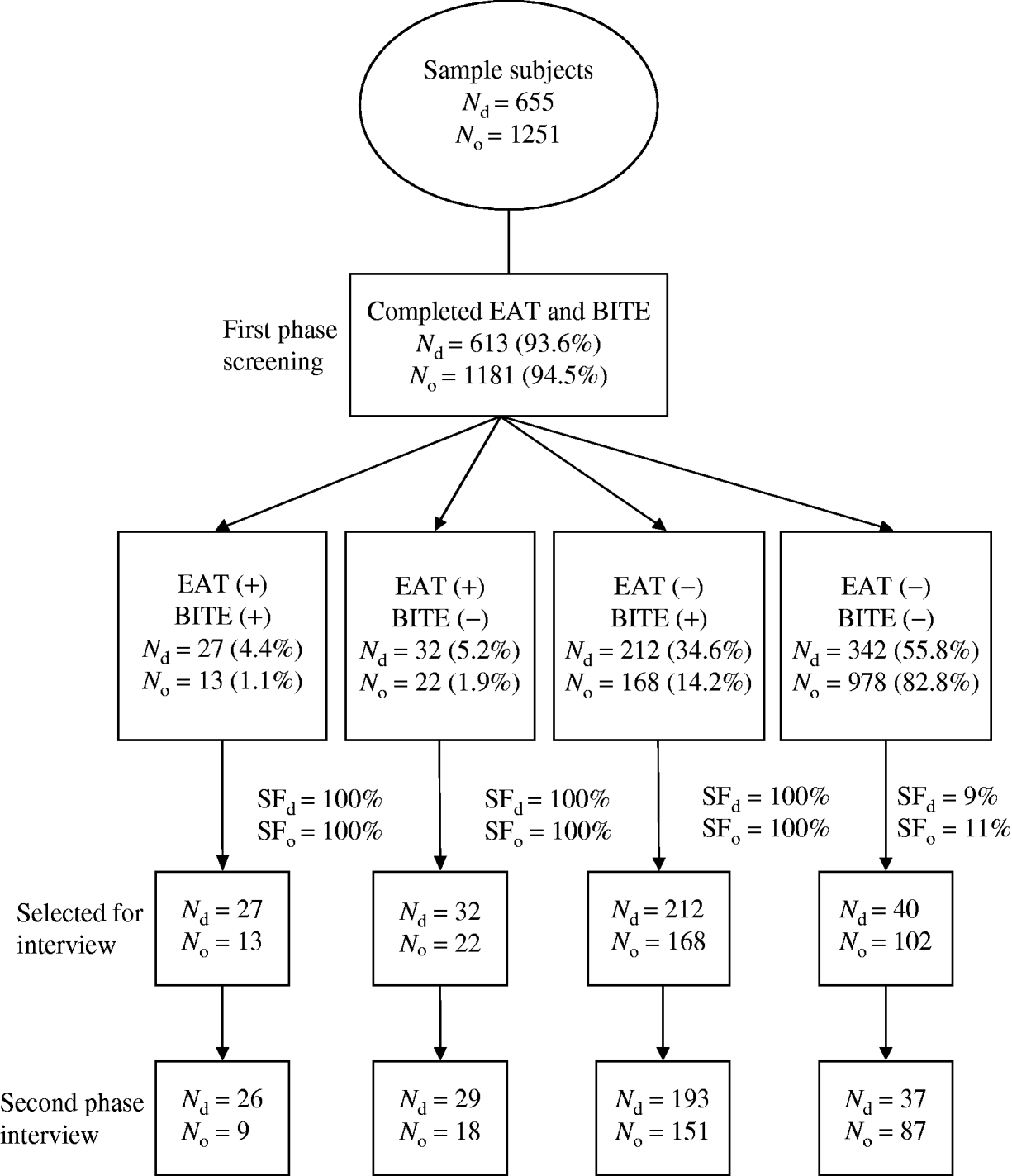
The numbers of participants in the four subgroups who received an interview at phase two are shown in Fig. 1. The sampling weights of phase-two participants can be derived as the inverse of the proportion of being selected for phase-two interview. For example, the sampling weight for subgroup EAT+BITE+ of the dance students was 1·04 (27/26). The percentages of subjects receiving face-to-face interview and telephone interview were 83·5% (n=238) and 16·5% (n=47) respectively for the dance students, and 82·6% (n=219) and 17·4% (n=46) respectively for the non-dance students.
Flow chart of the two-phase case identification of eating disorders among the female gifted dance and non-dance class students. EAT, Eating Attitudes Test; BITE, Bulimic Investigatory Test Edinburgh; N d, number of dance class students; N o, number of non-dance class students; SFd, sampling fraction of phase-one dance class students; SFo, sampling fraction of phase-one non-dance class students.

Measurements
Most self-reported questionnaires used in this study were administered in phase one, including the Body Shape Questionnaire (BSQ) and the Brief Symptom Rating Scale (BSRS), as well as demographic details, height, weight, and desired body weight, in addition to the screening questionnaire of the EAT and the BITE. In phase two, only the family APGAR (Adaptation, Partnership, Growth, Affection, and Resolve) scale was administered.
EAT
Eating problems were assessed using the EAT-26 (Garner et al. Reference Garner, Olmsted, Bohr and Garfinkel1982), an abbreviated version of the 40-item scale (EAT-40; Garner & Garfinkel, Reference Garner and Garfinkel1979) with a high correlation (r=0·98). Each item is rated on a six-point Likert scale. For scoring, each extreme response in the ‘anorexic’ direction was scored as 3 points, the adjacent alternatives as 2 points and 1 point respectively, while the remaining three response alternatives in the non-anorexic direction were scored as 0. The internal consistency (Cronbach's α=0·81) and test–retest reliability (intra-class correlation reliability=0·75) of the Chinese version of EAT-40 were demonstrated to be good in a previous study (Yang et al. Reference Yang, Soong, Kuo, Chang and Chen2004), and EAT-26 showed high correlation with EAT-40 (r=0·91) (Chen, Reference Chen1999).
BITE
This 36-item self-report measure consists of two subscales: the symptom scale (30 items) and the severity scale (six items). The former is rated with the binary response, while the latter is rated with the number corresponding to the frequency of bingeing or purging behaviors. The Chinese version of the BITE was found to have good internal consistency (Cronbach's α=0·95 and 0·77) and test–retest reliability (intra-class correlation reliability 0·86 and 0·88) for the two scales (Tseng et al. Reference Tseng, Lee and Lee1997). Among a clinically obese population, a BITE symptom score of 20 had a sensitivity of 82·4%, a specificity of 90·8%, and a positive predictive value of 51·9% for binge eating-related disorders (Tseng et al. Reference Tseng, Lee, Chen, Lee, Lin, Chen and Lai2004).
BSQ
This 34-item questionnaire, rated on a six-point, frequency-based Likert scale, assesses feelings about body shape as well as behavioral and emotional consequences of such feelings (Cooper et al. Reference Cooper, Tayor, Cooper and Fairburn1987). The BSQ was translated into Chinese by a two-stage procedure by M.M.-C.T. and its internal consistency among the participating students (n=1794) was found to be good (Cronbach's α=0·96). It was validated in a Taiwanese sample and found to discriminate well between subjects with EDs and normal female students.
BSRS
This 50-item self-rating scale was derived from Derogatis’ Symptom Check List-90 (SCL-90; Derogatis et al. Reference Derogatis, Lipman and Covi1973). The BSRS has been demonstrated to have good reliability and construct validity in psychiatric and non-psychiatric out-patients as well as in community samples (Lee et al. Reference Lee, Lee, Yen, Lin and Lue1990). Only the depression score and the General Severity Index (GSI; computed as the mean score of the 50 items of BSRS) score were reported in this study.
Family APGAR
This family function-screening questionnaire measures the participants' perception of five components of family function: adaptation, partnership, growth, affection, and resolve (Smilkstein, Reference Smilkstein1978; Chen et al. Reference Chen, Hsu and Hsu1980). A higher score indicates a higher level of family support.
Interview instrument and diagnosis
The Structured Clinical Interview for DSM-IV-TR Axis I Disorders Patient Version (SCID-I/P; First et al. Reference First, Spitzer, Gibbon and Williams2002) was used to evaluate ED diagnoses in the past year. The interview was conducted by one of two psychiatrists blind to the participants’ screening results at each school site, with one psychiatrist (M.M.-C.T.) having experiences in treating patients with EDs for 15 years. In an inter-rater reliability evaluation of eight patients (including ED and non-ED cases) before the field survey, the κ for EDs was 0·76 between the two psychiatrists. Those subjects who had clinically significant disorders of eating that did not meet the criteria for AN or BN were diagnosed as ED, not otherwise specified (EDNOS). Examples of EDNOS identified in this study included binge eating disorder (recurrent episodes of binge eating without inappropriate compensatory behaviors), menstruating AN (meeting the criteria for AN except for having regular menses), subthreshold BN (meeting the criteria for BN except for adequate frequency or duration), and purging disorder (purging regularly with the minimum frequency of once per month for 3 months, but without bingeing).
To minimize the possibility of missing cases of EDNOS (especially for purging disorders) by a negative response to the two probe questions for AN and BN, we added one more screening question: ‘Have you ever used any one of the following methods for weight maintenance or weight reduction, e.g. dieting, self-induced vomiting, taking laxatives, diuretics, or using suppositories?’ Information about changes in eating habits, body weight or menstruation and the corresponding time for such changes was also requested.
In addition to the SCID-I/P, the interview covered personal history of sexual/physical abuse, as well as family history of parents' marital status, mental illness, obesity, and weight reduction practice in close relatives.
Statistical analyses
Participants with missing data on more than 10% of each scale (i.e. ⩾3 missing items on the EAT or ⩾4 missing items on the BITE) were excluded from the analyses. The rest of the missing data was imputed by means of the same class, grade and school subgroups. The weighted prevalence and its 95% confidence interval (CI) were derived by taking into account differential sampling weights in a two-phase design using the Taylor series method (Dunn et al. Reference Dunn, Pickles, Tansella and Vazquez-Barquero1999) with the survey command svymean of the software package stata (StataCorp, 2003). Weighted logistic regression analyses were performed to assess the correlates of EDs by means of the survey command svylogit. Considering the correlated nature of our data, we also applied the cross-sectional time series command XTreg to examine whether the mean differences in BMI and all the psychometric scores among the two populations still existed after controlling for the random effect of school.
RESULTS
Characteristics of participants
The mean age was 15·8±0·9 years for the dance class and 15·9±0·9 years for the non-dance class students. The other characteristics of phase-one participants are presented in Table 1. Compared with the non-dance group, the dance group had a lower proportion of grade 12 (due to higher dropping-out rates from the dance program for students of higher grade), higher parental educational level, greater height, less body weight, lower proportion of overweight, and older age for menarche. In terms of the screening questionnaire and related psychiatric symptom scales, the dance group had higher scores for the EAT, both the symptom and the severity scales of the BITE, the BSQ, and both the depression scores and GSI of the BSRS compared with the non-dance group. The differences between the two groups in BMI and all the psychometric scores remained significant after controlling for the random effect of school.
Basic data for phase-one participants: female dance and non-dance students
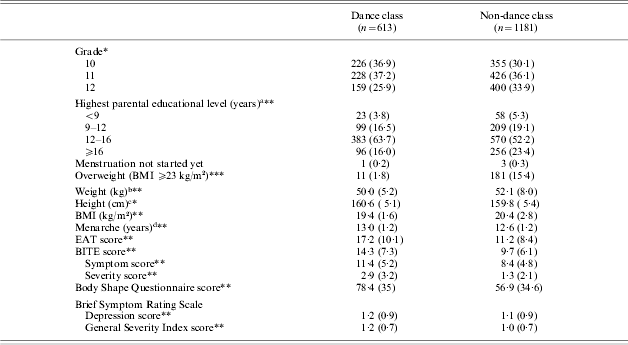
Values are n (%) or mean (s.d.).
s.d., Standard deviation; BMI, body mass index; EAT, Eating Attitudes Test; BITE, Bulimic Investigatory Test Edinburgh.
a Data missing for 12 students for the dance class and 88 for the non-dance class.
b Data missing for 2 students for the dance class and 18 for the non-dance class.
c Data missing for 1 student for the dance class and 18 for the non-dance class.
d Data missing for 28 students for the dance class and 93 for the non-dance class.
* p<0·01, ** p<0·001 for comparing the dance with the non-dance students.
Weighted 1-year prevalence of EDs
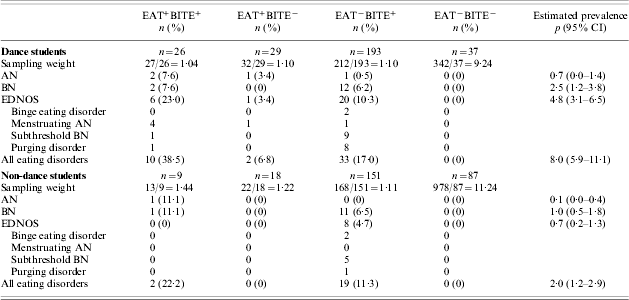
On the basis of interview, only two cases, one with BN and the other with subthreshold BN, were found to have developed binge eating or purging symptoms during the interval between the screening and interview and hence were not coded as having EDs for the subsequent analyses. The distribution of EDs among phase-two participants and the estimated prevalence are shown in Table 2. The prevalence of individual ED was much higher in the dance group (0·7% for AN, 2·5% for BN, and 4·8% for EDNOS) than in the non-dance group (0·1% for AN, 1·0% for BN, and 0·7% for EDNOS). For all EDs together, the prevalence in the dance group (8·0%) was four times more than that in the non-dance group (2·0%). If subjects with imputed data on the EAT or the BITE were deleted from analysis, the prevalence estimates changed only slightly, being 8·1% (95% CI 5·6–10·6) for the dance group and 2·1% for the non-dance group (95% CI 1·2–3·0).
Distribution of eating disorders (EDs) among phase-two participants and the estimated prevalence

AN, Anorexia nervosa; BN, bulimia nervosa; EAT, Eating Attitudes Test; BITE, Bulimic Investigatory Test Edinburgh; EDNOS, eating disorder, not otherwise specified.
The most frequently identified ED was either EDNOS (for the dance class students) or BN (for the non-dance class students), while AN was the least frequently identified. All the cases of AN were fat-phobic, that is none of them categorized as EDNOS due to non-fat-phobic.
Comparing the four subgroups, most cases were from those with BITE+, regardless of EAT+ or EAT−. For the subgroup EAT+BITE−, only two participants were diagnosed as AN or subthreshold AN, with restricting features for the dance class students. In terms of screening efficiency for any ED, combining the EAT with the BITE appeared to be better than using either one alone for the dance group, but the gain in efficiency was less obvious for the non-dance group, probably because of its low prevalence rate of AN.
Correlates of EDs
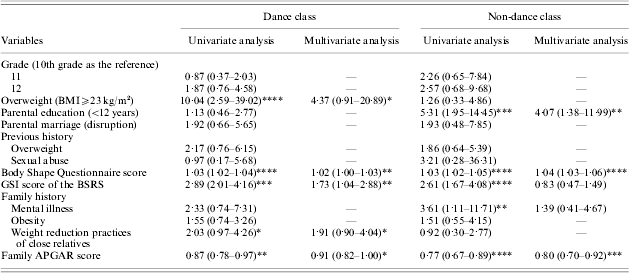
For the dance and non-dance students separately, the results of univariate logistic regression analyses revealed common and distinct correlates of EDs for the two groups (Table 3). When all the variables exhibiting a significant association in the univariate analyses were included for a multivariate logistic regression analysis, higher body shape concern and more psychological symptoms remained significantly associated with an increased risk of EDs for the dance students, with the effect of overweight, weight reduction practices of close relatives, and lower family support becoming borderline. Meanwhile, lower parental education, higher body shape concern, and lower family support remained significantly associated with an increased risk for EDs in the non-dance students. Overweight, more psychological symptoms, and weight reduction practices of close relatives were associated with EDs only for the dance students, whereas lower parental education was associated with EDs only for the non-dance students.
Univariate and multivariate logistic regression analysis of correlates for eating disorders

Values are odds ratios (95% confidence intervals).
BMI, Body mass index; GSI, General Severity Index; BSRS, Brief Symptom Rating Scale; APGAR, Adaptation, Partnership, Growth, Affection, and Resolve.
* p<0·1, ** p<0·05, *** p<0·01, **** p<0·001, for testing the null hypothesis H0: odds ratio=1·0.
To increase the power for detecting the correlates of EDs, two groups together were subjected to multivariate logistic regression analyses, including the variable class type along with six variables exhibiting a significant association with EDs in either group as well as three interaction terms between class type and the three distinctive correlates. All variables with a p>0·1 were deleted from the model in a backward manner. It turned out that lower parental education and the interaction between parental education and class type were associated with an increased risk for EDs in addition to dance class, higher body shape concern, and lower family support (Table 4). The interaction between parental education and class type remained significant in the final model, that is the association of parental education with EDs depended on class type. For the non-dance students, lower parental education was associated with a higher risk for EDs [odds ratio (OR)=4·10)], whereas for the dance students, lower parental education was not associated with an increased risk for EDs [OR=exp(1·41–1·60)=0·83, 95% CI 0·51–2·51].
Multivariate logistic regression analysis of correlates for eating disorders with both the dance and non-dance class students together

s.e., Standard error; OR, odds ratio; CI, confidence interval; APGAR, Adaptation, Partnership, Growth, Affection, and Resolve.
* p<0·1, ** p<0·05, *** p<0·01, **** p<0·001, for testing the null hypothesis H0: odds ratio=1·0.
DISCUSSION
On the basis of a two-phase survey in a nationally representative sample of dance class students as well as a comparison sample of non-dance class students, this study found that the prevalence of EDs in dance class students was higher than that in non-dance class students in Taiwan, and the order of frequency for individual ED was parallel to that in the general population but distinct from the results of earlier studies in ballet dancers of Western countries. To our knowledge, this is the first study examining EDs in gifted dance students in non-Western countries. As expected, we found that the prevalence of AN in dance class or non-dance class students was lower than that for its counterparts in Western countries. However, the prevalence of BN in this study was substantially higher than that of AN, regardless of the dance or non-dance group. The prevalence of BN for non-dance class students was even comparable to that of Western countries (1%) (Fairburn & Beglin, Reference Fairburn and Beglin1990; Hoek & van Hoeken, Reference Hoek and van Hoeken2003).
Our finding that EDNOS was more prevalent than any other EDs in the dance group was consistent with more recent Western studies (le Grange et al. Reference le Grange, Tibbs and Noakes1994; Abraham, Reference Abraham1996; Ravaldi et al. Reference Ravaldi, Vannacci, Zucchi, Mannucci, Cabras, Boldrini, Murciano, Rotella and Ricca2003; Ringham et al. Reference Ringham, Klump, Kaye, Stone, Libman, Stowe and Marcus2006). However, the prevalence rates were much lower than those of their counterparts in Western ballet dance groups. One reason might be the lower demand on body weight in Taiwanese dance students as they did not restrict their dance curriculum to ballet but also took courses in Chinese folk dance, martial art or jazz. Another possible reason is the younger age in our sample of high-school students as compared with the ballet dancers of college students, as the risk of EDs increased with age (Dotti et al. Reference Dotti, Fioravanti, Balotta, Tozzi, Cannella and Lazzari2002). Intriguingly, the unexpected lower prevalence of EDNOS compared with that of BN in the non-dance group might be accounted for by their lower exposure to weight-related stimuli as the non-dance students were kept on an extremely tight academic schedule in preparation for college entrance.
The finding that BN was more prevalent than AN in this study is similar to that of Western countries (Keel & Klump, Reference Keel and Klump2003) and a recent study in Iran (Nobakht & Dezhkam, Reference Nobakht and Dezhkam2000), but opposite to that observed in Hong Kong (Lee et al. Reference Lee, Hsu and Wing1992) or Japan (Nakamura et al. Reference Nakamura, Yamamoto, Yamazaki, Kawashima, Muto, Someya, Sakurai and Nozoe2000). The study in Japan was based on doctors’ reports rather than on a population survey. Weight concerns and Western influence were consistent features in all cases of BN, but might not be present in some cases of AN (Keel & Klump, Reference Keel and Klump2003). Unlike the atypical features found in some AN patients in non-Western society (Lee & Hsu, Reference Lee and Hsu1993), all the cases of AN in our samples were fat-phobic. Our findings of a consistently low prevalence of AN but a prevalence rate of BN equivalent to that of Western countries provide further support that BN is more susceptible to the Western influence than AN.
The common psychosocial correlates of EDs found in this study, including enrolment in a dance class, greater concern with body shape and lower family support, are consistent with other studies (Garner & Garfinkel, Reference Garner and Garfinkel1980; Waller et al. Reference Waller, Calam and Slade1989; Shisslak et al. Reference Shisslak, McKeon and Crago1990; Killen et al. Reference Killen, Taylor, Hayward, Wilson, Haydel, Hammer, Simmonds, Robinson, Litt and Varady1994). Among the three distinct correlates for the dance class students, overweight and more psychological symptoms are probably accounted for by the tension encountered in keeping body shape for this subpopulation. Recent neuroendocrinological studies have found that the brain machinery responsible for food intake and body weight can modulate emotion and motivated behavior as well (Kishi & Elmquist, Reference Kishi and Elmquist2005). Mood disturbances have been found to be associated with EDs in both the general population (Johnson-Sabine et al. Reference Johnson-Sabine, Wood, Patton, Mann and Wakeling1988; Patton et al. Reference Patton, Johnson-Sabine, Wood, Mann and Wakeling1990, Reference Patton, Selzer, Coffey, Carlin and Wolfe1999) and dancers (Garner & Garfinkel, Reference Garner and Garfinkel1980; Ravaldi et al. Reference Ravaldi, Vannacci, Zucchi, Mannucci, Cabras, Boldrini, Murciano, Rotella and Ricca2003), although one study found the association in the non-dancer but not in the dancer group (Holderness et al. Reference Holderness, Brooks-Gunn and Warren1994), probably because of its recruitment strategy for young adult women at risk for decreased bone density. Overweight among the dance class students might therefore be a consequence of maladaptation to the prevailing cultural pressure to be thin. Another possibility is that the dance class students with EDs might be influenced by a family environment in which weight reduction was prevalent (Klump et al. Reference Klump, Ringham, Marcus and Kaye2001), which is the third distinct correlate for this subpopulation. This is compatible with the finding that BN had a substantial contribution from familial influences (Kendler et al. Reference Kendler, Walters, Neale, Kessler, Heath and Eaves1995). From the practical point of view, our findings indicate that dance class students with overweight or emotional disturbances should be the focus of prevention or early detection of EDs.
A distinct correlate of EDs for the non-dance class students is lower parental education. Although EDs were initially reported to be most common among upper classes, the observation was not supported by later epidemiological surveys (Gard & Freeman, Reference Gard and Freeman1996). Another reason for the association of lower parental education with EDs might be that the predominant diagnosis found in this study was BN rather than AN.
Limitations of this study should be kept in mind in interpreting our results. First, for those students who were absent from school on the screening day, we missed information about their ED status. Second, there was time lag between the date of screening and the date of interviewing. For those participants who developed binge eating or purging symptoms during the interval between the screening and the interview, we did not code them as cases to minimize the impact of this time lag. However, as eating-related symptoms were shown to have good inter-rater (Cantwell et al. Reference Cantwell, Lewinsohn, Rohde and Seeley1997) and test–retest reliability (Rizvi et al. Reference Rizvi, Peterson, Crow and Agras2000), the chance of participants' failure to report these symptoms was probably negligible. Third, because of the limited number of cases in each diagnostic category and lack of consensus in the literature regarding the discrimination between AN and BN in terms of risk factors (Striegel-Moore, Reference Striegel-Moore1997; Jacobi et al. Reference Jacobi, Hayward, de Zwaan, Kraemer and Agras2004), the analyses of psychosocial correlates were conducted only for a broad diagnostic category including AN, BN and EDNOS. Finally, the body weight used in the screening was based on self-report only. Nevertheless, its impact on the estimation of EDs might be minimal because the self-reported weight had a high correlation with the measured one and our diagnoses of EDs were based on in-person interviews.
In conclusion, this study demonstrated that EDs were more prevalent in the weight-concerned subpopulation. BN was more prevalent than AN among Taiwanese high-school female students, and was at a similar rate to that found in Western countries. Despite the scarcity of literature with regard to BN among non-Western populations, we should be aware that BN has now emerged as a prevalent disorder in non-Western countries such as Taiwan.
ACKNOWLEDGMENTS
This study was sponsored by research grants from the National Science Council, Taiwan (NSC91-2413-H-134-021 and NSC92-2314-B-002-293). We thank all of the school teachers, students and personnel for their participation and assistance in this project.
DECLARATION OF INTEREST
None.