Frugivorous primates are important seed dispersers (Chapman Reference CHAPMAN1995) in neotropical and palaeotropical forests. In African forests, the most abundant cercopithecoid monkeys swallow smaller seeds up to 0.4 cm in size (Lambert Reference LAMBERT1999), and often spit out larger seeds. On the other hand, great apes, which have the largest bodies among African primates, swallow large seeds and defecate them intact in their faeces (Gorilla gorilla Savage 1847: Tutin et al. Reference TUTIN, WILLIAMSON, ROGERS and FERNANDEZ1991; Pan troglodytes Blumenbach 1775: Wrangham et al. Reference WRANGHAM, CHAPMAN and CHAPMAN1994; Pan paniscus Schwarz 1929: Idani Reference IDANI1986), thus acting as important long-distance dispersers. For example, in Dja Forest, Cameroon, about half of the seeds dispersed via primate faeces were done so by apes, despite their low densities (Poulsen et al. Reference POULSEN, CLARK and SMITH2001). It is also known that seeds from chimpanzee faeces have higher germination potential than those that have not passed through the gut (Takasaki Reference TAKASAKI1983, Wrangham et al. Reference WRANGHAM, CHAPMAN and CHAPMAN1994).
Size may be a limiting factor that determines whether a seed is swallowed by an animal. If it is larger than the animal's oesophagus, the animal cannot physically swallow it. The allometry of a seed is also relevant, because even with identical lengths, a rounder seed is more difficult to swallow than an elongated one. According to Chapman (Reference CHAPMAN1995), ‘it seems reasonable to speculate that selection may favour seeds that are ovate and elongate, like many pills’. However, there have been only a few empirical studies on seed size and shape in relation to endozoochory (Forget et al. Reference FORGET, DENNIS, MAZER, JANSEN, KITAMURA, LAMBERT, WESTCOTT, Dennis, Green, Schupp and Westcott2007, Lord Reference LORD2004). The width of a seed, which is orthogonal to the digestive tract, strongly restricts the swallowing action of an animal. However, most of the studies on chimpanzee seed dispersal presented only the length of the seeds and provided no information on their width (Gross-Camp et al. Reference GROSS-CAMP, MASOZERA and KAPLIN2009, Lambert & Garber Reference LAMBERT and GARBER1998, Poulsen et al. Reference POULSEN, CLARK and SMITH2001, Wrangham et al. Reference WRANGHAM, CHAPMAN and CHAPMAN1994; but Lambert Reference LAMBERT1999 provided some data).
Thus, in this study, we present data on the length and width of seeds that are either dispersed or not dispersed by chimpanzees at the Mahale Mountains National Park, Tanzania (see Nakamura & Nishida Reference NAKAMURA, NISHIDA, Kappeler and Watts2012 for the study site). Dispersed seeds (243 seeds from 14 plant species) are those known to be swallowed together with fruit pulp by the chimpanzees and are defecated intact in their faeces. The majority of them were collected from chimpanzee faeces, and those that were difficult to identify were collected directly from ripe fruits. Non-dispersed seeds (254 seeds belonging to 12 species) are those either destroyed or not utilized at all by the chimpanzees.
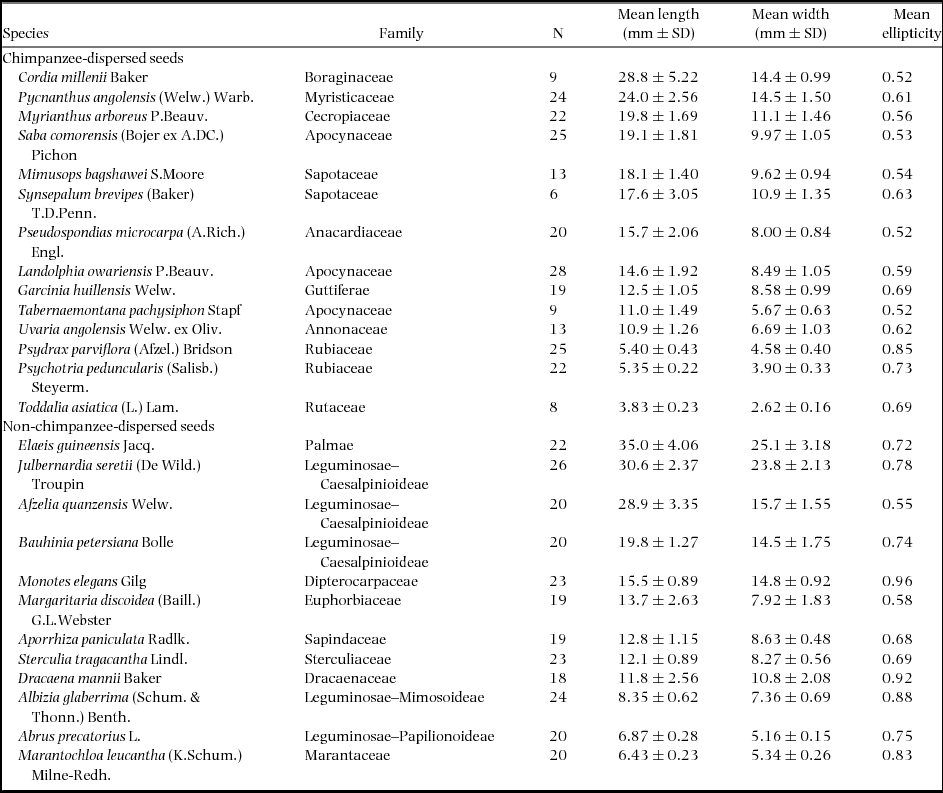
We measured the longest axis (length) and the orthogonal second-longest axis (width) of each seed with a calliper to the nearest 0.05 mm. Plant species and seed length, width and ellipticity are given in Table 1. The average ellipticity in each chimpanzee-dispersed plant species varied from more rounded Psydrax (ellipticity = 0.85) to more elongated Cordia (ellipticity = 0.52).
Seed size and ellipticity in 14 plant species whose seeds are swallowed whole (dispersed), and 12 species whose seeds are either destroyed or not utilized (non-dispersed) by Mahale chimpanzees. Ellipticity = width/length: when approaching 0, the shape is more elongated, and when approaching 1, the shape is more rounded.

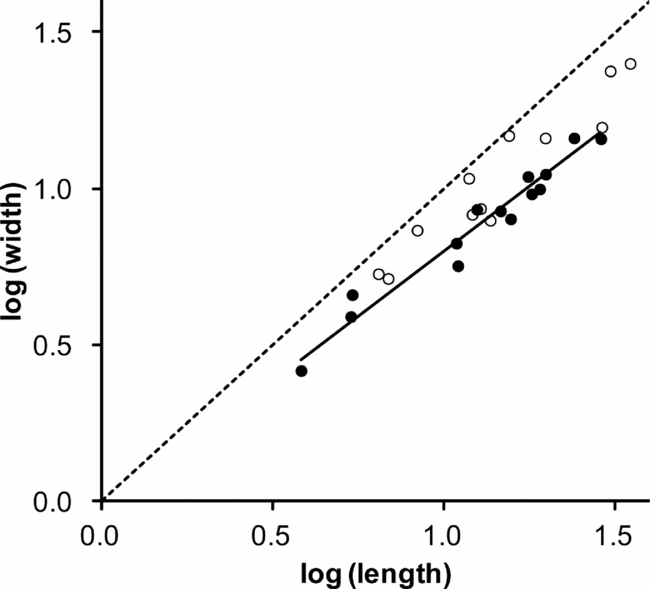
After log-transforming the length and width values (to improve normality), we regressed seed width against seed length by standardized major-axis regressions in order to test whether larger seeds have more elongated shapes (relatively narrower widths) compared with smaller ones. When the resulting slope is less than 1.0 and the 95% confidence interval is not overlapping with 1.0, the width of larger seeds is regarded to be significantly narrower than expected from the seed length. Figure 1 (black dots) shows the log-transformed average lengths and widths of seeds from 14 chimpanzee-dispersed plant species. The resulting slope was significantly lower than 1.0 (slope = 0.83, 95% CI = 0.72–0.94, P = 0.0080). Thus, at the species level, larger seeds swallowed by the Mahale chimpanzees were more elongated. When we used all individual seeds for analysis, this trend was also observed (slope = 0.80, 95% CI = 0.77–0.84, P < 0.0001). On the other hand, the slope for the non-dispersed seed species did not significantly differ from 1.0 (Figure 1, white dots: slope = 0.93, 95% CI = 0.75–1.15, P = 0.48). However, the slopes for dispersed and non-dispersed seeds did not significantly differ (Common Slope Test, P = 0.30).
Standardized major-axis regression for log-transformed length vs. width of chimpanzee-dispersed seeds (black dots) and non-chimpanzee-dispersed seeds (white dots) at Mahale. Each dot represents the average size of a seed in a species. The dashed line shows a slope of 1.0, and the solid line shows a slope for the black dots.
Because the 14 plant species, with seeds that were dispersed by chimpanzees, belong to various taxa, the observed pattern may be generally shared among those plant species that are adapted to seed dispersal by Mahale chimpanzees. Even phylogenetically related species follow this general pattern; besides Cordia millenii (Table 1), another Cordia species found at Mahale, C. africana, is also eaten by chimpanzees. Seeds of C. africana are much smaller (approximately 70–80 mm) and visibly rounder than the larger C. millenii.
The regression analysis of an already published dataset for gibbons (hybrid of Hylobates agilis and H. muelleri) (McConkey Reference MCCONKEY2000) produced a similar result (slope = 0.41, 95% CI = 0.21–0.80, P = 0.013). Thus, this trend may also be observed in other apes that swallow relatively large seeds in palaeotropical forests. On the other hand, seeds typically swallowed by the long-tail macaque (Macaca fascicularis) (data shown as ‘W’ in Table I of Lucas & Corlett Reference LUCAS and CORLETT1998) did not show such a trend (slope = 1.24, 95% CI = 0.93–1.65, P = 0.12), probably because macaques usually swallow much smaller seeds and spit out larger ones (Lucas & Corlett Reference LUCAS and CORLETT1998).
The production of larger seeds may be beneficial for plants since they contain more nutrition for germination. However, there is also a risk that such seeds may not be swallowed by dispersers if the size is too large. At Mahale, the chimpanzee is the largest seed disperser. At the same time, we have never observed Mahale chimpanzees utilizing fruits whose seeds are too large to swallow, except for human-introduced Mangifera indica L. Without larger seed dispersers in Mahale, chimpanzees may be the limiting factor for the size and shape of seeds in this region. Through frequent dispersal by chimpanzees, plants that produce seeds that can be swallowed by chimpanzees may have an advantage over those that produce seeds of the same size but which are more rounded, and they may have increased long-term relative abundances. This, in turn, should facilitate frequent consumption of such fruits by chimpanzees. Such a positive loop may partly explain why large seeds that are dispersed by chimpanzees tend to have elongated shapes at Mahale.
ACKNOWLEDGEMENTS
We thank the Tanzania Commission for Science and Technology, the Tanzania National Parks, and the Tanzania Wildlife Research Institute for permission to do research in Mahale as well as MMCRP members for their cooperation in maintaining the field site.