

According to a 2012 Bloomberg report, the wealth of the richest 70 legislators in China's National People's Congress (NPC) was 12 times that of the total wealth of all the members of US Congress, Supreme Court, and the US President.Footnote 1 Most of these super-rich deputies were private entrepreneurs (PEs). To put this into perspective, the Chinese Communist Party (CCP) had banned the new recruitment of PEs into the party in 1989 (Dickson Reference Dickson2003, 98), and the ban was officially lifted in 2001 when Jiang Zemin, who was the CCP's leader at that time, made the speech declaring that PEs were regarded as a part of the “new social class” that has “contributed to the development of a productive force” (Dickson Reference Dickson2003, 103). Echoing the “three represents” theory proposed by Jiang a year earlier, the CCP began to view the interests of capital as being in line with the ruling party. Only ten years later, these capitalists have become a salient group in the NPC. This contrast reminds us the dramatic change of PEs’ position in China's political landscape, especially with regard to Chinese legislative politics.
The increasing presence of PEs in China's legislatures has received significant attention from social scientists who have a regional focus on China (Li, Meng, and Zhang Reference Li, Meng and Zhang2006; Dickson Reference Dickson2008; Truex Reference Truex2014; Hou Reference Hou2015). Their studies have made significant contributions by improving our understanding of PE deputies in China's congresses. However, this body of literature is incomplete in two important ways. First, with the notable exception of Truex (Reference Truex2014), empirical studies of China's PE delegates tend to concentrate on township, county, district, and municipal congresses (Lu Reference Lu2014; Sun, Zhu, and Wu Reference Sun, Zhu and Wu2014; Zhang Reference Zhang2017). In other words, it is unclear whether their findings can be generalized to private business legislators in the NPC. As Sun (Reference Sun2014, 183–184) notes, “deputies to district level congresses are elected directly by voters, while congresses above district levels are elected by congress deputies from a lower level.” Second, studies using profile-based data to explore individual characteristics of PE deputies in the NPC are lacking. Preexisting research that investigates PE deputies’ personal backgrounds tends to focus on local congresses (Dickson Reference Dickson2003, Reference Dickson2008; Tsai Reference Tsai2007; Chen and Dickson Reference Chen and Dickson2010). Because of these limitations, we still do not know how extensively private business elites have been integrated into the NPC. More importantly, without accessing to microlevel data such as profiles of NPC deputies, extant research risks assuming PE deputies as a unitary actor and thus also risks underplaying within-group differences among these capitalists.
Within-group heterogeneities are not new to scholars of China's PEs. Empirical inquiries have revealed substantive differences among business owners in terms of their interests, identity, and political views (Tsai Reference Tsai2007, 72–104; Dickson Reference Dickson2008, 133–137; Chen and Dickson Reference Chen and Dickson2010, 38–147). However, recent studies on Chinese legislative politics have not fully incorporated these insights. Since it would be misleading to discuss PE deputies as a unitary actor, we turn to an alternative disaggregated approach.
Following a disaggregated approach, we introduce a new dataset that quantifies the profiles of the NPC's PE legislators from the 10th to the 12th NPC (2003–2017). To the best of our knowledge, this dataset offers the most comprehensive coverage of the NPC's private business legislators to date. This dataset contributes to the literature by disaggregating two types of PE legislators: (1) the “grassroots” group, which refers to those business elites who started their enterprises without having an explicit governmental background and (2) the “insider” group, namely, deputies who were either former officials or top managers of state-owned enterprises (SOEs)/collective enterprises, or whose companies were once SOEs/collective enterprises before being privatized. Our findings are striking. Taking the 11th NPC as an example, among the entire group of PE deputies, 41 percent can be classified as former “insiders.”
We make three contributions by introducing this profile-based dataset. First, these data can provide a more nuanced view of the causal mechanisms explaining exactly how deputies interact with the authoritarian state. In particular, our findings highlight the importance of the varying material interests of PE deputies. A hypothesized mechanism may have varying effects, which are contingent on which specific type of deputies is involved. Therefore, focusing on individual characteristics of PE deputies allows us to ask a couple of new theoretical questions about China's legislative politics. For example, this inquiry speaks well to the information-based argument advocated by two recently published prominent studies that highlight the role of the NPC in terms of conveying valuable information to the ruling party (Melanie Reference Manion2015; Truex Reference Truex2016). Based on this gathered information, the party-state is willing to incorporate deputy proposals on non-sensitive issues into policies. However, these studies have not specified whether different types of deputies would provide various types of information to the regime in accordance with their distinct interests. For instance, research reveals that business elites who are better connected politically obtain substantially more bank loans (Guo et al. Reference Guo, Jiang, Kim and Xu2014, 290). Tsai (Reference Tsai2007, 81) also shows that although difficulty in getting loans appears at the top of the lists of policy issues about which PEs are concerned, the “insiders” are less likely to be affected by this credit constraint. Therefore, PE deputies who are “insiders” may be less likely to speak in favor of changing the existing credit policy because they are more economically privileged. As a result, through this information-based mechanism, distinct types of PE deputies could affect credit policies in different ways.
Second, our microlevel data allow researchers to further investigate the underlying process explaining how local governments screen and select delegates, which has not been systematically examined at the provincial level (Dickson Reference Dickson2008, 173–176). By using the detailed biographical data of PE deputies in the NPC, we can explore differences between the group of selected PE deputies and the whole population of PEs at the provincial level. This paired comparison can explain how provincial governments decide who may participate in China's national legislatures, which may reveal valuable information with regard to local state-business relations.
Third, underscoring the differences among PE deputies, we offer a more nuanced view of the co-optation theory, which is currently a prevalent analytical framework of legislative politics in autocracies. The co-optation theory presumes the presence of potential challengers. Given the threat posed by opposition groups, the state is pressured to offer deputy positions to buy off these challengers (Gandhi Reference Gandhi2008; Magaloni Reference Magaloni2008). In other words, this theory would argue that the regime is more likely to integrate the most dissident business elites into the legislative body. However, as documented by previous studies, in the case of Chinese capitalists, their disposition toward the regime is deeply shaped by varying degrees of state dependence (Dickson Reference Dickson2003, Reference Dickson2008; Tsai Reference Tsai2007). In particular, the group of “insiders,” who are better connected with the state to assure the profitability, is more pro-regime (Chen and Dickson Reference Chen and Dickson2010). According to the co-optation theory, the “grassroots” type should be an ideal target for co-optation. In contrast to this expectation that PE deputies would be mainly drawn from the “grassroots” type, we find considerable temporal and provincial variations among PE deputies who are of the “grassroots” type. This finding casts doubt on a simple version of co-optation theory. We suggest that future studies need to articulate the scope conditions of the co-optation theory.
In this research note, we first present our data collection process and then provide an overview of PE deputies in China's NPCs. In particular, we find that PE deputies vary significantly across provinces with regard to whether they belonged to the “insider” group. We then make several suggestions for future quantitative analyses of PE legislators. We hope our microlevel data can help future researchers through better information regarding the varying individual interests of the NPC deputies and thus supplement the existing literature by offering more grounded microfoundations.
WHO ARE THE NPC'S PRIVATE ENTREPRENEUR DEPUTIES?
Data Collection Process
The dataset identifies the profiles of 2650 deputies of the 10th NPC (2002–2007), 2654 deputies of the 11th NPC (2008–2012), and 2691 deputies of the 12th NPC (2013–2017). Delegates from the People's Liberation Army, Hong Kong, Macao, and Taiwan are excluded from our coded sample. One of the authors and one research assistant collected biographical information on these deputies who were further coded into 14 categories, which included their occupation, social class, and whether they had experience studying or working overseas. One coder collected and coded all samples, and the second coder then recoded all samples.
To obtain original name lists of NPC deputies by province, we turn to the NPC's deputies name lists announced by Xinhua (www.xinhuanet.com), which is the NPC's official website.Footnote 2 Note that in each year, some deputies are disqualified because they are investigated for corruption or other serious legal or regulatory violations.
Coders collected information on individuals from the NPC's website, including basic information on each deputy (gender, party membership, education, and ethnicity). However, the NPC's website does not provide each deputy's curriculum vitae. Therefore, to access to the detailed biographical information, coders referred to the People's Congress Standing Committee of each province. Since the biographical information of deputies is incomplete on the NPC's official site, the coders followed the data collection method used by Truex (Reference Truex2014) and turned to Wikipedia (www.wikipedia.org/) and the Chinese encyclopedia Baidu Baike (https://baike.baidu.com/) to collect more information.
Some deputies’ personal Baidu Baike pages provided a detailed summary of their work experience. For those without Baidu Baike's coverage, the coders used the news database WiseSearch (wisesearch.wisers.net) to collect published reports on deputies’ personal experience. WiseSearch covers over 300 local and national Chinese newspapers dating back to 1998. In addition to using WiseSearch, the coders also employed keyword searches through online search engines such as Baidu and Google. Moreover, coders paid particular attention to the information concerning how the deputies obtained their first “barrel of gold” and their work experience before becoming PEs. Coders used deputies’ names as keywords to search for related online financial news reporting. News portals in China, such as Sina.com and QQ.com, all have a financial news channel. In addition, financial news websites such as Hexun.com feature a large number of interviews and profiles of entrepreneurs. The details of our coding procedures can be found in the associated codebook.
As an illustrative example, when searching for information about Cui Genliang, a PE deputy of the 12th NPC from Jiangsu province, the coder first went to NPC website but did not find his occupation. The coders then went to his Wikipedia page, which only provided the information that Cui was the founder and chairman of the Hengtong Group. The coder used Cui's full name as the key word searching through Baidu and Google and found his personal profile on Hexun.com. According to the profile, he was a People's Liberation Army veteran assigned by the government in 1982 to be the head of a local township and village enterprise, which made him a township level official. However, the information from Hexun.com was from Baidu Baike. To determine the accuracy and authenticity of this information, the coders used WiseSearch to search local newspaper stories about Cui and found a news story on Economic Daily written by Xue Haiyan (Section 11, April 26, 2016), which contained the same information about his personal life and career. Based on this information, Cui was coded as an “insider” who was a former SOE/collective enterprise official or someone who used to work in the government.
In the context of contemporary China, one caveat needs to be given particular attention. Although the official media and local governments often claim that some companies are not SOEs and thus categorize the CEOs and chairmen of those firms as PEs, the central and local governments still have varying portions of state-owned legal person shares of these companies, which is due to the complicated share structure in China. State shares and state-owned legal person shares were derived from an attempt to maintain the state-owned economy and prevent the loss of state-owned assets (Xu and Wang Reference Xu and Wang1999).
To distinguish between SOE/collectively owned companies and privately owned companies, the coders checked official corporate websites, the National Enterprise Credit Information Publicity System, Xueqiu.com, and finance.sina.com.cn, they also ran keyword searches to obtain the details of legal representation and ownership structures. Deputies from those companies with state ownership and state-owned legal person shares are excluded from coding as PEs.
Key Variables
Following the aforementioned coding procedure, NPC deputies were further coded into 14 categories, which included their occupation, social class, and whether they had experience studying or working overseas. Table 1 of the codebook offers a detailed description of how we code these categories.
Descriptive Statics of NPC by Profession (2003-2017)

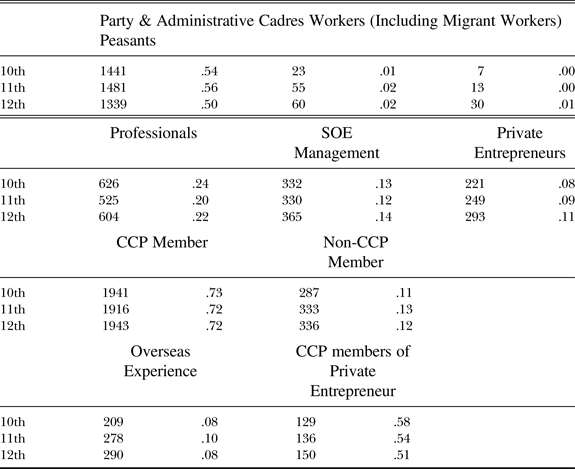
Upon a quick inspection, our dataset reveals a general pattern (see Table 1): the percentage of PE deputies increases steadily over time. These changes seem to be consistent with the CCP's policy of incorporating more business elites and thus increasing the legitimacy of the NPC as a political institution representing the interests of private business owners (Zhong Reference Zhong2003). In the 12th NPC, which was the most recent session, approximately 11 percent of all deputies were PEs.
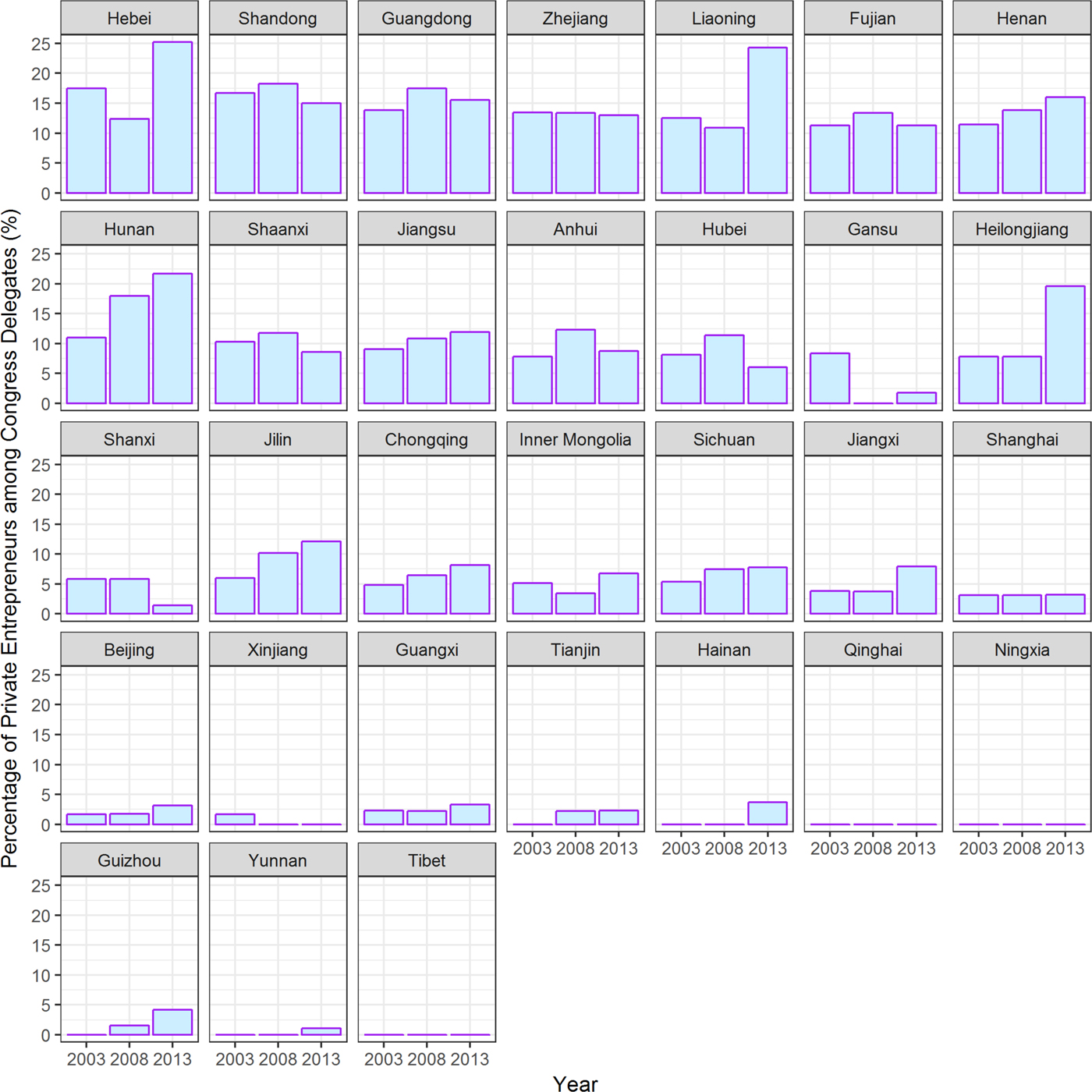
We also disaggregate our national-level data to further demonstrate regional and temporal variations. Figure 1 shows the distribution of PE deputies by province and session and illustrates several notable patterns. First, despite being at the top of China's administrative rank, direct-controlled municipalities in China (Beijing, Chongqing, Shanghai, and Tianjin) tend to elect relatively fewer numbers of PE deputies. Second, western China as a whole is characterized by a much lower representation of PEs. Third, during this period, Northeast China, a region that was traditionally dominated by SOEs, experienced one of the most dramatic increases in terms of its percentage of PE deputies. These findings suggest that a research design concentrating on a single locality or point in time may obscure the complexities of the role of PEs in China's NPCs.
Percent of PEs in NPC by Province and Session

TYPOLOGIES OF PRIVATE ENTREPRENEURS IN THE NPC
As Tsai (Reference Tsai2007) and Dickson (Reference Dickson2008) noted, a substantial proportion of government cadres and former SOE/collective enterprise managers entered the private sector after the 1980s. Consequently, the backgrounds of PEs are noticeably heterogeneous. For example, in 2000, 25 percent of private business owners were in cadres before they started their own enterprises, while another 10.5 percent were previously professional, technical, or skilled employees (Tsai Reference Tsai2005, 1139). To examine these distinctions, we differentiate two groups of the NPC's PE deputies: (1) the “insider” type, which refers to entrepreneurs who were either government officials or top managers of SOEs/collective enterprises before they began their own businesses, or whose companies were once SOEs/collective enterprises before being privatized; and (2) the “grassroots” type, who were previously farmers, workers, self-employed, or professionals. Table 3 of the codebook shows the percentage of “insiders” by province and their secession in the NPCs.
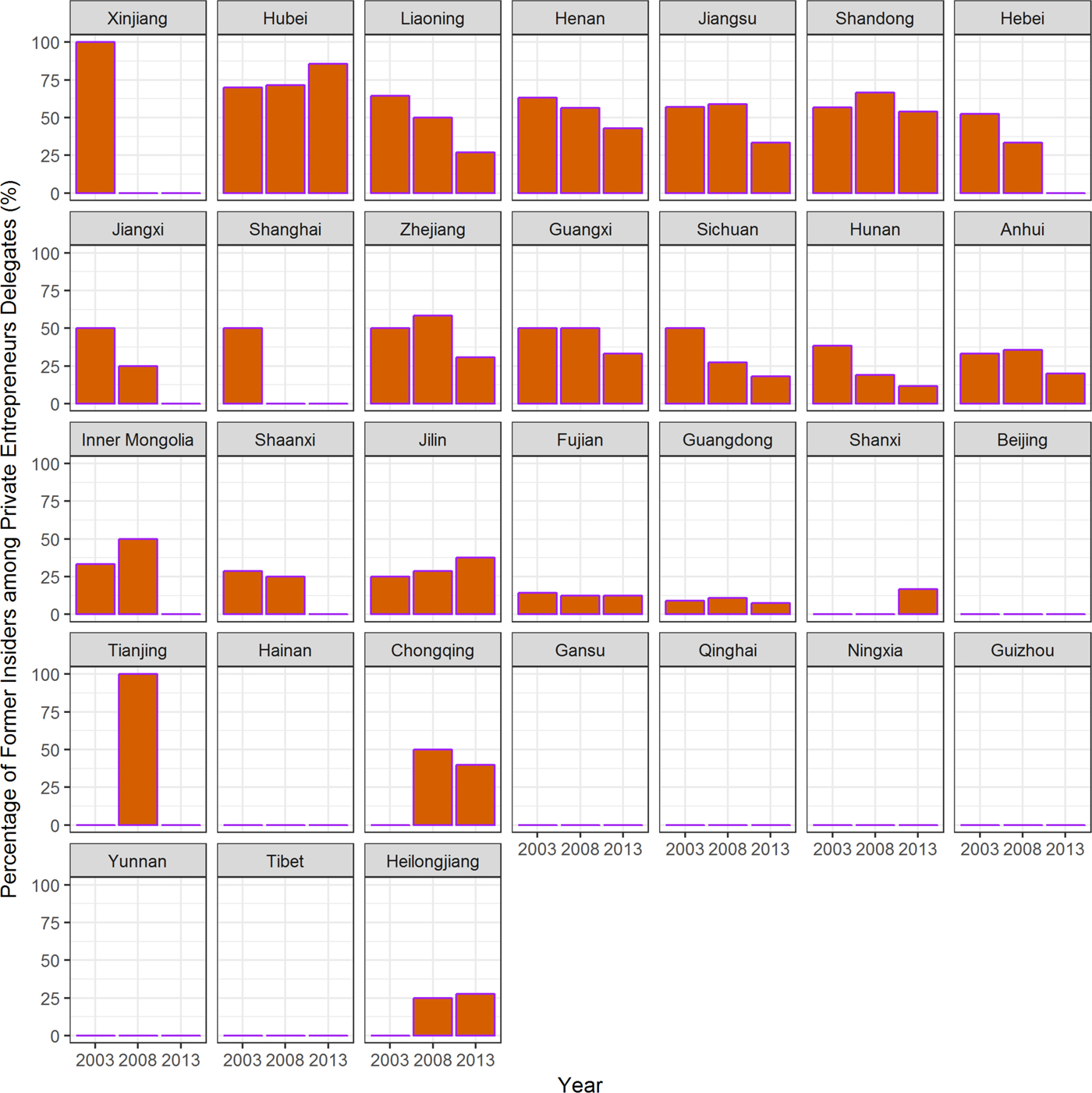
Figure 2 visualizes the temporal and spatial variation of “insiders” in the NPCs. Among all PE deputies in the 10th NPC (2003–2007), there were 94 “insiders” (43 percent of the PE deputies). Between 2008 and 2012, there were 101 such “insiders” (41 percent of the PE deputies) who were former government officials or SOE/collective enterprise managers and whose current enterprises were previously SOEs/collective enterprises. This number decreased to 24 percent in the 12th NPC with a total of 71 “insiders.” The decrease of “insiders” may be attributed to China's drastic economic transformation over time. The “insiders” are the beneficiaries of China's first round SOE reform in the late 1990s, and their business are mainly in labor-intensive industries, such as textiles, food, and general machinery. In the last decade, younger entrepreneurs who were not involved in the privatization started to make their fortunes, and the central government has encouraged the political participation of this younger generation. These generational changes may account for the tendency of the declining share of deputies who engaged in the early privatization.
Percent of “Insider” PEs in NPC by Province and Session

Putting these numbers into perspective shows that “insiders” were highly overrepresented in the NPC. According to Chen and Dickson (Reference Chen and Dickson2010, 41, Fig. 3.2), nearly 38 percent of China's PEs were party members in 2007. Among these red capitalists, 41 percent of their firms were previously SOEs. If we safely assume these capitalists constitute a large part of “insiders,” a simple calculation should show that approximately 16 percent of China's PEs were “insiders” in 2007. This number is much lower than the percent of “insiders” in the 10th NPC.
The overrepresentation of “insiders” in the NPC raises two crucial points. First, it demonstrates that the state is more likely to integrate politically compliant business elites into the national legislature, which contrasts with a simple co-optation argument. Because “insiders” arose from the state sector, they are more likely to cultivate friendships with government officials who were their former colleagues. As a result, their business profitability substantively depends on the financial support of the state in matters such as accessing bank loans (Kung and Ma 2016). Chen and Dickson (Reference Chen and Dickson2010, 79–82) find that entrepreneurs who received bank loans were more pro status quo. In addition, Chen and Dickson (Reference Chen and Dickson2010, 116, Table 5.4) show that entrepreneurs who used to be in cadres were more likely to support the regime even after controlling for a set of individual and firm characteristics.
Second, a large share of “insiders” in the NPC indicates that the selective inclusion of emerging business elites may hinder the development of a benign state–business relationship in the long run. On an anecdotal level, there has been a consensus that most “insiders” earned their first “barrel of gold” through Chinese privatizations (Wedeman Reference Wedeman2012). It was a very common practice for local officials to take advantage of privatization by selling discounted state assets to connected parties (Pei Reference Pei2016). Consequently, the majority of former SOE top managers and officials who were involved in these transactions enjoyed numerous private gains at the expense of state revenues. Put simply, the transfer underpricing of state assets is highly correlated with corruption in China (Fisman and Wang Reference Fisman and Wang2015). The literature on the transition economy suggests that managers who take control of privatized SOEs are motivated to keep the rule of law weak (Sonin Reference Sonin2003; Hoff and Stiglitz Reference Hoff and Stiglitz2004). In other words, the winners of China's early round of state-led privatization may not demand the rule of law. When these business elites are disproportionally integrated into the national congress, further institutional reform may be limited.
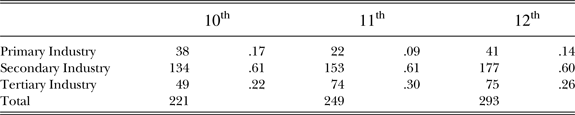
Finally, examining the distribution of PE deputies by occupation is interesting. The percentage of PEs by industry did not change significantly during the period of the three most recent NPCs (See Table 2). The PE deputies mainly came from traditional manufacturing sectors, the energy sector, and the real estate industry.Footnote 3 The percentage of PEs with an agriculture background increased in the 12th NPC, which is largely because some of these PEs were officially counted as farmers to fulfil the representativeness requirement of the central government.
Descriptive Statistics of Private Entrepreneur Deputies (2003–2017)

THE POTENTIAL USE OF PE DEPUTIES DATA FOR FUTURE EMPIRICAL STUDIES
We hope that the introduction of this new dataset will bring new opportunities to quantitative studies of PE deputies in China's NPCs. This dataset will be useful in several ways. First, using the percentage of the NPC's PE deputies as a dependent variable, future research can investigate a host of structural determinants of this variable. Why are some provincial People's Congresses more likely than others to elect deputies with private sector backgrounds? Are there any systematic patterns with regard to the political integration of business elites into the NPC across provinces? Answering these questions would improve our knowledge of how the party-state selects and screens potential PE deputies, which has a clear implication for a better understanding of state–business relations in China.
Second, the proportion of PE deputies may indicate the extent to which a local government has been captured by social groups. Therefore, this variable may be closely related to the quality of governance and especially the level of corruption. Studies focusing on the role of PE deputies in local People's Congresses have revealed ample evidence of the association between corruption and the presence of PE delegates (Li, Meng, and Zhang Reference Li, Meng and Zhang2006; Sun, Zhu, and Wu Reference Sun, Zhu and Wu2014; Zhang Reference Zhang2017). For example, in September 2016, 45 NPC deputies from Northeast China's Liaoning province (44 percent of the Liaoning NPC delegates) were unseated by the NPC Standing Committee for vote buying and bribery during the 2013 election (Cao Reference Cao2016). Remember that Liaoning had the second-highest number of PE delegates in the 12th NPC (see Figure 1). It should be particularly interesting to scrutinize how the current anti-corruption campaign orchestrated by Xi Jinping affects the types of entrepreneurs that gain access to the NPC.
Third, if the party-state designates the congress to extract useful information (Melanie Reference Manion2015; Truex Reference Truex2016), the presence of PE deputies may affect provincial economic policies through this information-sharing mechanism. Truex (Reference Truex2016) finds that deputy proposals appear to influence policy outcomes, especially for non-sensitive issues. PEs do have varying concerns on a host of policy areas (Tsai Reference Tsai2005). Future studies can inquire whether those proposals by PE deputies can affect economic issues by examining the content of the specific policy proposals (Lu, Liu, and Li Reference Lu, Liu and Li2016).
Finally, it is possible that firms might benefit from their ties with the NPC. For example, Truex (Reference Truex2014) shows that having a membership in the NPC brings extra profits to publicly listed firms. These benefits serve as rents to reward loyal deputies. For scholars of the Chinese political economy, it would also be interesting to investigate whether different types of PE deputies (insider/grassroots) benefit in different ways and to further disentangle concrete mechanisms that determine how firms reap financial benefits through the NPC membership.
CONCLUDING REMARKS
Since the early 2000s, the CCP has been integrating emerging private business elites into the party-state through a variety of formal institutional arrangements. In addition to granting CCP memberships to private enterprise entrepreneurs, the regime has allowed capitalists to act as national-level legislators. The recent presence of PE deputies in China's NPCs indicates a shifting pattern of state–business relations in recent decades. Given that state–business relations can influence the quality of governance, prospects of state–society relations, and long-term economic growth, scholars have made an array of hypotheses regarding the role of PEs in China's legislatures. However, the extent to which private business elites have been integrated into the national legislative system remains unclear. In addition, there is still a lack of microlevel data to disentangle the purported mechanisms. The main contribution of this article is that we construct the first systematic dataset of biographical profiles regarding PE deputies in China's NPCs. The study also reveals that among the group of PE deputies, a substantial percentage of these co-opted capitalists were former “insiders” who directly benefited from the large-scale privatization that has occurred since the late 1990s.
We suggest that our data are useful for other scholars who are interested in Chinese legislative politics. Our profile-based approach speaks to a large body of emerging literature discussing the role of the Chinese legislature. Our article is only an initial study. Because our goal here is to introduce a new dataset, most empirical evidence in the article is essentially descriptive. That is, we are left wondering how to draw causal inferences from further quantitative analysis. While more research is certainly needed, we hope that our dataset as a useful supplement to the extant studies of China's state–business relations in an effort to facilitate more grounded microlevel analyses of these phenomena.